Vol. 11, No. 2, 2019 Article ID IJIM-001101, 11 pages Research Article
Optimized Pricing Decisions In a Multi-Level Supply Chain With
Various Power and Channel Structures: A Game-Theoretic Approach
N. Araghi ∗, H. Nikoomaram †‡, F. Ghaffari §
Received Date: 2017-07-24 Revised Date: 2017-11-21 Accepted Date: 2018-05-18
————————————————————————————————–
Abstract
This article tries to explain the optimization of pricing decisions in a multi-level supply chain with different channel under different power structure. The emphasis is placed on three-stage supply chain models with a single product. These models are composed of three parts; these are: one supplier, one manufacturer, and one retailer. In addition three different channel structures will be considered for this supply chain; these include: the decentralized, the semi-integrated, and the integrated channel. There are two types of power balance structures for both the decentralized and the semi-integrated channels. The first type is a leader follower power structure, modeled as a Stackelberg game. The second type is an independent power structure and is treated as a Nash game. Appropriate mathematical models are developed for optimal pricing decisions. The analytical methods were extended to specify the Nash game. Several research findings have been obtained. Optimized decision making in supply chain management, however, is yet in the early stages. This is due to the hybrid environment in which individual firms should simultaneously decide with various supply chain configuration decisions. In order to facilitate decision making in such a hybrid environment, the overall supply chain patterns in the construction industry are studied in this paper.
Keywords: Pricing; Supply chain management; Game theory; Decision making; Optimization.
—————————————————————————————————–
1
Introduction
A
supply chain is a set of entities like suppli-ers, manufacturers, and retailers, who finally supply a specific product. Supply chain manage-ment is a vital process of trade activities that lead supply chains to higher profit, a rapid pro-duction cycle, and lower prices; in other words, supply chain management optimizes the results∗Department of Business Management, Science and Re-search Branch, Islamic Azad University, Tehran, Iran.
†Corresponding author. [email protected], Tel: +98(912)1350585.
‡Department of Business Management, Science and Re-search Branch, Islamic Azad University, Tehran, Iran.
§Department of Economics, Science and Research Branch, Islamic Azad University, Tehran, Iran.
of any supply chain. In addition, a supply chain consists of firms and their resources, personnel, activities, and technologies involved in providing a final product.
For the last two decades, supply chain manage-ment has become an area that has received sig-nificant attention from the business community. Supply chain management is a collection of proce-dures to coordinate and integrate all the members in the supply chain so that all of the activities in the supply chain will be effective.
In total, the three parts of supply chain manage-ment are as follows: the supply chain network, the supply chain configuration, and the supply chain coordination.
In this article, we focus on supply chain
ration. One of the main decisions in supply chain management involves supply chain configuration [5]. Decision-making in supply chain configura-tion can be placed into two categories: the first level is macro; in this level, the supply chain sys-tem and the decision of its members are consid-ered. The second level is micro and this level tries to follow-up the decisions made in the pre-vious level. Typical supply chain configuration decisions include multiple issues like pricing, ad-vertising, inventory, service time, ordering policy, supplier selection, etc. This article will focus on the aspect of pricing decisions. Pricing is an im-portant marketing strategy related to product po-sitioning and it affects other marketing elements such as channel decisions, promotion, and so on [20].
The main issue of this article is pricing decisions in multi-level supply chains. This type of supply chain reflects a chain structure in the construction industry. This supply chain structure has three levels comprising the supplier, the manufacturer, and the retailer [12,26].
To optimize the model and analyze decision-making in such multi-level situations (often with conflicting goals), game theory is the best choice. Game theory is a collection of analytical instru-ments that help people to find out the facts be-hind the behavioral patterns of phenomena [21].
This article tries to explain the optimization of pricing decisions in a multi-level supply chain with different channels. The emphasis is placed on three-stage supply chain models with a sin-gle product. These models are composed of three parts; they are: one supplier, one manu-facturer, and one retailer. In addition, various channel structures will be considered for this sup-ply chain. The first mode is a decentralized struc-ture and the members independently decide. The second mode indicates a semi-integrated supply chain, with forward integration or backward in-tegration performed by the manufacturer. The third mode is an integrated channel and the mem-bers full participate in the process. There are two types of power balance structures for both the decentralized and the semi-integrated chan-nels. The first type is a leader–follower power structure, modeled as Stackelberg game. The sec-ond type is an independent power structure and is treated as a Nash game.
Non-cooperative games are used for both the
decentralized and the semi-integrated channels. Then, we use the price model in order to explain the integrated channel. After that, we include the impact of the power structure. Some optimiza-tion software, such as Lingo, is always adopted to assist in solving the multi-level models. The results in this paper are calculated by Lingo.
2
Related Literature
2.1 The pricing decisions in a supply chain
The issue of pricing is one of the crucial elements that affect the profitability of the members in any supply chain. In economic considerations, pricing is introduced as a regulator for supply and de-mand [9]. Often, there is a conflict of objectives between the members of a supply chain. In such circumstances, the Pareto optimal pricing deci-sions are not always effective [7]. Supply chain pricing follows the main ideas of upright pricing. Both suppliers and manufacturers, by optimiz-ing their positions in the supply chain, try to op-timize the conditions for all the members [24]. Coordination could, therefore, be useful for the members of the supply chain. Pricing decisions, for supply chain members, are affected by various power and channel structures in different ways [6, 7]. So, the coordination among the different members in the channel must be considered [8]. The suitable power and channel structures are im-portant for all the members in every supply chain. Several industries, by creating a forward integra-tion between the manufacturers and their retail-ers, tend to work together in determining pricing and the other aspects of their business. In such a scenario, the supply chain is capable of reducing costs and offers lower prices to the end users [11]. The retailer could create greater profits when it makes the price decisions in partnership with the manufacturer [25]. In other research, the same results were found for the coordination between a manufacturer and a retailer [16]. Other studies too have drawn the same conclusions in various circumstances [1,2,3,22].
2.2 The application of game theory in supply chain management
there are conflicting objectives [4]. Game the-ory thus faces interactive optimization issues [4]. There are conditions in marketing and economics that have used mixed strategies; for example: promotion models and search models [23]. The companies set their relations strategically with both the competitors and the supply chain part-ners [10]. The supply chain members apply their interest in their individual decisions; the supply chain, therefore, cannot always reach optimal de-cisions [10]. When there is a decentralized chan-nel in the supply chain rather than a centralized channel, the overall profit will be lower. If the supply chain has an overall decision-making unit, it could optimize the decisions and maximize the total profits of the supply chain [10]. This arti-cle, by using game theory, tries to study optimal decision-making among multiple partners [10].
3
Research Setting
This article, investigates pricing issue only for one product in multi-level price models when the de-mand is sensitive to price. As previously men-tioned, there are three types of channel struc-tures in the supply chain. The first type is the decentralized channel, where each partner makes their decisions non-cooperatively and individu-ally. The second type is a semi-integrated chan-nel, where the manufacturer is semi-integrated with the other members in the supply chain. Fi-nally, there is the integrated channel structure. In the integrated channel, vertical integration sys-tems exist. We apply two power structures in both the decentralized and the semi-integrated channels. If the manufacturer is the leader of the supply chain, the model is designed as a Stackel-berg game. If the members of the supply chain have equal power and make their own decisions non-cooperatively and simultaneously, then the model is designed as an independent power struc-ture or a Nash game [7].
According to the above argument, the equilib-rium prices both for the decentralized channel and the semi-integrated channel in the two types of power structures were calculated by game the-ory. In addition, this paper studies the profits of the members individually and as a whole for the supply chain.
3.1 Method
In this section, the appropriate mathematical models are developed for the optimal pricing de-cisions. We use non-cooperative game models like the Nash game and the Stackelberg game for the calculation and analysis.
3.1.1 The research questions:
This paper tries to answer the following ques-tions:
1. How will the supply chain members de-cide about optimal pricing under the various power and channel structures?
2. Which structure is preferred by the mem-bers?
3. What kind of integration (forward or back-ward) is preferred by the manufacturer?
3.2 The calculation
In this supply chain, demand is a function of the retail price (Pr). We use the following non-linear demand function that is a common demand func-tion in marketing literature:
D(Pr) =ap−rb, a>0, b>0. (3.1)
In this function ”a” is the market scale parame-ter and ”b” is price elasticity; both of them are always positive [18,19,15,13].
Furthermore, we assume that all the members of the supply chain have the capacity to satisfy each other. We study a static model thereafter. In order to specify the profit of the members in the supply chain, and according to the demand function, we assume that ps represents the raw material prices and pm represents the final prod-uct price. Then,mm will be the profit margin of the manufacturer and mr will be the profit mar-gin for the retailer. The cost paid by the sup-plier is shown as cs and the manufacturer’s cost is shown as cm. δs indicates the amount of raw materials consumed per unit of the product. If the retailer controls the retail price, the manu-facturer controls the final product price, and the supplier controls the raw material price, we can extract the profit functions as follows:
1. The retailer’s profit function:
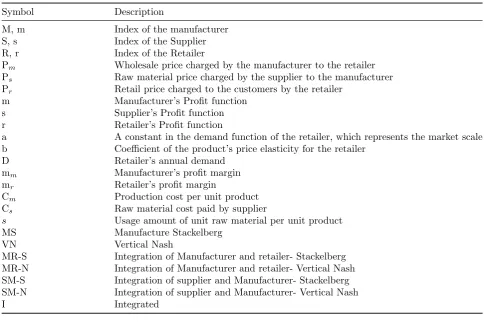
Table 1: Notation.
Symbol Description
M, m Index of the manufacturer
S, s Index of the Supplier
R, r Index of the Retailer
Pm Wholesale price charged by the manufacturer to the retailer Ps Raw material price charged by the supplier to the manufacturer Pr Retail price charged to the customers by the retailer
m Manufacturer’s Profit function
s Supplier’s Profit function
r Retailer’s Profit function
a A constant in the demand function of the retailer, which represents the market scale b Coefficient of the product’s price elasticity for the retailer
D Retailer’s annual demand
mm Manufacturer’s profit margin mr Retailer’s profit margin
Cm Production cost per unit product Cs Raw material cost paid by supplier
s Usage amount of unit raw material per unit product
MS Manufacture Stackelberg
VN Vertical Nash
MR-S Integration of Manufacturer and retailer- Stackelberg MR-N Integration of Manufacturer and retailer- Vertical Nash SM-S Integration of supplier and Manufacturer- Stackelberg SM-N Integration of supplier and Manufacturer- Vertical Nash
I Integrated
Mr =Pr−Pm
2. The manufacturer’s profit function:
Πm(Pm) =mmD(Pr), (3.3)
Mm =Pm−Psδs−Cm
3. The supplier’s profit function:
Πs(Ps) = (Ps−Cs)δsD(Pr) (3.4)
Now, we can specify the optimal pricing decisions for all the members in the supply chain under the various power and channel structures.
3.2.1 The decentralized channel
In this channel, two power structures have been considered. The first is the leader–follower struc-ture and the second is the independent power structure. In the first structure, the manufacturer is the leader and the Stackelberg game structure is used. In the second structure, all the members have equal status; for this, we use the Nash game.
Figure 1: Stackelberg and vertical Nash for the decentralized channel
Manufacturer Stackelberg:
regard to the retailer’s reaction function, chooses its profit margins. Initially, the Stackelberg game between the manufacturer and the retailer will be considered; consequently, the following outcome is observed:
We can derive the reaction function of the retailer from the profit function of the retailer as follows:
∂πr
∂Pr =D(Pr) + (Pr−Pm)×
∂D (Pr)
∂P r = 0 (3.5)
Then, the retailer’s reaction function can be de-rived as follows:
Pr=Pr(Pm) (3.6)
The supplier will determine the price of the raw material according to the manufacturer’s profit margin; thus the following outcome is seen:
Pm =mm+Psδs +Cm, (3.7)
Pr =Pr(Pm) so Pr =mm+Psδs +Cm.
Therefore, the profit maximization of the sup-plier is as follows:
∂πr
∂Pr (PrPs) =
δsD(Pr)+(Ps−Cs)δs×
∂D (Pr) ∂P r ×
∂Pr
∂Ps = 0 (3.8)
Therefore, the supplier’s reaction function for the pricing decisions is as follows:
Ps=Ps(Pr) =Ps(Pm) (3.9)
By interleaving the supplier’s reaction function and the retailer’s reaction function into the man-ufacturer’s profit maximization condition, we get the following outcome:
∂πm
∂Pm = [1−s × ∂P s
∂pm]D(Pr) + (Pm+Pss−Cm) (3.10) ×∂D (Pr)
∂P r × ∂Pr ∂Ps = 0
The Nash Game
In the vertical Nash game, all of the members in the supply chain are independent and make de-cisions non-cooperatively. This means that the supplier makes the pricing decisions according to other members’ profit maximization conditions. The manufacturer and the retailer behave simi-larly. In addition, each level makes its own deci-sions based on the prices of the higher level.
As you can see, the first order condition in or-der to obtain equilibrium in the Nash game is the profit maximization condition. The profit max-imization functions for each of the members are as follows:
∂πr
∂Pr =D(Pr) + (Pr−Pm)×
∂D (Pr)
∂P r = 0 (3.11)
∂πm
∂Pm =D(Pr)+(Pm+Psδs−Cm)×
∂D (Pr) ∂P r = 0
(3.12)
∂πs
∂Ps =δsD(Pr) + (Ps−Cs)δ
2
s ×
∂D (Pr) ∂P r = 0
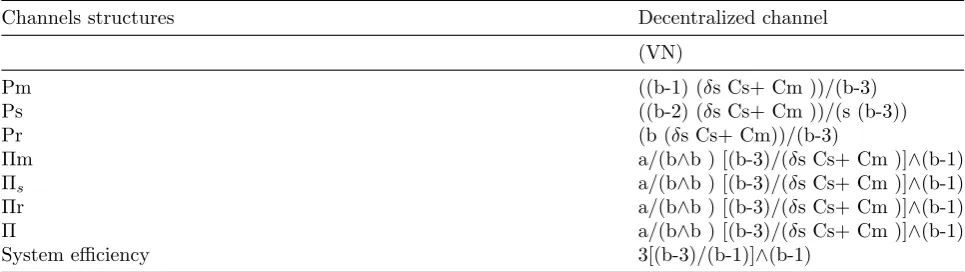
(3.13) After replacing D(Pr) with Equation 3.1 and by solving Equations3.6,3.12, and3.13, the optimal price and profit can be achieved. The results are shown in Table 2.
3.2.2 The Semi-Integrated Channel
In this situation, vertical forward or backward integration are performed. The members who do not participate in the integration, are inde-pendent. For the semi-integrated channel, both power structures have been considered. Then, we formulate the Stackelberg and the Nash games.
Manufacturer and Retailer Integration Structure:
In order to formulate the Stackelberg game, the manufacturer and the retailer act as leaders and the supplier acts as the follower. In the Nash game, the independent member and the inte-grated members have equal status.
Manufacturer-Retailer Stackelberg:
The integrated members are willing to make their own decisions according to supplier’s reaction function. The profit function for the integrated members is as follows:
Πmr =mmrD(Pr) (3.14)
While mmr = Pr−(Psδs)−Cm is profit margin of the integrated channel.
The supplier’s reaction function can be derived from the supplier’s profit function (Equation3.5).
∂πs
∂Ps =δsD(Pr) + (Ps−Cs)δ
2
s ×
∂D (Pr) ∂P r = 0
Table 2: Results for Independent power structure.
Channels structures Decentralized channel
(VN)
Pm ((b-1) (δs Cs+ Cm ))/(b-3)
Ps ((b-2) (δs Cs+ Cm ))/(s (b-3))
Pr (b (δs Cs+ Cm))/(b-3)
Πm a/(b∧b ) [(b-3)/(δs Cs+ Cm )]∧(b-1)
Πs a/(b∧b ) [(b-3)/(δs Cs+ Cm )]∧(b-1)
Πr a/(b∧b ) [(b-3)/(δs Cs+ Cm )]∧(b-1)
Π a/(b∧b ) [(b-3)/(δs Cs+ Cm )]∧(b-1)
System efficiency 3[(b-3)/(b-1)]∧(b-1)
Continue Table2.
Semi-integrated channel Integrated Channel
(MR-N) (SM-N)
- ((b-1) (δs Cs+ Cm ))/(b-2) (b (δs Cs+ Cm ))/(b-1)
((b-1) (δs Cs+ Cm ))/(δs (b-2)) -
-(b (δs Cs+ Cm))/(b-2) (b (δs Cs+ Cm))/(b-2)
-- a/(b∧b ) [(b-2)/(δs Cs+ Cm )]∧(b-1)
-a/(b∧b ) [(b-2)/(δs Cs+ Cm )]∧(b-1) -
-a/(b∧b ) [(b-2)/(δs Cs+ Cm )]∧(b-1) a/(b∧b ) [(b-2)/(δs Cs+ Cm )]∧(b-1) a/(b∧b ) [(b-1)/(δs Cs+ Cm )]
∧(b-1)
2a/(b∧b ) [(b-2)/(δs Cs+ Cm )]∧(b-1) 2a/(b∧b ) [(b-2)/(δs Cs+ Cm )]∧(b-1) a/(b∧b ) [(b-1)/(δs Cs+ Cm )]
∧(b-1)
2[(b-2)/(b-1)]∧(b-1) 2[(b-2)/(b-1)]∧(b-1) 1
So, the supplier’s reaction function is as follows:
Ps =Ps (Pr) (3.16)
By using Equation 3.14, the manufacturer can obtain its optimal pricing decision:
∂πmr
∂Pr = [1− ∂Ps
∂Pr×δs]D(Pr)+ (3.17)
(Pr−Psδs −Cm)×
∂D (Pr) ∂P r = 0
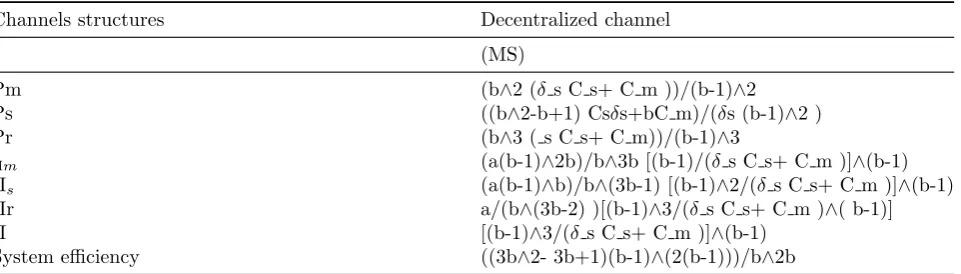
After replacing D(Pr) with Equation 3.1, the Stackelberg equilibrium results will be obtained. The results are shown in Table 3.
Manufacturer–Retailer Vertical Nash:
Here, independent power means that the in-tegrated members and the supplier have equal power. The Nash game thus takes shape.
The integrated members try to maximize their total profit based on the supplier’s raw material
price. The supplier makes the pricing decision and also maximizes its profit according to the profit margin of the integrated members. By us-ing Equations 3.5 and 3.14, we can extract the equilibrium conditions for the Nash game.
∂πs
∂Ps =δsD(Pr) + (Ps−Cs)δ
2
s ×
∂D (Pr) ∂P r = 0
(3.18) ∂πmr
∂Pr =D(Pr)+(Pr−Psδs −Cm)×
∂D (Pr) ∂P r = 0
(3.19) After solving Equations3.18 and3.19 simultane-ously, the Nash equilibrium results for price and profit can be obtained (see Table2).
Supplier and Manufacturer Integration Structure:
Supplier and Manufacturer Stackelberg:
Table 3: Results for Leader-follower power structure.
Channels structures Decentralized channel
(MS)
Pm (b∧2 (δs C s+ C m ))/(b-1)∧2
Ps ((b∧2-b+1) Csδs+bC m)/(δs (b-1)∧2 )
Pr (b∧3 ( s C s+ C m))/(b-1)∧3
Πm (a(b-1)∧2b)/b∧3b [(b-1)/(δs C s+ C m )]∧(b-1)
Πs (a(b-1)∧b)/b∧(3b-1) [(b-1)∧2/(δs C s+ C m )]∧(b-1)
Πr a/(b∧(3b-2) )[(b-1)∧3/(δ s C s+ C m )∧( b-1)]
Π [(b-1)∧3/(δs C s+ C m )]∧(b-1)
System efficiency ((3b∧2- 3b+1)(b-1)∧(2(b-1)))/b∧2b
Continue Table3.
Semi-integrated channel
(MR-N) (SM-N)
- b(δ s C s+ C m )/(b-1)
((b∧2-b+1) Csδs+bC m)/(δs (b-1)∧2 )
-(b∧2 (δ s C s+ C m ))/(b-1)∧2 (b∧2 (δ s C s+ C m ))/(b-1)∧2
- (a (b-1))/b∧2b
a/(b∧(2b-1) ) [(b-1)∧2/(δ s C s+ C m )]∧(b-1) [(b−1)∧2/(δs C s+ C m )]∧(b-1)
(a (b-1))/b∧2b [(b-1)∧2/( s C s+ C m )]∧(b-1) a/(b∧(2b-1) ) [(b-1)∧2/(δs C s+ C m )]∧(b-1) [(b-1)∧2/(δ s C s+ C m )]∧(b-1) [(b-1)∧2/(δ s C s+ C m )]∧(b-1)
((2b-1)(b-1)∧((b-1)))/b∧b ((2b-1)(b-1)∧((b-1)))/b∧b
Continue Table3.
- Integrated Channel
Pm - b(δ s C s+ C m )/(b-1)
Ps -
-Pr -
-Πm - a/(b∧b ) [(b-1)/(δs C s+ C m )]∧(b-1)
Πs -
-Πr -
-Π - a/(b∧b ) [(b-1)/(δs C s+ C m )]∧(b-1)
System efficiency - 1
supply chain. The retailer also acts as the fol-lower; therefore, we can formulate the Stackel-berg game between them. The members who are integrated are willing to set their wholesale price based on the reaction function of the retailer. In return, the retail price is also specified according to the price given by the integrated members. The profit function for the integrated members is as follows:
ΠSM = (Pm−Cm−Csδs)D(Pr) (3.20)
By replacing Equation3.20with Equation3.7, we
have
∂πsm
∂Pm =D(Pr) + (Pm−Cm−Csδs) (3.21)
×∂D (Pr) ∂P r ×
∂Pr ∂Ps = 0 The results are shown in Table 3.
Supplier and Manufacturer Vertical Nash:
maximize its own profit based on the given price by the integrated members. On the other hand, the integrated members, in order to maximize their profits, determine their price based on the retail price. By using Equations 3.3 and 3.20, we can derive the equilibrium conditions for the Nash game:
∂πsm
∂Pm =
D(Pr)+(Pm−Cm−Csδs)×
∂D (Pr)
∂P r = 0 (3.22) Simultaneously solving the above equation and Equation3.6, we get the results of the Nash equi-librium. (The results are shown in Table 1).
3.2.3 Integrated Channel
In the integrated channel, all the members in the supply chain integrate together. There is a full vertical integration for maximizing the entire sys-tem’s profits. This structure protects the mem-bers against conflict. Here, we assume that there is only one retail price (pr). Therefore, the total profit function for the supply chain is as follows:
Π = (Pr−Cm−Csδs)×D(Pr) (3.23)
By solving the above equation, we obtain the op-timal retail price. All the results for the inte-grated channel can be seen in Table3.
4
Conclusion and Discussion
4.1 Results
All the results and the related quantities are sum-marized in Table 2 and Table 3. The results of the leader–follower power structure are shown in Table2and the results for the independent power structure are shown in Table3. To achieve mean-ingful results, we will consider the price elasticity or b to be larger than 3. The results of the inte-grated channel are included in both tables.
4.2 Conclusion
In this paper, we investigate the effects of the power and the channel structures on the prices and profits for the supply chain members, indi-vidually and for the whole system.
The results demonstrate that the manufacturer in the decentralized channel or the integrated mem-bers in the semi-integrated channel are preferred
as the leaders of the chain. In this situation, the equilibrium profits are greater and the equilib-rium prices are lower. Forward integrations be-tween the manufacturer and the retailer do not improve their profits all the time. If the price elasticity is higher than 3 (b > 3), this integra-tion can improve their profits. If the product cost becomes greater than a certain level (0.2749), the chain members’ profits will increase. In addition, the market sensitivity to the retail price will be increased.
4.3 Discussion
There are many implications of these results; in this section, we will discuss them. Here, the im-pact of the different power structures and the channel structures are discussed.
The Effects of the Channel Structure:
The supply chain tends to choose the structure that makes the most profit.
1. When there is semi-integration structure in a three-level channel with the retailer, it always creates a larger profit for all the members toward the decentralized channel. When price elasticity: b≥3.5396.
2b2−2b + 1
b2 (
(b−1)3 b2(b−2))
b−1
≤1, b≥3.5396.
2. Whenever the degree of integration is higher, the efficiency is also higher.
(3b2−3b + 1)(b−1)3b−3
3b2b−2(b−3)b−1 =
πM S πV N ≥1,
2b−1 2b (
(b−1)2 b(b−2))
b−1
= π M R−S
πM R−N ≥1.
SoπM S ≥πV N&πM R−S≥πM R−N.
The Effects of the Power Structure:
1. The leader–follower structure in the decen-tralized channel is preferred. This structure leads the supply chain to lower equilibrium prices and larger profits.
Prms PV N
r
= P ms m PV N
m = b
2(b−3)
b3−3b
b3−3b2+ 3b−1 ≤1
Pms s PV N
s −1 =
−(b+ 1)× δsCs+Cm
(b−1)2((b−2)δsCs+Cm) ≤0
According to the above statement,
Prms ≤ PrV N
Pmms ≤ PmV N
Psms ≤ PsV N
2. In a semi-integrated channel, the integrated manufacturer-retailer acts as a leader and the supplier acts as a follower as preferred by the members of the supply chain. The leader–follower structure, rather than inde-pendent power, is preferred by the members.
PMRr −S PMRr −N
=b(b−2) (b−1)2=
b2−2b b2−2b + 1≤1
PMRs −S
PMRs −N −
1 =
− δsCs+ Cm
(b−1)2((b−1)δsCs+ Cm) ≤0
Thus, PrM R−S ≤ PrM R−N, PsM R−S ≤ PsM R−N The total profits in the manufacturer and retailer Stackelberg and the profits in the manufacturer and retailer Nash are shown as follows:
PMRmr−S PMRmr−N
= (b−1)
2b−1
bb(b−2)b−1 ≥1.
The above equation is a decrement function of b.
5
Contribution and the Areas
for Future Research
5.1 Contribution
The formulation of game-theoretic models in a multi-level supply chain for the pricing problem is presented. This model and the solution proce-dures are the decision support tools for managers to determine optimal decisions and understand the interaction between all the members in the
supply chain. This paper has provided a com-parative study for the pricing problem under the various power and channel structures. We have proved that forward integration does not always lead to increased profits. On the other hand, it was proved that the leader–follower power struc-ture brings about better results.
5.2 Future research
In this article, the competition at each level is not covered. A more general model with multiple members in each level could be developed. This model focuses on pricing as a market-strategic variable. Considering the other market variables like distribution cost is recommended. This research focuses on non-cooperative game approaches. Other types of game models could be interesting for future research.
References
[1] P. L. Abad, C. K. Jaggi, A Joint Approach for Setting Unit Price and the Length of the Credit Period for a Seller When End De-mand Is Price Sensitive,International Jour-nal of Production Economics 83 (2003) 115-122.
[2] F. J. Arcelus, G. Srinivasan, Inventory Poli-cies under Various Optimizing Criteria and Variable Markup Rates, Management Sci-ence 33 (1987) 756-762.
[3] A. Ardalan, Combined Optimal Price and Optimal Inventory Replenishment Policies When a Sale Results in Increase in Demand,
Computers & operations research 18 (1991) 721-730.
[4] G. P. Cachon, S. Netessine, Game Theory in Supply Chain Analysis. In: SimchiLevi, D., Wu, S.D., Shen, M. (Eds.),Handbook of Quantitative Supply Chain Analysis: Mod-eling in the E-Business Era., Kluwer Aca-demic Publishers, Boston, pp. (2004) 13-65.
[5] C. Chandra, J. Grabis, Supply Chain Config-uration, Springer Science+ Business Media,
LLC (2007).
Transac-tion Cost: A Game-Theoretic Analysis, In-dustrial Marketing Management 35 (2006) 178-190.
[7] S. C. Choi, Price competition in a channel structure with a common retailer,Marketing Science 10 (1991) 271-296.
[8] M. C. Cooper, L. M. Ellram, Characteristics of supply chain management and the impli-cations for purchasing and logistics strategy,
The international journal of logistics man-agement 4 (1993) 13-24.
[9] W. Elmaghraby, P. Keskinocak, Dynamic Pricing in the Presence of Inventory Consid-erations: Research overview, current prac-tices, and future directions, Management science 49 (2003) 1287-1309.
[10] F. Erhun, P. Keskinocak, Game Theory in Business Applications,Management Science and Engineering, Stanford University, Stan-ford (2003).
[11] M. L. Fisher, What Is the Right Supply Chain for Your Product?, Operations Man-agement: Critical Perspectives on Business and management, Harvard business review
March-April 4 (1997) 105-160.
[12] G. Q. Huang, X. Y. Zhang, V. H. Y. Lo, In-tegrated Configuration of Platform Products and Supply Chains for Mass Customization: A Game-theoretic Approach,IEEE Transac-tions on Engineering Management 54 (2007) 156-171.
[13] G. S. Joseph, J. Zhang, Pricing and Two-tier Advertising with One Manufacturer and One Retailer, European Journal of Opera-tional Research 192 (2009) 904-917.
[14] D. Kim Daesoo, W. J. Lee, Optimal Joint Pricing and Lot Sizing with Fixed and Vari-able Capacity, European Journal of Opera-tional Research 109 (1998) 212-227.
[15] H. J. Kunreuther, F. Richard, Optimal Pric-ing and Inventory Decisions for Non-seasonal Item,Econometric a 39 (1971) 173-175. [16] R. Lal, R. Staelin, An Approach for
Devel-oping an Optimal Discount Pricing Policy,
Management Science 30 (1984) 1524-1539.
[17] W. J. Lee, J. Daesoo, Optimal and Heuris-tic Decision Strategies for Integrated Prod-uct and Marketing Planning, Decision Sci-ences 24 (1993) 1203-1213.
[18] S. X. Li, Z. Huang, A. Ashley, Inventory Channel Coordination and Bargaining in a Manufacturer-Retailer System, Annals of Operations Research 68 (1996) 47-60. [19] S. C. Michael, Can a Franchise Chain
Co-ordinate?,Journal of Business Venturing 17 (2002) 325-341.
[20] M. J. Osborne, A. Rubinstein, A Course in Game Theory, Massachusetts Institute of Technology Press, Massachusetts (1994). [21] R. J. Tersine, R. L. Price, Temporary Price
Discounts and EOQ, Journal of Purchasing and Materials Management 17 (1981) 23-27. [22] H. R. Varian, A Model of Sales, The
Amer-ican Economic Review 70 (2009) 651-659. [23] M. Voeth, U. Herbst, Supply-chain
pricing-A new perspective on pricing in industrial markets, Industrial Marketing Management
35 (2006) 83-90.
[24] TM. Whitin, Inventory Control and Price Theory,Management Science 2 (1955) 61-68 [25] Yu. Yugang, C. Feng, C. Haoxun, A Stack-elberg Game and Its Improvement in a VMI System with a Manufacturing Vendor, Eu-ropean Journal of Operational Research 192 (2009) 929-948.
[26] Y. Yu, G. Yugang, Q. George, L. Liang, Stackelberg Game-theoretic Model for Op-timizing Advertising, Pricing and Inven-tory Policies in Vendor Managed InvenInven-tory (VMI) Production Supply Chains, Comput-ers and Industrial Engineering 57 (2009) 368-382.
Nakisa Araghi has got Ph.D. in business management and M.Sc. of Executive Management from Sci-ence and Research branch of Is-lamic Azad University, Tehran, Iran. She has experience in teach-ing mathematics. She is interested in mathematical methods in research such as Game theory.
Hashem Nikoomaram is profes-sor of Business Management. He is faculty member and head of Faculty of Management and Eco-nomics in Science and Research branch of Islamic Azad University, Tehran, Iran. Interested in Ac-counting and Finance.