Shahriar Amini Naghani1 , Samaneh Najarpourian2* , Seyed Abdolvahhab Samavi2
1. Department of Counseling and Psychology, University of Hormozgan, Bandar Abbas, Iran
* Corresponding Author: Samaneh Najarpourian, PhD.
Address: Department of Psychology and Counseling, Faculty of Humanities, University of Hormozgan, Bandar Abbas, Iran. Phone: +98 (17) 7314044
E-mail: [email protected]
Research Paper: Comparing the Effectiveness of the
Triple P-Positive Parenting Program and Parenting
Program of Acceptance and Commitment Therapy on
Parent-Child Relationship and Self-efficacy of Moth
-ers With Oppositional Defiant Disorder Children
Background: Parents may face challenges in establishing relationships with their children with Oppositional Defiant Disorder (ODD). This research was conducted to compare the effectiveness of the Triple P-Positive Parenting Program (Triple P) and the Acceptance and Commitment Therapy (ACT)-based parenting on the parent-child relationship and parental self-efficacy of parents with ODD children.
Methods: The design of this research was quasi-experimental and included two intervention groups and one control group. The study population consisted of all mothers of first-, second-, and third-grade primary school children with ODD who lived in Shahrekord City, Iran in 2018. The study mothers were chosen by purposive sampling method and then divided into three groups of Triple P, ACT, and control. Data were gathered using the Oppositional Defiant Disorder Rating Scale (ODDRS), the Parent-Child Relationship Scale (PCRS) and the Parental Self-Efficacy Questionnaire (PSEQ). Data analyses were carried out using multivariate analysis of variance, repeated measures analysis of variance and post hoc Bonferroni test in SPSS.
Results: Significant differences in the Post-test parent-child relationship (F=4.53, P<0.05) and follow-up parent-child relationship (F=8.03, P<0.05) and Post-test parental self-efficacy (F=11.24, P<0.05) and follow-up parental self-efficacy (F=11.04, P<0.05) were observed among Triple P, ACT, and control group. The findings also showed no significant difference in post-test and follow-up phases (P>0.05) between Triple P and ACT groups. There were significant differences in parent-child relationships and parental self-efficacy between Pre-test and Post-test phases in Triple P and ACT (P<0.05) groups, but there was no significant difference between the Post-test and follow-up stages (P>0.05).
Conclusion: The results of this research suggest that Triple P and ACT are effective techniques for improving parent-child relationships and parental self-efficacy in mothers of children with ODD.
A B S T R A C T
Keywords:
Positive psychology, Acceptance and Commitment, Oppositional defiant
disorder, Parent-child relations, Self-efficacy
Citation Amini Naghani Sh, Najarpourian S, Samavi SAV. Comparing the Effectiveness of the Triple P-Positive Parenting Program and Parenting Program of Acceptance and Commitment Therapy on Parent-Child Relationship and Self-efficacy of Mothers With Op-positional Defiant Disorder Children. Journal of Research & Health. 2020; 10(2):111-122. http://dx.doi.org/10.32598/JRH.10.2.7
: http://dx.doi.org/10.32598/JRH.10.2.7
Use your device to scan
and read the article online
Introduction
ne of the most prevalent clinical disor-ders in children and adolescents is the Oppositional Defiant Disorder (ODD). It is characterized by restless mood and be-havior, contradiction and disobedience, insolence, abusive behavior, irritation, loss of temper, non-observance of regula-tions and rules, and illegal behavior [1]. Various studies have revealed different incidence rates for this disorder across populations. In one recent study, the prevalence of the disorder among children aged 3-9 years was reported to range between 6% and 9%, with the risk of develop-ing this disease as 22% [2]. Studies indicate that ODD is more common in boys but has nearly the same preva-lence in boys and girls after puberty [1].
ODD is a progressive and chronic disorder that, before pre-primary school, is hard to diagnose [3]. The prog-nosis of ODD is extremely unpredictable, and affect-ed children are at risk of developing many other issues in adolescence and adulthood [4-6]. Etiologically, several factors for ODD have been suggested, ranging from ge-netic or biological factors to family, parenting, and social and environmental factors [7].
For the most aspect, children with ODD lack healthy family relationships, and studies have shown that inad-equate parent-child relationships in these households are among the variables affecting the occurrence and sever-ity of ODD [4,8]. The family’s interaction with these children are based on unstable and punishing parent-ing, harsh and dry laws, low empathy, and the absence of beneficial relationships [9]. Parents often have poor parenting abilities. They are usually violent, aggressive, incapable and inconsistent in their disciplinary behavior, all point to the significance of parent-child relationship in ODD pathology [7]. Furthermore, these children do not talk to their parents and disobey and disagree with them [10], which indicates the importance of parent-child relationships in these families. Also, parents may feel that their disciplinary techniques are unsuitable and ineffective in parenting [11].
Belief in parental self-efficacy implies the parents’ feel-ing and capacity to fulfill their responsibilities and par-enting duties [12]. Parental self-efficacy also relates to the views or opinions of the parents about their ability to organize and execute several child parental responsibili-ties [13]. Based on Ardelt and Eccles’ model, when par-ents believe in their low self-efficacy, they use punitive techniques. And, they are ready to leave persuasive
tech-niques as they realize the challenge between themselves and their children’s damaging behaviors. Eventually, the parents strongly believe that they lack a suitable parental self-efficacy level [14]. Believing in low self-efficacy of parents, however, can generate issues in parent-child re-lationships and cause inappropriate and maladaptive be-haviors in children [12]. It appears that in ODD children, the severity and frequency of these behaviors are more than other children. It is therefore essential to provide these parents with suitable psychological interventions and parenting training [15].
The Triple P-Positive Parenting Program (Triple P) [16]
is one of the ideal parenting programs that is efficient in solving parenting issues in families with ODD children. The program suggests altering the child’s behavioral is-sues by correcting the family environment [17] and has three primary goals: 1. Improving and supporting par-ents’ skills, understanding, trust and effectiveness; 2. Fos-tering affection, safety, and entertainment, by reducing conflicts and violence; and 3. enhancing social welfare
[18]. Triple P has five values: creating a healthy and ap-pealing environment, providing an attractive teaching environment, setting a definitive discipline, having real-istic expectations, and paying attention to one’s role as a parent [19]. Research demonstrates that this program can be beneficial for parents ‘ and children’s understanding, emotions, and behaviors [20-23].
Acceptance and Commitment Therapy (ACT) is an-other interventional protocol categorized as the third wave of conduct. This protocol has slowly entered the parenting field. The ACT is a cognitive-behavioral ther-apy that involves awareness, acceptance, and absence of knowledge as well as a precious and committed action to foster psychological flexibility [24]. ACT-based parent-ing improves the flexibility and capacity of parents to use parenting abilities in stressful circumstances by concen-trating on the mental evaluation of their children’s issues and their subjective significance of parenting [25, 26]. By defining experiential avoidances and adequate reactions to these children’s needs, ACT education has significant impacts on improving parents’ conduct over children with developmental and cognitive disabilities [27-29]. In their research on the efficacy of ACT on parents of chil-dren with autism disorder, Gould et al. found that ACT could enhance beneficial parental behavior [30].
Because of these issues, there is no doubt that parents with ODD children have problems with children that, in turn, cause additional problems for the children and their parents. Therefore, to enhance the relationship between the parents and their children, it is essential to provide
techniques for parenting education. Triple P is based on the behavioral first-wave conduct, and ACT-based par-enting education is based on the behavioral third-wave studies, so they have shown excellent outcomes, and are more suitable techniques for educating these parents. The objective of this research was to compare the effec-tiveness of Triple P and ACT on parent-child relation-ship and self-efficacy of mothers with ODD children.
Methods
This study is a quasi-experimental research with a Pre-test-Post-test and follow-up (2-month) design with two intervention groups (Triple P and ACT) and one control group. The study population consisted of all mothers of the first-, second- and third-grade school-children with ODD in Shahrekord City, Iran in 2018. Since it was not possible to accurately estimate the number of samples, we selected many samples in pi-lot projects. This sampling prevents accurate control of confounding variables; moreover, the size of each group can be at least 15 people in the experimental re-search [31]. Besides, the sample size of other studies is this number[7,22, 29]. Therefore, according to the inclusion criteria, 45 patients were randomly chosen from the survey population and 15 patients were as-signed to each group of Triple P group, ACT, control.
Inclusion criteria were diagnosis of ODD in children based on Oppositional Defiant Disorder Rating Scale (ODDRS) and diagnostic interview, 7 to 9 years old, mothers with at least high school diploma, absence of psychiatric disease pain, or using psychological interview-based neurological pills, and approval for therapy. Exclusion criteria were missing 1 intervention session, receiving other psychotherapy and support fa-cilities during the sessions, and unwilling to continue the therapy sessions.
To observe the ethical principles, the researchers in-formed the subjects that the study has been designed to help and provide them with useful parental teachings. Their data would be kept confidential, and they could withdraw from the research whenever they wanted. Then, the women gave their verbal consent to take part in the study. There was no intervention for the control group. The Triple P group received group training in a total of eight 2-hour sessions based on the Sanders protocol [32], and the ACT group received group training based on the Coyne and Murrell protocol [33] and Hayes et al. text-book [24] in ten 90-minute weekly sessions. The sum-mary of the training sessions is presented below.
Summary of triple P training sessions
First session: familiarization with group members, the introduction of group regulations, significance of par-enting, and a brief presentation of positive parpar-enting, ODD, its symptoms and etiologies.
Second session: teaching the concepts and descrip-tions of positive parenting, dimensions and values of positive parenting (creating a secure atmosphere, es-tablishing a positive teaching environment, applying the law of self-expression, having true expectations and taking care of yourself as a parent), causes of chil-dren’s behavioral issues, including hereditary and fam-ily problems (casual reward for negativity).
Third session: strengthening beneficial relationships between parents and the child (promoting and strength-ening good behavior, training in creating new abilities and behavior, various kinds of strengthening, physical affection, using good conduct table, informal education, and modeling), assignment.
Fourth session: teaching parents’ skills to control the child’s mild or severe unpleasant behaviors and learn how to deal with challenging behaviors (teaching how to provide instructions, codifying clear and unam-biguous rules of dealing with violations of rules and regulations through a guided discussion, illustrating the calm and clear instruction, planned neglect, use of the method of ignoring mild problems (use of a logi-cal consequence for severe adverse behaviors (use of silence method, use of dismissal method), common is-sues due to dismissal, giving assignment.
Fifth session: teaching how to control a child in situa-tions where control is low, providing solusitua-tions for fam-ily survival (acting as a team, avoiding dispute, using the time of leisure and relaxation), recognizing trouble-maker situations, training the measure steps planned for difficult situations, pre-preparation, entertaining activ-ity selection, reward for proper behavior, use of conse-quence for negative and unfavorable behaviors, use of preventive discussion, giving assignment.
offering strategies for holding change, exercising com-mon issues and playing roles.
Summary of ACT-based parenting sessions
First session: familiarizing with group members, group rules, the features and indications of headstrong and disobedient children, the significance of parenting, and the differences between ACT parenting and other tech-niques;
Second session: learning creative helplessness using the metaphor of well, the metaphor of being caught in the sands, the metaphor of being caught in the swamp, giving the assignment;
Third session: Training the mind’s productions, aware-ness of the mind’s commands, and different types of families from the perspective of acceptance and commit-ment, giving the assignment;
Fourth session: learning the concept of controlling the problem rather than resolving it, using the metaphor of remembering the numbers 2, 1, and 3, the metaphor of the ship with the monsters, and the hungry tiger meta-phor and finally the assignment;
Fifth session: acceptance training and psychological flexibility and acceptance of negative thoughts and feel-ings instead of control, avoidance, and elimination using guest metaphor and assignment;
Sixth session: teaching self-observing and self-concep-tualizing using chess metaphor and mindfulness exercis-es, practicing awareness of the finest sounds, practicing with the child, practicing the whole body examination, practicing eating raisins, and giving the assignment;
Seventh session: training mindfulness exercises, in-cluding practicing the awareness of the finest sounds, practicing with the child, practicing the whole body ex-amination, practicing eating raisins, and giving the as-signment;
Eighth session: teaching behavior change methods, teaching effective commanding, teaching prognoses, behaviors, contexts, behavioral consequences, teaching functional analysis of behavior, and giving the assign-ment;
Ninth session: learning values using the metaphor of the funeral, the metaphor of the gravestone, and the metaphor of the island, teaching the difference between values and goals and expectations, giving assignments;
Tenth session: reviewing previous discussions, sum-marizing, and summing up.
Research instruments
Oppositional Defiant Disorder Rating Scale
Hommersen [34] developed ODDRS based on the cri-teria for the Diagnostic and Statistical Manual of Mental Disorders (DSM), published by the American Psychiat-ric Association (APA) for the diagnosis of ODD in chil-dren aged 5-15 years. This scale has 8 items scored based on a 4-point Likert scale (from 0=Never to 3=Too high), with higher scores indicating higher severity of the dis-order, and parents describe each child’s symptoms based on their observations in the last 6 months. The develop-ers reported a coefficient of reliability of 0.92 (Cronbach alpha) and a test-retest coefficient of reliability of 0.95. Faramarzi et al. validated this scale and reported its coef-ficient of reliability as 0.93 calculated by the Cronbach alpha and 0.94 by the test-retest. Children’s psychiatrists and clinical experts also confirmed their validity of con-tent [35]. In our research, the Cronbach alpha coefficient of the scale was found as 0.70.
Parent-Child Relationship Scale
Pianta developed the 30-item Parent-Child Relation-ship Scale (PCRS) that assess parents’ perceptions of their relationship with their children. This scale consists of three subscales of conflict, proximity, and dependency, which collectively determine the parent-child relation-ship. The items are rated based on a 5-point Likert-type scale (from score 1 definitely is not applicable to score 5 is definitely applicable), and higher scores indicate bet-ter parent-child relationship [36]. Abarashi et al., while confirming the content validity of this scale, calculated its reliability with the Cronbach alpha coefficient. The reliability coefficients of conflict, proximity, depen-dency subscales and overall positive relationship were obtained 0.84, 0.70, 0.61, and 0.86, respectively [37]. In the present study, the Cronbach alpha coefficients of the proximity, dependence, and conflict subscales were 0.81, 0.83 and 0.91 respectively, and the Cronbach alpha coef-ficient of the total scale was obtained 0.95.
Parental Self-efficacy Questionnaire (PSEQ)
conflicts and resilience in parenting. This instrument consists of 10 items that are scored based on a 7-point Likert-type scale from rarely to consistently, with higher scores indicating higher levels of parental self-efficacy. Dumka et al. reported the Cronbach alpha coefficient of this questionnaire as 0.70 [38]. In the study of Taleii et al., after confirming the content validity of the scale by 3 faculty members, the Cronbach alpha coefficient was reported as 0.70 [22]. In this study, its Cronbach alpha coefficient was calculated as 0.83.
The descriptive indices mean and standard deviation and the inferential statistics Multivariate Analysis of Variance (MANOVA), repeated measures Analysis of Variance (ANOVA) and Bonferroni post hoc test were conducted in SPSS V. 22 for data analysis.
Results
With regard to descriptive data, most mothers had a diploma, so that 60% in the Triple P group, 60% in the ACT group and 53.3% in the control group had diploma education level, followed by BA and MA.
The Table 1 presents the mean and standard deviation values of the parent-child relationship and parental self-efficacy in Triple P, ACT, and control groups in three phases of Pre-test, Post-test, and follow-up. The findings indicate that the assumptions of MANOVA and repeated measures ANOVA have been established. MANOVA was used to compare the intervention and control groups.
The findings showed a substantial difference between the intervention groups and the control group (P<0.05) regarding the research variables at the post-test and fol-low-up phases, but not at the Pre-test phase (Table 2). The Bonferroni test (Table 3,4and5) provided the pair-wise comparison of Triple P and ACT in the Post-test and follow-up phase. Repeated measures ANOVA was used to compare the data at each stage of the research (pre-test, post-test, and follow-up).
The hypothesis of Mauchly’s sphericity was created concerning the parent-child relationship variable, but no hypothesis of sphericity was developed for the self-effi-cacy variable; thus, the Greenhouse-Geisser correction row was used. The findings are as follows:
Table 1. Descriptive data on studied variables and analysis of variance by group
Variable Test Stage
Positive Parenting Commitment and Acceptance Control
F Sig. Mean DeviationStandard Mean DeviationStandard Mean DeviationStandard
Parent-Child
relationship
Pre-test 46.73 99.14 93.71 82.14 06.75 006.15 16.0 0.849
Post-test 93.91 81.16 06.88 46.13 76 88.14 53.4 0.016
Follow-up 20.89 95.17 53.88 20.16 46.74 65.13 03.8 0.025
Self-efficacy
Pre-test 46.21 85.3 13.23 78.5 93.23 79.5 87.0 0.426
Post-test 33.38 64.10 60.37 01.8 26.25 16.6 24.11 0.001
Follow-up 06.36 66.8 46.39 95.11 46.24 82.5 04.11 0.001
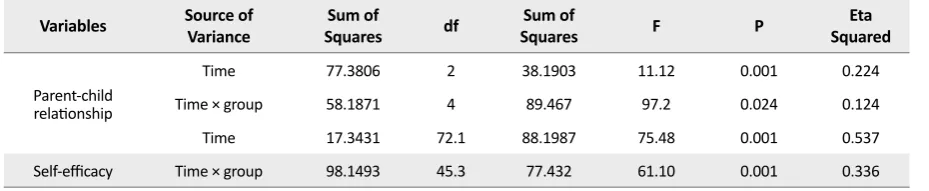
Table 2. Repeated measures ANOVA results on the parent-child relationship and parental self-efficacy
Variables Source of Variance SquaresSum of df SquaresSum of F P SquaredEta
Parent-child relationship
Time 77.3806 2 38.1903 11.12 0.001 0.224
Time × group 58.1871 4 89.467 97.2 0.024 0.124
Time 17.3431 72.1 88.1987 75.48 0.001 0.537
Regarding the time impact, the findings indicate a substantial difference between Pre-test, Post-test, and follow-up (P<0.05) in the parent-child relationship (F= 12.11) and parental self-efficacy (F=48.75). In both fac-tors (P<0.05), the impact of the time in the group was important, showing a substantial difference between the research-based phases (Table 2). Bonferroni post hoc test was used to create pairwise comparisons of the Pre-test, Post-Pre-test, and follow-up phases in each group. The findings are as follows:
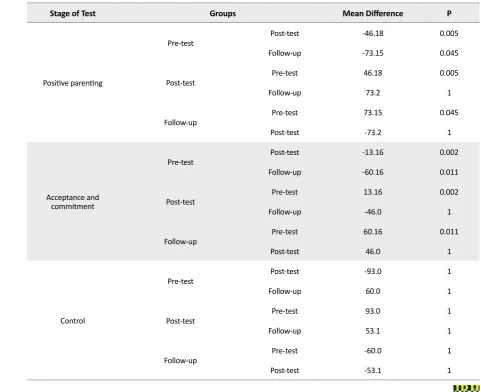
Based on the outcomes for the parent-child partnership, there was a substantial difference between the Pre-test and Post-test and follow-up phases (P<0.05) in the Triple P and ACT groups, but there was no significant difference be-tween them in the Post-test and follow-up phases (P>0.05). There was no significant difference between the various stages of the study in the control group (P> 0.05) (Table 3).
Based on the results for the parental self-efficacy vari-able, there was a significant difference in parental self-efficacy between the Pre-test, Post-test and follow-up stages in the Triple P and ACT groups (P<0.05), but there was no significant difference between the Post-test and follow-up stages (P>0.05). There was also no sig-nificant difference between the different phases of the experiment (P>0.05) in the control group (Table 4).
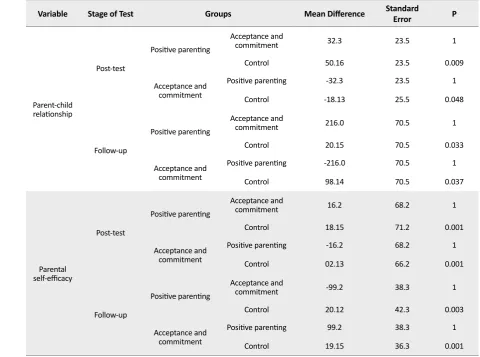
Based on the results, there was a significant difference in the parent-child relationship and parental self-efficacy variables at the Post-test and follow-up between the Tri-ple P and ACT groups and the control group (P<0.05). However, there was no significant difference between the Triple P and ACT groups (P>0.05) (Table 5).
Table 3. Bonferroni post hoc test results to compare Pre-test, Post-test, and follow-up for the parent-child relationship in each group
Stage of Test Groups Mean Difference P
Positive parenting
Pre-test Post-test -46.18 0.005 Follow-up -73.15 0.045
Post-test Pre-test 46.18 0.005
Follow-up 73.2 1
Follow-up Pre-test 73.15 0.045
Post-test -73.2 1
Acceptance and commitment
Pre-test Post-test -13.16 0.002 Follow-up -60.16 0.011
Post-test Pre-test 13.16 0.002
Follow-up -46.0 1
Follow-up Pre-test 60.16 0.011
Post-test 46.0 1
Control
Pre-test Post-test -93.0 1
Follow-up 60.0 1
Post-test Pre-test 93.0 1
Follow-up 53.1 1
Follow-up Pre-test -60.0 1
Discussion
The research findings showed that Triple P has a sig-nificant impact on improving the relationship between parent and child and the self-efficacy of the parents. The results also showed that the positive effect of Triple P re-mained until the follow-up stage. The findings for Triple P were consistent with some other research studies [20-23]. Bodenmann et al. found that Triple P could have a beneficial impact on maternal parenting and could also increase parental self-esteem and decrease parental stress and tension and enhance the relationship between mothers and children [39].
In a study on families with children who have atten-tion deficit disorder, Momeni and Taziki found that Tri-ple P could have a beneficial impact on improving the relationship between mothers and children [23]. Talei et al. noted in another research that Triple P could have
a beneficial effect on maternal self-efficacy improve-ment [22].
What is evident in this study and other studies is that Triple P can bring about beneficial adjustments in par-ents’ cognitive beliefs, feelings, and conducts, taking into consideration the primary objectives of this proto-col [18]. By enhancing the relationship between moth-ers and their children, Triple P can improve the expec-tations of parents and assist mothers to generate room where they fulfill the requirements of their children with ODD and do not perform destructive activities. These activities lead to a sense of parental self-efficacy. Par-ents of children with ODD often lack suitable parenting abilities and their disciplinary habits are often aggres-sive and inconsistent [7]. Triple P specifically examines parents’ decisions and their interpretations of children’s behaviors and adopts alternative methods to explain and
Table 4. Bonferroni post hoc test results to compare Pre-test, Post-test, and follow-up for self-efficacy in each group
Stage of Test Groups Mean Difference P
Positive parenting
Pre-test Post-test 16.86 0.001
Follow-up -14.60 0.001
Post-test Pre-test 16.86 0.001
Follow-up 2.26 0.768
Follow-up Pre-test 14.60 0.001
Post-test -2.26 0.768
Acceptance and commitment
Pre-test Post-test -14.46 0.001 Follow-up -16.33 0.002
Post-test Pre-test 14.46 0.001
Follow-up -1.86 1
Follow-up Pre-test 16.33 0.002
Post-test 1.86 1
Control
Pre-test Post-test -1.33 1
Follow-up -0.53 1
Post-test Pre-test 1.33 1
Follow-up 0.80 1
Follow-up Pre-test 0.53 1
interpret the conduct of children, their own behaviors, occurrences, and relationships.
The protocol enables parents to have a precise and thor-ough self-report on their behaviors [19]. Triple P teaches parents how to encourage positive habits of children and in turn, children’s positive activities have beneficial im-pacts on the emotions and behaviors of parents through a positive cycle [20]. One meta-analysis undertaken by Nowak and Heinrich found that Triple P has a potent ef-ficacy in enhancing parents’ and children’s behavior
[17]. Triple P can generally improve understanding and abilities, train problem-solving skills, expand entertain-ment and safety, and increase cognitive, entertain-mental, verbal, emotional and social skills in mothers [19].
With regard to the efficacy of ACT-based parent-ing, our findings supported the efficacy of ACT on the parent-child relationship and parental self-efficacy in mothers with ODD children. The positive results of
ACT continued up to the follow-up stage. This result was consistent with some other research studies [28-30]. In research on the efficacy of ACT-based parenting in families with children with a deadly disease, Burke et al. found that ACT could decrease psychological issues and enhance the abilities of parents. Their findings showed that this improvement continued even 6 months after the study completion [25]. Azimifar et al. found that ACT-based parenting could enhance the parental self-efficacy of mothers with children who have externalizing behav-ioral problems [29].
It should be noted that the ACT’s most significant objective is the absence of experiential avoidance and increased psychological flexibility [24]. Children’s mothers with ODD seem to avoid interactions with their children, and this scenario often leads to punitive, inflex-ible, and incoordinate techniques adopted by parents [7,
11]. ACT-based parenting teaches these mothers not to escape but attempt to embrace such situations, leading
Table 5. Bonferroni post hoc test results regarding the pairwise comparison of groups at Post-test and follow-up for the parent-child
relationship and parental self-efficacy
Variable Stage of Test Groups Mean Difference Standard Error P
Parent-child relationship
Post-test
Positive parenting
Acceptance and
commitment 32.3 23.5 1
Control 50.16 23.5 0.009
Acceptance and commitment
Positive parenting -32.3 23.5 1
Control -18.13 25.5 0.048
Follow-up
Positive parenting
Acceptance and
commitment 216.0 70.5 1 Control 20.15 70.5 0.033
Acceptance and commitment
Positive parenting -216.0 70.5 1
Control 98.14 70.5 0.037
Parental
self-efficacy
Post-test
Positive parenting
Acceptance and
commitment 16.2 68.2 1
Control 18.15 71.2 0.001
Acceptance and commitment
Positive parenting -16.2 68.2 1
Control 02.13 66.2 0.001
Follow-up
Positive parenting
Acceptance and
commitment -99.2 38.3 1 Control 20.12 42.3 0.003
Acceptance and commitment
Positive parenting 99.2 38.3 1
them to avoid misbehaviors and to be flexible in reaction to their condition.
ACT also emphasizes active action [24], so parents learn to embrace a healthy parenting strategy using the education they receive and not give up and restrain their parenting conduct if the child harasses them. One of ACT-based parenting’s primary objectives is to con-centrate on the subjective evaluation of child behaviors by the parents. ACT helps parents monitor their cogni-tive, behavioral, and emotional needs and manage them. Children sometimes create behavioral issues and ask their parents to fulfill their desires, but real parenting is that parents should embrace these behaviors and not give up the kid instantly. The ACT teaches parents how to respond to these behaviors. In reality, ACT enables parents to learn behavioral management [29], leading to enhanced child interactions, and therefore a sense of pa-rental self-efficacy.
Furthermore, the findings of this research showed no significant difference between the parent-child relation-ship efficacy of Triple P and ACT-based parenting and parental self-efficacy that continued up to the follow-up stage. This demonstrates that both instructional pro-grams could significantly impact mothers with kids suf-fering from ODD by providing expertise and abilities. According to the outcomes, it is not possible to prefer one instructional program over the other. Recently, the researchers have tried to incorporate these two training protocols. Brown et al., in two independent research studies showed that the combination of Triple P and ACT-based parenting could lead to a notable enhance-ment and a major impact on parents and kids [27,40]. It is therefore suggested that scientists attempt to incor-porate these two instructional methods and examine the effect of the combined protocol on parents and children. This research suffered from certain limitations, like other studies. Caution must be taken in generalizing the find-ings as study variables have been assessed using the questionnaires that is predisposed to biased responses. Due to time limitations, the research also lacked a more extended follow-up period (e.g. 6 months).
Conclusion
Parenting based on Triple P and ACT enhance parent-child relationships and self-efficacy of mothers with chil-dren with ODD. It is therefore proposed that specialists attempt to use both instructional programs for parents. It is expected that more and better services be provided for parents through the implementation of studies and the integration of these two programs.
Ethical Considerations
Compliance with ethical guidelines
Hormozgan University of Medical Sciences approved this study (the Ethical Code: IR.HUMS.REC.1398.126).
Funding
This paper was extracted from a PhD. thesis of the first-author at Hormozgan University.
Authors' contributions
Conceptualization, manuscript drafting: All authors; Data collection and analysis: Shahriar Amini Naghani.
Conflict of interest
The authors declared no conflict of interest.
References
[1] American Psychiatric Association. Diagnostic and sta-tistical manual of mental disorders (DSM-5®). Washing-ton, DC: Am Psychiatric Pub; 2013. [DOI:10.1176/appi. books.9780890425596]
[2] Ezpeleta L, Navarro JB, de la Osa N, Penelo E, Domènech JM. First incidence, age of onset outcomes and risk factors
of onset of DSM-5 oppositional defiant disorder: A cohort
study of Spanish children from ages 3 to 9. BMJ open. 2019; 9(3):e022493. [DOI:10.1136/bmjopen-2018-022493] [PMID] [PMCID]
[3] Rezabaygi Davarani M. [A glance over the confrontational disorder, conduct disorder and anti-social behavior (Per-sian)]. Exceptional Education. 2013; 1(114):58-67.
[4] Burke JD, Rowe R, Boylan K. Functional outcomes of child
and adolescent oppositional defiant disorder symptoms in
young adult men. J Child Psychol Psychiatry. 2014; 55(3):264-72. [DOI:10.1111/jcpp.12150] [PMID] [PMCID]
[5] Burke JD, Hipwell AE, Loeber R. Dimensions of oppositional
defiant disorder as predictors of depression and conduct dis
-order in preadolescent girls. J Am Acad Child Adolesc Psy-chiatry. 2010; 49(5):484-92. [DOI:10.1016/j.jaac.2010.01.016]
[6] Burke J, Loeber R. Oppositional defiant disorder and the
explanation of the comorbidity between behavioral disorders and depression. Clin Psychol: Sci Pract. 2010; 17(4):319-26. [DOI:10.1111/j.1468-2850.2010.01223.x]
[7] Jalali M, Shaeeri M, Tahmasian K, Pourahmadi E. [The ef-fects of triple P-Positive Parenting Program on 7-10 Year old
Children with Oppositional Defiant Disorder (ODD) (Per
[8] Costin J, Chambers SM. Parent management training as a
treatment for children with oppositional defiant disorder re
-ferred to a mental health. Clin Child Psychol Psychiatry. 2007; 12(4):511-24. [DOI:10.1177/1359104507080979] [PMID]
[9] Zisser A, Eyberg SM. (2010). Parent-child interaction ther-apy and the treatment of disruptive behavior disorders. In: Weisz JR & Kazdin AE, editors. Evidence-based Psychothera-pies for Children and Adolescents. New York: The Guilford Press; 2010.
[10] Burke JD, Romano-Verthelyi AM. Oppositional defi -ant disorder. In: Martel MM. Developmental Pathways to Disruptive, Impulse-Control and Conduct Disorders. Cam-bridge: Academic Press; 2018. [DOI:10.1016/B978-0-12-811323-3.00002-X]
[11] Roskam I, Brassart E, Loop L, Mouton B, Schelstraete
MA. Stimulating parents’ self-efficacy beliefs or verbal re
-sponsiveness: Which is the best way to decrease children’s externalizing behaviors? Behav Res Ther. 2015; 72:38-48. [DOI:10.1016/j.brat.2015.06.012] [PMID]
[12] Jones TL, Prinz RJ. Potential roles of parental self-efficacy
in parent and child adjustment: A review. Clin Psychol Rev. 2005; 25(3):341-63. [DOI:10.1016/j.cpr.2004.12.004] [PMID] [PMCID]
[13] De Montigny F, Lacharité C. Perceived parental
ef-ficacy: Concept analysis. J Adv Nurs. 2005; 49(4):387-96.
[DOI:10.1111/j.1365-2648.2004.03302.x] [PMID]
[14] Ardelt M, Eccles JS. Effects of mothers’ parental efficacy be -liefs and promotive parenting strategies on inner-city youth. J Fam Issues. 2001; 22(8):944-72. [DOI:10.1177/01925130102 2008001]
[15] Dretzke J, Frew E, Davenport C, Barlow J, Stewart-Brown S, Sandercock J, et al. The effectiveness and cost-effectiveness of parent training/education programmes for the treatment
of conduct disorder, including oppositional defiant disorder,
in children. Health Technol Assess. 2005; 9(50):iii, ix-x, 1-233. [DOI:10.3310/hta9500] [PMID]
[16] Sanders MR, Baker S, Turner KM. A randomized controlled
trial evaluating the efficacy of Triple P Online with parents of
children with early-onset conduct problems. Behav Res Ther. 2012; 50(11):675-84. [DOI:10.1016/j.brat.2012.07.004] [PMID]
[17] Nowak C, Heinrichs N. A comprehensive meta-analysis of Triple P-Positive Parenting Program using hierarchical linear modeling: Effectiveness and moderating variables. Clin Child Fam Psychol Rev. 2008; 11(3):114-44. [DOI:10.1007/s10567-008-0033-0] [PMID]
[18] Sanders MR. Triple P-Positive Parenting Program: A population approach to promoting competent parenting. Ae-JAMH. 2003; 2(3):127-43. [DOI:10.5172/jamh.2.3.127]
[19] Arjmandnia AA, Ashoori M, Jalil Abkenar S. [Comprehen-sive view to positive parenting program: Principle, goals, lev-els and content (Persian)]. Frooyesh. 2017; 6(2): 35-52.
[20] Pickering JA, Sanders MR. Reducing child maltreat-ment by making parenting programs available to all par-ents: A case example using the Triple P-Positive Parent-ing Program. Trauma Violence Abuse. 2016; 17(4):398-407. [DOI:10.1177/1524838016658876] [PMID]
[21] Sanders MR, Kirby JN, Tellegen CL, Day JJ. The triple P-Positive Parenting Program: A systematic review and
meta-analysis of a multi-level system of parenting sup-port. Clin Psychol Rev. 2014; 34(4):337-57. [DOI:10.1016/j. cpr.2014.04.003] [PMID]
[22] Talei A, Tahmasian K, Vafaie N. [Effectiveness of positive
parenting program training on mothers’ parental self-efficacy
(Persian)]. Family Research. 2011; 7(3): 311-323.
[23] Momeni Kh M, Taziki T. [The effectiveness of positive par-enting program on parent-child communication and parental
stress among students with attention deficit (Persian)]. Em
-powering Except Child. 2018; 8(1): 83-93.
[24] Hayes SC, Strosahl KD, Wilson KG. Acceptance and com-mitment therapy. Washington, D.C: American Psychological Association; 2009.
[25] Burke K, Muscara F, McCarthy M, Dimovski A, Hearps S, Anderson V, et al. Adapting acceptance and commitment therapy for parents of children with life-threatening illness: Pilot study. Fam Syst Health. 2014; 32(1):122. [DOI:10.1037/ fsh0000012] [PMID]
[26] Whittingham K, Sanders MR, McKinlay L, Boyd RN. Par-enting intervention combined with Acceptance and Commit-ment Therapy: A trial with families of children with cerebral palsy. J Pediatr Psychol. 2015; 41(5):531-42. [DOI:10.1093/ jpepsy/jsv118] [PMID] [PMCID]
[27] Brown FL, Whittingham K, Boyd RN, McKinlay L, So-fronoff K. Does stepping stones triple P plus acceptance and commitment therapy improve parent, couple, and fam-ily adjustment following paediatric acquired brain injury? A randomized controlled trial. Behav Res Ther. 2015; 73:58-66. [DOI:10.1016/j.brat.2015.07.001] [PMID]
[28] Blackledge JT, Hayes SC. Using acceptance and commit-ment training in the support of parents of children diag-nosed with autism. Child Fam Behav Ther. 2006; 28(1):1-8. [DOI:10.1300/J019v28n01_01]
[29] Azimifar Sh, Jazayeri R, Fatehizade M, Abedi A. [Evaluat-ing the effect of parent train[Evaluat-ing based on an acceptance and
commitment therapy on parenting self-efficacy in mothers
of children with externalizing behavior problems (Persian)]. Fam Res. 2018; 14(3): 443-57.
[30] Gould ER, Tarbox J, Coyne L. Evaluating the effects of ac-ceptance and commitment training on the overt behavior of parents of children with autism. J Contextual Behav Sci. 2018; 7:81-8. [DOI:10.1016/j.jcbs.2017.06.003]
[31] Delavar A. [Theoretical and practical foundations of re-search in the humanities and social sciences (Persian)]. Teh-ran: Roshd Publication; 2015.
[32] Briesmeister JM, Schaefer CE. Handbook of parent train-ing: Helping parents prevent and solve problem behaviors. Hoboken: John Wiley & Sons; 2007.
[33] Coyne L, Murrell A. The joy of parenting: An acceptance and commitment therapy guide to effective parenting in the early years. Oakland: New Harbinger Publications; 2009.
[34] Hommersen P, Murray C, Ohan JL, Johnston C.
Opposi-tional defiant disorder rating scale: Preliminary evidence of
[35] Faramarzi S, Abedi A, Ghanbari A. [Mother
communica-tion patterns and opposicommunica-tional defiant disorder of children
(Persian)]. Med J Tabriz Univ Med Sci. 2012: 34(2):90-6.
[36] Pianta RC. Child-parent relationship scale. Unpublished measure, University of Virginia. 1992; 427. https://www. bristol.ac.uk/media-library/sites/sps/documents/c-change/cprs.pdf
[37] Abarashi Z, Tahmasian K, Mazaheri MA, Panaghi L. [The impact of psychosocial child development training program, done through improvement of mother-child interaction,
on parental self-efficacy and relationship between mother
and child under three (Persian)]. J Res Psychol Health. 2009; 3(3):49-57.
[38] Dumka LE, Stoerzinger HD, Jackson KM, Roosa MW. Ex-amination of the cross-cultural and cross-language equiva-lence of the parenting self-agency measure. Fam Relat. 1996; 45(2):216-22. [DOI:10.2307/585293]
[39] Bodenmann G, Cina A, Ledermann T, Sanders MR. The
efficacy of the triple P-Positive Parenting Program in improv
-ing parent-ing and child behavior: A comparison with two other treatment conditions. Behav Res Ther. 2008; 46(4):411-27. [DOI:10.1016/j.brat.2008.01.001] [PMID]