N. Champagnat, T. Leli`evre, A. Nouy, Editors
NUMERICAL METHODS IN THE CONTEXT OF COMPARTMENTAL MODELS
IN EPIDEMIOLOGY
Peter Kratz
1, Etienne Pardoux
1and Brice Samegni Kepgnou
1Abstract. We consider compartmental models in epidemiology. For the study of the divergence of the stochastic model from its corresponding deterministic limit (i.e., the solution of an ODE) for long time horizon, a large deviations principle suggests a thorough numerical analysis of the two models. The aim of this paper is to present three such motivated numerical works. We first compute the solution of the ODE model by means of a non-standard finite difference scheme. Next we solve a constraint optimization problem via discrete-time dynamic programming: this enables us to compute the leading term in the large deviations principle of the time of extinction of a given disease. Finally, we apply the τ-leaping algorithm to the stochastic model in order to simulate its solution efficiently. We illustrate these numerical methods by applying them to two examples.
R´esum´e. On consid`ere des mod`eles comportementaux en ´epid´emiologie. Afin d’´etudier l’´ecart en temps long entre le mod`ele stochastique et sa limite loi des grands nombres (qui est la solution d’une EDO), on se base sur un principe des grandes d´aviations, qui nous conduit `a mener une ´etude num´erique des deux mod`eles, sur trois aspects diff´erents. Tout d’abord, nous calculons une solution approch´ee de l’EDO `a l’aide d’une m´ethode num´erique dite “non–standard”. Ensuite une r´esolvons num´eriquement un probl`eme de contrˆole sous contrainte, afin de calculer le terme principal des grandes d´eviations du temps de sortie d’une situation end´emique. Enfin nous mettons en oeuvre l’algorithme du “τ– leaping” pour simuler efficacement la solution du syst`eme stochastique. Nous illustrons ces simulations num´eriques en les appliquant `a deux exemples.
Introduction
It is well-known that deterministic ODE models of population dynamics (such as the evolution of diseases) are not appropriate for small population sizesN (i.e.,N <103,106). Recently, it has been shown (see [1]) that in some cases the ODE models can diverge from the corresponding stochastic models even for larger population sizes (N >106).
We consider the “natural” stochastic extensions for many compartmental ODE models in epidemiology: individual based Poisson driven models. The ODE models can be recovered from these models as the law of large numbers limit as the population size N approaches infinity. Hence, the deterministic model can be considered an appropriate first approximation of the stochastic model for largeN. While the dynamics of many of the underlying deterministic models are well-understood, the analysis of the corresponding stochastic models is often difficult.
We are interested in the long-term behavior of the epidemic process. For many deterministic models, the disease will finally either die out or become endemic, depending on the parameter choice and/or the initial
1 Aix-Marseille Universit´e, CNRS, Centrale Marseille, I2M, UMR 7373 13453 Marseille, France;
e-mail:[email protected]; [email protected]; [email protected]
©EDP Sciences, SMAI 2015
sizes of the compartments, i.e., the solution of the ODE converges to an asymptotically stable equilibrium. The theory of Large Deviations (also called the large deviations principle (LDP)) allows us to quantify the time taken by the stochastic model to diverge significantly from its deterministic limit. In particular, one can compute asymptotically, for largeN, the expected time which is needed to transfer the epidemic process from the domain of attraction of one equilibrium to the one of another equilibrium. For the simplest models, this helps, e.g., to answer the question of when an epidemic becomes extinct although it should be endemic according to the deterministic approximation. Particularly interesting cases are epidemiological models where the ODE has several stable equilibria (usually a disease-free equilibrium and an endemic equilibrium as, e.g., in [2, 3]).
The remainder of this article is structured as follows. In section 1, we formulate stochastic and deterministic compartmental models and introduce two specific models which we analyze throughout this article by means of numerical methods (section 1.1). We furthermore describe how the time of exit from the domain of attraction of a stable equilibrium can be computed (section 1.2). This motivates three different numerical projects which we outline in section 1.3. We address these questions in sections 2 - 4 as follows. First we apply a non-standard finite difference scheme due to [4] in order to compute the solution of the deterministic model numerically. Second, in section 3, by solving a control problem via dynamic programming, we compute the leading coefficient in the large deviations analysis of the time of exitτN by the solution of the SDE from the domain of attraction of a
locally stable equilibrium of the ODE. Finally, we simulate the stochastic process using the so-calledτ-leaping
algorithm.
1.
Compartmental models in epidemiology
1.1.
Stochastic and deterministic models
We consider diseases in large populations of (initially)N individuals which are split up into different groups (or compartments) according to the disease status of the individuals. Such groups are, e.g., the group of individuals susceptible to the disease, the group of infectious individuals and the group of immune individuals. In order to better compare the population dynamics for different values of N, we normalize the compartment sizes by dividing by N; instead of considering the number of individuals in the different groups, we hence rather consider their “proportions” with respect to the total size of the population (note that for models with non-constant population size, these are only initially truly proportions).
For a closed setA⊂Rd, we define thed-dimensional jump processZN via a set ofkjump directionsh j ∈Zd
and respective Poisson ratesβj(z),j= 1, . . . , k;ZiN(t) denotes the “proportion” of individuals in compartment i= 1, . . . , dat timet≥0:
ZN(t) :=ZN,x(t) :=x+ 1 N
k X
j=1 hjPj
Z t
0
N βj(ZN(s))ds
(1)
=x+
Z t
0 k X
j=1
hjβj(ZN(s))ds+
1 N
k X
j=1 hjMj
Z t
0
N βj(ZN(s))ds
;
here x ∈ A, (Pj)j=1,...,k are i.i.d. standard Poisson processes and Mj(t) = Pj(t)−t, j = 1, . . . , k, are the
associated martingales. The jump directions hj and their respective rates are chosen in such a way that ZN(t)∈Aalmost surely for allt.
The dynamics of the deterministic model corresponding to the stochastic process in (1) are given by the solution of the following ODE:
Z(t) :=Zx(t) =x+
Z t
0 k X
j=1
The two models are connected via a Law of Large Numbers (LLN) (see [5]): if the rates βj are Lipschitz
continuous, we have
lim
N→∞Z N,x
(t) =Zx(t) a.s. uniformly on compact time intervals [0, T]. (3)
Note also that in the case of Lipschitz continuous rates, equation (2) admits a unique solution on [0, T].
Example 1.1. SIS model. We first consider a simple SIS model without demography (S(t) being the number of susceptible individuals and I(t) =N −S(t) the number of infectious individuals at time t) . For β > 0, we assume that the rate of infections is βS(t)I(t)/N.1 In a similar way, we assume for γ > 0 that the rate of recoveries is γI(t). We ignore immunity due to earlier infection and assume that an infectious individual becomes susceptible after recovery. As population size is constant, we can reduce the dimension of the model by solely considering the proportion of infectious at time t, that is d= 1 andZt=It. Using the notation of
equations (1) and (2), we have
A= [0,1], h1= 1, h2=−1, β1(z) =βz(1−z), β2(z) =γz.
It is easy to see that the ODE (2) has a disease free equilibrium ¯x= 0. This equilibrium is asymptotically stable ifR0=β/γ <1.2 IfR0>1, ¯xis unstable and there exists a second, endemic equilibriumx∗= 1−γ/β which is asymptotically stable. While in the deterministic model the proportion of infectious individuals converges to the endemic equilibriumx∗, the disease goes ultimately extinct in the stochastic model.
Example 1.2. A model with vaccination. We consider a (deterministic) model with vaccination and demography described in [2] and its stochastic counterpart. We illustrate the different transitions in Figure 1; here,S andIdenote the number of susceptible respectively infectious individuals as before andV denotes the number of vaccinated individuals. We assume that individuals are vaccinated at a certain rate but can lose their protection again; the vaccine is not perfect but decreases the rate of infection by a factor σ∈[0,1]: if σ= 1, the vaccine is useless, if σ= 0 it protects the individuals perfectly. Furthermore, we assume that individuals are born susceptible and die (at the same rate) independently of their disease status. This ensures that the population size remains constant in the deterministic model. For simplicity, we ensure constant population size by synchronizing births and deaths in the stochastic model. Hence, we can again reduce the dimension of the models; the first coordinate of the process denotes the proportion of infective individuals, the second coordinate denotes the proportion of vaccinated individuals. Using the notations of equations (1) and (2), we obtain
A={z∈R2+|0≤z1+z2≤1},
h1= (1,0)>, β1(z) =βz1(1−z1−z2), h2= (1,−1)>, β2(z) =σβz1z2,
h3= (−1,0)>, β3(z) =γz1, h4= (0,1)>, β4(z) =θz2, h5= (0,−1)>, β5(z) =η(1−z1−z2),
h6= (−1,0)>, β6(z) =µz1, h7= (0,−1)>, β7(z) =µz2.
The basic reproduction number of this model is given by
R0= β µ+γ
µ+θ+ση µ+θ+η ,
˜
R0:= β µ+γ;
here, ˜R0 denotes the basic reproduction number without vaccination, i.e.,V(0) = 0 andφ= 0 (see [2]). There exists a disease-free equilibrium ¯x(¯x1= 0) which is asymptotically stable forR0<1 and unstable for ˜R0>1.
1The reasoning behind this is the following. Each individual (in particular each infected individual) meets other individuals at rateα. The probability that the encounter is with a susceptible isS(t)/N. Denote bypthe probability that such an event yields a new infection. Hence the total rate of new infections isβS(t)I(t)/N, ifβ=pα.
2R
0is the so-calledbasic reproduction number. It denotes the average number of secondary cases infected by one primary case
-S S S S S S S S w 7 S S S S o
-S
I
V
βSI/N (infection rate) γI (recovery rate) ηS (vaccination rate) θV(loss of vaccination) µN
(birth rate)
µS
(death rate)
µI
σβV I/N (σ∈[0,1]) (infection of vaccinated)
µV
Figure 1. Schematic representation of the disease transmission for the model with vaccination by [2].
ForR0<1<R˜0(and additional assumptions on the parameters, see [2] again), two endemic equilibriax∗and ˜x (x∗1,x˜1>0) exist: one (sayx∗) is locally asymptotically stable and one is unstable; the disease-free equilibrium is locally asymptotically stable.
1.2.
Large deviations
In order to quantify the deviation of the stochastic model from the deterministic model, an LDP is desirable. For the models we have in mind (cf. Examples 1.1 and 1.2), some of the ratesβj :A→R+ tend to zero asx approaches the boundary of A (this ensures that the process does not leave the domain A). For this reason, general results for LDPs for Markov jump processes (see [6–8]) do not apply. [9] provides a large deviations principle which allows for such diminishing rates; however, their assumptions do often not apply to the more complicated models in epidemiology.3 [10] provides an LDP on the space D([0, T];A)4 for a large class of epidemiological models with compact domainA by generalyzing the results from [9]; the rate functionIT ,x of
the LDP is given as follows:5
IT ,x(φ) := (RT
0 L(φ(t), φ
0(t))dt ifφis absolutely continuous andφ(0) =x
∞ else,
whereL denotes the Legendre-Fenchel transform:
L(x, y) := sup
p∈Rd
`(p, x, y) (4)
for
`(p, x, y) =hp, yi − k X
j=1
βj(x)(ehp,hji−1).
By [9], we have that
IT ,x(φ) = 0 if and only if φsolves the ODE (2). (5)
We interpret IT ,x(φ) as the action required to follow a trajectory φ, or in other words the action required to
deviate from the solution of the ODE.
3The assumptions in [9] apply to the SIS model (Example 1.1) but not to the model with vaccination in Example 1.2. 4Here, D([0, T];A) denotes the space of c`adl`ag functions on [0, T] with domain Aequipped with an appropriate metric such that the resulting space is Polish (see, e.g., [11]).
We are particularly interested in the Freidlin-Wentzell theory (see, e.g., [12, 13]). First, we want to compute thetimeτN,x at which the processZN,xleaves the domain of attraction of an asymptotically stable equilibrium O, i.e.,
τN,x:= inf{t >0|ZN,x(t)∈A\O}.
In the case of the SIS model (and R0>1) we consider the set O= (0,1]; for the model with vaccination (and appropriate parameter choice, in particularR0<1<R˜0), we consider the set
O={z∈A| lim
t→∞Z
z(t) =x∗}.6
In other words, we are interested in time of extinction of the disease7which should eventually become endemic
according to the deterministic model.
IfAis compact, it can be deduced from the LDP that for allδ >0,
lim
N→∞P
eN( ¯V−δ)< τN,x<eN( ¯V+δ)= 1, (6)
where ¯V is given by the solution of the following optimization problem:
¯
V := inf
z∈A\OV(x
∗, z) (7)
for V(x∗, z) := inf
T >0,φ∈D([0,T];A):φ(0)=x∗,φ(T)=zIT ,x ∗(φ)
(see [10]).
Second, we are interested in the place, whereZN leaves the domainO. Although existing Freidlin-Wentzell
theory cannot be applied to the epidemiological models in Examples 1.1 and 1.2, we strongly believe that the following holds (see [12, 13] again for corresponding results for other processes): for any compact set C ⊂ ∂O∩(A\O) with ¯V <infz∈CV(x∗, z),x∈O
lim
N→∞P
ZN,x(τN,x)∈C
= 0.
In particular, if there exits az∗∈∂O∩(A\O) withV(x∗, z∗)< V(x∗, z) for all otherz∈∂O∩(A\O), then for allδ >0,
lim
N→∞P
|ZN,x(τN,x)−z∗|> δ] = 0. (8)
1.3.
Research questions
In order to better understand the differences between deterministic and stochastic compartmental models in epidemiology, the theoretical results above suggest a thorough numerical analysis of the specific models of Examples 1.1 and 1.2. In the remainder of this article, we address the following questions.
1. In order to analyze the deviation of the stochastic model from its Law of Large Numbers limit, we first have to compute the solution of the deterministic models in a reliable way in section 2. In order to avoid instabilities of the solution (such as components becoming negative), we apply a non-standard finite difference scheme developed in [4].
6We want to remark here that we cannot consider the exit from the domain of attraction of the disease-free equilibrium ¯x, i.e.,
O={z∈A| lim
t→∞Z
z(t) = ¯x}.
The reason for this is that the absorbing set ˜A={z∈A|z1= 0}(wherez1 is the first coordinate ofz) cannot be left both by the
solution of the ODE and by the solution of the SDE.
7Respectively in the time when the process is no longer attracted by the endemic equilibrium and hence the probability of
2. The computation of the time (and place) of exit from domain depends on the solution of the optimization problem (7). We use dynamic programming to solve the optimization problem numerically and hence deduce the results about the time of exit according to (6) in section 3.
3. Finally, we simulate the processZN in section 4. It is not difficult to simulate the process in an exact way
by using Gillespie’s stochastic simulation algorithm (SSA) (see, e.g., [14, 15]). However, the simulation is rather slow as soon asN becomes large, and we hence adapt theτ-leaping algorithm (see, e.g., [16]).
2.
Computation of the solution of the ODE
The large deviations theory will tell us about the deviations between the long–term behaviors of the solution of the SDE and of its ODE LLN limit. Hence we are interested in the long-term behavior of the deterministic epidemiological models described by equation (2). Consequently we need a numerical scheme to compute the solution of the ODE (2) in a “reliable” way. By reliable, we mean in particular that the fixed points of the solution of the (discrete) numerical scheme are the same as the equilibria of the ODE (with the same local stability), which forces the long time bahavior of the numerical scheme to resemble that of the solution of the ODE. Explicit finite difference schemes for the solution of ODEs can have undesirable instabilities. In section 2.2 below, we consider the SIS model from Example 1.1 and illustrate that the solution of such a scheme can be oscillating around zero (and in particular become negative) if the parameters (particularly the step-size h) are not chosen with great care. For this reason, we apply a non-standard finite difference (NSFD) method for models in epidemiology which respects the qualitative behavior of the solution of the ODE (see [4]). This NSFD method follows two basic rules for NSFD methods (for a detailed description of the NSFD method see, e.g., [17, 18]). First, quadratic terms of the ODE are approximated in a non-local way (by mixed explicit/implicit terms). Second, non-trivial denominator functions are used for the discrete derivatives.
The remainder of this section is structured as follows. In section 2.1, we describe the specific NSFD method for epidemiological models from [4] and outline in which sense the qualitative long-term behavior of the ODE is respected. In section 2.2, we apply the method to the SIS model (Example 1.1) and compare it to the corresponding explicit scheme. Finally, we apply the method to the model with vaccination (Example 1.2) and compute the boundary separating the domains of attraction of the stable endemic equilibrium and the disease-free equilibrium.
2.1.
A NSFD method for epidemiological models
We consider deterministic models for which the ODE (2) can be rewritten in the following form
dZ
dt =A(Z)Z+f, Z(0) =x, (9)
where A(Z) = (ai,j(Z))i,j=1,...,d ∈Rd×d is a non-linear Metzler matrix8 andf ∈Rd; usually,f represents the
rates of birth and immigration into the different compartments (if they exist, cf. Example 1.2).
We follow [4] and discretize time by fixing the time steph >0; we writetm=mhform∈Nand approximate
the solutionZ of the ODE (9) at the discrete time pointstm by the solution ˜Z of the following implicit NSFD
scheme (i.e., ˜Zm≈Z(t m)):
˜
Zim+1−Z˜m i ψ(h) =
d X
j=1
ai,j( ˜Zm) ˜Zjm+1+fi (i= 1, . . . , d), Z˜0=x;
the denominator function ψ is specified below and satisfies ψ(h) =h+o(h2). We first note that this scheme can equivalently be written as
(I−ψ(h)A( ˜Zm)) ˜Zm+1= ˜Zm+ψ(h)f, Z˜0=x; (10)
8A Metzler matrix is a matrixA= (a
(I−ψ(h)A( ˜Zm)) is anM-matrix9and hence invertible (see [4]). For the definition of the denominator function, we assume that all equilibria of the ODE (9) are hyperbolic. Withϕ:R→Rsatisfyingϕ(h) =h+o(h2) and 0< ϕ(z)<1 for z >0 (e.g.,ϕ(z) = 1−exp(−z) orϕ(z) =z/(1 +z2)),ψ is defined as
ψ(h) :=ϕ(Qh)
Q for Q≥max
|λ|2 2|Re(λ)|
, (11)
where the maximum is taken over the eigenvaluesλof the Jacobian of the right hand side of (9) at the equilibrium points. In particular, we haveψ(h) =h+o(h2) as desired.
The NSFD scheme (10) is elementary stable in the sense that it has exactly the same fixed points as the continuous ODE (2) it approximates, with the same local stability for all values of h(see [4]). In addition, it can be ensured that the components of the solution of the scheme remain positive by choosing hand hence φ(h) small enough (see [4] again). For the examples we consider, the solution of the scheme always stays in the “natural domain” of the solution of the ODE (2).
2.2.
The SIS model
For the SIS model of Example 1.1, the ODE (2) becomes
Z(t) =x+
Z t
0
βZ(s)(1−Z(s))−γZ(s)
ds=x+
Z t
0
−βZ(s)2+ (β−γ)Z(s)
ds; (12)
recall that in this caseZ(t) denotes the number of infectious individuals at timet. This is a Riccati differential equation with constant coefficients which admits an explicit solution:
Z(t) =
( (β−γ)xexp((β−γ)t)
(β−γ)+βx(exp((β−γ)t)−1) ifβ6=γ x
1−βxt else.
(13)
We nevertheless compute the solution of the ODE (12) numerically by a standard (explicit) difference scheme and by the NSFD scheme introduced in section 2.1 in order to illustrate possible instabilities of the explicit scheme.
Let us first consider the following explicit scheme:
˜
Zm+1−Z˜m
h =β
˜
Zm(1−Z˜m)−γZ˜m, Z˜m=x (14)
or equivalently
˜
Zm+1= ˜Zm(1−γh+βh)−hβ( ˜Zm)2, Z˜m=x.
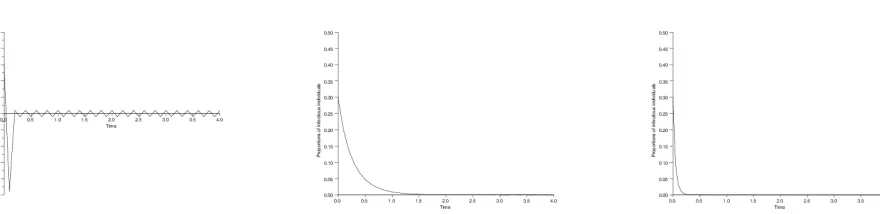
We note that if, e.g., β = 1/h and γ = 2/h, ˜Zm <0 for all m ≥1 which is obviously undesirable. If, e.g., β = 1/handγ= 4/h, the solution is oscillating around zero with ˜Zm<0 formodd and ˜Zm>0 form even.
We illustrate the solution for the latter case in the left picture of Figure 2.
Let us now apply the NSFD scheme to the model. We represent the ODE in the form (9) by setting A(Z) =−βZ+β−γand define the denominator functionψaccording to equation (11) (forϕ(z) = 1−exp(−z)). The solution does not suffer from the same instabilities as the solution of the explicit scheme as illustrated in the middle picture of Figure 2. We compare the solutions of the two schemes with the exact solution of the ODE as given in equation (13) (right picture of Figure 2). We want to remark here that the NSFD scheme is of course by no means the only possible scheme which avoids instabilities in this simple case. However, [4] provides us with a theoretical basis which ensures that instabilities do not occur even for much more complicated models.
9AnM-matrix is a matrixAwitha
Figure 2. The left picture denotes the solution of the explicit finite difference scheme (14). The middle picture denotes the solution of the NSFD scheme. The right picture denotes the exact solution of the ODE according to equation (13). Z(0) = 0.3,T = 4, h= 0.1,β = 4/h= 40, γ = 2/h= 20. We choose here a large step size hon purpose, to show how the two schemes behave for large step size. Of course, both improve if we reduceh.
2.3.
The model with vaccination
We now consider the model with vaccination from Example 1.2. We denote the proportions of susceptible, vaccinated and infectious individuals at timetbyZ1(t),Z2(t) andZ3(t) = 1−Z1(t)−Z2(t), respectively. Note that we cannot reduce the dimension from three to two if we want to represent the ODE in the form (9) (with appropriate Metzler matrixA). We set
A(Z) =
−βZ3−µ−η θ γ
η −σβZ3 0
βZ3 σβZ3 −µ−γ
and f = (µ,0,0)>
and choose the denominator functionψaccording to equation (11) forϕ(z) = 1−exp(−z). We readily observe that the relevant assumptions for the NSFD scheme are satisfied and apply the scheme for time steph= 0.1 to different initial values Z(0) and a set of parameters (cf. Figure 3) such that there exists a stable disease-free equilibrium (¯x= (0.14,0.86,0)>), a stable endemic equilibrium (x∗ = (0.24,0.45,0.31)>) and an unstable endemic equilibrium (˜x = (0.23,0.59,0.18)>; cf. the corresponding discussion in Example 1.2). We illustrate the evolution of the proportions of vaccinated and infectious individuals for different initial values in Figure 3. While the disease eventually dies out in the left picture, it becomes endemic in the right picture.
The NSFD scheme also allows us to approximately compute the characteristic boundary, i.e., the boundary separating the domains of attractions of the two stable equilibria ¯xandx∗ (in other words: the set of points for which the solution of the ODE converges to the unstable equilibrium ˜x). We illustrate the characteristic boundary in Figure 4.
3.
Computation of
V
¯
In order to answer the question of when the disease dies out, we have to compute the quantity ¯V (cf. equa-tions (6) and (7)). In other words, we have to solve a control problem. We first fix the time horizon T >0. We recall that we only have to consider absolutely continuous trajectories (as else IT ,x(φ) =∞) and hence we
control the trajectoryφvia its “derivative”; fort∈[0, T),s∈[t, T] and an integrable functionα, we write
φα(s) :=φ(s) =φ(t) +
Z s
t
Figure 3. Evolution of the proportions of vaccinated individuals (dashed lines) and infectious
individuals (solid lines) for initial values Z2(0)=0.5, Z3(0) = 0.05 (left picture) respectively Z2(0)=0.5,Z3(0) = 0.2 (right picture). T = 600,β = 3.6,γ= 1,η = 0.3,θ= 0.02,µ= 0.03, σ= 0.1.
Figure 4. The characteristic boundary separating the domains of attractions of ¯x= (0,0.86)>
(on the left) andx∗= (0.31,0.45)> (on the right). The unstable equilibrium ˜x= (0.18,0.59)> is on the characteristic boundary. Note the slight abuse of notation due to the reduction from dimension three to two. The parameters are as in Figure 3.
forx∈O, we define theset of admissible controls starting from (t, x) by
AT(t, x) :=nα: [t, T]→
Rd integrable x+
Z s
t
α(r)dr∈O¯∀s∈[t, T] andx+
Z T
t
α(r)dr∈A\Oo. (15)
The cost of an admissible controlαstarting from (t, x) is given by
JT(t, x, α) =
Z T
t
and thus the value function of the optimization problem becomes (t∈[0, T))
vT(t, x) = inf
α∈AT(t,x)J(t, x, α) (16)
and
vT(T, x) =
(
0 ifx6∈O ∞ else.
The value function thus has a singularity at the terminal timeT which is due to the constraintφ(T)6∈O. For the models we have in mind (cf. Examples 1.1 and 1.2), it is possible to move on∂O∩(A\O) by following the solution of the ODE (2) (which is free of cost, cf. (5)).10 For this reason, we havevT(t, x)≤vT˜(t, x) for ˜T < T
and therefore
lim
T→∞v
T(0, x∗) = ¯V .
We want to remark here that any admissible control αwith φα(T)6∈ (A\O)∩∂O (cf. (5) again) cannot be
optimal. Therefore, it would be equivalent to require the weaker restrictionx+Rs
0 α(r)dr∈A fors∈[0, T] in equation (15).
In the following, we describe a discrete dynamic programming algorithm for the numerical approximation of ¯V (section 3.1) and apply this algorithm to the models from Example 1.1 (section 3.2) and Example 1.2 (section 3.3).
3.1.
Approximation by discrete-time dynamic programming
In order to numerically compute the solution of the optimization problem (16), we apply discrete-time dynamic programming. To this end, we discretize time and considern+ 1 (n∈N) equidistant time points
0 =t0<· · ·< tn =T, i.e., tnm=tm=m∆tfor ∆t= T n.
Forj= 0, . . . , n−1 let ˜α= ( ˜α(tm))m=j,...,n−1, where ˜α(tm)∈Rd. We consider piecewise constant trajectories
and define recursively forx∈O,
˜
φα˜(tj) = ˜φ(tj) =x, φ˜(tm+1) = ˜φ(tm) + ˜α(tm)∆t (m=j, . . . , n−1).
We define the set of admissible controls by
˜
AT ,n(t j, x) :=
n
˜ α
˜
φα˜(tm)∈A∀m=j, . . . , n−1 and ˜φα˜(tn)∈(A\O)∩∂O o
.
The cost of an admissible control ˜α∈A˜T ,n(t
j, x) is given by
˜
JT ,n(tj, x,α˜) := ∆t n−1 X
m=j
L( ˜φα˜(tm),α˜(tm))
and the value function is given by
˜
vT ,n(tj, x) := inf ˜ α∈A˜T ,n(t
j,x) ˜
JT ,n(tj, x,α˜). (17)
10For the SIS model, we have∂O∩(A\O) ={0}. For the model with vaccination, we have
∂O∩(A\O) ={z∈A| lim
t→∞Z
z(t) = ˜x}
The constraint implies that
˜
vT ,n(tn−1, x) = ∆t inf
˜
α∈Rd:x+ ˜α∆t∈(A\O)∩∂OL(x,α˜). (18)
Furthermore, forj < n−1, the dynamic programming principle implies the following Bellman equation:
˜
vT ,n(tj, x) = inf ˜
α∈Rd:x+ ˜α∆t∈A
n
L(x,α˜)∆t+ ˜vT ,n(tj+1, x+ ˜α∆t) o
.
Hence the solution of the optimization problem can be computed backward in time.
We need next to discretize space. Note also that in the SIS model, the functionalLis explicitly known, while this is not the case in the vaccination model. For that reason we now distinguish between the two cases.
3.2.
The SIS model
We discretize space via a grid of the set A= [0,1] with fineness ∆x= 1/n¯, for some new integer ¯n. Hence the grid points are given by
xi:=i∆x fori= 0, . . . ,¯n.
Given a function f which is only defined on the grid points, we define values of the function for arbitrary x∈Aby its linear interpolationfint. In other words, we obtain forx∈A,
fint(x) := ¯n ¯ n X
i=0
1{x∈[xi,xi+1)}
n
f(xi)(xi+1−x) +f(xi+1)(x−xi)o.
We obtain the following (backward in time) algorithm for the solution of the optimization problem (17). 1. Forxon the grid,
¯
vT ,n,¯n(tn−1, x) = ∆t inf ˜
α∈Rd:x+ ˜α∆t∈(A\O)∩∂OL(x,α˜).
We denote the solution of this minimization problem by ˜α∗(t
n−1) = ˜α∗(tn−1, x). 2. Form < n−1,xon the grid,
¯
vT ,n,n¯(tm, x) = inf ˜
α∈Rd:x+ ˜α∆t∈A n
L(x,α˜)∆t+ ¯vT ,n,int n¯(tm+1, x+ ˜α∆t) o
.
We denote the solution of this minimization problem by ˜α∗(tm) = ˜α∗(tm, x).
Note that this algorithm involves the solution of n×n¯ minimization problems. We recover an approximation ˜
φ∗ = (φ∗(tm))m=0,...,n of the optimal trajectory starting from the stable equilibrium x∗, by the following
procedure (including another linear interpolation). 3. Form= 0, . . . , n−1,
˜
φ∗(t0) =x∗, φ˜∗(tm+1) =φ∗(tm) + ˜α∗int(tm, φ∗(tm))∆t.
It is well-known that under appropriate assumptions, the solution of this procedure converges to the solution of the optimization problem (16) (see, e.g., [19, 20]); the optimal coupling of time and space discretization is ∆t= ∆x. We want to remark here that standard assumptions do not apply to our model. For instance, the functionLis not Lipschitz continuous, evenL(x, y)→ ∞ forx→∂Ais possible.11 Furthermore, the terminal
11This is e.g. the case fory <0 andx→0. Note however that the action required to approach the boundary, e.g., at constant speed one is finite and we haveRt
Figure 5. Optimal trajectory ˜φ∗forT = 5 (left picture),T = 20 (middle picture) andT= 60
(right picture); ∆t= ∆x= 1
100,β= 1.5 andγ= 1.
constraint results in a singularity of the value function at terminal timeT. We are not aware of any analytical results including our set–up. We nevertheless have reasons to believe that
¯
V ≈v¯T ,n,int ¯n(t0, x∗) for large enoughT.
It is not in the scope of this article to provide a thorough analytical proof of the convergence of the algorithm. We readily observe that for the SIS model, the Legendre-Fenchel transform is given explicitly by
L(x, y) =ylog ˜θ−βx(1−x)(˜θ−1)−γx1 ˜ θ −1
,
where
˜ θ:= y+
p
y2+ 4βγx2(1−x) 2βx(1−x) .
Furthermore, the boundary consists of the single point{0}; hence equation (18) becomes
˜
vT ,n(tn−1, x) = ∆tL(x,−x/∆t).
We consider the following parameters: β = 1.5, γ = 1; in particular, we haveR0 = 1.5 >1 and the endemic equilibrium x∗ = 1/3 is stable. We apply the dynamic programming algorithm described in section 3.1 with
∆t= ∆x= 1/100 andT = 5,10,20,40,60 (i.e., ¯n= 100 andn= 500,1000,2000,4000,6000). We obtain
v5int,n,n¯(t0, x∗) = 0.0953, vint10,n,n¯(t0, x∗) = 0.0757, vint20,n,n¯(t0, x∗) = 0.0705,
v40int,n,n¯(t0, x∗) = 0.0702, vint60,n,n¯(t0, x∗) = 0.0702.
We hence deduce that ¯V ≈0.0702 and thus E[τN,x]≈exp(0.0702N) for largeN. We illustrate the solution of
the optimization problem in Figure 5 for T = 5,20,60. We observe that it is the cheapest to move slowly near the stable equilibriax∗ and the unstable equilibrium ¯x= 0.
3.3.
The model with vaccination
Unlike in section 3.2, the place of exit fromO is a priori not clear for the model with vaccination (cf. Exam-ple 1.2). It seems plausible that it is cheapest to exit O at the unstable endemic equilibrium ˜x. Indeed, if T is chosen large enough, an optimal (or near optimal) trajectory φcan move on the boundary towards ˜xafter the exit time without generating any extra cost (cf. (5)); in this case we have limt→∞φ(t) = ˜x. Hence, we can
assume that ˜xis indeed the place of exit for the numerical computation of ¯V. Therefore, equation (18) becomes
˜
However, the Legendre-Fenchel transformL cannot be computed explicitly. Here we use the following defi-nition ofL, which is equivalent to (4) (see [10]):
L(x, y) :=
(
infµ∈Bx,y`˜(µ, x) ifBx,y6=∅
∞ if not,
where forµ∈Bx,y,
˜
`(µ, x) :=X
j
βj(x)−µj+µjlog µj
βj(x) ;
and
Bx,y:= n
µ∈Rk
+|µj >0 only ifβj(x)>0 andy= X
j µjhj
o .
Since we seek to minimize
V := inf
T ,φs.t. φ(0)=x∗,φ(T)=˜x Z T
0
L(φ(t), φ0(t))dt,
our discretized dynamic programming equation reads: for eachx∈ G (the space grid),
v(tk, x) = inf x0∈G
n L
x,x
0−x
∆t
∆t+v(tk+1, x0) o
= inf
x0∈G n
˜
`(ˆµ(x, x0), x)∆t+v(tk+1, x0) o
,
where ˆµ(x, x0) is the argument which realizes the following minimum
inf
µ, x+∆P
jµjhj=x0 ˜ `(µ, x).
Note that here we avoid to consider interpolation between points on the grid. We have implemented this algorithm on a grid whose one of the axis is the line passing throughx∗and ˜x, with the following values of the parameters : β = 3.6,θ= 0.02,µ= 0.03,η = 0.3,σ= 0.1 andγ= 1.
The approximation of ¯V which we have found is 0.3891, with ∆t = 0.05, and the ∆x1 = ∆x2 = 0.005. This means that E[τN,x
∗
]≈exp(0.3891N) for largeN. Note that if ∆t is not small enough compared to ∆x, since we restrict the above minimization to x0 ∈ G, we cannot allow small speed, and we get larger values of
¯
V. We expect that more accurate results could be obtained, by doing the minimization overx0 on a finer grid, which necessitates to interpolate v(tk+1,·) between points on the grid. We have not been able to implement
this refinement, by lack of time. This will be done in the future. It should improve the numerical estimate of ¯
V. The above quantity should be considered as an upper bound of the true value.
4.
Simulation of
Z
NIn this section, we describe known exact and approximate simulation methods for the simulation of the solutionZN of equation (1). To this end, we fixN; with the notationsν
j= hj
N andaj(z) =N βj(z), equation (1)
can be rewritten as
ZN(t) =x+
k X
j=1 νjPj
Z t
0
aj(ZN(s))ds
Note that our ultimate goal would be to simulate the value of τN which, from the above Large Deviations
results, is huge, as soon asN is large. This may be seen as impossible. However, this is similar to the problem of rare event simulation, for which there exist specific techniques, which we intend to implement in the future. See also the discussion below in section 4.7.2. In the framework of this paper, we present some preliminary numerical work, which aims only at simulating the stochastic processZN over a given finite time horizon.
In the following, we first introduce the so-called stochastic simulation algorithm (SSA) proposed in [14, 15] (section 4.1). The SSA allows for the exact simulation of the process ZN. Unfortunately, this algorithm is
rather slow in some circumstances, typically when there are too many jumps of the Poisson processes on a fixed time interval. Therefore, we discuss faster approximate simulation methods in the subsequent sections: in section 4.2, we introduce the explicitτ-leaping algorithm (see [16]) in the form of [21]; in section 4.3, we discuss modifications of the τ-leaping algorithm: implicit and mid-point τ-leaping (section 4.3.1) and the algorithm from [22] which ensures that the simulated process remains in its domain, e.g., by preventing the components of the process from becoming negative (section 4.3.2). We apply the SSA and the modifiedτ-leaping algorithm from section 4.3.1 to the specific models from Examples 1.1 and 1.2 in sections 4.4 and 4.5, respectively. We conclude by addressing open research questions concerning the simulation of the processZN in section 4.7.
4.1.
The stochastic simulation algorithm
A mathematically exact procedure for simulating the evolution of the processZN given by equation (19) is
the stochastic simulation algorithm (SSA) first proposed in [14, 15]. The SSA changes the value of the solution at each jump time of one of the Poisson processes. The simplest implementation of the SSA is the so-called
direct method: Whenevert < T:
1. While in statezat time t, evaluate all functionsaj(z) and their suma0(z) :=P k
j=1aj(z).
2. Generate the time increment τ as the realization of an exponential random variable with parameter a0(z).
3. Choose an indexj∈ {1, . . . , k}according to the probability distribution aj(z)
a0(z) (j= 1, . . . , k). 4. Update
i. t←t+τ, ii. z←z+νj.
5. Record (t, z). Return to 1. if t+τ < T; else stop.
Carrying out step 3. is mathematically straightforward: we draw one realization r of a uniform random variable on [0,1]; then,j is the smallest positive integer for which
j X
i=1
ai(z)> ra0(z).
The SSA is mathematically exact. However, the task of explicitly simulating each jump makes the SSA too slow for practical implementation in some circumstances. The reason is that for large N, there are too many jumps on any fixed time interval.
4.2.
The explicit Poisson
τ
-leaping algorithm
A faster but approximate stochastic simulation procedure is the explicit Poissonτ-leaping algorithm (see [16]). The basic idea of this procedure is to advance the system by apreselected time incrementτ (in contrast to the
randomly generated time incrementτ in the SSA). On the one hand,τ should be chosen large enough in order to ensure that “many” jumps occur during this length of time (as else, the savings in computation time are not significant); on the other hand, it should be small enough such that the values of the functions aj are unlikely
during a leap τ are “likely” to be bounded bya0(z); here, (0 < 1) is the error control parameter. In other words,
|aj(ZN(t+τ))−aj(ZN(t))| ≤a0(ZN(t)) forj= 1. . . , k with high probability.
We estimate the largest value ofτ that meets this particular requirement as follows. First, we compute
fjj0(z) := d X
i=1 ∂aj(z)
∂zi
νij0 forj, j0= 1, . . . , k; (20)
here νij denotes thei-th component of the vectorνj. Subsequently, we calculate
µj(z) := k X
j0=1
fjj0(z)aj(z) and σ2j(z) := k X
j0=1
fjj20(x)aj(z) forj= 1, . . . , k (21)
and set
τ=τ(z) := min
j=,1...,k (
a0(z)
|µj(z)| ,
2a2 0(z) σ2
j(z) )
. (22)
Note that for a standard Poisson processP,
Pj Z t+τ
0
aj(ZN(s))ds
−Pj Z t
0
aj(ZN(s))ds d
=P Z t+τ
t
aj(ZN(s))ds
≈P(aj(ZN(t))τ) =P(aj(z)τ) =:pj
and thus
ZN(t+τ)≈d ZN(t) +
k X
j=1
pjνj =z+ k X
j=1 pjνj.
This procedure for the selection ofτ yields the followingτ-leaping algorithm. Whenevert < T:
1. While in statezat time t, evaluate the functionsaj and their suma0(z) =P k
j=1aj(z).
2. Computeτ via the formulas (20)-(22).
3. Fix a small integern(typically, e.g.,n= 10) and a moderate integer ¯n(typically, e.g, ¯n= 100). i. Ifτ < n
a0(z), rejectτ and execute ¯niterations of the SSA. Then, return to step 1. ii. Ifτ≥ n
a0(z), proceed to step 4.
4. Forj= 1, . . . , k, generatepj as a Poisson random variable with meanaj(z)τ.
5. Update i. t←t+τ, ii. z←z+Pk
j=1pjνj.
6. Record (t, z). Return to 1. if t+τ < T; else stop.
Let us shortly comment on this algorithm. pj represents an approximation of the number of jumps of typej
during the time interval [t, t+τ[. We remark again that the approximation bypjin step 4. is justified as long as aj(z) remains more or less constant over the subsequent time interval of lengthτ. The reason for step 3. i. is the
following. a1
0(z) is the mean time step to the next jump when applying the SSA. Ifτ is not significantly larger than a1
The explicitτ-leaping algorithm above has been shown to provide accurate simulation results; furthermore, it is substantially faster than the SSA for many “not-too-stiff” systems12(see [22]; see also [24] for theoretical evidence for this). We illustrate the gain of computation time by numerical experiments in sections 4.4 and 4.5 below for a modification of this algorithm (cf. section 4.3.2).
4.3.
Modifications of the
τ
-leaping algorithm
There exist several variants of the above described explicitτ–leaping algorithm. We now describe some of these.
4.3.1. Implicit and mid–pointτ-leaping algorithms
One may want to freeze the rates not at the value of the solution at the beginning of the discretization interval, but rather at an approximate value of the position at the end of that interval, or else at the mid-point.
The “implicit” τ-leaping algorithm is obtained by replacingaj(ZN(t))τ with
aj ZN(t) +τ b(ZN(t))
τ,
and the mid–pointτ-leaping algorithm consists in replacing the same quantities by
aj ZN(t) +τ b(ZN(t))/2
τ.
In [24] it is proved that the error in the mid-point τ-leaping algorithm is less than the one produced by the explicitτ–leaping algorithm.
4.3.2. A modifiedτ-leaping algorithm
As most numerical schemes, the τ-leaping algorithm has the disadvantage that the approximate solution might very well jump over the boundaries which the solution of the stochastic equation (19) can never cross. More precisely, the solution of (1) satisfies certain constraints. For example, in the case of constant total population, we have thatZN
i (t) ≥0, 1≤i ≤d, and Z0N(t) := 1− Pd
i=1Z N
i (t) ≥0. We would like that the
approximate solution satisfies these constraints as well. However, this might not be the case with a standard τ-leaping algorithm. In particular, if for some 0≤i≤d, ZN
i (t) is very small, then some of the Poisson driving
processes may push it over to a negative value during the next time interval of length τ. Because of that, at the beginningt of each time step, we define
Lj := min 1≤i≤d, νij<0
bN ZiN(t)c
and choose a critical value nc. The critical directions will be chosen by comparingLj tonc.
The modified Poissonτ-leaping procedure requires that a critical Poisson process cannot jump more than once in a time interval of lengthτ. That makes it impossible for a critical Poisson process to drive any component of ZN to a negative value. The theoretical justification for each step in this modified τ-leaping procedure is given
in [22].
Whenevert < T:
1. While in statezat time t, evaluate the functionsaj(z) and their suma0(z) =P k
j=1aj(z).
2. Identify the currently critical Poisson processes as thosePj for which
aj(z)>0 and Lj < nc.
3. Modify the τ-selection procedure from equations (20)-(22) by only taking into account those jump directionsj0 corresponding to thenon-critical Poisson processes. Denote the resulting time step byτ0. If there is no non-critical Poisson process, set τ0=∞.
4. Fix a small integern(typically, e.g.,n= 10) and moderate integer ¯n(typically, e.g, ¯n= 100). i. Ifτ0< an
0(z), reject τ
0 and execute ¯niterations of the SSA. Then, return to step 1.
ii. Ifτ0≥ n
a0(z) proceed to step 5. 5. Compute the sum ac
0(z) of the functions aj(z) of the critical Poisson processes. Generate τ00 as a
realization of the exponential random variable with parameter ac 0(z).
6. i. Ifτ0< τ00, setτ=τ0. For all the critical Poisson processesPj, setpj = 0. For all the non-critical
Poisson processesPj, generatepjas a realization of the Poisson random variable with meanaj(z)τ.
ii. Ifτ00≤τ0, setτ=τ00. Generate an integerjc according to the probability distributionaj(z)/ac0(z) (i.e., j runs over the index values of the critical Poisson processes). Set pjc = 1, and for all the other critical Poisson process, setpj= 0. For all the non-critical Poisson processesPj, generatepj
as a realization of the Poisson random variable with meanaj(z)τ.
7. Update i. t←t+τ, ii. z←z+Pd
j=1pjνj.
8. Ifz is not in its domain, replaceτ0←τ0/2, and return to step 6. 9. Record (t,z). Return to 1 ift+τ < T; else stop.
Remark 4.1. It may seem strange to use a uniform critical value nc, independent of the value of the rate
of each Poisson process. It would be natural to compare each Lj with the corresponding aj(ZN(t))τ, which
however would require to compute a first value ofτ. We intend to search for improvements in that direction in the future.
Remark 4.2. Although the modifiedτ–leaping algorithm is designed so as to reduce the chance of a negative value of any of theZN
i (t), it cannot completely rule them out. This is the reason for step 8. of the algorithm.
We suspect that this step might introduce a bias in the simulation, in that it tends to delete simulations with exceptionally large values of some of the Poisson process increments, and also to reduce the chance of approaching or hitting any of the boundaries, which is specially annoying for our purposes.
We intend to check two other possible approaches. The first one consists in projecting the computed point, if it is outside the domain. The second consists in replacingτbyτ /2, but without resimulating a new independent value of the Poisson process increment, but rather by simulating the new increments according to the conditional law ofPj(t+τ0)−Pj(t), given the previously simulated value ofPj(t+τ)−Pj(t), which, ifPj(t+τ)−Pj(t) =k,
follows a binomial law with parameters kandτ0/τ.
4.4.
The SIS model
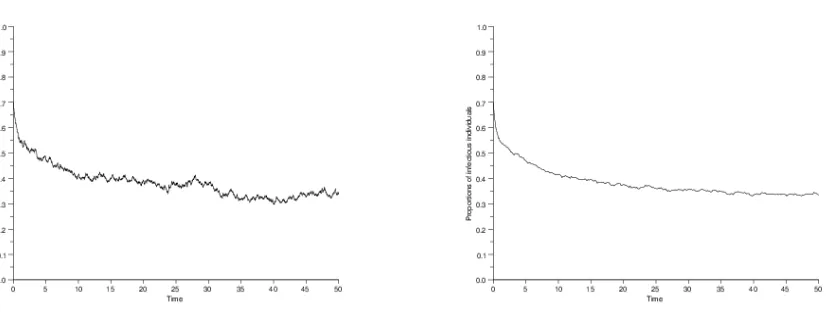
In this section, we apply the simulation algorithms from sections 4.1 and 4.3.2 to the SIS model (Example 1.1). We consider an endemic situation (β = 1.5, γ = 1, hence R0 = 1.5 > 1 and x∗ = 1/3) and compare the performance of the SSA to the modifiedτ-leaping algorithm. If the population size is relatively small,N = 2000, we observe that the computation times are similar for both algorithms (even smaller for the SSA). A closer look at the realized trajectory of the τ-leaping procedure confirms that almost all jumps are of size 1/2000. This suggests that in most cases, the selected time stepτ0 is rejected and the SSA is applied (cf. steps 3. and 4. i. of the algorithm). Hence, there is no significant gain in computation time. If we letN = 20000, the number of jumps (and hence the computation time) for the SSA increases approximately by a factor ten. Theτ-leaping algorithm is significantly faster which suggests that the time step τ0 is now rarely refused. While the SSA becomes inefficient for very large time horizons (e.g., T = 600) and population sizes (e.g., N = 200000), the process can still be simulated efficiently by the τ-leaping algorithm.
Figure 6. Realized trajectories of the SSA forN = 2000 (left picture) andN = 20000 (right
picture). Z(0) = 0.1,T = 50,β= 1.5,γ= 1.
Figure 7. Realized trajectories of the modifiedτ-leaping procedure forN = 2000 (left picture)
andN = 20000 (right picture). The parameters are as in Figure 6.
4.5.
The model with vaccination
We now apply the same algorithms to the model with vaccination (Example 1.2). We consider the bistable situation from section 2.3 (cf. Figure 3 for the parameters) and observe the same qualitative properties concerning computation times as for the SIS model in section 4.4. In Figures 8 and 9, we illustrate the realized trajectories for the SSA and the modified τ-leaping algorithm, respectively (left pictures: N = 2000, right pictures: N = 20000). For simplicity, we only display the proportions of infectious individuals. As in section 4.4, we observe that the trajectories approach the solution of the ODE asN → ∞.
Figure 8. Realized trajectories for the proportion of infectious individuals simulated by the
SSA (left picture: N = 2000, right picture: N = 20000). Z2(0) = 0.2,Z3(0) = 0.7,T = 50. All other parameters are as in Figure 3.
Figure 9. Realized trajectories for the proportion of infectious individuals simulated by the τ-leaping algorithm (left picture: N = 2000, right picture: N = 20000). All parameters are as in Figure 8.
4.6.
Computation time
SSA Population size N Time horizonT Computation time
2000 50 2.8
20000 50 24.66
200000 50 225.44
Modified tau-leaping
2000 50 2.3
20000 50 3.02
200000 50 1.05
The next table presents the computation times of the SSA and modified tau-leaping for different population sizes in the SIV model. The same comments as for the SIS model apply.
SSA Population size N Time horizonT Computation time
2000 50 4.51
20000 50 36.4
200000 50 352.64
Modified tau-leaping
2000 50 2.95
20000 50 1.04
200000 50 0.67
4.7.
Open questions
We conclude by describing two further open questions concerning the simulation of the process ZN. We
discuss briefly the simulation of models where some jump types are significantly more frequent than others (section 4.7.1). Finally, we discuss the simulation of rare events with the help of large deviations theory (section 4.7.2).
4.7.1. Models with different time scales
The simulation algorithms described in sections 4.1-4.3 tend to become inefficient or inaccurate if some of the jump rates are much larger than others (cf. also Footnote 12). In epidemiology, this is typically the case for so-called host-vector diseases (e.g., malaria), where the disease is transmitted from vectors (mosquitoes) to hosts (humans) and vice versa. In the particular case of malaria, the jumps concerning only the mosquito population have a much shorter time scale than those also concerning the human population (see, e.g., the model in [3]). It is hence time consuming to simulate a significant number of jumps within the human population.
In order to overcome this problem, we simulate only the jumps with small rates viaτ-leaping. Within the interval [t, t+τ[13, the jumps with large rates are approximated by the solution of the ODE (cf. section 2).14
We intend to analyze the efficiency and accuracy of this procedure. In particular, we are interested in whether the large deviations behavior (cf. section 1.2) is changed by this partial ODE approximation significantly.
4.7.2. Simulation of rare events
We are particularly interested in sampling the probability of the event that the processZN exits the domain
of attraction of a stable equilibrium before a given time T (cf. section 1.2). If N is large and T is relatively small, the probability of this event is typically extremely small. Applying a na¨ıve Monte Carlo (MC) approach is therefore inefficient and we rely on rare events simulation techniques. In [25], the application of Importance Sampling is explained in the context of diffusion processes. We intend to adapt this method in the following way. Via a change of measure, we transfer the process ZN to a jump process ˜Z (see, e.g., [6] for a Girsanov
theorem for processes of the type ofZN) for which the event of interest is much more probable. Then, we apply
MC simulation to the process ˜Z and associate a weight with each realization (hence the average in the MC is
13Here,τis the time step chosen by theτ-selection procedure applied to only the small rates.
14The initial valuezfor this computation can either be chosen explicitly, i.e.,z=ZN(t) or implicitly/at the mid-point of the
replaced by a weighted average). In order to choose the process ˜Z appropriately (i.e., such that the probability of exit is “maximized”), we use the theory of large deviations: the “cheapest” way to exit the domain is given by the trajectoryφ∗ (cf. sections 1.2 and 3); hence, we change the rates of the process in such a way that the corresponding rate functionI(φ∗) becomes small (ideally,φ∗ is approximately the solution of the ODE for the modified rates).
Acknowledgements: This research was supported by the ANR project MANEGE, the DAAD, the Labex Archim`ede and CEMRACS.
We thank Nicolas Champagnat and Tony Leli`evre for useful discussions concerning theτ–leaping algorithm.
References
[1] F. Campillo and C. Lobry. Effect of population size in a predator-prey model.Ecological Modelling, 246:1–10, 2012.
[2] Christopher M. Kribs-Zaleta and Velasco-Hern´andez. A simple vaccination model with multiple endemic states.Math. Biosci., 164(2):183–201, 2000.
[3] Nakul Chitnis, J. M. Cushing, and J. M. Hyman. Bifurcation analysis of a mathematical model for malaria transmission.Siam Journal of Applied mathematics, 67(1):22–46, 2006.
[4] Roumen Anguelov, Yves Dumont, Jean Lubuma, and M. Shillor. Dynamically consistent nonstandard finite difference schemes for epidemiological models.Journal of Computational and Applied Mathematics, 255:161–182, 2014.
[5] Thomas G. Kurtz. Strong approximation theorems for density dependent Markov chains. Stochastic Processes and their Applications, 6(3):223–240, 1978.
[6] Adam Shwartz and Alan Weiss.Large Deviations for Performance Analysis. Chapman Hall, London, 1995.
[7] P. Dupuis and R. S. Ellis.A weak convergence approach to the theory of large deviations. Wiley series in probability and statistics. Wiley, New York, 1997.
[8] Jin Feng and Thomas G. Kurtz.Large deviations for stochastic processes, volume 131 ofMathematical Surveys and Monographs. American Mathematical Society, Providence, 2006.
[9] Adam Shwartz and Alan Weiss. Large deviations with diminishing rates.Mathematics of Operations Research, 30(2):281–310, 2005.
[10] Peter Kratz and Etienne Pardoux. Large deviations in epidemiology.Preprint, 2015. [11] Patrick Billingsley.Convergence of Probability Measures. Wiley, New York, 1999.
[12] Amir Dembo and Ofer Zeitouni.Large deviations techniques and applications. Springer-Verlag, New York, 2009. [13] M. I. Freidlin and A. D. Wentzell.Random perturbations of dynamical systems. Springer, New York, 1998.
[14] Daniel T. Gillespie. A general method for numerically simulating the stochastic time evolution of coupled chemical reactions.
Journal of Computational Physics, 22(4):403–434, 1976.
[15] Daniel T. Gillespie. Exact stochastic simulation of coupled chemical reactions.The journal of chemical physics, 81(25):2340– 2361, 1977.
[16] Daniel T. Gillespie. Approximate accelerated stochastic simulation of chemically systems. Journal of Chemical Physics, 115(4):1716–1733, 2001.
[17] Ronald E. Mickens, editor.Applications of nonstandard finite difference schemes. World Scientific, Singapore, 2000.
[18] Ronald E. Mickens, editor.Advances in the applications of nonstandard finite difference schemes. World Scientific, Singapore, 2005.
[19] Maurizio Falcone and Tiziana Giorgi. An approximation scheme for evolutive Hamilton–Jacobi equations. InStochastic Anal-ysis, Control, Optimization and Applications: A Volume in Honor of W.H. Fleming, pages 288–303. Birkh¨auser, 1994. [20] Maurizio Falcone and Roberto Ferretti.Semi-Lagrangian Approximation Schemes for Linear and Hamilton-Jacobi Equations.
SIAM, Philadelphia, 2013.
[21] Yang Cao, Daniel T. Gillespie, and Linda R. Petzold. Improved leap-selection for accelerated stochastic simulation.The journal of chemical physics, 119(16):8229–8234, 2003.
[22] Yang Cao, Daniel T. Gillespie, and Linda R. Petzold. Avoiding negative populations in explicit Poisson tau-leaping. The journal of chemical physics, 8(2):1–8, 2005.
[23] Yucheng Hu and Tiejun Li. Highly Accurate Tau-leaping Methods with Random Corrections.J. Chem. Phys., 130(12), 2009. [24] David F. Anderson, Arnab Ganguly, and Thomas G. Kurtz. Error analysis of tau-leap simulation methods.The Annals of
Applied Probability, 21(6):2226–2262, 2011.
![Figure 1. Schematic representation of the disease transmission for the model with vaccination by [2].](https://thumb-us.123doks.com/thumbv2/123dok_us/10066319.1992992/4.612.144.451.123.263/figure-schematic-representation-disease-transmission-model-vaccination.webp)