Available Online at www.ijpret.com 29
INTERNATIONAL JOURNAL OF PURE AND
APPLIED RESEARCH IN ENGINEERING AND
TECHNOLOGY
A PATH FOR HORIZING YOUR INNOVATIVE WORK
INNOVATIVE SLIP FORMWORK FOR STRUCTURAL MEMBERS
SOHAM JOSHI, YASH JOSHI, JAY MULYE, MILAN MUNGALPARA, MEGHA PATELU.G. Student, Department of Civil Engineering, SVBIT, Gandhinagar Accepted Date: 16/08/2017; Published Date: 01/09/2017
\
Abstract: - Segregation and bleeding are major issues in concreting due to lack of material quality and improper construction practice. Mainly these issues took place due to free fall from higher height. In this study we try to solve these issues by innovative slip formwork. Current and expected challenges on large engineering and construction projects demand innovative methods for improved performance. Slip-forming is one of the potential concrete formwork methods that improves speed and productivity of repetitive vertical concrete work.[1] Using fabric formwork, it is possible to cast architecturally interesting, optimized structures that use up to 40% less concrete than an equivalent strength prismatic section, offering potentially significant embodied energy savings in new concrete structures. Fabric formwork allows elegant designs to be realized but its use also presents some unique challenges, including the practical provision of transverse reinforcement in slender, non-prismatic beam elements.[2] After placing and enough hardening of concrete, the slip form gets lifted vertically. Damages in the concrete are expected to happen due to the deformation in the formwork caused by the pressure acting on it which results in the pinching of concrete. In order to analyze this problem, the finite element analysis package ANSYS software is used to determine the deformation of the panel.[3]
Keywords: Concrete, Formwork, Bleeding, Segregation
Corresponding Author: MR. SOHAM JOSHI
Access Online On:
www.ijpret.com
How to Cite This Article:
Soham Joshi, IJPRET, 2017; Volume 6 (1): 29-37
Available Online at www.ijpret.com 30 INTRODUCTION
Slip forming is a construction technique that facilitates concrete structures without any horizontal construction joints. This construction technique has been used for several decades for production of concrete structures.[3] Different types of structures are slip formed, but typical ones are vertical structures such as towers, bridge columns and offshore platforms. Slip forming is not only used for straight vertical structures, but also on structures where geometry of the structures and wall thickness is changed.[3] However, the construction of such structures using conventional steel and timber formwork systems is difficult. Replacing these zero deflection molds with a flexible membrane, fabric formwork provides a system that capitalizes on the fluidity of wet concrete to take up almost any shape, thus facilitating the construction of non-prismatic, optimized, low embodied energy concrete structures.[2]
A. STRUCTURAL MEMBER TYPES AND THEIR FORMWORK:
1. Fiberglass formwork:
The use of fiberglass as a material to make forms for concrete work has increased rapidly within the past two years.[5]
Fiberglass forms provide a means of producing a concrete surface that is architecturally acceptable without rubbing and grinding.
Special patterns and designs can be readily molded into the material.
Large areas or sections may be made without joints or seams.
When repeated usage is possible, fiberglass is often the most economical form material.[5]
Available Online at www.ijpret.com 31 2. Plastic Formwork:
It comes as an individual structural elements like columns and walls. Various sized columns and walls are available in the market. The formwork is very easy to install and uninstall and has a very high repetitive nature. The ease of application makes it very useful where faster completion of work is a criteria. Refer Figure 2 for Plastic formwork in columns.[5]
Fig. 2[11]
3. Fiber-reinforced polymer (FRP) formwork system:
Available Online at www.ijpret.com 32 Fig. 3[12]
4. Aluminum Panel System Formwork:
System formwork has prefabricated modular components with casting panels. The system formwork can suit the required shape of concrete structure. The speedy and quality construction is the biggest advantage in this type while high initial cost is the main disadvantage and hence this is not economical to use in low-rise buildings. But this is the most economical form of formwork type to be used in high-rise building construction when it is having few (more than 10) typical stories as it can be made in a single story complete formwork set form and a faster floor to floor construction can be achieved. (Refer Figure 4)[5]
Available Online at www.ijpret.com 33 B. FORMWORK HISTORY
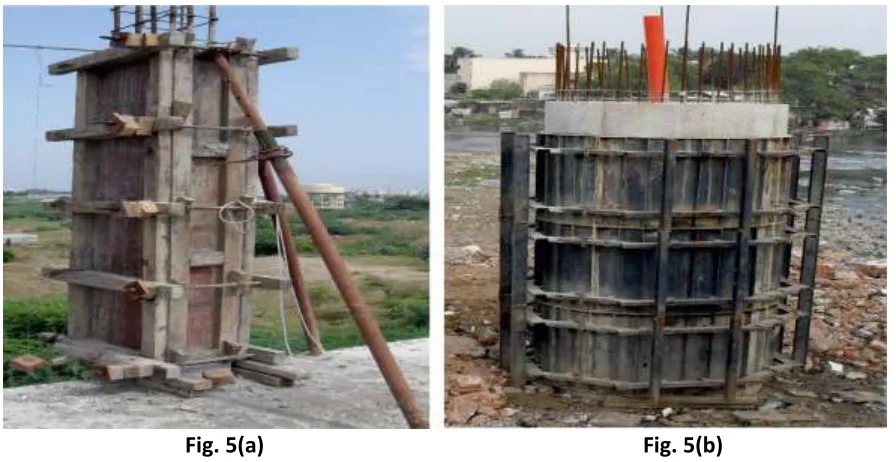
For many years reinforced concrete construction is predominantly followed in India, thus the formwork plays a vital role in the Indian construction. The most commonly used type of formwork systems are the traditional or conventional systems made of dressed lumber and fabricated at site during construction as shown in Fig.5(a).[4] They are also known as as-built formwork. Currently even for construction of wide variety of structures from small to medium sized projects, the conventional formwork systems are used. Quality, safety and economy are the three objectives of formwork construction. The conventional formwork systems could account only for the economy aspects of form construction, thus the modern formwork systems known as Engineered or System Formwork Systems was developed later.[4]
System Formworks are built of prefabricated modules (standard timber beams) with the metal frames and patented plywood sheathings. Since 1980, the concept of system formwork is improving tremendously due to the advancement in forming technology and fabrication process. New and innovative materials such as Plastic, FRP (Fiber Reinforced Polymer), Aluminum, etc., are used as an alternatives for the timber components as shown in Fig 5(b).[4]
Fig. 5(a) Fig. 5(b)
C. PROBLEMS IN CURRENT FORMWORK TYPES:
Available Online at www.ijpret.com 34 1. The shape of the building:
Simple block-shaped buildings are much easier to construct than buildings in awkward shapes, such as projects with curved, inclined, stepped, undefined or sculptured features. As a general rule, awkwardly shaped buildings can be more easily dealt with by using more traditional, labor-intensive formwork systems for their better adaptability.[6]
2. Design of the external wall:
Some buildings may have many architectural features on the building exterior such as fins or ribs, sun shading blades, planter boxes, deep rebate windows or hoods for air-conditioner units. These may limit the choice of system-type formwork due to features that interrupt with the casting process [6].
3. Internal layout:
Some buildings may have very simple layouts with few in-situ walls and floor plates framed with regularly spaced columns, as seen in many commercial and office buildings. However, some developments feature very complicated load-bearing internal walls that can make the casting process difficult.[8]
4. Structural forms:
Like internal layout, the structural form of buildings also affects the formwork options. For example, buildings with a structural core in the form of a vertical shaft limit the use of other formwork systems other than those of a self-climbing nature. Buildings in flat slab design make table forms or flying forms the most obvious choice. For buildings with regularly arranged shear wall designs, the best selection is large-panel type steel forms or other types of gang forms.[7]
5. Consistency in building dimensions:
Available Online at www.ijpret.com 35
Construction-related factors:
1. Speed of work:
When working with buildings with large construction areas and horizontal spread, projects can be expedited by the introduction of additional sets of formwork, to create more independent work fronts. This will, of course, increase the cost of production. For high-rise buildings, increasing the number of formwork used cannot always solve the question of speed, for the critical path still depends on the floor cycle. However, a properly selected, designed and arranged formwork system will increase work efficacy for each typical cycle. In some cases, adding half or a full set of formwork, especially for the floor forms, may help to speed up the cycle as the additional set can provide more flexibility when the form is struck at an earlier time. [8]
2. Re-use of formwork:
The re-use for traditional timber formwork is usually limited due to the durability of the plywood sheeting. The optimum number of times of timber form can be used is usually 12 to 14. Thus, it is still sufficiently economical to use timber formwork for high-rise buildings at heights in accordance to the multiple of the usual re-used times. Although the metal form can be re-used many times, the high initial cost of providing the form often discourages its selection, especially when there is no need to re-use them too many times, for example in a low-rise development. A careful balance between cost, speed, performance and the quality of output should be properly considered when making the selection.[7]
3. Dependence of work:
Many factors should be considered before employment of a construction plan and the selection of the right formwork system. These include considerations of whether there will be lifting appliances provided for the erection of formwork; whether these appliances will be able to access the work spot to assist in the operation as the structural works proceed; whether any special equipment will be required for striking the forms; and how the removed formwork panels can be transported to other spot to continue work.[8]
4. Provision of construction joints:
Available Online at www.ijpret.com 36 challenge the output and affect the quality of the concrete. Careful selection should be made to ensure a particular formwork system can satisfactorily allow such arrangements.[7]
5. Accessibility to work:
During the course of construction, accessibility problems may be created through segregation, temporary discontinuation, or blocking of the layout by the partially completed building. Or, in cases constructing a shaft-type core wall is constructed in an advanced phase, the shaft may stand independently for a long period of time before it is connected to the horizontal elements. Arrangements for access to work places should be properly arranged when carrying out construction planning. [7]
MATERIAL USED
1. Wooden planks:
A plank is timber that is flat, elongated, and rectangular with parallel faces that are higher and longer than wide. Used primarily in carpentry, planks are critical in the construction of ships, houses, bridges, and many other structures. Planks also serve as supports to form shelves and tables.
2. Steel:
Steel is an alloy of iron and other elements, primarily carbon. Because of its high tensile strength and low cost, it is a major component in buildings, infrastructure, tools, ships, automobiles, machines, appliances, and weapons.
3. Aluminum:
Aluminum or aluminum is a chemical element with symbol Al and atomic number 13. It is a silvery-white, soft, nonmagnetic, ductile metal in the boron group. By mass, aluminum makes up about 8% of the Earth's crust; it is the third most abundant element after oxygen and silicon and the most abundant metal in the crust, though it is less common in the mantle below.
CONCLUSION
Available Online at www.ijpret.com 37 segregation in the formwork. Therefore, we try to reduce the bleeding and segregation by using plastic formwork.
REFERENCES
1. M.R. Sharifi, S. Baciu and T. Zayed, Slip-Form Productivity Analysis for Concrete Silos, 1st International Construction Specialty Conference.
2. Mr John Orr, Dr Antony Darby, Professor Tim Ibell, Dr Mark Evernden, Fabric formwork for ultra high performance fibre reinforced concrete structures, IJIET.
3. P.Sathiya Bama, M.Priyadharshini, Dr.G.Jaisankar, An Analytical Study on Slipforming of Vertical Concrete Structures, IJIRT.
4. Ramesh Kannan , Helen Santhi; “Constructability Assessment of Climbing Formwork Systems Using Building Information Modeling”(2013);Elsevier Journal
5. https://www.masterbuilder.co.in/data/edata/Articles/March2014/150.pdf
6. M K Hurd, Formwork for Concrete, American Concrete Institute, 1995, 6th edition
7. C J Wilshere, Formwork, Thomas Telford, 1992.
8. A W Irwin & W I Sibbald, Falsework – Handbook of Design and Practice, London, Granada, 1983.
9. https://www.masterbuilder.co.in/wp-content/uploads/2017/05/Constructability-Analogy-of-Climbing-1.jpg
10. https://www.masterbuilder.co.in/wp-content/uploads/2014/04/Formwork-and-its-management- 9.jpg
11.https://sc01.alicdn.com/kf/HTB1nmxlJpXXXXaNXVXX760XFXXXP/1258216/HTB1nmxlJpXXXX aNXVXX760XFXXXP.png
12.https://cdn.forconstructionpros.com/files/base/acbm/fcp/image/2017/03/960w/FS_01_01_ DUO_Wall_Column.58c69e125c60e.jpg
![Fig. 2[11]](https://thumb-us.123doks.com/thumbv2/123dok_us/8707384.1740083/3.612.103.481.189.406/fig.webp)
![Fig. 3[12]](https://thumb-us.123doks.com/thumbv2/123dok_us/8707384.1740083/4.612.216.402.466.668/fig.webp)