ANALYSING EMPLOYEE COMMITMENT FOR
THE YOUNG NEW ZEALAND WORKFORCE
A thesis presented in partial fulfilment of the requirements for the degree of Masters of Business Studies in Human Resource Management at Massey University, New Zealand.
Adriana O’Meara
i
ABSTRACT
Younger workers are quickly becoming a vital part of our workforce as they are soon to fill a major experience and skill gap brought by the retirement of a large group of experienced employees. Research and popular media suggest that younger workers have different values and attitudes in the workforce compared to older generations, yet there is little empirical research in the area of organisational commitment on younger workers. This knowledge is important as managers and organisations need to understand what values and workforce desires drive young employees to competitively recruit, develop and retain this new workforce to mitigate the imminent retirement of older workers.
The purpose of this thesis is to further the understanding of the Millennial and Generation Z cohorts in the workplace by examining their types of organisational commitment when they first begin their careers. 175 young full-time workers in New Zealand aged between 17 and 30 years participated in the thesis and completed an online cross-sectional survey. The survey contained four shortened-versions of scales concerning organisational commitment, managerial trustworthiness, and well-being. Latent profile analysis was used to identify the profiles, of young employees’
organisational commitment.
well-ii
iii
ACKNOWLEDGEMENTS
A huge thank you to all the Millennials, Generation Z, managers, organisations, friends and co-workers who took an interest in this thesis and took part in it. It was surprising how many people got behind this and wanted to learn more!
Another thank you is to my parents, Dinah and Gerald, and my sister, Gaby, for their love and support throughout this thesis. My sister has been an inspiration for
staying a year, then another…and look where I am now. I got my love of reading and
writing from my parents but, regrettably, I did not receive my spelling and grammar capabilities from my mother who will read through this with a keen eye and a red pen. Fortunately for me, una buona mamma vale cento maestre. I hope to make all of you proud for adding to the family successful histories at university.
I would like to add a special acknowledgement to Pops, who unfortunately could not be here to see me finish this but had so much love to give every time I saw him and his memory has kept me writing these past few months. A tremendous thank you also to Nan and Nonna for making the sacrifice so many years ago to give a better future and education to my parents.
iv
v
TABLE OF CONTENTS
ABSTRACT ... i
ACKNOWLEDGEMENTS ... iii
TABLE OF CONTENTS ... v
LIST OF TABLES AND FIGURES ... viii
CHAPTER 1: INTRODUCTION ... 1
1.1 Overview ... 1
1.2 Aim of the Research ... 3
1.3 The Importance of Generations ... 4
1.4 Why Study Millennials and Generation Z? ... 7
1.5 Defining Organisational Commitment ... 9
1.6 Thesis Structure ... 13
CHAPTER 2: LITERATURE REVIEW ... 15
2.1 Overview ... 15
2.2 Millennials and Generation Z in the Workforce ... 15
2.3 The Organisational Commitment Model ... 20
2.4 Turnover Intentions, Well-being, and Perceived Managerial Trustworthiness ... 28
2.5 Conclusion ... 31
CHAPTER 3: METHOD ... 33
vi
3.2 Research Design Overview ... 34
3.3 Participants ... 37
3.4 Measures ... 40
3.4.1 Organisational Commitment ... 40
3.4.2 Perceived Managerial Trustworthiness Scale ... 40
3.4.3 Psychological Well-being at Work Scale ... 40
3.4.4 Turnover Intentions ... 41
3.5 Procedure ... 41
3.6 Analytic Strategy ... 42
CHAPTER 4: RESULTS ... 46
4.1 Overview ... 46
4.2 Descriptive Statistics ... 46
4.3 Missing Data ... 49
4.4 Latent Profile Analysis ... 49
4.5 Interpreting the Profiles ... 53
4.6 Testing the Thesis’ Research Questions ... 57
CHAPTER 5: DISCUSSION ... 59
5.1 Overview ... 59
5.2 Organisational Commitment of Young Workers ... 63
5.3 Implications and Applications ... 72
5.4 Limitations ... 74
vii
CHAPTER 6: CONCLUSION ... 80
REFERENCES ... 84
APPENDIX A: ETHICAL APPROVAL
………..93
APPENDIX B: INFORMATION SHEET FOR PARTICIPANTS ... 96
viii
LIST OF TABLES AND FIGURES
Table 1: Demographic Information of Participants………...39
Table 2: Descriptive Statistics and Correlations………48
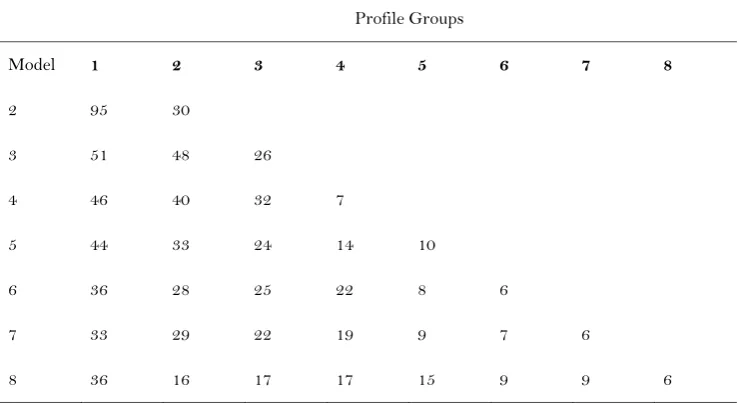
Table 3: Profile Membership Across Groups……….51
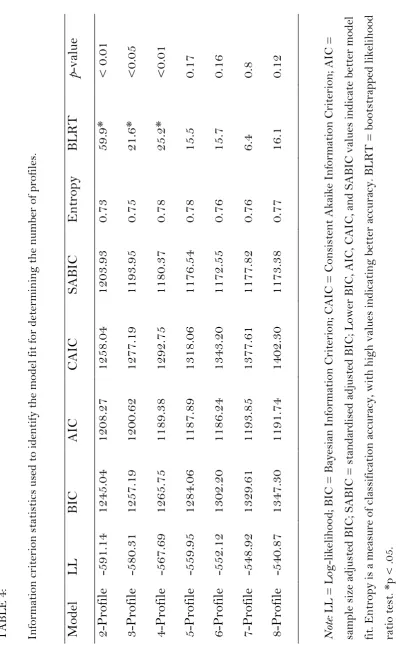
Table 4: Information Criterion Statistics Used to Identify Model Fit for
Determining Profile Number………....52
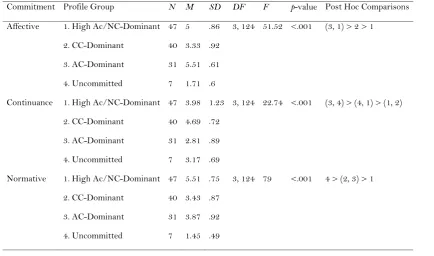
Table 5: Means and Standard Deviations for Affective, Continuance, and
Normative Commitment Within Each Profile Group ………54
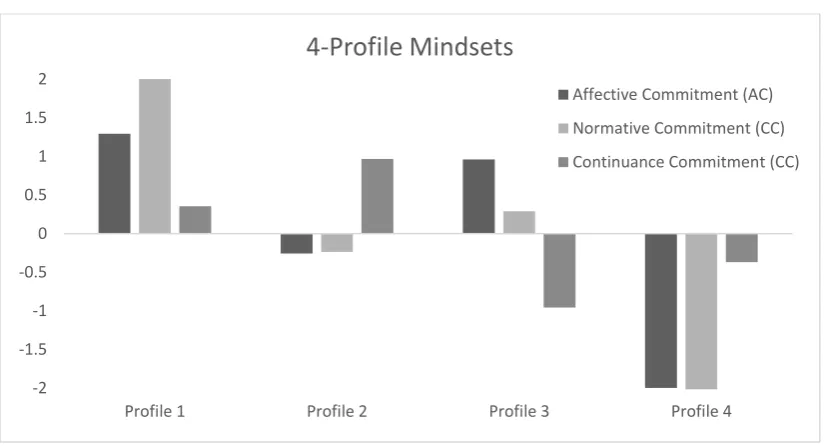
Figure 1: Profile Labels and Mean Scores for Affective, Continuance, and
Normative Commitment………...55
1
CHAPTER 1: INTRODUCTION
1.1 OVERVIEW
There are more generations in today’s workforce with ‘Millennials’ (individuals born between 1979 and 1994) making up over a third of it (Smola & Sutton, 2002). By 2025 they are expected to make up more than half of this population due to an aging
‘Baby Boomer’ workforce (Smola & Sutton, 2002; Williams & Nussbaum, 2001). Currently, the Baby Boomer generation (those born between 1940s and early 1960s) make up almost half of the workforce, and for the next decade will be working together with Millennials, Generation X (individuals born between late 1960s and 1980s), and the newest generation to enter the workforce, Generation Z (those born between 1995 and 2014) (Chaudhuri & Ghosh, 2012; Davey, 2003; Amayah & Gedro, 2014; Krahn & Galambos, 2014; Rothman, 2016).
2
Research on employees’ commitment profiles originated in the 1960s, and as a result there has been more research done on older workers that fit within Generation X and the Baby Boomer generation, than literature on younger workers. Millennials are remarkably still overlooked in this specific area of human resources literature, and research on Generation Z is very much in the early stages. Additionally, research by human resources experts tend to focus on the workforce as a homogenous group which is particularly prevalent in organisational commitment research (Mason, 2011). For now, there is a lack in literature on Millennials or Generation Z and there is much room to grow knowledge on these workers in all areas of research.
3
1.2 AIM OF THE RESEARCH
The purpose of this thesis is to extend upon the current literature on commitment profiles, particularly by looking at profiles found in young employees. Additionally, work outcomes and constructs can be analysed alongside the profiles generated to develop a clearer understanding on what behaviours drive Millennials and Generation Z to continue employment at their current workplace. Examining young workers early when starting their careers gives the best chance to identify the holistic commitment traits of these two generations before they are influenced by workplace cultures. Currently, there is an abundance of research that examines commitment profiles of employees as a homogenous group, and age or generational label are not observed or mentioned. To address this clear gap in literature, this research invited young workers to partake in the thesis if they met certain criteria, they must: Be working, be born between 1979 and 1994, and be in their first year of full-time employment in New Zealand. An online cross-sectional survey was used to great effect to seek a further an understanding on why Millennials and Generation Z are working at their current organisation, and what motivates them to continuing to work there. This thesis will often combine Millennial
and Generation Z workers under the label of ‘young workers’.
4
and commitment profile predictor constructs further, this thesis seeks to use a novel combination of variables to examine their relationships with young worker’s
organisational commitment. These variables are chosen due to the perceived empirical relevancy the variables have to common stereotypes of younger generations, which will be talked about further in Chapter 2. The variables studied in the present thesis alongside organisational commitment are: Perceived managerial trustworthiness, well-being at work, and turnover intentions.
1.3 THE IMPORTANCE OF GENERATIONS
A worker’s age is one of the most significant predictors for attitudes and behaviour differences alongside shared historical events (Morgan, 1998; Egri & Ralston, 2004). There are debates on whether the experience of aging is similar across generations or is constantly developing together with generational classifications (Morgan, 1998). The distinctiveness of generations is useful for creating a shared perception of identity, and as there is not one sole generation within the workforce, research on a particular generation often compares one generation to another, or later one. This thesis seeks to examine two generations, the Millennial generation and Generation Z, and future research may be able to compare our findings to older generations.
5
change according to governmental policies, such as China’s closed-door policy (Egri & Ralston 2004). Retirement plans and voting history are also identified to be major predictors of important differences in values and attitudes between generations as a result of societal movement (Morgan, 1998). The stereotypes for each major generation in the current workforce labelled above are further defined below.
Baby Boomers are named after the surge in births in western countries following the second world war and occurred between the early 1940s and early 1960s (Chaudhuri & Ghosh, 2012; Glass, 2007). This generation is the largest in American history and are
defined by rock and roll, women’s liberation, and the space race experiences (Glass, 2007). Baby Boomers have been significantly influenced by these historic events which have shaped their optimistic, driven and idealistic personality traits (Glass, 2007).
Generation X became the term used for people born between late 1960s and 1980s after a Canadian Author popularized this term (Glass, 2007). Historic events to define Generation X are very different to Baby Boomers. Generation X were born during divorce rates double of what the Baby Boomers experienced as children, experienced uncertainty in pay out of social security pensions, and they are significantly smaller in population size due to birth control accessibility (Glass, 2007; Jenkins, 2007). Parents of Generation X suffered the first of many vast corporate layoffs which has contributed to this generation having more cynical and pessimistic views of the workforce, while being optimistic in achieving personal well-being and happiness in relationships, and they are independent, autonomous and self-reliant (Arnett, 2000; Jenkins, 2007).
6
children and entering the workforce with knowledge already, multi-taskers, desire for constant feedback and openness (Myers & Sadaghiani, 2010).
Generation Z are the newest generation to enter the workforce and are born between 1995 and 2014 (Glass, 2017). This generation experienced complete technology assimilation in daily life, for example, in 2011, an independent nonprofit research center found that 77 per cent of children aged 12-17 years owned a cellphone (Lenhart, 2012). This generation is found as being more risk-adverse than Millennials and characterize themselves as being compassionate, open minded, responsible and loyal (Seemiller & Grace, 2016). Generation Z view their peers as being competitive, adventurous, and spontaneous which is supported by research on this group (Seemiller & Grace, 2016).
7
Growing up with social media and the ability to communicate globally and instantly have caused Millennials and Generation Z to be stereotyped as having vast differences from their predecessors, such as being more inclined to change jobs (i.e. “job
-hopping”), desiring flexibility in work, and openness in communication about pay and
security from their employment (Myers & Sadaghiani, 2010). These characteristics are said to be in sharp contrast to their predecessors, with stereotypes about older generations being resistant to change, having problems with technology, being fully commitment to their job, and possessing great loyalty to their organisation (McGregor & Gray, 2002).
These perceptions are both supported and opposed in research, with studies finding significant generational work differences, particularly in organisational loyalty (Smola & Sutton, 2002; McGregor & Gray, 2002). Others, however, are unable to find predicted significant workplace differences between Baby Boomers and Millennials or finding more similarities than differences (Parry & Urwin, 2010; Murry, Toulson & Legg, 2011; Becton, Walker & Jones-Farmer, 2014). The back-and-forth nature of research particularly creates a dilemma for organisations and managers as nowadays businesses of all sizes report problems in retaining young workers, and these issues are being further exacerbated through popular perceptions that Generation Z, Millennials, Generation X and Baby Boomers are incompatible in the workplace due to their differences in work values and attitudes (Sujansky & Ferri-Reed, 2009; Myers & Sadaghiani, 2010).
1.4 WHY STUDY MILLENNIALS AND GENERATION Z?
8
Chaudhuri & Ghosh, 2011). For this reason, literature on Millennials is becoming a vital area for researchers to focus on as managers and organisations seek to identify ways to enable, develop, and keep these new workers.
A popular notion of Millennials is that they show preference to having multiple career paths and so challenges pose managers and employers in keeping Millennials committed to their workplace (Cheramie, Sturman & Walsh, 2007; Gursoy, Maier & Chi, 2008; Myers & Sadaghiani, 2010). Comparisons between Millenials and Generation Z describe the latter as more conservative, entrepreneurial, money-oriented and pragmatic (Edwards, 2015). Research on organisational commitment is rapidly growing as HR managers seek to develop a clear understanding on commitment types for young workers beginning their careers and what impact young employees will have on the workforce.
Millennials and Generation Z have grown up in an environment where New Zealanders highly value individualism (79) and masculinity (58) (Hofstede, 2007). Sharing values with other western countries, New Zealanders work within a liberal market economy, meaning organisations display preferences toward individual performance, work flexibility, and a competitive organisational environment within and between companies (Hall & Soskice, 2011). This work culture is seen in some of the major stereotypes of younger workers, that they are less keen than their forerunners to commit to one organisation, and that they are constantly looking for better opportunities outside of their organisation (Ferri-Reed, 2014; Tulgan, 2013). Another New Zealand workplace stereotype relates to the high masculinity score, and only recently is New Zealand moving to a more gender-equal workforce which is strongly supported by the younger population (Hofstede, 2007).
9
change HR practices and policies to best support the organisation and its employees. For
example, Cher and Chan’s (2008) investigation on the impacts for key human resource
practices on permanent employees’ organisational commitment and their intention to
stay, found that practices such as facilitating person-organisation fit, remuneration, recognition, and opportunity positively affected organisational commitment. With Millennials and Generation Z entering the workforce, Chaudhuri and Ghosh’s (2012)
research determines that although generational cohorts have differing strengths and weaknesses, the expertise and strengths of both major generations (Millennials and Baby
Boomers) can be leveraged so valuable knowledge can be shared, such as Millennials’
expertise with technology, and Baby Boomers’ experience and specialized skills. This is
done through modern human resource development policies and practices such as reverse mentoring as a social exchange tool to enable both generations to be perceptive of their different needs, value systems, and work demands (Chaudhuri & Ghosh, 2012). For this, managers are particularly important as they carry out these practices and mentor new employees with the specific practices and policies of the organisation.
1.5 DEFINING ORGANISATIONAL COMMITMENT
10
This theory identifies that there are three components that make up commitment to an organisation, which are ‘affective’, ‘normative’, and ‘continuance’ commitment (Allen & Meyer 1990). Firstly, affective commitment is the commitment that an employee feels towards their organisation reflects a varying arrangement of emotional attachment
and involvement to the organisation, and is labelled as ‘AC’ (Allen & Meyer 1990). Allen
and Meyer (1990) define continuance commitment as an employee’s assessment of the
respective costs and benefits of remaining with or leaving the organisation (labelled as CC), and lastly, normative commitment is described as the sense of obligation to remain with the organisation (NC). These components are otherwise known as desire (AC), cost (CC) or obligation (NC) to remain at an organisation (Allen & Meyer 1990). When combined, these forms of commitment bind an individual to an organisation and decrease the likelihood of that individual leaving (Gellatly, Meyer & Luchak, 2006; Allen & Meyer 1990).
The three-component theory of organisational commitment is used for a variety of studies, for example, Gong, Chang and Xin (2009) use this model to understand the effect performance-oriented human resource practices has on employees. They found that
the practices which improve performance are mediated by middle managers’ affective
commitment to the firm, meaning that if managers have high AC, they would be more likely to respond positively when undertaking performance-oriented practices (Gong, Chang & Xin, 2009). As a result of the advances in organisational commitment research
cross-11
sectional data, and more accurately groups individuals that are similar in terms of behaviours, attitudes, beliefs, and experiences, which then can be related with precursors or outcomes of interest (Gellatly, Cowden & Cummings, 2014).
In this thesis, the three-component theory of organisational commitment is used in conjunction with three other variables to highlight influences and relationships that produce young employees’ organisational commitment. After examination of popular
perceptions of young workers’ attitudes and values, perceived managerial
trustworthiness, psychological well-being at work, and turnover intentions are examined as potentially having a significant relationship with Millennials’ and Generation Z
commitment to an organisation.
Each of these scales are specifically oriented to gaining responses from workers, to understand the workplace context, for example the definition of psychological well-being at work varies greatly according to what scale and literature is used. To examine
a worker’s well-being in a workplace context, Dagenais-Desmarais and Savois’s (2012)
split well-being up into five dimensions, being interpersonal fit at work, thriving at work, feelings of competency, perceived recognition at work, and desire for involvement at work. Perceived managerial trustworthiness relates to how much a worker trusts in their manager, or top manager, with four aspects of trust being made up of being affective trust, cognitive trust, willingness to be vulnerable, and overall trust (Dirks & Ferrin, 2002; Colquitt et al., 2007). Turnover intention is the simplest concept as it measures whether the employee seeks to remain at the organisation, or desires to leave and is planning to do so.
12
well-being at work scale as this widely used measure has the second advantage to help authenticate the validity of the commitment profiles it will find (Morin et al., 2015). This is particularly important as the sample demographic used in this thesis has not been examined in great depth in empirical literature.
Perceived management trustworthiness and the mentoring of employees has been found to play an important part in the creation of commitment profiles, however, there is little research investigating this in relation to work outcomes for employees (Kam et al., 2016; Chaudhuri & Ghosh, 2011). Therefore, the relationship between individual
well-being at work, employees’ trust in their managers and staying intentions are explored in
this thesis to further literature on how to increase young employee’s desire to stay at
their organisation.
The aim of this thesis is to advance commitment profile research, with a focus on young full-time workers entering the workforce, otherwise known as Millennials and Generation Z. Particular attention is on the formation of young employees’ commitment profiles and the work attitudes and values associated with these profiles, and how trust in management and workplace well-being has an effect on the commitment profiles of young workers and their intentions to stay at their organization.
This thesis hypothesises that Millennials and Generation Z will have between 4
– 8 organisational commitment profiles that vary in levels commitment from highly
committed to uncommitted to an organisation. Following empirical literatures’ findings,
13
1.6 THESIS STRUCTURE
The thesis commences with a literature review in Chapter 2. This review defines the stereotypes of current generational differences, with an emphasis on research concerning the unique traits young full-time workers beginning their careers have (i.e. Millennials and Generation Z). This chapter then examines the importance of literature on commitment profiles, the findings of leading research in this area in correlation to generational stereotypes, and how identifying commitment profiles is important for workplace management and understanding. Following this, is the main theoretical framework for commitment in the workplace, and the work predecessors and outcomes that have been linked to organisational commitment using this framework. Specifically, this Chapter explores the key studies on managerial trustworthiness, psychological well-being in the workplace and turnover intentions as important factors determining a young
employee’s decision to remain at their organization.
Chapter 3 details the methodology of this thesis, which includes the research design, population sample, scales, procedure, and analytic strategy. The research design uses an online self-report cross-sectional survey made up of four scales with 125 completed responses in total. The four scales are organisational commitment, perceived managerial trustworthiness, psychological well-being at work, and turnover intentions. The analytic strategy section explores the use of a latent profile analysis to identify and label clusters of individuals and the criteria for determining the best number of profiles from the data collected. Then, Chapter 4 presents the in-depth data analysis which consists of the descriptive statistics, response to missing data, definition and use of the latent profile analysis, interpretation of profiles found, and the further analyses testing the research questions.
Chapter 5 follows this with the key findings from this thesis, with its implications
14
15
CHAPTER 2: LITERATURE REVIEW
2.1 OVERVIEW
This chapter begins with a discussion of Millennials and Generation Z workers in the workforce and the current issue organisations and managers are facing with these generations. After this is an outline of the main theoretical framework for organisational commitment, Meyer & Allen’s (1991) three-component theory of organisational commitment, which provides a framework for determining the commitment profiles of the young workers whom took part in this thesis. Following this, empirical literature for the three chosen constructs to examine alongside organisational commitment are talked about. Chapter 2 concludes with a brief overview of the research questions and hypotheses for this thesis.
2.2 MILLENNIALS AND GENERATION Z IN THE WORKFORCE
As reviewed in Chapter 1, the increase of Millennials and Generation Z entering the workforce has seen a rise in managers and organisations calling for research to understand what young workers want from a workplace, and particularly around identifying significant differences in work patterns than to earlier generations.
16
Born during the rise of technology and rapid globalization, Millennials and Generation Z are bringing a new skillset and ways of working to the workplace (Smola & Sutton, 2002). They are strongly influenced by technology, multiculturalism, and ethnic diversity in the workplace, and research is echoing this sentiment (Smola & Sutton, 2002; Buckley, Beau, Novicevic, & Sigerstad, 2001; Chaudhuri & Ghosh, 2012). It is well known in the literature that employees can develop different types of work-related commitment, such as organisational commitment, or occupational commitment, however, there is debate around the types of organisational commitment found in Millennials and Generation Z (Meyer & Herscovitch, 2001; Cheramie, Sturman & Walsh, 2007; Gursoy, Maier & Chi, 2008; Myers & Sadaghiani, 2010; Tulgan, 2013; Ferri-Reed, 2014). Pryor et al., (2009) suggest that the Internet and having the ability to communicate globally has taught these two generations to tolerate and appreciate diversity and ethnic differences in the workplace. Despite recently entering the workforce, Millennials are quickly becoming a large presence in the workplace and in 2002, made up a third of the workforce (Smola & Sutton, 2002). With having preferences towards teamwork and linear hierarchy, there is concern that these characteristics will clash with some older generational preferences towards vertical hierarchy and tenure (Strauss & Howe, 2006; Junco & Mastrodicasa, 2007; Amayah & Gedro, 2014).
17
Topolnytsky, 2002; Meyer & Allen, 2004). With mixed empirical evidence on generational differences, research on organisational commitment and commitment profiles are becoming increasingly sought after for clarification on young employees’
work mindsets. These mindsets determine a young employee’s decision to remain at their
organization, and with organisations and managers seeking to retain young new employees, more evidence is needed for what young people want in employment.
More research will support managers who are currently pressured to maintain constant communication and feedback to younger workers due to researchers supporting
traits of Millennials as being “high-maintenance”, and needing continual job-related feedback (Epstein & Howes, 2008). Impatience with job career advancement, and a need for a strong social business network are additional issues managers are having to deal with (Pooley, 2005, Chaudhuri & Ghosh, 2012). A 2002 study on generational differences in employees’ values found that there were generational work differences, particularly in
organisational loyalty and that these work values also differ as employees age (Smola & Sutton, 2002). This study followed a similar 1974 and 1999 studies and had 350 American respondents with results suggesting that there is a change in attitude across generations among all American workers increasingly wanting a work-life balance (Smola & Sutton,
2002). The previous studies showed the lowest mean or desire ‘to be promoted quickly’,
could derive from the workers desire to have less responsibility at work or reflect less of a desire for rapid career growth and instead enhanced job enrichment and intrinsic rewards (Smola & Sutton, 2002).
18
experienced a world before there was a considerable emphasis on globalization and technology (Buckley, Beau, Novicevic, & Sigerstad, 2001; Smola & Sutton, 2002). However, this does not mean that the younger and older generations cannot work together and understand one another in the workplace. Ferri-Reed (2014)’s research on supervisors’ perceptions of Millennials and Generation Y employees (individuals born between 1995 and later) identifies that managers hold Millennials to the same standards applied to older generations, however, Millennial attitudes were different, resulting in managers looking for new ways of engaging these employees. One such way to improve
Millennials’ organisational commitment is for HR professionals to provide opportunities
to network and create relationships with their managers at work so that they feel supported (Chaudhuri & Ghosh, 2012; Kam et al., 2016). Ways to identify this is through measures of perceived managerial trustworthiness which identifies the trust employees
have in their top management by measuring top managers’ competence, integrity, and
benevolence (Mayer et al., 1995; Kam et al., 2016). More research in this area is needed, however, as there is little research investigating managerial input in relation to work outcomes and staying intentions for Millennials and young workers (Chaudhuri & Ghosh, 2011; Kam et al., 2016).
19
and Jones-Farmer (2014) sought to identify what generational stereotypes are present in their population sample. This thesis predicts that Baby Boomers display fewer job mobility behaviours and greater compliance-related behaviours in comparison to Generation Xers and Millennials, and that Generation Xers are less likely to work overtime than Baby Boomers and Millennials. The findings show that Baby Boomers did display fewer job mobility behaviours and Generation Xers are less likely to work overtime than Baby Boomers and Millennials, along with some evidence that Baby Boomers display greater compliance-related behaviours. However, the effect size for all the relationships were small, meaning that in contrast to popular stereotypes generational placement had a much weaker, and thus, not as strong as suggested by popular stereotypes, effect in workplace behavior (Becton, Walker & Jones-Farmer, 2014).
Likewise, Parry and Urwin’s (2010) examine popular perceptions of work
20
notions of self-worth (Smola & Sutton, 2002). This last piece of literature interestingly brings up a notable point that perhaps Millennials are not the only generation with changing characteristics.
2.3 THE ORGANISATIONAL COMMITMENT MODEL
This thesis has foundations in Meyer, Stanley and Parfyonova’s (2012) research
which introduces the perspective that commitment is viewed as a motivational construct, with the three-component theory of organisational commitment being integrated with theories of work motivation (e.g. Meyer & Maltin, 2010; Meyer & Parfyonova, 2010), and the self-determination theory (Deci & Ryan, 2000).
The most prominent theory of commitment is Meyer & Allen’s (1991) three -component theory of organisational commitment. This theory recognises that the commitment that an employee feels towards their organisation reflects a varying arrangement of emotional attachment and involvement to the organisation (affective
commitment), employee’s assessment of the respective costs and benefits of remaining
with or leaving the organisation (continuance commitment), and sense of obligation to remain with the organisation (normative commitment). This is otherwise known as desire, cost or obligation and combined these forms of commitment bind an individual to an organisation and decreases the likelihood of the individual leaving that organisation (Gellatly, Meyer & Luchak, 2006). Other literature suggests that the Ability –
21
Using Meyer & Allen’s (1991) three-component theory of organisational commitment shows that commitment can be made up of three mindsets, being desire, obligation, and cost (Meyer & Allen, 1991, 1997). Through this understanding of the three-component theory of organisational commitment, it can be summarized that high affective commitment scores indicate that employees stay at their organisation because they want to, high normative commitment scores indicate that employees stay at their organisation because they feel morally obliged to, and high continuance scores indicate that employees stay at their organisation because they must, or feel unable to leave (Meyer & Allen, 2004).
Research consistently shows that employees who want to stay (high affective commitment) tend to perform at a higher level than those who do not (low affective commitment). Employees who remain out of obligation (high normative commitment) also tend to out-perform those who feel no such obligation (low normative commitment), but the effect on performance is not as strong as that observed for desire. Finally, employees who have to stay primarily to avoid losing something of value (e.g., benefits, seniority) often have little incentive to do anything more than is required to retain their positions. So, not all commitments are alike (for summaries of the empirical evidence, see Allen & Meyer, 1996, 2000; Meyer et al., 2002).
In this thesis, commitment is measured using the shortened 9-item version of
Meyer, Allen and Smith’s (1993) scales used by Gellatly, Meyer & Luchak (2006) as
22
Allen, 2004). Taking this into consideration, it was determined that incorporating the original survey whilst using three other survey would have greatly increased the length of the overall survey and possibly increasing the likelihood of participants not answering the entire survey and so the revised version of the employee commitment survey is used for this thesis.
Luchak and Gellatly (2007) compared relations between affective and continuance commitment and turnover cognitions, absenteeism, and job performance. They found that their results support recent developments in research that identify different motivational mindsets associated with affective and continuance commitment (Meyer,
Becker, & Vandenberghe, 2004). Similarly, Somers (2009)’s later study using a sample of
hospital nurses, commitment profiles were compared to job withdrawal (i.e. turnover intentions and job search behaviour), work withdrawal (i.e. absenteeism and lateness), and job stress. From the five empirically-derived commitment profiles that surfaced, results indicated that the most positive work outcomes were associated with the affective–normative dominant profile which included lower turnover intentions. It was found that there were no differences among the commitment groups for lateness, and surprisingly, the continuance–normative dominant group had the lowest levels of absenteeism. Wasti (2005) found that work withdrawal is negatively associated with emotional attachment and sense of obligation that characterizes affective and normative commitment profiles and suggests that continuance commitment does not attenuate the combined influence of affective/normative commitment on work withdrawal. Somers (2010) argues that this extends to absenteeism so that the sense of moral obligation with normative commitment enhances the beneficial influence of high affective commitment levels on absenteeism.
23
argued that normative commitment has a dual nature and manifests itself differently depending on the strength of other components in an employee's commitment profile (i.e. Either as a moral duty or a sense of indebtedness), with each having different implications for work behaviour, and so the analysis will utilize all three commitment components.
Literature in the field of commitment is still in its early stages and there are many options for expanding this concept, like investigating fluctuations within each
individuals’ personal attributes and workplace behaviours (Becker, Ullrich & van Dick,
2013) or employee commitment to organisation-sponsored causes (Bingham et al., 2013). The past seven years of human resource developement and human resource management research has focused on organisational citizenship behaviours, motivation, technology, psychological traits, work attitudes, and work values as generational issues (Amayah & Gedro, 2014). This research is as a result of common stereotypes of generational differences within the workplace and the challenges this poses for managers and organisations (Becton, Walker & Jones-Farmer, 2014). Despite numerous prolific studies on these topics, leading researchers are still indecisive on what effect the growing millennial workforce has within the workplace and whether generations even have distinct differences. For instance, Chaudhuri and Ghosh’s (2012) study sought to address
24
Meyer, Allen & Smith (1993) tested the generalisability of the three-component theory of organisational commitment and found that occupational and organisational commitment contribute independently to the prediction of professional activity and work behaviour. There is a lot known about the implications of employee commitment for organisations, however, there needs to be more attention drawn to its ramifications for employees themselves due to research inconsistencies and unsystematic research. Consistently, research has positively linked affective commitment and employee well-being, and generally negatively linked continuance commitment and well-well-being, with little known surrounding normative commitment (Wasti, 2005; Meyer & Maltin, 2010). Meyer and Maltin (2010) suggest a theoretical framework based on an amalgamation of the three-component model of commitment (TCM) (Meyer & Allen, 1997) and self-determination theory of motivation (SDT) (Deci & Ryan, 2000) that will explain both the
consistencies and inconsistencies, and to guide future research. Sheldon et al.’s (2001)
study supports SDT which postulates that autonomy, competence, and relatedness are the most significant needs in event-related affect.
25
that samples are homogenous, meaning that findings can apply to employees in general (Meyer, Stanley & Vandenberg, 2013).
Empirical research in the field of organisational commitment consistently shows that commitment has a clear and significant impact on reducing turnover, and along with other factors such as the belief that committed workers work harder, makes research on employee commitment valuable for HR managers (Meyer & Allen, 2004).
Researchers have argued for research on examining a more direct relationship between human resource management practices and organisational commitment, such as offering broad-based incentives as a best practice to increase commitment (Kroumova & Lazarova, 2009), or defining and measuring organisational commitment in the context of strategic human resource management (Swailes, 2002). One study on small-to-medium enterprises identified that human resource management practices (i.e. organisational support, procedural justice, and the reputation of the organisation) can influence
knowledge employees’ commitment; while practices such as involvement in decision-making, skills management and degree of satisfaction with pay do not have any impact on commitment (Giauque, Resenterra & Siggen, 2010). Furthermore, one highly significant departure from studies of the separate forms of employee commitment is
Gellatly et al.’s (2009) investigation on how employee perceptions of development,
stability and reward oriented human resource management practices affected the
likelihood of affective and continuance commitment profile membership. Gellatly et al.’s
(2009) study suggests significant practical applications for shaping overall employee commitment in organisations by using human resource management practices strategically.
26
Somers, 2010; Meyer et al., 2012). Somers’ (2009) study identified that in hospitals
absences by nurses put pressure on nursing staff, and thus affect continuity of care so that high level of voluntary absences can be interpreted as poor citizenship behaviour. It is unclear if Meyer et al., (2012) considered this effect within their study which could have influenced their finding, specifically anything pertaining to organisational citizenship behaviour. While it is apparent how valuable understanding employee commitment in hospital and health care organisations are, comprehensive conclusions are being made by these researchers. It is important that these conclusions can be confidently generalised, as opposed to stating that these findings should be strictly limited to one setting. Thus, this thesis will aim to seek clarity on the generalisability of their data by conducting research that does not solely use health care professionals, and
its conclusions aim to either support Meyer at al’s (2012) seminal research, or provide
critical thought on the limitation of commitment profile generalisability. This research indicated that only a low proportion of peer-report forms could be matched with relevant self-report surveys therefor this thesis will not include peer-reviewed forms for data convenience, and instead rely on self-reports.
Another currently missed opportunity in literature is using the literature to identify behaviours of young people in the workforce. Two young generational cohorts are soon to be crucial members the workplace as Millennials are predicted to become a majority in the workplace, yet there are still many questions on what this cohort wants
out of a workplace to make them stay amongst fears of “job-hopping” (Smola & Sutton, 2002; Chaudhuri & Ghosh, 2011; Ferri-Reed, 2014). Studying organisational commitment gives great insights into the motivations behind staying at their workplace and this can also be linked with various factors to further this understanding.
27
remain. One issue that has been neglected is the coexistence of the commitment components or forms and its implications. Previous research has been largely variable-centered, looking at the antecedents and outcomes of each commitment form separately through correlational or regressional analysis. This type of analysis fails to recognize the fact that employees endorse varying levels of affective, continuance and normative commitment concurrently.
This research aims to contribute a relevant and more holistic argument with
predicting Meyer and Herscovitch’s (2001) focal (staying intentions) and discretionary
(citizenship) behaviour in young employees entering the workforce. This will be done through hypotheses based on established motivation theory (Meyer et al., 2012), behavioural measures of two widely studied work outcomes (job performance and employee well-being, respectively) in commitment research (Somers, 2010), and perceived management trustworthiness which has been found to be significant in the formation of commitment profiles (Kam et al., 2016).
Research on commitment profiles has previously undervalued identifying factors involved in the formation of, or change in, commitment profiles (Gellatly et al., 2009; Kam et al., 2016). More commonly has the focus been on work outcomes, particular well-being and job performance for workers in the medical sector. This means that there are many areas in commitment profile literature, such as other industries and demographics of workers, that are not yet fully erudite. To follow on from this, much has been identified about commitment profiles for employees as a holistic group, yet there is a gap in literature for investigating the younger cohort of workers as a group of interest. Within this thesis, this cohort encompasses young individuals born in 1979 and later, labelled as
“Millenials” and “Generation Z” (Chaudhuri & Ghosh, 2011; Tulgan, 2013), and are in
28
2.4 TURNOVER INTENTIONS, WELL-BEING, AND PERCEIVED
MANAGERIAL TRUSTWORTHINESS
This present research uses four measures to achieve the aim of this thesis which is to identify and define the type of organisational commitment profiles found in young employees. The first measure is the measure of organisational commitment which identifies the commitment profiles of the participants.
The second measure is turnover intentions which gives a very well-defined idea of whether the respondent has intentions to leave or stay at the organisation. Affective, continuance and normative commitment all relate negatively to job-related outcomes such as turnover and withdrawal behaviours, however for most other job-related outcomes, the implications for correlations differ (Meyer et al., 2002; Somers, 2010).
Work outcomes and constructs are analysed alongside the commitment profiles discovered in order to give a further understanding and context on what behaviours drive Millennials and Generation Z to continue employment at their current workplace. Well-being, perceived managerial trustworthiness, and turnover intentions are the constructs used within this thesis. This combination of constructs is so far unique within commitment profile, and they are used due to the relevancy each profile has on the sample demographic used for this thesis.
29
2010). Generation Z are described as being more risk-adverse than Millennials and have values being compassionate, open minded, competitive, adventurous, and spontaneous (Seemiller & Grace, 2016).
There is evidence to suggest that Millennials and Generation Z share work preferences as having continual feedback, ability to communicate between all members of the organisation, a dislike for organisations with a vertical hierarchal structure, empathetic, and having a strong desire for a work-life balance due to the increased ability to communicate with their peers and knowing how their organisation treat them (Buckley et al., 2001; Smola & Sutton, 2002; Kam et al., 2016; Seemiller & Grace, 2016). From these values that both generations share, two variables were chosen to give further insight into the behaviour profiles found in young workers. These variables predicted to have strong relationships with the profile groups of young employees are perceived managerial trustworthiness and psychological well-being at work.
Perceived managerial trustworthiness refers to how much a worker views their top management as being trusted. The scale for trustworthiness comes from Mayer et al. (1995), which establishes that three characteristics make up a perception of
trustworthiness in another individual. In this case, assessing a manager’s trustworthiness
examines the concern the manager has for their employee’s well-being (benevolence),
competence in relevant settings (ability), and the observance of the manager’s moral and ethical principles (integrity) (Mayer et al., 1995). While trust and trustworthiness are closely connected, alike to previous research, this thesis employed the term
trustworthiness, and Mayer et al.’s (1995) trustworthiness scale over trust so that the
findings are more able to be directly linked due to the clearer characteristics of trustworthiness (Salamon & Robinson, 2008; Kam et al., 2016).
30
three-component theory of organisational commitment. There is insufficient research thus far to claim the primary determinants of normative commitment, however there are
arguments for normative commitment to be primarily determined by the organisation’s
investment in the employee as well as early socialization experiences. Using predictive managerial trustworthiness allows this thesis to expand upon the uncertainty of normative commitment and will show evidence for the arguments supporting or opposing the usefulness of this commitment type. Normative commitment is suggested to be predictive of desirable job outcomes and behaviours, however, less so than affective commitment (Meyer et al., 2002).
Researchers are currently especially concerned with the relationships between commitment and employee-related outcomes, such as well-being. Well-being at work is particularly popular within this area of study as the workforce shifts to accommodate work-life balances for employees. Some researchers argue that negative effects from job stressors are buffered by affective commitment and protect employee health and well-being (Reilly, 1994; Meyer et al., 2002; Kam et al., 2016) whereas other research suggests that negative effects from job-related stressor have a greater effect on commitment (Begley & Czajka, 1993).
31
The well-being scale at work used in this thesis splits up well-being at work as being made up of five dimensions. These dimensions are interpersonal fit at work, thriving at work, feelings of competency, perceived recognition at work, and desire for involvement at work (Dagenais-Desmarais & Savois, 2012).
2.5 CONCLUSION
A possible of eight commitment profiles in Meyer and Herscovitch’s (2001)
typology can emerge through the use of latent profile analyses, otherwise known as latent class analyses. This is done through the more recent methodology of using a latent profile analysis which is found to produce more accurate results and fit with the research design of this thesis (Gellatly, Cowden & Cummings, 2014). Subsequent analyses include one-way ANCOVAs followed by post-hoc comparisons follow, to test the thesis’ hypotheses regarding profile differences and relationship between latent constructs, using separate analyses for each of the perceived management trustworthiness, well-being and turnover intentions scores. From these analyses this thesis aims to provide a better understanding of the motivational mechanisms that underlie commitment mindsets within young, full-time employees in New Zealand; and to provide a more holistic support for the understanding of how these commitment mindsets relate to outcomes of interests to all forms of organisations and their employees. Particular focus is on finding what types of
commitment profiles Millennial’s have, and the characteristics of these profiles; how trust in top management and psychological well-being at work affect the formation of these profiles; and lastly, how managers can retain employees by taking into account the characteristics of the commitment profiles found in this thesis.
This literature brings forth four research questions for this thesis. They are, what
commitment profiles do Millennial’s have, what are the characteristics of these profiles,
32
profiles, and lastly, how can managers retain employees according to the characteristics of the commitment profiles found?This thesis hypothesizes that between 4 – 8 organisational commitment profiles will be found, and that they will vary in levels of commitment from highly committed to uncommitted to an organisation. Trust in management and well-being will have positive associations with fully-committed profile traits, and negative relationships with uncommitted profile traits. Trust in management and psychological well-being will also have a strong, positive relationship with
33
CHAPTER 3: METHOD
3.1 OVERVIEW
This chapter introduces and describes the methods used in the research design, participants, measures, procedure and analytic analysis which are separated into five sections. Section 3.2 below illustrates the research designs used to obtain and analyse data from the sample population. Following this, section 3.3 introduces the sample population demographic, and section 3.4 presents the process and techniques carried out to target the desired population sample and how these individuals were able to take part in this thesis. Lastly, section 3.5 further describes the strategies taken to analyse the collected responses which occurred in a three-step process.
A cross-sectional survey was used to gain a sample demographic of young full-time workers whom are within their first year of full-full-time employment in New Zealand. The survey was posted online using Qualtrics, an online survey endorsed for research use by Massey University. The survey was viewed by members of the public on various social media sites, through personal emails sent to managers, employees in graduate programmes, university students, and through word of mouth with website links sent through social media sites. Young workers were asked to answer a series of questions and approximate time for survey completion was given. When publicising the survey, a
brief description of the researcher’s aim of the thesis was also given. The questions asked were about the employee’s commitment to their current organisation, their perceived trust in top management at their organisation, their well-being when at work, and intentions to stay or leave the organisation. Due to the method used for analysing results, fully completed surveys were required.
34
cent. These responses were subjected to a latent profile analysis to determine the number of profile groups, as well as the types of commitment profiles. The profiles discovered were interpreted and labeled based on the pattern of component means across the profile groups. Then, the relationships between the commitment profiles, and perceived managerial trustworthiness, well-being at work, and intention to stay were identified through a one-way analysis of covariance. Following this were post hoc comparisons using the profile groups as the independent variable. These stages of analysis are covered in more detail in the following sections.
3.2 RESEARCH DESIGN OVERVIEW
The aim of this thesis is to advance commitment profile research in the emerging research field on Millennial and Generation Z workers. This is done through a focus on young full-time workers aged less than thirty years whom are entering the workforce for the first time. A cross-sectional design is utilised in this thesis through the use of an online self-report survey that includes items from the 4 scales of organisational commitment, perceived managerial trustworthiness, psychological well-being at work, and turnover intentions. There is certain consideration of the formation of commitment profiles to an organisation and the work attitudes and values associated with these profiles. Additionally, this thesis examines how trust in management and workplace well-being affect the commitment profiles of young workers and their intentions to continue employment at their organization. With this aim, four research questions are formed and they are, what commitment profiles do Millennial’s have, what are the characteristics of
35
There are three possible ways of answering these questions, by using a qualitative approach, a quantitative approach or by using a mixture of both approaches. Quantitative methods seek to employ measurements to gain behavioural data, whereas qualitative methods collect words and use a rich dataset to gain meaning of actions (Bryman & Bell, 2015). Qualitative and quantitative methods are similar in the fact that both aim to reduce the massive amount of data collected, with the methods and outcomes of reduction differing. In quantitative methods data reduction is done through data analysis which often results in means or frequency tables, whereas qualitative methods aim to develop concepts from their rich data forms (Bryman & Bell, 2015). Both methods are used to uncover variation in their data set and seek to address the factors related to this variation, with the differences in this case being what type of variation is being looked at. Another important similarity is that both methods seek to limit and reduce the likelihood of error, either through ensuring good fit of concepts or that questions asked relate to what is measured, as well as how the research instrument is carried out (Bryman & Bell, 2015). Both methods are viable options for addressing variation in organisational commitment, and so it is the nature of the variation observed for this thesisthat determines which approach is more suited and appropriate to use.
By using a cross-sectional research design, qualitative, quantitative, or mixed methods approaches still could have been used to answer appropriately worded research questions. For example, a qualitative approach for the chosen cross-sectional research design involves qualitative interviews or focus groups at a specific one time, whereas a quantitative approach is generally carried out through social surveys or a specific one-time controlled observation (Bryman & Bell, 2015).
36
mindsets about the worker’s organisation, well-being, how they perceive their management to be trustworthy, and their intention to leave or stay at their organisation. Overall, it is intended that this survey generates a somewhat overview of younger
worker’s intent to remain at their organisation along with why they have that intention. The questionnaires used in this thesis all generate numbers to record the participants’
responses, and as such it is appropriate that a quantitative approach is used for examining this data. A qualitative approach could have been used to record participant’s responses,
however that would have resulted in a much smaller data-set. As most literature on
commitment profiles use of Meyer, Allen and Smith’s (1993) Organisational
Commitment scales, this thesis had the option of being fully quantitative or to use a mixed methods approach.
Furthermore, within qualitative or quantitative approaches, a variety of research designs can be used, such as experimental, cross-sectional, longitudinal, case study or comparative. This present thesis uses a cross-sectional research design due to the nature of the data anticipated to be collected, and the desire for the data to be collected at a singular point of time with the aim to examine the relationships of the data with more than two variables. Within commitment profile research a cross-sectional design is most commonly used for consistency in furthering earlier research, which is also the aim of this thesis. Other methods are used within commitment profile literature, such as in Kam et al.’s (2016) longitudinal study on the effect that huge change has on employees’
commitment to their organisation. In this study, Kam et al. (2016) examines the change
37
To analyse the survey responses a latent profile analysis technique is used to best group the data and respondents. Latent profile analysis uses latent continuous variables to identify clusters of individual employees with similar patterns of scores on the three commitment measures and is ideal for this thesis because of the continuous and quantitative nature of the data gathered, as well as the desired output of profile groups from the data (Vermunt & Magidson, 2013). The benefits of using latent profile analysis are that it allows the data to be interpreted as well as labeled from the patterns of means across each profile group. These patterns are looked at in forms of clusters, of which the number of clusters can be described and labelled according to commitment profile literature. One such research was a study by Gellatly, Cowden and Cummings (2016) which uses latent profile analysis to great effect when quantitatively analyzing profiles
of nurses’ commitment. Latent profile analysis is similar to the more commonly known latent class analysis, with the main difference between the two being that the latent profile analysis uses continuous variables, whereas a latent class analysis uses categorical data. The data gathered for this thesis is ordinal and continuous, and so in this case a latent profile analysis is the appropriate choice for data analysis.
3.3 PARTICIPANTS
38
platforms, organisational graduate programmes, and by email. Participation in the survey was entirely anonymous and voluntary. Participants were given one week to complete the survey, and reminders were made 6 days after each survey distribution to the corresponding online post or by email. Ethics approval was sought from Massey University Human Ethics Committee and was deemed Low Risk by peer review through
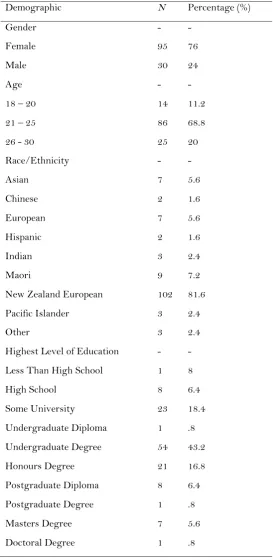
39 Table 1.
Demographic information of participants
Note:N = 125. Age range begins at 18 years as this is the youngest age of participants.
Demographic N Percentage (%)
Gender - -
Female 95 76
Male 30 24
Age - -
18 – 20 14 11.2
21 – 25 86 68.8
26 - 30 25 20
Race/Ethnicity - -
Asian 7 5.6
Chinese 2 1.6
European 7 5.6
Hispanic 2 1.6
Indian 3 2.4
Maori 9 7.2
New Zealand European 102 81.6
Pacific Islander 3 2.4
Other 3 2.4
Highest Level of Education - -
Less Than High School 1 8
High School 8 6.4
Some University 23 18.4
Undergraduate Diploma 1 .8 Undergraduate Degree 54 43.2
Honours Degree 21 16.8
Postgraduate Diploma 8 6.4
Postgraduate Degree 1 .8
Masters Degree 7 5.6
40
3.4 MEASURES
3.4.1 Organisational commitment
Commitment is measured using the shortened 9-item version of Meyer, Allen
and Smith’s (1993) scales used by Gellatly, Meyer & Luchak (2006). Each of affective
(AC), continuance (CC) and normative (NC) commitment were measured with three items on a 7-point Likert scale ranging from 1 –“strongly disagree” to 7 –“strongly agree”. Examples of items for these forms of commitment are: “I feel a strong sense of
“belonging” to this organisation” (AC); “I feel that I have too few options to consider
leaving this organisation” (CC); and, “This organisation deserves my loyalty” (NC).
3.4.2 Perceived managerial trustworthiness scale
Trust in top management is measured using shortened versions of Mayer et al.,
(1995)’s measures for competence, integrity, and benevolence. Ability was measured
using four items (e.g. “I feel very confident about top management’s skills”),
benevolence used four items (e.g. “Top management really looks out for what is
important to me”), and integrity was made up of five items (e.g. “Top management tries
hard to be fair in dealings with others”). Responses were measured using a 5-point Likert scale ranging from 1 –“strongly disagree” to 5 –“strongly agree”.
3.4.3 Psychological well-being at work scale
Psychological well-being at the workplace context was measured using Dagenais-Desmarais and Savois’s (2012) five dimension scale, with the dimensions being made up of interpersonal fit at work (e.g. “I enjoy working with the people at my
job”), thriving at work (e.g. “I have a great sense of fulfilment at work”), feelings of
competency (e.g. “I feel that I know what to do in my job”), perceived recognition at
41
work (e.g. “I like to take on challenges in my work”). Items were measured using a 5 -point Likert scale ranging from 1 –“strongly disagree” to 5 - “strongly agree”.
3.4.4 Turnover intentions
This thesis measured staying intention with four items from Abram’s (1992) shortened scale of turnover: “In the next few years I intend to leave this company”, “In
the next few years I expect to leave this company”; “I think about leaving this
company”, “I’d like to work in this company until I reach retirement age”. Responses were measured using a 5-point Likert scale ranging from 1 –“strongly disagree” to 5 -
“strongly agree”. High scores indicate greater likelihood of leaving.
3.5 PROCEDURE
This thesis aimed to reach participants whom met certain criteria: 1) they were within their first year of working; 2) the employment was full-time; 3) they were aged 30 years and younger, 4) they were working in New Zealand. This subset of workers was to obtain a sample of Millennial workers whom were just starting out in their careers and had recently or were within a year of joining the workforce. The sample population was obtained through volunteers all over New Zealand and was sent out through varying social media websites (i.e. Facebook, LinkedIn, ResearchGate, and Reddit) or through invitations via e-mail.
Social media sites were used to inform potential participants of the thesis being done via posts on Facebook groups that varied from university groups, area groups and groups specifically for studies wanting participants, posts on the researcher’s personal
42
the post, volunteers were able to click a link to anonymously complete the online survey through the Qualtrics website.
The survey began with an information page (see Appendix B: Information Page) detailing who the researcher and supervisors are, what the thesis is about and its
intentions. In order to proceed to the survey questions, participants had to answer ‘yes’
or ‘no’ to the question “I have read and understood the above consent form and desire of
my own free will to participate in this study”. Participants whom answered ‘yes’ to this
were then able to proceed to the questions while those whom answered ‘no’ were
advanced to the end of the survey. This self-report survey contained items from the measures of organisational commitment, perceived management trustworthiness, psychological well-being at work, and intention to leave the organisation (See Appendix C: Survey). All scales included items that were reverse keyed so that inconsistent or random answering could be identified. The amount of completed responses for the survey was determined to need a minimum of 100 responses to be a representative sample for Millennials. Completed responses was determined that it would need at least 60 per cent or above according to Mangion’s (1995) response rate
classification to gain an acceptable rate of responses.
3.6 ANALYTIC STRATEGY
The data from 125 workers in New Zealand were subjected to the following analyses. Missingness of data was examined, and then descriptive statistics and
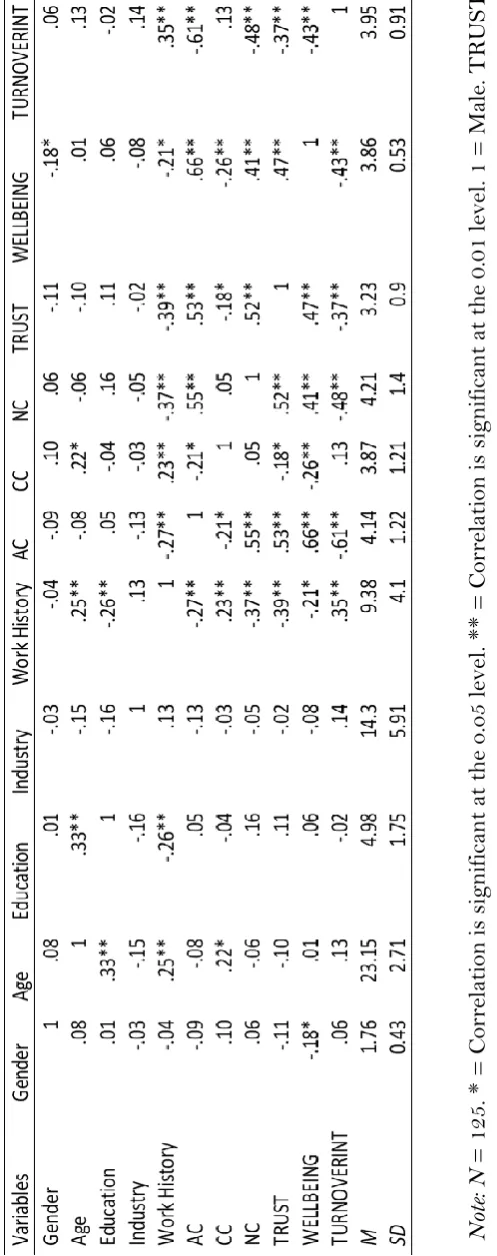
Spearman’s rho correlations among the variables used in the latent profile analysis