A study to evaluate effectiveness of structured teaching programme regarding
lifestyle related risk factors for cardiovascular diseases among young adult male
students in a selected college at Ernakulam District
1 Prof. Dr. Sindhu Devi, 2 Mrs. Tasha Jacob
1 Ph.D.Principal, Sree Sudheendra College of Nursing, Ambalamedu P.O., Ernakulam, Kerala.
2 Assistant Professor, Sree Sudheendra College of Nursing, Ambalamedu P.O., Ernakulam, Kerala.
1. INTRODUCTION:
Cardiovascular diseases are the most prevailing non communicable cause of death and disability in the Indian subcontinent and will be the prevailing overall cause of mortality among the inhabitants of South Asia in the next 20 years. During adulthood, teenagers start to make individual choices and develop personal lifestyles. Many of these lifestyle choices are related to risk factors for coronary heart disease such as diet patterns and development of obesity, physical inactivity, cigarette smoking, alcoholism etc. These risky behaviours can result in disease outcomes such as obesity , hypertension and other cardiovascular diseases which are among the leading cause of death in developed and developing countries 1.|
Abstract: A pre experimental one group pre – test, post - test design was undertaken to evaluate the effectiveness of STP on knowledge regarding lifestyle related risk factors for cardiovascular diseases among young adult male students in a selected College at Ernakulam district. The objectives were to determine the level of knowledge regarding life style related risk factors for cardiovascular diseases among young adult male students before structured teaching programme and to evaluate the effectiveness of structured teaching programme in terms of changes in the level of knowledge. Also, to find association between pre-test knowledge score and selected demographic variables.
Methods: The research approach adopted for this study was quantitative type and the research design was pre experimental one group pre- test post- test design. This study was conducted among 30 young adult male students in the age group of 18-24 years in selected Colleges at Ernakulam district based on inclusion criteria using convenient sampling technique. The data for the study was collected by structured knowledge questionnaire following which samples were subjected to STP on lifestyle related risk factors for cardiovascular diseases for a duration of one hour. Post test was conducted after seven days following intervention using same knowledge questionnaire. The data were analyzed and interpreted by descriptive and inferential statistics.
Results: Among the demographic variables, (100%) of the samples belonged to the age group of 18-20 years. 58% had monthly income between Rs 5000/- to Rs 10000/-. 40% of their parents were educated upto higher secondary education. 93% were from nuclear family. 13% of the samples have history of cardiovascular diseases in the family. Majority of samples 87% were from rural area. 27% each of the samples got previous information from parents and teachers respectively regarding lifestyle related risk factors for cardiovascular diseases.
The pre- test knowledge score were ; 20% of the participants obtained score between the range of good, 60% obtained score in the range of average and 20% obtained poor score. Similarly post test score were 80% obtained good score and 20% obtained average and nobody obtained poor score.
This indicates that the mean post -test knowledge score of the subjects 26.63 was higher than the mean pre- test score of 20.3. The calculated’t’ - value obtained from paired’t’ - test was 6.39 which is significant at p<0.05 level showing that there is improvement in the knowledge of the samples. The results of chi square analysis indicated that there was no significant association with any of the selected demographic variables. So the selected hypothesis H1 is accepted and H2 was rejected. Study was found to be effective
.
Interpretation and Conclusion: The result revealed that there was a significant improvement in knowledge among young adult male students regarding lifestyle related risk factors for cardiovascular diseases after structured teaching programme. This research shows that students should be given education on lifestyle related risk factors for cardiovascular diseases in the early stages of adulthood to follow healthy habits to prevent the risk of cardiovascular diseases.
Cardiovascular diseases are also called coronary arteriosclerosis. Coronary artery disease is the most common type of heart disease. Cardiovascular disease happens when the arteries that supply blood to heart muscles become hardened and narrowed due to the build-up of cholesterol and other materials called plaque on the inner walls of the blood vessels. This build up is called arteriosclerosis. As it grows, less blood can flow through the arteries. As a result heart muscles can’t get the blood or oxygen it needs. This can lead to chest pain (angina) or heart attack. Most heart attacks happens when a blood clot suddenly cuts of the heart's blood supply, causing permanent heart damage.1
In developed countries heart disease and stroke are the first and second leading cause of death for adult men and women .In some of the developing countries, CVD have also become the first and second leading causes responsible for one – third of all the deaths. 1An epidemiological survey was conducted to assess the prevalence and risk factors of heart disease among selected urban population in South India. About 1399 samples participated in the study. The result revealed that the overall prevalence of heart disease was 11%. The study concluded that the prevalence of heart disease is rising rapidly in urban India. Life style changes and aggressive control of risk factors are urgently needed to reverse this trend.2
Times of India states that in Kerala, 110 people die due to diseases which results from hypertension like cardiovascular disease. Studies in rural Kerala showed that among the adults, 17.9% are hypertensive.1 WHO in its study has recommended the need of teaching the students about the risk factors of coronary artery disease and introduction of early lifestyle modification in school curriculum by identifying risk factors among adulthood . The necessary lifestyle modification can be introduced early. Coronary artery disease is associated with the habit and lifestyle of people. Any attempt to establish a healthy lifestyle in the population can bring about a reduction in the morbidity and mortality rate due to coronary artery disease.1
A community based epidemiological study was conducted to determine the prevalence of multiple coronary risk factors in a North Indian Punjabi community .The result showed that there were significant prevalence of risk factors among both men and women respectively, with smoking or tobacco use 209 (37.6%) and 12(2.2%). Obesity 303 (54.5%) and 350 (61.3%), hypertension 322 (57.9%) and (279 (48.9%), diabetes 88 (25.9%) and 64 (21.15%) and low H D L cholesterol 103 (30.3%) and 83 (27.3%) of the subjects . Study concluded that obesity is the major determinant of multiple risk factors and appeared at a younger age.3
Leading a healthy lifestyle like no smoking ,controlling conditions such as high blood pressure, high cholesterol and diabetes, staying physically active, eating healthy food, maintaining a healthy weight and reducing and managing stress can help keep arteries strong, elastic and smooth and allow for the maximum blood flow.More recent data was illustrated that moderate sodium restriction and weight loss appears to be effective and safe and may also reduce long term risk of cardiovascular events. A disturbing increase in the prevalence of overweight among children has taken place over the past twenty years in the developing countries in India, Mexico, Nigeria and Tunisia.1
Therefore trying to detect presence of risk factors early in youth enables the planning and implementation of preventive intervention programmes targeted at reducing the likelihood of manifestation of cardiovascular disease in adulthood.
2. NEED FOR STUDY:
In today’s world, most deaths are attributable to non-communicable diseases.The facts given by WHO reveals the extent of the problem: An estimated 16.7 million or 29.2% of the total global death results from various forms of cardiovascular diseases. Many of which are preventable by action on the major primary risk factors such as unhealthy diet, physical inactivity and smoking. Out of 16.7 million deaths from cardiovascular diseases every year, 7.2 million are due to coronary artery disease and 5.5 million are due to cerebrovascular disease and 5.5 million are due to hypertension and other heart conditions. Around 80% of all CAD deaths worldwide took place in developing, low and middle income countries. Approximately 86% of global burden is also accounted by the developing countries. It is estimated by the year 2020: India will have the largest cardiovascular burden in the world. Among Indians coronary heart diseases tend to occur earlier in life than in any other ethnic group
.
10A comparative study was carried out to assess the prevalence of coronary artery disease in both urban and rural areas of the twin district Anantnag and Srinagar using non probability convenient sampling technique. The result showed that the overall rural prevalence was 6.70 % and urban prevalence was 8.37%. Prevalence of coronary artery disease was higher in males 7.88% and slightly lower in females 6.63%. 4
A randomized clinical trial on prevalence of conventional risk factors (cigarette smoking, diabetes, hyperlepidemia & hypertension) in patients with coronary artery disease was conducted .The result showed that among patients with coronary heart disease at least one of the conventional risk factor was present in 84.6% of women and 80.6% men.5
A case control study on effect of potentially modifiable risk factors associated with myocardial infarction in 525 countries was carried out. The findings showed that abnormal lipids, smoking, hypertension ,diabetes mellitus, abdominal obesity ,psycho social factors, alcohol consumption and physical inactivity account for most of the risk of myocardial infarction worldwide in both genders and at all ages in all regions. 6
In view of worldwide prevalence of coronary heart disease it is necessary to focus our attention to preventive aspects, rather than curative aspects alone. In countries like India we cannot afford to provide sophisticated health care facilities to all the people. Hence “Prevention is better than cure”. The process of disease prevention must be aimed at not only understanding the disease mechanism, but also identifying the risk factors and establishing intervention strategies that definitely reduces the risk. 11Public awareness programme is the best instrument in the prevention of occurrence of CAD by helping people to take care of their own health. It is obvious that the need for awareness is very high and no longer can be delayed. Although community education is the best instrument to impart knowledge providing information is not the only solution .The education must include strategies for motivation.13
The incidence of CAD on young adults is increasing mainly due to tobacco consumption, alcoholism, lack of physical activity &obesity. The report from Karnataka in 2001 signifies 91% of young individuals below 40 years who develop CAD, have history of one or more risk factors mainly smoking (74.8%), obesity (19%), hypertension (18.8%), hypercholesterolemia (18.1%) diabetes mellitus (16.4%) and family history of previous myocardial infarction (10%).7
Today CAD is the most prevalent non communicable disease and the main risk factor identified among the adults is physical inactivity, smoking and pan chewing .This insight lead the investigators to assess the knowledge of young adult males and to prepare and evaluate the effectiveness of structured teaching programme on CAD.
The structured teaching programme can be useful and informative to CAD and its prevention ,which helps them to internalize their risk status ,thereby will be motivated to bring about the desired modification in their life style .Thus the significance of studying the topic lifestyle related risk factors of cardiovascular disease is quite evident and the researchers had selected young adult males as the samples because they are more prone to be exposed to the risk factors of cardiovascular disease due to the change in the lifestyle pattern that exist today when compared to the olden days .Moreover if the younger generation could be motivated in their habit forming years healthy lifestyle can be cultivated in them ,which would help to prevent or delay the occurrence of CVD in the future .Thereby ,the incidence of CVD can be brought down .
3. OBJECTIVES:
Todetermine the pre- test knowledge score on lifestyle related risk factors for cardiovascular diseases among young adult male students in a selected college at Ernakulam district.
To assess the effectiveness of structured teaching programme on knowledge regarding lifestyle related risk factors for cardiovascular diseases among young adult male students in a selected college at Ernakulam district.
To find out the association between pre -test knowledge score and selected demographic variables among young adult male students in a selected college at Ernakulam district.
4. MATERIALS AND METHODS:
The research approach adopted for this study was quantitative type and the research design was pre experimental one group pre test post test design. In this study structured teaching programme was given to the samples after pre -test. Seven days after the structured teaching programme post- test was done to assess the knowledge regarding lifestyle related risk factors for cardiovascular diseases. In this study a comparison between the pre - test and post- test score was done to find out the effectiveness of structured teaching programme. This study was conducted in a selected College at Ernakulam, District, among 30 young adult male students in the age group of 18-24 years. The samples were selected on the basis of inclusion criteria by using non probability convenient sampling technique. The investigator introduced them and developed rapport with the subject. The investigators explained purpose of the study and obtained written informed consent from the subject prior to the study, Pre- test knowledge was assessed with the help of structured knowledge questionnaire regarding lifestyle related risk factors for cardiovascular diseases and after that a structured teaching programme was done. The post- test was conducted after seven days following intervention using the same knowledge questionnaire.
5. ANALYSIS AND DISCUSSION:
SECTION 1
DISTRIBUTION OF DEMOGRAPHIC VARIABLES AMONG PARTICIPANTS
Table- 1.1 Age distribution of samples N=30
N=30
Fig-1.1 Bar diagram showing distribution of samples according to age.
The above table- 1.1 and figure- 1.1 shows that with regard to the age, all the samples 30 (100%) were in the age group of 18- 20 years.
Table- 1.2 Distribution of samples in terms of family monthly income. N=30
N= 30 N=30
N=30 Age Frequency Percentage
18-20 years 30 100%
21-22 years 0 0%
23-24 years 0 0%
Family monthly income in Frequency Percentage
Rupees
Fig- 1.2 Bar diagram showing distribution of samples in terms of their family monthly income.
The above table 1.2 and figure 1.2 shows that most of the samples 58% belongs to the income group of 5000-10000.
Table- 1.3 Distribution of samples on the basis of qualification of parents. N=30
N=30
Fig- 1.3 Pie chart showing the distribution of samples on the basis of educational status of their parents.
The above table- 1.3 and figure- 1.3 shows that 40% of the parents of the samples were educated up to higher secondary level.
Qualification/ Educational Frequency Percentage status of parents
No formal education 2 6%
Primary education 8 26%
Secondary education 5 16%
Higher Secondary 12 40%
Degree/Diploma 4 13%
Table- 1.4 Distribution of samples with regard to type of family N=30
N=30
N=30
Fig- 1.4 Cone diagram showing distribution of samples with regard to their type of family.
The above table-1.4 and figure-1.4 shows that considering the type of family, majority of the samples 93% came from nuclear family.
Table- 1.5 Distribution of samples in terms of History of cardiovascular diseases in the family. N=30
N=30
Fig - 1.5 Pie diagram showing the distribution of samples in terms of history of cardiovascular diseases in the family. The above table-1.5 and figure-1.5 shows that most of the samples 87% had no history of cardiovascular diseases in their family.
Type of family Frequency Percentage
Nuclear family 28 93%
Joint family 2 7%
Extended family 0 0%
History of cardiovascular Frequency Percentage diseases in the family
Table- 1.6 Distribution of samples in terms of Area of residence. N=30
N=30
Fig- 1.6 Bar diagram shows distribution of samples according to their area of residence.
The above table- 1.6 and figure- 1.6 shows that while considering area of residence, 87% of the samples lived in rural areas.
Table-1.7 Distribution of samples in terms of previous source of information about cardiovascular diseases
N=30
N = 30
Area of residence Frequency Percentage
• Rural 26 87%
• Urban 3 13%
Previous source of information Frequency Percentage about cardiovascular diseases a) Friends 7 23%
b) Parents & family 8 27%
c) Teachers 8 27%
d) Health professionals 6 20%
e) Mass media 1 3%
Fig-1.7 Line diagram showing distribution of samples according to previoussource of information about cardiovascular diseases.
The above table 1.7 and figure 1.7 depicts about the previous source of information on cardiovascular diseases and it shows that 27% each of the participants had already got previous information from parents and teachers respectively.
SECTION II
ASSESSMENT OF KNOWLEDGE ON LIFESTYLE RELATED RISK FACTORS FOR CARDIOVASCULAR DISEASES AMONG SAMPLES DURING PRE TEST.
Table- 2.1 Frequency and Percentage distribution of level of knowledge on life style related risk factors for cardiovascular diseases among samples during pre- test.
N=30
The above table- 2.1 shows the frequency and percentage distribution of level of knowledge on life style related risk factors for cardiovascular diseases among samples during pre- test. The levels of knowledge were seen in 3 categories Poor, Average, and Good .Among the 30 samples, 6(20%) had poor knowledge, 18(60%) had average knowledge and 6(20%) had good knowledge.
Knowledge level Frequency Percentage
Table- 2.2 Mean, standard deviation, range and mean percentage of pre- test knowledge score regarding lifestyle related risk factors for cardiovascular diseases among samples.
N = 30
Domain Mean Standard Deviation Range Max. score Mean%
Knowledge 20.03 4.614 16 44 66.76%
The statistical outcome such as mean, standard deviation, range, mean score percentage of pre -test knowledge score regarding lifestyle related risk factors for cardiovascular diseases among samples were shown in the table – 2.2. Out of the maximum score 44, the samples had mean knowledge of 20.03 with standard deviation of 4.61 and mean percentage attained was 66.76%.
SECTION III
DISTRIBUTION OF POST – TEST KNOWLEDGE SCORE REGARDING LIFESTYLE RELATED RISKFACTORS FOR CARDIOVASCULAR DISEASES AMONG SAMPLES
Table- 3.1 Frequency and percentage distribution of level of knowledge on lifestyle related risk factors for cardiovascular disease among sample during post test
N=30
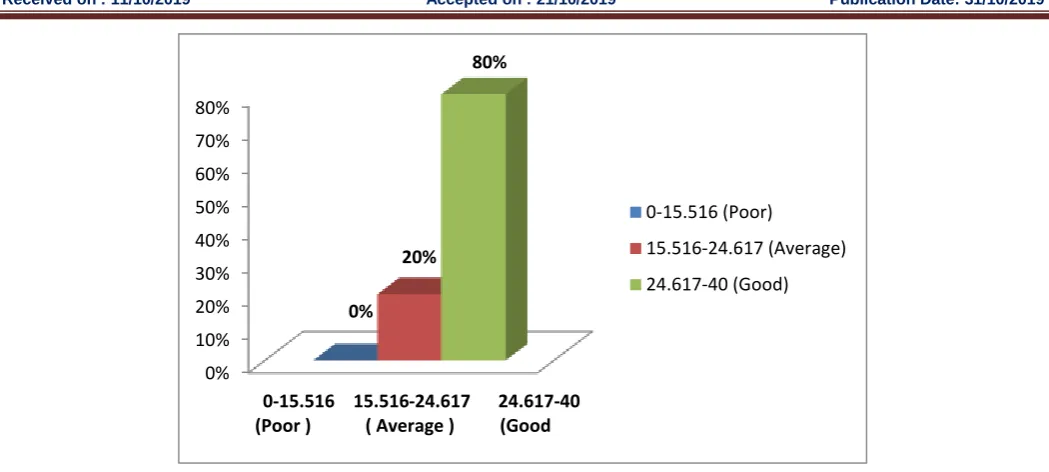
From the above table- 3.1, majority of samples those who participated in the study got good knowledge regarding life style related risk factors for cardiovascular diseases during the post -test after the administration of structured teaching programme on knowledge regarding lifestyle related risk factors for cardiovascular diseases. Out of the 30 samples 6(20%) had average knowledge regarding lifestyle related risk factors for cardiovascular diseases and 24(80%) had good knowledge. This indicated that the teaching programme helped the samples in gaining needed information on lifestyle related risk factors for cardiovascular diseases, which would in turn help them to identify the lifestyle related risk factors for cardiovascular diseases and thereby reduce the risk factors of cardiovascular diseases in their life.
0% 10% 20% 30% 40% 50% 60%
20%
60%
20%
0-15.516 15.516-24.617 24.617-40 (Poor ) ( Average ) (Good
0-15.516 (Poor)
15.516-24.617 (Average)
24.617-40 (Good)
Knowledge level Frequency Percentage
Poor <15.516 0 0%
Average 15.516-24.617 6 20%
Table - 3.2 Mean, standard deviation, range and mean percentage of post -test knowledge score regarding life style related risk factors for cardiovascular diseases.
N=30
The above table – 3.2 shows the statistical outcome such as mean, standard deviation range, maximum score, mean % of post -test knowledge score regarding lifestyle related risk factor of cardiovascular diseases among the samples. Out of the maximum score of 44, the samples had attained mean knowledge of 26.63 with standard deviation of 4.12, range 17 and mean score percentage attained was 88.76.
SECTION IV
EFFECTIVENESS OF STRUCTURED TEACHING PROGRAMME ON LIFE STYLE RELATED RISK FACTORS FOR CARDIOVASCULAR DISEASES BY COMPARING PRE AND POST TEST SCORES AMONG THE SAMPLES.
Table – 4.1 Comparison of pre-test and post-test level of knowledge among samples Ernakulum
Pre Test Post Test
Frequency Percentage Frequency Percentage
Poor (0 - 15.516) Average (15.516 -24.617)
Good (24.617 - 44)
6 18
6
20% 60% 20%
0 6 24
0 20% 80%
The above table compares the pre-test& post-test knowledge of the samples.60% had average knowledge, 20% had poor knowledge and 20% had good knowledge about lifestyle related risk factors for cardiovascular diseases during pre - test. In the post-test no one is having poor knowledge, 20% had average knowledge and 80% had good knowledge.
0% 10% 20% 30% 40% 50% 60% 70% 80%
0% 20%
80%
0-15.516 15.516-24.617 24.617-40 (Poor ) ( Average ) (Good
0-15.516 (Poor)
15.516-24.617 (Average)
24.617-40 (Good)
Domain Mean Standard Range Max. score Mean percentage Deviation
Table- 4.1 Comparison of mean, standard deviation, mean difference and paired “t” value of knowledge regarding lifestyle related risk factors of cardiovascular diseases among young adult males during pre – test and post – test.
TESTING OF HYPOTHESIS
H1: There will be a statistically significant difference between the mean pre – test knowledge score and mean post – test knowledge score of young adult male students regarding lifestyle related risk factors for cardiovascular diseases following the structured teaching programme.
The above table-4.1 reveals that the mean pre - test knowledge score was 20.03 and post- test knowledge score was 26.63 which was higher than the pre -test score. The standard deviation of pre- test knowledge score was 4.614 and post- test knowledge score was 4.12. The obtained‘t’ value was 6.390. which is greater than table value at 0 .05 level of significance. So the research hypothesis (H1) was accepted. The result indicated that the structured teaching programme was effective.
SECTION V
ASSOCIATION BETWEEN PRE TEST KNOWLEDGE SCORE AND SELECTED DEMOGRAPHIC VARIABLES AMONG THE SAMPLES
Table- 5.1 The association between the level of knowledge and selected demographic variables. N = 30
Demographic variables No. % Good Average Poor Chi square
Age 18-20 years 21-22 years 23-24 years Monthly income Below Rs.5000 Rs.5000- 10000 30 0 0 8 17 100% 0% 0% 26.6% 56.6% 6 0 0 2 3 20% 0% 0% 6.6% 10% 18 0 0 5 10 60% 0% 0% 16.6% 33.3% 6 0 0 1 4 20% 0% 0% 3.3% 13.3% 0 50.73 0% 10% 20% 30% 40% 50% 60% 70% 80% 0-15.516 (Poor) 15.516-24.617
(Average) 24.617-40 (Good) 0% 20% 80% 20% 60% 20%
Post - Test
Pre - Test
Variable Mean Standard Range Mean difference Paired “t” Deviation Value
Pre- test 20.03 4.614 16 6.6
Above 10000
Qualification/education
No formal education Primary education Secondary education Higher secondary education Degree/Diploma Post graduation
Type of family
Nuclear family Joint family Extented family
Area of residence
Rural Urban
Previous source of information Friends Parents Teachers Health professionals Mass media Seminars 5 1 8 5 12 4 0 28 2 0 26 4 7 8 8 6 1 0 16.6% 3.3% 26.6% 16.6% 40% 13.3% 0% 93.3% 6.6% 0% 86.6% 13.3% 23.3% 26.6% 26.6% 20% 3.3% 0% 1 0 4 1 1 0 0 6 0 0 6 0 O 3 1 1 1 0 3.3% 0% 13.3% 3.3% 3.3% 0%% 0% 20% 0% 0% 20% 0% 0% 10% 3.3% 3.3% 3.3% 0% 3 1 4 2 9 2 0 17 1 0 14 4 5 4 5 4 0 0 10% 3.3% 13.3% 6.6% 30% 6.6% 0% 56.6% 3.3% 0% 46.6% 13% 16.6% 13.3% 16.6% 13.3% 0% 0% 1 0 0 2 2 2 0 5 1 0 6 0 2 1 2 1 0 0 3.3% 0% 0% 6.6% 6.6% 6.6% 0% 16.6% 3.3% 0% 20% 0% 6.6% 3.3% 6.6% 3.3% 0% 0% 0% 0% 3.06 7.77
The table – 5.1 shows the association between knowledge and selected demographic variables of samples such as age, monthly income, qualification, education of parents, occupation of father and mother, type of family, history of cardiovascular disease, area of residence and previous source of information.
TESTING THE HYPOTHESIS 2:
H2: There will be a significant association between mean pre - test knowledge score and selected demographic variables. Among the demographic variables, the chi-square values were, age (x2=0),monthly income(x2=.50),qualification of parents(x2=10.3),type of family(x2=1.14),area of residence(x2=3.06) and previous source of information(x2=7.77) . In this study
,
the result of chi square analysis shows thatthe
demographic variables were not significant with knowledge at 0.05 level. So there was no significant association between pre – test knowledge score and any of the selected demographic variables.6. FINDINGS OF THE STUDY:
The findings of the study were;
6.1 SAMPLE CHARACTERISTICS
All 30(100%) samples belonged to the age group of 18-20 years.
Regarding the family monthly income in rupees, 17(58%) had income between Rs.5000& Rs.10000. 8, (26%) had income below Rs.5000 and 5 (16%) had income above Rs. 10000.
About the qualification/ educational status of parents, most of the samples, 12(40%) had higher secondary education, 8(26%) had primary education, 5(6%) had secondary education, 4(3%) had degree/ diploma and 2(6%) did not had any formal education.
When type of family was taken into consideration, 28(93%) were from nuclear family and 2(7%) were from joint family.
Regarding the history of cardiovascular diseases in the family, 26(87%) had no history of cardiovascular diseases in the family, only 4(13%) had history of cardiovascular diseases in the family
Based on the area of residence, 26(87%) lived in rural area and 4(13%) lived in urban area.
6.2 MAJOR FINDINGS OF THE STUDY:
ASSESSMENT OF KNOWLEDGE ON LIFESTYLE RELATED RISK FACTORS FOR CARDIOVASCULAR DISEASES AMONG YOUG ADULT MALE STUDENTS DURING PRE- TEST
Among the 30 samples, 6(20%) had poor knowledge, 18(60%) had average knowledge and 6(20%) had good knowledge.
ASSESSMENT OF KNOWLEDGE ON LIFESTYLE RELATED RISK FACTORS FOR CARDIOVASCULAR DISEASES AMONG YOUG ADULT MALE STUDENTS DURING POST- TEST
Among the 30 samples 6(20%) had average knowledge regarding lifestyle related risk factors for cardiovascular diseases and 24(80%) had good knowledge.
EFFECTIVENESS OF STRUCTURED TEACHING PROGRAMME IN TERMS OF GAIN IN KNOWLEDGE ON LIFESTYLE RELATED RISK FCTORS FOR CARDIOVASCULAR DISEASES
The mean pre - test knowledge score was 20.03 and post- test knowledge score was 26.63 which were higher than the pre -test score. The standard deviation of pre- test knowledge score was 4.614 and post- test knowledge score was 4.12. The obtained‘t’ value was 6.390 which is greater than table value at 0.05 level of significance. So the research hypothesis (H1)” there will be a statistically significant difference between the mean pre – test knowledge score and mean post – test knowledge score of young adult male students regarding lifestyle related risk factors for cardiovascular diseases following the structured teaching programme” was accepted. The result indicated that the structured teaching programme was effective.
RELATIONSHIP BETWEEN SELECTED DEMOGRAPHIC VAERABLES AND PRE-TEST SCORE
The present study showed that there was no significant association between demographic variables and knowledge score.
7. CONCLUSION:
This study enlightens the importance of the research work. The research was conducted on young adult male students of a college at Ernakulam district and revealed that there was significant lack of knowledge regarding life style related risk factors for cardiovascular diseases among young adult male students. The structured teaching programme had a remarkable role in improving their knowledge and the study also revealed that there was no association between knowledge and selected demographic variables.
8. RECOMMENDATIONS:
• Evidence from the review shows that much research has been conducted in the quantitative aspect of life style related risk factors for cardiovascular diseases. Researchers can be encouraged to do qualitative analysis of life style related risk factors for cardiovascular diseases so that we could provide better quality care.
• A comparative study can be conducted between samples of two colleges belonging to urban and rural area.. • A similar study can be conducted in community area.
REFERENCES:
1. Kaur J, and Bains K.,(2006): Report of national workshops on national rural health mission. Indian Journal of Public Health, Apr-Jun,97-99.
2. Yavagal,(2001): Coronary artery disease epidemic in Indians; A cause for alarm and call for action. Journal of Indian Medical Association, 98(11), 694-702.
3. Athavale AV, Durge PM, Zodpey SP, and Deshpande SH. ,(2000) :Prevalence and risk factors of coronary heart-disease in sedentary workers: Indian J Indus Med ,Jul-Aug, 43(2),18-20.
4. Vishwanathanmohan, and Raj Deepa, (2001) : Prevalence of heart disease among selected urban population in South India : Journal of American College of Cardiology,:38(4),682-687.
6. Gupta, and Mahajan,(2004):Modifiable risk factors of Myocardial Infarction : Journal of Advanced Nursing, 40(20) ,221-222.
7. R.Gupta, P.Joshi, V.Mohan, K.S.Reddy , and S.Yusuf ,(2004): Epidemiology and Causation of Coronary Heart Disease and Stroke in India: Heart Journal, 94(5),16-26.
8. Vaccarino V, Borgatta A, Gallus G, and Sirturi CR., (2003):Prevalence of coronary heart disease risk factors in northern Italian male and female employees: European Heart Journal , Jun; 16(6):761-9.
9. Brunner G. Manelis, M. Modan and S. Levin.,(2006): The prevalance of IHD: Journal of Chronic Diseases:(27); 4-5, 217-233.
10. De Fatima M, Nelson AS, and Armondo JM,(2004) : Prevalence of risk factors for cardiovascular diseases in urban population of North India: Journal of Public Health: Jan; 82(1),56-58.
11. Bhattacharya P, Marimuthu P, Chowdhari RN, Sarkar AK, Adak SK, and Banarji KK., (2007): Risk assessment of cardiovascular disease among bank employees. A biochemical approach: Journal of Occupational Medicine: 49(5),313-318.
12. http://www.faqs.org/abstracts/Health/Prognostic-Indicators-for-Coronary-Artery-Disease-Ready-for-the-Bedside.html
13. Park K. (2016).text book of preventive and social medicine(pp. 339 – 341).Bansaridas Bhanot Publishers.