Available Online at www.ijpret.com
246
INTERNATIONAL JOURNAL OF PURE AND
APPLIED RESEARCH IN ENGINEERING AND
TECHNOLOGY
A PATH FOR HORIZING YOUR INNOVATIVE WORK
IMPLEMENTATION OF GOOSE AND MMS PROTOCOL IN IEC 61850 BASED
DEVICES
CHILTON FERNANDES1, SAMARTH BORKAR2, SHRISHA PRASAD3
1. Microelectronics, ETC Dept., Goa College of Engineering, Goa University, India.
2. Professor, ETC Dept., Goa College of Engineering, Goa University India.
3. Manager-Firmware, R&D, Siemens Ltd. Goa.
Accepted Date: 27/02/2014 ; Published Date: 01/05/2014
\
Abstract: IEC 61850 is a standard for the design of electrical substation automation and integrates all the protection, control, measurement and monitoring functions by a common protocol. IEC 61850 protocol supports services such as Generic Object Oriented Substation Events (GOOSE) and Manufacturing Message Specification (MMS) to be implemented at high speed. The communication using IEC 61850 GOOSE replaces point to point copper wiring between the intelligent electronic devices (IED) in conventional substations with high speed communication over Ethernet technology. The study in this paper is conducted to analyze the structure and data encoding of the GOOSE Protocol Data Unit (PDU) by simulating the GOOSE message. A client/server relationship is established between PC and a development kit and communication between them is verified by using GOOSE and MMS protocols.
Keywords: IEC 61850, GOOSE, MMS, client/server
Corresponding Author: MR. CHILTON FERNANDES
Access Online On:
www.ijpret.com
How to Cite This Article:
Chilton Fernandes, IJPRET, 2014; Volume 2 (9): 246-253
Available Online at www.ijpret.com
247 INTRODUCTION
The IEC 61850 standard has contributed immensely to the way communication and information exchange is implemented within an electrical substation. This standard aims to ensure interoperability among devices from different vendors [7]. The main idea of standardizing the communication is to break down the functions of IED into core
functions called Logical Nodes (LN). Several logical nodes are grouped into a Logical Device (LD) which acts as an access point of the IED. Common information model for each LN and the associated services are standardized which provides the interoperability. [3]. For time-critical events such as protection of electrical equipment, GOOSE messages are exchanged between the devices by means of a local Ethernet network. This paper presents a detailed examination and analysis of the simulated GOOSE message using software and then using a development kit.
WHAT IS CLIENT/SERVER and PUBLISHER/SUBSCRIBER
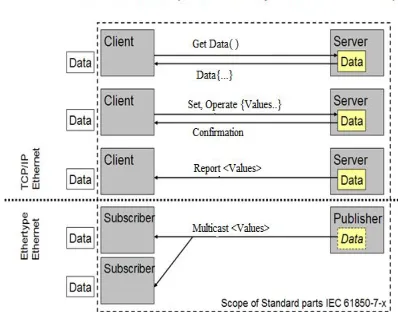
A server displays the data that can be accessed by the client over a TCP/IP connection or the client will receive an event-driven report from the server over TCP/IP. The connection is initiated by the client for e.g. client needs the data from the server so it sends a request and the server responds with the data [13]. The publisher sends multicast messages to all the devices connected to it and any device that has a subscriber role picks-up the messages it wants to receive.
Available Online at www.ijpret.com
248 GOOSE OVERVIEW
IEC 61850-7-2 defines a generic substation event service which can provide a fast and reliable distribution of input and output data values, including either digital or analogue values [8].
In the IEC 61850-8-1 part of the standard, one of the messages associated with the GSE services are the GOOSE messages that allows for multicast messages across the Local Area Network (LAN) [11].
Mappings specified by IEC 61850 Part 8-1 include the profiles for communication stacks, which are dependent on the service provided. For example, the Sampled Value and GOOSE services can be directly mapped on top of the ethernet layer [2].
SIMULATION AND ANALYSIS OF GOOSE MESSAGE STRUCTURE
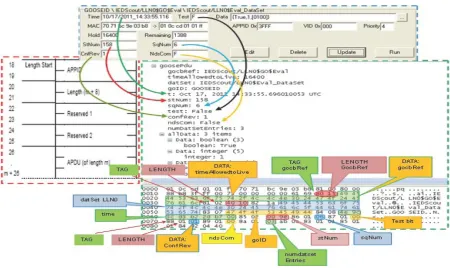
Simulated GOOSE messages are generated using OMICRONS IED Scout software within a personal computer (PC). This simulated GOOSE is captured on the NIC card of the laptop using Wireshark. Wireshark captures the packet and allows viewing all the fields in a packet. The following figure shows a simulated GOOSE packet captured using Wireshark. The Ethernet frame for GOOSE consists of the source address which is of the GOOSE generator (in this case PC). The destination address is the multicast address which starts with IEC-TC57XXX.
The GOOSE PDU consists of the following shown in fig. 2.
State number (stNum): This number is assigned whenever a GOOSE message is generated as a result of event change.
Sequence number (sqNum): This number is assigned in increasing order to retransmitted GOOSE messages.
Test: Is set if in test mode.
Time allowed to live: The maximum time packet remains alive after transmission.
NdsCom: Set when the data in the GOOSE message is invalid
Configuration revision (confRev): Indicates the version of the IED. ConfRev of the publisher and the subscriber should be the same.
Available Online at www.ijpret.com
249 GOOSE control block reference (gocbRef): Gives the name of the GOOSE control block
Data set (datset): Gives the name of the GOOSE dataset in the IED.
GOOSE ID (goID): GOOSE block in each IED has a different ID associated to it.
Timestamp (t): Each GOOSE message is associated the time when it was generated.
Figure 2: GOOSE PDU
PRACTICAL IMPLEMENTATION
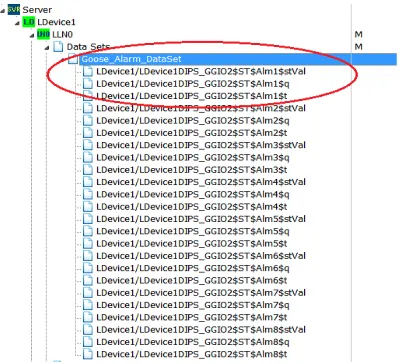
To establish client/server communication in the lab, we implemented a IEC 61850 Server using a Beck development kit and the client was running on a PC. The communication is over standard Ethernet through a switch as depicted. The Beck development kit consists of IEC 61850 Protocol integration stack PIS 10 version 1.0 from System Corp. The Server code was developed using the application programming interface (API) available from the libraries for PIS10. The server is coded to generate a GOOSE message when it senses a change on any of the 8 DIP switches.
Available Online at www.ijpret.com
250 input and output signals. The Server code has each DIP switch as DIPS_GGIO2. With data object as “AlmX” corresponding to the switches on the board and three data attributes namely stVal indicating the status value of the switch, “q” indicating the quality of information and “t” stating the time stamp of the GOOSE message as shown in fig 3.
The GOOSE message needs to satisfy the timing constrains of 4ms. This timing constrain is not analyzed in the paper as the GOOSE messages are generated using DIP switch. To test the timing constrain we can connect OMICRON test kit input to one of the GPIO of the Beck board and calculate the response time on OMICRON.
Figure 3: IED browser window
RESULTS
Available Online at www.ijpret.com
251 Figure 4: Telnet window
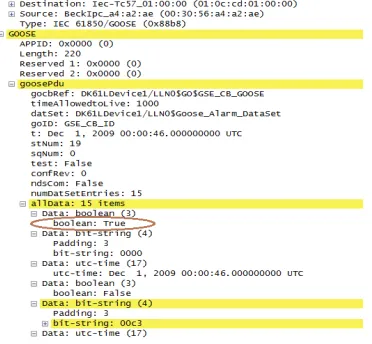
The presence of GOOSE messages indicate that the server is up and running also that the
GOOSE module is functioning. To further test the GOOSE module, the status of the 1st switch on
the board is changed, and instantaneously GOOSE messages start to appear in Wireshark. The messages received from the board’s module shown in fig. 5, abide to the same structure as was seen in the simulated GOOSE.
To test the client/server communication is established, read the status of the LEDs on the board. Triangle Microworks Hammer was used as a IEC 61850 client for our demonstration. The data is read using report control block of the server. This reporting scheme uses MMS protocol of the IEC 61850. Standard as shown in Fig 6.
Figure 5: Received GOOSE from Board
Available Online at www.ijpret.com
252 CONCLUSION
The IEC 61850 standard is still in the process of development as changes and expansion to new domain is carried out. In this paper we have successfully investigated the GOOSE message structure and data content to the bit level for complete understanding and the structure is confirmed by practical Implementation. We have also described how the GOOSE dataset appears in an Intelligent Electronic Device (IED). We were able to establish a client server communication between two IEC61850 based devices and successfully exchange the information using MMS protocol of IEC61850 standard.
REFERENCES
1.R. E. Mackiewicz , Member, IEEE “Overview of IEC 61850 and Benefits “.
2.Byong-Kwan Yoo, Seung-Ho Yang, Hyo-Sik Yang, Won-Yong Kim, Yu-Seok Jeong, Byung-Moon
Han and Kwang-Soo Jang, “Communication Architecture of the IEC 61850-based Micro Grid System”, Journal of Electrical Engineering & Technology Vol. 6, No. 5, pp. 605~612, 2011.
3.Victor Manuel Flores and Daniel Espinosa, Julian Alzate and Dave Dolezilek, Schweitzer, “Case
Study: Design and Implementation of IEC 61850 From Multiple Vendors at CFE La Venta II” Comisión Federal de Electricidad Engineering Laboratories, Inc.
4.Rajiv Krishnan, Bapuji Palki ABB Limited, “First experiences with design and engineering of IEC
61850 based Substation Automation Systems in India”, CEPSI 2006 Conference, Mumbai, November 6-10, 2006.
5.Il-Hyung Lim, Member, IEEE, and Tarlochan S. Sidhu, Fellow, IEEE, “Design of a Backup IED for
IEC 61850-Based Substation”, IEEE Transactions On Power Delivery, Vol. 28, No. 4, October 2013.
6.Ikbal Ali, Sr. Assistant Professor, Senior Member, IEEE, “High-speed Peer-to-peer
Communication based Protection Scheme Implementation and Testing in Laboratory”, International Journal of Computer Applications (0975 – 8887) Volume 38– No.4, January 2012.
7.Ivan De Mesmaeker1, Peter Rietmann, Klaus-Peter Brand, Petra Reinhardt “Substation
Automation based on IEC 61850”, Cigré SC B5 6th Regional CIGRÉ conference in Cairo, November 21 – 23, 2005.
Available Online at www.ijpret.com
253
9.L.X. Zhang, Student Member, IEEE, and Nirmal-Kumar C Nair, Member, IEEE “Testing
Protective Relays in IEC 61850 Framework” 2008 Australasian Universities Power Engineering Conference (AUPEC'08).
10. http://blog.iec61850.com/
11. C. Kriger, S. Behardien, J. Retonda-Modiya “A Detailed Analysis of the GOOSE Message
Structure in an IEC 61850 Standard-Based Substation Automation System” INT J COMPUT COMMUN, ISSN 1841-9836 8(5):708-721, October, 2013.
12. http://www.iec.ch/cgibin/procgi.pl/www/iecwww.p?wwwlang=E&wwwprog=dirwg.p&ctnu
m=1188
13. http://blog.iec61850.com/2011/01/what-are-clientserver-and.html
14. Klaus-Peter Brand, Wolfgang Wimmer “Modeling interoperable protection and control