Requirements Engineering
and Management
for Software Development
Projects
Foreword by Tom Gilb
Chemuturi Consultants [email protected]
ISBN 978-1-4614-5376-5 ISBN 978-1-4614-5377-2 (eBook) DOI 10.1007/978-1-4614-5377-2
Springer New York Heidelberg Dordrecht London Library of Congress Control Number: 2012944969
Springer Science+Business Media New York 2013
This work is subject to copyright. All rights are reserved by the Publisher, whether the whole or part of the material is concerned, specifically the rights of translation, reprinting, reuse of illustrations, recitation, broadcasting, reproduction on microfilms or in any other physical way, and transmission or information storage and retrieval, electronic adaptation, computer software, or by similar or dissimilar methodology now known or hereafter developed. Exempted from this legal reservation are brief excerpts in connection with reviews or scholarly analysis or material supplied specifically for the purpose of being entered and executed on a computer system, for exclusive use by the purchaser of the work. Duplication of this publication or parts thereof is permitted only under the provisions of the Copyright Law of the Publisher’s location, in its current version, and permission for use must always be obtained from Springer. Permissions for use may be obtained through RightsLink at the Copyright Clearance Center. Violations are liable to prosecution under the respective Copyright Law.
The use of general descriptive names, registered names, trademarks, service marks, etc. in this publication does not imply, even in the absence of a specific statement, that such names are exempt from the relevant protective laws and regulations and therefore free for general use.
While the advice and information in this book are believed to be true and accurate at the date of publication, neither the authors nor the editors nor the publisher can accept any legal responsibility for any errors or omissions that may be made. The publisher makes no warranty, express or implied, with respect to the material contained herein.
Printed on acid-free paper
This book is a practical textbook which will be useful for a requirements student and/or a software manager student, to get a picture of the very many practical considerations that go into specifying and validating requirement for IT/IS projects.
The book does not oversimplify subjects that require mature consideration in order to succeed. In my view the author gets many and most critical points correct, better than the many less mature authors.
For a small example of such points, the importance of stakeholders, the silliness of the non-functional requirement term, and an understanding that quality is designed in, not tested in.
The pages are, like my own detailed work, dense with powerful and useful lists of considerations. They will give excellent structure to a teacher who can help students discuss the points, and explain to students using examples.
I hope this textbook finds its place as a teaching tool for information technology courses. But the lone reader can safely use it as a mature way to survey the entire software development scene today.
Kolbotn, Norway, 8 June 2012 Tom Gilb
Gerald M. Weinberg, author of the book ‘‘The Psychology of Computer Programming’’ is attributed with the quote —‘‘If builders built houses the way programmers built programs, the first woodpecker to come along would destroy civilization.’’ I could not agree more. The rate of project failure is much higher in software development compared to either manufacturing or construction. It is not that there are no failures in manufacturing or construction. Those failures are in ‘‘first-of-its-kind’’ projects, especially in manufacturing. In construction, these are even fewer. For example, the Empire State Building of New York city was the first of its kind when it was built. It is the first building in the world to go up 80 floors high above ground. It was the tallest building in the world for a number of years. The issues, there would have been many, were solved in the specifications and the design stage. The construction would scrupulously adhere to the design. It was a success.
Why do software projects fail at such a high rate even when there were similar projects executed earlier?
Two major causes are attributed for this phenomenon. The first is the poor understanding and definition of product requirements. This leads to technical failure. The second is the poor project management of developing the software product to the specified requirements resulting in unsustainable overruns of cost and schedule. Both the reasons lead to project failure.
In this book, I am focusing on the precise understanding and definition of product requirements. As in other areas, there is more misunderstanding about this critical activity than right understanding.
‘‘The hardest single part of building a software system is deciding what to build…No other part of the work so cripples the resulting system if done wrong. No other part is more difficult to rectify later.’’said Frederick Brooks, Jr., Brooks Computer Science Building, University of North Carolina, USA. (From his paper ‘‘No Silver Bullet: Essence and Accident in Software Engineering,’’ 1986 as also The Mythical Man-Month: Essays on Software Engineering,Anniversary Edition, Chap. 16.) I concur wholeheartedly.
Unfortunately for me or perhaps for the software development industry itself, there is no commonly accepted taxonomy for software engineering activities. It is not that there are no definitions at all. The definitions that are there, are not universally accepted. Some, like ‘‘non-functional requirements’’ are downright ridiculous. That is the reason why I am explaining every term I use here, as you will notice, from the first fundamentals. Wherever, possible, I am using the ter-minology from a credible source. I am giving all the available meanings with my own interpretation with the idea that the reader is better informed when the same matter is presented by someone else with a different set of nomenclature. Please bear with me for this over-specification.
My own perception was gathered from my experience, observation, study and participation in discussion forums of how well the requirements are either engi-neered or managed. It is not very flattering to the community of requirements engineers or managers. There are many doubts, which begin right at the funda-mental stage among the practitioners. This is, perhaps, due to the fact that uni-versities are not conducting courses in requirements engineering and management. Their focus is more on engineering and producing code rather than on the forward or backward linkages to code production. Managements rather hasten the project teams into coding ASAP. Of course, there are exceptions without which, I would not have been able to gather best practices.
In this book, I tried to give you a complete view of the activities of require-ments engineering as well as requirerequire-ments management. Both the activities, engineering and management, are equally important. Engineering activities, per-formed well, produce the right deliverable. When we manage the engineering activities diligently, we produce the deliverable within the estimated cost and on schedule. The variances that are bound to be there would be predictable and within acceptable levels. Management activities when performed diligently would also allow us to plow the experience back into the process of performing engineering activities and facilitate improvement.
The information presented here is from my experience, observation, academic study and participation in the Internet discussion forums.
That was my intent and I would like to learn how you perceived my effort to be. Please feel free to email me [email protected] I promise to respond to every email that I receive normally in one business day.
When I look back, I find that there are so many people to whom I should be grateful. Be it because of their commissions or omissions, they made me a stronger and a better person, and both directly and indirectly helped to make this book possible. It would be difficult to acknowledge everyone’s contributions here, so to those whose names may not appear, I wish to thank you all just the same. I will have failed in my duty if I did not explicitly and gratefully acknowledge the persons below:
• My parents, Appa Rao and Vijaya Lakshmi, the reason for my existence. Especially my father, a rustic agrarian, who by personal example taught me the virtue of hard work and how sweet the aroma of sweat from the brow can be. • My family, who stood by me like a rock in difficult times. Especially my wife, Udaya Sundari, who gave me the confidence and the belief that ‘‘I can.’’ And my two sons, Dr. Nagendra and Vijay, who provided me the motive to excel. • My two uncles, Raju and Ramana, who by personal example taught me what
integrity and excellence mean.
• Springer Science+Business Media and especially Ms. Susan Lagerstrom-Fife and Ms. Courtney Clark for their belief in the content of this book, for their generous allocation of time, and for leading me by the hand like the Good Lord through every step of making this book a reality.
• The staff of Springer Science+Business Media all of whom were involved in bringing this book out to the public.
To all of you, I humbly bow my head in respect, and salute you in acknowl-edgement of your contribution.
Murali Chemuturi
1 Introduction to Requirements Engineering and Management. . . . 1
1.1 What is a ‘‘Requirement’’ . . . 1
1.2 Requirements Management . . . 4
1.3 Requirements Management Scenarios . . . 6
1.4 Agencies Responsible for Managing Requirements . . . 7
1.5 Approaches to Requirements Management . . . 8
1.6 Requirements Engineering . . . 9
1.7 Topics Proposed to be Covered in this Book . . . 10
2 Understanding Requirements . . . 13
2.1 Classification of Requirements . . . 13
2.2 Classification of Requirements Based on Functionality Considerations . . . 13
2.3 Classification of Requirements Based on Product Construction Considerations. . . 18
2.4 Classification of Requirements Based on Source of Requirements . . . 21
2.5 Levels of Requirements . . . 23
2.6 Definition of Requirements in the Context of Software Development . . . 24
2.7 Evolution of Requirements. . . 25
3 Elicitation and Gathering of Requirements. . . 33
3.1 Introduction . . . 33
3.2 Elicitation of Requirements . . . 34
3.2.1 Personal Interviews . . . 35
3.2.2 Customer/Market Surveys . . . 40
3.2.3 Questionnaires . . . 41
3.2.4 Observation . . . 42
3.2.5 Demonstration of Product Prototypes . . . 42
3.2.6 Product Demonstrations . . . 43
3.2.7 Brainstorming . . . 44
3.3 Gathering Requirements. . . 44
3.4 Elicitation and Gathering in Agile Projects . . . 47
3.5 Elicitation and Gathering in COTS Product Implementation. . . 47
3.6 Elicitation and Gathering in Testing Projects . . . 48
3.7 Elicitation and Gathering in Software Maintenance Projects. . . 49
3.8 Elicitation and Gathering in Real Time Software Development Projects . . . 50
3.9 Elicitation or Gathering? . . . 50
3.10 Deliverables of Elicitation and Gathering. . . 51
3.11 Pitfalls in Requirements Elicitation and Gathering . . . 52
3.12 Final Words . . . 54
4 Requirements Analysis. . . 55
4.1 Introduction to Analysis. . . 55
4.2 Analysis of the Information Collected in the Elicitation and Gathering. . . 57
4.3 Resolving the Issues that Cropped up During the Analysis . . . 65
4.4 Deliverables of Requirements Analysis Phase. . . 65
4.5 Final Words . . . 65
5 Establishment of Requirements. . . 67
5.1 Introduction to Establishment of Requirements. . . 67
5.2 Documentation . . . 68
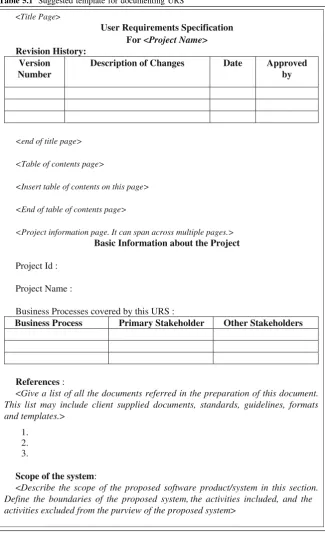
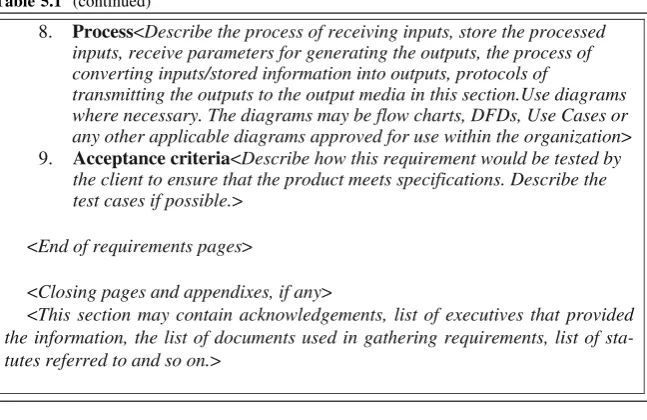
5.2.1 User Requirements Specification . . . 69
5.2.2 Software Requirements Specification . . . 70
5.3 Quality Control of the Documents . . . 75
5.4 Obtaining Approvals . . . 80
5.5 Configuration Management . . . 81
5.6 Establishment of Requirements in COTS Product Implementation Projects . . . 82
5.6.1 Gaps Analysis Document . . . 84
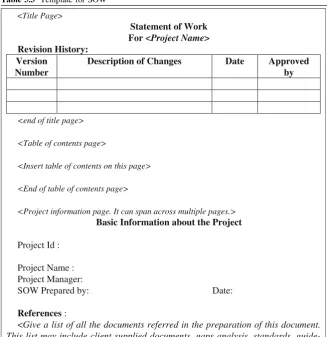
5.6.2 SOW Document . . . 84
5.7 Establishment of Requirements in Software Maintenance Projects. . . 86
5.8 Establishment of Requirements in Migration, Porting and Conversion Projects . . . 87
6 Quality Assurance in Requirements Management . . . 91
6.1 Introduction to Quality Assurance . . . 91
6.2 Quality Assurance in the Context of Requirements Engineering and Management . . . 93
6.2.1 Process, Standards and Guidelines. . . 93
6.2.2 Right People with Right Training . . . 95
6.2.3 Quality Control . . . 97
6.2.4 Measurement and Analysis . . . 97
6.2.5 Project Postmortem . . . 98
6.3 Verification . . . 98
6.3.1 Peer Reviews . . . 99
6.3.2 Managerial Reviews . . . 102
6.3.3 Best Practices and Pitfalls in Verification. . . 102
6.4 Validation . . . 103
6.4.1 Brainstorming . . . 103
6.4.2 Storyboarding . . . 104
6.4.3 Prototyping. . . 104
6.4.4 Expert Review . . . 104
6.4.5 End User Review . . . 105
6.4.6 Feedback Mechanism from Validation . . . 105
6.5 Determination of Applicable Quality Control Activities. . . 105
7 Planning for Requirements Management. . . 107
7.1 Introduction to Planning . . . 107
7.2 Definition of Planning . . . 107
7.3 Planning for Requirements Management . . . 108
7.4 To Document or Not to Document? . . . 109
7.5 Different Project Plans . . . 110
7.6 Planning for Requirements Management in Projects . . . 111
7.6.1 Requirements Elicitation and Gathering . . . 111
7.6.2 Requirements Analysis. . . 112
7.6.3 Requirements Establishment . . . 112
7.6.4 Requirements Change Control and Management . . . 113
7.6.5 Requirements Tracing, Tracking and Reporting. . . . 113
7.6.6 Measurement and Metrics . . . 114
7.6.7 Formats and Templates for Planning . . . 114
7.7 Best Practices and Pitfalls in Planning. . . 114
8 Requirements Change Management . . . 117
8.1 Introduction . . . 117
8.2 Communication of Changes . . . 118
8.3 Origination of Changes . . . 119
8.4 Change Request Resolution . . . 121
8.6 CRR . . . 125
8.7 Progress/Status Reporting of CRs . . . 126
8.8 Handling the Impact of CRs. . . 126
8.9 Measurement and Metrics of Change Management . . . 127
9 Requirements Tracing, Tracking and Reporting . . . 129
9.1 Introduction . . . 129
9.2 Requirements Traceability . . . 129
9.3 Need for Requirements Traceability . . . 130
9.4 Mechanisms for Tracing Requirements . . . 132
9.5 When Should We Trace the Requirements? . . . 134
9.6 Tracking of Requirements . . . 134
9.7 Requirements Reporting. . . 135
9.8 Reconciliation of Requirements . . . 136
10 Measurement and Metrics . . . 139
10.1 Introduction . . . 139
10.2 Measurement and Metrics . . . 139
10.3 Metrics Relevant to Requirements Engineering and Management . . . 141
10.3.1 Productivity Metrics . . . 143
10.3.2 Change Request Metrics. . . 145
10.3.3 Quality Metrics . . . 147
10.3.4 Relative Effort Metrics . . . 149
10.3.5 Schedule Metrics. . . 151
10.4 Summary of Metrics . . . 152
11 Roles and Responsibilities in REM . . . 153
11.1 Introduction . . . 153
11.2 Role of the Organization . . . 153
11.2.1 Organization . . . 154
11.2.2 Staff . . . 155
11.2.3 Process . . . 159
11.2.4 Quality Assurance . . . 161
11.2.5 Training . . . 161
11.2.6 Recognition and Rewards . . . 162
11.3 Role of the Individuals . . . 163
11.3.1 Business/System Analysts. . . 163
11.3.2 Quality Control . . . 164
11.3.3 Project Manager . . . 165
11.3.4 Process Definition and Improvement Group . . . 166
11.3.5 Senior Management . . . 167
12 Requirements Management Through SDLC . . . 169
12.1 Introduction . . . 169
12.2 Pre-Project Phase . . . 170
12.3 RM in Requirements Phase of SDLC . . . 171
12.4 Software Design . . . 171
12.5 Construction . . . 172
12.6 Testing . . . 172
12.7 Acceptance Testing . . . 173
12.8 Installation and Commissioning . . . 174
12.9 RM Through SDLC . . . 175
13 Tools and Techniques for Requirements Engineering and Management. . . 177
13.1 Introduction . . . 177
13.2 Structured Systems Analysis and Design Method . . . 177
13.2.1 Feasibility Study . . . 179
13.2.2 Requirements Analysis and Specification . . . 179
13.2.3 High Level Design . . . 179
13.2.4 Low Level Design . . . 179
13.2.5 Construction . . . 179
13.2.6 Testing. . . 180
13.2.7 Delivery and Implementation . . . 180
13.2.8 Software Maintenance . . . 180
13.2.9 Requirements Engineering and Management in SSADM . . . 181
13.2.10 ER Diagrams . . . 181
13.2.11 Data Flow Diagrams . . . 183
13.2.12 Context Diagram . . . 185
13.2.13 Structure Chart . . . 186
13.3 IEEE Software Engineering Standards . . . 187
13.4 Object Oriented Methodology. . . 188
13.5 Unified Modeling Language . . . 191
13.5.1 Class Diagrams . . . 191
13.5.2 Use Cases . . . 192
13.5.3 Sequence Diagrams . . . 196
13.5.4 Statecharts . . . 196
13.5.5 Activity Diagrams . . . 196
13.5.6 Component Diagrams . . . 197
13.5.7 Deployment Diagrams . . . 198
13.5.8 Final Words on UML . . . 198
13.6 Agile Methods . . . 199
13.7 Planguage . . . 200
14 Pitfalls and Best Practices in Requirements Engineering
and Management. . . 203
14.1 Introduction . . . 203
14.2 Best Practices and Pitfalls at the Organizational Level . . . 203
14.2.1 Approach to Requirements Engineering and Management . . . 204
14.2.2 Provision of Resources. . . 205
14.2.3 Training and Updating of Skills . . . 206
14.2.4 Definition and Improvement of Process . . . 206
14.2.5 Motivation and Morale of the Resources . . . 207
14.2.6 Quality Assurance . . . 209
14.2.7 Knowledge Repository . . . 210
14.3 Project Level Pitfalls and Best Practices . . . 211
14.3.1 Planning. . . 211
14.3.2 Preparation for Elicitation and Gathering of Requirements . . . 212
14.3.3 Misunderstanding About Requirements . . . 212
14.3.4 Vague Requirements . . . 212
14.3.5 Modeling Issues . . . 213
14.3.6 Prioritization of Requirements . . . 213
14.3.7 Change Management . . . 213
14.3.8 Tracing and Tracking of Requirements . . . 214
14.3.9 Supervision. . . 214
14.3.10 Project Postmortem . . . 214
14.4 Final Words of Pitfalls and Best Practices . . . 215
15 REM in Agile Projects. . . 217
15.1 Introduction . . . 217
15.2 Extreme Programming . . . 219
15.3 Scrum . . . 220
15.4 Dynamic Systems Development Method . . . 221
15.5 Feature Driven Development . . . 222
15.6 Test Driven Development . . . 223
15.7 Adaptive Software Development. . . 224
15.8 RUP and AUP . . . 225
15.9 Kanban . . . 226
15.10 Crystal Clear . . . 228
15.11 Establishment of Requirements in Agile Projects . . . 229
15.12 Tracing and Progress Monitoring of Requirements . . . 231
Appendix A: Documentation Guidelines. . . 233
Appendix B: Planguage. . . 249
About the Author . . . 261
ANSI American National Standards Institute
ASD Adaptive Software Development
AUP Agile Unified Process
BFS Business Function Specification CCB Change/Configuration Control Board CIO Chief Information Officer
CMMI Capability Maturity Model Integration COBOL Common Business Oriented Language
COTS Commercial Off The Shelf
CPU Central Processing Unit
CR Change Request
CRM Customer Relationship Management
CRR Change Request Register
DBA Database Administrator
DBMS Database Management System
DDS Detail Design Specification
DFD Data Flow Diagram
DIR Defect Injection Rate
DSDM Dynamic Systems Development Method EAI Enterprise Architecture Integration EDI Electronic Data Interchange EDP Electronic Data Processing
ERD Entiry-Relationship Diagram
ERP Enterprise Resources Planning
FDD Feature Driven Development
FDS Functional Design Specification
FS Functional Specification
GMP Good Manufacturing Practice
GPM Gross Productivity Metric for Requirements Engineering GSDP Good Software Development Practice
GUI Graphical User Interface
HLD High Level Design
HR Human Resources
IDE Interactive Development Environmet
IEEE Institute of Electrical and Electronics Engineers ISO International Organization for Standardization
IT Information Technology
IV&V Independent Verification and Validation JSS Joint Services Specification
LLD Low Level Design
LOC Lines of Code
MBA Master of Business Administration
MIS Management Information System
NASSCOM National Association of Software and Services Companies of India
NIU Network Interface Unit
OOAD Object Oriented Analysis and Design
OOM Object Oriented Methodology
PEG Productivity for Elicitation and Gathering PER Productivity for Establishing the Requirements
PM Project Management
RAM Random Access Memory
RCL Requirements Capture Language
REC Relative Effort spent on resolving CRs
RECC Relative Effort spent on a specific Change Request Category REM Requirements Engineering and Management
RM Requirements Management
RQC Relative Effort metric for Quality Control of Requirements engineering activities
ROI Return On Investment
RSM Requirements Stability Metric RUP Rational Unified Process
SCM Supply Chain Management
SCMP Software Configuration Management Plan SDLC Software Development Life Cycle SDS Software Design Specification
SMRE Schedule Metric for Requirements Engineering SOP Standard Operating Procedure
SOW Statement of Work
SPIN Software Process Improvement Network SPMN Software Project Managers Network SPMP Software Project Management Plan SQAP Software Quality Assurance Plan SRS Software Requirements Specification
TCM Test Coverage Metric
TDD Test Driven Development
TQM Total Quality Management
UI User Interface
UML Unified Modeling Language
URS User Requirements Specification
VARS Value Added Re-Sellers
WIP Work in Process
XP Extreme Programming
Introduction to Requirements
Engineering and Management
Requirements are the precursor to all other software development phases, namely, software design, software construction and testing. When the end result of the software development activity is a COTS (Commercial Off The Shelf) product, we term requirements as ‘‘product specifications’’. When the end result of the software development activity is to deliver the product to a single client in a project scenario, we use the term requirements. In either case, the activity of managing the require-ments is the same.
The importance of properly managing requirements cannot be overemphasized as any omission of a vital requirement or error committed during requirements analysis results in increased cost of the product and in some cases, may result in project / product failure. Another important aspect of requirements management is the change management. If changes to requirements are not properly controlled, it may result in uncontrollable scope creep and increased costs.
A proper understanding of requirements and careful management thereof can prevent project failures and contribute to the delivery of quality software products to intended clients.
1.1 What is a ‘‘Requirement’’
Consider these five statements:
1. I ‘‘hope’’ to have a car (The capability to posses a car is absent but hope exists that someday it might be possible)
2. I ‘‘wish’’ to have a car (The capability to posses a car is distinctly possible but not feasible yet)
3. I ‘‘desire’’ to have a car (The capability to posses a car exists. But there are other competing demands to cater to.)
M. Chemuturi,Requirements Engineering and Management for Software
Development Projects, DOI: 10.1007/978-1-4614-5377-2_1,
ÓSpringer Science+Business Media New York 2013
4. I ‘‘need’’ a car (The capability exists and it is feasible. Having a car surpassed other competing demands)
5. I ‘‘require’’ a car (Possessing a car can no longer be postponed. It is essential now)
Could you see the increasing emphasis with each statement as it moves from statement 1 to statement 5? The term ‘‘Requirement’’ connotes essentiality of some need.
The dictionary defines requirements as ‘‘a need’’, ‘‘a thing needed’’, ‘‘a nec-essary condition’’, ‘‘a demand’’, ‘‘something essential to the existence or occur-rence of something else’’, and ‘‘something that is needed or that must be done’’. Simply stated, a requirement is a need of some person or process. A require-ment is capable of being fulfilled. If we come across a requirerequire-ment that cannot be fulfilled, it becomes a desire that can perhaps be fulfilled at a later date or with a better technology or better set of circumstances.
Wikipedia defines requirements in the context of software engineering thus, ‘‘It is a statement that identifies a necessary attribute, capability, characteristic, or quality of a system in order for it to have value and utility to a user’’. In the context of other engineering disciplines, it defines requirements as ‘‘a singular docu-mented need of what a particular product or service should be or perform’’.
IEEE (Institute of Electrical and Electronics Engineers) standard 610 ‘‘Glossary of Software Engineering Terminology’’ provides three definitions:
1. A condition or capability needed by a user to solve a problem or achieve an objective,
2. A condition or capability that must be met/possessed by a system or system component to satisfy a contract, standard, specification or other formally imposed documents.
3. A documented representation of a condition or a capability as in (1) or (2) above.
CMMIÒ(Capability Maturity Model Integration) for Development version 1.3 also gives three definitions almost similar to IEEE definitions:
1. A condition or capability needed by a user to solve a problem or achieve an objective,
2. A condition or capability that must be met/possessed by a product, service, product component or service component to satisfy a supplier agreement, standard, specification or other formally imposed documents.
3. A documented representation of a condition or a capability as in (1) or (2) above.
As can be seen, CMMI definitions are slightly different that too, only in the second definition and that difference is only minimal. It appears that CMMI adopted the IEEE definitions.
1. They talk only about needs – that is, only the essential aspects. The do not take into consideration, the reasonable expectations of the users which expect the development team to bring their expertise to bear on the software product 2. They do not take into consideration the constraints of the users with which they
have to live with, even if the software offers better options. For example there are many situations where authentication by the signature of the hand is essential in spite of the great advances in the field of digital signatures. 3. They do not take into consideration the interfaces with other and perhaps
existing systems. This is especially so in cases where a COTS product like ERP (Enterprise Resources Planning) or CRM (Customer Relationship Manage-ment) type of product implementations.
4. They do not place the responsibility for the requirements. By not including the stakeholders who can state needs, the developers are mislead and miss out on some of the essential stakeholders while defining the requirements.
5. It ignores unstated needs. It gives the connotation that ‘‘if it is not documented, it is not considered’’. This is perhaps, the origin of the joke, especially in the matter of Microsoft’s Windows operating system, that it has a Start button but no Stop button!
The software development industry is generally adhering to these definitions. But circumstances are continuously changing especially so in the field of software and its development. We need a more comprehensive definition. Summarizing the above discussion, we may define ‘‘Requirements’’ in the context of software development projects, in a more comprehensive manner, thus,
A requirement is a need, expectation, constraint or interface of any stake-holders that must be fulfilled by the proposed software product during its development’’.
This definition has the following key terms:
1. Need—It is something basic without which the existence becomes untenable. It is the absolute minimum necessity if the system is to be useful. If a need is not met, the system becomes unusable or less usable.
2. Expectation—Expectation is an unstated need. When users entrust the devel-opment of software to a team (in-house or outsourced) it is expected that the development team brings expertise of software to bridge the gap in the needs stated by the user.
3. Constraint—It is a hurdle that the user has to live with. It may be in terms of a limitation on the leverage of the software design or development.
4. Interface—It is the basis for interaction with the customers, suppliers, and peers (in the forward chain or backward chain) of the user.
5. Stakeholders—A stakeholder is someone who is affected by the outcome of a human endeavor. A software development project has multiple stakeholders, namely,
a. The end user who is the ultimate user of the product
c. The marketing team, if the resultant product is a COTS product so that they can find customers and sell it
d. The managements of both the supplier and the customer as both derive ROI (Return on Investment) from the endeavor
6. That must be fulfilled—The need must be fulfilled. If it cannot be fulfilled either due to limitations of technology or finance, it becomes a future requirement. If the need cannot be fulfilled by the present endeavor, then the endeavor itself becomes unnecessary
7. The proposed software product—It is the place where the need is expected to be fulfilled. It is the end result of the present endeavor
8. During its development—This specifies the timeline when the need shall be fulfilled. If it is not being fulfilled during present development, then the need remains unfulfilled or a future need.
When we come to the software development arena, we have two types of requirements namely the user requirements and the software requirements.
User requirements are the needs specified by the end user for the proposed software product. They consist mainly of functionalities to be achieved by the software and any conveniences that are needed in improving the personal per-formance. Users may also require additional analyses that may be not possible in the present system but are necessary in improving the performance of the system or to serve the customers in a better manner.
Software requirements are additions to the user requirements that are unique to software systems like usability, security, user friendliness, audit trails and so on. Software Requirements is a term used by IEEE. Even then, IEEE did not define this phrase in its glossary of software engineering terminology standard in spite of defining a standard for ‘‘Software Requirements Specifications’’. Even the CMMI for development version 1.3 also does not mention this phrase.
1.2 Requirements Management
Having put the term ‘‘requirement’’ in its proper perspective, let us now look at the phrase ‘‘Requirements Management’’, the topic that is covered by this book. As can be readily seen the two words in this phrase are ‘‘Requirements’’ and ‘‘Management’’. We have already defined and put the term ‘‘Requirements’’ in its proper perspective.
2. The second connotation is as an ‘‘art and a social science (process)’’ practiced by individuals to get things done by others without absolute authority or clarity in the organizational processes.
3. The third connotation is as a ‘‘body of knowledge’’ about getting things done It is the second connotation that is pertinent to the present context of require-ments management. Management as a process consists of the following sub processes:
1. Planning 2. Organizing 3. Staffing 4. Controlling
Therefore, requirements management includes the above four aspects. CMMI Version 1.3 defines requirements management, as, ‘‘The management of all requirements received by or generated by the project or work group, including both technical and non-technical requirements levied on the project or work group by the organization’’. Technical requirements are defined as ‘‘properties of product or service to be acquired or developed’’ and non-technical requirements are defined as ‘‘requirements affecting product and service acquisition or development that are not properties of the product or service’’.
This definition specifies that requirements can be of two varieties, namely technical and non-technical requirements. It also states that requirements can be received from external sources such as customers or can be generated within the project team too. Especially in COTS (Commercial Off The Shelf) product sce-nario, many, if not all, requirements are generated within the project team.
Wikipedia defines requirements management, as, ‘‘Requirements management is the process of documenting, analyzing, tracing, prioritizing, and agreeing on requirements and then controlling and communicating to relevant stakeholders. It is a continuous process throughout the project’’.
This definition enumerates the activities to be performed as part of requirements management, namely,
1. Documenting requirements 2. Analyzing the requirements
3. Tracing the requirements through out the development life cycle 4. Prioritizing the requirements, especially their order of implementation 5. Agreeing upon the requirements, that is requirements are accepted for
imple-mentation by the project team and are approved by the stakeholders
6. Controlling the requirements, that is controlling the change to the agreed upon requirements
7. Communicating the status and progress of implementation of requirements and changes received thereon to all stakeholders.
Both are good definitions and cover requirements management in an apt manner and help us in understanding the subject fully. While the CMMI definition covers the activities using the term ‘‘management’’, the Wikipedia definition enumerates the activities. The Wikipedia definition can be considered as the continuation of the CMMI definition of requirements management.
As part of management, we plan for ensuring that right requirements (that are complete, exhaustive and clear) are made available to the development team. The plan would include activities:
1. for collecting, analyzing and establishing the project requirements
2. for ensuring that changes to the established requirements are carried out in a controlled manner
3. for ensuring that all requirements are traced through the development life cycle and are delivered to the customer effectively.
The organizing part consists of creating and maintaining an environment that is conducive to carry out requirements related activities efficiently and effectively. It includes defining processes for carrying out the required activities as well as ensuring that quality is built into the deliverables. It also includes defining pro-cesses for ensuring that changes to requirements are made in a controlled manner. Staffing process includes recruiting qualified personnel to carry out require-ments related activities; providing them necessary training; providing necessary tools and techniques; and keep them motivated.
Controlling is ensuring that all the above three activities are carried out con-forming to the corresponding plans and making mid-course corrections as and when required to ensure that deliveries are made on time and with the best attainable quality.
1.3 Requirements Management Scenarios
Requirements need to be managed during software development which is carried out for the following purposes:
1. When an organization wishes to shift a set business process from manual processing system to a computer-based processing system
a. When the requisite software is developed using its internal software development department, the project is referred to as ‘‘in-house project’’. b. When the requisite software is outsourced to an external software
devel-opment organization, the project is referred to as ‘‘external project’’. 2. When an organization decides to shift an older computer-based system (perhaps
a. When the requisite software is developed using its internal software development department, the project is referred to as ‘‘upgrade in-house project’’,
b. When the requisite software is outsourced to an external software devel-opment organization, the project is referred to as ‘‘upgrade external project’’ 3. When an organization decides to develop a software product for selling to
various customers, which I call ‘‘product development’’.
4. When an organization decides to overhaul their existing software product and upgrade it to next level which I call ‘‘product upgrade’’
Scenarios 1 and 2, are commonly referred to as ‘‘project development’’ and scenarios 3 and 4 are commonly referred to as ‘‘product development’’. I will be using these two terms in this book.
1.4 Agencies Responsible for Managing Requirements
Basically it is the project manager who has to manage the requirements for the project, but others do have a role in managing the requirements. In the project development scenario, two agencies need to manage requirements:
1. In the in-house project development scenario, the software project manager is responsible for managing the project requirements. Of course, he can delegate this activity to a business analyst on the team.
2. In the external project scenario, two persons are responsible for managing the requirements:
a. The project coordinator at the outsourcing organization b. The software project manager at the outsourced organization 3. In the product development scenario
a. Product Manger who is normally from the marketing department and is usually in-charge of selling the final product manages the requirements in the organization
b. The project manager who is leading the software development team. The above mentioned agencies are primarily responsible for managing software project’s requirements. It does not mean that other stakeholders are free of any responsibility in respect of project requirements management. The rest of the stakeholders have the secondary responsibility.
record the requirements and convey them to the development team. The devel-opment team has the responsibility to build and deliver the software conforming to the requirements as well as to ensure that all accepted requirements are fully met.
1.5 Approaches to Requirements Management
There are two schools or thought on this aspect. One school of thought states that the project requirements must be managed methodically and diligently conforming to a defined process which is continuously improved in the organization. The other school of thought is that there is no such need for expending special effort for managing project requirements as it is a natural part of software development.
The salient aspects of the first school of thought are:
1. The organization needs to be a process-driven organization. That is, the orga-nization must have a defined process; the process is diligently implemented within the organization; the process must be internalized; the organizational process is continuously improved conforming to a defined process for improvement.
2. The organizational process would have a set of procedures, standards, guide-lines, formats and templates for managing requirements.
3. The effectiveness of the implemented process is measured and corrective action is taken to correct / improve the process as necessary.
4. Deviations from the defined process are allowed and waivers given based on the specific set of conditions conforming to thetailoring guidelinesspecified in the process.
The main argument in favor of a process-driven approach is that uniformity can be achieved across the organization in the matter of requirements management. This is a great advantage for software development organizations executing multiple projects concurrently. If the requirements management is allowed without any controls, it is likely to derail the projects and result in failed project execution. The other advantages are that new project managers can perform on par with the experienced ones; experienced ones can perform at a higher level of performance; and it provides predictability for performance for everyone concerned in the project execution. Process-driven approach places the onus for performance and results on the process than on the individual.
individual and trust him/her to get the results than invest in a process. Ad-hoc approach places onus on the individual to obtain results. Heroics are possible. Adherents of agile methodologies prefer ad-hoc approach to requirements man-agement in true adherence to agile philosophy which puts emphasis on customer satisfaction over everything else. Agile projects use iterative life cycle for software development in which the total software product is developed and delivered in iterations with no iteration being longer than four weeks.
It is my observation that the methodical approach gets results relatively more often than an ad-hoc approach. Imagine yourself going to a doctor to cure some malady. Let us say that the doctor does not believe in process-driven approach. Assume for a minute that the doctor tells you ‘‘Here, take this medicine. If it doesn’t work come back and I will give you another medicine. I will cure your malady with an iterative approach. It is much faster and cheaper to cure your trouble than going through all those unreliable diagnostic procedures. What do you say?’’
Are you likely to continue your treatment with that doctor? The chances are very slim—right? You would go to a doctor who first diagnoses your malady using a series of diagnostic procedures than jumping into treatment right away, even though the doctor costs you more money. But here we are in software development organizations, advocating jumping into coding right away and thumb our noses at methodical approach.
Do I sound like condemning ad-hoc approach completely? Here are my recommendations:
1. When the organization is small with the owner managing the projects, ad-hoc approach would deliver results.
2. If the organization has few concurrent projects, say less than five, the ad-hoc approach would be adequate.
3. When the functional domain in which the organization operates is the same in all projects and the human resources are stable with little attrition, again the ad-hoc approach would get the results.
4. If the organization is large, handles multiple projects concurrently, has sig-nificant attrition in the human resources and the functional domains are dif-ferent in every project, a process-driven approach is perhaps mandatory.
1.6 Requirements Engineering
The word ‘‘Engineering’’ has multiple meanings and connotations.
One definition of the term ‘‘engineering’’ is ‘‘engineering is the application of science for practical purposes’’. It connotes that all engineering is based on proven scientific principle and thereforeengineering is not art.
electrical engineering, construction engineering, chemical engineering, electronics engineering and so on are all collectively known as engineering.
Engineering is also defined as a process. It is a process of converting the specifications of customers into such artifacts that are used by artisans to produce the product that fulfills the customer specifications. The artifacts can be engi-neering drawings, process documents, parts lists, material specifications and so on. The artifacts can even be textual documents.
The definition relevant to requirements engineering is the last one that it is a process. However, requirements engineering does not cover the entire definition. It only covers the definition partially. The activities included in requirements engi-neering are:
1. Collecting the requirements from customers 2. Compiling and collating the requirements 3. Establishment of the requirements 4. Ensuring the integrity of the requirements
5. Tracing, tracking and reporting the progress of requirements through the software development life cycle.
Each of these activities are discussed in detail in the following chapters.
1.7 Topics Proposed to be Covered in this Book
Having placed both ‘‘Requirements’’ and ‘‘Requirements Management’’ in their proper perspective, we are now ready to move forward. We will be learning all the above topics in greater detail in the subsequent chapters.
This book aims at consolidating my theoretical knowledge garnered from reading books; learning from the knowledgeable seniors; my own experience in software development; observation of peer projects; and my experience in con-ducting training programs to the learners of the discipline of requirements man-agement. This consolidation - it is my fervent hope would aid the learners as a guide for learning and the experienced professionals in the field as a reference text.
The following topics are covered to be covered in this book:
1. Introduction to Requirements Management—covered in this chapter 2. Understanding Requirements
3. Elicitation / Gathering Requirements 4. Requirements Analysis and Development 5. Establishment of Requirements
6. Verification and validation of requirements 7. Planning for Requirements Management
11. Roles & Responsibilities in Requirements Management 12. RM through SDLC
13. Tools and techniques for use in Requirements Management 13.1 SSADM
13.2 OOAD 13.3 UML
13.4 Agile methods
13.5 Any other organization specific tools
Understanding Requirements
We have defined the term ‘‘requirement’’ inChap. 1as applied in the context of requirements management in software development. Now let us discuss the requirements in greater detail so that we understand the term in its entirety.
2.1 Classification of Requirements
Requirements can be classified based on three considerations, namely,
1. Functionality considerations—these are the requirements that fulfill the set of selected business processes and deliver the results to end-users.
2. Product construction considerations—these are the requirements that are nec-essary to build the product efficiently as well as to maintain it later on. 3. Source considerations—requirements for software development are provided
from different sources. This classification is based on the agencies that provide the requirements.
2.2 Classification of Requirements Based on Functionality
Considerations
Requirements can be classified into two major classes from the functionality standpoint, namely,
1. Core functionality requirements 2. Ancillary functionality requirements
M. Chemuturi,Requirements Engineering and Management for Software
Development Projects, DOI: 10.1007/978-1-4614-5377-2_2,
ÓSpringer Science+Business Media New York 2013
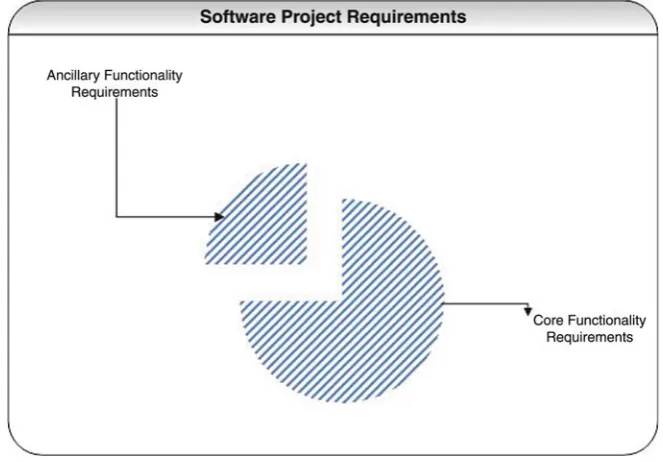
Core functionality requirements are those functionalities of the product without which, the product is not useful for the users. These functionalities must be ful-filled and exceptions cannot be granted or resorted to during development of the product. Core functionality addresses the performance of a set of business pro-cesses. The main purpose of software development is to fulfill this core functionality.
Ancillary functionality requirements supplement core functionality. Even if the ancillary functionality is not fulfilled, the product is still useful but may cause inconvenience in the form of loss of productivity or security. One significant point to be noted here is that the customer, more often than not, may not specify this functionality and even expects the development team to take care of this ancillary functionality!
processes using the software becomes tedious. That is the reason, I have not used the ‘‘functional and non-functional’’ classification of requirements.
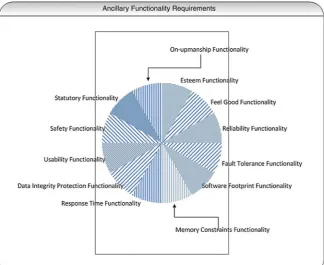
In almost all cases of software development, core functionality is addressed completely. The customer provides core functionality in project scenario. It is defined by the project team or domain experts in the case of a product development scenario. But when it comes to ancillary functionality, it is common to miss out on some of the ancillary functionality. In many cases where the end product of software development is panned by the critics, the criticism stems from the fact that all relevant ancillary functionality is not fully or not efficiently implemented. Various classes of statutory functionality requirements is depicted pictorially in Fig.2.2.
The following are the ancillary functionalities that need to be included in the overall requirements for the project:
The functionality to enable persons with disabilities to use the product as also the functionality to ensure that intruder prevention come under this category. 2. Safety functionality—This functionality protects the user from causing injury
to the users. However, as computer usage especially from this stand point cannot cause physical injury, it has to protect him from logical injuries including financial losses. Examples for safety functionality include charging the credit card but not booking a ticket in online transactions, computational inaccuracies, performing wrong transaction (buying shares when we intended to sell), and data loss due to accidental deletes.
3. Security functionality—While safety functionality is to protect the user from the product, security is safety from external attacks. Protection from intruders, malicious use of insiders, and data theft via the Internet and so on are examples of security functionality.
4. Usability functionality—It was originally referred to as User-friendliness. The objective of this functionality is to make the software usable intuitively and with minimal reference to user manuals. Graphical user Interface (GUI) has achieved much of this functionality but improvement is always possible. 5. Data Integrity Protection functionality—Now that computing shifted from EDP (Electronic Data Processing) rooms to end users, this has become an important functionality for any software product. End user can unintentionally and innocently affect data integrity. They may enter numerals in name fields and alphabets in numeric fields. In Human Resources (HR) applications, they may enter a date of birth such that the age of the employee may either be below legal employment age or above the retirement age. In hospital or hotel management applications, they may enter check out date as prior to check in date. Users can enter wrong data in a hoard of ways. It is essential that all necessary actions must be taken to prevent entry of wrong data. So data validation requirements become important aspect of ancillary functionality. 6. Response time functionality—Sometimes, especially in real time
applica-tions, response times form part of core functionality. In business applications however, they form part of ancillary functionality. In web based applications, response times are important as the user and the server may not be at one location and if the application does not respond fast enough, the user may abort the application or do something else. Normally these form part of organizational development standards.
7. Memory constraints functionality—With software controlling every device today, the constraint still remains. It is a thing of the past as far as computers are concerned but devices like mobile phones, cars, washing machines and the like, not to mention rockets and space shuttles, memory constraints remains. In these cases, memory constraint has to be taken into consideration. These requirements can be obtained from hardware manufacturers who supply the hardware on which the software needs to function.
Controlled (CNC) machines not only in workshops but also in homes do have this limitation. In the present era, the cars, the refrigerators, the washing machines, the ovens, the mobile phones all have software on a chip which have limited capacity. This calls for restrictions on the size of the software that can be installed on the chip. This information can be obtained from the hardware manufacturers supplying the selected chips on which the software is going to be installed.
9. Fault tolerance functionality—Users make mistakes in using software, mostly unintentionally. This functionality ensures that software does not crash or abort when a mistake is committed by the user. It provides an error message and provides an alternative path and allows the user to use other functionality besides coming out of the fault-scenario smoothly without causing any damage. 10. Reliability functionality—There is a misconception in some quarters that since there are no moving parts, software ought to function reliably if it correctly runs once. But in these days of fast obsolescence, this becomes applicable. Every 3 years a new version of the operating system, browser, and middleware are released. The hardware, including processors, Network Interface Units (NIUs), switches, etc. are also upgraded every now and then. Since most modern applications work on the Internet the threat of viruses, spyware and malware also increased significantly. Any of these can impact the way our software works. Therefore, it is important to build the software in such a way that some of the possible changes do not affect the software or provide functionality to indicate that the environment changed so that cor-rective action could be taken. The users should not be faced with a software failure to understand that it needs upgrade. Software failure due to environ-mental change needs to be trapped and an alternative path needs to be available for the users for smooth changeover or closure of the application. 11. Feel-good functionality—This functionality is making the user interface look
jazzy and sexy. The idea is to make the users feel good while using the software. This is adding glitz to the user interface screens and using nice pictures for buttons and icons and so on. I know of software product failure because the screens are not sexy!
12. Esteem functionality—This functionality brings pride to the users. For example, a Rolex watch delivers the same core functionality (showing time) as any other watch. But by ensuring that the thicker gold plating of the casing, scratch-proof crystal and so on, Rolex watches bring pride to the owners albeit at a higher cost. In software too this kind of functionality can be brought in the form of better messages, handling of error conditions, adding functionality that no other software possesses and so on.
2.3 Classification of Requirements Based on Product
Construction Considerations
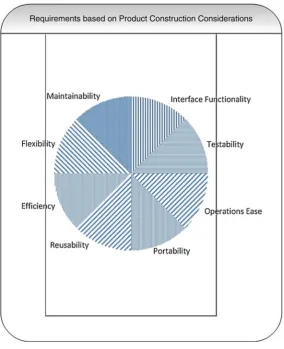
Any product, either for use by one organization or multiple organizations, needs to be built such that it works reliably without defects over the life of the product. In the case of software product, the life of the product is not dependent on its structure or wear and tear caused by functioning continuously but is dependent on the hardware platform it is installed on. A software product works as long as its hardware plat-form is unchanged, in working condition and is maintained well. In these days of fast obsolescence of hardware, the life of computer hardware itself is short com-pared to other types of machinery. As most of the present day software products are working on the Internet, there are many external factors that can adversely affect the application’s reliability and defect-free functioning of the software product. Therefore, utmost care needs to be exercised in constructing the software product so that minor modifications in the environment outside the software and hardware platforms would not impact the reliability and defect-free functioning of the product. These requirements are unlikely to come from the end users or manage-ments of the client organization. These need to be derived and implemented in the software product by the project team and the management of the software devel-opment organization. From this standpoint, the classification of requirements is enumerated below. Figure2.3depicts these requirements pictorially
1. Maintainability—The resultant product ought to be maintainable. That is, it ought to be possible to modify the code, add code or delete some code. The key aspect of maintainability is not just to add, modify or delete but to do those activities efficiently, effectively and with minimum expenditure of resources. Another important aspect of maintainability is that persons other than the original developers should be able to maintain the product. The product specifications that dictate product maintainability come under this category. These are normally in the standards and guidelines selected for the product. 2. Flexibility—Flexibility refers to the ability of the product to be used in
mul-tiple similar scenarios. For example, a materials management software product should be useful in engineering industry, chemical industry, mass production system and batch production system. Another understanding of flexibility refers to the ability of the product to be useful without any modification, when some of the underlying parameters change. For example, in a payroll software product, addition of a new deduction or addition of a new payment, should not render the product useless. On the other hand, the package should still be usable without changing the source code. The functionality specification that is focused on achieving flexibility in product functioning comes under this cate-gory. These specifications are usually part of standards, guidelines and ancillary functionality requirements.
space etc.) but also the time of end users, bandwidth on the network, backup storage and so on. The product should minimize the time expected to be spent by the users, perhaps, by reducing the needed key strokes and mouse clicks. The functionality specification that is focused on efficiency of resource usage comes under this category. Standards, guidelines, ancillary functionality requirements provide these requirements.
have originated there. In software industry, re-usability is rather an exception rather than a rule. But it pays to implement this concept in software products too. These are non-functional requirements and are normally covered by standards and guidelines or the organization.
5. Portability—In earlier days, porting is referred to as shifting the software developed in the same language such as COBOL from one hardware platform to another. But now, such a thing is passé. But another type of porting has come on to the scene. It is shifting the web site from one host to another. With cloud computing, it would be much more frequent in the future to be shifting applications from one host/data center to another. The functionality specifica-tions focused on ensuring that the impact of porting is minimized come under this category and include standards and guidelines for achieving the portability. 6. Operations ease—Modern software products are large and multi-functional systems involving many users, perhaps, from different geographical regions spanning international borders. To keep such systems operational round the clock, they need specialists running the operations. Therefore, many of them need dedicated/shared systems administrators, DBAs and network administra-tors. In many cases, updating the software or hardware has to be achieved without bringing down the systems. Therefore, the software product needs to be built keeping all these aspects in consideration. These aspects are covered normally by the standards and guidelines dealing with product architecture, design and construction.
7. Testability—Of course, the product has to be testable and will be so. What is so special about testability then? It is generally agreed that 100 % testing of large software products is not practicable. Therefore, a variety of quality assurance activities are implemented during software development. The cost of fixing defects varies proportionately with the stage in which the defect is uncovered. A defect uncovered during unit testing costs much less to fix than a defect that is uncovered during system testing stage. The final product is always testable but what is sometimes becomes difficult to test is, the software unit/ component. The software product has to be designed and built in such a way that every software unit is independently testable in a stand-alone manner. Testability requirements are normally covered by the standards and guidelines dealing with software architecture, design and construction guidelines. 8. Interface functionality—In these days of web based Internet applications,
2.4 Classification of Requirements Based on Source
of Requirements
Yet another way to look at requirements is based on the source from where it is obtained. There are many sources from which we can garner requirements for the proposed software product. Enumerated below are the possible sources for establishing the requirements for a software product.
1. End users—These people are those that use the end product to perform their individual business processes. The software product is basically aimed at fulfilling their needs. These people provide the core functionality especially relating to the aspects of inputs, process and outputs at working level. End users may not be able to provide the management requirements expected from the software. End users can be located in the case of project scenario (intended for use within one organization) in the departments funding the software development. In the case of a COTS (Commercial Off The Shelf) product scenario, end users are scattered across the target market for the product. We may perhaps need to conduct market surveys to get their needs or select randomly some end users and interview them to obtain their needs and the core functionality for the product.
4. Project team—Project team comprises of the project mangers, project leaders, software designers, business analysts, programmers, testers, User Interface (UI) developers, and Database Administrators (DBAs). These people are also a source of providing requirements albeit the fact that they may not be able to provide core functionality unless the product is proposed to be used in software devel-opment activities. They would however be able to provide ancillary functionality such as usability, maintainability, safety, security, and reliability and so on. 5. Statutes—Statutes include governmental regulations pertaining not only to
usability of the software but also about possible illegal activities. The intended software product shall not either commit, aid or abet any sort of criminal activity. Therefore, the requirements need to include all statutes that need to be implemented as well as ensure that all prohibited functionality is excluded from the proposed software product. The business analysts carrying out requirements analysis ought to be aware of the statutes that mandate inclusion of functionality as well as the functionality that is prohibited. Some of the examples of prohibited activities include stealing of personal data, siphoning away of monies in dormant bank accounts, sending spam emails and so on. 6. Industry standards—These include standards of industry (such as ISO,
CMMI, NASSCOM (National Software and Services Companies of India) or professional associations (such as IEEE, SPINs, SPMNs) or organizational standards of either the vendor organization or the client organization. These standards address various aspects of software engineering methodologies including processes, guidelines, formats, templates and checklists). A host of information and best practices are available from such standards and ancillary functionality can be derived from those standards.
7. Software designers—Software designers can provide ancillary requirements about the efficiency, fault tolerance, operations ease, installation ease, usability, structural stability and so on of the end product. Software designers are also normally part of the project team but are treated separately because software designers play a key role in the final product. Finally it is the soft-ware designers that have to shoulder the responsibility for any missing/ defective functionality in the end product of software development.
8. Software programmers—Software programmers are at the end of the chain for implementing the requirements in the software. However, they are the people who need to implement all the requirements conveyed to them using software design documents. However, coding guidelines, UI guidelines, and any other organizational guidelines would not form part of design documents and programmers are expected to be knowledgeable of such standards as well as implement them effectively in every program they code. Software pro-grammers can specify ancillary functionality aspects pertaining to maintain-ability, testmaintain-ability, reusability of the code and so on.
10. Management of software development team—These individuals include project manager, project leader and other senior management personnel including program managers. These individuals would be in a position to have a bird’s eye view of the overall project and would be able to provide interface requirements to ensure that the software product would be able to interface effectively with other applications in the organization. They would also be able to ensure that all functionality is included for the proposed software product.
11. Marketing department—Especially in product development organizations, marketing is a source of product requirements/specifications. A Marketing department can generate product requirements from the field staff or a market survey of the potential users of the proposed product. Market surveys are a very popular vehicle to collect user requirements and freeze product specifi-cations. A Marketing department is the primary source for one-upmanship functionality in a COTS product.
2.5 Levels of Requirements
Institute of Electrical and Electronics Engineers (IEEE) has specified two levels of requirements specifications, namely, the User Requirements Specification and Software Requirements Specification. This gives rise to the question ‘‘Do we have two levels of requirements in software development?’’
In any product there are two sets of requirements. One is the set of needs that the product fulfills and the second is the set of specifications that the product must adhere to in order for it to fulfill the needs of users. Let us take a bridge over a river (or a body of water) as an example. The need to be fulfilled is a bridge that can carry six lanes of traffic over a river of two furlongs breadth. Now based on this specification, some preliminary work is carried out to determine the depth of the water body, the banking on both the sides, the soil quality at the bottom of the water, the number of cars, trucks and other vehicles that traverse the bridge etc. Based on the study, the specifications for the bridge are finalized. These are the product specifications for the bridge, which include the load it has to support, the type of bridge (suspension, column supported, arched etc.), the width and so on. Based on these product specifications, a bridge is designed. Using the design, the bridge is constructed.
Thus, there are three layers before the actual fabrication/manufacture/con-struction begins and these are:
1. The needs
2. The product Specifications 3. The design
In software development too, we have three levels before the coding begins. There are various nomenclatures for these three levels. I am presenting a few here but there could be others.
1. User Requirements Specification (URS), System Requirements Specification (SyRS), Business Function Specification (BFS), Functional Specification (FS), Requirements
2. Low Level Design (LLD), Software Requirements Specification (SRS), Func-tional Design Specification (FDS), Architecture
3. High Level Design (HLD), Software Design Description (SDD), Software Design Specification (SDS), Detail Design Specification (DDS)
Now the next question that arises is ‘‘what requirements do we need to man-age—user requirements or software requirements?’’
User requirements are original and first in the chain. Software requirements are not original. They are derived from user requirements. When user requirements change, the software requirements also change. Therefore, we need to manage user requirements. If we can minimize changes to user requirements, the changes to software requirements would automatically be minimized. This book focuses on managing user requirements.
2.6 Definition of Requirements in the Context of Software
Development
How do you answer the question ‘‘what constitutes a software application?’’ I am sure there will be numerous or multiple alternative answers for this question. The answer I select is that the application consists of a number of information processing processes. Information processing processes can be further divided into three classes, namely,
1. Input processes 2. Output processes 3. Associative processes
Output processes send information across the application boundary. The recipients of information would be an entity (an individual, a machine or another computer application). The output could be normal data in the form of a report either on paper or computer screen or to another application, or it could be control data in the form of trigger to another application. The giving/receiving application can be on another computer or another machine.
Associative processes are those processes that aid and assist the input and output processes in information processing. Consider a login process; it is neither an input nor an output. Similarly a file upload is a process; and so is an integrity checking process and so is the POD (Power On Diagnostics) process. These are all examples of associative processes.
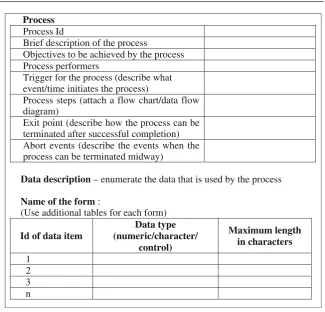
Requirements elicitation/gathering is mainly enumerating all the processes that form a part of a software application and obtaining details about these processes so that downstream activities can be executed without further reference to the client or with minimal reference to the client.
Now each process has these attributes:
1. Inputs—each process receives certain inputs. While input processes receive inputs from external sources, output processes and associative processes receive inputs from the internal sources.
2. Outputs—Each process delivers some outputs. While output processes deliver to external recipients, input processes and associative processes deliver to internal recipients.
3. Process—each process carries out some transformation of inputs and converts them to outputs. Each process consists of some related steps with a start and an end event. The process includes verification of the inputs for their complete-ness, appropriateness and freedom from errors.
4. Triggers—each process needs a trigger that initiates the process into execution. The trigger could be an event initiated by an individual or another application or could even be by the application itself.
When we enumerate all the processes and define all the above four aspects for each of the processes comprising the software application, we have a complete requirements specification document.
2.7 Evolution of Requirements
In a new product—non-existent in the market—This is a scenario in which a completely new product, the type which is not existing in the market is contem-plated. In this scenario, the requirements are evolved as follows:
1. Idea germination