Framework for Rapid Integration of Offline Experiments
into Remote Laboratory
https://doi.org/10.3991/ijoe.v13i12.7738
Ning Wang
University of Houston, Texas, USA
Gangbing Song University of Houston, Texas, USA
Xuemin Chen!!"
Texas Southern University, Texas, USA [email protected]
Abstract—Remote laboratory (RL) has become an important component of online education and smart factory due to its capability of remote operation and cost-saving. Recent advantages of information technology have provided vari-ous ways to develop RLs. However, how to rapidly bring an offline experiment online is still a vital issue in the development of RL. In this paper, a new flexi-ble framework based on social instant messaging (IM) application architecture is proposed for integrating an offline remote experiment into RL rapidly as a communication node with unique ID. To rapidly connect the LabVIEW con-trolled devices to server, a new LtoN_UID (LabVIEW to Node.js with Unique ID) module built on Socket.IO protocol is designed and implemented. To demonstrate the effectiveness of this new flexible framework, two existing en-gineering experiments, i.e., a Smart Vibration Platform (SVP) experiment and a PID motor speed control experiment, are integrated into remote laboratory.
Keywords—Remote Laboratory, Instant Messaging Application Architecture, Flexible Framework, LabVIEW, Node.js
1
Introduction
A real-time remote access laboratory with distributed and modular was designed at University of Southern Queensland [4]. They proposed a general architecture for distributed Peer-to-Peer (P2P) network control systems, but only focused on Micro-Controller Unit (MCU) and communication protocol selection. However, how to develop a flexible software system to quickly develop the RL system is still not ad-dressed clearly.
A flexible RL architecture was designed and implemented at University of Li-moges and University of Mostaganem [5]. They proposed a flexible architecture based on Node.js web engine, and used a FEHI (Flexible Ethernet Hardware Inter-face) and PEB (Practical Evaluation Board) to directly handle the real-time communi-cation between experiment equipment and Node.js server without using any software tools, such as NI LabVIEW, MATLAB. However, for an existing experiment, the new hardware interface and PEB need to be reconfigured and re-implemented.
A unified framework has been developed at Texas Southern University and Uni-versity of Houston based on the traditional P2P RL system architecture [6], [7]. To support real-time communication, an LtoN (LabVIEW to Node.js) module was de-signed and implemented for traditional P2P connection between user and experi-mental device [6]. However, this LtoN module can only connect an experiment with server using tranditional P2P approach to achieve real-time communication. Conse-quently, how to rapidly integrate experiment into the RL system is still not well ad-dressed by this framework.
As the experimental hardware and the network model limitations which are dis-cussed above, it is hard to be extended to other institutes with their proposed solu-tions. Therefore, how to design a flexible approach to rapidly integrate remote exper-iment into RL system is still a vital research topic for RL development [5], [6], [7]. To address this essential issue, a new flexible framework based on social Instant Messag-ing (IM) application architecture as a TURN-KEY remote experimental integration solution is proposed and implemented in this paper. With this new framework, a new offline experiment can be added into the RL system as a node with its unique ID. With the Web 2.0 technology, this flexible framework is easy to be integrated into most of popular web-based Learning Management Systems (LMSs), such as, Moodle, iLab Shared Architecture (LSA) to connect them into social network. Moreover, a new LtoN_UID (LabVIEW to Node.js with Unique ID) module built on Socket.IO protocol is designed and implemented for rapid connecting the experimental equip-ment with server. To the best knowledge of the authors, this solution is the first one using the popular social IM application architecture to implement the RL system without extra plug-ins.
To demonstrate the effectiveness of this new flexible framework, a remote Smart Vibration Platform (SVP) experiment and a remote PID motor speed control experi-ment are revamped. Meanwhile, this new framework also can be used for the integra-tion of industrial equipment remote control and monitoring applicaintegra-tions. It will be an essential improvement for the RL system development in future.
framework is presented. In Section 4, the rapid integration of two remote experiments is discussed. Concluding remarks are drawn in Section 5.
2
Empirical Study of Related Technologies for Flexible
Framework Development
The distributed RL system aims to expand a One-to-Multi (O2M) communication paradigm, where one central system serves multiple users; or to a Multi-to-Multi (M2M) communication paradigm, with many users using many experiments by dif-ferent providers. In a distributed system, experimental modules need to be created and hosted by individuals. Users are all scattered in the network, and anyone can connect to any experiment if it is available. To achieve this goal, a distributed RL system with excellent features should have a flexible system architecture, a stable real-time mid-dleware in server, and a high performance real-time data transmission protocol [4]. To achieve these excellent features of the distributed system, online social IM application architecture, Node.js and Socket.IO are the suitable candidates for the new flexible framework implementation based on our empirical research.
2.1 Document title and meta-data
Send
Message
Update
Message
Send
Update
Send
Message
Broadcast
Message
Send
Broadcast
Chatter
Chatter
Chat Room
Client Web Application
Chat-Room Web Server
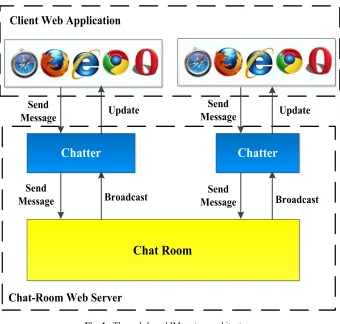
Fig. 1. The web-based IM system architecture.
2.2 Node.js Web Engine
en-gine, the Node.js is an especially fast and efficient web engine which is more suitable to handle the high perfor-mance real-time communication.
Because Node.js stays away from certain undesirable interfaces, such as synchro-nous I/O, it only exposes non-blocking asynchrosynchro-nous interfaces to the programmer. As each web application running on the Node.js is a single thread, the users don’t need to consider an event completing and taking over while they are in the middle of another task. Node.js uses the module architecture to simplify the creation of complex web applications [12]. Each module contains a set of functions related to the 'subject' of the module. For example, the Node-HTTP-proxy module contains functions specif-ic to HTTP (Hypertext Transfer Protocol) Proxy. Furthermore, it provides some core modules to support user to access files on the file system, to create HTTP Proxy and Socket.IO, and to perform other useful functions. Node.js is also a promising technol-ogy and an excellent choice for high load web applications.
2.3 Data Transmission Protocol Selection
WebSock-et are to break the limitations of the request/response protocol such as HTTP [15]. In summary, WebSocket provides an alternative approach to the REST/SOAP (Simple Object Access Protocol)/AJAX (Asynchronous JavaScript and XML) technologies for developing the real-time communication web application, such as, some web-based control applications [14]. Moreover, WebSocket is the next generation method of asynchronous communication between client and server, and is already standardized by the World Wide Web Consortium (W3C). Currently, it is already implemented in the most of the popular web browsers, such as Microsoft Edge, Chrome, Safari, Fire-fox, Opera, and among others [15].
Socket.IO is designed based on WebSocket, and enhances the WebSocket by providing built-in multiplexing, horizontal scalability, automatic JSON (JavaScript Object Notation) encoding/decoding, and more [16]. In general, Socket.IO uses fea-ture detection to decide which approach, such as WebSocket, AJAX long polling or Flash, will be used to establish the connection for real-time web applications. Through blurring the differences between the different transmission mechanisms, it is possible for Socket.IO to support the real-time web applications in any popular browsers. Socket.IO includes two parts: a client-side library for the browsers, and a server-side library supported by Node.js. Although Socket.IO works as simply a wrapper for the WebSocket, it provides more features, which includes broadcasting to multiple sockets, storing data associated with each client, and asynchronous I/O, to support real-time web applications development.
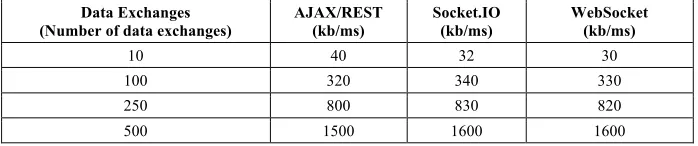
To compare the different real-time data transmission protocol performance, we tested 10, 100, 250 and 500 data exchanges per millisecond between the client web module and the server-side middleware. Each data exchange between the Node.js server and the Chrome browser is a 4K bytes random data string. The Node.js server is running in release mode. Meanwhile, the console messages are minimized output for both server and client. The server is HP Proliant DL380e Gen8. Hardware of the server includes Intel Xeon E5 2.5 GHz processer, 16 GB of RAM. The network is the University of Houston’s main Campus Wi-Fi network, and the download speed of this network is around 45 Mbps and the upload speed around 75 Mbps. Based on the test results listed in Table I, the Socket.IO and WebSocket have better performane than AJAX/REST in general. Comparing the SocketIO with WebSocket, SocketIO has better performances than WebSocket has. Consequently, Socket.IO is selected for implementing real-time data transmission between the users and the experimental devices.
Table 1. Comparison between different data transmission protocol
Data Exchanges
(Number of data exchanges) AJAX/REST (kb/ms) Socket.IO (kb/ms) WebSocket (kb/ms)
10 40 32 30
100 320 340 330
250 800 830 820
3
Methodology
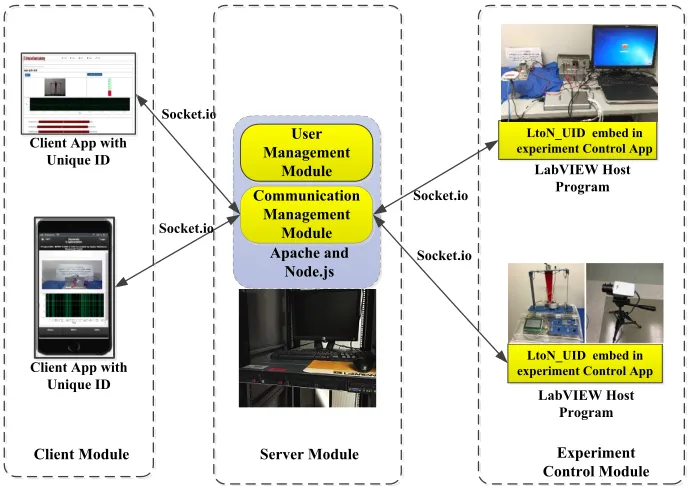
To answer our research question, “How to design a framework to rapidly and flexi-bly integrate the remote laboratory system?”, a novel flexible framework is proposed. It is designed based on the online IM application architecture, and a new version LtoN module is developed to rapidly and flexibly integrate the remote laboratory. Fig. 5 shows the architecture of the novel flexible framework. The novel flexible framework includes three parts: client web module, server module, and LtoN module for experi-ment control.
3.1 Client Web Module
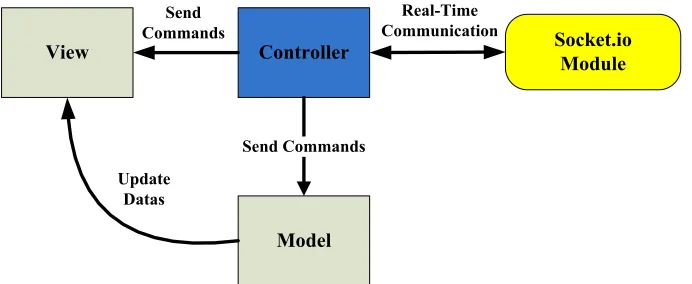
In the client web module design and implementation, the MVC (Model-View-Controller) software architectural pattern is used for implementing the User Interfaces (UI) as shown in Fig. 2. As client web technology has matured, frameworks, such as AJAX, JavaScript MVC, AngularJS, have been created that allow the MVC compo-nents to execute partly on the web browsers. To run the client web module on any popular browsers, the HTML5 technology is used for the web application implemen-tation. Some popular development languages, HyperText Markup Language (HTML), Cascading Style Sheets (CSS), and JQuery/JQuery-Mobile JavaScript libraries, for web application development are involved as well. In addition, to resolve the need of installing extra plugins for support efficient real-time data transmission, the Socket.IO module is used to client web module implementation. Meanwhile, the server-based Mashup technology is used for User Interface (UI) integration as well.
Socket.io Module Controller
Model View
Send Commands Send
Commands
Update Datas
Real-Time Communication
Fig. 2. The client web module designed model with MVC.
3.2 Server Module
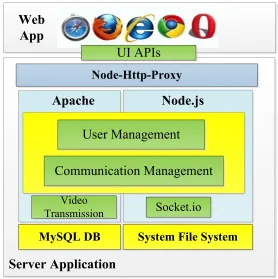
unique ID, and system creates a communication thread and pair them together based on this unique ID. With this module, the remote laboratory system based on the novel flexible framework can flexibly create one user to one equipment experiment, multi users to one equipment cooperative experiment, one user to multi equipment experi-ment and multi users to multi equipexperi-ment cooperative experiexperi-ment. It will significantly benefit the remote laboratory implementation. Fig.3 shows the architecture of server module.
Server Application
Node.js
Socket.io
Apache
Node-Http-Proxy
Video
Transmission
User Management
Web
App
MySQL DB
UI APIs
System File System
Communication Management
Fig. 3. The architecture of server module.
3.3 The New LtoN_UID Module
To rapidly connect the experimental equipment into the remote laboratory plat-form, an essential issue, “How to design a real-time communication module which can be easily used to connect experimental equipment and end users?”, must be ad-dressed. To address this issue, an easy to use real-time communication module based on Socket.IO, namely LtoN_UID (LabVIEW to Node.js with Unique ID) is proposed and implemented using LabVIEW [17], [18]. To fulfill the requirement of the new online IM application architecture based framework, the unique ID management func-tion has been integrated into the LtoN_UID module. The new LtoN_UID module can support P2P and M2M real-time communication via the unique ID arranged by server. Moreover, some bugs also have been fixed in this new LtoN_UID module to improve its performance.
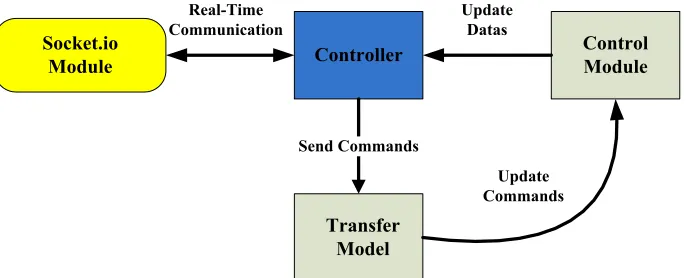
With the development of computer technology, LabVIEW also integrated a new feature to interact with the experiment Virtual Instruments by using RESTful web services technology. REST (Representational State Transfer) provides a lightweight protocol accessible to a wide variety of clients. The architecture does not require complex message passing and provides a simple interface for user to begin using Web services in LabVIEW. However, it requires the client interface to be developed using different technologies, and LabVIEW plug-ins must be installed in the browsers [43]. To resolve this plug-in issue and support efficient data transmission, the new real-time communication module, LabVIEW to Node.js with Unique ID (LtoN_UID) is de-signed and implemented.
Socket.io
Module Controller
Transfer Model
Control Module
Send Commands Real-Time
Communication UpdateDatas
Update Commands
Fig. 4. the LtoN_UID module designed model with MVC.
client web module can real-time communicate with experimental equipment without LabVIEW plug-ins. Meanwhile, any experimental equipment controlled by LabVIEW can be rapidly integrated into the remote laboratory system anywhere.
4
Implementation Discussion
To illustrate the effectiveness of the new flexible framework, a SVP experiment and a PID motor speed control experiment have been rapidly connected with users. Fig. 6 shows the whole implementation process of two remote experiments based on the new flexible framework. The detailed process of the experiment integration is given below
4.1 Experiment Hardware Setup.
The SVP hardware platform include a flexible steel frame fixed on top of a plexi-glass box, a motor, two Shape Memory Alloy (SMA) wires and a purchased magnetic iron clamped on a container of Magneto-Rheological (MR) fluid. To measure the acceleration, vibration of the platform and temperature of SMA, a data acquisition device, NI DAQ 6008 USB, to get the experimental data from the sensors of SVP.
The PID motor speed control hardware contains a) DC motor with tachometer, b) power amplifier c) power supply for the amplifier, d) NI USB-6361 X Series DAQ and e) PC workstation.
4.2 Experiment Software Integration.
The software implementation of two remote experiments includes three tasks: the client module implementation, server module integration and experiment control application implementation.
Client Web module Implementation. To implement the client app, HTML5 Technology is used to implement the user interface. With the server-based Mashup technology, the data was analyzed and reformatted on the server module, and then the data was transmitted to the user's browsers. To achieve the real-time communication with server module, a communication function with UID is implemented using Sock-et.IO module in client app. Through this communication function, client app can be rapidly and flexibly connected with two experiments through server module.
As shown in Fig. 6, to implement the web application, HTML5 Technology is used to implement the user interface. The new LtoN_UID protocol module is used to im-plement the real-time data communication. With the server-based Mashup technolo-gy, the data was analyzed and reformatted on the remote server, and then the data was transmitted to the user's browsers. The UI includes three parts: 1) experiment real-time video; 2) real-real-time experiment data display; 3) experiment control components.
Apache and Node.js Communication
Management Module Socket.io
LabVIEW Host Program LtoN_UID embed in experiment Control App
LabVIEW Host Program Socket.io
Socket.io
Socket.io User
Management Module
Server Module Experiment
Control Module Client App with
Unique ID
Client App with Unique ID
Client Module
o
LtoN_UID embed in experiment Control App
Fig. 6. The whole implementation process of a remote PID experiment and a remote SVP experiment.
module, which is used to arrange and manage the user unique ID, is implemented and integrated into the server module as well.
Integrate the New LtoN_UID Module to the Experiment Control Application.
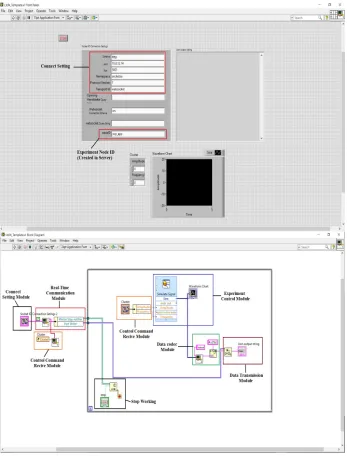
With the new version LtoN module, students can conduct the experiment, save the experiment data to file system. More details of this new real-time data transmission protocol are illustrated in the following:
• The new module includes two parts, experiment equipment control part running in
workstation and implementing by LabVIEW; and server part running in web server which was developed using JavaScript language and enhanced by the Socket.IO.
• In this new LtoN_UID module, some special communication instruction set based
on the experiment unique ID to connect the experiment with server-side user man-agement module to handle the real-time data transmission.
• In this new module, we revise some brief instructions to control experiment
pro-gress for improving the real-time communication performance.
5
Future Works
Although the novel flexible framework delivers a new rapid integration approach to support remote laboratory development, there are still further development required to improve the new framework stability and usability. More specifically, issues that need improvement are as follows:
1.Integrating the novel flexible framework into more Learning Management Sys-tems. Currently, we implemented our Wiki-based remote laboratory management platform based on this novel framework, and it includes a scheduler, a communica-tion management module, a user management module, and a learning materials management module. In future, we plan to integrate the novel flexible framework into some popular LMS (e.g., Moodle, MIT iLab Shared Architecture) to avoid double registration of students.
2.Integrating some industrial experiments based on our novel flexible framework. Such as, industrial equipment remote monitoring application, industrial equipment remote training application, etc.
6
Conclusion
In this paper, a new flexible framework has been designed and implemented suc-cessfully with a combination of advantages of social online IM application architec-ture and the new LtoN_UID module for experiment equipment real-time control. Comparing to other remote laboratory development framework including the unified framework we designed before, this new framework solved the issues of flexibility and scalability in remote laboratory development. Remote laboratory developers can bring the LabVIEW controlled offline experiment or equipment online with less effort with this framework. This flexible framework will significantly benefit remote labora-tory development for online engineering education and smart faclabora-tory.
7
References
[1] L. Gomes and S. Bosgoyan, "Current trends in remote laboratories", IEEE Transactions on Industrial Electronics., vol. 56, no. 12, pp. 4744-4756, Dec. 2009. https://doi.org/10.1109/ TIE.2009.2033293
[2] M. Tawfik, D. Lowe, C. Salzmann, D. Gillet, E. Sancristobal and M. Castro, "Defining the Critical Factors in the Architectural Design of Remote Laboratories." IEEE-RITA, vol. 10, no. 4, pp. 269-279. Nov. 2015. https://doi.org/10.1109/RITA.2015.2486388
[3] M.A. Prada, J.J. Fuertes, S. Alonso, S. García, and M. Domínguez, “Challenges and solu-tions in remote laboratories. Application to a remote laboratory of an electro-pneumatic classification cell.” Computers & Education, vol.85, pp.180-190, 2015. https://doi.org/10.1016/j.compedu.2015.03.004
[5] S. Farah, A. Benachenhou, G. Neveux, D. Barataud, G. Andrieu and T. Fredon, "Multi-User And Real-Time Flexible Remote Laboratory Architecture for Collaborative and Co-operative Pedagogical Scenarios." iJOE, vol.12, no.4, pp. 33-36, 2016.
[6] N. Wang, X. Chen, G. Song, and H. Parsaei, "Using Node-HTTP-Proxy for Remote Ex-periment Data Transmission Traversing Firewall." International Journal of Online Engi-neering (iJOE), Vol 11, No.2, pp.60-67, 2015. https://doi.org/10.3991/ijoe.v11i2.4443 [7] N. Wang, X. Chen, G. Song, and H. Parsaei, "Remote experiment development using an
improved unified framework." in World Confer- ence on E-Learning in Corporate, Gov-ernment, Healthcare, and Higher Education, vol. 2014, no. 1, pp. 2003–2010, 2014. [8] C.T. Moncreiff, "Computer network chat room based on channel broadcast in real time."
U.S. Patent 6,061,716, 2000.
[9] M. Dereshiwsky, "Equity in the Online Classroom: Adolescent to Adult." In Proc. Social Justice Instruction Conf. 2016, pp. 33-42. https://doi.org/10.1007/978-3-319-12349-3_4 [10] S.L. Bangare, S. Gupta, M. Dalal, and A. Inamdar, "Using Node. Js to Build High Speed
and Scalable Backend Database Server." In Proc. NCPCI. Conf. 2016, vol.2016, pp.19. [11] T. Hughes-Croucher, M. Wilson "Up and Running with Node.js ", Node: Up and Running
(1st Ed.), Sebastropol: O'Reilly Media, pp. 4-11, ISBN 978-1-4493-9858-3, April, 2012 [12] P. Teixeira, "Professional Node.js: Building Javascript based scalable software." John
Wiley & Sons, 2012.
[13] I. Fette, "The websocket protocol." Internet Engineering Task Force (IETF), 2011. pp. 5-6, ISSN: 2070-1721.
[14] V. Pimentel, B.G. Nickerson, "Communicating and displaying real-time data with Web-Socket." IEEE Internet Computing., vol.16, no.4, pp.45-53, 2012. https://doi.org/10.1109/ MIC.2012.64
[15] V. Wang, F. Salim, P. Moskovits, "The definitive guide to HTML5 WebSocket" Berkeley, Calif, 2013, Vol. 1, USA: Apress, https://doi.org/10.1007/978-1-4302-4741-8
[16] R. Rai "The Socket.IO protocol", Socket.IO Real-time Web Application Development, Se-bastropol: O'Reilly Media, pp. 87-91, ISBN 178-2-1607-87, February, 2013.
[17] N. Wang, X. Chen, G. Song, and H. Parsaei, "A novel real-time video transmission ap-proach for remote laboratory development." International Journal of Online Engineering (iJOE), Vol. 11, No. 1, pp. 1–4, 2015.
[18] Wang, N., Chen, X., Song, G. and Parsaei, H., 2015. "An Experiment Scheduler and Fed-erated Authentication Solution for Remote Laboratory Access." International Journal of Online Engineering, 11(3).
[19] N. Wang, X. Chen, Q. Lan, G. Song, H. Parsaei, and S.C. Ho, "A Novel Wiki-Based Re-mote Laboratory Platform for Engineering Education." IEEE Transactions on Learning Technologies, Vol. PP, No. 99. 2016 https://doi.org/10.1109/TLT.2016.2593461
8
Authors
Ning Wang is with University of Houston, Texas, USA.
Gangbing Song is with University of Houston, Texas, USA.
Xuemin Chen is with Texas Southern University, Texas, USA ([email protected]).