Methods and applications of new technologies used for reducing
of chemical usage and controlling of pests (a review)
Mohammad Ali Ebrahimi
1, Mohammad Hadi Khoshtaghaza
1*, Saeid Minaei
1,
Bahareh Jamshidi
2(1. Department of Biosystems Engineering, College of Agriculture, Tarbiat Modares University, Tehran, Islamic Republic of Iran; 2. Agricultural Engineering Research Institute, Agricultural Research Education and Extension Organization (AREEO), Karaj, Iran)
Abstract: Initial low cost of pesticides and lack of knowledge on the part of agricultural producers has led to an overuse of pesticides, with dangerous consequences. On the other hand, today, pesticides have an important role in the increment of agriculture products. Therefore, in recent years, the major aims of agricultural, environmental and even the food industry researchers have been to reduce the usage of chemical materials in agricultural applications. To achieve this, variable rate application in sprayers using different technologies such as machine vision, ultrasonic sensors, spectrometry, laser scanning, as well as pest identification and classification, have been applied in recent studies. This paper reviews these works reported in the 21 century. In addition, the best result is suggested in the conclusion section for future studies.
Keywords: machine vision, ultrasonic sensors, spectrometry, laser, pest identification and classification
Citation: Ebrahimi, M. A., M. H. Khoshtaghaza, S. Minaei, and B. Jamshidi. 2018. Methods and applications of new technology used for reducing of chemical usage and controlling of pest (a review). Agricultural Engineering International: CIGR Journal, 20(2): 144–153.
1 Introduction
Pest management in field and greenhouse conditions has been one of the main concerns for the agricultural producers. The need to reduce losses and crop damages, which can severely affect marketable yields, forces farmers to use different methods such as pest scouting, regular spraying program and integrated pest management (IPM) to control and protect fields against pest damages. In the present century, the use of pesticides has increased due to its initial low cost, easy accessibility, quick influence and lack of environmental consciousness on the part of growers, resulting in dangerous consequences.
Although the use of chemicals helps pest management, it has also had many side effects on human health,
Received date: 2017-11-25 Accepted date: 2018-05-04 ∗ Corresponding author: M. H. Khoshtaghaza, PhD, Tarbiat Modares University, Tehran, Islamic Republic of Iran. Tel: 00982148292310, Fax: 00982148292200, Email: khoshtag@ modares.ac.ir.
animals and the environment (Belforte et al., 2011). Therefore, in recent years many studies have been undertaken to use new technologies for accurate detection and effective management of pests in order to decrease the use of chemicals in farms and greenhouses. Canopy detection (Giles et al., 1988; Meron et al., 2000; McKerrow and Neil, 2001; Carreiras et al., 2006; Gil et al., 2007; Lee and Ehsani, 2008) and insect identification (Gotsch and Brauschweig, 1999; Ridgway et al., 2002; Koumpouros et al., 2004; Neethirajan et al., 2007; Li et al., 2009) have received special attention.
based on canopy detection to reduce the usage of chemicals. VRA of agrochemicals has been promoted to treat orchards on site-specific and tree-specific bases (Khot et al., 2012; Mallarino and Wittry, 2006). VRA favours good environmental stewardship towards moderating the use of chemicals that could have long-term impacts on human health and the environment. Also, VRA could potentially reduce overall production costs for fruit orchards. Variable rate technology needs detection systems such as machine vision, ultrasonic sensors, spectrometry and laser to locate the target.
This paper presents the principles and applications of the main systems in agriculture used for canopy detection and insect identification, including systems that work based on machine vision, ultrasonic sensors, spectrometry and laser.
2 Canopy detection
2.1 Laser scanner
Laser scanner as a new method has been used in recent studies (Keightley and Bawden, 2010; Liorens et al., 2011; Seidel et al., 2011; Mendez et al., 2012; Seidel et al., 2012). Although the application methods of this technology are different, their principles are the same. For example,in a recent study, the laser scanner was used to posit the spraying arms according to the tree canopy (Figure 1). In this work,at a given position along the row, measured points were sent from the laser scanner to the computer and are imported into the main spraying program and further into the positioning algorithm module. At the end the module sends controls to the electro-hydraulic valves in order to move the spraying arms cylinders (Osterman et al., 2013).
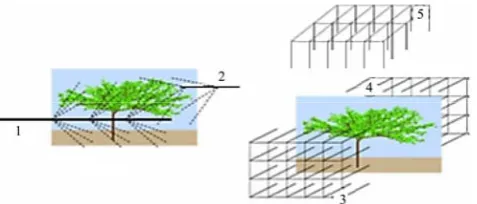
In another approach, after obtaining the virtual tree, the program allows the simulation of a terrestrial laser scanner (LSS) and then determines some vegetative parameters from this simulation. Concerning data from the LSS, the program provides a set including the distances from the laser beam origin to nearby plant objects (branches or leaves). The virtual tractor-mounted LiDAR (is a surveying method that measures distance to a target by illuminating the target with pulsed laser light and measuring the reflected pulses with a sensor) advances along the row (OY axis), the laser beam is
directed toward the interior part of the vegetation (OX axis). Through a secondary angular movement in the XZ plane the scanner measures the distances from the virtual orchard (Figure 2) (Mendez et al., 2013).
Figure 1 Spraying arms with eight degrees of freedom (DF) positioned according to the shape of a tree canopy in the upper (U),
middle (M) and lower (L) zone
Note: Fitted canopy segments are described with (x, y, θ) where x and y are coordinates of the midpoint and θ is angle of the normal (Osterman et al. 2013).
1. Lateral angular 2. Opposite lateral angular 3. Orthogonal lateral 4. Opposite orthogonal lateral 5. Zenith
Figure 2 Types of scan (Mendez et al. 2013)
Results reported by researches on target-directed spraying, it is expected that the drift and ground deposits of pesticides can be reduced dramatically. In addition, more effective spraying enables changes in the effective dose, which results in smaller amounts of pesticides consumed.
2.2 Multispectral spectrometry
use of spectrum in this field, there should be a qualitative difference between the target and the surroundings.
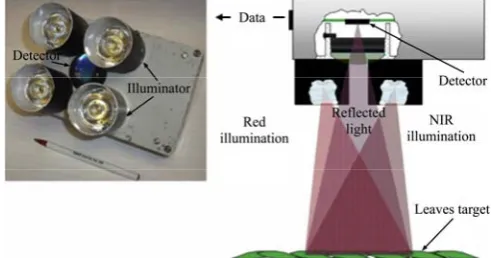
The quality of young and mature leaves is different. Therefore, spectral sensors can sense the young leaves. Based on this principle, Larbi et al. (2013) developed a leaf detection system using multispectral spectrometry. They supposed that psyllids only feed on young citrus leaves and designed a leaf detection module to detect young leaves for selective spraying. In this approach, a four-band sensor (570, 670, 750, and 870 nm) was mounted on a metal frame, with the sensor facing downwards at an adjustable target distance from the floor. The sensor could be moved with the aid of a variable speed motor and a sprocket-chain arrangement in two directions: (A: near-infrared bands leading, and B: visible bands leading). In an earlier effort, it was found that sensor angle significantly affects the detection of young leaves and that perpendicular orientation of the sensor to the target gives the best results. A piece of flat black painted cardboard was used as background to absorb light waves emitted from the sensor and eliminate noise (Figure 3). The classification algorithm involved calculating different vegetation indices (using the sensor’s spectral reflectance data) and implementing either the Euclidean Distance (ED) or the Matching Measures (MM) classifier.
Figure 3 Four-band sensor (left) and its schematic profile (right) (Larbi et al., 2013).
2.3 Ultrasound system
Making use of an ultrasound system as a robust tool has increased in agricultural studies especially for the measurement of tree canopy volume (Gil et al., 2007; Zaman and Salyani, 2004; Tumbo et al., 2002; Escolà, 2010; Balsari and Tamagnone, 1998). Ultrasonic sensors transmit high-frequency sound waves towards an object
and sense the reflected echo. The distance between the sensor and the object is then calculated by measuring the time difference between the transmission and reception of the waves (Liorens et al., 2011). However, due to the relative wide angle divergence of ultrasonic waves (Wei and Salyani, 2004), the field of view becomes larger as the distance between the sensor and the canopy (target) increases thereby reducing the accuracy of measurements and increasing the possible interference in the signal reception of two consecutive sensors (Liorens et al., 2011).
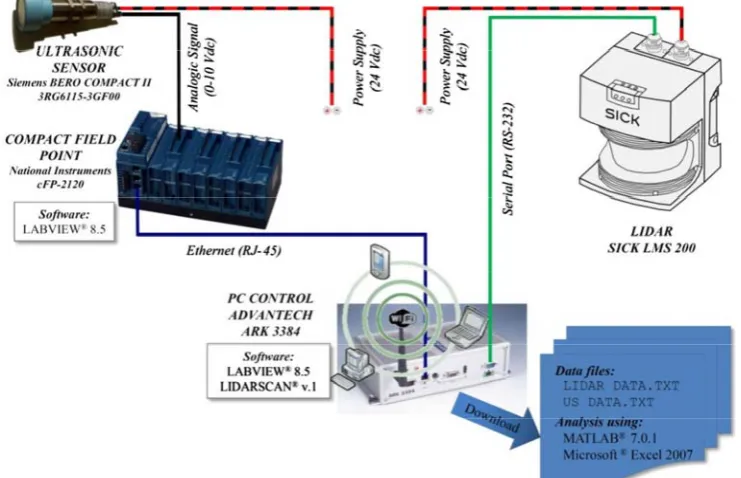
In an approach developed by Liorens et al. (2011) three ultrasonic sensors were placed with an equidistant spacing of 0.4 m on a stainless steel mast mounted on the side of an air-blast orchard sprayer. The sprayer was equipped with six individual and adjustable spouts (three on each side of the machine). These three sensors were connected to the central control unit placed on the rear part of the sprayer on which a computer and a Compact Field Point were installed. Data processing was done using a program developed based on LabVIEW software. (Figure 4).
The aim of this study was to compare the ultrasonic and LIDAR sensors. Results indicated that an ultrasonic sensor can be an appropriate tool to determine the average canopy characteristics, while a LIDAR sensor provides more accurate and detailed information about the canopy.
transceivers used for sending and receiving ultrasound signals were the same. The triggering of transceivers was used to prevent unwanted false detections that could arise from the signal being detected on the selected transceiver immediately after another transceiver produced a sound
burst. In comparison to spraying in the control spraying mode (CM), the assessment of ultrasound electronic control system in AM mode for proportional spray application showed 20.2% total saving in spray volume per nozzle and area unit (0.30 l min-1 flow rate reduction).
Figure 4 Scheme of electronic connections between all the elements installed in the prototype (Liorens et al. 2011).
Much operational accuracy of the ultrasonic sensor is affected by environmental conditions such as exposure to cold weather, outdoor temperatures, crosswinds and temperature change, as well as sprayer design properties such as dust clouds, travel speeds and spray clouds effects. Evaluation of this parameters was done by Jeon et al. (2011). According to their reports, after exposure to outdoor cold conditions for four months, the RMS error in the distance measured by the ultrasonic sensor increased from 3.31 to 3.55 cm, which was not statistically significant. Neither the presence of dust cloud nor the changes in crosswind speeds over a range from 1.5 to 7.5 m s-1 had significant effects on the mean
RMS errors. Varying sensor travel speed from 0.8 to 3.0 m s-1 had no significant influence on sensor ability to detect distances. Increasing ambient temperature from 16.7°C to 41.6°C reduced the detection distance by 5.0 cm. The physical location of the spray nozzle with respect to the ultrasonic sensor had a significant effect on mean RMS errors. The mean RMS errors of sensor distance measurements were varied from 2.3 to 83 cm (Figure 5).
Figure 5 Experimental setup to test the sensor stability with the spray clouds (Jeon et al. 2011).
2.4 Machine vision system
precision sprayer. For this purpose, they made a setup which included a camera, tractor and a sprayer where an electro-pneumatic valve had been placed in front of each nozzle (Figure 6).
Figure 6 Figures of the precision sprayer (Bossu et al. 2008)
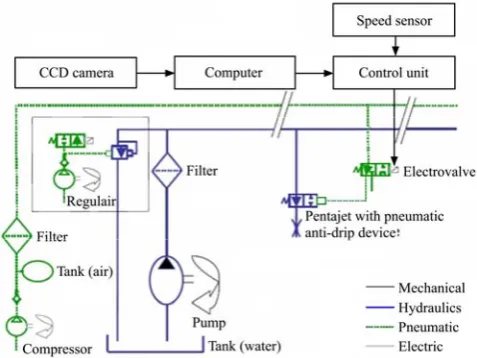
The Tecnoma”TS200” sprayer is composed of a six-meter boom with twelve nozzles spaced 50 cm apart. The hydraulic circuit was similar to the conventional sprayer with an output from the main pump fed to a pressure control valve (a constant pressure regulation). In the context of precision agriculture, two sensors have been embedded in the tractor: a vision system placed in the front part of tractor inclined with a 58◦ tilt-angle, CCD camera, Sony U1000, 1598 ×1199, and a speed sensor fixed on the front wheel. Moreover, the sprayer has been modified (Figure 7). So that, weed patches are clearly identified by a blob-colouring method. Finally, a pinhole model was used to transform the weed patch coordinates image into world coordinates in order to activate the right electro-pneumatic valve of the sprayer at the right moment.
Figure 7 General Flowchart of the precision sprayer (Bossu et al. 2008)
In the field applications distinction the difference between the target and the environment is not clear. Therefore, it is necessary to apply other statistical
techniques to extract the target. Support vector machine as a classification method can be a good example to omit the background from the crop picture and clear the target. In this field, Ahmed et al. (2012) had a study about weed controlling. They used a support vector machine (SVM) to classify crops and weeds observed in digital images. The images used in this study were taken from a chilli (Capsicum frutescens L.) field. With, five weed species commonly found in the chilli fields of Bangladesh (Pigweed, Marsh herb, Lamb’s quarters, Cogongrass, Bur cucumber). The images were taken with an OLYMPUS FE4000 point-and-shoot digital camera. The camera is equipped with a 4.65-18.6 mm lens pointed towards the ground vertically while taking the images. Four size independent shape features were selected for this study: form factor, elongation, convex and solidity. The results of this study reveal that SVM achieves an accuracy of above 97% accuracy over a set of 224 test images. Importantly, there is no misclassification of crops as weeds and vice versa.
2.5 Other works
3 Pest detection
Using variable rate application in sprayers and estimation of the tree canopy in fruit orchard reduced pesticide usage. Nevertheless, because of the difference situation, applying this method for the greenhouse is not useful. Therefore, it needs another method to control parasites in greenhouse. Among, it seems that application methods of monitoring (Fedor et al., 2009), identification (Larios et al., 2008; Weeks et al., 1999; Wen et al., 2009a) and classification (Wen et al., 2009b) of insects can be more effective in the greenhouse.
However, insect identification is a time-consuming work which requires expert knowledge for integrated pest management (Wen and Guyer, 2012). Nevertheless, automated insect identification can be a useful solution to tackle this problem. Using image processing technique in different methods has been gaining more interest in many research fields (Martin et al., 2008; Bechar et al., 2010; Kumar et al., 2010; Solis-Sánchez et al., 2011; Solis-Sánchez, 2009; Boissard et al., 2008; Cho et al., 2007; Syed, 2006).
Colour and shape are two parameters that have major roles in image processing technique. Accordingly, Hassan et al. (2014) used colour-based and shape-based descriptors to automate the classification of insects. They proposed an automatic insect identification framework that can distinguish between grasshoppers and butterflies in coloured images. In this study, two classes of insects
are chosen for a proof-of-concept. Classification is achieved by manipulating insects’ colour and their shape features since each class of the sample case have different colour and distinctive body shapes. The proposed insect identification process starts by extracting features from samples and splitting them into two training sets. The first training emphasizes on computing RGB features while the other one is normalized to estimate the area of binary colour that signifies the shape of the insect. Support Vector Machine (SVM) classifier is used to train the data obtained. As the final decision, classifier combines the result of these two features to determine which class an unknown instance belongs to. The preliminary results demonstrated the efficacy of our two-step automatic insect identification approach that motivates us to extend this framework to identify a variety of other species of insects.
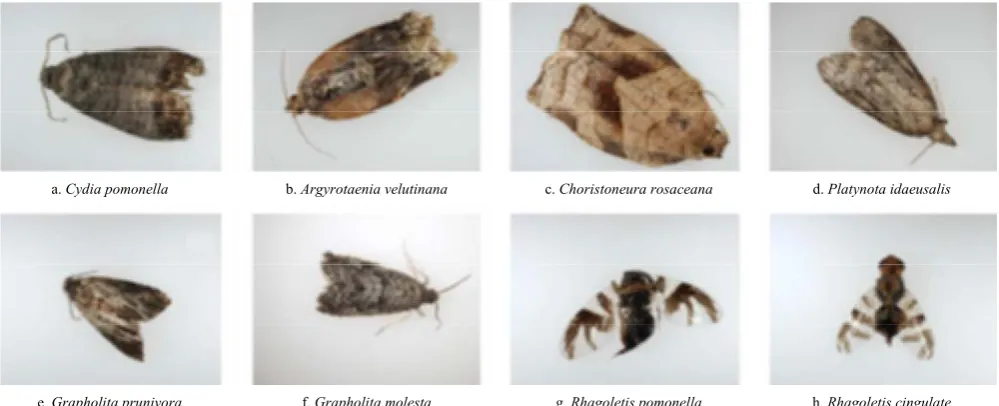
The parameters such as messy image background, missing insect features, and varied insect pose and size which exist in such amount made it difficult to identify and classify insects, thereby reducing the accuracy of the work. Wen and Guyer (2012) conducted a study on image-based orchard insect automated identification and classification method with the aim of proposing a more robust automated method that can work suitably on field insect images considering the variant situation. Therefore, they obtained eight insect species from integrated pest management pest colonies at Michigan State University (Figure 8).
a. Cydia pomonella b. Argyrotaenia velutinana c. Choristoneurarosaceana d. Platynota idaeusalis
e. Grapholita prunivora f. Grapholita molesta g. Rhagoletis pomonella h. Rhagoletis cingulate
In this study, three models were used. The first model was built for insect identification and classification using affine invariant local features; the second one called a global feature model built for insect identification and classification using 54 global features; and the last one was a hierarchical combination model that was based on local feature and global feature models to combine the advantages of the two models and increase the performance. For this purpose, the insects after being frozen were placed on a white balance panel under the reflectance light base of a Nikon stereoscopic zoom microscope SMZ1000 (Nikon, Tokyo) with Plan Apochromatic 0.5× objective. A DS-Fi1 colour digital camera (Nikon, Tokyo) was mounted on the microscope. Illumination was provided by a gooseneck light guide powered by a Schott-Fostec Eke Pheostat 150W light source (Schott North America Inc., NY). The images were taken from the insect facing varying directions along with top and side views. The original resolution of 1280 × 960 was rescaled to 160 × 120 pixel size for computational efficiency based on the preliminary study of classification under the differing resolution. The experimental results on field insect image classification achieved the classification rate of 86.6% when testing with the combination model.
Because of some small-sized insects, it won’t be possible to gain accurate results use traditional image processing technique. To tackle this problem Li et al. (2015) decided to use a multiracial analysis. In their research multiracial analysis was adopted for segmentation of whitefly images based on the local singularity and global image characters with the help of regional minima selection strategy. They utilized this strategy to extract features of candidate whitefly image area. The performance was compared to that of the fixed threshold. Afterward, most false alarms from leaf veins were decreased by considering the size and shape of the white-flies. Moreover, a robotic system was designed to carry out the experiments (Figure 9). The experiments were conducted by capturing field images in a greenhouse. Detection results were compared with other adaptive segmentation algorithms. The results showed that the F-values measuring precision and recall scores are higher
in the case proposed multiracial analysis (88.6%) compared to conventional methods such as Watershed (60.2%) and Efficient Graph-based Image Segmentation (EGBIS; 42.8%).
Figure 9 Environment and agricultural robot in experiment (Li et al. 2015)
According to different varieties of insects and their identification problems, alternative solutions were presented by researchers. Among them, Zayas and Flinn (1998) introduced a machine vision technique that used multivariate analysis to detect insects in crop background images. The extraction of small spots from biological images was first reported by Olivo-Marin (2002). Singh et al. (2009) reported on the use of near-infrared (NIR) hyperspectral imaging systems to detect wheat kernels damaged by insects. Some other related works are done by Gotsch and Brauschweig (1999), Koumpouros et al. (2004), Hanafi (2003), Li et al. (2009), Yao et al. (2013), Clement et al. (2015) and Ridgway et al. (2002).
4 Conclusions
the other hand, pest management can be done at the first application before the crop is damaged. Also, automated insect identification system in sprayers can make a significant contribution to producers who own large orchards and have limited pest scouting expertise. Therefore, we suggest to researchers to introduce a new system for real-time controlling of field and greenhouse based on automatic pest identification and variable rate application of agrochemicals.
References
Ahmed, F., H. A. Al-Mamun, A. S. M. H. Bari, E. Hossain, and P. Kwan. 2012. Classification of crops and weeds from digital images: A support vector machine approach. Crop Protection, 40(3): 98–104.
Ariana, D. P., and R. Lu. 2008. Quality evaluation of pickling cucumbers using hyperspectral reflectance and transmittance imaging: Part I. Development of a prototype. Sensing and Instrumentation for Food Quality and Safety, 2(3): 144–151. Balsari, P., and M. Tamagnone. 1998. An ultrasonic airblast
sprayer. In Proceedings of the International Conference on Agricultural Engineering, 585–586. Oslo, Norway, 24-27 August.
Bechar, I., S. Moisan, M. Thonnat, and F. Bremond. 2010. On-line video recognition and counting of harmful insects, In
Proceedings of the ICPR 2010 20th InternationalConference, 4068–4071. Istanbul, 23-26 August.
Belforte, G., G. Eula, and T. Raparelli. 2011. A new Technique for safe pesticide spraying in Greenhouses. Available at: http://cdn.intechopen.com/pdfs-wm/13008.pdf. Accessed 21 January 2011.
Boissard, P., V. Martin, and S. Moisan. 2008. A cognitive vision approach to early pest detection in greenhouse crops.
Computers and Electronics in Agriculture, 62(2): 81–93. Bossu, J., Ch. Gee, and F. Truchetet. 2008. Development of a
machine vision system for a real time precision sprayer. Electronic Letters on Computer Vision and Image Analysis 7(3): 54–66.
Cao, N. 2013. Calibration optimization and efficiency in near infrared spectroscopy. Graduate Theses and Dissertations. 13199
Carreiras, J. M. B., J. M. C. Pereira, and J. S. Pereira. 2006. Estimation of tree canopy cover in evergreen oak woodlands using remote sensing. Forest Ecology and Management, 223(1-3): 45–53.
Chen, X., D. Wu, Y. He, and S. Liu. 2011. Nondestructive differentiation of panax species using visible and shortwave near-infrared spectroscopy. Food and Bioprocess Technology, 4(5): 753–761.
Cho, J., J. Choi, M. Qiao, C. Ji, H. Kim, K. Uhm, and T. Chon. 2007. Automatic identification of whiteflies, aphids and thrips in greenhouse based on image analysis. International Journal of Mathematics and Computers in Simulation, 1(1): 46–53. Clement, A., T. Verfaille, C. Lormel, and B. Jaloux. 2015. A new
colour vision system to quantify automatically foliar discolouration caused by insect pests feeding on leaf cells.
Biosystems Engineering, 133(1): 128–140.
Da Silva, A., C. Sinfort, C. Tinet, D. Pierrat, and S. Huberson. 2006. A Lagrangian model for spray behaviour within vine canopies. Journal of Aerosol Science, 37(5): 658–674. Dekeyser, D., A. T. Duga, P. Verboven, A. M. Endalew, N.
Hendrickx, and D. Nuyttens. 2013. Assessment of orchard sprayers using laboratory experiments and computational fluid dynamics modelling. Biosystems Engineering, 114(2): 157–169.
Delele, M. A., A. De Moor, B. Sonck, H. Ramon, B. M. Nicolaï, and P. Verboven. 2005. Modelling and validation of the air flow generated by a cross flow air sprayer as affected by travel speed and fan speed. Biosystems Engineering, 92(2): 165–174. Duga, A. T., K. Ruysen, D. Dekeyser, D. Nuyttens, D. Bylemans, B. M. Nicolai, and P. Verboven. 2015. Spray deposition profiles in pome fruit trees: Effects of sprayer design, training system and tree canopy characteristics. Crop Protection, 67(1): 200–213.
ElMasry, G., D. W. Sun, and P. Allen. 2012. Near-infrared hyperspectral imaging for predicting colour, pH and tenderness of fresh beef. Journal of Food Engineering, 110(1): 127–140.
Escol, A., J. R. Rosell-Polo, S. Planas, E. Gil, J. Pomar, F. Camp, J. Llorens, and F. Solanelles. 2013. Variable rate sprayer. Part 1 e orchard prototype: design, implementation and validation.
Computer and Electronics in Agriculture,95(1): 122–135. Escolà, A. 2010. Method for real-time variable rate application of
plant protection products in precision horticulture/fructiculture. Ph.D. diss., Department Agro forestry Engineering, University of Lleida, Spain.
Fedor, P., J. Vanhara, I. Malenovsky, J. Havel, and I. Spellerberg. 2009. Artificial intelligence in pest insect monitoring.
Systematic Entomology, 34(2): 398–400.
Gil, E., A. Escolà, J. R. Rosell, S. Planas, and L. Val. 2007. Variable rate application of plant protection products in vineyard using ultrasonic sensors. Crop Protection, 26(8): 1287–1297.
Giles, D. K., M. J. Delwiche, and R. B. Dodd. 1988. Electronic measurement of tree canopy volume. Transactions of ASAE, 31(1): 264–272.
Gupta, P., N. P. S. Sirohi, and I. M. Mishra. 2012. Air flow characteristics of an air-assisted sprayer through horizontal crop canopy. International Journal of Agricultural and Biological Engineering, 5(1): 1–6.
Hanafi, A. 2003. Integrated production and protection today and in the future and in greenhouse crops in the Mediterranean region. In Proceedings of the VI International Symposium on Protected Cultivation in Mild Winter Climate: Product and Process Innovation, 755–765. Ragusa-Sicily, Italy, 30 September 2003
Hassan, S. N. A., Z. Z. Htikemuhammad Yusof, and L. W. Shoon. 2014. Automatic classification of insects using colour-based and shape-based descriptors. International Journal of Applied Control, Electrical and Electronics Engineering, 2(2): 23–35. Jejcic, V., T. Godesa, M. Hocevar, B. Sirok, A. Malnersic, A.
Stancar, M. Lesnik, and D. Stajnko. 2011. Design and testing of an ultrasound system for targeted spraying in orchards.
Journal of Mechanical Engineering, 57(7-8): 587–598. Jeon, H. Y., H. Zhu, R. Derksen, E. Ozkan, and C. Krause. 2011.
Evaluation of ultrasonic sensor for variable-rate spray applications. Computers and Electronics in Agriculture, 75(1): 213–221.
Keightley, K. E., and G. W. Bawden. 2010. 3D volumetric modeling of grapevine biomass using Tripod LiDAR.
Computers and Electronics in Agriculture, 74(2): 305–312. Khot, L. R., R. Ehsani, G. Albrigo, A. J. Landers, and P. A. Larbi.
2012. Spray pattern investigation of an axial-fan airblast precision sprayer using a modified vertical patternator.
Applied Engineering in Agriculture, 28(5): 645–647.
Khot, L. R., R. Ehsani, G. Albrigo, P. A. Larbi, A. Landers, J. Campoy, and C. Wellington. 2012. Air-assisted sprayer adapted for precision horticulture: spray patterns and deposition assessments in small-sized citrus canopies.
Biosystems Engineering, 113(1): 76–85.
Koumpouros, Y., B. D. Mahaman, M. Maliappis, H. C. Passam, A. B. Sideridis, and V. Zorkadis. 2004. Image processing for distance diagnosis in pest management, Computers and Electronics in Agriculture, 44(2): 121–131.
Kumar, R., V. Martin, and S. Moisan. 2010. Robust insect classification applied to real time greenhouse infestation monitoring. In IEEE ICPR Workshop on Visual Observation and Analysis of Animal and Insect Behavior, Istanbul, Turkey, August.
Larbi, P. A., and M. Salyani. 2012. CitrusSprayEx: An expert system for planning citrus spray applications. Computers and Electronics in Agriculture, 87(1): 85–93.
Larbi, P. A., R. Ehsani, M. Salyani, J. M. Maja, A. Mishra, and J. C. Neto. 2013. Multispectral-based leaf detection system for spot sprayer application to control citrus psyllids. Biosystems Engineering, 116(4): 509–517.
Larios, N., H. Deng, and T. G. Dietterich. 2008. Automated Insect Identification through concatenated histograms of local
appearance features: feature vector generation and region detection for deformable objects. Machine Vision and Applications, 19(2): 105–123.
Lee, K., and R. Ehsani. 2008. A laser-scanning system for quantification of tree-geometric characteristics. In 2008 Providence, 1. Rhode Island, June 29-July 2.
Li, Y., Ch. Xia, and J. M. Lee, 2009. Vision-based pest detection and automatic spray of green-house plant, In IEEE International Symposium on Industrial Electronics, 920–925. Seoul, Korea, 5-8 July.
Li, Y., C. Xia, and J. M. Lee. 2015. Detection of small-sized insect pest in greenhouses based on multifractal analysis.
Optik-International Journal for Light and Electron Optics, 126(19): 2138–2143.
Liorens, J., E. Gil, J. Liop, and A. Escola. 2011. Ultrasonic and LIDAR sensors for electronic canopy characterization in vineyards: Advances to improve pesticide application methods.
Sensors, 11(2): 2177–2194.
Liu, Y., R. Gao, Y. Hao, X. Sun, and A. Ouyang. 2012. Improvement of near-infrared spectral calibration models for brix prediction in 'Gannan' navel oranges by a portable near-infrared device. Food and Bioprocess Technology, 5(3): 1106–1112.
Mallarino, A. P., and D. J. Wittry. 2006. Variable-rate application for phosphorus and potassium: impacts on yield and nutrient management. In Proceedings of the 18th annual integrated crop management conference, 219–224. Iowa State University, 30 November.
Manley, M., P. Williams, D. Nilsson, and P. Geladi. 2009. Near infrared hyperspectral imaging for the evaluation of endosperm texture in whole yellow maize (Zea maize l.) kernels. Journal of Agricultural and Food Chemistry, 57(19): 8761–8769.
Martin, V., S, Moisan, B. Paris, and O. Nicolas, 2008. O.50-Towards a video camera network for early pest detection in greenhouses, In Proceedings of the International Conference on Endure Diversifying Crop Protection, 1–5. Grande-Motte, France, 12-15 October.
McKerrow, P., and H. Neil. 2001. Plant acoustic density profile model of CTFM ultrasonic sensing. IEEE Sensors Journal, 1(4): 245–255.
Mendez, V., H. Catalan, J. R. Rosell, J. Arno, R. Sanz, and A. Tarquis. 2012. SIMLIDAR – simulation of LIDAR performance in artificially simulated orchards. Biosystems Engineering, 111(1): 72–82.
Mendez,V., H. Catalan, J. R. Rosell-Polo, J. Arno, and R. Sanz. 2013. LiDAR simulation in modelled orchards to optimize the use of terrestrial laser scanners and derived vegetative measures. Biosystems engineering, 115(1): 7–19.
soluble solids content. Postharvest Biology and Technology, 62(2): 149–160.
Meron, M., S. Cohen, and G. Melman. 2000. Tree shape and volume measurement by light interception and aerial photogrammetry. Transactions of ASAE, 43(2): 475–481. Neethirajan, S., C. Karunakaran, D. S. Jayas, and N. D. G. White.
2007. Detection tech-niques for stored-product insects in grain,
Food Control, 18(2): 157–162.
Olivo-Marin, J. C. 2002. Extraction of spots in biological images using multiscale prod-uct. Pattern Recognition, 35(9): 1989–1996.
Osterman, A., T. Godesa, M. Hocevar, B. Sirok, and M. Stopar. 2013. Real-time positioning algorithm for variable-geometry air-assisted orchard sprayer, Computers and Electronics in Agriculture, 98(7): 175–182.
Park, B., M. Kise, W. Windham, K. Lawrence, and S. Yoon. 2008. Textural analysis of hyperspectral images for improving contaminant detection accuracy. Sensing and Instrumentation for Food Quality and Safety, 2(3): 208–214.
Paudel, A., D. Raijada, and J. Rantanen. 2015. Raman spectroscopy in pharmaceutical product design. Advanced Drug Delivery Reviews, 89(1): 3–20.
Peng, Y., and R. Lu. 2006. Improving apple fruit firmness predictions by effective correction of multispectral scattering images. Postharvest Biology and Technology, 41(3): 266–274. Ridgway, C., E. R. Davies, J. Chambers, D. R. Mason, and M.
Bateman. 2002. Rapid machine vision method for the detection of insects and other particulate bio-contaminants of bulk grain in transit. Biosystems Engineering, 83(1): 21–30. Rundlöf, T., L. McEwen, M. Johanssona, and T. Arvidssona. 2014.
Use and qualification of primary and secondary standards employed in quantitative 1H NMR spectroscopy of pharmaceuticals. Journal of Pharmaceutical and Biomedical Analysis, 93(1): 111–117.
Salyani, M. 2003. Calibration of Airblast Sprayers. Lake Alfred, FL: University of Florida Cooperative Extension Service, Institute of Food and Agricultural Sciences.
Seidel, D., F. Beyer, D. Hertel, S. Fleck, and C. Leuschner. 2011. 3D-laser scanning: a non-destructive method for studying above-ground biomass and growth of juvenile trees.
Agricultural and Forest Meteorology, 151(10): 1305–1311. Seidel, D., S. Fleck, and C. Leuschner. 2012. Analyzing forest
canopies with ground based laser scanning: a comparison with hemispherical photography. Agricultural and Forest Meteorology, 154-155: 1–8.
Sidahmed, M. M., and R. B. Brown. 2001. Simulation of spray dispersal and deposition from a forestry airblast sprayer e part I: air jet mode. Transactions of the ASAE, 44(1): 5.
Singh, C. B., D. S. Jayas, J. Paliwal, and N. D. G. White. 2009. Detection of insect-damaged wheat kernels using near-infrared hyperspectral imaging. Journal of Stored Products Research, 45(3): 151–158.
Solis-Sánchez, L. O., R. Castaneda-Miranda, J. J. García-Escalante, I. Torres-Pacheco, R. G. Guevara-González, C. L. Castaneda-Miranda, and P. D. Alaniz-Lumbreras. 2011. Scale invariant feature approach for insect monitoring, Computers and Electronics in Agriculture, 75(1): 92–99.
Solis-Sánchez, L. O., J. J. García-Escalante, R. Castaneda-Miranda, I. Torres-Pacheco, and R. Guevara-González. 2009. Machine vision algorithm for whiteflies (Bemisia tabaci Genn.) scouting under greenhouse environment, Journal of applied entomology, 133(7): 546–552.
Syed, A. R. 2006. Pest and disease management for crop production inside green-houses. In International Symposium on Greenhouses, Environmental Controls and In-house Mechanization for Crop Production in the Tropics, 89–102. Cameron Highlands, Pahang, Malaysia, 30 June 2006
Tumbo, S. D., M. Salyani, J. D. Whitney, T. A. Wheaton, and W. M. Miller. 2002. Investigation of laser and ultrasonic ranging sensors for measurements of citrus canopy volume. Applied Engineering in Agriculture, 18(3): 367–372.
Walklate, P. J., K. L. Weiner, and C. S. Parkin. 1996. Analysis of and experimental measurements made on a moving air-assisted sprayer with two-dimensional air-jets penetrating a uniform crop canopy. Journal of Agricultural Engineering Research, 63(4): 365–377.
Weeks, P. J. D., M. A. O’Neill, K. J. Gaston, and L. D. Gauld. 1999. Automating insect identification: exploring the limitations of a prototype system. Journal of Applied Entomology, 123(1): 1–8.
Wei, J., and M. Salyani. 2004. Development of a Laser Scanner for Measuring Tree Canopy Characteristics: Phase 1. Prototype Development. Transactions of ASAE, 47(6): 2101–2107. Wen, C., and D. Guyer. 2012. Image-based orchard insect
automated identification and classification method. Computers and Electronics in Agriculture, 89(3): 110–115.
Wen, C., D. E. Guyer, and W. Li. 2009a. Local feature-based identification and classification for orchard insects.
Biosystems and Engineering, 104(3): 299–307.
Wen, C., D. E. Guyer, and W. Li. 2009b. Automated insect classification with combined global and local features for orchard management. ASABE Paper No. 095865. Nevada, America: American Society of Agricultural and Biological Engineers.
Yao, Q., Q. Liu, T. G. Dietterich, S. Todorovic, J. Lin, G. Diao, B. Yang, and J. Tang. 2013. Segmentation of touching insects based on optical flow and NCuts. Biosystems Engineering,
114(2): 67–77.
Zaman, Q. U., and M. Salyani. 2004. Effects of foliage density and ground speed on ultrasonic measurement of citrus tree volume.
Applied Engineering in Agriculture, 20(2): 173–178.