225
RESEARCH ON THE INFLUENCE OF SOIL WORKS
ON COWPEA CULTIVATED UNDER ECOPEDOLOGICAL CONDITIONS
IN SOUTHERN OLTENIA
DRĂGHICI I.1), DRĂGHICI RETA 1)
, CROITORU MIHAELA 1)
1)
Research and Development Station for Plant Culture on Sands Dabuleni, Romania
E-mail: [email protected]
Keywords: moisture conservation, weed degree,yield
ABSTRACT
The results obtained in the cowpea culture, studied during 2016-2018 in the conditions of the sandy soils, highlight the importance of germination bed preparation and the size of the nutrition space on the growth and fructification processes of the plant. Analyzing the soil moisture dynamics during the plant vegetation, there is a better conservation of water in the soil, when was performed by plowing at a depth of 22-25 cm + disking to a depth of 10-15 cm, the soil
moisture being within the limits of 6.98-16.8%. The best results were recorded by sowing 25 germinable seeds / m2 in a germination bed prepared by the plowing at a depth of 22-25 cm + disking of 10-15 cm deep (9.75 pods / plant, 8.85 grains / pod, 2483.5 kg / ha). This version was recorded the lowest level of weed (scoring on the EWRS scale with note 2.0, in the branching phase and 1.66, in the flowering phase
.
INTRODUCTION
The cowpea (Vigna unguiculata (L.) Walp), is a leguminous plant of vital importance to millions of people in West and Central Africa. It provides a less expensive source of protein for both rural and urban consumers (Inaizumi et al., 1999, Kamara et al., 2018). The development of research on the cultivation of cowpea on sandy soils in southern Oltenia has led to the need to increase agricultural yields on land with low natural fertility, from the category of sandy soils, where the legume culture for grain often involves serious risks, as a result of the action limitation of numerous restrictive specific factors. Research on the effect of the soil works highlights their impact on the accumulation and preservation in the soil of a larger amount water from rainfall, the accumulation of as much nutrients, as possible in the soil by stimulating nitrification processes, creating favorable conditions for germination of seeds and providing a crop with as less weed (Lupu, 2009, Ball
226
substances in sufficient quantities for good development (Zăvoi A., 1967).
MATERIAL AND METHOD
The researches were carried out during the period 2016-2018, under ecopedological conditions in southern Oltenia, and they focused on the influence of soil works and plant density over the production of the cowpea. The experiment was placed in the field, according to the parcel method subdivided by two factors: Factor A - Soil works (Scarified to a depth of 55-60 cm; Plowing at a depth of 22-25 cm + Disking of 10-15 cm deep; Disking at a depth of 10-15 cm); Factor B - sowing density with three graduations (20 seeds germinable / square meter, 25 seeds germinable / square meter, 30 seeds germinable /
square meter). The research was carried out on the Doljana cowpea variety, sown under irrigation conditions on a sandy soil with reduced natural fertility. At the beginning of the experiment, were made laboratory tests on the physical and chemical quality of the soil. Determinations were performed on the soil moisture of 30 to 30 days, the degree of weed, determinations and measurements and determinations of biometrics and productivity of the plant. The obtained results were statistically interpreted by the analysis of the variant and using the mathematical functions.
RESULTS AND DISCUSSIONS
Results on soil chemical properties, highlight differentiated values on the soil profile (Table 1). Thus, the pH values migrated from a weak acid to a depth of 0-50 cm, to neutral on a depth of 50-75 cm. The humus content recorded overhead values on a depth of 0-25 cm and due to the richer organic material resulting from the spreading of the
deposits resulting from the draining of the drainage channels, the experiment being located along such a drainage channel. On the profile of the soil was recorded a low content in total nitrogen, with values between 0.03-0.06%, medium in phosphorus 18-38 ppm, as well as a good state of supply with potassium 40-83 ppm
Table 1
The chemical properties of psamosol within the experimental field
Depth
(cm) pH (H2O)) Humus (%) Nt (%)
P AL (ppm)
K AL (ppm)
0-25 5.65 1.06 0.06 38 83 25-50 5.88 0.94 0.04 36 74 50-75 6.45 0.35 0.03 18 40
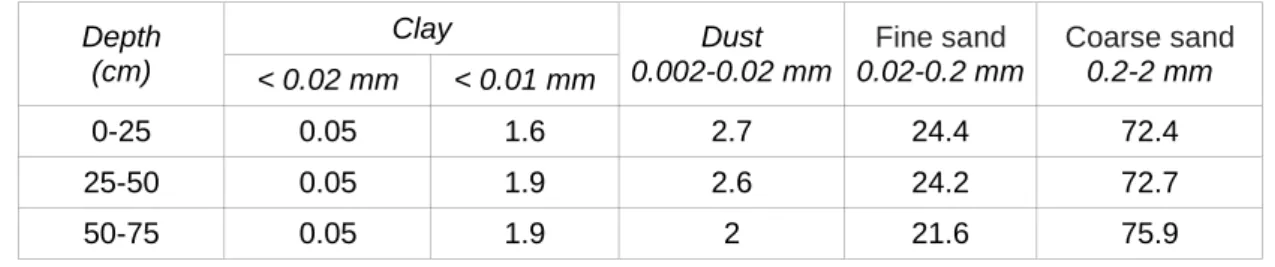
Analyzing the granulometric composition of psamosol in the experimental device (Table 2), there is a low content of clay (0.05 - 1.9%), dust (2-2.6%). In contrast, fine sand content increased to 21.6-24.4%, and coarse sand predominantly ranged from 72.4-75.9%.
During season of the cowpea growing (May-August), the amount of rainfall recorded 369.6 mm, which in conjunction
227
correlation between soil moisture and accumulated monthly rainfall.
Table 2
The granulometric composition of psamosol within the experimental field
Depth (cm)
Clay Dust
0.002-0.02 mm
Fine sand 0.02-0.2 mm
Coarse sand 0.2-2 mm < 0.02 mm < 0.01 mm
0-25 0.05 1.6 2.7 24.4 72.4 25-50 0.05 1.9 2.6 24.2 72.7 50-75 0.05 1.9 2 21.6 75.9
Table 3
Determination of soil moisture evolution during the vegetation period of the cowpea, depending on the soil and climatic conditions of 2017
Experimental variant
Depth (cm)
*Soil moisture (%) / climate conditions Average soil moisture (%) / average air temperature
(oC)
The amount of
rainfall from May to August
(mm) April May June July August
Scarified
0-25 13.74 15.93 5.49 15.98 5.87 11.40 25-50 13.78 14.75 6.04 14.78 6.44 10.96
50-75 12.97 14.45 6.88 14.36 6.12 10.96
Average 13,5 15.04 6.14 15.04 6.144 11.11
Plowing+ Disking
0-25 15.02 16.44 7.22 16.78 6.78 12.45
25-50 15.54 15.27 7.45 17.02 7.26 12.51
50-75 14.12 14.62 7.02 16.58 6.88 11.84 Average 14,90 15.44 7.23 16.80 6.98 12.27
Disking
0-25 13.22 13.68 5.42 15.02 4.38 10.34 25-50 13.68 13.75 5.96 14.21 5.02 10.52
50-75 13.11 12.64 4.77 12.77 4.16 9.49
Average 13,33 13.36 5.38 14 4.52 10.12
Climate conditions
Rainfall (mm)
62.8 78.6 17.4 120.8 28.8 x 369.6 Average
monthly air temperature
(0C)
12 17.8 24 24.8 24.8 20.68 x
* Soil samples were collected at the end of each month
The height of the plant, the height of insertion of the first pods / plant was influenced by the sowing density, these elements generally registering higher values in the variants at which higher densities were provided, thus reducing the nutrition space , which forced vegetative growth at the expense of productive growth (Table 4). Analyzing,
228
pods / plant = 9.75, the number of seeds in the pods = 8.85).
The preparatory work the soil for sowing and plant density of the cowpea influenced the degree of weed culture, significantly (r = 0.677 *) and distinct significantly (r = 0.838 **) according to the stage of plant growth (Figure 1). Thus, in the branching phase was recorded a degree of weed, în EWRS scale, note in the range from 2 to 6.33, and the
flowering stage, it fell within the limits of 1.33 to 4.3, the foliar defense of the plant suffocating much of the weeds. The lowest degree of weeds was recorded in the variants where the soil preparation was performed by plowing + disking. Similar research was conducted from maize by C. Lupu, 2009, which emphasized the importance of carrying out plowing, compared to only work scarified or disking.
Table 4
Biometrics and productivity results of the cowpea plant recorded under the influence of soil works and sowing density
Experiment al variant
No. germinable seeds / square meter
(g.s. / s.m.)
The height of the plant (cm)
Minimum height of pods / plant
insertion
(cm)
No.pods / the plant
No. seeds/ pod
Scarified
20 105.5 23 7.5 8,15
25 116 22 7.25 7,5
30 117.5 24 6.75 7,5
Average 113 23 7.17 7.72
Plowing + Disking
20 112.35 25.6 9.8 8,5
25 118.9 28.5 9.75 8,85 30 124.25 26.75 8.2 7,9 Average 118,5 26.95 9.15 8.42
Disking
20 108.5 25.35 9 8,75
25 114 24.1 8 8,5
30 118.5 25 6.5 7,65
Average 113,67 24.82 7.83 8.3
229
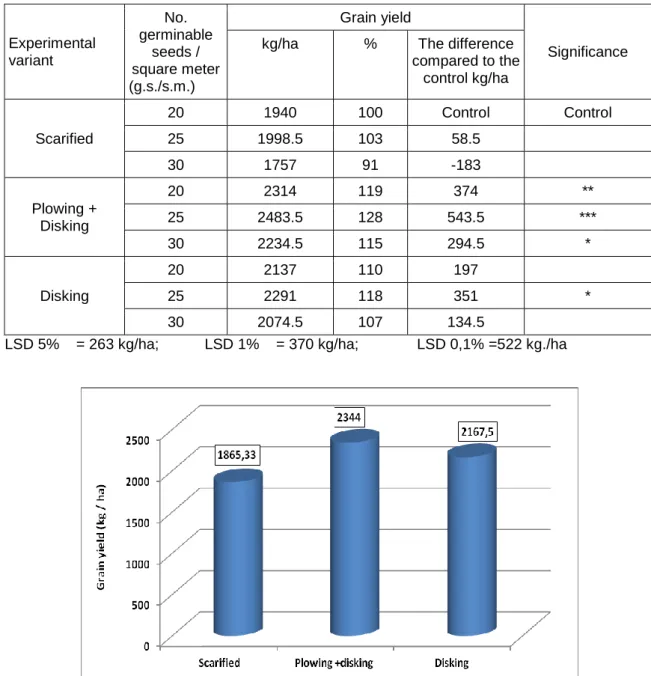
Statistical analysis of the production of cowpea in different variants of the soil work and sowing densities, highlights the achievement of production differences of 294.5-543.5 kg / ha, in the soil work variant by plowing to the depth of 22-25 cm + disking to the depth of 10-15 cm, statistically assured as compared to sowing 20 g.s. / s.m., in scarified to the depth of 55-60 cm (Table 5). Under the study conditions, the cowpea plant best used the density of 25 g.s. / s.m., when
the seed was made in a germination bed, prepared by plowing + disking (2483.5 kg / ha). The effect of the soil works on the cowpea yields is shown graphically in Figure 2, showing the variant of soil working by plowing at the depth of 22-25 cm + disking at 10-15 cm, by the difference of 478.67 kg / ha, compared to the scarified work at 55-60 cm deep and 176.5 kg / ha, compared to the soil disking at 10-15 cm deep.
Table 5
The influence of soil works and plant density on the production of beans obtained in cowpea under the conditions of sandy soils
Experimental variant
No. germinable
seeds / square meter (g.s./s.m.)
Grain yield
Significance kg/ha % The difference
compared to the control kg/ha
Scarified
20 1940 100 Control Control 25 1998.5 103 58.5
30 1757 91 -183
Plowing + Disking
20 2314 119 374 **
25 2483.5 128 543.5 *** 30 2234.5 115 294.5 *
Disking
20 2137 110 197
25 2291 118 351 *
30 2074.5 107 134.5
LSD 5% = 263 kg/ha; LSD 1% = 370 kg/ha; LSD 0,1% =522 kg./ha
230
CONCLUSION
Preparing the germinative bed, by working at depths of 22-25 cm + disking at a depth of 10-15 cm, ensures the best soil moisture conservation during the vegetation period of the cowpea culture.
Working the soil and seeding density influenced the level of weed in cowpea culture, significantly (r = 0.677 *) and distinct significantly (r = 0.838 **),
depending on the plant phase of the plant.
The cowpea has achieved the best results were recorded by sowing 25 germinable seeds / m2 in a germination bed prepared by the plowing at a depth of 22-25 cm + disking of 10-15 cm deep (9.75 pods / plant, 8.85 grains / pod, 2483.5 kg / ha).
AKNOWLEDGEMENT
This research activity was carried out with the support of the Ministry of Agriculture and Rural Development, Romania, through the ADER Sectorial
Program 2015-2018 and was funded by the ADER Project 16.3.1./16.10.2015
BIBLIOGRAPHY
1. Alpha Y. Kamara, Abdullahi I. Tofa,
Stephen Kyei-Boahen, Reuben Solomon,
Hakeem A. Ajeigbe and Nkeki Kamai, 2018
- Effects of plant density on the performance of cowpea in nigerian savannas.
Experimental Agriculture, Volume 54, Issue 1, pp. 120-132.
2. Cornelia Lupu, 2009 - Influence of basic soil
tillage on both maize yield and some soil features, under ards Secuieni conditions. An. INCDA Fundulea, Agrotechnics of crops, vol LXXVII, 2009, pp. 95-104.
3. Dadson, R. B., Hashem, F. M., Javaid, I.,
Joshi, J., Allen, A. L. and Devine, T. E.,
2005 - Effect of Water Stress on the Yield of Cowpea (Vigna unguiculata L. Walp.) Genotypes in the Delmarva Region of the United States. Journal of Agronomy and Crop Science, doi: 10.1111/j.1439-037X.2005.00155.x, vol. 191, pp. 210-217.
4. Draghici Reta, 2012. Optimization of the
productionofbeanscowpeaunder the impact
of technological factors. Scientific Papers Series A. Agronomy, vol LV, UASVM Bucharest, ISSN 5785, ISSN-L 2285-5785.
5. Inaizumi, H., Singh, B. B., Sanginga, P. C.,
Manyong, V. M., Adesina, A. A. and
Tarawali, S. ,1999 - Adoption and impact of
dry season dual purpose cowpea in the semi arid zone of Nigeria. IITA and Meg. Comm. Network 14 pp.
6. Robertson B.M., 1995 – Studies of rooting
pattern earliness and seed size and density in Vigna unguiculata (L.) Walp. Ph. D. Diss. Univ. of California, Riverside.
7. Sipoş Gh., D. Scurtu,Gh. Sin, I. Moga, 1981
– Densitatea optimă a plantelor agricole. Ed. Ceres, Bucureşti.
8. Zăvoi A., 1967 - Contributions related to