Standards and Fatness
Una discusión sobre la imagen corporal de alumnos/as de inglés:
patrones de belleza y gordura
Pedro Augusto de Lima Bastos
1*
Rosane Rocha Pessoa
2**
Universidade Federal de Goiás, Goiânia, Brazil
In this qualitative study, we intend to discuss how adolescent students in a Brazilian public school classroom define their body image and personalize the themes beauty standards and fatness. Grounded on a critical approach to language teaching, these two social themes were problematized in eight lessons of Ensino Médio (secondary education). The discussion of the empirical material suggests that (1) body image is strongly connected to gendered relations, making life experiences of men and women different based on the bodies they have, and (2) beauty standard and fatness are strongly related to students’ lives since twelve out of nineteen students personalized the themes by telling oppressive stories they went through because of their bodies.
Key words: Beauty standard, critical language teaching, fatness, social themes.
En este estudio cualitativo, nos proponemos discutir cómo alumnos/as adolescentes en un aula de una escuela pública brasileña definen su imagen corporal y personalizan los temas patrones de belleza y
gordura. Basándose en un enfoque crítico a la enseñanza de inglés, esos dos temas fueron problematizados en ocho clases de enseñanza secundaria. La discusión del material empírico sugiere que (1) la imagen corporal está conectada con relaciones de carácter general, haciendo que la experiencia de hombres y mujeres sea diferente según sus cuerpos, y (2) los patrones de belleza y gorduraestán fuertemente conectados a las vidas de los/as alumnos/as, ya que doce de diecinueve alumnos/as personalizaron el tema al contar historias de opresión que ellos/as vivenciaron a causa de la imagen que hacen de sus cuerpos.
Palabras clave: enseñanza crítica de lenguas, gordura, patrones de belleza, temas sociales.
* E-mail: [email protected] ** E-mail: [email protected]
How to cite this article (apa, 6th ed.): de Lima Bastos, P. A., & Pessoa, R. R. (2019). A discussion on English language students’ body image: Beauty standards and fatness. Profile: Issues in Teachers’ Professional Development, 21(1), 13-26. https://doi.org/10.15446/profile.v21n1.69603.
This article was received on December 28, 2017 and accepted on August 5, 2018.
Introduction
In a text titled “Why bodies matter: Discourse and materiality after mass murder”, the linguistic anthro-pologist Bucholtz (2016) affirms that bodies should be placed at the centre of our thinking, as they are not only the locus of lived experience, but also the site of power relations and the source of social agency. According to her, many language-oriented scholars of various stripes have maintained a steady focus on different aspects of embodiment. One of these approaches examines
the embodied politics and practices of race, gender, sexuality, and other axes of difference as organizing categories of society, culture, and power, including the semiotics of self-presentation and cultural interpretation, such as voice quality, linguistic forms, and ideological discourses that render bodies culturally legible or illegible, valued or marginalized. (Bucholtz, 2016, p. 4)
Ideological discourses concerning bodies have also been of great concern in critical language teaching scholarship (Pessoa, 2014; Pessoa & de Urzêda Freitas, 2016; Kubota & Lin, 2009; Moita Lopes, 2002; Nelson, 2009; Norton & Toohey, 2011), but, to our knowledge, the themes beauty standards and fatness have not been much addressed. Besides, these themes are not mentioned in the domains of Critical Applied Linguistics, as we can see below:
[Critical Applied Linguistics] presents a way of doing applied linguistics that seeks to connect it to questions of gender, class, sexuality, race, ethnicity, culture, identity, politics, ideology, and discourse. (Pennycook, 2001, p. 10)
We consider there is a strong need for taking these themes seriously at school and addressing them in language teaching scholarship since, according to Moy (2015), there has been a rapid increase in rates of body dissatisfaction and unrealistic beauty ideals, and they have a negative influence on body image.1
1 According to Croll (2005), “body image is the dynamic percep-tion of one’s body—how it looks, feels, and moves” (p. 155).
This overconcern with body image is profoundly influenced by beauty standards propagated by cultural and mediatic messages (Croll, 2005) and it can lead to “restrictive dieting and unhealthy weight control methods” causing “potentially dangerous disordered eating behaviors” (Croll, 2005, p. 158). Grounded on Davison, Markey, and Birch, Moy (2015) also affirms that the “issue of body image is mostly acute for adolescents whose pubertal development results in physical changes” (p. 1), but “children as young as five years old are concerned about their weight, and many girls by the age of nine display signs of body image dissatisfaction and problematic eating behaviors” (p. 3). So, what we want to highlight in this study is a minority category which, to our knowledge, has not been represented in Critical Applied Linguistics studies and it has not been problematized in language classrooms.
Based on our experience with critical language teaching (Crookes, 2012, 2013; de Urzêda Freitas, 2012; Hawkins & Norton, 2009; Janks, 2010; Jordão & Fogaça, 2012; Kubota, 2015; Kumaravadivelu, 2012; Norton & Toohey, 2004; Okazaki, 2005; Pennycook, 1999, 2001; Pessoa, 2014; Pessoa & de Urzêda Freitas, 2012) and on the first author’s experiences as an individual who lived his adolescence as a fat person, we aimed to develop this research by bringing the themes fatness and beauty standards to the English language classroom. This paper is part of a study developed in eight English lessons of a 1st year classroom of Ensino Médio (secondary
education), which corresponds to the last three years of basic education in Brazil. The question we want to address in this paper is how adolescent students in a Brazilian public school classroom define their body image and personalize the themes beauty standards and
and dealing with fatness and beauty standards in language lessons. Because of space constraints, we do not focus on the pedagogical aspects of dealing with such themes in language lessons, an issue that can be addressed in future research. What we want to show are stories of oppression regarding body size that emerged in the research data. These stories cannot be denied since they are inside our classrooms and can affect how students think about themselves and act in this world.
This paper is divided into five parts: first, we provide a general overview of our research; second, we aim to show how bodies are politically and socially constructed, and what we understand by a critical approach to the teaching of English; third, we contextualize the research; fourth, we discuss how students define their body image and personalize the themes beauty standards and fatness
based on the theoretical reflections previously made; fifth, we conclude by showing the importance of dealing with the themes body image and fatness in language lessons.
Different Views on the Body and Our Understanding of Critical Language Teaching
We consider that every aspect of our society is socially constructed. In the case of our bodies, it would not be different since “members of a society construct their bodies in ways that comply with accepted views of masculinity and femininity” (Lorber & Martin, 2007, p. 228). We expect women’s and men’s bodies to look the way they are discursively constructed to look; for example, we expect men to look stronger than women. Croll (2005) argues that puberty is a crucial period for adolescents, as boys acquire characteristics admired by society such as strength, broadness, and height, whereas girls “generaly get rounder and have increased body fat” (p. 155).
Lorber and Martin (2007) point out that a person is seen in different ways depending on whether they follow beauty standards or not, since “people whose bodies comply with valued conventions are admired,
praised, and held up to others as ideals to be emulated” (Lorber & Martin, 2007, p. 230). Nonetheless, the others, for example, the fat individual, who is a non-disciplined figure of how a body should look, “is still often reduced to a mere question of individual life-style choices and personal morals” (Harjunen, 2009, p. 26). An example of how the adjective fat characterizes an experience can be found in Mason (2012). In her article about weight discrimination, she “examines the income inequalities between fat and nonfat people” (Mason, 2012, p. 412) and she provides “evidence for the existence of weight-based employment discrimination” (Mason, 2012, p. 433). From Mason’s (2012) words, we can interpret that discrimination towards divergent bodies is also structural.
But what influences our conceptions of normal and accepted? Foucault (1995), in Discipline and punish, theorizes a subtle kind of power that is constant, effective, and invisible: the disciplinary power. This type of power happens through “a multiplicity of often minor processes, of different origin and scattered location, which overlap, repeat, or imitate one another” (p. 138). Disciplinary power is invisible because it hides its face behind disciplinary institutions such as hospitals, schools, military, etc. Harjunen (2002) affirms that, for fat bodies, the “school is one of the most central places where discipline is learnt” (p. 80).
instru-ment, bodies go through a process of normalization: “The Normal is established as a principle of coercion” (Foucault, 1995, p. 184) and it either excludes or imposes correction to what is abnormal.
These notions developed by Foucault (1995) are pertinent when we look at the fat body with political lenses. The Body Mass Index (bmi), which is an exam that is frequently used to classify whether bodies are normal or overweight and obese, is an example of how disciplinary power works in the health field. Oliver (2006) argues that “such labels also become internalized by the ‘overweight’ or ‘obese’ who think that something is wrong with them or that they must change their behavior in order to meet a particular physical ideal” (p. 15, emphasis on original). Oliver also discusses how these normalization processes of the fat body come from a political standpoint. He points out that the reason why fat people in America are considered obese and sick are more related to “the pecuniary interests of the pharmaceutical industry” (Oliver, 2006, p. 16) than to harmful health problems.
Oliver (2006) also explains how obesity became an epidemic in the usa because of money and how this notion was spread out in the world. We start to see how the concept of obesity is related to the market when we are aware of what is behind the obesity discourse: (a) the American Obesity Association, which intends to fight against obesity, gets almost all its funding from weight-loss companies; and (b) every year, Americans spend more than 45 billion dollars on weight-loss products “and the pharmaceutical industry desperately wants a larger share of this market” (Oliver, 2006, p. 51). That is why weight-loss products are usually only supposed to make a person thinner, not healthier, as the obesity discourse advocates. Oliver provides us with an example of a weight-loss medication that was approved by the Food and Drug Administration in the mid-1990s to be commercialized in the usa and only later it was discovered that it caused heart damage (p. 53), that is, if obesity is so judged for inducing heart
damage, why would the Food and Drug Administration approve a medication that causes it? These concerns raised by Oliver make it hard not to question the discourse of obesity.
Following a Foucauldian line of thought, Wright (2009) debates on the concept of biopedagogies, which involve two notions: biopower and pedagogies. Based on Foucault, Wright defines biopower as “the gover-nance and regulation of individuals and populations through practices associated with the body” (p. 1). Moreover, the term pedagogy is not simply defined as teaching or techniques for education, but “a practice that involves the negotiation of knowledge (ideas) in relations of power and one that goes beyond the classroom” (Wright, 2009, p. 8). Therefore, biopedago-gies cannot be linked only to the classroom as human beings negotiate knowledge about themselves and the world through their daily interactions.
Biopedagogies attempt to understand the meanings associated with the body through its interactions, whether in the classroom or outside, in a more politicized way. Its practices happen everywhere around the world: “on the web, on television, radio, film, billboards, and posters, and pamphlets in doctors’ waiting rooms” (Wright, 2009, p. 7). These meaning-making practices can influence how people see themselves, act on themselves, and see or act on others. We all know that education, media, and social institutions influence the way we act, but how does it influence our conception of our own bodies?
by their peers for deviating from beauty standards. This study suggests that even human beings at an early age are aware of the influence of media on our body image and on our notions of what being healthy is.
Harjunen (2003) also intends to understand fat women and their social interactions. In her article, she uses the notion of liminality to analyze narratives of women concerning the experience of being fat. Liminality is a concept that describes the in-between. A person in liminality is in between two different states. This is exemplified by Harjunen’s (2003, p. 1) discussion when she argues that the number of people who have become permanently fat has increased worldwide, while in our culture we see the thin body as the original one and the fat body as a “temporary disruption”. Harjunen (2003) contends that this state leaves the agency of these women behind because fat people must transform their bodies first so they can act, that is, a “proper subjectivity and agency can only be achieved in a thin body” (p. 6).
This discussion allows us to affirm that fatness and
beauty standards are political issues related to “power, disparity, difference, or desire” (Pennycook, 2001, p. 7). The way we think about our bodies is completely social and political, and not neutral as the medical discourse seems to be. Therefore, if we are to follow a critical stance to language teaching, we need to problematize these social issues in the classroom and understand bodies beyond the medical discourse, that is, from a social, discursive perspective.
We agree with Moita Lopes (2003) when he argues that language education is at the core of contemporary life as we live in a world where nothing important is done without discourse. He argues that at the same time we have access to a multiplicity of discourses about different cultural forms of life which allow us to experience new subjectivities, we also run the danger of the single discourses, such as the discourse of global capitalism, which transforms things into commodities and people into clients. Thus, language teachers are in
a crucial position to address social and political issues at school. As hightlighted in the previous section, the culture of thinness is one of the single discourses in modern Western societies that should be dealt with by language teachers.
The teaching of a foreign language in Brazil is known for being funny and entertaining, and many language teachers “have adopted a merely functional understand-ing of language in their classes” (Pessoa & de Urzêda Freitas, 2012). Because of that, there is a great focus on linguistic aspects rather than on social content, and the teacher “backs away from connecting language to broader political context” (Pennycook, 1999, p. 334). However, this represents a huge loss, since
language teachers are in a key position to address educational inequality, both because of the particular learners they serve, many of whom are marginalized members of the wider community, and because of the subject matter they teach—language—which can itself serve to both empower and marginalize. (Hawkins & Norton, 2009, p. 32)
Hawkins and Norton (2009) contend that it is through language that meanings are reproduced and negotiated, and it is not a neutral practice. In doing so, “what we do, think, say as humans is always affected by larger questions of social power and to some extent reproduces those same relations, which then reaffect what we do, think, or say” (Pennycook, 2001, pp. 119-120). It is because of this that classrooms should be con-sidered political sites where macro relations can be either reproduced or changed. So, classrooms are places where teachers are in a crucial position to act against social injustices.
Pennycook (1999) affirmed that, at first, critical work focused on issues of “class, race, or gender”, and then it started encompassing areas such as “sexuality, ethnicity, and representations of Otherness” (p. 331). We consider that this list should expand to include
any social theme as long as the focus is on inequality.
and, in spite of their importance especially to children and adolescents, they do not seem to have been much studied by critical applied linguists in Brazil or elsewhere.
The Study
We adopt a qualitative research paradigm since our aims are to discuss how adolescent students in a Brazilian public school classroom define their body image and how they personalize the themes beauty standards and fatness. Merriam (2002) affirms that the qualitative paradigm
lies with the idea that meaning is socially constructed by individuals in interaction with their world. The world, or reality, is not a fixed, single, agreed upon, or measurable phenomenon that is assumed to be in positivist, quantitative research. (p. 3)
Therefore, “qualitative researchers are interested in understanding what those interpretations are at a particular point in time and in a particular con-text” (Merriam, 2002, p. 4). Considering that, a key word for qualitative research is interpretation because “researchers strive to understand the meaning people have constructed about their world and their experi-ences” (Merriam, 2002, pp. 4-5). We follow a critical stance in qualitative research since one of our aims is to investigate “how the social and political aspects of the situation shape the reality” (Merriam, 2002, p. 4), that is, how the social and political aspects of having a divergent body can shape students’ realities.
The research context is a 1st year classroom of Ensino
Médio in a Brazilian public school. Twenty-seven students were in the classroom, but only 23 signed the consent form and accepted to take part in the research. From the 23 students, 12 were male and 11 were female. Their ages ranged mostly from 15 to 17, and two students were 18. They chose fictitious names and that is how they will be referred to in this text. Another participant in this research is the collaborator, who will be referred to as Isabela. During the study, she kindly accepted to observe the first author’s classes and reflect on them. Since the
first author of this paper was the teacher of the group, we refer to him using his first name, Pedro.
The empirical material was generated in December 2015, and in this article we analyze three sources of this material in which participants shared experiences as having divergent bodies: (a) an initial questionnaire (henceforth iq), focusing on how students feel or think of their body image; (b) a final interview (henceforth fi), in which they give opinions about the lessons and the relationship between the two themes and their lives; and (c) reflective sessions (henceforth rs) with the collabora-tor, in which the teacher and the collaborator discussed important moments he was not able to observe alone. The first two sources were generated in Portuguese, while the last was generated in a mixture of Portuguese and English.
After generating the empirical material, we tried to identify the most recurrent themes, two of which are discussed here. Initially, we aimed to analyze the pedagogical implications of working with the critical approach in a public school. However, in the sources we used, students showed a strong connection to the topics we discussed. Because of that, we had to broaden our objectives. So, the discussion in this paper emerges from the empirical material and was not previously established. The first discussion, based on the iq, focuses on how students felt about their bodies, and the second, based on the iq, fi, and rs, focuses on how students related the themes to their personal experiences.
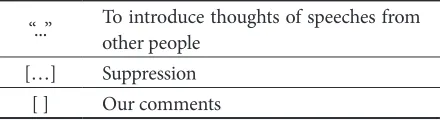
The transcription of the interviews was not done literally; however, the content of the speeches was not changed. Interjections, unnecessary repetitions, and incomplete sentences were eliminated. The students’ excerpts were translated from Portuguese into English. Table 1 shows the transcription symbols used.
Table 1. Transcription Symbols
“...” To introduce thoughts of speeches from other people
[…] Suppression
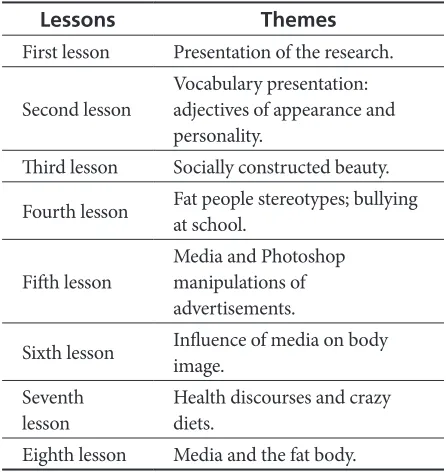
The first author of the article taught eight lessons of 45 minutes each. Table 2 offers a description of the topics addressed in each lesson:
Table 2. Lessons
Lessons Themes
First lesson Presentation of the research.
Second lesson Vocabulary presentation: adjectives of appearance and personality.
Third lesson Socially constructed beauty.
Fourth lesson Fat people stereotypes; bullying at school.
Fifth lesson Media and Photoshop manipulations of advertisements.
Sixth lesson Influence of media on body image.
Seventh
lesson Health discourses and crazy diets. Eighth lesson Media and the fat body.
De Urzêda Freitas (2012) states that “the critical approach does not intend to transform foreign lan-guages/English classes into sociology class—as it has been argued”2 (p. 93). The classes planned aimed to
teach language through the problematization of social issues. We prefer to say that our objective was to teach students how to negotiate meaning (Canagarajah, 2013) through the topics discussed. So, in every class, students were in contact with videos, pictures, and written text because we believe that students negotiate meaning and learn to communicate through the mediation of real-world texts. All the materials used in class were in English and the teacher spoke predominantely in English, but discussions were mostly held in Portuguese as the students were not used to discussing topics in that
2 Citations originally read in Portuguese were translated into English by the authors.
target language. Linguistic resources from English and Portuguese were used for negotiating and construct-ing meanconstruct-ing about beauty standards and fatness, so the teacher and the students moved across languages.
Social Experience With Divergent Bodies
Beauty standards and body image are socially con-structed and are influenced by “cultural messages and societal standards of appearance and attractiveness” (Croll, 2005, p. 155). We aim, in this session, to quali-tatively analyze how adolescent students in a Brazilian public school English classroom define their body image
and personalize the themes beauty standards and fatness. In the iq, we found a difference on how the girls and the boys defined their body image. Most of the students with negative body image were girls compared to the other boys as presented in Table 3.
Table 3. Negative/Positive Body Image Negative
Body Image
Positive Body
Image Total
Male 1 (11%) 8 (89%) 9 (100%)
Female 5 (45%) 6 (65%) 11 (100%)
Note. Twenty-three students participated in the research, but only 20 were present in the first class and answered the iq.
We categorized students as having either positive or negative body images depending on how they described their appearance. The speeches below are examples of negative and positive body images that students have about themselves:
Sinto que devo mudar meu corpo para ser mais aceita na sociedade. (Ana Clara, female, iq) [I feel as if I should change my body to be more accepted in society.]
(Jymmi, female, iq) [Sometimes I feel embarrassed because of the acne that appears on my body, like on my face, on my back, or on my bosom. In many cases I avoid wearing certain types of clothes, like low-cut ones, because I am ashamed of the fact that people keep commenting and criticizing.]
Eu não me acho bonito e me acho um pouco desengonçado. As pessoas devem me achar pequeno e desengonçado. (Jorge, male, iq) [I do not think I am handsome and I find myself clumsy. People might think of me as short and clumsy].
Eu me sinto, em relação a meu corpo e minha aparência, bem satisfeito, pois não me acho feio, apesar de não acreditar que exista pessoas feias. (Heródoto, male, iq) [I feel very satisfied in relation to my body and appearance, because I do not think I am ugly, though I do not believe there are ugly people.]
Me sinto bem comigo mesmo e me acho bonito, não sou obcecado pela aprovação da opinião dos outros. (Gabriel, male, iq) [I feel good about myself and I think I am handsome; I am not obsessed with the approval of others’ opinions.]
These speeches suggest that differences in body image are gendered (Harjunen, 2009; Lorber & Martin, 2007) and are in accordance to what Lorber and Martin (2007) say about girls: “the pressure to have a conforming body begins early in life” (p. 240), which is the case of the students researched, who are around 15 years old. Ana Clara’s and Gabriel’s excerpts focus on how they think their bodies are seen by others. Their speeches indicate that women are far more pressured than men to have an accepted body, since, for Ana Clara, her body must be changed in order to achieve social acceptance, while Gabriel affirms he does not give any importance to what others think about his body.
The way Ana Clara and Jorge define their bodies is also another point that corroborates the gendered aspect of body image. A deeper discussion on how Ana Clara feels about her body is developed at the end of this section, but here we can see that she is a fat girl who thinks she should be smaller to be more accepted, while Jorge affirms that people find him very short, and maybe, because of that, he might look clumsy. Jorge’s
speech shows how he is affected by the notion that men are supposed to look bigger than women, as Lorber and Martin (2007) argue, while the female student feels pres-sured to look smaller. Croll (2005) affirms that “puberty for boys brings characteristics typically admired by society—height, speed, broadness, and strength” (p. 155). However, a late development of these characteristics, as could possibly be Jorge’s case, may “have an impact on body image as well as psychological health.” (Croll, 2005, p. 155) The feelings these students express towards their bodies reflect broader social structures that define men’s characteristics as “superior to women’s, thus justifying men’s social dominance” (Lorber & Martin, 2007, p. 232). When men do not achieve this expected dominance and such masculinity is challenged, it may result in a negative body image as in Jorge’s speech.
Although some women feel they should look smaller than men, three out of eleven girls partially challenged what Lorber and Martin (2007) and Croll (2005) point out when it comes to female standards of beauty. They affirmed they would like to get a little weight and look bigger, as shown in the speeches below:
Sobre meu corpo, eu sinto que pode melhorar tipo eu engordar um pouco e entrar na academia para ficar com o corpo definido e com as pernas e os glúteos maiores. (Luiza, female, iq) [In relation to my body, I feel that it can be improved, like, I could gain some weight and go to the gym to get a fit body with bigger legs and glutes.] Particularmente eu gosto do meu corpo e da minha aparência, mas acho que ele deve mudar já que quero que minhas pernas e meu glúteo cresçam mais um pouco. (Maria Clara, female, iq) [I particularly like my body and my appearance, but I think it should be changed, since I want my legs and my glutes to grow a little.] Às vezes eu me sinto mal por me sentir feia e magra de mais, isso é uma das piores coisas, não se sentir bem com você mesma. Eu poderia ser diferente. (Isabela, female, iq) [Sometimes I feel bad for feeling ugly and too thin. This is one of the worst things, not feeling good about yourself. I could be different.]
in terms of size. However, mentioning the word “big” as a desired physical trait does not mean they want to challenge social norms or get fat, but that they intend to get muscular. This “new standard” is also legitimized by media discourses as we show in the excerpt below, published in one of the most famous Brazilian sports site:
Currently, the female body standard has been changing. Now women want to have a stronger and well-shaped body. . . . The female public wants thicker thighs, larger glutes, stronger arms, increasing the muscular mass. (Oliveira, 2014, para. 1)
In the rs, the teacher researcher had the chance to discuss his lessons with the collaborator and try to expand his views about them. Here, we bring an event in which a boy said to a girl she could not be cured with Photoshop:
Isabela: [Quando você mostrou o vídeo sobre manipulação em Photoshop], ela falou: “deixa eu baixar esse Photoshop”. E o outro aluno falou: “Você não tem cura não”. [[When you showed the video about Photoshop manipulation], she said: “I want to download this Photoshop”. And then the other student said: “You don’t have any cure”.] [...]
Pedro: Então assim, ela não tem cura. O que ele acabou de falar? Que tem um padrão melhor que o outro, e que não tem como cê chegar nesse padrão. [So, she does not have any cure. What has he just said? That there is a better pattern than the other and that you cannot achieve this beauty pattern.]
Isabela: É como se [o Photoshop] fosse uma cura, né, então ela tá doente. [It’s as if [Photoshop] were a cure, right? So, she is sick.] Pedro: Sim, a gente patologiza tudo, transforma tudo em doença. Feiura é doença. Pra que isso? Pra controlar as pessoas. Porque tudo que é doença, controla a gente e influencia o nosso modo de viver e agir. [Yes, we pathologize everything, transform everything into a disease. Being “ugly” is a disease. Why? To control people, because everything that is considered a disease controls us and influences our way of living and acting.] (Teacher and Collaborator, male and female, rs)
The event narrated by the collaborator may not be related to how a student defines his/her body image, but
it is important to show how notions of beauty can be established in an interaction, and, therefore, influence one’s body image. We can observe how the student opens the discussion for medicalization by indexing his speech with the word cure. Since cure refers to a whole array of words related to health, such as medicine and treatment, he medicalizes the other’s difference according to his perspective. Conrad (2005) affirms that the body, mainly the female body, “has become a project, from ‘extreme makeover’ to minor touch ups, and medicine has become the vehicle for improvement” (p. 8). We must also note the gendered differences in beauty standards, as the student who uttered such message is male, and the student who desired being photoshopped is female. We agree with Oliver (2006) and Conrad (2005) that medicalization processes of divergent bodies is of great interest to the cosmetic and pharmaceutical industries, and “drug companies are having an increasing impact on the boundaries of the normal and the pathological, becoming active agents for social control” (Conrad, 2005, p. 11). Interestingly enough, we must also remember that these discourses are inside the English language classroom, constituting it as an essential place for the problematization of such discourses.
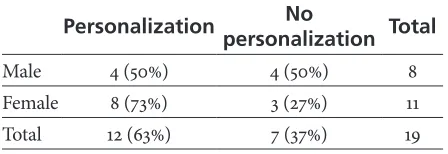
Another aspect to be considered is how students personalized the theme in the final interview. In the fi, they talked about the classes and the relationship of the themes with their lives. In Table 4, we show the quantity of students who personalized the themes:
Table 4. Personalization of the themes Personalization personalizationNo Total
Male 4 (50%) 4 (50%) 8
Female 8 (73%) 3 (27%) 11
Total 12 (63%) 7 (37%) 19
Note. From 23 students, only 19 participated in the fi.
they went through because of the bodies they have/ had. From the twelve students who personalized the theme, five reported stories especially about bullying experiences, either being the perpetrator or the victim. In the following fragments, we have an example of a girl telling how she bullied fat children when she was a kid and a boy telling how he suffered from bullying:
Eu já era bem preconceituosa quando eu era pequena, em relação a pessoa que era gordinha. Hoje eu me arrependo, acho ridículo, né? Mas já mudei essa forma. Me arrependo já por ter xingado, batido, essas pessoas, que eram colega de sala e só pelo fato de ser gordinha eu achava horrível. (Jymmi, female, fi) [I was really prejudiced in relation to fat people when I was little. Today I regret it, I think it is ridiculous. I changed. I regret having called names and hitting these people who were my classmates. Just because of the fact they were fat, they were terrible people to me.]
Eu já fui gordo quando eu era menor e eu já sofri bullying quando eu era menor. Uma vez eu tava passando numa pracinha, aí vinha três meninos e eles começou a me bater porque eu era gordo. E com isso eu fiquei com raia e até fiz dieta pra emagrecer. (Scorpion, male, fi) [I used to be fat when I was little and I suffered from bullying. One day, I was passing by a square, and then three boys came and they started hitting me because I was fat. Then, I got really angry and started dieting to get thinner.]
Jymmi seems to consider the fat body as “a bodily abnormality and a form of deviance” (Harjunen, 2002, p. 81) and as deserving punishment. The speeches also confirm Harjunen’s position that the “school is one of the most central places where girls are taught the boundaries of the acceptable or ideal female body” (Harjunen, 2002, p. 90). In the case presented, it is not just the fat female body that is marginalized at school, but also the male body as in Scorpion’s case. Moreover, the reports are also in accordance with the conclusion Silva et al. (2014) reached in their study: People who deviate from this acceptable body “are rejected and even excluded from the group when it is perceived they do not put any effort in improving their appearances” (p. 442).
Seven out of these twelve students mentioned how standards of beauty were oppressive to them in various contexts, family being one of them. In the following dialogue, we have Ana Clara’s speech about her life and her family:
Ana Clara: [...] Na minha família, eles costumam achar que os magros são mais bonitos, mas a maior parte da minha família é tudo gordo. [In my family, they usually think that thin people are prettier, but most of my relatives are fat.]
Pedro: Mas como assim eles acham os magros mais bonitos? [But how come they think thin people are prettier?]
Ana Clara: É porque a minha mãe, ela sempre tá propondo pra mim emagrecer, porque ela acha que eu não sou saudável, digamos, porque meu peso é muito grande, porque fica difícil pra encontrar roupa, pra encontrar alguém que goste de mim do jeito que eu sou. Aí por isso ela quer que eu emagreça [com voz trêmula]. [It is because of my mother, she is always asking me to get thinner, because she thinks it is not healthy, let’s say, because I am overweight, because it is difficult to find clothes, to find somebody who really likes me the way I am. That’s why she wants me to get thinner [with a trembling voice]].
Pedro: O que você acha disso? [What do you think about that?] Ana Clara: Eu acho muito pesado porque às vezes eu choro, porque nem minha mãe me aceita do jeito que eu sou. [I think it is very sad because sometimes I cry, because not even my mother accepts me the way I am.] (Student and teacher, female and male, fi)
. . . [she] has lost weight” (Harjunen, 2003, p. 6), that is, her ability to act in this world is static and her mother does not see her as “a competent agent” (Harjunen, 2003, p. 6). From Ana Clara’s experience, we can see how fat people are subjected to a kind of oppression, by means of which it is understood that it is the individual’s responsibility to be accepted in society and the only way to achieve that is getting thinner.
As presented before, twelve out of nineteen students personalized the theme. The other seven students did not mention personal stories in the interview, but five of them classified the experience of discussing such themes as important. Besides, three of them told stories related to the theme about people they knew, and three out of the seven affirmed they enjoyed the lessons.
Final Thoughts
Fatness and beauty standards are themes which, to our concern, have not been much addressed by critical applied linguists in classroom research. We aimed to focus on how adolescent students in a Brazilian public school classroom defined their body image and personalized the themes beauty standards and
fatness. Even though the research uses local empirical material, we emphasize that the theme discussed is of global interest, since body dissatisfaction rates have increased considerably worldwide (Moy, 2015). Our study corroborates with others (Croll, 2005; Harjunen, 2009, Lorber & Martin, 2007; Mason, 2012; Petroski, Pelegrini, & Glaner, 2012) in the sense that body image is a gendered subject, that is, female and male adolescents experience their bodies differently because of gendered social constructions around concepts of beauty. Moreover, regardless of whether they are following a lean thin beauty standard or a muscular one, we could see how women are much more pressured not to deviate from beauty standards. Differences regarding students’ sexuality and race were not taken into consideration because of research time constraints, but we consider it to be of utmost
relevance to find out how intersectionalization of other variables affects body image.
Twelve of the nineteen students who took part in the fi personalized the themes by telling personal stories. Five told stories related to bullying, whether being the victim or the perpetrator, while seven told stories related to oppression suffered because of beauty standards. From these personalizations, we consider the importance of studying fatness from a social perspective, since fat is an adjective that characterizes an experience (Cooper, 2010), not a disease. Our empirical material suggests that being fat constrains fat people’s agency, limiting their possibilities in life. Such notions reflect macro structures of power and need to be problematized through questioning the discourse of obesity and the beauty standards.
We agree with Moita Lopes (2003) that language is discourse, and, as we have shown, the research par-ticipants are deeply affected by discourses of obesity and beauty standards. If we teach language following a structuralist approach favouring the teaching of language structures, we believe we are helping the dissemination and reproduction of naturalized discourses, such as the discourse of obesity. These naturalized discourses are not innocent or neutral: they are always ideological. Problematizing fatness and body size in the language class should be aimed at making students feel posi-tive about their bodies, so that students may have the opportunity to develop positive perceptions of their bodies and change the way they position themselves in the world. Considering that “the way we view our bodies determines the way we participate in the world” (Baker, 2014), if students are not confident with their bodies, we will not achieve one of the main purposes of education, which is subjectification, defined by Biesta (2015) as “the way in which children and young people come to exist as subjects of initiative and responsibility rather than as objects of the actions of others” (p. 77).
developed will raise the interest of critical applied linguists and language teachers to develop research and teaching practices based on the themes addressed, since they are strongly related to students’ lives.
References
Baker, J. (2014, July 14). Change your world, not your body: The social impact of body love [Video file]. Retrieved from https://www.youtube.com/watch?v=iSjwdN9vW0g. Biesta, G. (2015). What is education for? On good education,
teacher judgement, and educational professionalism.
European Journal of Education, 50(1), 75-87. https://
doi.org/10.1111/ejed.12109.
Bucholtz, M. (2016). Why bodies matter: Discourse and
materiality after mass murder (Unpublished essay).
Retrieved from http://www.linguistics.ucsb.edu/ faculty/bucholtz/sites/secure.lsit.ucsb.edu.ling.d7_b/ files/sitefiles/research/publications/Bucholtz2016-WhyBodiesMatter-long.pdf.
Canagarajah, S. (2013). Translingual practice: Global Englishes
and cosmopolitan relations. New York, us: Routledge.
https://doi.org/10.4324/9780203120293.
Conrad, P. (2005). The shifting engines of medicalization.
Journal of Health and Social Behaviour, 46(1), 3-14.
https://doi.org/10.1177/002214650504600102.
Cooper, C. (2010). Fat studies: Mapping the field.
Sociology Compass, 4(12), 1020-1034. https://doi.
org/10.1111/j.1751-9020.2010.00336.x.
Croll, J. (2005). Body image and adolescents. In M. Story
& J. Stang (Eds.), Guidelines for adolescent nutrition
services (pp. 155-166). Minneapolis, us: University of
Minnesota.
Crookes, G. V. (2012). Critical language pedagogy. In L.
Ortega et al. (Eds.), Encyclopedia of applied linguistics.
Cambridge, uk: Cambridge University Press.
Crookes, G. V. (2013). Critical elt in action: Foundations,
promises, praxis. New York, us: Routledge. https://doi.
org/10.4324/9780203844250.
de Urzêda Freitas, M. (2012). Educando para transgredir: reflexões sobre o ensino crítico de línguas estrangeiras/
inglês [Teaching to transgress: Reflections on foreign
language/English critical teaching]. Trabalhos em
Linguística Aplicada, 51(1), 77-98. https://doi.org/10.1590/
s0103-18132012000100005.
Foucault, M. (1995). Discipline and punish: The birth of the
prison. New York, us: Random House.
Harjunen, H. (2002). The construction of an acceptable female body in Finnish schools. In V. Sunnari, J.
Kangasvuo, & M. Heikkinen (Eds.), Gendered and
sexualized violence in educational environments (pp.
78-91). Oulu, fi: Oulu University Press.
Harjunen, H. (2003, August). Obesity as a liminal and
marginalized experience. Paper presented at Gender
and Power in New Europe: The 5th European Feminist
Research Conference, Lund University, Sweden.
Harjunen, H. (2009). Woman and fat: Approaches to the
social study of fatness (Doctoral dissertarion). University
of Jyväskylä, Finland. Retrieved from https://jyx.jyu. fi/dspace/handle/123456789/22599.
Hawkins, M., & Norton, B. (2009). Critical language teacher
education. In A. Burns & J. Richards (Eds.), Cambridge
guide to second language teacher education (pp. 30-39).
Cambridge, uk: Cambridge University Press.
Janks, H. (2010). Literacy and power. New York, us:
Routledge.
Jordão, C. M., & Fogaça, F. C. (2012). Critical literacy in the
English language classroom. delta: Documentação de
Estudos em Lingüística Teórica e Aplicada, 28(1), 69-84.
https://doi.org/10.1590/s0102-44502012000100004. Kubota, R. (2015). Race and language learning in
multicultural Canada: Towards critical antiracism.
Journal of Multilingual and Multicultural Development,
36(1), 3-12. https://doi.org/10.1080/01434632.2014.8
92497.
Kubota, R., & Lin, A. (Eds.) (2009). Race, culture, and
identities in second language education: Exploring
critically engaged practice. New York, us: Routledge.
S. L. McKay, G. Hu, & W. A. Renandya (Eds.), Principles and practices for teaching English as an international
language (pp. 9-27). New York, us: Routledge.
Lorber, J., & Martin, P. (2007). The socially constructed body: Insights from feminist theory. In P. Kivisto (Ed.),
Illuminating social life: Classical and contemporary
theory revisited (pp. 226-244). Thousand Oaks, us:
Pine Forge Press.
Mason, K. (2012). The unequal weight of discrimination:
Gender, body size, and income inequality. Social
Problems, 59(3), 411-435. https://doi.org/10.1525/
sp.2012.59.3.411.
Merriam, S. (2002). Introduction to qualitative research.
In S. Merriam (Ed.), Qualitative research in practice:
Examples for discussion and analysis (pp. 3-17). San
Francisco, us: Jossey-Bass.
Moita Lopes, L. P. (2002). Identidades fragmentadas: a
construção discursiva de raça, gênero e sexualidade em
sala de aula [Fragmented identities: The discursive
construction of race, gender, and sexuality in the classroom]. Campinas, br: Mercado de Letras. Moita Lopes, L. P. (2003). A nova ordem mundial, os
parâmetros curriculares nacionais e o ensino de inglês no Brasil: a base intelectual para uma ação política [The new world order, the national curricular parameters and English teaching in Brazil: Intellectual basis for political action]. In L. Barbara & R. de C. G. Ramos
(Eds.), Reflexão e ações no ensino-aprendizagem de
línguas [Reflection and actions in language teaching
and learning] (pp. 29-57). São Paulo, br: Mercado
de Letras.
Moy, G. (2015). Media, family, and peer influence on children’s
body image (Master’s thesis). The State University
of New Jersey, usa. Retrieved from https://rucore. libraries.rutgers.edu/rutgers-lib/48157/.
Nelson, C. (2009). Sexual identities in English language
education: Classroom conversations. New York, us:
Routledge.
Norton, B., & Toohey, K. (2004). Introduction. In B.
Norton & K. Toohey (Eds.), Critical pedagogies and
language learning (pp. 1-17). Cambridge, uk: Cambridge
University Press.
Norton, B., & Toohey, K. (2011). Identity, language learning,
and social change. Language Teaching,44(4), 412-446.
https://doi.org/10.1017/S0261444811000309.
Okazaki, T. (2005). Critical consciousness and critical
language teaching. Second Language Studies, 23(2),
174-202.
Oliveira, N. (2014, July 17). Com novo padrão de beleza, mulheres buscam coxas e glúteos volumosos [With new beauty standard, women want bigger thighs and glutes].
Globo Esporte. Retrieved from http://globoesporte.
globo.com/eu-atleta/nutricao/noticia/2014/07/com- novo-padrao-beleza-mulheres-buscam-coxas-e-gluteos-volumosos.html.
Oliver, J. (2006). Fat politics: The real story behind America’s
obesity epidemic. New York, us: Oxford University Press.
Pennycook, A. (1999). Introduction: Critical approaches
to tesol. tesol Quarterly, 33(3), 329-348. https://doi.
org/10.2307/3587668.
Pennycook, A. (2001). Critical applied linguistics: A
critical introduction. Mahwah, us: Lawrence Erlbaum
Associates.
Pessoa, R. R. (2014). A critical approach to the teaching of
English: Pedagogical and identity engagement. Revista
Brasileira de Linguística Aplicada, 14(2), 353-372. https://
dx.doi.org/10.1590/S1984-63982014005000005. Pessoa, R. R., & de Urzêda Freitas, M. T. (2012). Challenges
in critical language teaching. tesol Quarterly, 46(4),
753-776. https://doi.org/10.1002/tesq.46.
Pessoa, R. R., & de Urzêda Freitas, M. T. (2016). Língua como espaço de poder: uma pesquisa de sala de aula na perspectiva crítica [Language as space of power:
Classroom research from a critical perspective]. Revista
Brasileira de Linguística Aplicada, 16(1), 133-156. https://
dx.doi.org/10.1590/1984-639820158394.
Petroski, E., Pelegrini, A., & Glaner, M. (2012). Motivos e prevalência de insatisfação com a imagem corporal em adolescentes [Reasons and prevalence of body
Coletiva, 17(4), 1071-1077. https://doi.org/10.1590/ s1413-81232012000400028.
Rabinow, P. (Ed.). (1984). The Foucault reader. New York,
us: Pantheon Books.
Silva, M., Taquette, S., & Coutinho, E. (2014). Senses of body
image in adolescents in elementary school. Revista de
About the Authors
Pedro Augusto de Lima Bastos is a graduate student in Linguistic Studies at Universidade Federal de
Goiás. His research interests are decolonial and critical perspectives on language teaching and language teacher education.
Rosane Rocha Pessoa is an associate professor of English at the Faculdade de Letras of the Universidade
Federal de Goiás, Regional Goiânia. She develops research in the areas of language teaching and language teacher education grounded on critical perspectives.
Saúde Pública, 48(3), 438-444. http://dx.doi.org/10.1590/
S0034-8910.2014048005083.
Wright, J. (2009). Biopower, biopedagogies and the obesity
epidemic. In J. Wright & V. Harwood (Eds.), Biopolitics
and the obesity epidemic: Governing bodies (pp. 1-14).