Open Access
Research article
Assessing harmful effects in systematic Reviews
Heather M McIntosh*, Nerys F Woolacott and Anne-Marie Bagnall
Address: Centre for Reviews and Dissemination, University of York, York, UK
Email: Heather M McIntosh* - [email protected]; Nerys F Woolacott - [email protected]; Anne-Marie Bagnall - [email protected] * Corresponding author
Abstract
Background: Balanced decisions about health care interventions require reliable evidence on harms as well as benefits. Most systematic reviews focus on efficacy and randomised trials, for which the methodology is well established. Methods to systematically review harmful effects are less well developed and there are few sources of guidance for researchers. We present our own recent experience of conducting systematic reviews of harmful effects and make suggestions for future practice and further research.
Methods: We described and compared the methods used in three systematic reviews. Our evaluation focused on the review question, study designs and quality assessment.
Results: One review question focused on providing information on specific harmful effects to furnish an economic model, the other two addressed much broader questions. All three reviews included randomised and observational data, although each defined the inclusion criteria differently. Standard methods were used to assess study quality. Various practical problems were encountered in applying the study design inclusion criteria and assessing quality, mainly because of poor study design, inadequate reporting and the limitations of existing tools. All three reviews generated a large volume of work that did not yield much useful information for health care decision makers. The key areas for improvement we identified were focusing the review question and developing methods for quality assessment of studies of harmful effects.
Conclusions: Systematic reviews of harmful effects are more likely to yield information pertinent to clinical decision-making if they address a focused question. This will enable clear decisions to be made about the type of research to include in the review. The methodology for assessing the quality of harmful effects data in systematic reviews requires further development.
Background
Systematic reviews are important tools for evidence-based health care. They are certainly one of the reasons for the progress that has been made in obtaining reliable evi-dence on the beneficial effects of interventions. A recent study of the medical literature, using Medline and the Cochrane Library, showed that the number of systematic reviews published has increased dramatically, from a
sin-gle publication in the years 1966 to 1970, to 23 in 1981 to 1985, and 2467 in 1996 to 2000 [1]. Most of the sys-tematic reviews focused on efficacy or effectiveness. How-ever, to make a balanced decision about any intervention it is essential to have reliable evidence on the harms as well as the benefits. Although the coverage of harmful effects has increased over time, only 27% of the reviews published between 1996 and 2000 included any
Published: 19 July 2004
BMC Medical Research Methodology 2004, 4:19 doi:10.1186/1471-2288-4-19
Received: 30 March 2004 Accepted: 19 July 2004
This article is available from: http://www.biomedcentral.com/1471-2288/4/19
information about safety, and only 4% focused primarily on the safety of the intervention reviewed [1]. This is per-haps unsurprising as many authors of systematic reviews restrict inclusion to randomised controlled trials (RCTs) to minimise bias, and harmful effects are often inade-quately assessed and/or reported in RCTs [2,3]. Another important reason for the relative lack of reliable evidence on harmful effects is that RCTs are not always suitable to evaluate them and other types of study design need to be considered [4].
The methodology for conducting systematic reviews of beneficial effects from RCTs is well established, whereas the methods for systematically reviewing randomised or observational data on harmful effects are less well devel-oped and less often used. Only 1.25% of 3604 publica-tions cited in the 2001 edition of Side Effects of Drugs (SEDA-24) were systematic reviews [5]. At present researchers, like us, who conduct systematic reviews have limited sources of guidance, such as the suggestions offered by the Cochrane Collaboration [6]. Fortunately, research into the methodology of incorporating harmful effects data in systematic reviews is on the increase, from which we expect more sources of guidance to emerge.
It is not uncommon, even among experienced reviewers, to assume that the objective of a systematic review of harmful effects should encompass all known and previ-ously unrecognised harmful effects and that data from all types of study design should be sought. We have re-visited three systematic reviews of drug interventions in which we had reviewed harmful effects, to evaluate our own recent experience, identify areas for improvement and to share our ideas with other researchers undertaking reviews.
Methods
We used three reviews for this study on the basis that they had been completed recently (between 2001 and 2003) and that one of us had been the lead reviewer of harmful effects in each review. The reviews were conducted as Health Technology Assessments for the National Coordi-nating Centre for Health Technology Assessment (NCCHTA) on behalf of the National Institute for Clinical Excellence (NICE). The reviews, in order of completion, were: nicotine replacement therapy (NRT) and bupropion sustained release (SR) for aiding smoking cessation [7], atypical antipsychotics for schizophrenia [8], and newer antiepileptic drugs for epilepsy in adults [9].
We described and compared the methods used in each review and the problems we encountered in applying those methods. We focused our evaluation on the review objectives, the inclusion criteria for study design and the quality assessment of the primary studies. We do not report on the matter of searching for studies about
harm-ful effects which presents another challenge to those who conduct systematic reviews [10,11], because exploratory work following from the reviews described here is under-way and preliminary results are reported elsewhere [12,13].
Results
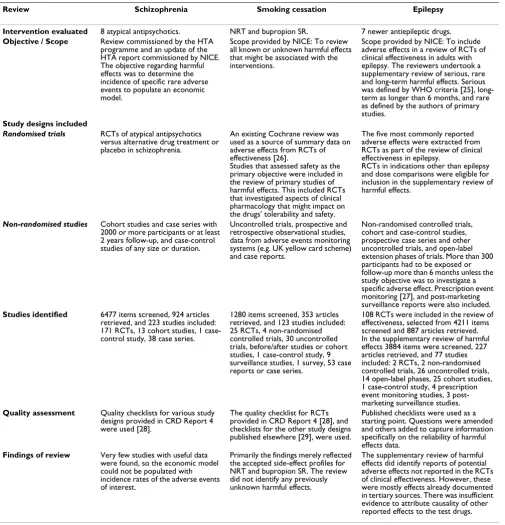
The main components of the three systematic reviews of harmful effects are described in Table 1. Our evaluation highlighted the following aspects of the methodology that could have been improved on and others that require fur-ther development.
Review objectives
The schizophrenia review objective appeared to be appro-priate in seeking to determine the incidence of named outcomes that were considered by health economists to be most likely to lead to a change in prescribed treatment [14]. The objectives of the smoking cessation and epilepsy reviews were very broad in comparison. Given that the side-effect profiles of the drugs for smoking cessation were well established, with details available in various pub-lished standard reference texts [15,16], it would have been more efficient to focus the review effort on a clear ques-tion, such as the significance of seizures for bupropion SR and the cardiovascular effects of nicotine in NRT. The objective of the review of harmful effects of the antiepilep-tic drugs did not target clinical decision-making; the sup-plementary review of harmful effects might have been of real use to decision makers if we had focused on a crucial clinical question such as the safety of the drugs in pregnancy.
Study designs
All three reviews included study designs other than RCTs to assess harmful effects. The types of non-randomised studies included for each review reflected differences in the reviews' objectives, our judgment as reviewers as to where the most useful data were likely to be found, and was to some extent pragmatic in terms of the time availa-ble to complete the reviews. The reviews with the broad objectives included more non-randomised studies and more diverse study designs. The schizophrenia and epi-lepsy reviews specified a minimum size and duration of study to be included (see table) in an attempt to add data over and above what was available from the largest and longest RCTs. Doing this did involve some indetermina-ble risk of missing important information.
harmful effects had we reviewed beforehand the RCTs that were summarised briefly in the Cochrane review. Simi-larly in the epilepsy review all the adverse events (not just the most common) reported in the RCTs of clinical effec-tiveness should have been reviewed before moving on to observational studies.
Applying the inclusion criteria
Once the inclusion criteria for study design had been defined, applying them was problematic. Reports of pri-mary studies rarely described the study design in sufficient detail. Many of the studies included in the schizophrenia review purported to be cohort studies but on closer exam-ination were in fact large case series involving more than
Table 1: Description of the assessment of harmful effects in the three systematic reviews
Review Schizophrenia Smoking cessation Epilepsy
Intervention evaluated 8 atypical antipsychotics. NRT and bupropion SR. 7 newer antiepileptic drugs.
Objective / Scope Review commissioned by the HTA programme and an update of the HTA report commissioned by NICE. The objective regarding harmful effects was to determine the incidence of specific rare adverse events to populate an economic model.
Scope provided by NICE: To review all known or unknown harmful effects that might be associated with the interventions.
Scope provided by NICE: To include adverse effects in a review of RCTs of clinical effectiveness in adults with epilepsy. The reviewers undertook a supplementary review of serious, rare and long-term harmful effects. Serious was defined by WHO criteria [25], long-term as longer than 6 months, and rare as defined by the authors of primary studies.
Study designs included
Randomised trials RCTs of atypical antipsychotics versus alternative drug treatment or placebo in schizophrenia.
An existing Cochrane review was used as a source of summary data on adverse effects from RCTs of effectiveness [26].
Studies that assessed safety as the primary objective were included in the review of primary studies of harmful effects. This included RCTs that investigated aspects of clinical pharmacology that might impact on the drugs' tolerability and safety.
The five most commonly reported adverse effects were extracted from RCTs as part of the review of clinical effectiveness in epilepsy.
RCTs in indications other than epilepsy and dose comparisons were eligible for inclusion in the supplementary review of harmful effects.
Non-randomised studies Cohort studies and case series with 2000 or more participants or at least 2 years follow-up, and case-control studies of any size or duration.
Uncontrolled trials, prospective and retrospective observational studies, data from adverse events monitoring systems (e.g. UK yellow card scheme) and case reports.
Non-randomised controlled trials, cohort and case-control studies, prospective case series and other uncontrolled trials, and open-label extension phases of trials. More than 300 participants had to be exposed or follow-up more than 6 months unless the study objective was to investigate a specific adverse effect. Prescription event monitoring [27], and post-marketing surveillance reports were also included.
Studies identified 6477 items screened, 924 articles retrieved, and 223 studies included: 171 RCTs, 13 cohort studies, 1 case-control study, 38 case series.
1280 items screened, 353 articles retrieved, and 123 studies included: 25 RCTs, 4 non-randomised controlled trials, 30 uncontrolled trials, before/after studies or cohort studies, 1 case-control study, 9 surveillance studies, 1 survey, 53 case reports or case series.
108 RCTs were included in the review of effectiveness, selected from 4211 items screened and 887 articles retrieved. In the supplementary review of harmful effects 3884 items were screened, 227 articles retrieved, and 77 studies included: 2 RCTs, 2 non-randomised controlled trials, 26 uncontrolled trials, 14 open-label phases, 25 cohort studies, 1 case-control study, 4 prescription event monitoring studies, 3 post-marketing surveillance studies.
Quality assessment Quality checklists for various study designs provided in CRD Report 4 were used [28].
The quality checklist for RCTs provided in CRD Report 4 [28], and checklists for the other study designs published elsewhere [29], were used.
Published checklists were used as a starting point. Questions were amended and others added to capture information specifically on the reliability of harmful effects data.
Findings of review Very few studies with useful data were found, so the economic model could not be populated with incidence rates of the adverse events of interest.
Primarily the findings merely reflected the accepted side-effect profiles for NRT and bupropion SR. The review did not identify any previously unknown harmful effects.
one intervention. Some of the 'cohort study' data on bupropion SR included in the smoking cessation review had actually been derived retrospectively from RCTs. How exactly the 'cohorts' had been established in studies of epi-lepsy was often unclear in terms of the source population, eligibility criteria, and selection, or was simply not reported. Had we, in all three reviews, only included reports of studies fitting textbook definitions of particular study designs, virtually all of the primary study reports we identified would have been excluded. The inclusive approach we took turned out to be unrewarding.
In the smoking cessation review, in addition to difficulties with the study design inclusion criteria, application of the criterion to only include studies in which assessment of adverse events was the primary objective was problematic because it involved a high degree of subjective judgment.
Quality assessment
We encountered problems when applying published checklists in our reviews of harmful effects. The response to some questions depended on the outcome of interest, for example, follow-up may have been adequate for the assessment of the primary (usually a beneficial) outcome of the study but not for the collection of data on harmful effects. We also found that published checklists omit key features such as how harmful effects data were recorded. In the epilepsy review we were in a position to learn from the earlier reviews and spent time clarifying the questions in the checklists so that they would provide information relevant to the reliability of the harmful effects data. We also added items pertinent to reports of harmful effects such as how and when events were recorded and whether the time at which they occurred during the study was reported. Although this informed approach was a step in the right direction, the major hindrance to applying checklists in all three reviews was inadequate reporting of the basic design features of the primary studies.
Once the quality criteria had been applied there remained the challenge of interpreting the results. In our reviews we described the evidence identified and tabulated the response to each checklist question for each primary study. This generated lengthy summaries that had limited utility. Even comparing validity within study designs (not across them) we found it impossible to synthesise the information as all the included studies had methodologi-cal flaws and features that could not be assessed due to inadequate reporting. Reaching a decision about which studies were likely to give the most reliable results was not straightforward.
Discussion
Our experience of reviewing harmful effects mirrors that of other researchers in that a significant investment of effort failed to yield significant new information [6,17].
A focused review question is standard practice for assess-ing beneficial outcomes in systematic reviews and should also be so when reviewing harms. Researchers conducting reviews need to make sure that they address a well-formu-lated question about harms that are likely to impact on clinical decisions. Focusing a review question about harmful effects will not necessarily mean restricting it to specific adverse events but may mean, for example, addressing a particular issue such as long-term effects, drug interactions, or the incidence of mild effects of importance to patients. If the aim of the research is to look for previously unrecognised harmful effects, analysis of primary surveillance data may be more appropriate than a systematic review [18]. Researchers also need to be aware that scopes set by external commissioning bodies, despite having consulted with national professional and patient organisations, may not be a suitable question to address in a systematic review. The wisdom of broad and non-specific questions about harmful effects should be questioned because the resources, especially time, needed to do this comprehensively are usually insufficient.
It is important to realise that an unquestioning belief that observational studies are the best source of harmful effects data simply because they are not RCTs can be a pitfall. It is essential to think carefully about the review question before widening the inclusion criteria to include non-ran-domised study designs. Some harmful effects, such as very rare events or those emerging in the long-term, are unlikely to be addressed adequately in RCTs. But, even if observational studies are appropriate to the review ques-tion researchers should be prepared for the difficulty of interpreting observational study data outweighing the anticipated benefits.
It is essential that quality assessment is able to discrimi-nate poor from better quality studies of harmful effects. Levels of evidence hierarchies have several shortcomings. The hierarchy of evidence is not always the same for all harmful or beneficial outcomes. For example, an RCT with adequate internal validity but limited sample size or follow-up may be a less reliable source of information about relatively uncommon harmful effects emerging in the long-term than a large well-conducted cohort study with many years of follow-up. Another problem with ranking evidence in a hierarchy is that different dimen-sions of quality get condensed into a single grade, result-ing in a loss of information. Furthermore, the dimensions included in current hierarchies may not be the most important in terms of reflecting the reliability of a partic-ular study's findings [24]. Researchers need to clarify a pri-ori what exactly they need to glean from their quality assessment of the primary studies in their own review of harmful effects and it may be necessary to differentiate clearly between internal and external validity.
We suggest that further research is needed to collate, assimilate and build on the existing information relevant to systematically reviewing primary studies for harmful effects of health care interventions. This should include a review of the literature pertinent to the methodology of incorporating evidence of harmful effects in systematic reviews; a description and categorisation of the methods used in systematic reviews published to date, and any evi-dence from methodological research on which they are based; and the development of quality assessment methods.
Conclusions
Appraisal of our recent experience highlighted some of the problems inherent in conducting systematic reviews of harmful effects of health care interventions. Such reviews need to address a well-formulated question to facilitate clear decisions about the type of research to include and how best to summarise it, and to avoid repeating what is already known. The review question about harmful effects needs to be relevant to clinical decision-making. A system-atic review of the methodology pertinent to systemsystem-atic reviews of harmful effects is warranted.
Competing interests
None declared.
Authors' contributions
AMB, HMM and NFW conducted the review work described. NFW conceived of the study. NFW and HMM drafted the manuscript. All authors contributed to, read and approved the final manuscript.
Acknowledgements
None declared.
References
1. Ernst E, Pittler MH: Assessment of therapeutic safety in sys-tematic reviews: literature review.BMJ 2001, 323:546. 2. Ioannidis JPA, Lau J: Completeness of safety reporting in
rand-omized trials: an evaluation of 7 medical areas.JAMA 2001,
285:437-443.
3. Loke YK, Derry S: Reporting of adverse drug reactions in ran-domised controlled trials - a systematic survey. BMC Clin Pharmacol 2001, 1:3.
4. Cuervo GL, Clarke M: Balancing benefits and harms in health care.BMJ 2003, 327:65-66.
5. Aronson JK, Derry S, Loke YK: Adverse drug reactions: keeping up to date.Fundam Clin Pharmacol 2002, 16:49-56.
6. Cochrane Adverse Effects Sub-Group of the Cochrane Non-Ran-domised Study Methods Group: Including adverse effects in sys-tematic reviews: interim recommendations. [http:// www.dsru.org/wwwboard/latestdraft.pdf].
7. Woolacott NF, Jones L, Forbes CA, Mather LC, Sowdon AJ, Song FJ, Raftery JP, Aveyard PN, Hyde CJ, Barton PM: The clinical effective-ness and cost-effectiveeffective-ness of bupropion and nicotine replacement therapy for smoking cessation: a systematic review and economic evaluation.Health Technol Assess 2002, 6 (16):1-245.
8. Bagnall A-M, Jones L, Ginnelly L, Lewis R, Glanville J, Gilbody S, Davies L, Torgerson D, Kleijnen J: A systematic review of atypical antip-sychotic drugs in schizophrenia.Health Technol Assess 2003, 7 (13):1-193.
9. Wilby J, Kainth A, McIntosh HM, Forbes C: The clinical effective-ness and cost-effectiveeffective-ness of newer drugs for epilepsy in adults.Health Technol Assess, in press.
10. Derry S, Loke YK, Aronson JK: Incomplete evidence: the inade-quacy of databases in tracing published adverse drug reac-tions in clinical trials.BMC Med Res Methodol 2001, 1:7. 11. Bagett R, Chiquette E, Anagnostelis B, Mulrow C: Locating reports
of serious adverse drug reactions [poster].Proceeding of the 7th Annual Cochrane Colloquium: October 1999; Rome .
12. Golder S, McIntosh HM, Duffy S, Glanville J: Developing efficient search strategies to identify papers on adverse events. In:
Abstract Book HTAi 1st Annual Meeting: May-June 2004; Krakow . 13. Golder S, Duffy S, Glanville J, McIntosh HM, Miles J: Designing a
search filter to identify reports of adverse events. In: Abstract Book HTAi 1st Annual Meeting: May-June 2004; Krakow .
14. Lewis S: Cost utility of the latest antipsychotics in severe schizophrenia (CUtLASS): a multi-centre, randomised, con-trolled trial.Health Technol Assess, in press.
15. Martindale: The Complete Drug Reference. 33rd edition. Edited by: Sweetman SC. London, Pharmaceutical Press; 2002.
16. Dukes MNG, Aronson JK: Meyer's side effects of drugs: an ency-clopedia of adverse reactions and interactions. Oxford, Elsevier; 2000.
17. Loke YK, Derry S: Incorporating adverse effects data into reviews: how to get started [abstract].9th Annual Meeting for UK Contributors to the Cochrane Collaboration: 2003; Coventry .
18. Medawar C, Herxheimer A: A comparison of adverse drug reac-tion reports from professionals and users, relating to risk of dependence and suicidal behaviour with paroxetine.Int J Risk Saf Med 2004, 16:5-19.
19. Juni P, Altman DG, Egger M: Assessing the quality of randomised controlled trials.Systematic Reviews in Health Care Meta-analysis in context 2nd edition. Edited by: Egger M, Smith GD and Altman DG. London, BMJ; 2001.
20. Deeks JJ, Dinnes J, D'Amico R, Sowden AJ, Sakarovitch C, Song F, Pet-ticrew M, Altman DG: Evaluating non-randomised intervention studies.Health Technol Assess 2003, 7 (27):1-173.
21. Downs S, Black N: The feasibility of creating a checklist for the assessment of the methodological quality both of ran-domised and non-ranran-domised studies of health care interventions.J Epidemiol Community Health 1998, 52:377-384. 22. Slim K, Nini E, Forestier D, Kwiatkowski F, Panis Y, Chipponi J:
Meth-odological index for non-randomised studies (MINORS): development and validation of a new instrument.ANZ J Surg
Publish with BioMed Central and every scientist can read your work free of charge "BioMed Central will be the most significant development for disseminating the results of biomedical researc h in our lifetime."
Sir Paul Nurse, Cancer Research UK
Your research papers will be:
available free of charge to the entire biomedical community
peer reviewed and published immediately upon acceptance
cited in PubMed and archived on PubMed Central
yours — you keep the copyright
Submit your manuscript here:
http://www.biomedcentral.com/info/publishing_adv.asp
BioMedcentral
23. Wells G, Shea B, O'Connell D, Peterson J, Welch V, Losos M, Tugwell P: Newcastle-Ottawa scale (NOS) for assessing the quality of nonrandomised studies in meta-analysis. [[http://www.ohri.ca/ programs/clinical_epidemology/oxford.htm]].
24. Glasziou P, Vandenbroucke J, Chalmers I: Assessing the quality of research.BMJ 2004, 328:39-41.
25. WHO Collaborating Centre for International Drug Monitor-ing: Definitions [http://www.who-umc.org/defs.html]
26. Silagy C, Mant D, Fowler G, Lancaster T: Nicotine replacement therapy for smoking cessation (Cochrane Review). The Cochrane Library Oxford, Update Software; 2001.
27. Mann RD: Prescription-event monitoring - recent progress and future horizons.Br J Clin Pharmacol 1998, 46:195-201. 28. Centre for Reviews and Dissemination: Undertaking systematic
reviews of research on effectiveness. Edited by: Khan SK, ter Riet G, Glanville J, Sowden AJ and Kleijnen J (Eds). York, University of York; 2001.
29. Crombie IK: The Pocket Guide to Critical Appraisal. London, BMJ Publishing Group; 1996.
Pre-publication history
The pre-publication history for this paper can be accessed here: