Open Access
Software review
HitKeeper, a generic software package for hit list management
Jörg Hau
1, Michael Muller
2and Marco Pagni*
3Address: 1Nestlé Research Center, Department of BioAnalytical Science, PO Box 44, CH-1000 Lausanne 26, Switzerland, 2EPFL Database Laboratory, CH-1015 Lausanne, Switzerland and 3Swiss Institute of Bioinformatics, Vital-IT group, CH-1015 Lausanne, Switzerland
Email: Jörg Hau - [email protected]; Michael Muller - [email protected]; Marco Pagni* - [email protected] * Corresponding author
Abstract
Background: The automated annotation of biological sequences (protein, DNA) relies on the computation of hits (predicted features) on the sequences using various algorithms. Public databases of biological sequences provide a wealth of biological "knowledge", for example manually validated annotations (features) that are located on the sequences, but mining the sequence annotations and especially the predicted and curated features requires dedicated tools. Due to the heterogeneity and diversity of the biological information, it is difficult to handle redundancy, frequent updates, taxonomic information and "private" data together with computational algorithms in a common workflow.
Results: We present HitKeeper, a software package that controls the fully automatic handling of multiple biological databases and of hit list calculations on a large scale. The software implements an asynchronous update system that introduces updates and computes hits as soon as new data become available. A query interface enables the user to search sequences by specifying constraints, such as retrieving sequences that contain specific motifs, or a defined arrangement of motifs ("metamotifs"), or filtering based on the taxonomic classification of a sequence.
Conclusion: The software provides a generic and modular framework to handle the redundancy and incremental updates of biological databases, and an original query language. It is published under the terms and conditions of version 2 of the GNU Public License and available at http:// hitkeeper.sourceforge.net.
Background
The automated annotation of protein or DNA sequences is performed using a rather heterogeneous collection of motif predictors, which include regular expressions, gen-eralized profiles, hidden Markov models and neural net-works. Since the search for hits by a motif on a sequence is expensive in terms of processing time, the lists of hits obtained by comparing collections of motifs with collec-tions of sequences are usually stored and distributed as dedicated databases. InterPro [1] is a canonical example
of such a public resource that, by definition, covers only publicly available sequences and motifs.
However, biological research is often carried out using sequences and motifs that are derived from public, as well as private, sources. There is a clear need to incorporate both sources of data into the same workflow; however, since the software used to generate, manage and keep the public data up-to-date is usually not available, it is diffi-cult to reproduce and maintain similar hit lists locally. Published: 28 March 2007
Source Code for Biology and Medicine 2007, 2:2 doi:10.1186/1751-0473-2-2
Received: 8 February 2007 Accepted: 28 March 2007
This article is available from: http://www.scfbm.org/content/2/1/2
© 2007 Hau et al; licensee BioMed Central Ltd.
Further issues that complicate matters are the update fre-quency of public databases, which can lead to an almost continuous data flow, and the redundancy between differ-ent databases. As an example, redundancy is visible by the fact that the same protein sequence may appear in differ-ent differ-entries, in differdiffer-ent databases, or in differdiffer-ent releases of the same database. Since most computations are CPU-expensive, repeating the same computation should obvi-ously be avoided.
To satisfy these requirements and to simplify the in-house management of data from very different sources in various formats, we have developed HitKeeper. It is a software for the fully automatic handling of multiple sequence and motif databases, as well as classification (taxonomy) information, on a large scale. In addition, HitKeeper
implements an elaborate and original query syntax to retrieve information. The distribution provides the core programs, a number of test scripts, and a manual with detailed instructions for the set-up of a pilot installation. Since the software architecture is designed to be customiz-able and extensible, it should be relatively easy for a user with some proficiency in the Perl programming language to introduce new data types and algorithms into the sys-tem.
Implementation
Program architecture
The following description is focused on the essential fea-tures and algorithms of HitKeeper. The installation and a number of technical details are explained in-depth in the
Reference Manual, which is part of the distribution pack-age.
HitKeeper is a collection of scripts that interact as concur-rent clients with a relational database management sys-tem (RDBMS). The software is mostly written in Perl and was developed and tested under various flavours of Linux and Mac OS X using MySQL as RDBMS; it is currently being extended to other RDBMS.
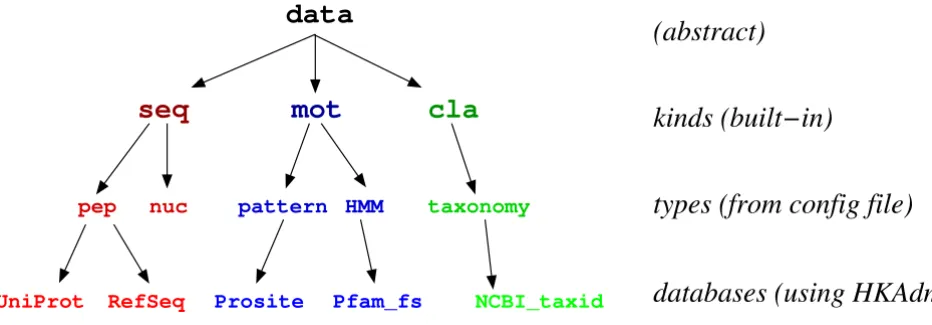
Fig. 1 is a schematic representation of the logical organi-zation of HitKeeper. Starting from the abstract concept of "data", the structure is built around three kinds whose properties are reflected in the organization of the software and that are hardcoded in the application: seq, biological sequences; mot, motifs for predicting hits on the sequences, and cla, hierarchical classification (currently limited to taxonomy).
For each kind, HitKeeper allows multiple types of data to be dealt with. As an example, seq allows multiple types of sequence data, such as "pep" (for peptide) and "nuc"(for nucleotide). Similar to this, mot may comprise the type "pattern" as well as "profile" or "HMM". All types, and all
computation algorithms between them (e.g. which pro-gram is used to run a pattern search on a peptide sequence), are defined in a central configuration file. Besides some general parameters (database server, etc.), this file also holds the list of the modules and external programs that are used (a) for parsing the flat files, (b) performing the actual computations, and (c) dispatching and/or mirroring to any external computing elements. Custom modules written in Perl can be added, either derived from the existing modules or written "from scratch". Parsing of the input data is based on lazy parsing
that extracts only the relevant information. This mini-mizes the amount of maintenance that might be induced by format changes in the source data. Custom modules can also be provided for the mirroring of the databases to external computing elements (e.g. formating for a BLAST server).
Five distinct clients are available. Three of them,
HKLoader, HKUpdater and HKPublisher, are used for RDBMS housekeeping and control of the data flow. They operate concurrently in the background, similar to a sys-tem daemon. The two other scripts, HKReader and HKAd-min, are used to interact with the RDBMS. While the former is solely intended for querying the system, the lat-ter also allows the administration of HitKeeper; as an example, the HitKeeper administrator defines interactively which database (UniProt, Prosite, etc.) is actually parsed and used for the calculations. Both scripts provide the functionality of a command-line tool, and the interactiv-ity of a "shell-like" environment; they accept input from STDIN and can thus be controlled through other scripts and pipes. This allows automation and enables perform-ing tasks in batch mode, either directly from the com-mand line or by reading comcom-mands from a file.
Data lifecycle and computations
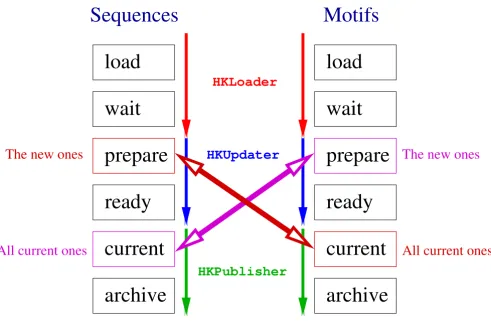
As mentioned above, HitKeeper reads three kinds of input data. Each is associated with a "pipeline" where several versions of a database, such as weekly releases, can coexist. However, only the version with the status 'current' is in the production stage and can be queried. Fig. 2 illustrates how the seq and mot pipelines are synchronized with respect to the incremental updates of the hit list.
Computations are set up on a per-database basis, so that
All hit list computations are performed by calling external software, i.e. they are not hardcoded in HitKeeper. A sim-ple imsim-plementation of a pattern-matching algorithm is provided and can be used as template for custom exten-sions.
If a sequence or motif database is updated, repeating the same computations for sequences or motifs that have not changed should be avoided. This is the purpose of the incremental update algorithm in HitKeeper. The algorithm is identical for sequence and motif database updates. Complications arise from the optional subscriptions and from the handling of redundancy; a typical case handled by our algorithm is outlined in Fig. 3.
Results and discussion
Installation, validation and scalability
The prerequisites for the installation of HitKeeper are the availability of a MySQL server and a few Perl modules from CPAN; according to our experience, the presence of the system administrator is preferable at this stage. The deployment of a HitKeeper installation as such is essen-tially performed through a shell script within a few sec-onds.
The validation of a HitKeeper installation concerns in par-ticular the incremental updates and the query mechanism. Two tests are provided in the distribution and imple-mented as shell scripts, thus emulating commands as they would be typed by the user instead of querying the RDBMS directly. They should be run as "operational qual-ification tests" and will verify the correct behaviour of the parser, computation engine, incremental update, and query mechanism.
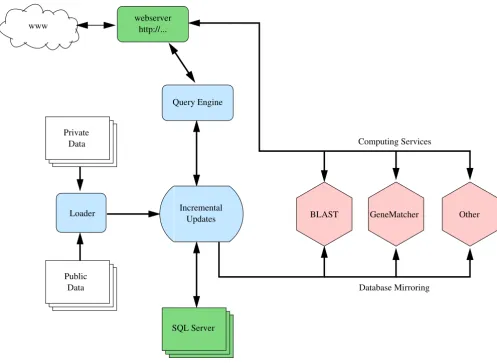
Historically, HitKeeper was developed as the "back end" of the MyHits web site [2] as depicted in Fig. 4. MyHits has been in production status since 2003 and currently han-dles more than 7 million non-redundant sequences with weekly updates from a number of major databases, and 21 million hits on these (Table 1). Thus, HitKeeper can be considered to be robust and scalable.
Queries
HitKeeper implements an elaborate and original query syntax to retrieve information. Besides support for logical operators (OR, AND, NOT), HitKeeper allows sequences to be retrieved with logical constraints on the arrange-ment of the motifs found along the sequence. An expres-sion that specifies such a particular "motif of motifs" is called a metamotif. Metamotif queries are expressed in a grammar that is specific to HitKeeper, yet human readable. This grammar is parsed and then compiled into an SQL query. The metamotif query language was inspired by our experience with mmsearch [3] and twofeat [4].
While presenting the full query capabilities of HitKeeper is out of the scope of this paper, some typical examples of the query language are given below. The setup of the fol-lowing example dataset is described fully in the Reference Manual; hits can be calculated overnight on a standard Linux workstation. We make use of three common data-bases: The Swiss-Prot protein sequences (designated with sw hereafter) [5], the Prosite patterns (pat) [6], and the NCBI taxonomy data (taxid) [7,8]. An additional database of "virtual" motifs is automatically derived from the Swiss-Prot "FT" lines (feature) with a script that produces more than 800 of these 'virtual motifs'. The computation yields two 'hit' lists (Swiss-Prot vs Prosite, and Swiss-Prot
HitKeeper ontology
Figure 1
HitKeeper ontology. Logical organization of the data and software. See text for discussion.
databases (using HKAdmin)
(abstract)
kinds (built−in)
types (from config file)
data
UniProt RefSeq Prosite Pfam_fs NCBI_taxid pep nuc HMM taxonomy
mot
seq
cla
vs the ft motifs), and a single 'hat' list (i.e. match between sequence and classification): Swiss-Prot vs NCBI
taxo-momy. The latter is used for filtering by taxonomy.
Schematic representation of the sequence and motif pipelines
Figure 2
Schematic representation of the sequence and motif pipelines. Several successive versions of a given source database usually coexist at different stages in a pipeline. The databases are processed by three scripts running simultaneously, in a man-ner similar to a system daemon: HKLoader watches the source data files for changes (using the date/time stamp). This script is responsible for parsing and converting the raw data, detecting redundancy, and transferring the "clean" data into the SQL data-base. HKUpdater updates the hit list. Once a motif database enters the prepare state, the new motifs are computed against the sequences that are in current state. Similarly, when a sequence database comes in the states prepare, the new sequences are computed against the motifs that are in the current state. The two computational tasks, sequences-vs-motifs and motifs-vs-sequences, are never executed simultaneously – this keeps the two pipelines synchronized. Once the calculations are done,
HKPublisher becomes responsible for the deployment of the databases to external computing elements (e.g. a blast server) and the database flagged as ready is promoted to current ("in production"): all subsequent queries are now applied to this database. Previous versions can be kept as archives or deleted to reclaim space.
load
wait
prepare
ready
current
archive
HKPublisher
H
K
Updater
H
KL
oader
load
wait
prepare
ready
current
archive
Sequences
Motifs
The new ones
All current ones
All current ones
The new ones
Table 1: Turnover of sequence data
db versions total entries sequences
current 39 ~ 7 · 106 ~ 5.7 · 106
total over 9 months 545 ~ 122 · 106 ~ 8.3 · 106
ratio 0.07 0.06 0.69
Example of redundancy management
Figure 3
Example of redundancy management. This example [9] uses four motif (MA ... MD) and four sequence databases (SA ... SD). The upper part of the figure corresponds to all data that are currently in production. The table on the upper left repre-sents the different databases and some of their individual entries (horizontal and vertical lines). A yellow rectangle symbolizes a subscription for computation. The small table on the right-hand side represents five "non-redundant" sequences ("Snr", arranged in columns) and three motifs ("Mnr", in rows). The computations between individual sequences and motifs are sym-bolised with black crosses; these do not necessary signal the presence of a match, but indicate the fact that the necessary calcu-lations have been performed. - The bottom part of the figure shows a new version of sequence database SB that is being prepared to replace the current version. Sequence s0 will be deleted from database SB, sequence s5 will be inserted, s3 and s4 are new to SB but already present in other databases. The computations that must be performed are indicated by the red crosses. Note that there is no need to compute s4 against m3, since it was already present in SD which, in turn, is already sub-scribed to MD. - The same principle applies for updating a database of motifs.
s
1
s
2
s
3
s
4
+
+
s
5
+
+
+
+
P
r
e
par
e
C
urr
ent
+ +
+
+
+ +
+
+
+
+
+
+
s
0
s
2
s
4
s
4
s
2
s
0
s
1
s
3
s
1
s
3
s
5
m2
m1
m3
m1
m3
c
urr
ent
v
e
rs
ion
s
S
A
S
B
S
C
S
D
S
n
r
S
n
r
S
n
r
The original text entries can be retrieved using alternative but unique designations. As an example, the Prosite entry for the pattern with id CORNICHON can be retrieved using its name, ID, or accession number:
mot_fetch_entry pat:CORNICHON mot_fetch_entry PS01340
Queries can be "stored" using a query identifier, indicated by -ref=... in the examples below. These identifiers are used to repeat, refine or even string together queries. The following example will refer to all bird sequences from Swiss-Prot:
hat_query cla_parent=Aves seq_source=sw -ref=$BIRDSEQ
Re-using the same query, count the sequences and the spe-cies, then retrieve the non-redundant sequences of all birds in Swiss-Prot:
query_stat $BIRDSEQ seq_fetch_nr $BIRDSEQ
Since the taxonomy data are available, it is easy to list all species covered by that query:
cla_fetch_desc $BIRDSEQ
A list of all matches of Prosite patterns against these sequences can be obtained as follows:
hit_query seq_name=$BIRDSEQ mot_source=pat
Schematic structure of the MyHits webserver
Figure 4
Schematic structure of the MyHits webserver. The tasks provided by HitKeeper are shown in blue. Services that provide infrastructure (MySQL, Apache) are displayed in green, and computing services in pink. The different tasks are distributed over different hosts, and synchronization of data is controlled by HitKeeper.
Public
Data
Private
Data
Loader Incremental Updates Query Engine
SQL Server
Computing Services
Database Mirroring
HitKeeper also has the capability to perform negative matching, such as finding all bird sequences with no
match by any Prosite pattern:
hit_query seq_source=sw mot_source=pat -ref=$PROSITE
seq_query seq_name=$BIRDSEQ not_seq_name=$PROSITE
A simple example is to retrieve all existing hits for the pro-tein VAV_RAT [Swiss-Prot:P54100]:
hit_query seq_name=sw:VAV_RAT
Note that these include DOMAIN sh2 (one hit), DOMAIN sh3 (two hits) in a particular arrangement. To search all sequences that fulfill a similar arrangement, a metamotif query with the followed by operator ~~ is used:
mom_query
(DOMAIN_sh3~~ DOMAIN_sh2~~ DOMAIN_sh3)
At the time of writing, there are about 22 proteins meet-ing this criterion in Swiss-Prot.
As another example, Prosite has a pattern pat:THIORE-DOXIN that targets the active site of the thioredoxin domain [Prosite:PS00194]. In Swiss-Prot, the thioredoxin domain itself is annotated and was extracted from the FT line as ft:DOMAIN_Thioredoxin. The hit by the pattern is usually present within the domain annotation, but not always. In addition, some domain annotations do not
include an active site that the pattern would match. The analysis is not straightforward since many proteins have multiple hits with the pattern and domain annotations. The following commands were used to obtain the counts as shown in Table 2:
First, a hit query for hits by either of the two motifs pat:THIOREDOXIN or ft:DOMAIN_Thioredoxin is per-formed and is saved under the query identifier $all_hit. The comma between the two motif names is the OR oper-ator:
hit_query-ref=$all_hit
mot_name=pat:THIOR-DOXIN,ft:DOMAIN_Thioredoxin
Next a search for hits is carried out where the motif pat:THIOREDOXIN is 'embedded' in the motif ft:DOMAIN_Thioredoxin. Since there are proteins with multiple thioredoxin domains, a metamotif with the is included operator /</ was used to associate the pattern and the annotation. As this is a metamotif query, mom query is used instead of hit query:
mom_query(pat:THIOREDOXIN)/</(ft:DOMAIN_Thioredoxin) -ref=$mom_hit
In a third step, hits that contain the motif pat:THIORE-DOXIN but that are not included in those that bind the metamotif are identified:
hit_query mot_name=pat:THIOREDOXIN
not_hit_list=$mom_hit -ref=$pat_not_mom
and the last dataset consists of hits with the motif ft:DOMAIN_Thioredoxin, but that are not in the meta-motif hit list:
hit_query mot_name=ft:DOMAIN_Thioredoxin not_hit_list=$mom_hit -ref=$ft_not_mom
Finally, the results of all four queries are reported:
query_stat $all_hit $mom_hit $ft_not_mom $pat_not_mom
The result is summarised in Table 2 and shows that there are 81 matches by patterns that are not included in the matches by domains. On the other hand, there are 72 domains where the corresponding pattern is not present. The execution time of this last example is typically only a few seconds.
Conclusion
HitKeeper provides a generic, modular and extensible framework to handle the redundancy and incremental
Table 2: Match counts
#sequences #motifs #hits condition
374 2 737 X OR Y
231 2 542 X /</ Y metamotif
81 1 81 X NOT IN (X /</ Y)
68 1 72 Y NOT IN (X /</ Y)
Publish with BioMed Central and every scientist can read your work free of charge
"BioMed Central will be the most significant development for disseminating the results of biomedical researc h in our lifetime."
Sir Paul Nurse, Cancer Research UK Your research papers will be:
available free of charge to the entire biomedical community peer reviewed and published immediately upon acceptance cited in PubMed and archived on PubMed Central yours — you keep the copyright
Submit your manuscript here:
http://www.biomedcentral.com/info/publishing_adv.asp
BioMedcentral
updates of biological databases and calculations between them. It allows any user to manage his/her own "private" collections of protein sequences and motifs, in addition to the public ones. HitKeeper implements an elaborate query syntax to retrieve information. These queries enable the user to specify constraints for searching proteins, such as retrieving sequences that contain specific motifs, or a defined arrangement of motifs ("metamotifs"), or queries based on the classification of sequences.
While it is not a "ready-to-use" annotation software, the system is designed to be modular, extensible and scalable. New data formats can easily be incorporated by writing custom parsers. The command-line interface of HitKeeper
allows straightforward integration and interaction with standard tools in the Unix environment, such as scripting, piping, etc.
HitKeeper is used at the production stage in the "back-end" of the MyHits web site. Hence it is actively maintained; bug fixes and new functionalities are being added into the distribution on a regular basis.
Availability and requirements
Project name: HitKeeperProject home page: http://hitkeeper.sourceforge.net
Operating system: Linux, Mac OS X, Solaris
Programming language: Perl, bash, SQL
Other requirements: MySQL 4.1 or higher, a few Perl modules from CPAN
License: GNU General Public License version 2
Any restriction to use by non-academics: None
Competing interests
The author(s) declare that they have no competing inter-ests.
Authors' contributions
MP had the original idea and implemented most of the software. MM investigated the incremental update algo-rithm and the query language [9]. JH developed the setup and testing procedures and wrote the documentation. All authors read and approved the final manuscript.
Acknowledgements
We thank many people that have contributed, be it with suggestions, test-ing, discussions or code, to the development of HitKeeper: Vassilios Ioan-nidis, Laurent Falquet, Lorenzo "Luli" Cerutti, Heinz Stockinger, Monique Zahn-Zabal, Brian Stevenson, Dmitry Kuznetsov, Christelle Vangenot, Fabio Porto and Victor Jongeneel. Funding to pay the publication charges
was provided by the Swiss Institute of Bioinformatics. MP acknowledges financial support from EMBRACE. The EMBRACE project is funded by the European Commission within its FP6 Programme, under the thematic area "Life sciences, genomics and biotechnology for health", contract number LHSG-CT-2004-512092.
References
1. Mulder NJ, Apweiler R, Attwood TK, Bairoch A, Bateman A, Binns D, Bradley P, Bork P, Bucher P, Cerutti L, Copley R, Courcelle E, Das U, Durbin R, Fleischmann W, Gough J, Haft D, Harte N, Hulo N, Kahn D, Kanapin A, Krestyaninova M, Lonsdale D, Lopez R, Letunic I, Mad-era M, Maslen J, McDowall J, Mitchell A, Nikolskaya AN, Orchard S, Pagni M, Ponting CP, Quevillon E, Selengut J, Sigrist CJA, Silventoinen V, Studholme DJ, Vaughan R, Wu CH: InterPro, progress and sta-tus in 2005. Nucl Acids Res 2005, 33:D201-205.
2. Pagni M, Ioannidis V, Cerutti L, Zahn-Zabal M, Jongeneel CV, Falquet L: MyHits: a new interactive resource for protein annotation and domain identification. Nucl Acids Res 2004, 32:W332-335. 3. Junier T, Pagni M, Bucher P: mmsearch: a motif arrangement
language and search program. Bioinformatics 2001,
17:1234-1235.
4. Rice P, Longden I, Bleasby A: EMBOSS: the European Molecular Biology Open Software Suite. Trends Genet 2000, 16(6):276-7. 5. Wu C, Apweiler R, Bairoch A, Natale D, Barker W, Boeckmann B,
Ferro S, Gasteiger E, Huang H, Lopez R, Magrane M, Martin M, Maz-umder R, O'Donovan C, Redaschi N, Suzek B: The Universal Pro-tein Resource (UniProt): an expanding universe of proPro-tein information. Nucleic Acids Res 2006, 34(Database issue):D187-91.
6. Hulo N, Bairoch A, Bulliard V, Cerutti L, De Castro E, Langendijk-Genevaux P, Pagni M, Sigrist C: The PROSITE database. Nucleic Acids Res 2006, 34(Database issue):D227-30.
7. Wheeler D, Chappey C, Lash A, Leipe D, Madden T, Schuler G, Tatusova T, Rapp B: Database resources of the National Center for Biotechnology Information. Nucleic Acids Res 2000, 28:10-4. 8. Benson D, Karsch-Mizrachi I, Lipman D, Ostell J, Rapp B, Wheeler D:
GenBank. Nucleic Acids Res 2000, 28::15-8.
9. Muller M: Analysis, design and implementation of improved queries on an integrated biological database. Master's thesis