R E V I E W
Open Access
The effectiveness of intervention with
board games: a systematic review
Shota Noda
1*, Kentaro Shirotsuki
2and Mutsuhiro Nakao
3Abstract
To examine the effectiveness of board games and programs that use board games, the present study conducted a
systematic review using the PsycINFO and PubMed databases with the keywords
“
board game
”
AND
“
trial;
”
in total,
71 studies were identified. Of these 71 studies, 27 satisfied the inclusion criteria in terms of program content,
intervention style, and pre
–
post comparisons and were subsequently reviewed. These 27 studies were divided into
the following three categories regarding the effects of board games and programs that use board games:
educational knowledge (11 articles), cognitive functions (11 articles), and other conditions (five articles). The effect
sizes between pre- and post-tests or pre-tests and follow-up tests were 0.12
–
1.81 for educational knowledge, 0.04
–
2.60 and
−
1.14
–
−
0.02 for cognitive functions, 0.06
–
0.65 for physical activity, and
−
0.87
–
−
0.61 for symptoms of
attention-deficit hyperactivity disorder (ADHD). The present findings showed that, as a tool, board games can be
expected to improve the understanding of knowledge, enhance interpersonal interactions among participants, and
increase the motivation of participants. However, because the number of published studies in this area remains
limited, the possibility of using board games as treatment for clinical symptoms requires further discussion.
Keywords:
Board game, Systematic review, Education, Cognitive function
Background
A board game is a generic term for a game played by
placing, moving or removing pieces on a board and that
utilizes a game format in which pieces are moved in
particular ways on a board marked with a pattern.
Ex-amples of board games include chess, Go, and Shogi.
Re-search involving chess, which is played by two players
on a board with 64 black and white squares and 16
pieces for each player [
1
], has contributed to the
theoret-ical development of cognitive psychology [
2
]. For
ex-ample, Burgoyne et al. [
3
] conducted a meta-analysis
and demonstrated that chess skills are significantly and
positively correlated with four broad cognitive abilities:
fluid reasoning, comprehension-knowledge, short-term
memory, and processing speed. Similarly, a
meta-analysis by Sala and Gobet [
4
] found that chess
instruc-tion moderately improves the cognitive skills of children.
In contrast, Go is ancient board game that consists of
simple elements (a line and circle, black and white
colors, and stone and wood materials) combined with
simple rules that generate subtleties that have enthralled
players for millennia [
5
]. Go is a famous board game in
Asian countries and has been used as a tool for
increas-ing or maintainincreas-ing brain activity for more than 5000
years [
6
]. It is currently gaining popularity in the United
States and Europe [
6
], and Kim et al. [
7
] has suggested
that playing Go might be effective for children with
attention-deficit hyperactivity disorder (ADHD) due to
its activation of hypo-aroused prefrontal cortical
func-tion and the enhancement of executive funcfunc-tion. Lin
et al. [
8
] conducted an intervention study using GO in
patients with Alzheimer’s disease and showed that
play-ing Go can also improve the clinical symptoms
associ-ated with depression, anxiety, and Alzheimer’s Disease.
Similar to chess and Go, Shogi is a board game for two
players that is also referred to as Japanese chess. Wan
et al. [
9
] conducted an experiment with undergraduate
students and found that Shogi training is related to
acti-vation in the head of the caudate nucleus. Taken
to-gether, the abovementioned findings suggest that chess,
Go, and Shogi are effective ways to achieve various
outcomes.
© The Author(s). 2019Open AccessThis article is distributed under the terms of the Creative Commons Attribution 4.0 International License (http://creativecommons.org/licenses/by/4.0/), which permits unrestricted use, distribution, and reproduction in any medium, provided you give appropriate credit to the original author(s) and the source, provide a link to the Creative Commons license, and indicate if changes were made. The Creative Commons Public Domain Dedication waiver
(http://creativecommons.org/publicdomain/zero/1.0/) applies to the data made available in this article, unless otherwise stated.
* Correspondence:[email protected]
1Graduate School of Human and Social Sciences, Musashino University, 3-3-3
Ariake, Koutouku, Tokyo 135-8181, Japan
There are many board games other than chess, Go,
and Shogi. For example, educational board games, such
as Kalèdo, have been used to improve nutrition
know-ledge and promote a healthy lifestyle for children [
10
].
Zeedyk et al. [
11
] investigated the effectiveness of a
board game for increasing knowledge about road safety
and danger and found that the interventions were
sig-nificantly effective in increasing children’s knowledge.
Although the impacts of various board games have been
previously examined, their effects have yet to be
compre-hensively reviewed. As a result, the functions and effects
of board games as a whole remain unclear. Thus, the
present review systematically examined the effectiveness
of board games and programs that use board games.
Methods
For the present review, a literature search based on the
Preferred Reporting Items for Systematic Reviews and
Meta-Analyses [
12
] using the PsycINFO and PubMed
databases was conducted to collect findings on the
ef-fectiveness of board games and programs using board
games. The keywords for the literature search were
“board game”
AND
“trial,”
and the date selected was
September 13th, 2018. The search identified nine studies
from PsycINFO and 32 studies from PubMed. The first
author of this review performed a manual search that
identified six additional studies, and 24 additional
stud-ies were extracted from Sala & Gobet [
4
], which
con-ducted a meta-analysis about the benefits of chess.
Duplicate studies were deleted and, ultimately, a list of
references consisting of 66 articles was prepared.
The inclusion criteria for the present study were as
follows: (a) studied the effects of board games and
pro-grams using board games on psychological and
educa-tional outcomes, (b) included pre–post comparative
tests, (c) used an interventional or experimental rather
than a review approach, (d) had full text availability, (e)
was written in English, and (f) was peer reviewed. A
screening to remove articles that were judged not to
sat-isfy any of the criteria from (a) to (f) was conducted, and
29 articles were extracted. Additionally, one study was
excluded because it did not use a traditional board game
(it used a Wii Fit balance board), and one study was
ex-cluded because the content details of the board game
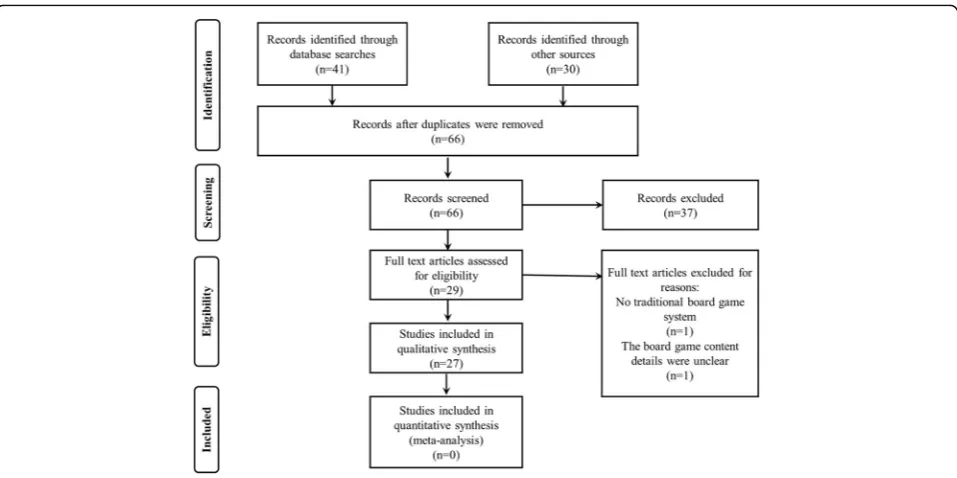
were unclear. Ultimately, 27 articles were selected for
the present study; the literature search process is
pre-sented in Fig.
1
.
Furthermore, in the studies where the means and
standard deviations of the intervention group are
de-scribed, Cohen’s d was calculated to assess effect sizes
between pre- and post-tests or between pre-tests and
follow-up tests with the following formula based on
Cohen [
13
].
d
¼
M
2‐
M
1SD
pooledSD
pooled¼
ffiffiffiffiffiffiffiffiffiffiffiffiffiffiffiffiffiffiffiffiffiffiffiffiffiffiffiffiffiffiffiffiffiffiffiffiffiffiffiffiffiffiffiffiffiffiffiffiffiffiffiffiffiffiffiffiffiffiffiffiffiffiffiffiffiffiffiffiffiffiffiffiffiffiffiffiffiffi
n
2‐
1
ð
Þ
SD
22þ
ð
n
1‐
1
Þ
SD
21n
2þ
n
1‐
2
!
v
u
u
t
Note:
M
1and
M
2are the mean of the intervention
group at the pre-test session and the post-test session or
follow-up test session, respectively.
SDpooled
is the
pooled standard deviation (
SD
1is the standard deviation
of the intervention group at the pre-test session and
SD
2is the standard deviation at the post-test session or
follow-up test session).
n
1is the number of samples at
the pre-test session.
n
2is the number of samples at the
post-test session or follow-up test session.
In the studies where the means and standard
devia-tions are described in the intervention group and the
other groups, Cohen’s d was also calculated to assess
ef-fect sizes compared to the other groups (control groups)
with the following formula based on Sala et al. [
14
].
d
¼
M
gi‐
M
gcSD
pooled‐preSDpooled‐pre¼
ffiffiffiffiffiffiffiffiffiffiffiffiffiffiffiffiffiffiffiffiffiffiffiffiffiffiffiffiffiffiffiffiffiffiffiffiffiffiffiffiffiffiffiffiffiffiffiffiffiffiffiffiffiffiffiffiffiffiffiffiffiffiffiffiffiffiffiffiffiffiffiffiffiffiffiffiffiffiffiffiffiffiffiffiffiffiffiffiffi
ni‐1
ð ÞSDpre:i2þðnc‐1ÞSDpre:c2
niþnc‐2
! v
u u t
Note:
Mgi
and
Mgc
are the mean gain of the
interven-tion group and the control group (other group) at the
post-test session or at the follow-up test session,
respect-ively, and
SDpooled-pre
is the pooled standard deviation
of the two pre-test standard deviations.
SDpre.i
is the
standard deviation of the intervention group at the
pre-test session, and
SDpre.c
is the standard deviation of the
control group at the pre-test session.
ni
is the number of
samples in the intervention group who received the
pre-test session and post-pre-test session or the pre-pre-test session
and follow-up test session.
nc
is the number of samples
in the control group who received the pre-test session
and post-test session or the pre- test session and
follow-up test session.
According to Cohen [
13
], Cohen’s d of approximately
0.20 is small, 0.50 medium, and 0.80 large.
Results and discussion
The effect of interventions with board games
In the present review, the selected studies were divided
into the following three categories regarding the effects
of board games and programs that use board games:
educational knowledge (11 articles), cognitive functions
(11 articles), and other conditions (five articles).
An overview of the findings about the effects of board
games and programs that use board games related to
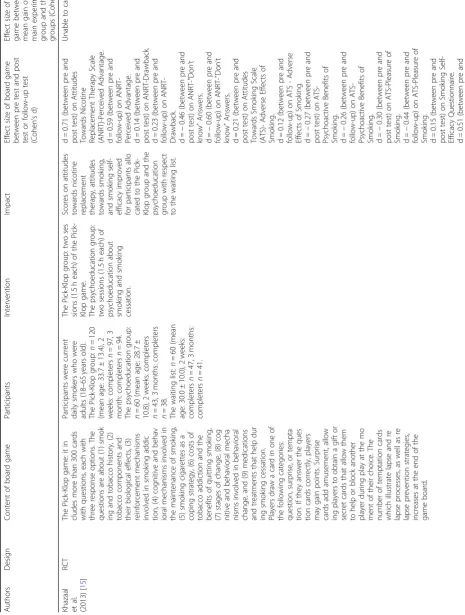
educational knowledge is shown in Table
1
[
10
,
11
,
15
–
23
]. Board games in this category were used for
the purpose of improving educational knowledge, and
the effect sizes (Cohen’s d) between pre- and
post-tests or between pre-post-tests and follow-up post-tests ranged
from 0.12 to 1.81 and between the mean gain of the
main intervention group and the other groups ranged
from 0.81 to 0.93 and
−
1.84 to
−
1.65.
An overview of the findings about the effects of board
games and programs that use board games on cognitive
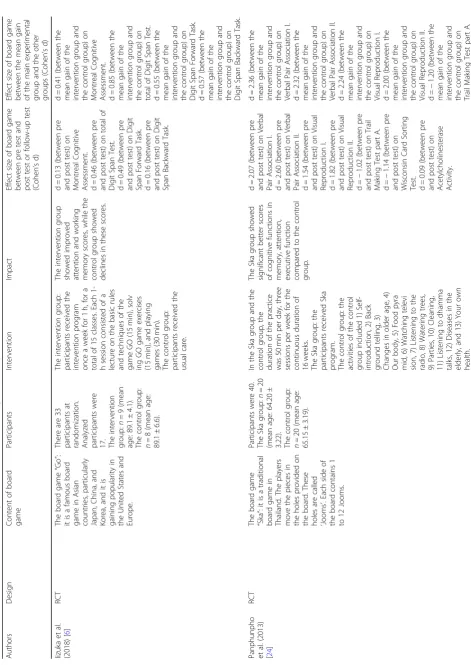
functions is shown in Table
2
[
6
,
24
–
33
]. This category
included board games such as Go, Ska, and chess, and
the effect sizes (Cohen’s d) between pre- and post-tests
of cognitive function ranged from 0.04 to 2.60 and
−
1.14
to
−
0.02. The effect size of the exacerbation was
calcu-lated in only the chess group of Sala et al. [
27
]. The
ef-fect sizes (Cohen’s d) between the mean gain of the
main intervention group and the other groups ranged
from 0.06 to 2.36 and
−
1.38 to
−
0.22.
An overview of the findings about the effects of board
games and programs that use board games on other
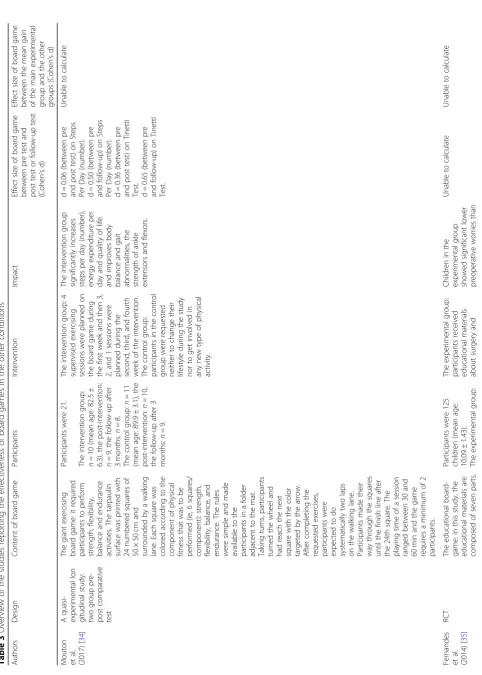
conditions is shown in Table
3
[
7
,
8
,
34
–
36
]. This
cat-egory addressed the impacts of board games on physical
activity, anxiety, ADHD symptoms, and the severity of
Alzheimer’s Disease. The effect sizes (Cohen’s d)
be-tween pre- and post-tests or bebe-tween pre-tests and
follow-up tests ranged from 0.06 to 0.65 for physical
ac-tivity and from
−
0.87 to
−
0.61 for ADHD symptoms.
Board games and educational knowledge
Eleven studies that used board games to increase
educa-tional knowledge were selected for this review. The
present findings showed that board games influence
educational knowledge and concomitant outcomes, with
the effect sizes for educational knowledge ranging from
very small to large.
Board games can be used as a tool to encourage
learn-ing. In previous studies, specialized board games aimed
at improving knowledge in the field of education were
targeted and subsequently developed and investigated.
For example, Wanyama et al. [
16
] conducted a study of
the Make a Positive Start Today game, which is a board
game aimed at improving knowledge about human
im-munodeficiency virus (HIV) and sexually transmitted
in-fections (STIs). Similarly, Kalèdo is an educational board
game used to increase nutrition knowledge [
10
,
19
,
21
].
It has been shown that these board games contribute to
increasing knowledge related to each particular field.
Table
1
Overview
of
the
studies
reporting
the
effectiveness
of
board
games
in
educational
knowledge
Authors Design Conte nt of board game Participants Interven tion Impact Effect size of board game betwee n pre test and post test or fol low-up test (Cohen ’ sd ) Eff ect size of board gam e be tween the me an gain of the mai n exper imental group and the othe r groups (C ohen ’ sd ) Khazaal et al. (2013) [ 15 ] RCT The Pick-Klop game: it in clud es more than 300 car ds with questions, each with three response opt ions. The questions are abou t (1) sm ok ing and tob acco history , (2) tob acco com ponent s and their biolo gical effect s, (3) rein forceme nt mec hanisms involved in smokin g add ic tion, (4) cog nitive and behav ioral me chanism s involved in the mai ntenanc e of sm okin g, (5) smo king cigarettes as a cop ing strat egy, (6) costs of tob acco add ictio n and the ben efits of quitting sm oking, (7) stage s of chang e, (8) cog nitive an d b e havioral m e cha nisms involved in be havioral chang e, and (9) me dications and treatme nts that help dur ing smokin g cess ation. Players draw a card in one of the followi ng categories: question, surprise, or temp ta tion. If they an swer the que s tion car ds corr ectly, players may gain point s. Surpri se cards add amuse ment, allow ing players to obtain a gift or secret cards that all ow the m to help or bloc k anothe r pla yer dur ing pla y at the mo men t of the ir choi ce. The num ber of temp tation cards which illus trate lap se and re lap se processe s, as well as re lap se prevention strat egie s, increases at the end of the gam e board . Participants were current daily sm okers who we re adult s (18 – 65 years old). The Pick-Klop group: n = 120 (me an age: 33.7 ± 13.4 ), 2 weeks: com pleters n =9 7 , 3 mont h: com pleters n = 94. The psych oeduc ation group: n = 60 (mean age : 28.7 ± 10.8) , 2 weeks: compl eter s n = 43, 3 mont hs: compl eter s n = 38. The wai ting lis t: n = 60 (me an age: 30.0 ± 10.0), 2 we eks: compl eter s n = 47, 3 mont hs: compl eter s n = 41. The Pick-Klop group: tw o ses sions (1.5 h each ) of the Pick-Klop gam e. The psych oeducation group: two sessi ons (1.5 h each) of psycho education abou t smoki ng an d smo king cessation. Scores on attitud es towards nic otine replacement therapy, attit udes towards sm oking, and sm oking self-efficac y improve d for particip ants allo cated to the Pick-Klop group an d the psycho education group with respe ct to the wai ting list. d = 0.71 (betwe en pre and post test) on Attitu des Towards Ni cotine Replacem ent The rapy Scal e (ANRT)-P erceive d Adva ntage. d = 0.59 (betwe en pre and follow-up) on ANRT-Percei ved Advantage. d = 0.14 (betwe en pre and post test) on ANRT -Drawback. d = 0.23 (betwe en pre and follow-up) on ANRT-Drawback. d= − 0.46 (betwe en pre and post test) on ANRT -"Don ’ t know ” Answ ers. d= − 0.60 (betwe en pre and follow-up) on ANRT-"Do n ’ t know ” Answ ers. d = 0.21 (betwe en pre and post test) on Attitu des Towards Sm oking Scale (ATS)-Adverse Eff ects ofSmoking. d=
0.12 (betwe en pre and follow-up) on ATS -Adverse Effects of Smo king. d= − 0.27 (betwe en pre and post test) on ATS-Psychoac tive Be nefits of Smoking. d= − 0.26 (betwe en pre and follow-up) on ATS-Psychoac tive Be nefits of Smoking. d= − 0.30 (betwe en pre and post test) on ATS-P leasure of Smoking. d= − 0.44 (betwe en pre and follow-up) on ATS-Pleasure of
Smoking. d=
Table
1
Overview
of
the
studies
reporting
the
effectiveness
of
board
games
in
educational
knowledge
(Continued)
Autho
rs
Des
ign
Co
ntent
of
board
gam
e
Participant
s
Interve
ntion
Impac
t
Effect
size
of
board
gam
e
betw
een
pre
test
and
post
test
or
follow-up
test
(Coh
en
’
sd
)
Effect
size
of
bo
ard
game
be
tween
the
mean
gain
of
the
main
exper
iment
al
group
and
the
other
groups
(Cohen
’
sd
)
follow-up)
on
Smok
ing
Self-Efficac
y
Quest
ionnaire.
d=
−
0.09
(betwe
en
pre
an
d
post
test)
on
Cig
arettes
Smok
ed
Per
Day.
d=
−
0.67
(betwe
en
pre
an
d
follow-up)
on
Cigare
ttes
Smok
ed
Per
Day.
Wanyam
a
et
al.
(2012
)
[
16
]
RCT
The
“
mak
e
a
po
sitive
st
art
tod
ay!
”
board
game:
it
is
an
ed
ucation
al
board
game
on
the
uptak
e
of
know
le
dge
abou
t
HIV
an
d
se
xually
trans
mitted
inf
ections.
It
is
inten
ded
to
increase
peo
ple
liv
ing
with
HIV
’
s
particip
ation
an
d
atte
ntion,
to
ge
nerate
know
ledge
on
HIV,
se
xually
trans
mitted
inf
ections
and
an
tiretroviral
treat
ment,
and
to
enhanc
e
prevention
be
havior.
Participant
s
w
e
re
180
patie
nts.
The
interve
ntion
group:
n
=
90
(me
an
age:
60
).
The
stan
dard
of
car
e
group:
n
=
90
(me
an
age:
55
).
The
interve
ntion
group
pla
yed
the
“
make
a
posi
tive
start
tod
ay!
”
board
game.
The
stan
dard
of
car
e
group
particip
ated
a
stan
dardized
heal
th
talk
.
The
interve
ntion
group
which
pla
yed
the
“
make
a
positi
ve
start
tod
ay!
”
board
game
has
highe
r
uptake
of
know
ledge
of
HIV
and
sexually
transmitted infect
ions
than
the
standard
o
f
care
group.
Unabl
e
to
cal
culate
Unabl
e
to
calc
ulate
Nieh
&
Wu
(2018
)
[
17
]
cRCT
The
Gal
axy
Rescuers
game:
it
is
de
signed
for
2
to
6
players.
The
st
oryline
of
the
game
is
abou
t
6
characters
atte
nding
the
trai
ning
sch
ool
to
be
come
the
rescuers
of
the
Gal
axy.
The
gam
e
includ
es
3
st
ages.
At
the
first
stage
,
the
pla
yers
earn
points
by
an
swering
quest
ions
abou
t
bul
lying.
At
the
second
stage,
the
pla
yers
com
plete
a
mi
x
an
d
matc
h
game
by
mat
ching
characters,
such
as
a
bully,
a
victi
m,
a
rei
nforcer,
or
a
defen
der
and
the
ir
role
s
in
a
bullying
inc
ident
.
The
thir
d
st
age
is
a
col
laborative
gam
e
in
which
the
pla
yers
nee
d
to
work
tog
ether
to
acco
mplish
their
training
tas
ks.
Participant
s
w
e
re
328
students
(11
–
12
years
old).
The
gam
e-onl
y
group:
n
=
116. The
gam
e-with
-debri
efing
group:
n
=
125.
The
cont
rol
group:
n
=
87.
The
gam
e-only
group
played
the
Galaxy
Re
scuers
gam
e.
The
gam
e-with
-debriefing
group
pla
yed
the
Gal
axy
Res
cuers
gam
e
and
cond
ucted
reflec
tion
and
disc
ussion.
The
cont
rol
group
cond
ucte
d
regul
ar
bul
ling
curriculum
using
conve
ntiona
l
teach
ing
method
s,
such
as
an
tibullying
vid
eos
and
workshe
et
assignm
ents.
The
Galaxy
Resc
uers
game
significan
tly
increased
players
’
know
ledge
abou
t
bullying. The
game-with-debriefing
group
showe
d
a
larger
in
creas
e
in
bullying
know
ledge
than
the
game-only
group.
The
game-with-debriefing
group
also
showe
d
a
chang
e
in
bullying
attitud
e
and
empath
y.
Unabl
e
to
cal
culate
Unabl
e
to
calc
Table
1
Overview
of
the
studies
reporting
the
effectiveness
of
board
games
in
educational
knowledge
(Continued)
Autho
rs
Des
ign
Co
ntent
of
board
gam
e
Participant
s
Interve
ntion
Impac
t
Effect
size
of
board
gam
e
betw
een
pre
test
and
post
test
or
follow-up
test
(Coh
en
’
sd
)
Effect
size
of
bo
ard
game
be
tween
the
mean
gain
of
the
main
exper
iment
al
group
and
the
other
groups
(Cohen
’
sd
)
Marti
ns
et
al.
(2018
)
[
18
]
cRCT
The
bo
ard
game
educational
interve
ntion
“
Trilha
Fam
ília
Ama
men
ta
”
(Breast
feeding
Fam
ily
’
s
Tra
il).
Participant
s
w
e
re
171
chi
ldren
in
the
thir
d
grad
e
of
elem
entary
sch
ool.
Analy
zed
partic
ipants
we
re
99.
The
interve
ntion
group:
n
=
51,
post-as
sessme
nt
afte
r
30th:
n
=4
8
.
The
cont
rol
group:
n
=
56,
post-as
sessm
ent
after
30th:
n
=
51.
The
interve
ntion
group:
children
part
icipated
in
the
educ
ational
interven
tion
with
the
board
game.
The
cont
rol
group:
children
did
not
particip
ate
in
the
educ
ational
interven
tion
with
the
board
game.
Score
s
for
know
ledge
on
breastf
eedi
ng
we
re
higher
in
the
interven
tion
group,
on
the
7th
and
30th,
than
the
contro
l
group.
Withi
n
the
interven
tion
group,
there
was
a
signific
ant
increase
of
the
me
ans
of
scores
for
know
ledge
on
breastf
eedi
ng
in
the
postt
est
for
the
30th
day
.
d
=
1.
50
(b
etween
pre
and
post
test
at
the
7th
day)
on
Breastf
eedin
g
Kn
owledg
e.
d
=
1.
81
(b
etween
pre
and
post
test
at
the
30th
day)
on
Breastf
eedin
g
Kn
owledg
e.
d
=
0.81
(bet
ween
the
mean
gain
of
the
interven
tion
group
and
the
cont
rol
group
at
the
7th
day)
on
Breastf
eeding
Knowle
dge.
d
=
0.93
(bet
ween
the
mean
gain
of
the
interven
tion
group
and
the
cont
rol
group
at
the
30th
day)
on
Breastf
eeding
Knowle
dge.
Viggi
ano
et
al.
(2018
)
[
19
]
cRCT
The
bo
ard
game
“
Kaledo
”
:i
t
is
a
new
educational
board
gam
e
to
improve
nut
rition
know
ledge
an
d
to
promo
te
a
heal
thy
lifestyl
e.
The
gam
e
is
de
signed
to
be
attract
ive
for
pe
ople
of
every
age
from
kids
to
adu
lts.
A
typi
cal
game
se
ssion
requi
res
two
to
four
pla
yers
an
d
lasts
abou
t
15
–
30
min.
Participant
s
w
e
re
1313
chi
ldren.
The
treat
ment
group:
n
=8
3
7
,
the
first
post-as
sessm
ent
at
8
mont
hs:
n
=
651,
the
se
cond
post-as
sessm
ent
at
18
mont
hs:
n
=
254.
The
cont
rol
group:
n
=
476,
the
first
post-as
sessm
ent
at
8
mont
hs:
n
=
356,
the
se
cond
post-as
sessm
ent
at
18
mont
hs:
n
=
202.
The
treat
ment
group:
the
children
part
icipated
in
one
sessio
n
(15
–
30
mi
n)
with
the
board
game
Kale
do,
every
we
ek
for
20
weeks.
The
cont
rol
group:
the
children
did
not
pla
y
with
Kaledo
.
The
treat
ed
group
signific
antly
increased
the
cons
umption
of
healthy
food
,
an
d
decreased
junk
food
cons
umption
compared
to
the
contro
l
group.
The
treat
ed
group
signific
antly
increased
in
frequency
and
durati
on
of
phy
sical
activ
ity
compared
to
the
cont
rol
group. The
BMI
z-score
in
the
treated
group
signific
antly
de
creas
ed
compared
to
that
in
the
con
trol
group.
Unabl
e
to
cal
culate
Unabl
e
to
calc
ulate
Karbow
nik
et
al.
(2016
)
[
20
]
RCT
The
bo
ard
game
“
An
timicroGAM
E
”
was
de
signed
to
integ
rate
Participant
s
w
e
re
124
students. The
board
game
group:
n
=
The
board
game
group:
particip
ants
pla
yed
board
gam
e
“
Antimi
croGAME
”
.
The
board
gam
e
group
sign
ificantly
increases
Unabl
e
to
cal
culate
Unabl
e
to
calc
Table
1
Overview
of
the
studies
reporting
the
effectiveness
of
board
games
in
educational
knowledge
(Continued)
Autho
rs
Des
ign
Co
ntent
of
board
gam
e
Participant
s
Interve
ntion
Impac
t
Effect
size
of
board
gam
e
betw
een
pre
test
and
post
test
or
follow-up
test
(Coh
en
’
sd
)
Effect
size
of
bo
ard
game
be
tween
the
mean
gain
of
the
main
exper
iment
al
group
and
the
other
groups
(Cohen
’
sd
)
bac
teriolo
gy
and
me
chanism
s
of
action
of
an
timicrob
ial
drugs.
The
fact
ual
content
of
the
“
An
timicroGAM
E
”
was
bas
ed
aro
und
the
exist
ing
bas
ic
me
dical
pharm
acology
sy
llabus
for
the
unde
rgraduate
course
in
me
dicine
and
further
revised
by
an
inde
pende
nt
sen
ior
spec
ialist
in
medical
pharm
acol
ogy.
63
(me
an
age:
23
.2
±
1.
1).
The
cont
rol
group
(lecture
-bas
ed
semi
nar):
n
=
61
(me
an
age
:
23.6
±
1.7).
The
cont
rol
group:
particip
ants
rece
ived
lecture-bas
ed
semin
ar.
know
ledge
rete
ntion
at
post
-test
in
fi
nal
exami
natio
n.
Kno
wledge
rete
ntion
of
board
game
group
was
higher
than
lecture-based
se
minar
group.
Viggi
ano
et
al.
(2015
)
[
21
]
cRCT
The
bo
ard
game
“
Kaledo
”
Participant
s
w
e
re
3110
(9
–
19
years
old).
The
treat
ment
group:
n
=
1663
(me
an
age:
13.3),
the
fol
low-up
after
6
mon
ths:
n
=
1076
,
the
follow-up
afte
r
1
8
mont
hs:
n
=
624.
The
cont
rol
group:
n
=
1447
(me
an
age:
13
.0),
the
fol
low-up
afte
r
6
mon
ths:
n
=
1080
,
the
fol
low-up
after
18
mont
hs:
n
=
421.
The
treat
ment
group:
the
treat
ment
group
receive
d
Kaledo
each
we
ek
ov
er
20
cons
ecutive
weeks.
The
cont
rol
group:
the
cont
rol
group
did
not
rece
ive
any
interve
ntion.
At
the
first
post-asses
sment
afte
r
6
mont
hs,
the
treat
ment
group
ob
tained
sig
nificantly
higher
sco
res
than
the
contro
l
group
on
the
adolescen
t
food
ha
bits
chec
klist
(the
exa
minati
on
of
healthy
eating
be
haviors
in
adoles
cents)
,
nut
rition
know
ledge,
heal
thy
and
unhealt
hy
diet
and
food,
physical
activ
ity
and
lifestyle,
food
ha
bits.
The
treat
ed
group
had
significan
tly
lower
BMI
z-score
with
respe
ct
to
the
contro
ls
at
the
first
post-as
sessme
nt
after
6
month
s,
and
second
post-asses
sment
afte
r
18
mont
hs.
Unabl
e
to
cal
culate
Unabl
e
to
calc
ulate
Charl
ier
&
Fraine (2013
)
[
22
]
cRCT
The
ed
ucat
ional
board
game
in
first
aid:
the
game
bo
ard
is
a
landscape
of
a
devel
oping
Participant
s
w
e
re
120
chi
ldren
in
ge
neral
se
condary.
The
board
game
group:
particip
ants
pla
yed
the
board
gam
e.
The
board
gam
e
group
and
the
lecture
group
d
=
1.
40
(b
etween
pre
and
post
test)
on
K
nowledg
e
of
First
Aid.
d=
−
1.84
(betwe
en
the
mean
gain
of
the
interven
tion
Table
1
Overview
of
the
studies
reporting
the
effectiveness
of
board
games
in
educational
knowledge
(Continued)
Autho
rs
Des
ign
Co
ntent
of
board
gam
e
Participant
s
Interve
ntion
Impac
t
Effect
size
of
board
gam
e
betw
een
pre
test
and
post
test
or
follow-up
test
(Coh
en
’
sd
)
Effect
size
of
bo
ard
game
be
tween
the
mean
gain
of
the
main
exper
iment
al
group
and
the
other
groups
(Cohen
’
sd
)
(1994
)
[
23
]
exper
iment
al
study
cm
)
that
consists
of
dice,
pla
stic
toke
ns,
six
lifestyl
e
risk
fact
or
score
car
ds,
an
d
40
gam
e
quest
ion
car
ds.
The
gam
es
can
be
pla
yed
by
tw
o
to
six
individ
uals
and
req
uires
app
roxim
ately
60
min
to
com
plete.
Pla
yers
atte
mpt
to
col
lect
tokens
award
ed
by
the
nurs
e
to
cance
l
the
10
life
style
ris
k
factors
depict
ed
on
their
sco
re
cards,
by
provi
ding
corr
ect
an
swers
to
que
stions
on
the
40
gam
e
car
ds.
12. The
cont
rol
group:
n
=
11.
particip
ated
twice,
2
weeks
apart,
for
a
p
e
riod
of
60
min
.
The
cont
rol
group:
the
cont
rol
group
car
ried
on
with
their
regul
arly
sc
heduled
class
room
activ
itie
s.
increased know
ledge
of
anatomy
and
physiol
ogy,
diet
and
nutrit
ion,
and
lifestyl
e
risk
fact
ors.
The
gain
know
ledge
on
post-t
est
we
re
found
to
be
sig
nifi
cant
betw
een
the
board
gam
e
group
and
the
control
Table
2
Overview
of
the
studies
reporting
the
effectiveness
of
board
games
in
cognitive
functions
Autho rs Des ign Con tent of board gam e Part icipants Interven tion Im pact Effect size of bo ard game betwee n pre test and post test or follow-up test (Cohen ’ sd ) Effect size of board gam e be tween the mean gai n of the mai n exper iment al group an d the othe r groups (Co hen ’ sd ) Iizuka et al. (2018 ) [ 6 ] RCT The board game “ Go ” : it is a famous board gam e in Asian cou ntries , particularly Jap an, China, and Ko rea, an d it is gai ning popularity in the Un ited Stat es an d Eu rope. The re are 33 part icipants at ran domiz ation. An alyzed part icipants were 17 . The intervent ion gro up: n = 9 (mean age : 89.1 ± 4.1). The control group: n = 8 (mean age : 89 .1 ± 6.6). The interven tion group: particip ants receive d the inteven tion progr am once a week for 1 h, for a total of 15 cl asses. Each 1-h session cons isted of a lecture o n the bas ic rul es and techni ques of the game GO (15 min), solv ing GO game exerc ises (15 mi n), and pla ying games (30 min ). The control group: particip ants receive d the usual car e. The interve ntion group showe d im proved atte ntion an d work ing memor y scores, wh ile the cont rol group showed de clines in the se scores. d = 0.13 (bet ween pre and post test ) on Montre al Cogni tive Assessm ent. d = 0.46 (bet ween pre and post test ) on total of Digit Span Te st. d = 0.49 (bet ween pre and post test ) on Digit Span Forw ard Task . d = 0.16 (bet ween pre and post test ) on Digit Span Backward Task. d = 0.41 (betwe en the mean gai n of the interve ntion group and the cont rol group) on Mont real Cogni tive Ass essment . d = 0.85 (betwe en the mean gai n of the interve ntion group and the cont rol group) on total of Digit Span Test. d = 0.55 (betwe en the mean gai n of the interve ntion group and the cont rol group) on Digit Span Forw ard Task . d = 0.57 (betwe en the mean gai n of the interve ntion group and the cont rol group) on Digit Span Backward Task. Panp hunpho et al. (2013) [ 24 ] RCT The board game “ Ska ” : it is a tradition al board game in Thai land. The players move the pieces in the hol es provided o n the board . The se hol es are called ‘ Joom s ’ . Each side of the board contains 1 to 12 Joom s. Part icipants we re 40. The Ska group: n =2 0 (m ean age: 64.20 ± 3. 22). The control group: n = 20 (me an age: 65 .15 ± 3.19 ). In the Ska group and the control group, the duratio n of the pract ice was 50 mi n per day, three session s per we ek for the continu ous dur ation of 16 weeks. The Ska group: the particip ants receive d Ska program. The control group: the activities o f the control group includ ed 1) Self-introduction, 2) Back ground tell ing, 3) Changes in olde r age , 4) Our body , 5) Foo d pyra mid, 6) Watch ing televi sion, 7) Lis tening to the radio, 8) Wate ring tre es, 9) Partie s, 10) Cleaning , 11) Listen ing to dhamma talks, 12) D iseases in the elderly, and 13 ) Your own health. The Ska group showe d sign ificant be tter scores of cog nitive fu nctions in memor y, atte ntion, exec utive function com pared to the contro l group. d = 2.07 (bet ween pre and post test ) on Verbal Pair Association I. d = 2.60 (bet ween pre and post test ) on Verbal Pair Association II. d = 1.54 (bet ween pre and post test ) on Visua l Reprod uction I. d = 1.82 (bet ween pre and post test ) on Visua l Reprod uction II. d= − 1.02 (betwe en pre and post test ) on Trail Making Test part A. d= − 1.14 (betwe en pre and post test ) on Wiscon sin Card Sort ingTest. d=
Table
2
Overview
of
the
studies
reporting
the
effectiveness
of
board
games
in
cognitive
functions
(Continued)
Autho
rs
Des
ign
Con
tent
of
board
gam
e
Participan
ts
Interven
tion
Im
pact
Effect
size
of
bo
ard
gam
e
betwee
n
pre
test
and
post
test
or
follow-up
test
(Cohen
’
sd
)
Effect
size
of
board
game
be
tween
the
mean
gai
n
of
the
main
exper
iment
al
group
an
d
the
othe
r
groups
(Co
hen
’
sd
)
d=
−
1.
38
(b
etween
the
mean
gai
n
of
the
interve
ntion
gro
up
and
the
cont
rol
group)
on
Wi
sconsin
Card
Sorting
Test
.
d
=
0.06
(betwe
en
the
mean
gai
n
of
the
interve
ntion
gro
up
and
the
cont
rol
group)
on
Ac
etylch
olineste
rase
Ac
tivity.
Demil
y
et
al.
(2009
)
[
25
]
RCT
The
che
ss
game
Participan
ts
we
re
26
with
schizophre
nia.
The
chess
group:
n
=
13
(me
an
age:
34.7
years
old).
The
treatmen
t
as
usual
group:
n
=1
3
(mean
age
:
38.9
years
old).
The
chess
group:
the
chess
group
prac
ticed
chess
10
times
(twice
per
week;
60
min
per
sessi
on).
The
che
ss
group
sign
ificantly
mad
e
more
pe
rseverative
errors
o
n
Wi
sconsin
Sorting
Card
Test
than
the
treat
ment
as
usual
group
in
the
pre-test
ass
essment
.
Bu
t,
this
differ
ence
was
no
lon
ger
presen
t
in
the
second
asses
sment.
On
the
Stro
op
Te
st,
the
num
ber
of
read
item
s
of
chess
group
was
sign
ificantly
inc
reased
in
the
se
cond
asses
sment
for
the
St
roop
A
(Co
lour)
and
C
(I
nterferen
ce).
Unabl
e
to
calc
ulate
Un
able
to
calculate
Sala
et
al.
(2015
)
[
26
]
A
quasi-exp
eriment
al
longi
tudinal
study:
two
group
pre
-post
com
parative
test
The
che
ss
game
Participan
ts
we
re
560
student
s
in
the
third,
fourth,
and
fifth
grades. The
intervent
ion
group:
n
=
30
9
(169
males
and
140
females)
.
The
control
group:
n
=
251
(116
males
and
135
female
s).
The
interven
tion
group:
the
interven
tion
group
receive
d
a
mand
atory
chess
cou
rse
(chess
course
and
online
training).
The
chess
courses
lasted
betw
een
10
and
15
h
(1
or
2
h
per
week)
.
The
control
group:
the
control
group
performed
only
the
nor
mal
schoo
l
activit
ies
with
out
any
chess-related
activ
ity.
The
interve
ntion
group
sign
ificantly
im
prove
d
math
ematic
al
probl
em-solv
ing
sco
res
compared
with
the
cont
rol
group.
d
=
0.34
(bet
ween
pre
and
post
test
)
on
mathe
matical
pro
blem-solving
scores
.
d
=
0.33
(betwe
en
the
mean
gai
n
of
the
interve
ntion
gro
up
and
the
cont
rol
group)
on
math
ematic
al
probl
em-solv
ing
sco
res.
Sala
&
Gobet
.
(2017
)
[
27
]
A
quasi-exp
eriment
al
The
che
ss
game,
the
che
ckers
gam
e
an
d
Experim
ent
1
Participan
ts
we
re
233
Exper
iment
1
The
chess
group:
the
Exper
iment
1
The
res
ults
showe
d
no
Exper
iment
1
d
=
0.04
(bet
ween
pre
Exper
iment
1
d=
−
0.23
(bet
ween
Table
2
Overview
of
the
studies
reporting
the
effectiveness
of
board
games
in
cognitive
functions
(Continued)
Autho rs Des ign Con tent of board gam e Participan ts Interven tion Im pact Effect size of bo ard gam e betwee n pre test and post test or follow-up test (Cohen ’ sd ) Effect size of board game be tween the mean gai n of the main exper iment al group an d the othe r groups (Co hen ’ sd ) longi tudinal study: thre e group pre-post com parative test the Go game student s in three classes of thir d an d fourth grad es from eight Itali an schoo ls (mean age 8.50 : ± 0.67 years ). The chess group: n = 53 The checker group: n =8 2 The regular scho ol activites group: n =9 8 Experim ent 2 Participan ts we re 52 student s in three classes of fou rth grades primary sc hool (mean age : 9.32 ± 0.32 years ). The three class es were rando mly assigned to thre e groups (a chess group, a Go gro up, a control group) . particip ants atten ded 25 h of chess le ssons. The chec kers group: the particip ants atten ded 25 h of chec kers lessons . The regul ar sch ool activit ies group: the particip ants atten ded regular sch ool activ itie s only. Exper iment 2 The chess group: the particip ants atten ded 15 h of chess le ssons dur ing schoo l hours, along with regular sch ool activ itie s. The Go group: the particip ants atten ded 15 h of Go le ssons dur ing schoo l hours, along with regular sch ool activ itie s. The regul ar sch ool activit ies group: the particip ants atten ded regular sch ool activ itie s only. siginifica nt differ ences be tween the thre e groups in mathm atica l abi lity or metacog nitive abi lity. Exper iment 2 The che ss group mar ginally out performed the Go group in math ematic al ability . No significan t differ ence was fou nd betwee n the cont rol an d the chess group in math ematic al abi lity. No significan t differ ences we re foun d betw een the thre e groups with regard to metacog nition . and post test ) on mathe matical pro blem-solving scores in the chess group. d = 0.30 (bet ween pre and post test ) on mathe matical pro blem-solving scores in the checker group. d = 0.36 (bet ween pre and post test ) on mathe matical pro blem-solving scores in the regular sch ool activ ites . d= − 0.14 (betwe en pre and post test ) on mataco gnitive ability scores in the chess group. d = 0.07 (bet ween pre and post test ) on mataco gnitive ability scores in the chec kergroup. d=
0.09 (bet ween pre and post test ) on mataco gnitive ability scores in the regul ar schoo l activ ites. Exper iment 2 Unabl e to calc ulate mean gai n of the che ss group an d the che ckers group) on mathe matical probl em-sol ving sco res. d= − 0. 32 (b etween the mean gai n of the che ss group an d the reg ular sch ool activities group) on mat hemat ical probl em-sol ving sco res. d= − 0. 22 (b etween the mean gai n of the che ss group an d the che ckers group) on matac ognitive abi lity scores. d= − 0. 22 (b etween the mean gai n of the che ss group an d the reg ular sch ool activities group) on mat acognit ive ability sco res. Exper iment 2 Un able to calculate Acie go et al. (2012 ) [ 28 ] A quasi-exper imental longi tudinal study: tw o group pre-post com parative test The che ss game Participan ts we re 230 student s. The extracurricular activity of chess group: n =1 7 0 The extracurricular activities o f soc cer or basketball group: n = 60 The extracurricular activ ity of chess group: the particip ants were conduc ted che ss as extracurricular. The extracurricular activit ies of soccer or basketball group: the particip ants were conduc ted soc cer or basketball as extracurricular. The extrac urricular activity of che ss group sign ificantly im prove d cog nitive abi lities (sim ilaritie s, dig it span obje ct ass embly mazes) and coping (iden tifies the probl em, thinks of alternatives, asses ses the alternatives, confid ent pe rformanc e) com pared to the extracurricular activ ities of socce r or bas ketball group. d = 0.38 (bet ween pre and post test ) on similarities in Wechsle r Intellig ence Scal e for children (WISC-R). d = 0.55 (bet ween pre and post test ) on digit span in WISC -R. d = 0.41 (bet ween pre and post test ) on objec t assembly in WISC-R. d = 0.38 (bet ween pre and post test ) on maze s in WI SC-R. d = 0.82 (bet ween pre and post test ) on d = 0.26 (betwe en the mean gai n of the extrac urricular activity of chess group and the extrac urricular activities o f soc cer or bas ketball group) on simil arities in Wec hsler Intel ligence Scal e for chi ldren
(WISC-R). d=
Table
2
Overview
of
the
studies
reporting
the
effectiveness
of
board
games
in
cognitive
functions
(Continued)
Autho
rs
Des
ign
Con
tent
of
board
gam
e
Participan
ts
Interven
tion
Im
pact
Effect
size
of
bo
ard
gam
e
betwee
n
pre
test
and
post
test
or
follow-up
test
(Cohen
’
sd
)
Effect
size
of
board
game
be
tween
the
mean
gai
n
of
the
main
exper
iment
al
group
an
d
the
othe
r
groups
(Co
hen
’
sd
)
ident
ifies
the
probl
em
in
coping. d=
0.71
(bet
ween
pre
and
post
test
)
on
thinks
of
alternatives
in
coping.
d
=
0.77
(bet
ween
pre
and
post
test
)
on
asses
ses
the
alternatives
in
coping.
d
=
0.65
(bet
ween
pre
and
post
test
)
on
confid
ent
performance
in
coping.
group)
on
digit
spa
n
in
WI
SC-R.
d
=
0.30
(betwe
en
the
mean
gai
n
of
the
extrac
urricular
activity
of
chess
group
and
the
extrac
urricular
activities
o
f
soc
cer
or
bas
ketball
group)
on
objec
t
ass
embly
in
WI
SC-R.
d
=
0.25
(betwe
en
the
mean
gai
n
of
the
extrac
urricular
activity
of
chess
group
and
the
extrac
urricular
activities
o
f
soc
cer
or
bas
ketball
group)
on
maze
s
in
WISC-R. d=
0.52
(betwe
en
the
mean
gai
n
of
the
extrac
urricular
activity
of
chess
group
and
the
extrac
urricular
activities
o
f
soc
cer
or
bas
ketball
group)
on
ident
ifies
the
probl
em
in
cop
ing.
d
=
0.48
(betwe
en
the
mean
gai
n
of
the
extrac
urricular
activity
of
chess
group
and
the
extrac
urricular
activities
o
f
soc
cer
or
bas
ketball
group)
on
thinks
of
alternatives
in
cop
ing.
d
=
0.60
(betwe
en
the
mean
gai
n
of
the
extrac
urricular
activity
of
chess
group
and
the
extrac
urricular
activities
o
f
soc
cer
or
bas
ketball
group)
on
asses
ses
the
alternatives
in
cop
ing.
d
=
0.33
(betwe
en
the
mean
gai
n
of
the
extrac
urricular
activity
of
chess
group
and
-Table
2
Overview
of
the
studies
reporting
the
effectiveness
of
board
games
in
cognitive
functions
(Continued)
Autho
rs
Des
ign
Con
tent
of
board
gam
e
Participan
ts
Interven
tion
Im
pact
Effect
size
of
bo
ard
gam
e
betwee
n
pre
test
and
post
test
or
follow-up
test
(Cohen
’
sd
)
Effect
size
of
board
game
be
tween
the
mean
gai
n
of
the
main
exper
iment
al
group
an
d
the
othe
r
groups
(Co
hen
’
sd
)
females) The
control
group:
n
=
20
(me
an
age:
9.74,
15
males
an
d
5
females)
The
control
group:
the
particip
ants
regul
arly
atten
ded
sc
hool
activit
ies
after
class.
pe
rformanc
e.
Thi
rd
Edit
ion.
Scholz
et
al.,
(2008
)
[
33
]
A
quasi-exper
imental
longi
tudinal
study:
tw
o
group
pre-post
com
parative
test
The
che
ss
game
Participan
ts
we
re
53
student
s.
The
chess
group:
n
=
31 The
control
group:
n
=2
2
The
chess
group:
the
particip
ants
receive
d
1
hour
of
chess
le
sson
instead
of
1
hour
of
regular
math
matics
lessons
pe
r
we
ek
for
the
duratio
n
of
one
schoo
l-year. The
control
group:
the
particip
ants
receive
d
the
planned
five
regul
ar
lessons
of
mathe
matics
per
week.
Calcu
lation
abi
lities
for
simpl
e
add
ition
tasks
and
cou
nting
improve
d
sign
ificantly
more
in
the
chess
group
than
in
the
cont
rol
group.
Unabl
e
to
calc
ulate
Un
able
to