Open Access
Methodology
A rapid and robust method for simultaneously measuring changes
in the phytohormones ABA, JA and SA in plants following biotic and
abiotic stress
Silvia Forcat
1, Mark H Bennett
1, John W Mansfield
1and Murray R Grant*
2Address: 1Biology Division, Imperial College London, Exhibition Road, London SW7 2AZ, UK and 2School of Biosciences, University of Exeter,
Stocker Road, Exeter, EX4 4QD, UK
Email: Silvia Forcat - [email protected]; Mark H Bennett - [email protected]; John W Mansfield - [email protected]; Murray R Grant* - [email protected]
* Corresponding author
Abstract
We describe an efficient method for the rapid quantitative determination of the abundance of three acidic plant hormones from a single crude extract directly by LC/MS/MS. The method exploits the sensitivity of MS and uses multiple reaction monitoring and isotopically labelled samples to quantify the phytohormones abscisic acid, jasmonic acid and salicylic acid in Arabidopsis leaf tissue.
Background
Phytohormones play an important role in mediating host responses to various biotic and abiotic stresses such as pathogen challenge, insect herbivory, drought, cold and heat stress. Traditionally, salicylic acid (SA) and jasmonic acid (JA) have been, respectively, associated with resist-ance to biotrophic and necrotrophic pathogens (reviewed in [1,2]. Although classical SA and JA responsive molecu-lar markers indicate that these phytohormones function antagonistically, recent studies suggest that both the tim-ing and amplitude of hormonal signals play key roles in determining the final pathological phenotype [3,4].
Emerging evidence suggests that a key strategy of plant pathogens is to modify plant hormone levels to promote pathogenicity. Consequently, pathogens have evolved complex repertoires of effector proteins whose functions include modulation of basal phytohormone levels during development of disease. For example, during foliar infec-tion, the hemibiotrophic bacterial pathogen, Pseudomonas syringae pv. tomato DC3000, delivers ~30 effector proteins
into the plant cell [5]. Experimental data suggest they act with a surprising degree of redundancy to modify host sig-nalling pathways, and one clear strategy is to suppress or modify plant hormone responses [6,7].
Recently, the stress hormone, abscisic acid (ABA), better known for its role in response to drought stress and main-tenance of seed dormancy (reviewed by (8) has been dem-onstrated to influence plant pathogen interactions [9-12]. Emerging evidence suggests there are most likely antago-nistic interactions between ABA and, JA/ET (ethylene) [13] or SA, signalling pathways depending upon the life-style of the infecting pathogen. Thus it is important to be able to measure changes in endogenous concentrations of these hormones at different stages of the infection proc-ess. Moreover there is an increasing interest in crosstalk between biotic and abiotic stress pathways [14], how plants prioritize their responses under a given stress and how plants respond to multiple stresses. Plants clearly use phytohormonal signals in a combinatorial manner to achieve distinct outcomes yet actual levels of individual
Published: 30 June 2008
Plant Methods 2008, 4:16 doi:10.1186/1746-4811-4-16
Received: 8 February 2008 Accepted: 30 June 2008
This article is available from: http://www.plantmethods.com/content/4/1/16
© 2008 Forcat et al; licensee BioMed Central Ltd.
hormones are seldom measured, and if so, only a single hormone is usually quantitated. However the evidence for perturbation of one hormone pathway can having pro-found effects on synthesis and accumulation of other hor-mones is considerable [15]. Conventional methods for measuring the hormones such as using enzyme-linked immuno-sorbent assay (ELISA), high-performance liquid chromatography (HPLC) or gas chromatography/mass spectrometry (MS) methods are of limited sensitivity or require a lengthy derivatisation process. Recently we have used C18 solid phase extraction columns for reliable measurements of the acidic hormones SA, ABA and JA [10,16], however the methodology is time-consuming. Currently, no single method appears to be suitable for the range of hormones implicated in plant pathogen interac-tions.
We therefore sought to develop a robust quantitative anal-ysis using crude soluble plant extracts by exploiting the high sensitivity of LC/MS. Here we present a method for determining ABA, JA and SA from a single extract that is rapid, accurate, technically simple and requires minimal amounts of tissue. The nature of the method lends itself to high throughput phytohormone determination from time-delimited sampling of plant responses in which these hormones are suspected to participate. This method provides several advantages over previously published methods which individually measure ABA, JA and SA [17-19] as these approaches require time-consuming addi-tional steps such as partitioning of the extracts, solvent evaporation by the use of a rotary evaporator, drying of the sample under N2 and resuspension of the residue. Such manipulations compromise the speed of the process, increase potential technical error and restrict its use as a high throughput method. Moreover, this is also the first report where these three acidic hormones are accurately measured from a single extract.
Methods
While, plant hormones such as ABA has been measured individually in crude extracts, [18] no one method has been published that allows simultaneous simple, rapid and accurate measurement of the three acidic hormones, JA, SA and ABA via LC/MS. We therefore developed a method with an extraction solvent that allowed the repro-ducible and stable extraction of the analytes of interest from relatively small amounts of starting material as well as the ability to inject directly relatively large volumes of the sample whilst retaining good peak shapes. While here we report characterization of this method on Arabidopsis thaliana leaves, this method is equally applicable to other plant species such as tomato (M. Grant unpublished).
Plants were grown for four to five weeks in a controlled environment chamber under short days (10 h), 70% humidity as previously described [20].
Pathogen or abiotic stressed plant material was harvested into liquid nitrogen and freeze dried. Samples were next placed in a 2 ml microfuge tube and ground in a bead beater (Qiagen or equivalent) with 3 mm tungsten beads at 25 Hz/s for 3 min. Ten milligram of powdered tissue (~110 mg fresh weight, or equivalent to approximately two fully expanded Arabidopsis leaves) was weighed into a new 2 ml microfuge tube and extracted with 400 μl of 10% methanol containing 1% acetic acid to which inter-nal standards had been added (1 ng of 2H
6 ABA, 10 ng of 2H
2 JA and 13.8 ng 2H4 SA). Each treatment also included
an extraction control containing no plant material. A 3 mm tungsten bead was placed in each microfuge tube and samples were extracted in the bead beater for 2 min at 25 Hz/s, placed on ice for 30 min then centrifuged at 13,000 g for 10 min at 4°C. The supernatant was carefully removed and the pellet re-extracted with 400 μl of 10% methanol containing 1% acetic acid. Following a further 30 min incubation on ice the extract was centrifuged and the supernatants pooled. The two extractions resulted in 90–95% recovery of the targeted analytes.
Samples (50 μl) were then analysed by HPLC-electrospray ionisation/MS-MS using an Agilent 1100 HPLC coupled to an Applied Biosystems Q-TRAP 2000 (Applied Biosys-tems, California, USA). Chromatographic separation was carried out on a Phenomenex Luna 3 μm C18(2) 100 mm × 2.0 mm column, at 35°C. The solvent gradient used was 100%A (94.9% H2O: 5% CH3CN: 0.1% CHOOH) to 100%B (5% H2O: 94.9% CH3CN: 0.1% CHOOH) over 20 min. Solvent B was held at 100% for 5 min then the solvent returned to 100% A for 10 min equilibration prior to the next injection. The solvent flow rate was 200 μl/ min. To reduce contamination of the MS, the first 2 min of the run was directed to waste using the inbuilt Valco valve.
Analysis of the compounds was based on appropriate Multiple Reaction Monitoring (MRM) of ion pairs for labelled and endogenous JA, SA and ABA using the fol-lowing mass transitions; 2H
2-JA 211 > 61, JA 209 > 59, 2H4
SA 141 > 97, SA 137 > 93, 2H
6 ABA 269 > 159, ABA 263 >
153, SA-glyc 299 > 93.
The optimised conditions were as follows: Temperature 400°C, Ion source gas 1 50 psi, Ion source gas 2 60 psi, Ion spray voltage -4500 V, curtain gas 40 psi, CAD gas set-ting 2; the DP (-25 V), EP (-9) and CEP (-2) were held con-stant for all transitions. Collision energies (CE) and dwell times (DT) were specific for each compound/internal standard pair, the parameters used were JA CE-25, DT 100 ms, ABA CE-17, DT 250 ms and SA CE-38, DT 50 ms. Data were acquired and analysed using Analyst 1.4.2 software (Applied Biosystems).
Hormones were determined in three independent sam-ples for each treatment or timepoint.
Results and Discussion
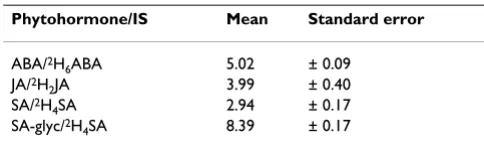
Reproducibility of the phytohormone extraction method To provide material with representative amounts of the three phytohormones, six leaves on four, 5-week old plants were first wounded with a plastic pipette tip (induc-tion of JA biosynthesis) and then left to dessicate for 2 h (induction of ABA). Material was harvested in aluminium foil, frozen immediately in liquid nitrogen, crushed to generate a homogeneous mixture and freeze dried. Seven 10 mg samples of freeze dried material were extracted after the incorporation of deuterated hormone standards and each hormone was expressed as a ratio of phytohormone to deuterated internal standard (IS). This method pro-duces highly reproducible quantitation as determined by the mean ratios of phytohormone/IS and associated standard errors (maximum of 10% of replicate means) as shown in Table 1. The absolute amounts of each hormone as determined in the freeze dried tissue are presented as ratios of phytohormone/IS (Fig. 1a) or absolute amounts of phytohormone/g freeze dried tissue (Fig. 1b), demon-strating that this method successfully captures the dynamic range of stress related hormone changes from small tissue samples. The method also allows determina-tion of glycosylated derivatives of salicylic acid by quanti-tation relative to the 2H
4 SA standard (Fig. 1a).
Reproducibility of LC/MS measurements
To test the reproducibility of the hormone measurements with this LC/MS method the wounded and desiccated material described above was repeatedly injected (10 times). Table 2 shows all hormone measurements were
highly reproducible, with a Relative Standard Deviation (% RSD) for quantification under 4% and for Retention Time under 0.18%.
Sample stability
It is important to develop a method that is not only facile and robust, but also amenable to high throughput screen-ing, for example screening of mutant and knockout lines or chemical banks for altered phytohormone profiles. To test the stability of the extracts three samples of wounded and dessicated tissue were injected and analysed. These samples remained in the autosampler (6°C) for 48 h and were then reinjected. Table 3 summarizes the ratio of phy-tohormone to internal standard at t = 0 and t = 48 h. No significant degradation of the sample was detected over the 48 h period, indicating that this method can be used to prepare and screen at least one hundred samples in one run.
To determine whether freeze drying adversely affected phytohormone content, fresh frozen and freeze dried material were compared. Ten replicate samples, each con-taining three expanded leaves from a 5 week old plant were prepared. Each replicate was weighed and one set of five replicates was freeze dried and ground in the bead beater while the other five samples were frozen in liquid nitrogen and then ground to a fine powder in liquid nitro-gen. All extraction volumes were identical for each set of replicates. Absolute levels of JA and SA were measured and expressed as gFW of tissue, based upon original fresh weight measurements (Fig. 2). Comparison of the levels of phytohormones from fresh and lyophilized material, showed that yields were consistently lower, about 25%, less from the freeze dried tissue. This result illustrates that freeze drying process reduces phytohormone extraction yields using this method. However, in many instances the convenience of freeze dried material, especially when weighing large replicated samples sets, more than com-pensates for these reduced yields. This compares favoura-bly with a 50% decrease in the absolute amounts of SA but no change in JA levels reported when freeze dried extrac-tions from cucumber were compared to those from the equivalent amount of fresh tissue [19].
Linearity of response
Because different plant extracts will have differing base-line hormone levels it is important to demonstrate that this method can accurately measure a proportional increase in the discriminatory m/z ion signal with increas-ing amounts of each hormone. To address this question a bulk sample derived from combining eighteen 10 mg extracts was prepared, and then realiquoted into eighteen 500 μl samples of which triplicate aliquots were subject to the following six treatments. Treatment 1 comprised con-trol untreated samples. Treatments 2–6 had, respectively, Table 1: Hormone extraction reproducibility in technical
replicate of extracts of wounded and desiccated tissue.
Phytohormone/IS Mean Standard error
ABA/2H
6ABA 5.02 ± 0.09
JA/2H
2JA 3.99 ± 0.40
SA/2H
4SA 2.94 ± 0.17
SA-glyc/2H
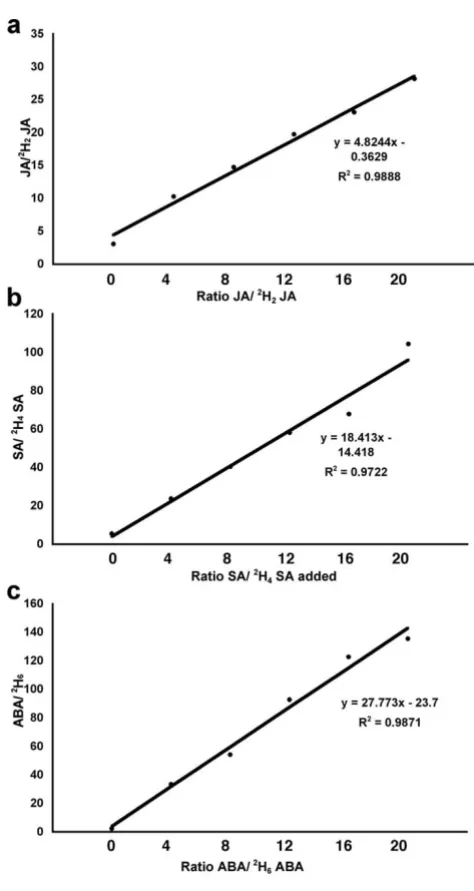
the following ratios of deuterated standards compared to unlabelled phytohormone added;, 1:4, 1:8, 1:12, 1:16 and 1:20. Plotting the ratio of non-deuterated to deuterated standards for JA, SA and ABA (Fig. 3) shows that there was a linear increase in the m/z "area under the curve" signal across the range of concentrations that we routinely expect to be detected in various plant-pathogen interactions and abiotic stresses. The limits of detection based on a ratio of 1:3 signal to noise (LOD) calculated from the standard addition curves for JA, ABA and SA, were 0.22, 0.05 and 0.9 ug/g of freeze dried tissue respectively. The limits of quantification 0.45, 0.11 and 1.9 for JA, ABA and SA respectively, were calculated in the same way as the LOD, based on a ratio 1:6 signal to noise.
We next confirmed that the amount of sample used in this method was within the linear range whereby an increase in sample amount is proportional to an increase in LC/MS signal for each of the analysed hormones. Replicate extrac-tions of 5, 10 and 15 mg aliquots of freeze dried leaves
were analysed by LC/MS and phytohormone/IS ratios determined. Fig. 4 clearly shows that all three phytohor-mones produced a linear response with increasing amounts of sample (R2 > 0.997).
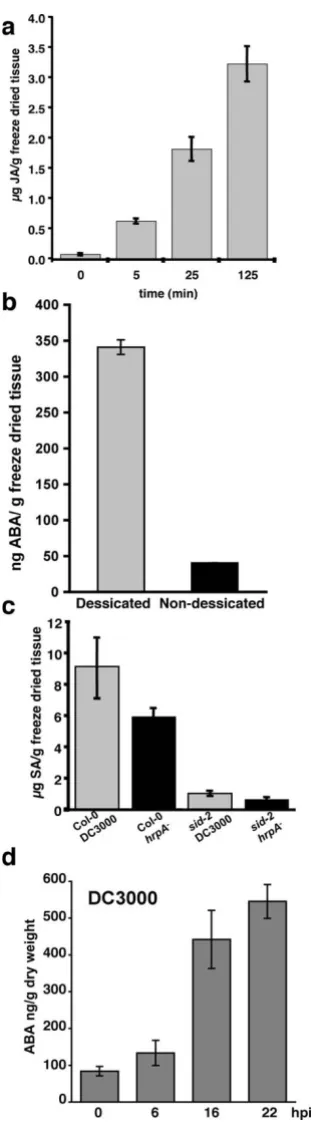
To demonstrate that this method could capture dynamic changes in phytohormones we applied treatments designed specifically to modulate levels of each hormone. We first analysed changes in JA levels following leaf wounding. Fig. 5a shows an ~8 fold increase in JA within 5 min of wounding an Arabidopsis leaf with a micropi-pette tip. Wound induced JA levels remained significantly elevated for more than 2 h following treatment.
ABA levels were induced by leaving a detached leaf to des-iccate at room temperature (~22°C, 60% relative humid-ity) for 2 h. ABA levels were determined relative to adjacent attached leaves (Fig. 5b). ABA levels are generally undetectable in leaves of Arabidopsis plants grown under controlled environmental conditions unless specially
Table 3: Phytohormones remain stable two days after extraction.
Analyte/IS RSD % Quantification RSD % Retention Time
ABA/2H
6ABA 4.05 1.70 e-14
JA/2H
2JA 22.70 0.00
SA/2H
4SA 17.00 1.70 e-14
SA-glyc/2H
4SA 3.92 0.09
Table 2: LC-MS reproducibility in hormone determination following 10 replicate injections of a stress-treated extract
Analyte/IS RSD % Quantification RSD % Retention Time
ABA/2H
6ABA 3.62 1.60 e-14
JA/2H
2JA 1.76 1.40 e-14
SA/2H
4SA 3.80 1.60 e-14
SA-glyc/2H
4SA 2.49 0.18
The phytohormone extraction method is reproducible
Figure 1
adapted methods are used. By contrast, 2 h of desiccation caused an ~800% increase in ABA levels. The LOD for ABA was ~4 fold that obtained by Lopez-Carbonella & Jaureugi (2005). Their protocol used two different organic extrac-tions and an optimised HPLC method to target ABA. Given the simplicity of our extraction protocol and added ability to detect JA and SA this LOD compares favourably.
Changes in endogenous SA levels were demonstrated by comparing pathogen challenged control plants with the isochorismate synthase 1 deficient plant (sid2). Col-0 and sid2 plants were inoculated with either virulent P. syringae pv. tomato DC3000 (DC3000) or the type three secretion deficient DC3000 hrpA mutant (21). Salicylic acid was determined 21 h post inoculation. As expected, in wild type plants both DC3000 and the hrp mutant accumulate significant amounts of SA and SA-glycoside, whereas lev-els of these metabolites were strongly attenuated in the sid2 background (Fig. 5c). By contrast, both ABA (Fig 5d) and JA (data not shown) levels increased following chal-lenge with DC3000 as previously determined using 70% methanol extracts and C18 solid phase extraction col-umns prior to LC/MS [10].
Conclusion
We have developed a rapid, high throughput, cost effec-tive method for quantification of the three major stress hormones in Arabidopsis. The method requires minimal tissue, is highly reproducible and can accurately measure phytohormones across the expected physiological
dynamic range. Moreover, it compares well with other methods that have more complex extraction methods that specifically target the individual hormones, ABA, JA or SA targeted here. The use of freeze dried material promotes ease of handling and automation. Yield decreases associ-ated with freeze drying compared to fresh-frozen material, probably due either to analyte insolubilisation or to
vola-Linearity of detection of phytohormones
Figure 3
Linearity of detection of phytohormones. To ensure the method is capable of capturing the range of differences in phytohormones expected during stress associated experi-ments, five diluted deuterated standards were compared to unlabelled "stressed controls" in ratios indicated. a-c demon-strates that for ABA, JA and SA respectively, there is a statis-tically significant linear increase in abundance of the expected ion over a 20 fold range.
Comparison of absolute yields from freeze dried (FD) or fresh frozen Arabidopsis leaf material
Figure 2
tilization during the freeze drying process, were mini-mized. This method is equally applicable to fresh or freeze dried tissues and the experimental circumstances will dic-tate the starting material. In our experience, use of freeze dried tissue is more convenient for scaling up extraction, especially when weighing multiple samples, e.g. during for time course analyses. The advantage of using Multiple Reaction Monitoring is that it is relatively easy to custom-ise runs to identify other discriminatory metabolites, such as aromatic derived secondary compounds, which are readily associated with plant stress responses.
Authors' contributions
All authors designed the experiments. SF carried out the plant stress experiments and sample processing, MB designed and carried out the mass spectrometry methods. All authors participated in data extraction and statistical
analysis. SF and MG wrote the manuscript. All authors read and approved the final manuscript
Phytohormone response metrics
Figure 4
Acknowledgements
We would like to thanks Wendy Byrne for excellent technical support. This work was funded through a British Biotechnology and Science Research Council grant BB/D007046/1 to MG and JWM.
References
1. Glazebrook J: Contrasting mechanisms of defense against bio-trophic and necrobio-trophic pathogens. Annu Rev Phytopathol 2005,
43:205-27.
2. Robert-Seilaniantz A, Navarro L, Bari R, Jones JDG: Pathological hormone imbalances. Curr Opin Plant Biol 2007, 10:372-379. 3. Loake G, Grant M: Salicylic acid in plant defence--the players
and protagonists. Curr Opin Plant Biol 2007, 10:466-72.
4. Mur LA, Kenton P, Atzorn R, Miersch O, Wasternack C: : The Out-comes of Concentration-Specific Interactions between Sali-cylate and Jasmonate Signaling Include Synergy, Antagonism, and Oxidative Stress Leading to Cell Death. Plant Physiol 2006, 140:249-62.
5. Buell CR, Joardar V, Lindeberg M, Selengut J, Paulsen IT, Gwinn ML, Dodson RJ, Deboy RT, Durkin AS, Kolonay JF, Madupu R, Daugherty S, Brinkac L, Beanan MJ, Haft DH, Nelson WC, Davidsen T, Zafar N, Zhou L, Liu J, Yuan Q, Khouri H, Fedorova N, Tran B, Russell D, Berry K, Utterback T, Van Aken SE, Feldblyum TV, D'Ascenzo M, Deng WL, Ramos AR, Alfano JR, Cartinhour S, Chatterjee AK, Dela-ney TP, Lazarowitz SG, Martin GB, Schneider DJ, Tang X, Bender CL, White O, Fraser CM, Collmer A: The complete genome sequence of the Arabidopsis and tomato pathogen Pseu-domonas syringae pv. tomato DC3000. Proc Natl Acad Sci USA
2003, 100:10181-6.
6. DebRoy S, Thilmony R, Kwack YB, Nomura K, He SY: A family of conserved bacterial effectors inhibits salicylic acid-mediated basal immunity and promotes disease necrosis in plants. Proc Natl Acad Sci USA 2004, 101:9927-32.
7. Nomura K, Melotto M, He SY: Suppression of host defense in compatible plant-Pseudomonas syringae interactions. Curr Opin Plant Biol 2005, 8:361-8.
8. Nishimura N, Yoshida T, Kitahata N, Asami T, Shinozaki K, Hirayama T: Hypersensitive Germination1 encodes a protein phos-phatase 2C, an essential component of abscisic acid signaling in Arabidopsis seed. Plant J 2007, 50:935-49.
9. Adie BA, Perez-Perez J, Perez-Perez MM, Godoy M, Sanchez-Serrano JJ, Schmelz EA, Solano R: ABA is an essential signal for plant resistance to pathogens affecting JA biosynthesis and the activation of defenses in Arabidopsis. Plant Cell 2007,
19:1665-81.
10. de Torres-Zabala M, Truman W, Bennett MH, Lafforgue G, Mansfield JW, Rodriguez Egea P, Bogre L, Grant M: Pseudomonas syringae pv. tomato hijacks the Arabidopsis abscisic acid signalling pathway to cause disease. Embo J 2007, 26:1434-43.
11. Hernandez-Blanco C, Feng DX, Hu J, Sanchez-Vallet A, Deslandes L, Llorente F, Berrocal-Lobo M, Keller H, Barlet X, Sanchez-Rodriguez C, Anderson LK, Somerville S, Marco Y, Molina A: Impairment of cellulose synthases required for Arabidopsis secondary cell wall formation enhances disease resistance. Plant Cell 2007,
19:890-903.
12. Mohr PG, Cahill DM: Suppression by ABA of salicylic acid and lignin accumulation and the expression of multiple genes, in Arabidopsis infected with Pseudomonas syringae pv. tomato. Funct Integr Genomics 2007, 7:181-91.
13. Anderson JP, Badruzsaufari E, Schenk PM, Manners JM, Desmond OJ, Ehlert C, Maclean DJ, Ebert PR, Kazan K: Antagonistic interaction between abscisic acid and jasmonate-ethylene signaling pathways modulates defense gene expression and disease resistance in Arabidopsis. Plant Cell 2004, 16:3460-79.
14. Fujita M, Fujita Y, Noutoshi Y, Takahashi F, Narusaka Y, Yamaguchi-Shinozaki K, Yamaguchi-Shinozaki K: Crosstalk between abiotic and biotic stress responses: a current view from the points of conver-gence in the stress signaling networks. Curr Opin Plant Biol 2006,
9:436-42.
15. Klee H: Hormones are in the air. Proceedings National Academy of Science, USA 2003, 100:10144-10145.
16. Truman W, Bennett MH, Kubigsteltig I, Turnbull C, Grant M: Arabi-dopsis systemic immunity uses conserved defense signaling
The extraction method is capable of capturing the dynamic response of phytohormones to inducing stresses
Figure 5
Publish with BioMed Central and every scientist can read your work free of charge "BioMed Central will be the most significant development for disseminating the results of biomedical researc h in our lifetime."
Sir Paul Nurse, Cancer Research UK
Your research papers will be:
available free of charge to the entire biomedical community
peer reviewed and published immediately upon acceptance
cited in PubMed and archived on PubMed Central
yours — you keep the copyright
Submit your manuscript here:
http://www.biomedcentral.com/info/publishing_adv.asp
BioMedcentral pathways and is mediated by jasmonates. Proc Natl Acad Sci USA
2007, 104:1075-80.
17. Durgbanshi A, Arbona V, Pozo O, Miersch O, Sancho JV, Gomez-Cadenas A: Simultaneous determination of multiple phyto-hormones in plant extracts by liquid chromatography-elec-trospray tandem mass spectrometry. J Agric Food Chem 2005,
53:8437-42.
18. Lopez-Carbonell M, Jauregui O: A rapid method for analysis of abscisic acid (ABA) in crude extracts of water stressed Ara-bidopsis thaliana plants by liquid chromatography--mass spectrometry in tandem mode. Plant Physiol Biochem 2005,
43:407-11.
19. Segarra G, Jauregui O, Casanova E, Trillas I: Simultaneous quanti-tative LC-ESI-MS/MS analyses of salicylic acid and jasmonic acid in crude extracts of Cucumis sativus under biotic stress. Phytochemistry 2006, 67:395-401.
20. de Torres M, Sanchez P, Fernandez-Delmond I, Grant M: Expression profiling of the host response to bacterial infection: the tran-sition from basal to induced defence responses in RPM1-mediated resistance. Plant J 2003, 33:665-76.