© Strojniški vestnik (44) št. 7-8, str. 226-236, 1998 © Journal o f Mechanical Engineering (44) No. 7-8, pp. 226-236, 1998 Tiskano v Sloveniji. Vse pravice pridržane. Printed in Slovenia. All rights reserved. UDK 621.576:621.577:519.87 SV:0039-2480(98)4-R2 UDC 621.576:621.577:519.87
Pregledni znanstveni članek Review scientific paper
Numerično simuliranje delovanja hlajenih absorberjev
s padajočim kapljevinskim filmom v navpični cevi
Numerical Simulation of the Performance of Cooled Absorbers
with Falling Liquid Films in Vertical Tubes
MARTIN PFLÜGL
V članku je predstavljeno dejansko delovanje hlajenih in adiabatnih absorberjev za več primerov. Numerično simuliranje je izvedeno na podlagi matematičnega modela, ki popisuje sočasen prestop toplote in snovi v napravah s filmom kapljevine. Izračuni so predstavljeni v diagramih, ki prikazujejo delovanje absorberjev v odvisnosti od Reynoldsovega števila za film na vstopu raztopine
v absorber in pogojev hlajenja. Obravnavana je tudi možnost zmanjšanja površine z uporabo obtoka bogate raztopine.© 1998 Strojniški vestnik. Vse pravice pridržane.
(Ključne besede: absorberji, delovanje absorberjev, sim uliranje num erično, m odeli m atem atični)
The real performance o f cooled and adiabatic absorbers is demonstrated by several case studies. The cases were simulated numerically by a mathematical model fo r simultaneous heat and mass transfer o f falling liquid film equipment. The calculated charts show the performance o f absorbers depending on the entrance film Reynolds number and the cooling conditions. The possibility of exchange area savings o f absorbers due to reflux o f the rich solution is studied. © 1998 Journal of Mechanical Engineering. All rights reserved.
(Keywords: absorbers, perform ance o f absorbers, num erical sim ulation, m athem atical m odels)
0 UVOD
Pri termodinamičnem popisu ali simuliranju delovanja absorpcijske toplotne črpalke ali toplotnega transform atorja običajno naredim o precej poenostavitev. Pogosto predpostavim o, da je kapljevina, ki zapušča absorber v popolnem term odinam ičnem rav n o težju s paro. H krati upoštevamo, da je absorber ustrezno izdelan in omogoča doseganje zahtevanih koncentracijskih razlik v raztopini. Da bi lahko ocenili pomen omenjene predpostavke, moramo preučiti dejansko obnašanje absorberja.
Absorberji in generatorji transformatorjev toplote imajo nalogo, da poleg temperaturnega dviga s prenosom snovi omogočijo prenos toplote. Obe nalogi je mogoče razdeliti tako, da v prvi napravi izvedemo samo prenos snovi, v drugi pa samo prenos toplote. Pri absorberjihje očitno, daje adiabatni ab sorber manj učinkovit od hlajenega. Ce iz absorberja takoj ne odvajamo sproščene toplote s hladilnim sredstvom, se temperatura naglo dvigne in kmalu dosežemo točko nasičenja. Adiabatni absorberji lahko torej funkcionirajo samo v primeru, če je vstopajoča raztopina dovolj podhlajena.
V hlajenih absorberjih lahko omejimo temperaturo tako, da dosežemo najboljše razmerje med temperaturnim dvigom in zadostno izstopno koncentracijo v raztopini. Hlajeni absorberji torej delujejo učinkovito, če je vstopna raztopina blizu točke nasičenja. Zato so za toplotne črpalke primerni le absorberji s sočasnim odvodom toplote.
0 INTRODUCTION
For the thermodynamic design or simulation of an absorption heat pump or heat transformer cycle usually several simplifications are made. One of them is the assumption that the solution leaves the appara tus in the very state of thermodynamic vapour-liquid equilibrium. As a second one the apparatus is con sidered realizable for the requested solution field. To judge these assumptions the real behaviour of ab
sorbers has to be examined.
Absorbers and generators for heat transform ers, besides establishing the temperature boost by mass transfer, primarily have the task of exchanging heat. It is conceivable to split the two tasks so that in one apparatus the mass transfer is carried out and in a second one the heat exchange is made. But, con sidering e.g. the absorber, obviously the adiabatic absorber is less efficient than a cooled one. If the released heat of absorption is not removed immedi ately by a coolant the temperature of the absorbent increases rapidly and soon the saturation point is reached. Furthermore the adiabatic absorber func tions only if the lean solution is fed sufficiently subcooled.
1 MATEMATIČNI MODEL 1 MATHEMATICAL MODEL
Za popis hlajenega absorberja je treba poleg ustreznega modela toka tekočine upoštevati še sočasen prenos toplote in snovi. Za tovrsten način popisa je primerna tehnika padajočega filma.
Za p ostavitev m odela [1] smo izbrali dvodimenzionalni ustaljeni problem tankega filma kapljevine (raztopine soli), ki teče po ravni navpični steni (uporabimo lahko tudi za navpične cevi). Na površini filma poteka kondenzacija čiste pare hladiva in se ob sproščanju toplote absorbira v film. V filmu poteka prenos toplote in snovi, ki ustvarja temperaturne in koncentracijske poteke. Del sproščene toplote gre skozi celotno debelino filma in steno in ga odvajamo s hladilnim sredstvom. Preostali del toplote zviša temperaturo raztopine.
Ustrezne enačbe za popis problema dobimo z upoštevanjem ohranitvenih zakonov:
- ohranitev celome mase,
- ohranitev mase laže hlapljive komponente, - ohranitev gibalne količine in
- ohranitev toplotne energij e.
Za poenostavitev, pri čemer ne naredimo bistvenih napak, smo izbrali naslednje predpostavke: - Glavni tok filma v navpični smeri ima popolnoma
razvit hitrostni potek (p(rj) na kateremkoli mestu v navpični smeri z.
- Hitrosti pare v plinski fazi so dovolj majhne, da lahko zanemarimo spremembo gibalne količine na meji faz.
- Fizikalne lastnosti filma kapljevine so konstantne skozi ves film za posamezno mesto v navpični smeri z.
- V smeri z je prenos toplote in snovi z molekularno difuzijo in turbulenco zanemarljiv v primerjavi s konvektivnim prenosom.
Z uporabo brezdimenzijskih veličin dobimo enačbo za hitrostni profil v navpični smeri (p{r])\
In order to describe cooled absorbers, in ad dition to an adequate fluid flow model the simulta neous heat and mass transport has to be regarded. For this need the falling film technique is an excellent tool.
To establish the model [1] we consider the two-dimensional steady problem of a thin liquid film of salt solution flowing down a plane vertical wall (applicable also to vertical tubes). At the film sur face pure vaporous absorbate condensates and be comes absorbed, accompanied by the release of heat. Mass and heat transport in the film takes place and leads to concentration and temperature profiles. One part of the transported heat passes all the liquid film, and the wall and is carried off by the coolant. The remaining part increases the solution temperature.
To get the governing equations for this prob lem the conservation laws have to be obeyed: - conservation of total mass,
- conservation of the volatile component, - conservation of momentum, and - conservation of heat.
For simplification but not crucial restriction the following assumptions are made:
- The film mean flow in vertical direction has the fully developed velocity profile (0(77) at any verti cal position z.
- Vapour velocities in the gas phase are sufficiently low for interfacial momentum transfer to be ne glected.
- The physical properties in the liquid film are con sidered constant across the film for one vertical position z.
- In z-direction compared to the convective trans port the molecular and turbulent transport of mass and heat is neglected.
Introducing dimensionless quantities, the equation for the profile of vertical velocity <50(77) is:
i | £t(77)1 d(p
V
J
driki jo lahko rešimo ločeno, če izberemo ustrezen model turbulence. V brezdimenzijski obliki zapisa moramo upoštevati
- ^ • 0 - ^ ) = o (i).
Fr
and can be solved independently if a suitable turbu lence model is choosed. Thereby the standardization condition has to be taken into account
J
<50(77)0(77 (2).Iz enačbe (1) lahko ob podanem Rey- noldsovem številu določimo Froudovo število. Zaradi spreminjanja masnega toka in lastnosti kapljevine, kot posledice spremembe temperatur in sestave, se rahlo spreminja tudi hitrostni potek v navpični smeri z.
Zaradi prenosa snovi skozi površino filma v samo eni smeri je potek prečnih hitrosti 1/7(77) podan z naslednjo enačbo:
From equation (1) results the Froude num ber if the Reynolds number is given. Due to variyng mass flow rate and fluid properties controlled by tem perature and concentration the vertical velocity pro file is weakly dependent on the vertical z position.
/ o
Za prenos toplote in snovi imamo sistem dveh For the mass and heat transport we get the parcialnih diferencialnih enačb: system of two partial differential equations:
dT dT 1 1 3
r dr] Re Pr dr\
dx dx 1 1 d r dC, dr] Re Sc dp
( * \
^1 + £aL ^
D
LV , 1 + —e Q
a J
dT 1 dh
---
1---dp c dx
y077
J 1 | e Q e M
Le a
v y
dx dr\
(4 )
(5).
In addition to this system of equations, the še robne pogoje na mestu, kjer film raztopine vstopa boundary conditions at the film entrance - at the wall
and at the film surface one needs to consider: Za rešitev tega sistema enačb je treba določiti
e pogoje na mestu, kjer film raztopine vsti v absorber, na površini stene in na površini filma:
C= 0 , 0<77 < 1 :
77 = 0 : ohranitev snovi
ohranitev toplote
77 = 1 : ravnovesje faz
dx dr]
x = x 0 T = T0
77 = 0 : conservation of mass
- 0
conservation of heat
a , ( C ) - [ U O - r t ( f ) ] = 3 ^
0 dr]
77 = 1 : phase equilibrium
x A 0 = f(Ts( 0 , p )
(6),
(7),
(8),
(9 ),
ohranitev snovi conservation of mass
777a = X . 771 „ + p D dx
S dii,
ohranitev toplote+ * „ - h J + a K (7; - T j A
S
conservation of heat
d r 1 dh
+ --- dx
dp s c ox s l L e, dr]
(10),
(11).
Za robne pogoje (8), (10) in (11) velja, da ni turbulentnega prenosa snovi v neposredni bližini stene in na mejni površini med kapljevino in plinom.
Zaradi diferencialne razredčilne toplote v zadnjem členu enačbe (5) in robnih pogojev (9), (10) in (11) so enačbe (3), (4) in (5) povezane in jih je treba reševati hkrati. Turbulentni prenos gibalne količine, snovi in toplote je predstavljen s prenosnimi koeficienti E t , Em in £q.Za enoparametrsko obravnavo je izbran koncept m ešalne dolžine. Po vzoru Grossmana [2] je film razdeljen na tri področja. V prvem področju, poleg stene je turbulentna viskoznost £c izračunavana po priporočilu Van Driesta [3], Za jedro turbulentnega toka je izbrana enačba, ki jo je predlagal Reichardt [4] in je modificirana za tok filma. Za popis turbulentne viskoznosti v bližini površine filma pa je izbran koncept, ki sta ga predlagala Lamourelle in Sandali [5] in predpostavlja zmanjšanje turbulence v bližini površine filma kot posledico površinske napetosti. Koncept uporablja posplošeno korelacijo, ki stajo podala Mills in Chung [6],
For the boundary conditions (8), (10) and (11), the turbulent transport is considered to be damped out near the wall and the liquid/gas inter face.
Due to the differential heat of solution in the last term of equation (5), and because of the bound ary conditions (9), (10) and (11), the equations (3), (4) and (5) are coupled and can be solved only simul taneously. The turbulent transport of momentum, mass and heat is represented by the transport coeffi cients £t, Em and Eg. For this 1 -parameter approach
Turbulentno difuzivnost za snov eM in toploto
Eq je izbrana enako kakor za gibalno količino et. Uporaba predpostavk se ujema z izsledki Jischa [7] in Sin-Ming Yih-a [8], ki sta ugotovila, da sta turbulentno Prandtlovo in Schmidtovo število enaka 1 za Reynoldsova in Prandtlova števila, ki se pojavljajo pri reševanju problema padajočega filma.
Za rešitev sistema enačb (1) do (11) je bil razvit računalniški program in v zadnjem času bistveno izpopolnjen. Za izračun ravnovesja med paro in kapljevino, termodinamične in transportne lastnosti, sta bila izdelana dva sklopa podprogramov, in sicer za vodno raztopino litijevega bromida in glicerola.
The turbulent diffusivities for mass Em and heat £q are chosen here equal to that for momentum £t. This follows the results of Jischa [7] and Siu-Ming Yih [8] who found the turbulent Prandtl and Schmidt numbers to be equal to 1 for the Reynolds and Prandtl number ranges to be considered for this falling film problem.
For the solution of the system of equations (1) to (11) a computer program had been developed in the past, and has recently been radically improved. To calcu la te the v ap o u r/liq u id eq u ilib riu m , thermophysical and transport properties, two subrou tine packages for aqueous solutions of lithium bro mide and glycerol have been supplied.
2 OBRAVNAVANI PRIMER 2 CASE STUDY
Na delovanje absorberja vplivajo predvsem trije parametri:
- debelina filma <5 oziroma masni pretok raztopine na enoto širine M} oziroma Reynoldsovo število za film Re,
- koeficienta prenosa toplote hladiva ac in
- temperaturna razlika med raztopino in hladilnim sredstvom To - Tc.
O m enjeni param etri določajo količino prenesene toplote na hladilno sredstvo, povečanje koncentracije laže hlapljive komponente v kapljevitem absorpcijskem sredstvu in odmik od ravnovesnega stanja na izstopu iz absorberja. Odvisnosti smo p rik azali v štu d iji ab so rb erja v prvi stopnji dvostopenjskega toplotnega transformatorja.
Za absorpcijsko sredstvo je izbrana vodna raztopina litijevega bromida, v katerega se absorbira vodna para. Na sliki 1 so predstavljeni vsi pomembni
The performance of an absorber is charac terized by the influence of mainly three parameters: - the film thickness S or the solution mass flow rate
per unit horizontal length of exchange area M /or the film Reynolds number Re,
- the heat transfer coefficient of the coolant ot and - the temperature difference between liquid solu
tion and coolant To - Tc.
These determine the amount of heat trans ferred to the cooling medium, the concentration in crease of the volatile component in the liquid absor bent and the deviation from equilibrium at the ab sorber outlet. To demonstrate the dependencies a case study has been done for an absorber of the first stage of a two stage heat transformer.
An aqueous solution of lithium bromide was used as an absorbent for water vapour. In Fig. 1 all the base data for the simulation calculations are given.
Sl. 1. Osnovni podatki za izračun primera absorberja s padajočim filmom
podatki za izračun simuliranja. V absorber dovajamo podhlajeno raztopino in na notranji strani navpičnih cevi ustvarimo film absorpcijskega sredstva. Na zunanji strani cevi je nasičena voda, ki se pri tem uparja. Zunanja stran absorberja pomeni uparjalnik za drugo stopnjo toplotnega transformatorja. Za prikaz na podlagi spreminjanja omenjenih treh parametrov je v diagramih prikazano delovanje absorberja, pri čemer je izbrana konstantna dolžina absorberja (2m).
Na slikah 2 do 5 je predstavljeno delovanje absorberja za dva zanimiva primera. V prvem primeru absorber uparja vodo pri temperaturi Z , ki je za 5 K nad vstopno temperaturo Tg raztopine.
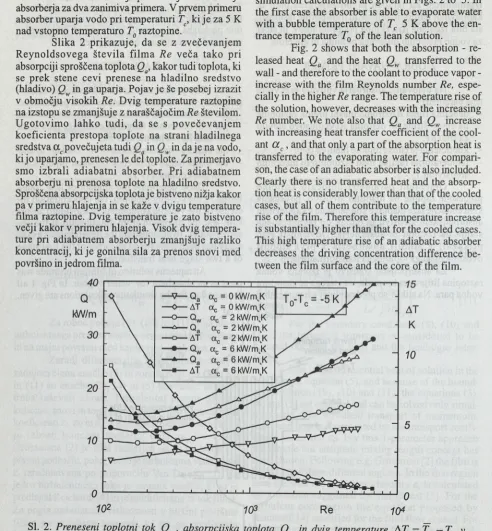
Slika 2 prikazuje, da se z zvečevanjem Reynoldsovega števila filma Re veča tako pri absorpciji sproščena toplota Qa, kakor tudi toplota, ki se prek stene cevi prenese na hladilno sredstvo (hladivo) Qw in ga uparja. Pojav je še posebej izrazit v območju visokih Re. Dvig temperature raztopine na izstopu se zmanjšuje z naraščajočim Re številom. Ugotovimo lahko tudi, da se s povečevanjem koeficienta prestopa toplote na strani hladilnega sredstva oc, povečujeta tudi Qa in Qw in daje na vodo, ki jo uparjamo, prenesen le del toplote. Za primerjavo smo izbrali adiabatni absorber. Pri adiabatnem absorberju ni prenosa toplote na hladilno sredstvo. Sproščena absorpcijska toplota je bistveno nižja kakor pa v primeru hlajenja in se kaže v dvigu temperature filma raztopine. Dvig temperature je zato bistveno večji kakor v primeru hlajenja. Visok dvig tempera ture pri adiabatnem absorberju zmanjšuje razliko koncentracij, ki je gonilna sila za prenos snovi med površino in jedrom filma.
The subcooled lean solution is fed to the vertical tubes establishing the falling film on the inner wall. Outside the tubes saturated water is vaporized so forming the evaporator of the second stage of the heat trans former. To design the performance charts the above three parameters have been varied for a constant absorber length of 2 m.
To demonstrate the behaviour of an absorber two instructive examples out of the results of several simulation calculations are given in Figs. 2 to 5. In the first case the absorber is able to evaporate water with a bubble temperature of Tc 5 K above the en trance temperature T0 of the lean solution.
Fig. 2 shows that both the absorption - re leased heat Qa and the heat Qw transferred to the wall - and therefore to the coolant to produce vapor - increase with the film Reynolds number Re, espe cially in the higher Re range. The temperature rise of the solution, however, decreases with the increasing
Re number. We note also that Qa and Qw increase with increasing heat transfer coefficient of the cool ant ac , and that only a part of the absorption heat is transferred to the evaporating water. For compari son, the case of an adiabatic absorber is also included. Clearly there is no transferred heat and the absorp tion heat is considerably lower than that of the cooled cases, but all of them contribute to the temperature rise of the film. Therefore this temperature increase is substantially higher than that for the cooled cases. This high temperature rise of an adiabatic absorber decreases the driving concentration difference be tween the film surface and the core of the film.
SI. 2. Preneseni toplotni tok Qw, absorpcijska toplota Qa in dvig temperature AT = TL - T 0 v
odvisnosti od filmskega Reynolds-ovega števila, pri čemer je temperatura hladilnega sredstva Tc za 5 K višja od temperature vstopajoče raztopine T0
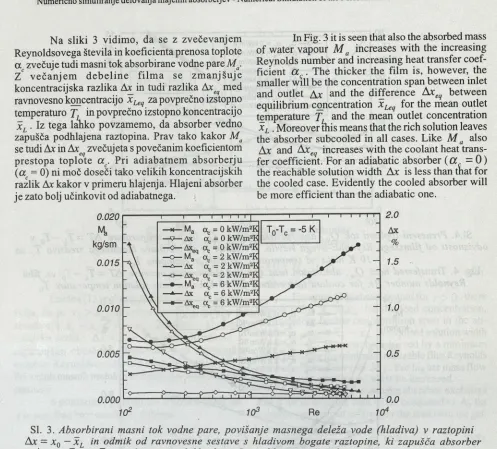
Na sliki 3 vidimo, da se z zvečevanjem Reynoldsovega števila in koeficienta prenosa toplote a zvečuje tudi masni tok absorbirane vodne pare Ma. Z večanjem deb elin e film a se zm anjšuje koncentracijska razlika Ax in tudi razlika Axeq med ravnovesno koncentracijo x Leq za povprečno izstopno temperaturo T , in povprečno izstopno koncentracijo
X . Iz tega lahko povzamemo, da absorber vedno zapušča podhlajena raztopina. Prav tako kakor Ma
se tudi Ax in Axe zvečujeta s povečanim koeficientom prestopa toplote ac. Pri adiabatnem absorberju ( a = 0) ni moč doseči tako velikih koncentracijskih razlik Ax kakor v primeru hlajenja. Hlajeni absorber je zato bolj učinkovit od adiabatnega.
In Fig. 3 it is seen that also the absorbed mass of water vapour M a increases with the increasing Reynolds number and increasing heat transfer coef ficient a .. The thicker the film is, however, the smaller will be the concentration span between inlet and outlet Ax and the difference Axeq between equilibrium concentration x Leq for the mean outlet temperature T, and the mean outlet concentration
x L . Moreover this means that the rich solution leaves the absorber subcooled in all cases. Like M a also Ax and Axeq increases with the coolant heat trans fer coefficient. For an adiabatic absorber ( CCc = 0 ) the reachable solution width Ax is less than that for the cooled case. Evidently the cooled absorber will be more efficient than the adiabatic one.
0 . 0 2 0 “ I---1--- 1--- 1---1 I I I l"” --- 1---1--- 1--- 1---1----1 I I — M a o c = 0 k W / m 2K
T 0 - T c = ' 5 K k g / s m
— v — A x a „ = 0 k W / m 2K — O — A x ea 0 ^ = 0 k W / m 2K - o - M a a c = 2 k W / m 2K
0 . 0 1 5 — £ — A x = 2 k W / m 2K
— □— A x a = 2 k W / m 2K — M a a c = 6 k W / m 2K ■ ■*— A x a c = 6 k W / m 2K — ■— A x on a „ = 6 k W / m 2K
0 . 0 1 0 — A
2.0
Ax %
- 1.5
- 1.0
0.005 0.5
0.000
102 103 R e
0.0
10*
SI. 3. Absorbirani masni tok vodne pare, povišanje masnega deleža vode (hladiva) v raztopini
Ax = x 0 — x L in odmik od ravnovesne sestave s kladivom bogate raztopine, ki zapušča absorber Axeq = x Leq — x L v odvisnosti od filmskega Reynolds-ovega števila, pri čemer je temperatura
hladilnega sredstva Tc za 5 K višja od temperature vstopajoče raztopine T0
Fig. 3. Absorbed mass o f water vapor M a , increase o f water concentration Ax = x 0 —x L and deviation from equilibrium concentration o f the rich solution leaving the absorber A xeq = x L — x L
vs. film Reynolds number Re, for coolant temperature Tc 5 K above lean solution temperature T0
Sliki 4 in 5 prikazujeta podobno delovanje absorberjev, kakor je prikazano na slikah 2 in 3, pri čemer pa moramo opozoriti na dvojno skalo za Q in
Mq. V primeru odvoda toplote se količina absorbirane pare in sproščene absorpcijske toplote skoraj podvojita. V nasprotju s sliko 2 lahko opazimo, da se skoraj vsa absorpcijska toplota prenese na steno cevi oziroma hladilno sredstvo, zaradi česar ni bistvenega dviga temperature raztopine. Pri visokih koeficientih prestopa toplote se raztopina celo ohladi (različno merilo za AT).
Pri termodinamičnem načrtovanju toplotnih transformatorjev in toplotnih črpalk v mnogo primerih zahtevamo večje koncentracijske razlike Ax, kakor pa jih lahko dosežemo s preprostim absorberjem. Za zadovoljitev takšnih zahtev uporabimo absorber z obtokom, pri čemer določen delež bogate raztopine vračamo nazaj v absorber (sl. 6). Z mešanjem izstopajoče in vstopajoče raztopine se spremenijo
Fig. 4 and Fig. 5 show nearly the same behaviour as figures 2 and 3, but one must pay atten tion to the doubled scale of the Q- and M a -axes. So we note that for this cooling case the absorbed heat and mass become almost doubled, too. Unlike the case of Fig. 2 it is remarkable that nearly all the ab sorption heat is transferred to the wall, say to the coolant, and in consequence there is no temperature increase of the solution. For the higher heat transfer coefficient the solution even becomes cooled (note the different A T -scale).
ab-S1.4. Preneseni toplotni tok Qw, absorpcijska toplota Qa in dvig temperature A T — TL —TQ v
odvisnosti od filmskega Reynolds-ovega števila, pri čemer je temperatura hladilnega sredstva Tc za 10 K nižja od temperature vstopajoče raztopine T0
Fig. 4. Transferred heat Qw, absorption heat Qa and temperature increase A T = TL —T0 vs. film Reynolds number Re, for coolant temperature Tc 10 K below lean solution temperature T0
SI. 5. Absorbirani masni tok vodne pare, povišanje masnega deleža vode (hladiva) v raztopini Ax = ;t0 - x L in odmik od ravnovesne sestave s hladivom bogate raztopine, ki zapušča absorber
^ X 'e q ^ Le q x L v odvisnosti od filmskega Reynolds-ovega števila, pri čemer je temperatura
hladilnega sredstva Tc za 10 K nižja od temperature vstopajoče raztopine T0
Fig. 5. Absorbed mass of water vapor M a , increase of water concentration Ax = x0 — xL and deviation from equilibrium concentration of the rich solution leaving the absorber Axeq = x Leq — x L
vs. film Reynolds number Re, for coolant temperature Tc 10 K below lean solution temperature T0
parametri, ki popisujejo dotok raztopine. Z uvedbo sorber feed variables of state become changed. With
obtočnega razmerja: the definition for the reflux ratio:
izračunamo sestavo pri vstopu v absorber:
M , r =
M „
we get for the feed concentration:
(12)
_ ^ - x L) xin+ r ( j - x in) x L
\ - x L + r ( l - x j (13) in entalpijo pri vstopu, ki določa temperaturo vstopa v and for the enthalpy at the absorber feed which de
SI. 6. Absorber z obtokom bogate raztopine
Fig. 6. Absorber with reflux o f rich solution
H 0 =
{ l - H L) H in + r { \ - H in) H L
\ - H L + r ( \ - H in)
(14).
Enačba (13) pokaže, da za vsak r > 0 vedno velja, da je x0 > x h
absorberju x L - x0
in koncentracijska razlika v Zahtevano koncen tracijsko razliko Ax = x L — xjn lahko dosežemo z najmanjšim obtočnim razmerjem r za najmanjše mogoče Reynoldsovo število ali masni pretok M f .
Pri večjih masnih pretokih moramo povečati obtočno razmerje.
S primerjavo površin absorberja z obtokom
A in površine brez obtoka/4 fl dobimo:
A_
A)
1 + r1
- 1-Pri konstantnih robnih pogojih za absorber (pretoki, temperature in sestave pri vstopu in izstopu) lahko sprem injam o obtočno razm erje. S tem izračunamo površino in dolžino (višino) absorberja za poljuben obtok, kije večji od najmanjšega pri različnih kombinacijah masnega toka Mf (ali Reynoldsovega števila za film Re).
S spreminjanjem obtočnega razmerja med 0 in 20, pri konstantni dolžini absorberja (2 m) lahko prikažemo vpliv obtočnega razmerja na površino absorberja. Na sliki 7 lahko vidimo, da s povečanjem obtočnega razmerja lahko celo zmanjšamo površino ne glede na način odvoda toplote. Vzrok je v tem, da se s povečevanjem obtočnega razm erja močno poveča tudi Reynolds-ovo število za film, kar vodi k večji količini na cev prenesene toplote Qw na enoto širine, kar je vidno tudi na slikah 2 in 4. Zaradi zmanj šanja površine bi pričakovali, da se bo pri absorberju z obtokom zmanjšala tudi količina toplote, prenesena na hladilno sredstvo. Na sliki 8 lahko vidimo, d aje največje zmanjšanje Qc med 6 in 16% v različnih razmerah hlajenja in za največje obtočno razmerje.
Equation (13) shows us that for r > 0 . there always holds x 0 > x m for the feed concentration, and therefore for the concentration span in the ab sorber x L - x 0 < x L - xin. A required solution width
Ax — xl — x in then can be achieved by a minimum
reflux ratio r for the minimum realizable film Reynolds number or mass flow rate M f . For higher mass flow rates the reflux ratio also must be increased.
Now let us consider the absorber exchange area A for an absorber with reflux compared to A0 for a simple one without reflux. For the area ratio we get:
V M , '
(15).
f lr=0
J M f
LU
Now for fixed boundary conditions of the absorber - i.e. rates, temperatures and concentra tions at the inlet and the outlet - it is possible to vary the reflux ratio. For any reflux greater than the mini mum one a different combination of mass flow rate
M j (or say film Reynolds number Re), exchange area and absorber length will be obtained.
By taking the variation of the reflux ratio from 0 up to 20, and fixing the length to 2 m the depen dence of exchange area ratio can be calculated. Fig. 7 shows that for reflux ratios greater than about 2 and for all cooling conditions even a saving of ex change area can be achieved. This is due to the fact that for great reflux ratios the film Reynolds number also increases substantially. This leads to greater heat transfer Qw per unit horizontal length of exchange area, as it is clearly seen in Figs. 2 and 4. Due to the area saving it is to be expected that the total heat amount Qc transferred to the coolant will be lower for an absorber with reflux. For this reason let us inspect Fig. 8 noting that the maximum decrease of
Sl. 7. Razmerje površin A /A 0 in Reynolds-ovih števil za film R e/R e0 v odvisnosti od obtočnega razmerja r in za različne pogoje odvoda toplote
Fig. 7. Ratio o f absorber exchange area A / A0 and film Reynolds number R e/R e0 vs. reflux ratio r for various cooling conditions
SI. 8. Razmerje odvedene toplote Qc /<2c0 v odvisnosti od obtočnega razmerja r in za različne pogoje odvoda toplote
Fig. 8. Ratio of total amount o f cooling heat Qc /Q cQ vs. reflux ratio r for various cooling conditions
3 SKLEP 3 CONCLUSION
Glede na preneseno toploto je hlajen absorber bolj učinkovit kakor adiabatni absorber z ločenim prenosnikom toplote. Vzrok je v tem, da se adiabatni absorber zaradi intenzivnega porasta temperature hitro približa ravnovesnemu stanju. Hlajeni absorbeiji lahko tudi pri večjih masnih pretokih odvajajo razmeroma velike količine toplote na hladilno sredstvo in absorbirajo večje količine pare. Po drugi strani pa so za večje spremembe koncentracij primerne predvsem izvedbe s tankim filmom kapljevine. Iz nasprotujočih si teh dveh trditev sklepamo, da je treba narediti kompromis med koncentracijsko razliko in količino odvedene toplote.
Absorber z obtokom bogate raztopine lahko zagotovi velike razlike koncentracij laže hlapljive komponente v raztopini. Pri večjih obtočnih razmerjih lahko celo zmanjšamo površino absorberja, pri čemer je zmanjšanje celotne, na hladilno sredstvo prenesene
količine toplote zanemarljivo.
Regarding the exchanged heat the cooled absorber is more efficient than the adiabatic absorber followed by a heat exchanger. This is because the adiabatic absorber, due to the strong temperature in crease in the solution, soon reaches a near equilib rium state. Also a cooled absorber with a rather high mass flow can transfer a greater amount of heat to the coolant and absorb more vapour. On the other hand a wide solution field is only realized when de signing for thin liquid films. These last two contrast ing statements must lead to a compromise when de signing an simple absorber for required solution width and heat transfer.
temperaturna prevodnost raztopine površina absorberja
površina absorberja brez obtoka specifična toplota raztopine difuzivnost v raztopini Froudovo število zemeljski pospešek entalpija
tok entalpije absorpcijska toplota dolžina absorberja Lewisovo število
gostota masnega toka absorbirane pare masni tok
masni tok absorbirane pare na dolžinsko enoto masni tok filma raztopine na dolžinsko enoto masni pretok v absorber vračajoče se raztopine tlak
Prandtlovo število
absorpcijska toplota na dolžinsko enoto na hladilno sredstvo prenesen toplotni tok na hladilno sredstvo prenesen toplotni tok
brez upoštevanja obtoka na hladilno sredstvo prenesen toplotni
tok na dolžinsko enoto razmerje obtokov
Reynoldsovo število Schmidtovo število temperatura filma raztopine dvig temperature raztopine hitrost filma v navpični smeri hitrost filma v prečni smeri masno razmerje hladiva v raztopini povišanje masnega razmerja hladiva
razlika masnega razmerja do ravnovesnega stanja razdalja od stene v vodoravni smeri
razdalja od vstopa filma v navpični smeri
thermal diffusivity o f solution exchange area
exchange area of absorber without reflux heat capacity of solution
diffusion coefficient in solution Froude number
gravity enthalpy enthalpy stream heat of absorption absorber length Lewis number flux of absorbed mass rate o f mass flow rate o f absorbed mass film mass flow rate rate of reflux mass flow pressure
Prandtl number rate o f absorption heat rate o f total coolant heating
rate of total coolant heating without reflux
rate o f heat transferred to coolant
reflux ratio Reynolds number Schmidt number film temperature
solution temperature increase vertical film flow velocity transverse velocity in the film
concentration o f absorbate in solution absorbate concentration increase deviation from equilibrium concentration horizontal distance from wall in film vertical distance from top o f film 4 OZNAČBE
4 NOTATION
a -À /p c A Ao c
D ,
F r - M 2 g = 9,92 h H
Aha L
Le= a / D ma
M
M = m„
f
M M]
P ,
P r - v / a
Q ß H cO m2/s rri2 m2 J/kgK , m2/s„
> ' & 5 J/kg J/s J/kg m kg/s m2 kg/s L kg/sm kg/sm kg/s bar W/m W W W/m
Re= M f / p v
Sc = v / D
T
K_
A T = T0 - T l k
u m/s
V m/s
X _ wt%
Ax = xl _~x 0 wt%
&Xeq= x Leq - X LWt%
y m
m
koeficient prenosa toplote a W/m2 K heat transfer coefficient
debelina filma S m film thickness
turbulentna snovska difuzivnost £m m2/s turbulent mass diffusivity
turbulentna toplotna difuzivnost e Q m2/s turbulent heat diffusivity
difuzivnost vrtincev £ r m2/s eddy diffusivity
brezdimenzijska oddaljenost od stene V = y / 8 dimensionless distance from wall
toplotna prevodnost raztopine A W/m K thermal conductivity o f solution
kinematična viskoznost raztopine v m2/s kinematic viscosity of solution
gostota raztopine P kg/m3 density o f solution
brezdimenzijska hitrost filma v smeri toka (p = u / u dimensionless film flow velocity
brezdimenzijska hitrost filma prečno na smer toka ¥ = v / u dimensionless transverse velocity
brezdimenzijska razdalja v navpični smeri X= z / s dimensional vertical distance
Indeksi Subscripts
hladilno sredstvo c coolant
ravnovesje eq equilibrium
plinska faza g gas phase
vstop v absorber z upoštevanjem obtoka in input in absorber with reflux
dno absorberja L bottom of absorber
izstop iz absorberja z upoštevanjem obtoka out output from absorber with reflux
površina filma s surface of film
stena w wall
Eksponent
povprečna vrednost v filmu na mestu v navpični smeri
Superscript
mean value in film at vertical position z
5 LITERATURA 5 REFERENCES
[1] Pflügl, M., Moser, F.: Behaviour of absorbers with falling films o f salt solutions in heat pump applications. 3rd International Symposium on the Large Scale Applications of Heat Pumps, Oxford, England, 1987, paper G 1 [2] Grossman, G., Heath, M.T.: Simultaneous heat and mass transfer in absorption o f gases in turbulent liquid films.
Int. J. Heat Mass Transfer 27, No. 12,1984,2365
[3] Van Driest, E.R.: On turbulent flow near a wall. J. Aero. Sci., Nov. 1956,1007
[4] Reichardt, H.: Vollständige Darstellung der turbulenten Geschwindigkeitsverteilung in glatten Leitungen. Z. Angew. Math. Mech. 31,1951,208
[5] Lamourelle, A. R, Sandali, O. C.: Gas absorption into a turbulent liquid. Chem. Eng. Sei. 27,1972,1035 [6] Mills, A. F., Chung, D. K.: Heat transfer across turbulent falling films. Int. J. Heat Mass Transfer 16,1973,694 [7] Jischa, M.: Turbulent heat and mass transfer. Int. Chem. Eng. 25, No. 2,1985,201
[8] Siu-Ming, Y., Jung-Liang, L.: Prediction of heat transfer in turbulent falling liquid films with or without interfacial
shear, AIChE J. 29, No. 6,1983,903
Avtorjev naslov: doc. dr. Martin Pflügl, dipl. inž. Author’s Address: Doc. Dr. Martin Pflügl, Dipl. Ing.
Inštitut za kemijski inženiring Tehnična univerza Graz Inffeldgasse 25 A-8010 Graz, Avstrija
Institute of Chemical Engineering Technical University of Graz Inffeldgasse 25
A-8010 Graz, Austria
Prejeto: