https://doi.org/10.5194/essd-10-1265-2018 © Author(s) 2018. This work is distributed under the Creative Commons Attribution 4.0 License.
Biophysics and vegetation cover change: a
process-based evaluation framework for confronting land
surface models with satellite observations
Gregory Duveiller1, Giovanni Forzieri1, Eddy Robertson2, Wei Li3, Goran Georgievski4,
Peter Lawrence5, Andy Wiltshire2, Philippe Ciais3, Julia Pongratz4, Stephen Sitch6, Almut Arneth7, and Alessandro Cescatti1
1European Commission Joint Research Centre (JRC), Ispra, Italy 2Met Office, Exeter, UK
3Laboratoire des Sciences du Climat et de l’Environnement (LSCE), Gif-sur-Yvette, France 4Max-Planck Institut für Meteorologie, Hamburg, Germany
5National Center for Atmospheric Research (NCAR), Boulder, USA 6College of Life and Environmental Sciences, University of Exeter, Exeter, UK
7Karlruher Institut für Technologie (KIT), Garmisch-Partenkirchen, Germany
Correspondence:Gregory Duveiller ([email protected])
Received: 21 February 2018 – Discussion started: 21 March 2018 Revised: 28 June 2018 – Accepted: 2 July 2018 – Published: 13 July 2018
1 Introduction
Terrestrial vegetation regulates land–climate interactions through both biogeochemical and biogeophysical mecha-nisms. The role of vegetation from the biogeochemical side relies on its capacity to act either as a carbon sink or a car-bon source (Le Quéré et al., 2016). Changes in land cover, which are dominated by forest area loss, have a pronounced effect on climate by reducing the terrestrial carbon stocks (Canadell and Raupach, 2008). However, land cover also controls both radiative and non-radiative biophysical surface properties of vegetation that influence the water, momentum and energy budgets (Bonan, 2008). Land use and land cover change (LULCC) alters these biophysical properties and in turn affects the local climate through changes in the surface energy balance (Anderson et al., 2011; Bonan, 2008; Davin and de Noblet-Ducoudré, 2010; Lee et al., 2011; Mahmood et al., 2014; Pielke et al., 2011). For instance, a vegetation cover transition from forest to grassland typically causes an increase in albedo (because grasses are generally brighter than trees and in cold climates grasses have a more homoge-neous snow cover during the cold season; see Betts and Ball, 1997; Jackson et al., 2008; Loranty et al., 2014), but also a decrease in summer evapotranspiration (because grasses have lower aerodynamic conductance, see Bonan, 2008, and they typically have shallower roots and thus cannot access water in deeper soil horizons, e.g. Canadell et al., 1996; Fan et al., 2017; Oliveira et al., 2005). The result of competing biophysical processes on the surface energy balance varies spatially and temporally and can lead to warming or cooling depending on the specific vegetation change and on the back-ground climate (e.g. presence of snow or soil moisture) (Pit-man et al., 2011). In some cases, the associated changes in biophysical properties may offset the intended biogeochem-ical effects of land-based mitigation (Betts, 2000). Yet, poli-cies tackling climate mitigation through land management focus only on biogeochemical mechanisms and neglect their biophysical consequences.
Recent advances have demonstrated that satellite remote sensing observations can provide valuable diagnostics of the effect of vegetation cover change on their biophysical prop-erties (Alkama and Cescatti, 2016; Duveiller et al., 2018b; Forzieri et al., 2017; Li et al., 2015; Zhao and Jackson, 2014). Biophysical surface properties, such as albedo (Schaaf et al., 2002) and land surface temperature (Wan, 2008), are typi-cally more accessible to remote sensing instruments than bio-geochemical properties like carbon stocks and fluxes. The latent heat flux of the land can also be estimated from re-mote sensing observations using data-driven models (Mc-Cabe et al., 2016; Miralles et al., 2011; Mu et al., 2007), while the residual sensible and ground heat fluxes can be ob-tained from a combination of such datasets by imposing the closure of the surface energy balance (Duveiller et al., 2018b; Forzieri et al., 2017). To exploit such datasets for analysing the biophysical effects of LULCC, two different approaches
are typically adopted. The first focuses on places where veg-etation cover has changed over a period of time and com-pares the situation before and after this event, taking care in controlling for the effects of inter-annual climatic variability over a local window (e.g. Silvério et al., 2015; Alkama and Cescatti, 2016). The second approach relies on a space-for-time substitution that isolates the potential impact of a land cover transition by comparing neighbouring areas with simi-lar environmental conditions but contrasting vegetation (e.g. Zhao and Jackson 2014; Li et al., 2015; Peng et al., 2014; Duveiller et al., 2018b). Both appear to yield similar results (Li et al., 2016), but the space-for-time approach allows the exploration of more transitions and over a larger spatial ex-tent since it is not limited to places where actual change has occurred (Duveiller et al., 2018b).
The biophysical consequences of LULCC are known to depend on the background climate (Pitman et al., 2011; Winckler et al., 2017b), which in turn varies with climate change (IPCC, 2014). To better anticipate these changes it is necessary to predict these biophysical effects with robust model frameworks. Land surface models (LSMs) are used to represent terrestrial processes within Earth system mod-els, in which they simulate both the carbon cycle and land-atmosphere fluxes of energy, water and momentum. Initia-tives like the Land-Use and Climate, Identification of Robust Impacts (LUCID) project (de Noblet-Ducoudré et al., 2012; Pitman et al., 2009) have attempted to evaluate the capacity of LSMs to represent biophysical effects of LULCC by inter-comparing several simulations of past LULCC and showing large discrepancies amongst models, especially in separating between turbulent fluxes. Such inter-comparison exercises should also continue within broader initiatives such as the Land Use Model Inter-comparison Project (LUMIP) contri-bution to the Coupled Model Intercomparison Project Phase 6 (CMIP6) (Lawrence et al., 2016). However, there is a lack of model evaluation against observation-driven datasets, in which the spatial, temporal and climatic patterns can be eval-uated at finer scale. Confrontation with observations could considerably contribute towards improving the robustness and consistency of models, but requires special attention to ensure simulations and observations are comparable regard-ing how vegetation cover is implemented and how biophysi-cal processes are represented.
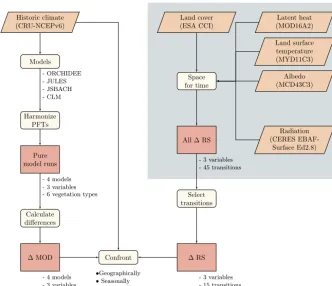
Figure 1.Flowchart resuming the processing steps undertaken for the present study. The part in the grey box corresponds to work done in a previous study (Duveiller et al., 2018b).
2 Material and methods
Isolating the effect of vegetation cover change from both model simulations and observations in order to make them comparable requires a series of dedicated processing steps. To assist the reader in following the methodology developed in this work, Fig. 1 summarizes the main steps in a synthetic flowchart.
2.1 Remote sensing estimations
The observation part of the analysis is based on satellite re-mote sensing observations to assess the effects of vegetation on the surface energy balance for different vegetation cover types (Duveiller et al., 2018a). This remote sensing dataset (RS dataset for short) consists of spatially and seasonally explicit estimates of changes in surface properties follow-ing specific vegetation transitions. These surface properties are albedo, land surface temperature (LST) and evapotranspi-ration (ET), obtained from the respective MODIS products MCD43C3 (Schaaf et al., 2002), MYD11C3 (Wan, 2008) and MOD16A2 (Mu et al., 2011). The changes in these vari-ables are calculated at the original scale of the product 0.05◦, but the dataset is provided at a spatial resolution of 1◦, with each cell representing the mean changes occurring at the finer scale of 0.05◦. This coarser spatial resolution is necessary for
a specific step to ingest CERES EBAF surface radiation data (Kato et al., 2013) in the processing chain, but is also ideal to align the dataset with the simulations of LSMs. The data represent a multi-annual average year with a monthly tem-poral resolution. This synthetic year is constructed from the median values for a given month over the period 2008–2012 for every 0.05◦ pixel. The original land cover map used to build this dataset is the ESA CCI land cover map for 2010 (ESA, 2017), but with a simplified reclassification of land cover types into major vegetation classes according to the International Geosphere-Biosphere Programme (IGBP) clas-sification scheme. A total of 45 distinct vegetation transitions are provided in the RS dataset. Although these are referred to as vegetation transitions, the information does not come from observations over transient vegetation changes, but rather from paired observations of distinct vegetation cover types at the same location. As a result, values for a given pair are only available where there is sufficient spatial abundance, or co-occurrence, of both vegetation types. For more details on the dataset and how it was produced, readers may refer to Duveiller et al. (2018a).
directly retrieved from satellites and are computed as a resid-ual flux from the closure of the surface energy balance. How-ever, it can be considered that H+G is dominated by H since the ground heat values are generally much smaller and can be neglected at annual scale. In this study net radiation is con-sidered positive when the flux goes from the atmosphere to the ground, while latent, sensible and ground heat fluxes are positive when they exit from the surface to the atmosphere.
2.2 Land surface model simulations
To simulate the biophysical effects of local vegetation tran-sitions that are comparable to the RS dataset, we need to run LSMs forced by a realistic climate and with idealized vege-tation distributions. The four models evaluated here are OR-CHIDEE (Krinner et al., 2005), JULES (Best et al., 2011; Clark et al., 2011), JSBACHv3.1 (Reick et al., 2013) and CLM4.5 (Oleson et al., 2013). The forcing consists of his-toric climate data from CRU-NCEP v6, and observationally derived global atmospheric CO2concentration (Le Quéré et al., 2015). Models were spun up for steady state in biomass pools and leaf area index (LAI) and then forced with transient CRU-NCEP v6 reconstructed climate and CO2from 1950 or earlier, and up until 2014. To obtain values of the surface variables of interest (Rn, LE and H+G) that are coherent with those of the RS dataset, the median monthly values of these fluxes from 2008 until 2012 was calculated.
Models differ in how they represent the surface energy bal-ance per plant functional type (PFT) at the sub-grid level. Not all models can calculate heat fluxes per PFT within a grid cell, and thus some need to resort to flux aggregation at grid cell level to derive resulting variables such as temperature. To overcome this problem and isolate the effect of vegeta-tion cover change on the surface energy budget, simulavegeta-tions are made in which the entire grid cell is covered by a sin-gle PFT. Separate simulations are run for each PFT of every model, in which the entire surface of the Earth is covered by a single PFT. The effect of a change in PFT can then be re-trieved by subtracting values of biophysical fluxes between the two corresponding simulations. Since there is no feed-back between the vegetation and the climate in this set-up, having such homogeneous distributions of vegetation across vast geographic extents does not generate climate biases out-side of the grid cell.
2.3 Harmonizing vegetation classes
The models differ in how they represent vegetation using dif-ferent PFTs, each with their own parametrization. To facili-tate the harmonization with the IGBP vegetation classes in the remote sensing dataset, only 6 broad vegetation classes are considered: evergreen broadleaf trees (EvgTr), decidu-ous broadleaf trees (DecTr), needleleaf trees (NedTr), shrubs
(Shrub), grasses (Grass) and crops (Crops). A total of 15
transitions (from paired comparisons of PFTs) are thus
avail-able and can also be used to represent inverse transitions (e.g.
1LE for DecTr to Crops is equal to −1LE for Crops to
DecTr). To obtain these broad vegetation classes from the RS
dataset, the IGBP classes of evergreen and deciduous needle-leaf forest (ENF and DNF, respectively) were merged into
NedTr, whereas classes not represented by models or mixed
classes such as woody savannas (SAV), mixed forests (MF) and wetlands (WET) have been omitted. The other three classes (Shrub,Grass andCrops) can be directly assigned with their corresponding classes in the scheme used in the RS dataset (SHR, GRA and CRO).
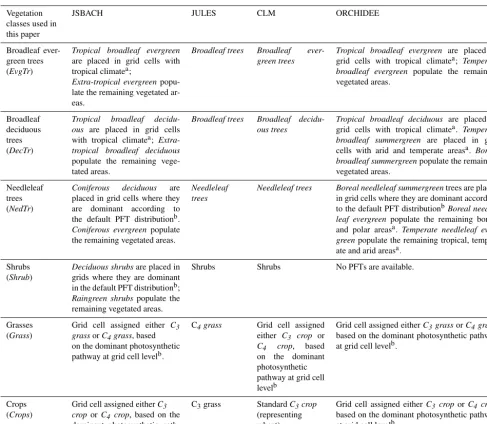
The harmonization of the different modelled PFTs to these 6 broad classes required the use of some decision rules that are summarized in Table 1. PFTs whose differences relate to their climatic regime (such as “Tropical broadleaf decidu-ous” and “Temperate broadleaf decidudecidu-ous” in ORCHIDEE) are geographically separated and can be aggregated into a single global PFT. The spatial representation of the climate zones is taken from the revisited Köppen–Geiger classifi-cation product (Kottek et al., 2006). A similar approach is adopted to keep all needleleaf tree PFTs in a single layer, as the deciduous needleleaf trees are predominantly located in a well-defined geographic area in Siberia without a strong overlap with evergreen needleleaf trees. For grasses and crops, LSMs typically make a separation between C3and C4 systems for carbon fixation, which is not currently feasible to detect from remote sensing observations (and thus is ab-sent in the RS dataset). For the two classes,GrassandCrops, the decision rule adopted is to assign the dominant photosyn-thetic pathway (C3or C4) within a grid cell to the entire grid cell. Since different models may have a different default PFT distribution map, the PFT distribution of JSBACH (based on work by Knorr and Heimann, 2001) is selected here as refer-ence and used for the harmonization of the other models as well. An exception to this rule is applied for JULES, which represents crops as grasses. In this case, to maximize infor-mation content theCropsclass is assigned exclusively with the C3grass PFT and the Grassclass contains only the C4 grass PFT. There are some further model-specific details in the harmonization procedure. For CLM, theCrops simula-tion is composed exclusively of the generic C3crop. Even if some LSMs can simulate some crop managements options, such as irrigation, this has been switched off to maximize inter-comparability amongst model runs. Regarding trees, JULES does not distinguish PFTs based on phenology, con-sidering only the difference between broadleaf and needle-leaf trees. TheEvgTrandDecTrsimulations will therefore be identical in JULES. Shrubs are simulated as a PFT by all models except for ORCHIDEE, for which the Shrubclass remains empty.
Table 1.Summary of how the specific plant functional types (PFTs) of the different land surface models (LSMs) are mapped into the six broad vegetation classes used in this study. Model-specific nomenclature of PFT is used in italics.
Vegetation classes used in this paper
JSBACH JULES CLM ORCHIDEE
Broadleaf ever-green trees (EvgTr)
Tropical broadleaf evergreen
are placed in grid cells with tropical climatea;
Extra-tropical evergreen popu-late the remaining vegetated ar-eas.
Broadleaf trees Broadleaf ever-green trees
Tropical broadleaf evergreen are placed in grid cells with tropical climatea; Temperate broadleaf evergreen populate the remaining vegetated areas.
Broadleaf deciduous trees (DecTr)
Tropical broadleaf decidu-ous are placed in grid cells with tropical climatea; Extra-tropical broadleaf deciduous
populate the remaining vege-tated areas.
Broadleaf trees Broadleaf decidu-ous trees
Tropical broadleaf deciduous are placed in grid cells with tropical climatea. Temperate broadleaf summergreen are placed in grid cells with arid and temperate areasa. Boreal broadleaf summergreenpopulate the remaining vegetated areas.
Needleleaf trees (NedTr)
Coniferous deciduous are placed in grid cells where they are dominant according to the default PFT distributionb.
Coniferous evergreen populate the remaining vegetated areas.
Needleleaf trees
Needleleaf trees Boreal needleleaf summergreentrees are placed in grid cells where they are dominant according to the default PFT distributionbBoreal needle-leaf evergreenpopulate the remaining boreal and polar areasa. Temperate needleleaf ever-greenpopulate the remaining tropical, temper-ate and arid areasa.
Shrubs (Shrub)
Deciduous shrubsare placed in grids where they are dominant in the default PFT distributionb;
Raingreen shrubspopulate the remaining vegetated areas.
Shrubs Shrubs No PFTs are available.
Grasses (Grass)
Grid cell assigned either C3
grassorC4grass, based
on the dominant photosynthetic pathway at grid cell levelb.
C4grass Grid cell assigned
either C3 crop or
C4 crop, based
on the dominant photosynthetic pathway at grid cell levelb
Grid cell assigned eitherC3grassorC4grass,
based on the dominant photosynthetic pathway at grid cell levelb.
Crops (Crops)
Grid cell assigned eitherC3
crop orC4 crop, based on the
dominant photosynthetic path-way at grid cell levelb.
C3grass StandardC3crop
(representing wheat)
Grid cell assigned eitherC3 croporC4crop,
based on the dominant photosynthetic pathway at grid cell levelb.
The spatial merging of different PFTs into single simulation layers requires assignment from ancillary maps indicated by the following superscripts:aKöppen–Geiger classification (Kottek et al., 2006) to distinguish arid, tropical, temperate and boreal climate zones;bdefault PFT distribution of JSBACH including dominant photosynthetic pathways (Knorr and Heimann, 2001).
the harmonized dataset presented here only includes simu-lated values over the areas where the RS data are available.
2.4 Protocol to evaluate agreement
The harmonized dataset is presented and analysed along three different bi-dimensional spaces. The first is geographic space, in which mean annual values per pixel are obtained by averaging all monthly observations. The second is labelled seasonal space, in which averages are made along latitudinal bands for each month, illustrating the seasonal course of the variables, such as in Hovmöller diagrams (Hovmöller, 1949). The third is climatic space, in which variables are analysed
along temperature and precipitation gradients. The climatic axes of this space are mean annual temperature and annually cumulated precipitation for the period 2008–2012 based on the CRU TS4.00 climate data (Harris et al., 2014). The ratio-nale behind using these spaces is to encourage more process-based model evaluation by ensuring that the agreement or disagreement between models and observations is coherent spatially, seasonally and climatically.
ORCHIDEE
JULES
JSBA
CH
CLM
RS
−100 0 100
−50 0 50
−50 0 50
−50 0 50
−50 0 50
−50 0 50
Longitude
Latitude
−30 −20 −10 0 10 20 30
∆LE [W m ]-2
(a) Annual mean changes
ORCHIDEE
JULES
JSBA
CH
CLM
RS
J F M A M J J A S O N D −50
0 50
−50 0 50
−50 0 50
−50 0 50
−50 0 50
Month
Latitude
(b) Seasonal changes
ORCHIDEE
JULES
JSBA
CH
CLM
RS
0 1000 2000 3000
−10 0 10 20 30
−10 0 10 20 30
−10 0 10 20 30
−10 0 10 20 30
−10 0 10 20 30
Annually cum. ppt. [mm yr ]
Mean ann
ual temper
ature [
°
C]
(c) Changes in climate space
Changes in LE for transition EvgTr to crops
-1
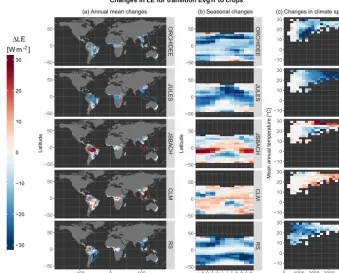
Figure 2.Inter-comparison of how the land surface models and remote sensing (RS) estimate a change in latent heat flux (LE) for the
vegetation transition from evergreen broadleaf trees to crops (Crops – EvgTr). We summarize the data within three different comparison spaces to illustrate(a)the spatial variability, representing the annual mean for each pixel;(b)the seasonal variability; and(b)the variability in climate space, represented by mean annual temperature and annually cumulated precipitation.
are usually taken as a reference over model simulations, in some cases the latter can also serve to evaluate the quality of the former (Massonnet et al., 2016). In order to evaluate the agreement without setting a single product as a reference, we measure agreement based on a metric that has the property of being symmetric. This means the value of the metric remains numerically unchanged whether it is applied to productsX
andY, or if these are inverted. This is not the case when us-ing a coefficient of determinationR2from a standard regres-sion ofY onX, which differs from that of a regression of
XonY. Beyond being symmetric, the index of agreementλ
that we use is also dimensionless, bounded (between 0 for no agreement to 1 for perfect agreement) and easy to compute (Duveiller et al., 2016). Furthermore, its interpretation is rel-atively intuitive for practitioners since its value is the same as that of the familiar correlation coefficient r when there are no additive or multiplicative bias contributing to the dis-agreement betweenXandY. When there are biases, its value reduces proportionately to this bias. For two sets,X andY, each containingnvalues, the index is defined as follows:
λ=1−
n−1
n P
i=1
(Xi−Yi)2
σX2+σY2+(µX−µY)2+κ
, (1)
whereµ andσ represent the mean and standard deviation, respectively.κis a term set to zero if the correlation between
XandY is positive, and otherwise set as follows:
κ=2
Xn
i=1(Xi−µX)(Yi−µY)
. (2)
Besides this index of agreement, the analysis also uses the correlation coefficientrand the mean absolute biasBas de-fined by the following formulas:
r=
n−1
n P
i=1
(Xi−X)(Yi−Y)
σXσY
, (3)
B=
n P
i=1
|Xi−Yi|
n . (4)
3 Results
ORCHIDEE
JULES
JSBA
CH
CLM
RS
−100 0 100
−50 0 50
−50 0 50
−50 0 50
−50 0 50
−50 0 50
Longitude
Latitude
−30 −20 −10 0 10 20 30
∆(H+G) [W m ]-2
(a) Annual mean changes
ORCHIDEE
JULES
JSBA
CH
CLM
RS
J F M A M J J A S O N D −50
0 50
−50 0 50
−50 0 50
−50 0 50
−50 0 50
Month
Latitude
(b) Seasonal changes
ORCHIDEE
JULES
JSBA
CH
CLM
RS
0 1000 2000 3000
−10 0 10 20 30
−10 0 10 20 30
−10 0 10 20 30
−10 0 10 20 30
−10 0 10 20 30
Annually cum. ppt. [mm yr ]
Mean ann
ual temper
ature [
°
C]
(c) Changes in climate space
Changes in H+G for transition DecTr to NedTr
-1
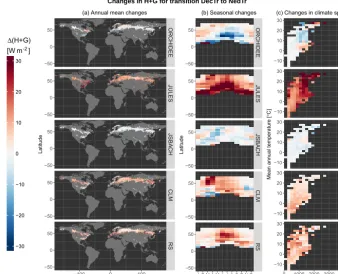
Figure 3.Same as Fig. 2 for a change in the residual flux of the energy balance composed of both sensible heat and ground heat fluxes
(H+G) for the vegetation transition from deciduous broadleaf trees to needleleaf trees (DecTr–NedTr).
dataset. Therefore, this section starts by describing a selec-tion of cases of how different products portray changes in geographic, seasonal and climatic space of a given variable following a specific vegetation cover transition.
The first case, shown in Fig. 2, consists of changes in LE resulting from the conversion of evergreen broadleaf trees to crops (EvgTrtoCrops) corresponding to a common land cover change associated with tropical deforestation. It is clear from this figure that not all models reproduce the expected effects of tropical deforestation (i.e. a reduction in LE due to crops having shallower roots and thus less access to wa-ter for transpiration) that are seen in the RS dataset. JSBACH and CLM see an increase in mean annual LE following defor-estation in large parts of the world. ORCHIDEE and JULES generally predict the sign correctly, a reduction of LE, but for JULES the behaviour in the seasonal and climatic space shows contrasting patterns to those of RS, while those of JS-BACH might be more in line despite the constant bias of this model. Please note that in this and similar figures presented in this work, data for a given transition are only available for areas where there is a local co-occurrence of the two vegeta-tion types according to the land cover distribuvegeta-tion used in the RS dataset.
The second case, displayed in Fig. 3, concerns changes in H+G following the conversion of broadleaf deciduous to needleleaf trees (DecTr toNedTr). This transition can
rep-resent for instance changes in planted forest species, such as what occurred for most of the past 250 years in Eu-rope (Naudts et al., 2016). According to the RS dataset, this change is associated with a general increase in H+G, par-ticularly in the summer period and across all latitudes (at least those in which there is a joint presence ofDecTr and
NedTr, and thus a higher likelihood that this conversion
oc-curs). ORCHIDEE and JSBACH do not capture the sign of change in H+G dynamic, sometimes showing a reduction in H+G that is quite large for ORCHIDEE in the summertime and in warmer climates. CLM and JULES show more con-sistent patterns with RS. However, JULES overestimates the magnitude of change, especially in warmer climates, while CLM simulates a higher rise in H+G in spring in northern mid-latitudes to high latitudes that is not present in the ob-servations.
ORCHIDEE
JULES
JSBA
CH
CLM
RS
−100 0 100
−50 0 50
−50 0 50
−50 0 50
−50 0 50
−50 0 50
Longitude
Latitude
−30 −20 −10 0 10 20 30
∆Rn [W m ]-2
(a) Annual mean changes
ORCHIDEE
JULES
JSBA
CH
CLM
RS
J F M A M J J A S O N D −50
0 50
−50 0 50
−50 0 50
−50 0 50
−50 0 50
Month
Latitude
(b) Seasonal changes
ORCHIDEE
JULES
JSBA
CH
CLM
RS
0 1000 2000 3000
−10 0 10 20 30
−10 0 10 20 30
−10 0 10 20 30
−10 0 10 20 30
−10 0 10 20 30
Annually cum. ppt. [mm yr ]
Mean ann
ual temper
ature [
°
C]
(c) Changes in climate space
Changes in Rn for transition Grass to NedTr
-1
Figure 4.Same as Fig. 2 for a change in the net radiative flux (Rn) for the vegetation transition from grasses to needleleaf trees (Grass–
NedTr).
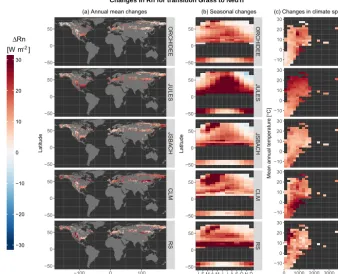
by the darker canopy. However, the geographic, seasonal and climatic patterns differ from observations and vary across the models. Seasonally, the RS dataset illustrates the strong snow effect on albedo in northern latitudes in spring, when the radi-ation load increases substantially as the days become longer while snow cover remains, thus amplifying the albedo differ-ences between snow-covered grasses and darker evergreen trees. The higher increases in Rn that are present in the RS observations along the mountain ranges in North America are only captured by JULES. The magnitude of the spring albedo effect for this transition is slightly underestimated in OR-CHIDEE and overestimated in JSBACH and CLM, although for CLM it appears to extend more in time and latitude than what is reported in the RS dataset. While these discrepancies might be due more to misrepresentation of snow-related pro-cesses within the models than to misrepresentation of vege-tation, it remains a good example of a process-based model evaluation, since it focuses on the comprehensive biophysical effect of the process of vegetation cover change.
For any vegetation transition, the similarities and discrep-ancies, both amongst models and with the RS dataset, can be summarized synthetically in a single diagram for all fluxes and for the three spaces under investigation (geographic, sea-sonal and climatic). Figure 5 shows such a diagram for the case of the tropical deforestation transitionEvgTrtoCrops, the same transition which is represented in Fig. 2. Every
panel in Fig. 5 provides an inter-comparison of the pair-wise agreement between products either with the indexλ, using squares in the lower right triangle of the panel, or with the correlation coefficient,r, using circles in the upper left tri-angle. Whilst the sizes of the symbols represent the rela-tive value of the metric, the colour provides the value of the mean absolute bias. For two productsX andY, all metrics (λ,r and B) are calculated using the respective equations with the aggregated values over the three reasoning spaces, i.e. the binned values in geographic, seasonal and climatic space, such as those represented in Fig. 2. Generally Rn is better represented across the board, especially the seasonal patterns, and LE tends to suffer larger biases. The agreement amongst the models can be also gauged by comparing the size of the symbols within the triangles of Fig. 5. Analogous plots to those in Fig. 5 are available for all 15 transitions in the Supplement.
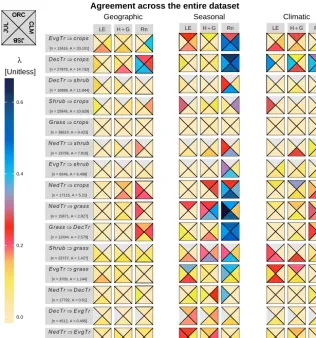
To provide a general overview for all transitions, Fig. 6 shows the agreement for each model with the RS dataset for all three fluxes averaged over geographic, seasonal and climatic space. The transitions are ordered according to the magnitude of gross transitions that have occurred in the re-cent past between 2000 and 2015 according to the annual ESA CCI annual land cover maps (ESA, 2017), withEvgTr
toCropsbeing the largest. Generally, the agreement in
agree-●
●
●
●
●
●
●
●
● ●
●
●
●●
● ●
●
●
●
●●
●
● ●●
●
● ● ●
●
●
●
●
●
●
●
●
●
●
●
●
●
●
●
●
●
●
●●
●
●
●
●
●
●
●
●●
●
●
●
●
●
●
●
●
●
●
●
●
●
● ● ●
●
Geographic Seasonal Climatic
LE
H+G
Rn
RS CLM
JSBA
CH
JULES
ORCHIDEE
RS CLM
JSBA
CH
JULES
ORCHIDEE
RS CLM
JSBA
CH
JULES
ORCHIDEE
RS CLM JSBACH JULES ORCHIDEE
RS CLM JSBACH JULES ORCHIDEE
RS CLM JSBACH JULES ORCHIDEE
Value of
λ or |r|
●
●
●
0.0 0.2
0.4
0.6
0.8
1.0
0 5 10 15 20
Bias [W m ]-2
● ●
r < 0
r > 0
Summarizing agreement for transition: EvgTr to crops
Figure 5.Summary of the agreement between land surface models amongst themselves and with the remote sensing estimations for the
vegetation transition from evergreen broadleaf trees to crops (Crops–EvgTr). The agreement is measured using the index of agreementλ
(size of the squares), the Pearson correlation coefficientr(size of the circles, red border indicates negative correlation) and the absolute bias (colour of the symbols). The data used to calculate these metrics are the values previously averaged in bins according to the spatial, seasonal and climatic analysis spaces shown in Fig. 2. Hence, these metrics relate only to areas where both vegetation types locally co-exist in reality. The fluxes represented are net radiation (Rn), latent heat flux (LE), and the combination of the sensible and ground heat fluxes (H+G).
ment in climatic space, and then more frequent agreement regarding the seasonal cycle. Net radiation is the variable that models simulate best, particularly the seasonal patterns, while H+G come second and LE comes third. Overall, the transition in which there is highest agreement between mod-els and RS across all variables and spaces isDecTrtoCrops, while the one with least agreement isGrasstoCrops.
No model stands out as having consistently better per-formance than the others. Models differ in which transi-tions they simulate best. JULES performs best forNedTrto
Grass, CLM forEvgTrtoCrops, and both JSBACH and
OR-CHIDEE for DecTr toCrops. When looking at each vari-able across transitions and facets, the models showing high-est mean agreement for LE, H+G and Rn are JULES, CLM and JULES respectively. Disregarding the situations when agreement is very poor, rare are the cases when all models similarly agree with RS, i.e. when all colours in a single box of Fig. 6 have similar colours. Those that stand out always in-volve Rn and are seasonal agreement forGrasstoDecTrand both seasonal and climatic agreement for DecTr toCrops.
There are also cases in which a single model stands out as having much higher agreement than all the others, such as CLM for the spatial agreement of Rn forEvgTrtoCrops, JULES for the seasonal agreement of Rn forNedTrtoDecTr, JSBACH for climatic agreement of H+G forNedTrtoShrub
and ORCHIDEE for climatic agreement of H+G forNedTr
toCrops.
LE H+G Rn
EvgTr⇒crops [n = 13416, A = 33.101] DecTr⇒crops [n = 27879, A = 14.732] DecTr⇒shrub [n = 10888, A = 11.844] Shrub⇒crops [n = 25846, A = 10.629] Grass⇒crops [n = 36610, A = 9.423] NedTr⇒shrub [n = 19706, A = 7.818] EvgTr⇒shrub [n = 6545, A = 5.498] NedTr⇒crops
[n = 17115, A = 5.21] NedTr⇒grass
[n = 15871, A = 2.827] Grass⇒DecTr [n = 12444, A = 2.579] Shrub⇒grass [n = 23727, A = 1.427] EvgTr⇒grass [n = 3700, A = 1.144] NedTr⇒DecTr
[n = 17792, A = 0.61] DecTr⇒EvgTr
[n = 4512, A = 0.466] NedTr⇒EvgTr
[n = 915, A = 0.042] 0.0
0.2 0.4 0.6 λ
[Unitless]
Geographic
LE H+G Rn
Seasonal
LE H+G Rn
Climatic
ORC ORC ORC
JULJULJUL
JSB JSB JSB
CLMCLMCLM
Agreement across the entire dataset
Figure 6.Summary of the agreement between models and remote sensing for all fluxes and all transitions in each of three facets of analysis:
spatial, seasonal and climatic. The position of each triangle represents one of the four land surface models as shown in the top corner: ORCHIDEE (ORC), the Community Land Model (CLM), JSBACH (JSB) and JULES (JUL). The fluxes represented are net radiation (Rn), latent heat flux (LE), and the combination of the sensible and ground heat fluxes (H+G). The colour of the triangle represents the value of the index of agreementλ. Below each transition label, the numbernprovides the total number of original individual spatio-temporal records used to calculate each metric. The order of the transitions (from top to bottom) corresponds to the order of gross changes that have occurred between 2000 and 2015 according the ESA CCI land cover maps, which is provided below each transition label in megahectares (Mha).
appear as the places where there is the strongest agreement with RS, while the tropics show decisively lower agreement. The higher agreement amongst models in northern latitudes is maintained across the seasons, but the agreement with RS is only high in spring, probably due to the capacity of some models to catch the snow-induced albedo changes when trees are replaced by shrubs or grasses. The overall agreement in climate space indicates how for warm climates, models agree amongst themselves less in the more humid conditions, while there is generally a large disagreement with RS for all condi-tions. In colder climates, inter-model agreement is high but agreement with RS is higher for wetter conditions.
4 Discussion
This model-evaluation framework specifically targeting the biophysical effects of LULCC is unique in that it brings
Amongst models
With remote sensing
−100 0 100 −50
0 50
−50 0 50
Longitude
0.0 0.2 0.4 0.6 λ
[Unitless]
Spatial agreement
Amongst models
With remote sensing
J F M A M J J A S O N D −50
0 50
−50 0 50
Month
Latitude
Seasonal agreement
Amongst models
With remote sensing
0 1000 2000 3000 −10
0 10 20 30
−10 0 10 20 30
Annually cum. ppt. [mm yr ]
Mean ann
ual temper
ature [
°
C]
Climatic agreement
-1 (a)
(b)
Latitude
Figure 7.Agreement amongst models and between models and remote sensing for all transitions and all fluxes together. The agreement
amongst models(a)is calculated as the mean of allλvalues calculated for each model pairs, while the agreement with remote sensing(b)is the mean values ofλfor each model with respect to the remote sensing dataset.
people making decisions based on conclusions derived from model outputs, the dataset and the evaluation can provide a welcome overview of model performance across space, time and climate zones, along with an overall an idea of the cur-rent level of uncertainty associated with using these tools for estimating the biophysical impacts of LULCC.
The overall picture of the general benchmarking exercise of model performances is not encouraging. For various veg-etation transitions, models do not even agree amongst them-selves on the magnitude nor the sign of the change. The study confirms with observational data what previous analyses had reported based on model inter-comparisons regarding how models have more difficulties to simulate turbulent fluxes than radiative ones (de Noblet-Ducoudré et al., 2012), despite that the former have been shown to drive the local tempera-ture response to land cover and management (Bright et al., 2017). As can be expected, the seasonal patterns observed in the RS dataset are better simulated than climatic or tial patterns. Models are especially poor in capturing the spa-tial patterns, arguably because LSMs typically use the same parameterization for a given PFT across the globe, thereby disregarding the spatial variability of traits that can naturally occur, which in turn is sampled by the observation-driven es-timates. In this sense, some model improvement could come by adopting the concept of optical functional types, based on traits detectable by remote sensing (Ustin and Gamon, 2010). Models also tend to agree more amongst themselves than with observations. This may stem from similarities in the construction of models and their underlying assumptions. Europe may come out as a place of higher inter-model agreement because vegetation models were based heavily on information on temperate ecosystems, resulting in a bet-ter representation of temperature deciduous systems than drought-deciduous systems (Morales et al., 2005). Data for other ecosystems have only become available in more re-cent decades. Inter-model agreement, and to a lesser
ex-tent RS-model agreement, is also higher in the areas where flux measurements from eddy-covariance towers, frequently used for carbon cycle calibration, are denser (Schimel et al., 2015). This converges towards an evident conclusion that strengthening the observational base is still essential to en-sure the quality of model results. As discussed in Duveiller et al. (2018b), the RS dataset also has shortcomings, and these may partly explain discrepancies with respect to model sim-ulations. A valid criticism is that the RS dataset relies on an evapotranspiration product (Mu et al., 2011) that has been shown to underperform compared to other satellite-driven products both at local (Michel et al., 2016) and at global scales (Miralles et al., 2016). However, this was the only available product at the sufficiently fine spatial resolution of 0.05◦, and despite the underperformance, ancillary analyses in Duveiller et al. (2018a, b) suggest that the product quality is sufficient for the purpose of studying local differences.
from the mismatch between climate and vegetation. In an all-forest simulation over a grid cell subjected to the real climate observed over a savanna, the trees may be more stressed than if they were mixed with low-evaporative grasses. Therefore, transitions of forests to grasses reported in this dataset may be overestimating the reduction of processes such as evapo-transpiration over savanna regions. Overall, these issues il-lustrate how increasing the spatial resolution of the model simulations to better match that of observations should im-prove their inter-comparisons. This would result both from a better characterization of vegetation heterogeneity, but also from enabling LSMs to better resolve local climate variabil-ity and the resulting biophysical effects of LULCC.
Another particularity of the model set-up employed here is that only the local first-order biophysical effects of LULCC are explored. Non-local effects related to LULCC occur-ring elsewhere, as explored by modelling exercises such as Winckler et al. (2017a), are not considered here because they cannot be directly estimated by remote sensing diagnostics. Given that the analysis is also based on uncoupled LSMs runs, there are no possible feedbacks of the vegetation cover change on global climate, nor are there any local atmospheric feedbacks. Considering second-order effects stemming from the bi-directional land–climate interactions would require us-ing LSMs coupled with a general circulation model within an Earth system model in which some cells are affected by LULCC, but this is beyond the scope of the present work.
The inter-comparison exercise presented here can be ex-tended and improved. Doing so could further address other limitations of the current set-up, such as the fact that only a single source of meteorological forcing data is used to run the model simulations. Such datasets, based on climate re-analysis, can be particularly prone to errors and uncertainties in data-poor regions. Initiatives such as LUMIP (Lawrence et al., 2016) could use the present framework to run LSMs with different forcing datasets and evaluate how the simulated bio-physical impacts of LULCC are sensitive to the quality of the input data. Another criticism of the inter-comparison is the mismatch between model runs, which do not explicitly include the effects of land management, and the RS dataset, which intrinsically does, simply because these are present in the observations. The biophysical impacts of land manage-ment changes have been shown to be as important as the ef-fects of land cover change (Luyssaert et al., 2014), and could thus further account for the discrepancies between models and observations. The exercise could thus be extended with runs that include management for the models which can ef-fectively simulate it, and it could also evaluate the improve-ment based on the RS benchmark. Finally, the exercise could be improved by extending the observational part to an en-semble of RS datasets. The input biophysical variables used to construct the RS dataset, namely albedo, land surface tem-perature and evapotranspiration, could be derived from dif-ferent satellite instruments and based on other, ideally bet-ter algorithms. Ultimately, the RS dataset could be based on
products from geostationary satellites to be able to study the diurnal patterns of biophysical effects of LULCC and how these are represented in the models.
5 Data availability
The dataset consisting of both harmonized model simula-tion and remote sensing estimasimula-tions is freely available in Zenodo: https://doi.org/10.5281/zenodo.1182145 (Duveiller et al., 2018c).
6 Conclusions
This paper presents a process-oriented model evaluation framework for biophysical effects of vegetation cover change. A harmonized multi-dimensional dataset has been generated including dedicated simulations from four ma-jor LSMs along with observation-driven estimations based on satellite imagery. The analysis of these data along ge-ographic, seasonal and climate dimensions results in an overview of model performance that can serve to highlight hotspots of agreement and disagreement both amongst mod-els and with respect to an observational benchmark. The overall capacity of current LSMs to represent biophysical ef-fects of LULCC is low. The seasonal cycle of radiative fluxes is the process that models capture best, whilst performance drops considerably when considering spatial and climatic gradients for all fluxes. We anticipate that the dataset will serve to identify specific model shortcomings with respect to observations and to other models, but also to highlight where models can be trusted more and where model development should be prioritized. This should in turn contribute to the larger goal to develop and inform land-based mitigation and adaptation policies that account for both biogeochemical and biophysical vegetation impacts on climate. Improving the ro-bustness and consistency of land-surface models is essential to develop and inform land-based mitigation and adaptation policies that account for both biogeochemical and biophysi-cal vegetation impacts on climate.
Supplement. The supplement related to this article is available
online at: https://doi.org/10.5194/essd-10-1265-2018-supplement.
Author contributions. GD, AC and SS conceived the study. ER,
WL, GG and PL did the model runs, which GF harmonized together. GD did all the analyses and wrote the paper with contribution of all the authors.
Competing interests. The authors declare that they have no
Acknowledgements. The study was funded by the FP7 LUC4C project (grant no. 603542)
Edited by: David Carlson
Reviewed by: Wim Thiery and one anonymous referee
References
Alkama, R. and Cescatti, A.: Biophysical climate impacts of re-cent changes in global forest cover, Science, 351, 600–604, https://doi.org/10.1126/science.aac8083, 2016.
Anderson, R. G., Canadell, J. G., Randerson, J. T., Jack-son, R. B., Hungate, B. a, Baldocchi, D. D., Ban-Weiss, G. a, Bonan, G. B., Caldeira, K., Cao, L., Diffenbaugh, N. S., Gurney, K. R., Kueppers, L. M., Law, B. E., Luys-saert, S. and O’Halloran, T. L.: Biophysical considerations in forestry for climate protection, Front. Ecol. Environ., 9,174–182, https://doi.org/10.1890/090179, 2011.
Best, M. J., Pryor, M., Clark, D. B., Rooney, G. G., Essery, R. L. H., Ménard, C. B., Edwards, J. M., Hendry, M. A., Porson, A., Gedney, N., Mercado, L. M., Sitch, S., Blyth, E., Boucher, O., Cox, P. M., Grimmond, C. S. B., and Harding, R. J.: The Joint UK Land Environment Simulator (JULES), model description – Part 1: Energy and water fluxes, Geosci. Model Dev., 4, 677–699, https://doi.org/10.5194/gmd-4-677-2011, 2011.
Betts, A. K. and Ball, J. H.: Albedo over the boreal
forest, J. Geophys. Res.-Atmos., 102, 28901–28909,
https://doi.org/10.1029/96JD03876, 1997.
Betts, R.: Offset of the potential carbon sink from boreal foresta-tion by decreases in surface albedo, Nature, 408, 187–90, https://doi.org/10.1038/35041545, 2000.
Bonan, G. B.: Forests and climate change: forcings, feedbacks, and the climate benefits of forests, Science, 320, 1444–1449, https://doi.org/10.1126/science.1155121, 2008.
Bright, R. M., Davin, E., O’Halloran, T., Pongratz, J., Zhao, K., and Cescatti, A.: Local temperature response to land cover and man-agement change driven by non-radiative processes, Nat. Clim.
Change, 7, 296–302, https://doi.org/10.1038/nclimate3250,
2017.
Canadell, J., Jackson, R. B., Ehleringer, J. B., Mooney, H. A., Sala, O. E. and Schulze, E.-D.: Maximum rooting depth of vegetation types at the global scale, Oecologia, 108, 583–595, https://doi.org/10.1007/BF00329030, 1996.
Canadell, J. G. and Raupach, M. R.: Managing Forests for Climate Change Mitigation, Science, 320, 1456–1457, https://doi.org/10.1126/science.1155458, 2008.
Clark, D. B., Mercado, L. M., Sitch, S., Jones, C. D., Gedney, N., Best, M. J., Pryor, M., Rooney, G. G., Essery, R. L. H., Blyth, E., Boucher, O., Harding, R. J., Huntingford, C., and Cox, P. M.: The Joint UK Land Environment Simulator (JULES), model description – Part 2: Carbon fluxes and vegetation dynamics, Geosci. Model Dev., 4, 701–722, https://doi.org/10.5194/gmd-4-701-2011, 2011.
Davin, E. L. and de Noblet-Ducoudré, N.: Climatic
Im-pact of Global-Scale Deforestation: Radiative
ver-sus Nonradiative Processes, J. Climate, 23, 97–112,
https://doi.org/10.1175/2009JCLI3102.1, 2010.
Duveiller, G., Fasbender, D., and Meroni, M.: Revisiting the con-cept of a symmetric index of agreement for continuous datasets,
Sci. Rep.-UK, 6, 19401, https://doi.org/10.1038/srep19401, 2016.
Duveiller, G., Hooker, J., and Cescatti, A.: A dataset mapping the potential biophysical effects of vegetation cover change, Sci. Data, 5, 180014, https://doi.org/10.1038/sdata.2018.14, 2018a. Duveiller, G., Hooker, J., and Cescatti, A.: The mark of vegetation
change on Earth’s surface energy balance, Nat. Commun., 9, 679, https://doi.org/10.1038/s41467-017-02810, 2018b.
Duveiller, G., Forzieri, G., Robertson, E., Li, W., Georgievski, G., Lawrence, P., Wiltshire, A., Ciais, Ph., Pongratz, J., Sitch, S., Arneth, A., and Cescatti, A.: Biophysical effects of vegetation cover change from satellite and models, Zenodo, https://doi.org/10.5281/zenodo.1182145, 2018c.
ESA: Land Cover CCI Product User Guide Version 2,
avail-able at: http://maps.elie.ucl.ac.be/CCI/viewer/download/
ESACCI-LC-Ph2-PUGv2_2.0.pdf (last access: 9 July 2018), 2017.
Fan, Y., Miguez-Macho, G., Jobbágy, E. G., Jackson, R. B., and Otero-Casal, C.: Hydrologic regulation of plant root-ing depth, P. Natl. Acad. Sci. USA, 114, 10572–10577, https://doi.org/10.1073/pnas.1712381114, 2017.
Forzieri, G., Alkama, R., Miralles, D. G., and Cescatti, A.: Satellites reveal contrasting responses of regional climate to the widespread greening of Earth, Science, 356, 1180–1184, https://doi.org/10.1126/science.aal1727, 2017.
Harris, I., Jones, P. D., Osborn, T. J., and Lister, D. H.: Up-dated high-resolution grids of monthly climatic observations – the CRU TS3.10 Dataset, Int. J. Climatol., 34, 623–642, https://doi.org/10.1002/joc.3711, 2014.
Hovmöller, E.: The Trough-and-Ridge diagram, Tellus, 1, 62–66, https://doi.org/10.3402/tellusa.v1i2.8498, 1949.
IPCC: Climate Change 2014: Impacts, Adaptation, and Vulnerabil-ity, Part A: Global and Sectoral Aspects, Contribution of Work-ing Group II to the Fifth Assessment Report of the Intergovern-mental Panel on Climate Change, edited by: Field, C. B., Barros, V. R., Dokken, D. J., Mach, K. J., Mastrandrea, M. D., Bilir, T. E., Chatterjee, M., Ebi, K. L., Estrada, Y. O., Genova, R. C., Girma, B., Kissel, E. S., Levy, A. N., MacCracken, S., Mastrandrea, P. R., and White, L. L., Cambridge University Press, Cambridge, UK, New York, NY, USA, 2014.
Jackson, R. B., Randerson, J. T., Canadell, J. G., Anderson, R. G., Avissar, R., Baldocchi, D. D., Bonan, G. B., Caldeira, K., Diffenbaugh, N. S., Field, C. B., Hungate, B. A., Jobbágy, E. G., Kueppers, L. M., Nosetto, M. D., and Pataki, D. E.: Pro-tecting climate with forests, Environ. Res. Lett., 3, 044006, https://doi.org/10.1088/1748-9326/3/4/044006, 2008.
Kato, S., Loeb, N. G., Rose, F. G., Doelling, D. R., Rutan, D. A., Caldwell, T. E., Yu, L., and Weller, R. A.: Surface Ir-radiances Consistent with CERES-Derived Top-of-Atmosphere Shortwave and Longwave Irradiances, J. Climate, 26, 2719– 2740, https://doi.org/10.1175/JCLI-D-12-00436.1, 2013. Knorr, W. and Heimann, M.: Uncertainties in global
ter-restrial biosphere modeling: 1. {A} comprehensive
sen-sitivity analysis with a new photosynthesis and energy balance scheme, Global Biogeochem. Cy., 15, 207–225, https://doi.org/10.1029/1998GB001059, 2001.
up-dated, Meteorol. Z., 15, 259–263, https://doi.org/10.1127/0941-2948/2006/0130, 2006.
Krinner, G., Viovy, N., de Noblet-Ducoudré, N., Ogée, J., Polcher, J., Friedlingstein, P., Ciais, P., Sitch, S., and Prentice, I. C.: A dynamic global vegetation model for studies of the coupled atmosphere-biosphere system, Global Biogeochem. Cy., 19, 1– 33, https://doi.org/10.1029/2003GB002199, 2005.
Lawrence, D. M., Hurtt, G. C., Arneth, A., Brovkin, V., Calvin, K. V., Jones, A. D., Jones, C. D., Lawrence, P. J., de Noblet-Ducoudré, N., Pongratz, J., Seneviratne, S. I., and Shevliakova, E.: The Land Use Model Intercomparison Project (LUMIP) con-tribution to CMIP6: rationale and experimental design, Geosci. Model Dev., 9, 2973–2998, https://doi.org/10.5194/gmd-9-2973-2016, 2016.
Lee, X., Goulden, M. L., Hollinger, D. Y., Barr, A., Black, T. A., Bohrer, G., Bracho, R., Drake, B., Goldstein, A., Gu, L., Katul, G., Kolb, T., Law, B. E., Margolis, H., Meyers, T., Monson, R., Munger, W., Oren, R., Paw, U. K. T., Richardson, A. D., Schmid, H. P., Staebler, R., Wofsy, S., and Zhao, L.: Observed increase in local cooling effect of deforestation at higher latitudes, Nature, 479, 384–387, https://doi.org/10.1038/nature10588, 2011. Le Quéré, C., Moriarty, R., Andrew, R. M., Canadell, J. G., Sitch, S.,
Korsbakken, J. I., Friedlingstein, P., Peters, G. P., Andres, R. J., Boden, T. A., Houghton, R. A., House, J. I., Keeling, R. F., Tans, P., Arneth, A., Bakker, D. C. E., Barbero, L., Bopp, L., Chang, J., Chevallier, F., Chini, L. P., Ciais, P., Fader, M., Feely, R. A., Gkritzalis, T., Harris, I., Hauck, J., Ilyina, T., Jain, A. K., Kato, E., Kitidis, V., Klein Goldewijk, K., Koven, C., Landschützer, P., Lauvset, S. K., Lefèvre, N., Lenton, A., Lima, I. D., Metzl, N., Millero, F., Munro, D. R., Murata, A., Nabel, J. E. M. S., Nakaoka, S., Nojiri, Y., O’Brien, K., Olsen, A., Ono, T., Pérez, F. F., Pfeil, B., Pierrot, D., Poulter, B., Rehder, G., Rödenbeck, C., Saito, S., Schuster, U., Schwinger, J., Séférian, R., Steinhoff, T., Stocker, B. D., Sutton, A. J., Takahashi, T., Tilbrook, B., van der Laan-Luijkx, I. T., van der Werf, G. R., van Heuven, S., Van-demark, D., Viovy, N., Wiltshire, A., Zaehle, S., and Zeng, N.: Global Carbon Budget 2015, Earth Syst. Sci. Data, 7, 349–396, https://doi.org/10.5194/essd-7-349-2015, 2015.
Le Quéré, C., Andrew, R. M., Canadell, J. G., Sitch, S., Kors-bakken, J. I., Peters, G. P., Manning, A. C., Boden, T. A., Tans, P. P., Houghton, R. A., Keeling, R. F., Alin, S., Andrews, O. D., Anthoni, P., Barbero, L., Bopp, L., Chevallier, F., Chini, L. P., Ciais, P., Currie, K., Delire, C., Doney, S. C., Friedlingstein, P., Gkritzalis, T., Harris, I., Hauck, J., Haverd, V., Hoppema, M., Klein Goldewijk, K., Jain, A. K., Kato, E., Körtzinger, A., Land-schützer, P., Lefèvre, N., Lenton, A., Lienert, S., Lombardozzi, D., Melton, J. R., Metzl, N., Millero, F., Monteiro, P. M. S., Munro, D. R., Nabel, J. E. M. S., Nakaoka, S.-I., O’Brien, K., Olsen, A., Omar, A. M., Ono, T., Pierrot, D., Poulter, B., Röden-beck, C., Salisbury, J., Schuster, U., Schwinger, J., Séférian, R., Skjelvan, I., Stocker, B. D., Sutton, A. J., Takahashi, T., Tian, H., Tilbrook, B., van der Laan-Luijkx, I. T., van der Werf, G. R., Viovy, N., Walker, A. P., Wiltshire, A. J., and Zaehle, S.: Global Carbon Budget 2016, Earth Syst. Sci. Data, 8, 605–649, https://doi.org/10.5194/essd-8-605-2016, 2016.
Li, Y., Zhao, M., Motesharrei, S., Mu, Q., Kalnay, E., and Li, S.: Local cooling and warming effects of forests based on satellite observations, Nat. Commun., 6, 6603, https://doi.org/10.1038/ncomms7603, 2015.
Li, Y., Zhao, M., Mildrexler, D. J., Motesharrei, S., Mu, Q., Kalnay, E., Zhao, F., Li, S., and Wang, K.: Potential and Ac-tual impacts of deforestation and afforestation on land sur-face temperature, J. Geophys. Res.-Atmos., 121, 14372–14386, https://doi.org/10.1002/2016JD024969, 2016.
Loranty, M. M., Berner, L. T., Goetz, S. J., Jin, Y., and Randerson, J. T.: Vegetation controls on northern high latitude snow-albedo feedback: observations and CMIP5 model simulations, Glob. Change Biol., 20, 594–606, https://doi.org/10.1111/gcb.12391, 2014.
Luyssaert, S., Jammet, M., Stoy, P. C., Estel, S., Pongratz, J., Ceschia, E., Churkina, G., Don, A., Erb, K., Ferlicoq, M., Gielen, B., Grünwald, T., Houghton, R. A., Klumpp, K., Knohl, A., Kolb, T., Kuemmerle, T., Laurila, T., Lohila, A., Loustau, D., McGrath, M. J., Meyfroidt, P., Moors, E. J., Naudts, K., Novick, K., Otto, J., Pilegaard, K., Pio, C. A., Rambal, S., Rebmann, C., Ryder, J., Suyker, A. E., Varlagin, A., Wattenbach, M., and Dolman, A. J.: Land management and land-cover change have impacts of similar magnitude on surface temperature, Nat. Clim. Change, 4, 389–393, https://doi.org/10.1038/nclimate2196, 2014.
Mahmood, R., Pielke, R. A., Hubbard, K. G., Niyogi, D., Dirmeyer, P. A., McAlpine, C., Carleton, A. M., Hale, R., Gameda, S., Beltrán-Przekurat, A., Baker, B., McNider, R., Legates, D. R., Shepherd, M., Du, J., Blanken, P. D., Frauenfeld, O. W., Nair, U. S., and Fall, S.: Land cover changes and their bio-geophysical effects on climate, Int. J. Climatol., 34, 929–953, https://doi.org/10.1002/joc.3736, 2014.
Massonnet, F., Bellprat, O., Guemas, V., and Doblas-Reyes, F. J.: Using climate models to estimate the quality of
global observational data sets, Science, 354, 452–455,
https://doi.org/10.1126/science.aaf6369, 2016.
McCabe, M. F., Ershadi, A., Jimenez, C., Miralles, D. G., Michel, D., and Wood, E. F.: The GEWEX LandFlux project: eval-uation of model evaporation using tower-based and glob-ally gridded forcing data, Geosci. Model Dev., 9, 283–305, https://doi.org/10.5194/gmd-9-283-2016, 2016.
Michel, D., Jiménez, C., Miralles, D. G., Jung, M., Hirschi, M., Ershadi, A., Martens, B., McCabe, M. F., Fisher, J. B., Mu, Q., Seneviratne, S. I., Wood, E. F., and Fernández-Prieto, D.: The WACMOS-ET project – Part 1: Tower-scale evaluation of four remote-sensing-based evapotranspiration algorithms, Hy-drol. Earth Syst. Sci., 20, 803–822, https://doi.org/10.5194/hess-20-803-2016, 2016.
Miralles, D. G., Holmes, T. R. H., De Jeu, R. A. M., Gash, J. H., Meesters, A. G. C. A., and Dolman, A. J.: Global land-surface evaporation estimated from satellite-based observations, Hydrol. Earth Syst. Sci., 15, 453–469, https://doi.org/10.5194/hess-15-453-2011, 2011.
Miralles, D. G., Jiménez, C., Jung, M., Michel, D., Ershadi, A., Mc-Cabe, M. F., Hirschi, M., Martens, B., Dolman, A. J., Fisher, J. B., Mu, Q., Seneviratne, S. I., Wood, E. F., and Fernández-Prieto, D.: The WACMOS-ET project – Part 2: Evaluation of global ter-restrial evaporation data sets, Hydrol. Earth Syst. Sci., 20, 823– 842, https://doi.org/10.5194/hess-20-823-2016, 2016.
European forest biomes, Glob. Change Biol., 11, 2211–2233, https://doi.org/10.1111/j.1365-2486.2005.01036.x, 2005. Mu, Q., Heinsch, F., Zhao, M., and Running, S. W.: Development
of a global evapotranspiration algorithm based on MODIS and global meteorology data, Remote Sens. Environ., 106, 285–304, https://doi.org/10.1016/j.rse.2006.07.007, 2007.
Mu, Q., Zhao, M., and Running, S. W.: Improvements
to a MODIS global terrestrial evapotranspiration
al-gorithm, Remote Sens. Environ., 115, 1781–1800,
https://doi.org/10.1016/j.rse.2011.02.019, 2011.
Naudts, K., Chen, Y., McGrath, M. J., Ryder, J., Valade, A., Otto, J., and Luyssaert, S.: Europe’s forest management did not mitigate climate warming, Science, 351, 597–600, https://doi.org/10.1126/science.aad7270, 2016.
de Noblet-Ducoudré, N., Boisier, J.-P., Pitman, A., Bonan, G. B., Brovkin, V., Cruz, F., Delire, C., Gayler, V., van den Hurk, B. J. J. M., Lawrence, P. J., van der Molen, M. K., Müller, C., Reick, C. H., Strengers, B. J., Voldoire, A., Noblet-Ducoudré, N. de, Boisier, J.-P., Pitman, A., Bonan, G. B., Brovkin, V., Cruz, F., Delire, C., Gayler, V., Hurk, B. J. J. M. van den, Lawrence, P. J., van der Molen, M. K., Müller, C., Reick, C. H., Strengers, B. J., and Voldoire, A.: Determining Robust Im-pacts of Land-Use-Induced Land Cover Changes on Surface Climate over North America and Eurasia: Results from the First Set of LUCID Experiments, J. Climate, 25, 3261–3281, https://doi.org/10.1175/JCLI-D-11-00338.1, 2012.
Oleson, K., Lawrence, D., Bonan, G., Drewniak, B., Huang, M., Koven, C., Levis, S., Li, F., Riley, W., Subin, Z., Swenson, S., Thornton, P., Bozbiyik, A., Fisher, R., Heald, C., Kluzek, E., Lamarque, J.-F., Lawrence, P., Leung, L., Lipscomb, W., Muszala, S., Ricciuto, D., Sacks, W., Sun, Y., Tang, J., and Yang, Z.-L.: Technical Description of Version 4.5 of the Commu-nity Land Model (CLM), NCAR Technical Note, Boulder, Col-orado, available at: http://www.cesm.ucar.edu/models/cesm1.2/ clm/CLM45_Tech_Note.pdf (last access: 9 July 2018), 2013. Oliveira, R. S., Bezerra, L., Davidson, E. A., Pinto, F., Klink, C. A.,
Nepstad, D. C., and Moreira, A.: Deep root function in soil wa-ter dynamics in cerrado savannas of central Brazil, Funct. Ecol., 19, 574–581, https://doi.org/10.1111/j.1365-2435.2005.01003.x, 2005.
Peng, S.-S., Piao, S., Zeng, Z., Ciais, P., Zhou, L., Li, L. Z. X., My-neni, R. B., Yin, Y., and Zeng, H.: Afforestation in China cools local land surface temperature., P. Natl. Acad. Sci. USA, 111, 2915–2919, https://doi.org/10.1073/pnas.1315126111, 2014. Pielke, R. A., Pitman, A., Niyogi, D., Mahmood, R., McAlpine,
C., Hossain, F., Goldewijk, K. K., Nair, U., Betts, R., Fall, S., Reichstein, M., Kabat, P., and de Noblet, N.: Land use/land cover changes and climate: Modeling analysis and observational evidence, WIRES Clim. Change, 2, 828–850, https://doi.org/10.1002/wcc.144, 2011.
Pitman, A. J., De Noblet-Ducoudré, N., Cruz, F. T., Davin, E. L., Bonan, G. B., Brovkin, V., Claussen, M., Delire, C., Ganzeveld, L., Gayler, V., Van Den Hurk, B. J. J. M., Lawrence, P. J., Van Der Molen, M. K., Müller, C., Reick, C. H., Seneviratne, S. I., Strengen, B. J., and Voldoire, A.: Uncertainties in climate re-sponses to past land cover change: First results from the LU-CID intercomparison study, Geophys. Res. Lett., 36, L14814, https://doi.org/10.1029/2009GL039076, 2009.
Pitman, A. J., Avila, F. B., Abramowitz, G., Wang, Y. P., Phipps, S. J., and de Noblet-Ducoudré, N.: Importance of background climate in determining impact of land-cover change on regional climate, Nat. Clim. Change, 1, 472–475, https://doi.org/10.1038/nclimate1294, 2011.
Reick, C. H., Raddatz, T., Brovkin, V., and Gayler, V.: Rep-resentation of natural and anthropogenic land cover change in MPI-ESM, J. Adv. Model. Earth Syst., 5, 459–482, https://doi.org/10.1002/jame.20022, 2013.
Schaaf, C. B., Gao, F., Strahler, A. H., Lucht, W., Li, X., Tsang, T., Strugnell, N. C., Zhang, X., Jin, Y., Muller, J.-P., Lewis, P., Barnsley, M., Hobson, P., Disney, M., Roberts, G., Dunderdale, M., Doll, C., d’Entremont, R. P., Hu, B., Liang, S., Privette, J. L., and Roy, D.: First operational BRDF, albedo nadir reflectance products from MODIS, Remote Sens. Environ., 83, 135–148, https://doi.org/10.1016/S0034-4257(02)00091-3, 2002. Schimel, D., Pavlick, R., Fisher, J. B., Asner, G. P., Saatchi, S.
S., Townsend, P., Miller, C., Frankenberg, C., Hibbard, K., and Cox, P.: Observing terrestrial ecosystems and the car-bon cycle from space., Glob. Change Biol., 21, 1762–76, https://doi.org/10.1111/gcb.12822, 2015.
Silvério, D. V, Brando, P. M., Macedo, M. N., Beck, P. S. A., Bustamante, M., and Coe, M. T.: Agricultural expansion dom-inates climate changes in southeastern Amazonia: the over-looked non-GHG forcing, Environ. Res. Lett., 10, 104015, https://doi.org/10.1088/1748-9326/10/10/104015, 2015.
Ustin, S. L. and Gamon, J. A.: Remote sensing of
plant functional types, New Phytol., 186, 795–816,
https://doi.org/10.1111/j.1469-8137.2010.03284.x, 2010. Wan, Z.: New refinements and validation of the MODIS
Land-Surface Temperature/Emissivity products, Remote Sens. En-viron., 112, 59–74, https://doi.org/10.1016/j.rse.2006.06.026, 2008.
Winckler, J., Reick, C. H., and Pongratz, J.: Robust identifi-cation of local biogeophysical effects of land-cover change in a global climate model, J. Climate, 30, 1159–1176, https://doi.org/10.1175/JCLI-D-16-0067.1, 2017a.
Winckler, J., Reick, C. H., and Pongratz, J.: Why does the lo-cally induced temperature response to land cover change dif-fer across scenarios?, Geophys. Res. Lett., 44, 3833–3840, https://doi.org/10.1002/2017GL072519, 2017b.