https://doi.org/10.5194/wes-3-107-2018
© Author(s) 2018. This work is distributed under the Creative Commons Attribution 3.0 License.
Effects of defects in composite wind turbine blades –
Part 3: A framework for treating defects as uncertainty
variables for blade analysis
Trey W. Riddle1, Jared W. Nelson2, and Douglas S. Cairns3 1Sunstrand, LLC, 1401 Locust Street, Louisville, KY 40206, USA 2SUNY New Paltz, Division of Engineering Programs, New Paltz, NY, USA
3Montana State University, Dept. of Mechanical and Industrial Engineering, Bozeman, MT, USA
Correspondence:Jared W. Nelson ([email protected]) Received: 3 March 2017 – Discussion started: 21 April 2017
Revised: 29 January 2018 – Accepted: 30 January 2018 – Published: 14 March 2018
Abstract. Given that wind turbine blades are large structures, the use of low-cost composite manufacturing processes and materials has been necessary for the industry to be cost competitive. Since these manufacturing methods can lead to the inclusion of unwanted defects, potentially reducing blade life, the Blade Reliability Collaborative tasked the Montana State University Composites Group with assessing the effects of these defects. Utilizing the results of characterization and mechanical testing studies, probabilistic models were developed to assess the reliability of a wind blade with known defects. As such, defects were found to be best assessed as design parameters in a parametric probabilistic analysis allowing for establishment of a consistent framework to validate categorization and analysis. Monte Carlo simulations were found to adequately describe the probability of failure of composite blades with included defects. By treating defects as random variables, the approaches utilized indicate the level of conservation used in blade design may be reduced when considering fatigue. In turn, safety factors may be reduced as some of the uncertainty surrounding blade failure is reduced when analyzed with application specific data. Overall, the results indicate that characterization of defects and reduction of design uncertainty is possible for wind turbine blades.
1 Introduction
As part of the Department of Energy sponsored, Sandia National Laboratory led, Blade Reliability Collaborative (BRC), a metric has been developed to precisely address the geometric nature of flaws based on statistical commonality in blades (Nelson et al., 2017). The function of the flaw charac-terization portion of this program has been to provide quanti-tative analysis for two major directives: acquisition and gen-eration of quantitative flaw data describing common defects in composite wind turbine blades and development of a flaw severity designation system and probabilistic risk manage-ment protocol for as-built flawed structures. To meet these di-rectives, the effects of porosity, in-plane (IP) waves, and out-of-plane (OP) waves were investigated, based on priorities provided by the wind turbine industry (Riddle et al., 2011).
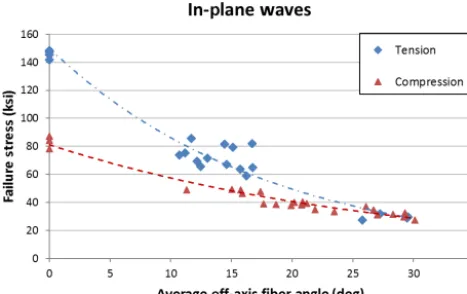
consid-Figure 1. Individual and trending failure stress for each average off-axis fiber angle tested.
ered, the approach may not even be conservative. With a sta-tistical treatment, probabilistic data outside of the database can be accommodated. While the probability of failure for such data may be low, it still exists, as seen by premature failures associated with manufacturing defects. Some simi-lar prior work on wind turbine blade probabilistic analysis has been performed by Bacharoudis and Philippidis (2013). However, defects were not included. With a probabilistic ap-proach, overly conservative SF may be decreased, resulting in more reliable blades, at a lower cost (more optimal de-signs). This would be a new paradigm in the development of certification of wind turbine blades.
This approach has the additional advantage that the re-liability can be quantified, as opposed to simply assuming the safety factor will accommodate all unknowns. While it is difficult to make a one-to-one comparison between this standard analysis technique and the proposed probabilistic approach, important comparisons illustrate the advantage of this method of analysis. As intended by the BRC, probabilis-tic models were developed and analyzed to help ensure ade-quate wind blade design life.
2 Methods and model setup
2.1 Background theory
Currently, the standard wind blade design and certification process generically define only one reliability target: a 20-year lifetime based on deterministic estimations of fatigue-life. However, variations in the structural behavior of com-posites cannot adequately be characterized by traditional de-terministic methods that utilize safety factors to account for uncertain structural responses. Moreover, lightweight com-posite materials are known to be sensitive to fatigue, defects, and damage. Therefore, a methodology focused on reliabil-ity targets, which incorporates probabilistic modeling, is es-sential to accurately determine the structural reliability of a composite structure. Typically, these methods are used with
limit state equations in the design process to describe the reli-ability or probreli-ability of failure in a wide variety of a systems (Rackwitz and Flessler, 1978; Ditlevsen and Madsen, 1996; Mahadevan and Haldar, 2000; Kim et al., 2012) such as off-shore structures (Kolios and Brennan, 2009). Since a wind turbine blade is a complicated composite structure where uncertainty exists at many levels, each uncertainty variable (e.g., E, G, ν, flaw magnitude, and location) can be pre-scribed a distribution that describes the frequency of occur-rence for values of that parameter. These distributions may then be used in the limit state equation to address the total uncertainty or probably of failure in the system. Reliability targets can then be developed to better address the design of a wind blade in the context of acceptable numerical out-puts. While these procedures generally derive from civil or aerospace engineering, wind turbine blades are generally not considered to be a risk to human lives. Therefore, reliability targets such as probability of failure and mean time between repairs and failures may have acceptably higher values and consider economic attributes such as primary manufacturing costs, uptime, cost of downtime and cost of repair. In doing so, a manufacturer may set acceptable levels which reduces the overall cost of the bade construction in light of the cost to repair or replace and design for failure allowable failure rates which have an overall impact of reducing the cost of energy.
2.2 Model overview
Figure 2.Conceptual flow diagram of probability reliability proto-col (PReP) framework.
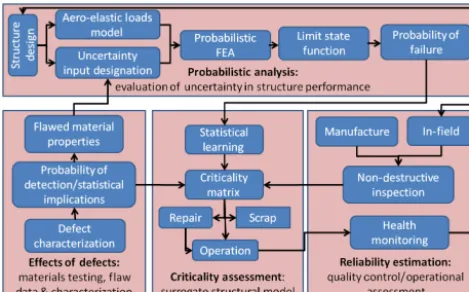
As noted above, the overall effort can be divided into two major directives: (1) acquisition of relevant defect statistics and defect-laden lamina response, (2) development of a abilistic model to assess the global structural response, prob-ability of failure, and estimation of time to failure for wind blades with flaws. Both directives are addressed within the context of the framework proposed called the probabilis-tic reliability protocol (PReP). A conceptual flow diagram showing the interconnectedness of each element of PReP is shown in Fig. 2. The PReP algorithm combines defect char-acterization and probabilistic structural reliability analysis with field and manufacturing data in an iterative feedback loop. A comprehensive reliability program aimed at assess-ing as-built structures can be divided into four interrelated components:
a. effects of defects: this involves the identification, char-acterization and analysis of defects. Develops character-istic parameters, material properties, and damage mod-els.
b. probabilistic analysis: this involves a stochastic ap-proach that considers multi-scale mechanical property variability, damage/defect detection, residual strength analysis, global, and macro-structural response.
c. criticality assessment (CA): this has been developed as a surrogate model for the stochastic analysis. It is a time-efficient metric for use by operators, manufactures and repair technicians to evaluate the risk of operating a structure with known flaws and/or damage.
d. reliability estimation and evaluation: this is the use of the CA to assess structures on the manufactures floor and in the field. Results from inspections as to the ac-curacy of the models and the implications to blade reli-ability are then fed back into the design and evaluation procedures.
Each one of the components are complicated and require independent steps which coalesce into the larger framework. However, they may also be utilized independently. The ef-fects of deef-fects component was the target topic of the com-panion paper (Nelson et al., 2017). This paper will focus on describing the elements of the probabilistic analysis compo-nent as an independent formulation.
The general approach, which incorporates a finite element simulation into a probabilistic reliability evaluation, adheres to the following steps:
1. build a parametrically defined blade model
2. define random variables (RV) and their distributions
3. define outputs variables of interest
4. define the load scheme
5. perform simulations
6. extract relevant probabilistic output response data
7. input data into reliability analysis.
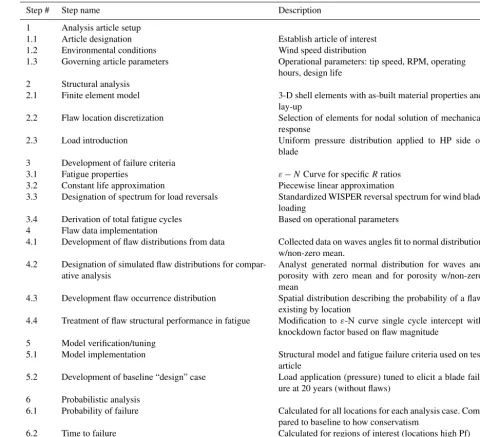
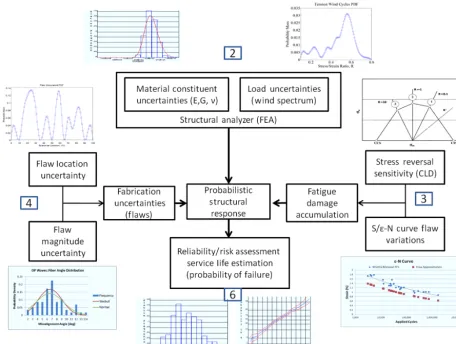
This methodology may be utilized for any application. How-ever, the specifics may vary according to the structure and objectives of the analysis. Table 1 lists the steps necessary to perform the analysis outlined in PReP for a wind blade ap-plication. In this table, a title for each step and task are given, as well as a short description of the task. Figure 3 illustrates the flow of information and interconnections of the various analysis components. Several of the steps identified in the previous table are notated by the corresponding step number on the figure (Riddle et al., 2013).
2.3 Definition of a performance function
The overall structural system is a function of a combined cumulative distribution function (CDF),F. For this case, a multivariate probability density function (PDF) is formed as generalized by Eq. (1):
F(x1, . . ., xn)≡P r(X1≤x1, . . .Xn≤xn). (1)
The PDF describes how the overall system reacts to the com-bination of relevant variables. The system reaction to any one variable can be found by taking the partial derivative of the joint CDF with respect to each of the variables as shown in Eq. (2):
f(x)= ∂ nF
∂x1. . .∂xn
x
. (2)
Table 1.Structural reliability analysis hierarchy.
Step # Step name Description
1 Analysis article setup
1.1 Article designation Establish article of interest 1.2 Environmental conditions Wind speed distribution
1.3 Governing article parameters Operational parameters: tip speed, RPM, operating hours, design life
2 Structural analysis
2.1 Finite element model 3-D shell elements with as-built material properties and lay-up
2.2 Flaw location discretization Selection of elements for nodal solution of mechanical response
2.3 Load introduction Uniform pressure distribution applied to HP side of blade
3 Development of failure criteria
3.1 Fatigue properties ε−NCurve for specificRratios 3.2 Constant life approximation Piecewise linear approximation
3.3 Designation of spectrum for load reversals Standardized WISPER reversal spectrum for wind blade loading
3.4 Derivation of total fatigue cycles Based on operational parameters 4 Flaw data implementation
4.1 Development of flaw distributions from data Collected data on waves angles fit to normal distribution w/non-zero mean.
4.2 Designation of simulated flaw distributions for compar-ative analysis
Analyst generated normal distribution for waves and porosity with zero mean and for porosity w/non-zero mean
4.3 Development flaw occurrence distribution Spatial distribution describing the probability of a flaw existing by location
4.4 Treatment of flaw structural performance in fatigue Modification toε-N curve single cycle intercept with knockdown factor based on flaw magnitude
5 Model verification/tuning
5.1 Model implementation Structural model and fatigue failure criteria used on test article
5.2 Development of baseline “design” case Load application (pressure) tuned to elicit a blade fail-ure at 20 years (without flaws)
6 Probabilistic analysis
6.1 Probability of failure Calculated for all locations for each analysis case. Com-pared to baseline to how conservatism
6.2 Time to failure Calculated for regions of interest (locations high Pf)
analysis has worked well for the aviation industry where an aircraft can be pulled into a hanger and inspected relatively easily. A wind turbine blade on the other hand will remain at 100 m where inspection procedures (and results) are limited. Therefore, the typical design approach is based on a safe life criterion. While an extreme event plays a role in the sudden onset of damage, failure modes are typically considered to be fatigue driven.
Wind is variable and thus the resulting bending moment and shear of a blade is variable. Application of an infinitely variable loading scenario to design and test is unreasonable. Therefore, rain-flow counting is typically used to convert a spectrum of wind speeds (realized structurally as moments) into a set of cycles. The fatigue-life can then be used in con-junction with the Palmgren-Miner rule for linear damage
ac-cumulation (Dowling, 2012):
D=
k
X
i=1 n(Si) N(Si)
, (3)
whereDis the cumulative damage,nis the number of load cycles at the applied stressSi, andN is the number of
cy-cles to failure atSi. Fatigue failure is typically defined as
occurring whenDexceeds a value of 1. A commonly used model for the fatigue-life of composites is the power law as described in Eq. (4) and modified equation for flaw fatigue-life is presented in Eq. (5) (Samborsky, 2012; Nijssen, 2011):
Figure 3.FEA and risk analysis overview with steps 2, 3, 4, and 6 corresponding to Table 1 identified.
S=KANb, (5)
whereSis the maximum applied stress (or strain),N is the number of fatigue cycles,Ais the power lower fit coefficient (often referred to as the single cycle intercept), b is the fit parameter for the power law slope, and K is the newly ap-pointed flaw knockdown factor.
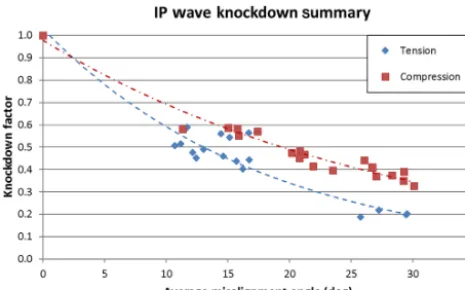
Fatigue data of composites containing flaws found in wind turbine blades are not readily available. However, previous studies on damaged composites have shown that the fatigue-life slope remains largely unchanged with damage (Lin and Styuart, 2007). Therefore, an idealized approach has been taken to adjust existing material dataS−N(orε−N) curves by a shift in the static failure values (knockdown factor) ap-plied to the single cycle interceptAin Eq. (5). Flaw knock-down factors, derived from empirical testing (Nelson et al., 2017), were utilized for this analysis is a scalar quantity used to reduce a material property as a function of the defect char-acteristic parameter. Presented in Fig. 4 is an example of the correlation between knockdown factor and composite me-chanical response. An illustration of Eq. (5) for a flaw that
resulted in a 25 % reduced static strain to failure is shown in Fig. 5.
The natural extension to this discussion is then to trans-late a design life of years into cycles. In doing so, one can construct the compact limit state function shown in Eq. (6):
g(X)=1−D(X)=1− k
X
i=1 1n(εi)
N(εi)
, (6)
wherein the resulting strain (εi) is a function of the
Figure 4.Empirically derived knockdown factor as related to fiber misalignment angle.
2.4 Construction of simulation
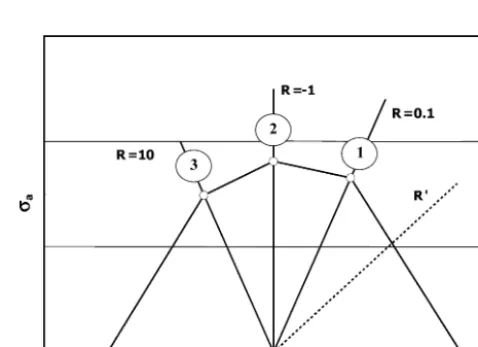
Previous work has shown that composites are sensitive to the variations in loading rehearsals (cyclic loading) and thefore, accurate modeling of fatigue damage accumulation re-quires usage of fatigue-life estimations for specificRratios. Constant life diagrams (CLDs) are used for this purpose, such as the example shown in Fig. 6 (Mandell et al., 2010). The amount of data necessary to generate a CLD is often prohibited by cost and time constraints. Therefore, several predictive algorithms have been developed in lieu of copi-ous amounts of testing. Fatigue data for the material sys-tems used in the analysis presented were only available for R=10,R=0.1: ultimate tension strain (UTS) and ultimate compression strain (UCS). The piecewise linear methodol-ogy (Fig. 7) has shown good accuracy in predicting fatigue-life with limited amount of test data. Therefore, it was used (Philippidis and Vassilopoulos, 2004). This method requires a limited amount of test data and performs linear interpola-tion between the known data points.
The wind loading spectrum utilized for this analysis was derived from the well-known WISPER load reversal prob-ability distributions (Tenhave, 1992). Two probprob-ability mass functions (PMFs) were developed from the WISPER data to assess the high and low-pressure sides of the blades indepen-dently. The high-pressure side was assumed to always be in tension; thus, the PMFR-values varied from 0.1 to 0.8. Con-versely, the low-pressure side was assumed to always be in compression; thus,Rvalues varied from 1.25 to 10. Based on the WISPER data and these modifications, probability val-ues were generated for 100 discrete load reversal bins. The probability mass distribution and complementary cumulative distribution for the high-pressure side are displayed in Fig. 8. Typical computational fluid dynamics and aeroelastic simu-lations are used to transform these wind speeds into corre-sponding pressure distributions on the blade surface for use in the structural analysis.
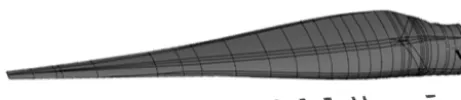
Wind turbine blades are complex composite structures and one cannot properly assess the integrity of any portion with-out considering the global response and load share tenden-cies. It is well known that 2-D shell elements used in 3-D finite element models are required to capture information such as three-dimension distortions, stress concentrations, and buckling strengths. Other methods such as beam prop-erty extraction and one-dimensional classical beam section analysis are widely used for preliminary calculations (Veers et al., 1993). These techniques have been used by other in-vestigators for probabilistic analysis of wind turbines (Veers et al., 2003; Lekou and Philippidis, 2009). A full-scale blade model (Fig. 9) was used in this analysis. Prior work (Resor and Paquette, 2012) validated the model (or mesh) generat-ing engine NuMAD by for use in ANSYS. Moreover, on-scale testing was performed on a wind blade as part of this work, wherein strain field data were collected unload which verified the FEA model output. Most of the uncertainty pa-rameter (E,G,ν) variations have been implemented as sys-tem wide global properties. The occurrence of flaws has been captured by analyzing and modifying the material properties for a local region of the mesh.
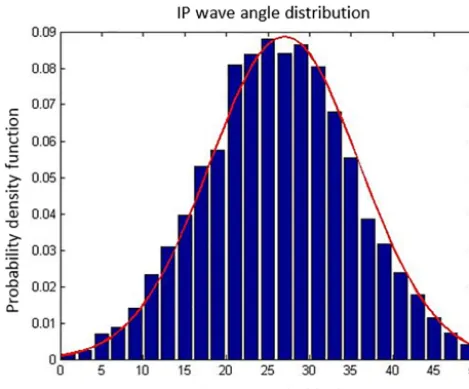
Flaw locations and magnitude parameters were treated as stochastic variables. First, the probability of a flaw occur-ring in a specific location was described by a novel spline fit (Fig. 10), designating a probability mass function as a function of blade location. One novelty of this approach is the capacity for updating procedures that do not rely on the use of traditional, complicated inference techniques. A user performing inspections on the composite structure, such as a quality control technician, may record the frequency and lo-cation of observed flaws. These points can then be treated as delta functions in the subsequent piecewise polynomial fit-ting procedure. Frequencies can easily be updated as more events are recorded, enabling the regeneration of distribu-tions used in a statistical analysis. These data are hard to come by; therefore, a fictitious set of frequencies was se-lected. The chosen frequencies and corresponding PMF are displayed Fig. 11 and were used in the stochastic analysis to ascertain the probability of a flaw occurring in a specific location. When the sampling algorithm identifies the exis-tence of a flaw, a second distribution describes the probabil-ity of the flaw’s characteristic parameter magnitude. Figure 12 displays the treatment of an example flaw magnitude as an uncertainty parameter used in this analysis. As noted be-low, it was found that off-axis fiber angles of waves collected in a survey of wind turbine blades follow typical distributions such as normal and Weibull.
3 Case studies
Figure 5.Representative shiftedS−Ncurve associated with knockdown factor.
Table 2.Stochastic variables used in probabilistic analysis.
Variable Distribution Mean SD Model characteristic property
Wind speed Weibull;a=1.89,b=5.29 NA NA Pressure distribution/moment magnitude Wind load reversal ratio WISPER NA NA Stress/strain,R
Case 1 – flaw location Spline NA NA % of length from blade root Case 1 – IP flaw magnitude Normal 27.0 18.0 In-plane off axis degree Case 1 – OP flaw magnitude Normal 6.5 2.8 Out-of-plane off axis degree Case 2 – IP flaw magnitude Half-Gaussian 0.0 18.0 In-plane off axis degree Case 2 – OP flaw magnitude Half-Gaussian 0.0 2.8 Out-of-plane off axis degree Youngs modulus [E11] Lognormal 4.14E+10 2.10E+09 Spar cap material property Youngs modulus [E22] Lognormal 1.63E+10 2.00E+09 Spar cap material property
Figure 6.Representative GFRP constant life diagram (Mandell et
Figure 8.Wind cycle distributions for high pressure side from WISPER data (Tenhave, 1992).
Figure 9.Finite element model of full blade.
Figure 10.Probability of flaw mass, or occurrence, spatially dis-tributed along span-wise length.
was generated to match the actual blade laminate and plan-form schedule. A benchmark standard International Elec-trotechnical Commission (IEC) approach to fatigue evalua-tion was used to develop the baseline analysis, Case 0, to which two probabilistic analyses using the stochastic vari-ables presented in Table 2 were then compared. For all anal-yses the blade spar was discretized into 100 locations. The maximum nodal strain response in the spar laminate 1 direc-tion (span wise – material tension and/or compression) was output from the FEA model for use in the post-processing script. A combined fatigue and probabilistic analysis was then performed on each location using Monte Carlo
simula-Figure 11.Probability mass of flaws at each blade location.
tion. The methodology for each case is described below with discussion of the results following.
3.1 Case 0: baseline (design)
Figure 12.Distribution of sampled magnitudes of IP fiber misalign-ment angles used in Case 1.
3.2 Case 1: probability of occurrence
This analysis case utilized two probability distributions to de-scribe defect uncertainty. The first distribution used in the analysis was probability of occurrence. This distribution de-scribes the probability mass of a flaw existing in a blade us-ing a spatial distribution. For this analysis, a 1-D cubic spline distribution was used to allow for flaws down the length of the spar cap. The spline formulation allows for high fidelity, continuous interpolation of probabilities between specific lo-cations of known flaw frequencies. When the simulation pre-dicted a flaw’s existence, then a second distribution was used to describe the magnitude of the flaw based on the actual field data collected from utility-scale wind blades. An example of the distribution and sample set used in the analysis for IP waves is displayed in Fig. 12.
3.3 Case 2: half-Gaussian fiber wave magnitude This analysis case utilizes only one probability distribution to describe defect uncertainty. The analysis assumes that there is a 100 % chance of a flaw occurring at every location in the blade (Fig. 13). The flaw occurrence magnitude is de-scribed by a one-sided probability distribution (Fig. 14). For this case, a flaw magnitude of zero would indicate that there is no flaw at that specific location.
4 Results and implications
The assumption of a low probability of failure during a typ-ical 20-year blade lifetime was used for this analysis since the probability of failure used for the IEC safety factors was not known. To validate the model, this assumption was used for the baseline Case 0 scenario, whereas Case 1 and 2
as-Figure 13.Probability mass of 100 % that a flaw is located at each blade location used in Case 2.
Figure 14. Half-Gaussian distribution of sample set for IP fiber misalignment magnitudes used in Case 2.
sumes failure within the blade lifetime due to manufacturing flaws not inherent in the certification process. For each case, the likelihood of reaching failure for a given safety factor is presented as failure probabilities which allows for easy com-parison. In short, the absolute probability of failure could be tracked through the 20-year life cycle, if the design failure probability is known. As such, both the prescribed IEC and reduced material safety factors were used in the evaluation of both Case 1 and 2 allowing for direct comparison of the level of conservatism. Using Monte Carlo simulations and experimental strain responses, analysis samples and failure probabilities were generated.
5 Case 1: spatially varying distribution of defects
Figure 15.Probability of failure by location(a)and as a function of time for location 22(b).
Figure 16. Probability of failure by location with reduced IEC safety factor.
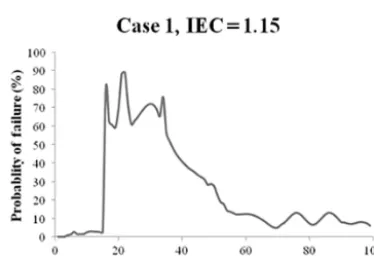
determine the critical point along the blade length by relating Pfto time in service, using a linear fatigue damage accumu-lation model at each location. Based on the number of cycles at the 22 % mark, it is indicated that failure will occur ap-proximately 7 years into the life cycle, as seen in Fig. 15b,. It is important to note that is a combination of the worst sce-narios with the inclusion of a typical material SF. Therefore, the probability of failure is artificially high as the load case in this analysis was chosen intentionally to yield a fatigue failure of the blade (using a safety factor of 1.3) in 20 years. Using this as the starting point, a stochastic analysis incorpo-rating the effects of defects is performed in addition to using the safety factor and the results compared.
While this case indicates a significant chance of failure, the blade will likely be overdesigned if a SF is used in con-junction with a probabilistic simulation of defects to ensure a reasonablePf. To quantify this implication, the same model was run with the safety factor reduced to 1.15 from 1.3. As seen in Fig. 16, while the locations of the critical points re-main the same, none of these points have a 100 % Pf. As such, these results imply that additional structural reinforce-ments are not necessary, meaning weight and cost can be re-duced. This approach has the added benefit of introducing some level of quantifiable reliability, as opposed to the “as-sumed to be small probability of failure” of the SF approach.
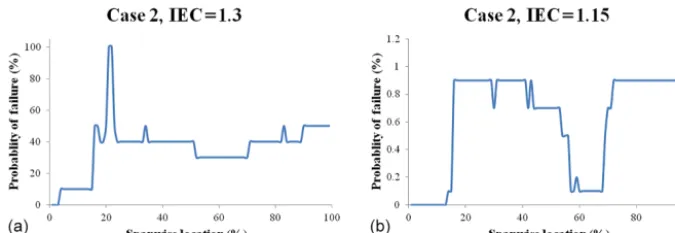
5.1 Case 2: half-Gaussian fiber wave magnitude results As noted, the inputs were then modified using a half-Gaussian distribution (Fig. 14) with a 100 % probability of a flaw at every location. The case was run for both safety factors and the results are shown in Fig. 17. While it is evi-dent in both cases that thePfapproaches 100 % failure prob-ability, the reduction of the safety factor results in a reduced estimation that failure will occur which is consistent with the results of Case 1.
5.2 Implications of probabilistic approach to reliability As with any analytical method, detailed and accurate inputs are necessary to use this probabilistic analysis to address un-certainty of blades with manufacturing defects. When the two cases are compared, it is evident that distributions of flaw magnitude affect the results significantly, as seen when Figs. 15, 16, and 17 are compared. The differences are ampli-fied further when the strength reduction is considered where a dramatic shift in laminate strength is noted, as seen in all four portions of Fig. 18. The variation between the two cases is significant and the impacts on the laminate are clear, when flaws are assumed to be occur at all locations as in Case 2 (Fig. 18c, d). While the likelihood of instances with strength reduction decreases in this case, the reduction of strength is likely to be greater, which aligns with previous testing of wavy laminates that indicated an exponential decrease in laminate strength (Riddle et al., 2012). While this trend is meaningful, it is imperative to recall that these distributions were generated during this investigation and may not be in-dicative of the industry at large or of any one particular man-ufacturer’s process or products. Therefore, it is also impera-tive that test data representaimpera-tive of the materials used in the design system be established.
5.3 Model validation via experiments
fiber-Figure 17.Probability of failure by location for standard IEC safety factor(a)and reduced IEC safety factor(b).
Figure 18.Strength reduction sample sets as a function of flaw magnitude distributions for the following: Case 1 in compression(a), Case 1 in tension(b), Case 2 in compression(c), and Case 2 in tension(d).
glass spar and one with a carbon fiber spar, were manufac-tured according on the Sandia Blade System Design Study (BSDS). The blade was originally designed as mechanism to study large-scale commercial blade construction at a smaller and more manageable subscale size (Berry, 2008). Strain data during static loading were collected from all defects through the use of a digital image correlation system. The National Wind Technology Center facilities were used to actuate the blade in fatigue loading at three locations, allowing for mul-tiple flaws to be assessed individually and with geometric
Figure 19.Representation of subscale blade test layout and testing locations.
Figure 20.Actual subscale blade test(a)with final failure at flaw location(b).
6 Conclusions and impact on wind turbine blade designs and certification
A hierarchical treatment for the probabilistic reliability of composite wind turbine blades has been developed and pre-sented. The emphasis here is on composite materials variabil-ity and the effect of defects. However, the framework is ap-plicable to any variability and is meant to reduce or eliminate safety factors if one knows probability distributions. This work postulates that one should quantify and assess manufac-turing defects by their magnitude and criticality for durability and damage tolerance. The same can be said of other impor-tant probabilistic distributions affecting reliability, where SF is used in lieu of probabilistic calculations.
Two cases were developed to show the utility of the tech-nique. The first case included a probability of occurrence plus a probability for amplitude. The probability of occurrence is a hypothetical distribution based on one manufacturer’s anec-dotal manufacturing data. (It is noted that each blade design will have a unique probability of flaw distribution based on the design details and manufacturing technique.) The defect size probability was from the work developed herein. This case indicates that the probability of failure is 1.0 if both a safety factor and probabilistic flaw data are used to predict re-liability. However, it provides the basis for reducing a scalar safety factor for determining blade reliability and possibly, certification.
The second case was one where flaws are assumed to be everywhere in a structure, but with a probability distribution associated with the size of the defect. This probability distri-bution for size was based on studies of dissected blades from a variety of manufacturers. With this analysis, it was shown
that the scalar material safety factor can also be reduced in this case with acceptable reliability. Case 2 may also be ap-plicable to a damage tolerant design philosophy where peri-odic inspections are conducted and flaws above a certain size can be detected.
The two approaches detailed in this analysis, known defect distributions and blades assumed to have defects, but without any spatial statistical information (e.g., existing fleet) the im-pact of probabilistic analysis with respect to reducing conser-vative safety factors. Understanding these is critical in terms of reliability and is important if one wants to justify reduc-ing SF. Both magnitude and distribution are important for a comprehensive probabilistic reliability analysis.
For demonstration of the framework for treating defects as uncertainty variables for blade analysis, 9 m blades were manufactured and tested with known defects at known loca-tions. The ultimate failure occurred as predicted at a known defect location and the reliability predictions were conser-vative. That is, the structure went to higher cycles than pre-dicted in the reliability framework.
Finally, this work has implications for the certification of wind turbine blades. It provides a rational basis for reducing assumed scalar safety factors with quantifiable and accept-ability reliaccept-ability. This has the net result of mitigating con-servative designs and ultimately the cost of energy from a given wind turbine.
Data availability. Data may be found as reported to Sandia National Laboratories in Nelson et al. (2012a, b). In addition, data have also been added into the Blade Materials & Structures Testing Database compiled by the Composite Technologies Research Group at Montana State University; this database is updated and hosted by Sandia National, http://energy.sandia.gov/ energy/renewable-energy/water-power/technology-development/ advanced-materials/mhk-materials-database/.
Competing interests. The authors declare that they have no con-flict of interest.
Acknowledgements. The authors wish to acknowledge the help from Sandia contract monitors Joshua Paquette and Daniel Laird. The authors also wish to acknowledge technical help from Tom Ashwill and Mark Rumsey. In addition, the work and research presented herein could not have been performed without the assistance of the entire Montana State University Composites Group.
Edited by: Athanasios Kolios Reviewed by: two anonymous referees
References
Bacharoudis, K. C. and Philippidis, T. P.: A probabilistic ap-proach for strength and stability evaluation of wind turbine rotor blades in ultimate loading, Struct. Saf., 40, 31–38, https://doi.org/10.1016/j.strusafe.2012.09.006, 2013.
Berry, D.: Blade System Design Studies Phase II: Final Project Re-port, Report No. SAND2008-4648, Sandia National Laborato-ries, Albuquerque, NM, 2008.
Desmond, M., Hughes, S., and Paquette, J.: Structural Testing of the Blade Reliability Collaborative Effect of Defect Wind Turbine Blades Report No. NREL/TP-5000-63512, National Renewable Energy Laboratory, Boulder, CO, 2015
Ditlevsen, O. and Madsen, H. O.: Structural reliability methods, 178, New York, Wiley, https://doi.org/10.1002/9780470611708, 1996.
Dowling, N. E.: Mechanical behavior of materials, Pearson, https://doi.org/10.1080/10426910008913020, 2012.
FAA AC 25.571-1D: Damage Tolerance and Fatigue Evaluation of Structure, Federal Aviation Administration, Washington, DC, 13 January, 2011.
Hu, W., Choi, K. K., and Cho, H.: Reliability-based design opti-mization of wind turbine blades for fatigue life under dynamic wind load uncertainty, Struct. Multidiscip. O., 54, 953–970, 2016.
Kim, W. B., Hong, J. H., Kim, K. W., Choi, J., Kim, J. K., and Sung, H. G.: Reliability Analysis of Solid Rocket Motor under Bayesian Framework, 53rd AIAA/ASME/ASCE/AHS/ASC Structures, Structural Dynamics and Materials Conference 20th AIAA/ASME/AHS Adaptive Structures Conference, https://doi.org/10.2514/6.2012-1764, 2012.
Kolios, A. and Brennan, F.: RELIABILITY BASED DESIGN OF NOVEL OFFSHORE STRUCTURES, 3rd International Confer-ence on Integrity, Chengdu, China, 2009.
Lekou, D. J. and Philippidis, T. P.: PRE-and POST-THIN: a tool for the probabilistic design and analysis of composite rotor blade strength, Wind Energ., 12.7, 676–691, 2009.
Lin, K. Y. and Styuart, A. V.: Probabilistic approach to damage tol-erance design of aircraft composite structures, J. Aircraft, 44, 1309–1317, 2007.
Mahadevan, S. and Haldar, A.: Probability, Reliability, and Statistical Methods in Engineering Design, Wiley, https://doi.org/10.1002/bate.200002930, 2000.
Mandell, J., Samborsky, D., Pancasatya, A., and Sears, A.: Anal-ysis of SNL/MSU/DOE fatigue database trends for wind tur-bine blade materials, SAND2010-7052, Sandia National Labo-ratories, Albuquerque, NM, 2010.
Mustafa, G., Suleman, A., and Crawford, C.: Probabilistic mi-cromechanical analysis of composite material stiffness proper-ties for a wind turbine blade, Compos. Struct., 131, 905–916, https://doi.org/10.1016/j.compstruct.2015.06.070, 2015. Nelson, J., Riddle, T., and Cairns, D.: Effects of defects in
com-posite wind turbine blades: Round 1, available at: http://prod. sandia.gov/techlib/access-control.cgi/2012/128110.pdf (last ac-cess: 2 December 2017), 2012a.
Nelson, J., Riddle, T., and Cairns, D.: Effects of defects in com-posite wind turbine blades: Round 2, available at: http://prod. sandia.gov/techlib/access-control.cgi/2012/128111.pdf (last ac-cess: 2 December 2017), 2012b.
Nelson, J. W., Riddle, T. W., and Cairns, D. S.: Effects of de-fects in composite wind turbine blades – Part 1: Characteri-zation and mechanical testing, Wind Energ. Sci., 2, 641–652, https://doi.org/10.5194/wes-2-641-2017, 2017.
Nijssen, R. P. L: Fatigue life prediction and strength degradation of wind turbine rotor blade composites, Diss., Knowledge Centre WMC and DPCS group of Aerospace Engineering, 2011. Philippidis, T. P. and Vassilopoulos, A. P.: Life prediction
method-ology for GFRP laminates under spectrum loading, Compos. Part A-Appl. S, 35, 657–666, 2004.
Rackwitz, R. and Flessler, B.: Structural reliability under combined random load sequences, Comput. Struct., 9, 489–494, 1978. Resor, B. and Paquette, J.: A NuMAD Model of the Sandia TX-100
Blade, Report No. SAND2012-9274, Sandia National Laborato-ries, Albuquerque, NM, 2012.
Riddle, T. W., Cairns, D. S., and Nelson, J. W.: Char-acterization of manufacturing defects common to com-posite wind turbine blades: Flaw characterization, 52nd AIAA/ASME/ASCE/AHS/ASC Structures, Structural Dynam-ics and Materials Conference 19th AIAA/ASME/AHS Adaptive Structures Conference, 1758, https://doi.org/10.2514/6.2011-1758, 2011.
Com-posite Structures. 53rd AIAA/ASME/ASCE/AHS/ASC Struc-tures, Structural Dynamics and Materials Conference 20th AIAA/ASME/AHS Adaptive Structures Conference, 1420, https://doi.org/10.2514/6.2012-1420, 2012.
Riddle, T. W., Cairns, D. S., and Nelson, J. W.: Effects of Defects Part A: Stochastic Finite Element Modeling of Wind Turbine Blades with Manufacturing Defects for Relia-bility Estimation, 54th AIAA/ASME/ASCE/AHS/ASC Struc-tures, Structural Dynamics, and Materials Conference, 1627, https://doi.org/10.2514/6.2013-1627, 2013.
Samborsky, D., Mandell, J., and Miller, D.: The SNL/MSU/DOE fatigue of composite materials database: recent trends, 53rd AIAA/ASME/ASCE/AHS/ASC Structures, Structural Dynam-ics and Materials Conference 20th AIAA/ASME/AHS Adaptive Structures Conference, 1573, https://doi.org/10.2514/6.2012-1573, 2012.
Tenhave, A. A.: WISPER and WISPERX: Final definition of two standardised fatigue loading sequences for wind turbine blades, NASA STI/Recon Technical Report 94, 30872, 1992.
International Electrotechnical Commission (IEC 61400-1): Wind turbines part 1: Design requirements, 3rd Edn., International Electrotechnical Commission, Geneva, Switzerland, 2005. Veers, P. S., Lange, C. H., and Winterstein, S. R.: FAROW: A Tool
for Fatique and Reliability of Wind Turbines, Sandia National Laboratories, Albuquerque, NM, 1993.