Journal of Innovation in Health Informatics Vol 22, No 3 (2015)
INNOVATION IN
HEALTH INFORMATICS
Short report
Cite this article: Wrenn G, Syed I, Kasiah F. Using a self-service kiosk to identify behavioural health needs in a primary care clinic serving an urban, underserved population. J Innov Health Inform. 2015;22(3):323-328.
http://dx.doi.org/10.14236/jhi.v22i3.134
Copyright © 2015 The Author(s). Published by BCS, The Chartered Institute for IT under Creative Commons license http://creativecommons.org/ licenses/by/4.0/
Author address for correspondence: Glenda Wrenn
Morehouse School of Medicine 720 Westview Dr SW Suite 245-D Atlanta, Ga 30310, USA E-mail: [email protected]
Accepted July 2015
Using a self-service kiosk to identify
behavioural health needs in a primary
care clinic serving an urban, underserved
population
Glenda Wrenn
Morehouse School of Medicine, Atlanta, USA
Irshad Syed
Grady Health System, Atlanta, USA
Fatima Kasiah
Morehouse School of Medicine, Atlanta, USA
ABSTRACT
Background Integration of behavioural health into primary care clinics is an established model of care and important approach to eliminating mental health dis-parities, but demands on provider time is a barrier to mental health screening. The purpose of this study was to determine the feasibility of using a kiosk placed in a primary care clinic to screen for multiple mental health disorders.
Methods Quality improvement initiative with Plan-Do-Study-Act implementation and time series monitoring of utilisation outcomes.
Results A total of 281 screens were completed identifying positive screens for depression (30%) and bipolar disorder (17%). Post-traumatic stress disorder and concerning substance use were less common.
Conclusions Development of health information technology to facilitate behav-ioural health assessment in primary care is a promising approach to integrated care and provides additional benefits of population health monitoring.
Keywords: community psychiatry, integration, mental health, patient-centred
approach, primary care, technology on September 12, 2020 by guest. Protected by copyright.
BACKGROUND
It has been 15 years since the 16th Surgeon General’s landmark report on mental health, which conveyed a central message that mental health is fundamental to health and that mental disorders are real health conditions. Yet, patients and providers continue to struggle with stigma and systems of care that make addressing mental health a challenge and eliminating disparities an elusive aim. Routine screening for depression in primary care is recom-mended when staff-assisted supports are in place.1 Health care
professionals are also advised to ask adults about their drinking habits and provide counselling to those who drink at a risky or hazardous level.2 Comorbid mental health conditions are also
prevalent in primary care and concerning in settings with high rates of unmet mental health needs.
Assessment of mental health is challenging in part because providers have a limited amount of time with each patient to collect important clinical data and provide preventive medical services.3,4 Social history and behavioural health information
are among commonly missed preventive screens.5 This may
in part be due to the perceived extended time to assess these domains, and the fact that it may represent more sensitive data. Relying on existing staff to interview patients is time consum-ing, and research has shown that patients are more likely to disclose sensitive information to a computer.6 Freely available
standardised, validated self-assessments exist that can accu-rately detect depression (Patient Health Questionnaire, PHQ-2 & PHQ-9), substance abuse (Drug Abuse Screening Test, DAST-10, Alcohol Use Disorders Identification Test, AUDIT-10), risk for bipolar disorder (Mood Disorders Questionnaire, MDQ) and post-traumatic stress disorder (Posttraumatic Stress Disorder-Primary Care, PTSD-PC). Having self-service kiosks that patients can engage for ‘wellness assessment’ and screening for risky use of substances and highly prevalent mood disorders in primary care is both patient-centred and pro-motes efficiency in patient flow as patients spend valuable time waiting during the clinic visit. Patients’ wait time can be used to collect important clinical information that providers could use to aid their decision-making and prioritisation of issues.
Grady Health System is one of the nation’s largest public hospitals. The Asa G. Yancey, Sr. M.D. Health Center (Asa Yancey), was the first of six neighbourhood health centres with comprehensive primary care services in the greater Atlanta community.
Asa Yancey provides primary and preventive health care to adult and paediatric patients. Additional services on site include nutrition, pharmacy, radiology and laboratory, social services, and family planning. Physicians employed with Grady Health System provide medical care with nurse prac-titioners and midwives on site. The clinic is located approxi-mately five miles from the main campus, and in 2012, it had over 20,000 patient encounters, of which almost 15,000 were for adult patients. Consistent with the mission of the health system, the clinic provides primary care services to individu-als regardless of their ability to pay. Of the patient population, within the clinic, 45% is uninsured; Medicare covers 20%,
population is predominantly English speaking (99%), non-Hispanic (91%) and African-American (96%). Of the patients, 68% are women, and the mean age is 52 years. Most of the patients are unmarried (56%) or divorced (17%). The clinic is staffed by six adult providers who provide 4.6 full-time equiv-alent (FTE) staffing for adult primary care services. Providers were previously trained in the use of paper versions of these standardised, validated instruments and were also trained in the use of treatment algorithms to respond to assessment results. Providers also participated in SBIRT (screening, brief intervention, referral and treatment) training, which included exposure to motivational interviewing techniques.
A quality improvement project was designed to pilot the fea-sibility and acceptability of a self-service kiosk in a primary care waiting room, and later, in triage areas. Prior to this improve-ment project, only some behavioural health domains were assessed routinely. When these data were collected, paper forms were completed and then scanned into electronic health record (EHR), or written within the progress note. This prohib-ited tracking of progress or outcomes at the individual patient or system level. Although there were some clinician-administered surveys that could have been written into the health system’s EHR with significant cost investment, this would also require more provider/staff time, and the benefits were perceived as limited due to the length of assessment time within the context of patient visits. The current report describes the kiosk pilot implementation and presents results from screening efforts.
METHODS
The Institutional Review Board of Morehouse School of Medicine and the Office of Research Administration of Grady Health System approved this quality improvement project. The kiosk project involved development of an ‘EHR Ready’ application with customised software developed by project staff that would allow patients to complete behavioural health ‘wellness assessments’ while waiting for their appointments. The purpose of this software design was to facilitate interface and EHR integration if the health system decided to invest in patient portal software. The software was designed by a psychiatrist (GW) who developed the algorithm from stan-dardised assessments previously validated for use in primary care7–14 in collaboration with Slabb, Inc., a kiosk vendor. A
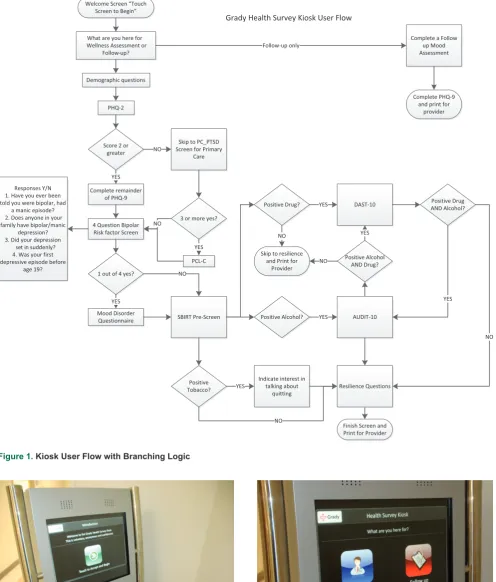
user flow with decision rules was created to enable algorithm administration on a kiosk platform (Figure 1).
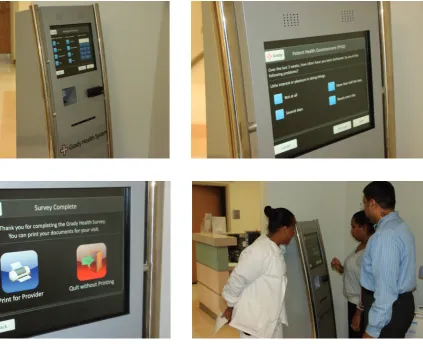
No protected health information was collected for the pilot, and patients were prompted by the kiosk to print out their results to give to their provider in order to be used for patient care on the day of self-assessment (Images 1-7). Anonymous data were stored on the kiosk and periodically downloaded for use in performance improvement. The primary care kiosk pilot employed a comprehensive behavioural health screen where patients completed an algorithm-driven screening and assess-ment for depression, substance abuse, bipolar disorder, and PTSD; and if being treated within primary care for depres-sion, they could complete symptom severity assessments at
on September 12, 2020 by guest. Protected by copyright.
http://informatics.bmj.com/
Journal of Innovation in Health Informatics Vol 22, No 3 (2015)
RESULTS
During the pilot period, 281 wellness assessments were com-pleted (Table 1). Depression was the most common condition identified (30%), with bipolar and hazardous drinking at high rates as well. As this was the first exposure to computerised repeating the assessment at multiple time points, patients were
instructed at check in to complete the survey only if they had not done so before. In addition, prior to full implementation, staff and patients were invited to use the kiosk and provide feedback on ease of use and to observe self-administration. Those data were excluded from the analysis.
Figure 1. Kiosk User Flow with Branching Logic
on September 12, 2020 by guest. Protected by copyright.
http://informatics.bmj.com/
Photos of the kiosk in use
Table 1. Wellness assessment positive screen results* (N = 281)
Condition N %
Depression 83 30
Bipolar 49 17
PTSD 3 1
Hazardous drinking
23
8Concerning drug use
3
1*Positive screen is defined as: Depression PHQ-9 >10; Bipolar MDQ >7; PTSD PCL-C > 44; Hazardous alcohol use AUDIT-10 > 8; Concerning drug use DAST10 > 3.
screening for both clinic patients and providers, we expected a lag in technology adoption, which is reflected in the low overall number of screens (N = 281).
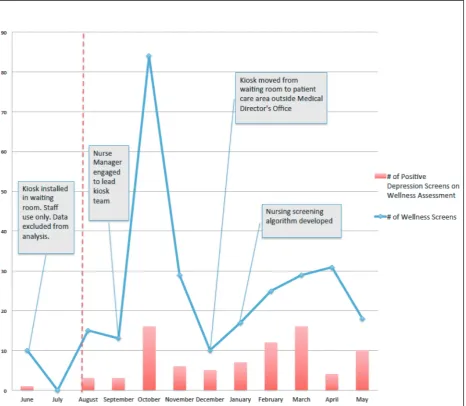
Plan-Do-Study-Act (PDSA) improvement methods were used to review monthly utilisation data and problem-solve strategies to engage patients. Screening and positive depres-sion results from the pilot period along with major PDSA inter-ventions are depicted in Figure 1. Representatives from front desk, nursing and provider staff were engaged as champions of the effort, and several challenges from patients
(unplug-were overcome. As shown in Figure 2, upward trends in kiosk use occurred following efforts to engage nursing leader-ship, but based on feedback from clinic meetings, physician champions primarily drove use by encouraging their patients to complete the screen prior to their next visit, or the same day if a concern was identified. In addition to initial depres-sion assessments, 94 follow-up depresdepres-sion screens were conducted and 25% were positive for depression. The follow-up assessment kiosk option was used for active manage-ment, and unique users could not be identified, limiting data
on September 12, 2020 by guest. Protected by copyright.
http://informatics.bmj.com/
Journal of Innovation in Health Informatics Vol 22, No 3 (2015)
to encourage patients’ active engagement in addressing behavioural health needs within primary care settings and convey a message that their providers value attention to behavioural health concerns.
CONCLUSIONS
These results are preliminary and generalisability to other populations with differing comfort levels with technology is limited. Future research will require improved patient and provider education about the purpose of the kiosks. Adaptation to more discreet devices (i.e. tablets) could increase patient use. Replication in other clinics is pos-sible at the cost of hardware and a software user license. Additional improvements are planned based on pilot results, including addition of an anxiety assessment and translation to Spanish.
DISCUSSION
This was a pilot project that emerged from provider input into practice improvement preferences in the process of implementing integrated care. Current implementation models rely on staff-administered screening, usually lim-ited to one or two behavioural health domains. This pilot study suggests that a patient-engaged screening method can detect more comprehensive behavioural health needs. Our PDSA findings stress the importance of implementa-tion planning and addiimplementa-tional strategies to encourage new technology adoption. In this case, more robust efforts to educate patients (signage and informational flyers) could have improved utilisation. Use of the kiosk did enable clinic-level assessment of behavioural health needs with rela-tively minimal cost of new technology investment. This is a model that other clinics within the health system can adopt
Figure 2. Kiosk utilisation and depression screening outcomes 2013–2014
on September 12, 2020 by guest. Protected by copyright.
http://informatics.bmj.com/
REFERENCES
1. Uspreventiveservicestaskforce.org. Recommendation Summary – US Preventive Services Task Force [Internet]. 2014 [cited 17 December 2014]. Available from: http://www.uspreventiveser-vicestaskforce.org/Page/Topic/recommendation-summary/ depression-in-adults-screening.
2. Uspreventiveservicestaskforce.org. Recommendation Summary – US Preventive Services Task Force [Internet]. 2014 [cited 17 December 2014]. Available from: http://www. uspreventiveservicestaskforce.org/Page/Topic/recommenda- tion-summary/alcohol-misuse-screening-and-behavioral-coun-seling-interventions-in-primary-care.
3. Mai Q, Holman CDAJ, Sanfilippo FM, Emery JD and Preen DB. Mental illness related disparities in diabetes prevalence, quality of care and outcomes: a population-based longitudinal study. BMC Medicine 2011;9:118. http://dx.doi.org/10.1186/1741-7015-9-118. PMid:22044777; PMCid:PMC3215928.
4. Yarnall KSH, Pollak KI, Østbye T, Krause KM and Michener JL. Primary care: is there enough time for prevention? American Journal of Public Health 2003;93(4):635–41. http://dx.doi.org/10.2105/AJPH.93.4.635. PMid:12660210; PMCid:PMC1447803.
5. Shires DA, Stange KC, Divine G, Ratliff S, Vashi R, Tai-Seale M, et al. Prioritization of evidence-based preventive health services during periodic health examinations. American Journal of Preventive Medicine 2012;42(2):164–73. http://dx.doi.org/10.1016/j. amepre.2011.10.008. PMid:22261213; PMCid:PMC3262983. 6. Rhodes KV, Drum M, Anliker E, Frankel RM, Howes DS and
Levinson W. Lowering the threshold for discussions of domestic violence: a randomized controlled trial of computer screening. Archives of Internal Medicine 2006;166(10):1107–14. http:// dx.doi.org/10.1001/archinte.166.10.1107. PMid:16717173. 7. Arroll B, Goodyear-Smith F, Crengle S, Gunn J, Kerse N,
Fishman T, et al. Validation of PHQ-2 and PHQ-9 to screen for major depression in the primary care population. The Annals of
Family Medicine 2010;8(4):348–53. http://dx.doi.org/10.1370/ afm.1139. PMid:20644190; PMCid:PMC2906530.
8. Hirschfeld R, Williams J, Spitzer R, Calabrese J, Flynn L, Keck P, et al. Development and validation of a screening instrument for bipolar spectrum disorder: the Mood Disorder Questionnaire. The American journal of psychiatry 2000;157(11):1873–75. http://dx.doi.org/10.1176/appi.ajp.157.11.1873.
9. Van Dam D, Ehring T, Vedel E and Emmelkamp P. Validation of the Primary Care Posttraumatic Stress Disorder screening ques-tionnaire (PC-PTSD) in civilian substance use disorder patients. Journal of Substance Abuse Treatment 2010;39(2):105–13. http://dx.doi.org/10.1016/j.jsat.2010.05.005. PMid:20598826. 10. Wilkins K, Lang A and Norman S. Synthesis of the psychometric
properties of the PTSD checklist (PCL) military, civilian, and specific versions. Depression and Anxiety 2011;28(7): 596–606. http://dx.doi.org/10.1002/da.20837. PMid:21681864; PMCid:PMC3128669.
11. DiClemente C, Crouch T, Norwood A, Delahanty J and Welsh C. Evaluating training of screening, brief intervention, and refer-ral to treatment (SBIRT) for substance use: reliability of the MD3 SBIRT Coding Scale. Psychology of Addictive Behaviors 2015;29(1);218–24. PMid:25402834.
12. Bohn M, Babor T and Kranzler H. the alcohol use disorders identification test (AUDIT): validation of a screening instrument for use in medical settings. Journal of Studies on Alcohol and Drugs 1995;56(4). http://dx.doi.org/10.15288/jsa.1995.56.423 13. Yudko E, Lozhkina O and Fouts A. A comprehensive review of
the psychometric properties of the drug abuse screening test. Journal of Substance Abuse Treatment 2007;32(2):189–98. http://dx.doi.org/10.1016/j.jsat.2006.08.0020. PMid:17306727. 14. Connor K and Davidson J. Development of a new resilience
scale: the Connor–Davidson Resilience Scale (CD-RISC). Depression and Anxiety 2003;18(2):76–82. http://dx.doi. org/10.1002/da.10113. PMid:12964174.
on September 12, 2020 by guest. Protected by copyright.
http://informatics.bmj.com/