http://mojem.um.edu.my 36
[1]
Institute of Education,
International Islamic University Malaysia
[2]
School of Business,
University Kuala Lumpur (UniKL), Malaysia
Corresponding Author:
International Islamic University Malaysia
Email:
ABSTRACT
Interactions in e-learning are very important in delivering updates, information and course contents. With the advancement of communications technology such as Learning Management System (LMS), social network sites (SNS) and mobile technology, communication is no longer a barrier for interacting with lecturers and peers. In Moore’s Transactional Distance Theory, interactions are categorized under student-student, student-lecturer and student-content. When these interactions are addressed, effective learning takes place. On the hand, Ghazali’s framework of four rungs of consciousness relates intrinsic motivation to qalb, ruh, aql and nafs. When these intrinsic elements are fulfilled, students are able to reach the highest learning accomplishment namely wisdom (Hikmah) and well-being. This present study seeks to explore the practice of interactions among e-learning students in the context of Moore’s distance theory that also conform to the Islamic teaching in an e-learning environment. For this qualitative research, two selected e-learning students (from the B.Ed. degree program) at an Islamic University in Malaysia were interviewed as participants. The results show that students perceive the rigorous importance of practicing interaction to enrich learning in the e-learning environment of a university. Learners, however, have difficulties interacting due to technology barriers and attitude. These difficulties affect their feeling of well-being.
Keyword: E-learning environment, Interaction, Islamic teaching, well-being, education, Malaysia
E-ISSN NO: 2289 – 4489
INTERACTION IN E-LEARNING ENVIRONMENT: DOES IT FULFILL WITH ISLAMIC TEACHING?
http://mojem.um.edu.my 37
INTRODUCTION
The present scenario of education no longer requires a full time attendance by teachers and students in the classroom. Teachers can be detached from the students with the use of Internet technology via video conferencing, Skype, Learning Management System (LMS) and social networks. The trend of blended mode learning involves learning both in traditional classroom and through the Internet. Learning via Internet relates to e-learning which allows for interactivity and accessible environments for students to learn at their own pace, whatever their neighborhood or income level (Powell, 2011). With the approach of both traditional and e-learning, teaching is expected to comply with the Islamic principle in learning with the presence of a teacher. Interaction in e-learning requires students to communicate with their teachers, peers and contents. In this interaction process, knowledge, experience and all types of learning activities are transferred to the learning communities. Wagner (1994) stated that “interactions are reciprocal events that require at least two objects and two actions”. He viewed that “interaction occurs when these objects and events mutually influence one another” (p. 8).
Teaching is meaningful as Islam necessitates teachers to accommodate the needs of intrinsic motivation driven by the four rungs of consciousness namely aql, ruh, qalb and nafs. When e-learning is introduced in a university, the most important factor to consider in the planning is how to address communication that allows learning to take place.
The set-up of e-learning topic of interaction should be prepared sufficiently to ensure suitable discussion. Hence, at the time of module- designing, time duration for each subject should be controlled reliably. For instance, if the time duration provided for each subject is too long it may not enhance learning experiences; rather it may be a reason for pressure, anxiety and exhaustion among the e-learning students. An increasing amount of research and evaluation is being reported on this type of online interactivity (Berge, 1999; Garrison, Anderson, & Archer, 2000). Hence, during the last twelve years numerous researches (Alfahad, 2008; Benigno, & Trentin, 2000; Yiong, Sam & KockWah, 2008; Collison, Elbaum, Haavind, & Tinker, 2000; Meyer, 2002; Shih, & Cifuentes, 2001; Su, Bonk, Magjuks, Liu, & Lee, 2005) have highlighted the concept of interactivity and interactions. Nonetheless, a few of them have focused on the practice of the three foremost types of interactions to enhance the e-learning environment. On the other hand, there is no article on interaction which has been researched regarding the fulfillment of Islamic teaching in the e-learning environment. Consequently, the main aim of this study is to explore the practice of Moore’s (1989) three categories of interactions which promote, foster and nourish an Islamic e-learning environment in an Islamic university.
http://mojem.um.edu.my 38
Trend of E-Learning Interactions
E-learning in Malaysia has increased in popularity because of the Malaysian Government vision to upgrade in-service teachers in obtaining a degree. Majid (2003) opines that e-learning in Malaysia is complementing the traditional face to face teaching. Being the first university in the country that offers e-learning as a full mode of learning, UNITAR (Universiti Tun Abdul Razak) experienced a number of challenges in terms of conceptual and operational interactive system in offering a wide range of courses (Alhabshi, 2002). In the early 1990s, Universiti Sains Malaysia (USM) started online learning by using video conferencing as a content based interaction to convey learning associated information to the distant learners.
With the new technology development of learning management system (LMS) and internet accessibility, Malaysia has further embarked on the blended mode of learning offering in-service teachers to further their studies in related field such as Islamic education, counseling and English. Questions are still unanswered on the effectiveness of the blended mode of learning. These include addressing the cognitive domain on the course content provided. Further, communication delivery system and lecturer’s strategies in teaching are yet to be evaluated.
Numerous definitions regarding “interaction” are found from reviewing some significant literature. For instance, Thurmond (2003) refers to interaction as:
“…the learner’s engagement with the course content, other learners, the instructor, and the technological medium used in the course. True interactions with other learners, the instructor, and the technology results in a reciprocal exchange of information. The exchange of information is intended to enhance knowledge development in the learning environment. Depending on the nature of the course content, the reciprocal exchange may be absent – such as in the case of paper printed content. Ultimately, the goal of interaction is to increase understanding of the course content or mastery of the defined goals” (p. 4).
http://mojem.um.edu.my 39
The e-learning interaction theory has been championed by Moore (1989) to promote three types of interactions namely student-student, student-content and student-teacher. This Transactional distance theory involves physical distance of learners from the teacher to be reduced when the three interactions are promoted through either the learning management system or using a blended strategies to include classroom face to face teaching.
Lecturers must ensure an optimum level of interactions and discussions with students to enhance the e-learning experience (Yiong, Sam, & Wah, 2008). Meyer (2002) encourages teachers to take responsibility for properly using technology as a communication tool in their classes. Eight segments of facilitators’ tasks to inspire them related online work and interaction are found from the research study of Collison, Elbaum, Haavind, and Tinker (2000). Those are as follows:
1. Leading introductory, community-building activities. 2. Providing virtual ‘hand holding’ to the digitally challenged.
3. Acknowledging the diversity of participants’ backgrounds and interests. 4. Infusing personality with tone, graphics and humor.
5. Maintaining a nurturing pace of responding. 6. Keeping up with a pace set.
7. Organizing posts and discussion threads.
8. Balancing private email and public discussion (p. 49).
CONCEPTUAL FRAMEWORK
Moore (1989) from his research offered three major types of interactions namely (1) learner-instructor, (2) learner-learner, and (3) learner-content interaction.
Figure 1. Three types of interactions adapted from Moore’s (1989) classification of interactions in distance education
Learner Content
Learner
http://mojem.um.edu.my 40 Learner-instructor interaction is “regarded as essential by many educators and highly desirable by many learners” (Moore, 1989, p. 2). Moreover, Moore (1992) has claimed that increasing interaction between learner and instructor can lead to a smaller transactional distance (i.e., a physical separation that results in a psychological and communicative gap) and more effective learning. Learner-learner interactions take place “between one learner and other learners, alone or in group settings, with or without the real-time presence of an instructor” (Moore, 1989, p. 4). Learner-content interaction is defined as “the process of intellectually interacting with content that results in changes in the learner’s understanding, the learner’s perspective, or the cognitive structures of the learner’s mind” (Moore, 1989, p. 2). These three types of Moore’s interactions are important for the augmentation of the Islamic teaching in the e-learning environment.
Learning from Islamic perspectives
Contemporary scholars such as Alawneh (1998) have explained the analysis of being from Ghazali (1043-1111A.C) framework of ruh, qalb, aql and nafs. Aql is the intellectual faculty of mind and it is used to acquire and process information. Knowledge can only be obtained when the student acquires and processes the information. This process requires an effective learning environment that prompts students to think critically, linking new to prior knowledge. The process of deep thinking will result in the connection to the Creator. Thus, learning resources provided in the e-learning must include problem solving activities and prompt discussion. Further, the materials and references should be well organized and integrated with Islamic theories and practice to accommodate high order thinking.
Ruh is said to be the source of life and the place for good conduct. In the Holy Qur’an Allah declares,
“And they ask you, [O Muhammad], about the soul. Say, "The soul is of the affair of my Lord. And mankind have not been given of knowledge except a little” (Surat Al-‘Isra’, Ayat 85).
This rung provides the nature or fitrah to be curious and explore intellectual capability. It also drives a person to communicate, socialize and need to be connected to others. For this reason, a lecturer or educator should create warmth and a friendly environment for the students to share their experiences and problems when learning at a distance. According to Gourneau (2005) contribution is needed from both teachers and students to the learning environment for building close relationship and for acquiescent progress.
http://mojem.um.edu.my 41
This indicates that when a person is able to utilize his intelligence and connect with the Almighty, he will accomplish wisdom (Hikmah), tranquility (Sakinah) and well-being (Saada). This connection involves contemplation towards God and can only be achieved through effective teaching strategies.
Nafs is the lowest rung of consciousness that links to the desire. In the Holy Qur’an following ayat has been declared regarding nafs:
“And I do not acquit myself. Indeed, the soul is a persistent enjoiner of evil, except those upon which my Lord has mercy. Indeed, my Lord is Forgiving and Merciful” (Surat Yusuf, Ayat 53).
Thus, nafs drives towards life goal and human actions. It can be purified through good conduct and prayers. Allah (swt) says,
“But as for he who feared the position of his Lord and prevented the soul from [unlawful] inclination” (Surat An-Nāzi`āt, Ayat 40).
All these elements must be addressed by the teacher to ensure students remain persistent in learning despite barriers and challenges in life.
Notwithstanding, it is regretful when teachers show their reluctance to practice interaction through the e-learning environment. Some teachers remain totally unfamiliar with teaching through technology in the e-learning environment. For the appropriate use of technology and effective teaching strategies, lecturers must be trained not only to use the technology but also in strategies to integrate learning with the Creator.
METHODOLOGY
http://mojem.um.edu.my 42
Moreover in a qualitative study more priority is given to the quality rather than quantity.
Participants of this Study
In order to select participants for this study the researchers were selective and careful. The researchers selected only two interviewees since Denzin (1989) suggests that numerous numbers of examples can be extracted from an interview and at the same time it is also possible to analyze in great depth. Baker and Edward (2012) cite, “Qualitative researchers generally study many fewer people, but delve more deeply into those individuals, settings, subcultures, and scenes, hoping to generate a subjective understanding of how and why people perceive, reflect, role-take, interpret, and interact” (p. 8). Baker and Edward (2012) acknowledge that “The question of ‘How many’ is not exclusive to qualitative research…” (p. 4).
Two e-learning students (from a B. Ed. degree program from an Islamic University in Malaysia) were selected for the interview session. One of the interviewees is a third year TESL (Teaching English as a Second Language) male student (interviewee A, age 35). Another interviewee is a second year female student (interviewee B, age 33) who is doing Counseling. The interviewees’ selection was based on the criteria of English language competency, excellent results and availability of the students.
Data collection procedures
The interview questions were semi structured. All questions were prompted to the two interviewees based on three types of interactions namely student-teacher interaction, student-student interaction and student-content interaction, and the integration of Islamic values and teaching in distance education program. Audio tape recorder was used to record the participants’ responses.
Data analysis procedures
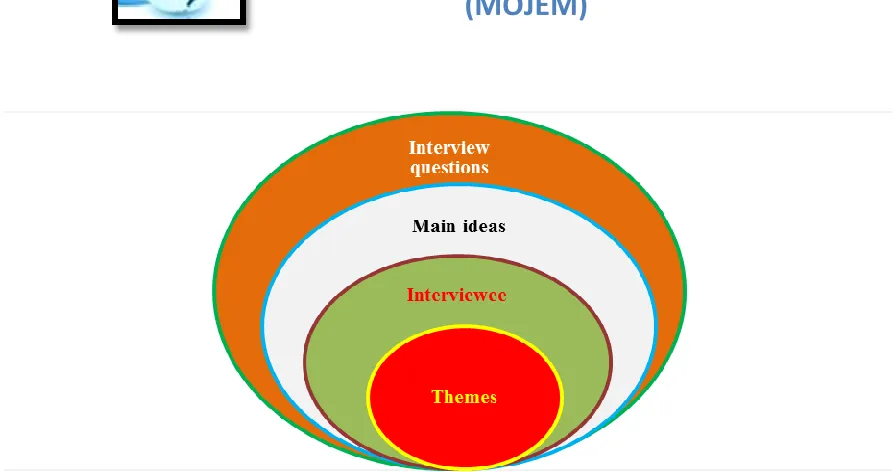
http://mojem.um.edu.my 43 Figure 2. The second stage of interview coding diagram
At the third stage of data analysis a four column interview coding template was used to amass overall responses of the participants and to generate themes. In these columns the researchers followed four steps which are interview questions, main ideas, name of interviewee, themes respectively. Following diagram is the demonstration of these four column template:
Subordinate keyword questions
Subordinate main point from conversation
Elaboration examples from verbal to support the subordinate
Occurrence of main idea transferred into the form as key words
Frequency of occurrences
http://mojem.um.edu.my 44 Figure 3. The third stage of interview coding diagram
Finally, the data were analyzed by interpreting the meaning of themes and descriptions. Two researchers were involved in interviewing the students to ensure reliability of data transcription.
RESULT
This section explores the e-learners’ perceptions, experience and opinions regarding the practice of three sorts of interactions (student-lecturer, student-student and student-content) which are related to interpersonal interaction, social interaction and intellectual discourse respectively in Islamic e-learning environment in an Islamic university in Malaysia. It also identifies the integration of Islamic values to comply with Islamic teaching in the e-learning environment of an Islamic university.
Interpersonal interaction
When interviewee A was asked regarding the importance of interpersonal interaction of e-learning, he described more on the student-teacher interaction. He exposed his knowledge and experiences regarding the learner-instructor interaction. Confidently he said that his lecturers provide the necessary notes and information concerning learning. The lecturers also assign project to the learners on a weekly basis through the LMS. As a result students can easily select their time-table by going through the LMS to check their learning related information including the tasks which they were required to accomplish.
http://mojem.um.edu.my 45
Accordingly, interviewee B like interviewee A highly emphasized on the student-lecturer interaction and it is obvious from her statement as she tells that lecturers provide some events and updated information regarding learning through the LMS. She mentioned one of her previous lecturer’s name from whom she has obtained information about the students’ attendance as well as other activities to do, before this interview session.
“Facilities throughout the e-learning system… they (teachers) provide us events … or latest news. we have to update for example.. I just received from my former lecturer as informed us about the attendance… actions to be taken”.
Interviewee B was really pleased with the interpersonal interaction in the e-learning system. To her, students are able to receive the directions and guidelines from the lecturers since it is easier to get them (lecturers) in e-learning service continuously. As she says “lecturers are always there to give the instructions to the students”. Accordingly she acknowledges that e-learning environment is such a place from where a learner is able to communicate with lecturers directly. She is really satisfied with the student-teacher interaction in an e-learning environment.
“So far e-learning is helping me. Frankly, LMS is helping a lot. E-learning is where ..like.. you are seeing your lecturer one to one. You are learning one to one. It’s more like focusing on what you want to know and my lecturer really attend me as it is all the questions that I puff out.”Again she comments, “it is only one to one interaction with the lecturer”.
Nonetheless, the statement of interviewee A is totally opposite to the view of interviewee B. Hence participant interviewee A has to face difficulty getting feedback from the lecturers according to the expected time. His comment is similar with Anderson since he (2006) argues, “The teacher often is not sitting on her ‘end of the log’ when their intervention is most advantageous for the learner”.
“….Once you answer one forum it is hard to get others to reply or to partake in what you are saying, even the lecturers are not there for to criticize on your work or what you are providing them”.
Moreover, interviewee B informs that lecturers are willing to answer the learners’ queries in a relaxing mood through LMS.
“When you are there online… your lecturer is at easy puff and mood, right…relaxed at the other side, so she or he is open to answer all your questions”.
http://mojem.um.edu.my 46 “The lecturers want to help me. I also want to get help from the lecturer but the problem is the distance. You never regard the lecturers as lecturers . . . regard them as friends because they are good listeners”.
Interviewee B explains her concerns on the process by which lecturers evaluate the learners.
“The lecturers will go through the answers through the forum, or through the quiz, and check our grammar…all those things are important to evaluate us.... it concerns marks”.
Again she argues that through interpersonal interaction of LMS, lecturers not only control their students’ performance rather they perceive the learners’ attitude, stability, regularity and also skill by seeing their attendance.
“This interaction system itself ... is like you are learning one to one with the lecturer… he controls you… Not even your work but your attitude…your attendance show your attitude, your consistency and your ability”.
An excellent metaphor has been given by interviewee B regarding the lecturers as she compares them with a learner’s parents who always take care of their children to become a good person.
“This student-lecturer interaction system in e-learning is like you have a mother ... Your lecturer is your mother or father… that controls everything… molding you to become ... a good learner, a good person… personally.”
Social interactions
Interviewee A informs that students interact with each other through Facebook. They can contact among themselves anytime through Facebook because their names can be seen by the peers. So learner-learner social interactivity becomes easier.
“The Facebook where …whenever student is inside then the student’s name will appear in the section so we can know who is inside. So we can contact them and an (interact) yeah, interact with them”.
Repeatedly social interaction with the group members is very important to interviewee A Students can discuss and exchange opinions regarding their assignments and they can be comprehended concerning their tasks by their peers through the e-learning interactive web-site.
http://mojem.um.edu.my 47
Interviewee B, on the other hand, can communicate with her junior learners and fellow students by using the e-learning system.
“Connect with the juniors. Using e-learning connecting with the peers outside there, connecting with the juniors”.
Moreover, she exposes some problem regarding the accessibility of social interaction tools in the e-learning system especially when many people use the web site.
“Accessibility . . . to be frank . . . when there are many people online . . . there will be lots of problems occur . . . I have to reorganize my folio. I will make sure all my friends they will complete all the assignments given”
Interviewee B delineates enthusiastically her feeling toward the distance learning program as it is the only way to be closer with her peers despite staying some distance from them. As she says, “The only way is through LMS… the heart is near to one another”. Likewise she opines that learner-learner open discussion can be possible through this e-learning service to help each other. Numerous numbers of comments, responses and opinions can be obtained from the distance learning classmates. “Open discussion to help one another. You receive lots of feedback from your friends”.
Intellectual Discourse
Interviewee A is really glad and cheerful to get interaction with the LMS. He opines: “I find that having an interactive section in the e-learning content system will be very much celebrated by me”. Interviewee B on the other hand, compares the LMS with Oxygen without which human beings cannot breathe and she thinks this content is the heart and soul of the learners. “LMS is our heart and soul, like oxygen”. She defines content as the course outline which is replete with course related information. “Content is like course outline . . . lots of materials on the subject course”.
In addition, interviewee B gets advantage from the content beyond her educational zone. She finds all types of talent, proficiency and competency inside this content management system. “LMS is helping me outside in my education field. Using LMS…all the skills are there.” Therefore, despite facing some difficulties in using LMS at the initial stage; interviewee A is satisfied after he has learnt and benefitted from LMS. He is even eager to offer the LMS the highest score.
“In terms of the ease of use during my first time going into the LMS I find it a bit difficult since the icons were not clearly stated. And so I do not know where to go and I had to explore it for around one to three days but once I get the use of it everything seems easy. So I think if I am to give score from one to five I will give the four”.
http://mojem.um.edu.my 48 “To certain extent it does because it is easy for us to get notes from the lecturers and even information regarding our studies but to certain extent it does not because sometimes it is not that interactive between us to communicate with our colleagues and lecturers”.
Interviewee A acknowledged that at the beginning of the semester he could communicate with his teachers and also access the LMS. Nevertheless, he also faced some problems in downloading the modules. To resolve the problem he used to go to the Facebook (FB) and they used to help him cordially.
“Yeah once during my first semester . . . at that time the LMS was still in its first stage. So . . . it’s a very hectic most of my subjects where I was being enabled by the lecturers I could get and could get into the system. I can’t download some of the notes. So, what I did was I went to the FB and told them about my problems and even I mention about the problems of the lecturers and they help me very much with rectifying the problem.”
Likewise, interviewee B had encountered difficulties collecting learning modules from the LMS, despite the modules being uploaded by the lecturers earlier.
“The lecturers who taught me… they always use it 160%. They have the same problem with us, that is the management of the content system. They have downloaded the documents but we didn’t receive in our site”.
In improving the LMS, interviewee B suggests uploading learning related videos from YouTube; previous documents related to the achievement status of learners, paper work and learning materials. Learner-content interaction occurs when learners access audio, video, text and graphic representations of the subject matter under study (Hirumi, 2002).
“..Can improvise it by putting more videos, or YouTube, links, or maybe you can put more filing.. Filing of achievements in the LMS . . . or maybe marks for previous quiz… in detail . . .. So that we know to which level we have reached . . ..” YouTube videos that are relevant, seminars, paper works, courses we can attend”.
One suggestion given by interviewee A was to enlarge the icons by providing clear instructions for the users so that they can easily enter the LMS and work in a friendly e-learning environment website.
“Regarding the LMS design what I can say is that after this we can have large icons, even we can have the main page where give instructions to users on how to use, on where to go. We can add into the content management system”.
Awareness of Islamic values
http://mojem.um.edu.my 49
Furthermore, he demonstrates to have alarm system for Solah inside the content because sometimes learners forget about the timetable of Solah especially while doing their assignment. Getting the alarm enable to remind them regarding the time for Solah.
“The thing that I think which can be put into the content we can have few Hadith and Sunnah. Wherever we go into the LMS; let’s say when we want to do our work may be there is the sentence from the Qur’an that we can take with the translation about that we can read, we can ease our mind, maybe we can also add, putting in the time for the solah and giving an alarm for the students, when we are doing our work we tend to forget that it is time for the prayer. So it can be very much useful”.
DISCUSSION
The interviewees have shown uniformity in describing the lecturers’ attitude. They both have agreed that the lecturers are trying their best to accommodate the LMS for the students. Despite technical problem in LMS, the lecturers are willing to include Facebook to ensure interactivity in learning with a good learning track. Facebook allows interaction between lecturer and students and students and students, as compared to the University LMS, where two-way interaction was inhibited. Thus, the positive attitude shown by the lecturers has encouraged students to achieve enjoyment, well-being and tranquility.
There have been contradictory perceptions regarding interpersonal interaction in LMS but both of them have emphasized the necessity of this interaction for distance learners. Both of them acknowledged that they obtained the updated learning relevant information and tasks from the lecturers through LMS. In e-learning surroundings lecturers become guardian for the learners. Moreover, teachers explain the problematic and challenging points, elaborate concepts and elucidate all types of uncertainties experienced by the students through e-learning service. Student-teacher interaction in distance education program is obligatory to enlighten the teaching-learning activity and without interactivity with the teacher a student is unable to improve academically. Student-teacher interaction may be critically important for certain personalized learning outcomes and it is a valuable addition to many interactions (Anderson, 2006) in the e-learning educational environment.
Accordingly, it can be realized, from the Islamic perspective, that Islam highly admires the act of student-teacher interactivity. For instance, during Qur’an revelation Almighty Allah (SWT) used to interact with our respected Prophet Muhammad (SAW) (may Allah exalt his mention) through the Angel Jibreel (Gabriel). Allah (S.W.T.) says: “Even as We have sent unto you a messenger from among you, who recites unto you Our revelations and causes you to grow, and teaches you the Scripture and wisdom, and teaches you that which ye knew not.” [Al-Baqarah 2: 151].
http://mojem.um.edu.my 50
Similarity is found between their arguments about exchanging the comments, views, and opinions among their peers. According to Anderson (2006) learner-learner interaction encourages the learners to work together for problem solving, analyzing and interpreting data, sharing information and insights. He (2006) again argues that there remain similarity of effective learner-learner interactions between traditional classroom and e-learning environment, too. Both of the informants’ experiences, interpretations, and observations demonstrate that learner-learner interaction is practiced to enhance the teaching-learning in e-learning environment. So by removing the existing problems and challenges, the effective practice of learner-learner interaction can be ensured.
CONCLUSION
From the research it is proved that student-lecturer, student-student and student-content interactions are essential to enhance the e-learning environment. Further, students of an Islamic university in Malaysia have complained against these interactions especially when they face massive problems dealing with the content management system. Such gaps of student-content interaction should be eradicated by undertaking some necessary steps; moreover suggestions which are indicated by the learners can be considered to resolve this problem. It is possible to comply with Islamic teaching through the intellectual discourse unit of interaction, too. The respondents suggest inclusion of Qur’anic
verses and Sunnah so that students can collect Islamic information and evidence to Islamize their learning and to be aware of their Shariah based activities.
Further research is needed to determine the importance of practicing these three types of interactions in the Islamic perspective and to fulfill Islamic teaching by removing all shortcomings and complexities from the e-learning environment at the Islamic University. From this study the overall picture of interactions in e-learning surroundings at the Islamic University is not established. However, it offers some understanding of the application and importance of interaction among Islamic University e-learning students.
REFERENCES
Al-Qur’an- Surat Al-‘Isra’, Ayat 85.
Al-Qur’an- Surat Yusuf, Ayat 53.
Al-Qur’an- Surat An-Nāzi`āt, Ayat 40.
Al-Qur’an- Surat Al-Baqarah, Ayat 151.
Alawneh, S. F. (1998). Human motivation: An Islamic perspective. The American Journal of Islamic Social Science, 15 (4), 19-39.
http://mojem.um.edu.my 51
Alhabshi, A.O. (2002). E-learning – a Malaysia case study. Paper presented at the Africa-Asia workshop on Promoting Co-operation in information and Communication Technologies Development, National Institute of Public Administration (INTAN), Bukit Kiara Main Campus, Kuala Lumpur, Malaysia.
Anderson, T. (2006). Interaction in learning and teaching on the Educational semantic web. In C. Juwah (Ed.), Interection in online Education: Implications for Theory and Practice (pp. 141-155). Oxon UK: Routledge.
Baker, S. E., & Edward, R. (2012). How many qualitative interviews is enough? : expert voices and early career reflections on sampling and cases in qualitative research. Southampton: National Centre for Research Methods.
Benigno, V., & Trentin, G. (2000).The evaluation of online courses. Journal of Computer Assisted Learning, 16, 259-270.
Berge, Z. (1999). Interaction in post-secondary web-based learning. Educational Technology,39(1), 5-11.
Denzin, N.K. (1989). Interpretive biogarphy, qualitative research methods. Series 17, London:Sage.
Collison, G., Elbaum, Haavind, S., & Tinker, R. (2000). Facilitating online learning: Effective strategies for moderators. Educational Technology & Society, 6(2), 72-74.
Creswell, J. W. (2009). Research design qualitative, quantitative and mixed methods approaches (3rd ed.). Thousand Oaks: California.
Garrison, D. R., & Anderson, T. (1998). Learning in a networked world: New Roles and Responsibilties
(Campbell-Gibson ed.). Madison Wi.: Atwood.
Garrison, D. R., Anderson, T., & Archer, W. (2000). Critical thinking in a text-based environment. Computer conferencing in higher education. Internet in Higher Education, 2(2), 87-105.
Gourneau, B. (2005). Five attitudes of effective teachers: Implications for teacher training. Essays in Education, 13, 1-8.
Hirumi, A. (2002). A framework for analyzing, designing and sequencing planned e- learning Interactions.
Quarterly Review of Distance Education, 3 (2), 141–60.
Meyer, K. A. (2002).Quality in distance education: Focus on online learning. ASHE-ERIC Higher Education Report, 29(A), 1-12.
http://mojem.um.edu.my 52
Majid, T. A. T. (2003). Multimedia and e-learning: A new direction for productivity promotion and enhancement. In Takashi Tajima (Eds), Report of the APO Seminar on Multimedia for Productivity Promotion and Enhancement (With Special Focus on e-Learning) (Chapter 7, pp.119-128). Republic of China: Published by the Asian Productivity Organization.
Moore, M. G. (1992). Distance education theory. The American Journal of Distance Education, 5(3), 1-6.
Powell, A., & Barbour, M. K. (2011). An examination of government policies for e-learning in New Zealand’s secondary schools. Journal of Open, Flexible and Distance Learning15 (1),75-89.Retrievedfrom http://journals.akoaotearoa.ac.nz/index.php/JOFDL/article/view/17/18
Shih, Y. C., & Cifuentes (2001). One tale of why and how to teach and learn online internationally. Tech Trends, 45 (6), 8-13.
Su, B., Bonk, C. J., Magjuka, R. J., Liu, X., & Lee, S. (2005). The importance of interaction in web-based education: A program-level case study of online mba courses. The Journal of Interactive Online Learning, 4 (1), 1-19.
Thach, E. C. and Murphy, K. L. (1995). Competencies for distance education professionals. Educational Technology Research and Development,43 (1), 57-79.
Thurmond, V. A. (2003). Examination of Interaction Variables as Predictors of Students' Satisfaction and Willingness to Enroll in Future Web-Based Courses While Controlling for Student Characteristics. In C. Crawford et al. (Eds.), Proceedings of Society for Information Technology & Teacher Education International Conference 2003 (pp. 528-531). Chesapeake, VA: AACE.
Wagner, E. D. (1994). In support of a functional definition of interaction. The American Journal of Distance Education, 8(2), 6-26.