Migration Policy
no.115 september 2006
M
ig
ra
ti
o
n
P
o
lic
y
l
E
co
n
o
m
ic
a
n
d
S
o
ci
a
l
C
o
u
n
ci
Constitution and Terms of Reference
1. The main tasks of the National Economic and Social Council shall be to analyse and report on strategic issues relating to the efficient development of the economy and the achievement of social justice.
2. The Council may consider such matters either on its own initiative or at the request of the Government.
3. Any reports which the Council may produce shall be submitted to the Government, and shall be laid before each House of the Oireachtas and published.
4. The membership of the Council shall comprise a Chairperson appointed by the Government in consultation with the interests represented on the Council, and
• Five persons nominated by agricultural and farming organisations;
• Five persons nominated by business and employers organisations;
• Five persons nominated by the Irish Congress of Trade Unions;
• Five persons nominated by community and voluntary organisations;
• Ten other persons nominated by the Government, including the Secretaries General of the Department of Finance, the Depart-ment of Enterprise, Trade and EmployDepart-ment, the DepartDepart-ment of Public Enterprise, the Department of Social and Family Affairs, and a representative of the Local Government system;
4. Any other Government Department shall have the right of audience at Council meetings if warranted by the Council's agenda, subject to the right of the Chairperson to regulate the numbers attending.
5. The term of office of members shall be for three years. Casual vacancies shall be filled by the Government or by the nominating body as appropriate. Members filling casual vacancies may hold office until the expiry of the other members' current term of office.
6. The numbers, remuneration and conditions of service of staff are subject to the approval of the Taoiseach.
September 2006
Published by the National Economic and Social Council
Copies of this report may be obtained from
The National Economic and Social Council, 16 Parnell Square, Dublin 1
or the Government Publications Sales Office, Sun Alliance House, Molesworth Street, Dublin 2
Chairperson
Mr. Dermot McCarthy Secretary General,
Department of the Taoiseach and Secretary to the Government
Deputy Chairperson
Ms. Mary Doyle Assistant Secretary,
Department of the Taoiseach
Government Nominees
Dr. Sean Barrett Professor Brigid Laffan Professor John FitzGerald Professor Eithne McLaughlin Dr. Peter Bacon
Mr. Tom Considine Secretary General, Department of Finance
Mr. Sean Gorman Secretary General, Department of Enterprise, Trade and Employment
Mr. Brendan Tuohy Secretary General,
Department of Communications, Marine and Natural Resources
Mr. John Hynes Secretary General, Department of Social and Family Affairs
Mr. Niall Callan
Secretary General, Department of Environment, Heritage and Local Government
Nominated by Business and Employers Organisations
Ms. Aileen O’Donoghue IBEC
Dr. Danny McCoy IBEC
Mr. Liam Kelleher CIF
Mr. Brendan Butler IBEC
Mr. John Dunne CCI
Nominated by the Irish Congress of Trade Unions
Mr. David Begg ICTU
Ms. Sally Anne Kinahan ICTU
Mr. Manus O’ Riordan SIPTU
Mr. Peter McLoone IMPACT
Mr. Jack O’Connor SIPTU
Nominated by Agricultural and Farming Organisations
Mr. Seamus O’ Donohue ICOS
Mr. Ciaran Dolan ICMSA
Mr. Damian McDonald Macra na Feirme
Mr. Michael Berkery IFA
Mr. Con Lucey IFA
Nominated by Community and Voluntary Organisations
Fr. Sean Healy CORI
Mr. Eric Conroy INOU
Ms. Deirdre Garvey The Wheel
Mr. John Mark McCafferty SVP
Mr. John Dolan DFI
Secretariat
Dr. Rory O’ Donnell Director
Mr. Noel Cahill Economist
Mr. Jarlath McKee Social Policy Analyst
Dr. John Sweeney Economist
Ms. Catherine O’Brien Ms. Tracy Curran Ms. Sheila Clarke
Abbreviations viii
Preface ix
Acknowledgements xi
Executive Summary xiii
Chapter 1
Introduction 1
part i
Understanding Migration
Chapter 2
Migration Trends and Channels
2.1 Migration Trends: An Overview 7
2.2 Channels of Migration 10
2.3 Migrants in the Irish Economy 20
2.4 Conclusion 24
Chapter 3
Understanding Migration: Causes and Effects
3.1 Introduction 27
3.2 Overview of economic and social effects 27
3.3 Causes of Migration 30
3.4 Economic Effects of Migration 31
3.5 Social Effects of Migration 51
3.6 Conclusion 64
Chapter 4
Understanding Migration: EU Enlargement and Deepening
4.1 Introduction 71
4.2 EU Enlargements and European Migration 71
4.3 EU Deepening and European Migration 80
4.4 Managing the Impact on Standards 84
4.5 Secular Trends in the Mobility of Europeans 88
Appendix 4.1: Major Milestones in the Development
of the Freedom of Movement of Persons within the European Union 91
part ii
Policy
Chapter 5
Understanding Migration: Global Change
5.1 Introduction 101
5.2 Historical Overview 101
5.3 Refugees and Asylum Seekers 102
5.4 Migration and Trade 103
5.5 Future Global Migration Flows 105
5.6 Conclusion 106
Chapter 6
Framing Ireland’s Ends and Means
6.1 Introduction 109
6.2 Understanding Migration: What Part I tells us 110
6.3 Ireland’s Economic and Social Goals 118
6.4 The Place of Migration in Advancing
Ireland’s Economic and Social Goals 122
Chapter 7
Policy on EU Migration and Enlargement
7.1 Introduction 129
7.2 Community Preference 129
7.3 Monitoring and Protecting Standards 130
7.4 The Effectiveness of the Structural Funds 131
7.5 The Accession of Romania and Bulgaria 133
Chapter 8
Policy on Migration from outside the EU
8.1 Introduction 142
8.2 Background: Ireland’s Initial Response to Non-EEA Migration 142
8.3 International Experience 147
8.4 NESC Policy Recommendations 151
Chapter 9
Labour Standards and Labour Market Policies
9.1 Introduction 167
9.2 Why Labour Standards? 168
9.3 Achieving Labour Standards 171
Chapter 10
The Challenge of Integration
10.1 Introduction 183
10.2 The Consultant’s Approach to Intgration 183
10.3 European Union Context for Integration 186
10.4 The Irish Migration Context:
A Favourable Time To Address The Integration Challenge 186
10.5 The Elements of Integration Policy 187
10.6 Mainstream Service Provision 189
10.7 Citizenship and long-term Residency 191
Chapter 11
Adapting Social Policy
11.1 Introduction 195
11.2 Overarching Policy Challenges 196
11.3 Policy Fields 199
Chapter 12
Policy Development and Management
12.1 Introduction 215
12.2 The Institutional and Policy Landscape 215
12.3 The Policy Challenge 219
12.4 Institutional Arrangements to Achieve
Policy Coherence And Coordination 226
References 230
List of Tables
Table 2.1 Annual Change in Irish, Non-Irish and Total Population (000s) 9
Table 2.2 New Work Permits Issued to Non-EEA Nationals
by Job Category, January 2003 – April 2005 12
Table 3.1 Indices of Growth in Weekly Earnings and Employment,
Selected Sectors, and Consumer Price Index, 1998–2005 (1998=100) 40
Table 3.2 Self-Employment in Construction
(as Percentage of Total Engaged in Construction) 41
Table 3.3 Average Hourly Earnings by Sector 42
Table 3.4 Change in Employment by Sector and Nationality
(000s) over the year to 2006 (First Quarter) 46
Table 3.5 Total Migration by Age Group 2000-2005 53
Table 3.6 Population Growth, Natural Increase and Net Migration (000s) 54
Table 3.7 Projections of Dependency Ratios 55
Table A3.1 All Persons (000s) Aged 18 to 24 and Early School Leavers,
Classified by ILO Employment Status 65
Table A3.2 Unemployment Rates of Persons Aged 25 to 64
Classified by Highest Level of Education attained 66
Table A3.3 Labour Force Participation Rate of Persons Aged
25 to 64, Classified by the Highest Level of Education Attained,
March-May 2002 to March-May 2005 67
Table A3.4 ILO Participation Rates by Age and Gender 68
Table A3.5 ILO Unemployment Rates by Age and Gender 69
Table 4.1 Composition of Resident Working Age Population
by National Groupings, 2005 (row percentages) 73
Table 4.2 Employment rates by Nationality, EU 15 (Q2, 2005) 74
Table 7.1 Ireland and Selected New and Acceding
EU Member States: Selected Characteristics 135
Table 11.1 Mapping the Adaptation Challenge for Social Policy 196
List of Figures
Figure 2.1 Non-Irish Immigration Flows by Nationality (000s) 8
Figure 2.2 Composition of Non-Irish Population Aged 15 and Over 10
Figure 2.3 Channels of Legal Migration from Outside the EEA 19
Figure 2.4 Percentage of Total (ILO) Employment by Sector held by
(a) all non-Irish Nationals, and (b) EU 10 Nationals, Q4 2005 22
Figure 3.1 Low-skilled Wages Relative to Average Wages 36
Figure 3.2 Annual Percentage Change in Gross Real Compensation Per Head 37
Figure 3.3 Gross Average Weekly Earnings Series, 1998–2005 39
Figure 3.4 Percentage Change in Quarterly Hourly Industrial Earnings 43
Figure 4.1 The Evolving European Acquis Communantaire 82
Figure 6.1 The Trilemma of Low-Skilled Migration 112
Figure 6.2 Three Broad Goals of Migration 120
Figure 9.1 Complementarity in Labour Market Objectives 178
List of Boxes
Box 4.1 The Laval Case 86
Box 8.1 Employment Permits Act (2006) 149
Box 8.2 Proposals on Family Reunification in the Department of
Justice, Equality and Law Reform’s April 2005 Discussion Document 160
Box 10.1 EU Migration and Integration Policy 185
Box 10.2 The Common Basic Principles adopted by the European Union 192
BMW
Border, Midlands and West
CAP
Common Agricultural Policy
CEE
Central and Eastern Europe
CF
Cohesion Fund
COMPAS
Centre on Migration Policy and Society
CRS Central Records System CSO Central Statistics Office DETE Department of Enterprise, Trade and Employment
DFA
Department of Foreign Affairs
DJELR
Department of Justice, Equality and Law Reform
DSFA
Department of Social and Family Affairs
DWS Developmental Welfare State EC European Community ECJ
European Court of Justice
ECSC
European Coal and Steel Community EEA European Economic Area EEC European Economic Community EFTA
European Free Trade Area EOCP Equal Opportunities Childcare Programme ERDF European Regional Development Fund ESF
European Social Fund
ESRI
Economic and Social Research Institute EU European Union EURES European Employment Services FDI Foreign Direct Investment FIS Family Income Supplement FOI Freedom of Information GAIE Gross Average Industrial Earnings GDP Gross Domestic Product GNIB Garda National Immigration Bureau GNP
Gross National Product
HRC Habitual Residence Condition HSE Health Services Executive IEBI International Education Board of Ireland ILO International Labour Organisation INIS Irish Naturalisation and Immigration Service IT Information Technology JLC Joint Labour Committee MEP
Member of the European Parliament
MRCI
Migrant Rights Centre of Ireland
MIDA
Migration for Development in Africa
MS Member States NCIP National Childcare Investment Plan NCCRI National Consultative Committee on Racism Interculturalism NDP National Development Plan NGO Non-governmental Organisation NMS
New Member States
NPAR
National Plan Against Racism
NQAI
National Quality Authority of Ireland
ODERC
Office of the Director for Employment Rights
OECD Organisation for Economic Co-operation and Development QNHS Quarterly National Household Survey PPS
Personal Public Service
PRTB Private Residential Tenancies Boards R&D Research and Development RIA Reception and Integration Agency S&E
Southern and Eastern
S&T
Science and Technology
SDM
Service Delivery Model
SIEPS
Swedish Institute for European Policy Studies
SM
Single Market
SME
Small and Medium Enterprises SWA Supplementary Welfare Allowance TA Transitional Arrangements TLMP Temporary Labour Migration Programmes TOEFL
Tests of English as a Foreign Language UB Unemployment Benefit UN United Nations UNHCR
United Nations High Commissioner for Refugees
US
United States
Acknowledgements
The Council and the Secretariat would like to acknowledge the assistance of a number of individuals in the preparation of this report.
We owe particular thanks to Frank Laczko and Gervais Appave, and to their colleagues at IOM—Meyer Burstein, Pauline Conroy, Philip Martin and Martin Ruhs—for the meticulous work they undertook in documenting Ireland’s migration policy, conducting workshops and advising the NESC Secretariat. Diane Grammer, head of the IOM office in Dublin, played an important role in organising the workshops and liaising with NESC. The Council thanks all the individuals and organisations that participated in IOM workshops.
The staff of several government departments represented on the Council— particularly Enterprise, Trade and Employment, Social and Family Affairs, Environment, Heritage and Local Government—provided detailed assistance to the Secretariat. In addition, the Council and Secretariat benefited greatly from the expert help of Paul Burns and Peter Jones of the Department of Justice, Equality and Law Reform. As usual, colleagues in the Economic and Social Research Institute, particularly Alan Barrett and John FitzGerald, shared their expertise with the Council and Secretariat. Thanks are also due to Denise Charlton, Catherine Cosgrave and Fidele Mutwasibo, of the Immigrant Council of Ireland, Siobhan O’Donoghue of the Migrant Rights Centre, Martin Shanahan of the Expert Group on Future Skill Needs, Mike Jennings of SIPTU, Aidan Pender of Fáilte Ireland, Ronaldo Munck of Dublin City University, and Alice Feldman of University College Dublin.
Immigration is a new experience for Ireland. In a short space of time, the proportion of non-nationals in the population has reached the level found in other advanced countries. The effects of migration have been broadly positive. It has increased economic activity, enhanced skills and widened the range of services available. To date, there has not been much evidence of the negative effects to which migration can give rise. However, the exploitation of some migrants is a real problem and migration can create a range of other anxieties. Indeed, experience of other countries shows that positive short-term effects are no guarantee that migration will work out well in the long run. To make a success of migration Ireland must connect the elements of its migration policy more closely and factor the integration of migrants more fully into mainstream policies.
The focus of this report is labour migration. The Council sought to develop a shared understanding of the impact of migration on the labour market, economic development and social cohesion. It commissioned a review of Ireland’s migration experience and policy from the International Organization of Migration (IOM), based in Geneva. NESC is publishing IOM’s report separately (IOM, 2006).
Main Findings
Economic Impact
Research suggests that from 1993 to 2003, migration increased both the overall size of the economy (total GNP) and average living standards (GNP per head). Many migrants had education were skills. Their arrival improved competitiveness, increased employment and boosted GNP. This led, in turn, to an increase in low-skilled employment and lower unemployment. It also helped to moderate the gap between the earnings of high-skilled and low-skilled workers.
The Migrants’ Experience
Many migrants work in jobs that do not reflect their level of education. In this respect, there are parallels between Ireland’s experience of emigration in the 1980s and immigration to Ireland today.
There is evidence that the employment of migrant workers has, in many instances, not conformed to the labour standards which Irish society considers acceptable.
Illegal Migration and Undocumented Status
Illegal or irregular migration is undoubtedly present, in Ireland and other countries. There are a number of channels into the pool of irregular migrants, including asylum, the work permit system and educational migration. But the extent of irregular migration is unknown.
Demographic Effect
Migration is one of the main factors shaping Ireland’s demographic trajectory. In the past decade, over half of the growth of population was due to migration. Over the next decade, the CSO projects an increase in the population of between 437,000 and 686,000. Immigration could contribute from 150,000 to 300,000 of this.
Uncertainties
Although we know a lot about recent migration, we remain uncertain about some of the facts, many of its economic and social effects and its future scale. For example, we do not know how much migration is temporary, how effectively migrants will progress to jobs that reflect their education, nor the impact of migration on the distribution of wages in recent years. Consequently, we remain uncertain about the effect of migration on Ireland’s long-run growth and prosperity.
The Council Draws a Number of Conclusions
from these Findings and International Research
1. Pressure for migration—legal and illegal—is an unavoidable feature of the emerging world order to which all societies and states must respond.
2. The enlargement of the EU was a moral, political and economic imperative. The states that joined the EU in 2004 have higher levels of education than countries with comparable income levels. Because of its booming economy and its decision to open its labour market in 2004, Ireland attracted a disproportionate share of this mobile, relatively educated, workforce.
separation. It must be combined with enhancement of social participation and protection by means of the Developmental Welfare State and be associated with a narrowing of income distribution.
Conversely, migration will not contribute to Ireland’s economic and social strategy if it is driven by demand for labour at low levels of wages and condi-tions, or if migrants are confined to low-skilled, traded, sectors that are highly cost-sensitive. These are among the conditions in which migration is likely to actually lower GNP per head in Ireland and widen inequality in incomes.
4. Integration of migrants is one of the main factors determining the overall success or failure of migration. While many countries have used migrant labour to meet labour shortages, few European countries have achieved successful long-term integration into economic, social, cultural and political life. This is especially the case with low-skilled migrants or those perceived to be very different.
5. Migration has the potential to undermine the rule of law. It can weaken the ability of the state institutions to define, control and monitor who resides in Ireland. It can create situations in which some people are vulnerable to exploitation. It can weaken trust in the ability of public institutions to ensure the rule of law, which tends to become a self-fulfilling prophesy.
Overall Implications for Policy
1. Ireland needs to clarify its approach to migration, focusing simultaneously on three broad goals:
s Economic and social development;
s The rule of law; and
s Integration of migrants into economic, social, cultural and civic life.
2. ‘Migration Policy’ should be defined broadly:
3. We urgently require a ‘whole-of-government’ approach:
The three goals of migration policy, outlined above, are interdependent and all departments must take some responsibility for each of them. This challenges Ireland’s public policy system to:
s Build a widely-shared understanding—and communicate a clear vision—of
the role of migration in Ireland’s long-term economic and social development;
s Achieve a whole-of-government approach to a range of cross-cutting issues;
s Ensure that the integration agenda is now mainstreamed in key
service-delivery departments; and
s Create information systems that support individual policy spheres and allow
sufficient connection between them.
The Council recommends that government now create institutional arrangements to achieve these tasks.
Specific Policy Recommendations
Policy on EU Migration and Enlargement
As a member of the EU, Ireland adheres to the principles of free movement and Community Preference. The Council endorses this approach.
The coming accession of Romania and Bulgaria will widen socio-economic disparities within the Union. Within the principles of free movement and Community Preference, Ireland retains the right to apply transitional arrange-ments, restricting the access of Romanians and Bulgarians to the labour market for a number of years.
In deciding on this matter, a number of factors should be taken into account:
s prevailing conditions in the Irish labour market;
s the fact that significant economic benefits and political capital accrued to
Ireland from the decision not to impose restrictions in 2004;
s transitional arrangements may have more impact on the composition of
migration than its total level.
Policy On Migration From Outside The EU
The Council supports the policy articulated since EU enlargement in 2004—that low-skilled workers should be sourced from within the EU. It welcomes the reduction in the number of new work permits. Even with this, a considerable level of legal low-skilled migration from low-income countries outside the EU is likely, principally through family reunification.
The Council believes that only a limited level of low-skilled migration from outside the EU should be permitted and that it should take place through high-quality programmes. These should prevent skilled migrants being trapped in low-paying, cost-sensitive and vulnerable sectors. It recommends that migrants engaged in low-skilled work should, on certain conditions, have the opportunity for education or training.
The Council welcomes the Government’s proposed introduction of an Irish ‘green card’ for high-skilled workers, with the right to be accompanied immediately by a spouse and the prospect of permanent residence after two years.
The Council believes that the attraction of students from outside the EEA must be consistent with a well-articulated international education policy. It welcomes the move to restrict the right to work to students who are completing full-time courses of at least one year’s duration that lead to a recognised qualification. However, the new measures would not appear to be effectively implemented and the Council welcomes the fact that students will be required to have employment permits.
Family reunification is potentially the largest source of migration to Ireland from outside the EU. There are anomalies and inequities in the ease with which people legally resident in Ireland can be joined by family members who are non-EEA nationals. The Council urges further discussion and development of policy on family reunification.
Labour Standards and Labour Market Policy
Core labour standards and employment rights are integral to the Council’s unified view of economic and social development. Framed correctly, legally-binding labour standards are not a burden on economic success or business performance, but supportive of them. While the creation of employment across the skill spectrum is a genuine part of Ireland’s economic and social progress, jobs that are reliant on low standards are not.
The labour issues thrown up by migration and globalisation can put employers and unions in uncharted territory. National social partnership can be a critical support in finding a constructive approach. Experience shows that partnership with government helps the partners to demonstrate that that their actions serve not only their legitimate self-interest, but also wider social purposes.
A central argument of this report is that labour market policy, in key areas, is one of the most important policy responses to migration. The success or failure of migration depends on how well the labour market works for both migrants and Irish citizens. In particular, migration increases the urgency of raising the productivity of people at work and raising the employment rate. There is a danger that the ready availability of migrants could reduce pressure to raise the skills of the resident population and tackle the obstacles to the participation of Ireland’s most marginalised citizens, including welfare-to-work disincentives.
Integration Policy and the Adaptation of Social Policy
Ireland’s relatively successful early experience of migration does not guarantee that migrants will integrate sufficiently into Irish society or the Irish economy. While government must play a leading role, successful integration hinges on a vibrant civil society. The main approach to integration should be adaptation of mainstream policies and services, rather than creation of separate services for migrant groups. Language competency should be a cornerstone of integration policy.
Migration poses two challenges to social policy: increased scale and more diversity. These differ in each service area—education, health, housing, social welfare, policing and justice. There are some issues that arise in all areas. These include improving the collection and use of data, enhancing the ability of staff to deal with a diversity of users, understanding the vulnerabilities of women in the migration-integration process and providing the public with better information on service entitlements and standards.
Conclusion
In this report, the Council sets out its understanding of recent migration to Ireland and makes recommendations on Irish policy. In doing this, it makes considerable use of a study prepared for NESC by the International Organization of Migration, based in Geneva (IOM, 2006). Drawing on their wide knowledge of migration and migration policy in many countries, the Consultants argue that the success of migration in any country depends on the creation of a shared understanding that migration can contribute to a prosperous and socially-inclusive society.
The Council shares this view. Indeed, it believes that a first step to building such a shared vision is to understand recent migration to Ireland. To understand Ireland’s recent experience it is necessary to see it in the light of three factors:
1. The causes and consequences of migration;
2.The widening and deepening of the European Union (EU); and
3.Changes at the global level—geopolitical, economic, technological and social.
Adopting this approach, Part I (Chapters 2–5) of the report outlines the Council’s understanding of recent migration to Ireland. Because new CSO data has been published since the Consultants undertook their work, Part I of the Council’s document contains a fairly detailed summary of the evidence on recent migration to Ireland.
Chapter 2 reports recent migration trends and explains the channels through which migrants arrive in Ireland. Chapter 3 reviews the causes and effects of migration. It draws on international research, published data on Ireland and the increasing body of research on Ireland’s migration experience. Considerable evidence is emerging on the origin, skill profile and employment of migrant workers and their impact on the Irish economy and this is summarised. Evidence and research on the social and cultural effects of recent migration has not yet accumulated.
Chapter 5 completes the understanding of recent migration to Ireland by briefly describing the changes in geo-politics and global economic structures that have caused a significant increase in international migration in recent decades. International migration is a central feature of the new world order and pressure for migration from poorer countries is likely to increase.
We open Part II (Chapters 6–12) of the report by asking: what kind of under-standing of migration does the analysis in Part I yield? In the Council’s view, there are three elements to our current understanding of, and perspective on, migration:
1) Awarenessof the range of possible economic and social effects of migration and of the experiences of other countries;
2) Findingson the pattern, scale and effects of migration to Ireland to date; and
3) Uncertainties about some existing elements of migration and several key future trends and effects.
Given this understanding, the Council proposes a way of framing Ireland’s goals with respect to migration and the means available to achieve them. It suggests that three broad goals should inform Ireland’s policies on migration: economic and social development, the rule of law and integration. The chapter finishes by identifying ways in which migration can support Ireland’s economic and social strategy and conditions necessary for migration to make this positive contribution.
Chapter 7 underlines the fact that, as a member of the EU, Ireland adheres to the principles of free movement and Community Preference. The Council endorses this approach. Drawing on the analysis of EU enlargement in Chapter 4, it argues that the widening of socio-economic differences within the EU makes it more important for Member States to monitor and protect social and labour standards. It also increases the importance of Structural Funds that are sufficiently generous and effective to support strong growth of living standards in the new Member States. It discusses the fact that Ireland retains the right to adopt transitional arrangements when Romania and Bulgaria join the Union, and identifies the factors that should shape that decision.
several contributions to the search that is underway for policies which are, at the one time, supportive of Ireland’s economic and social strategy, fair to all categories of migrants and reflect Ireland’s strong commitment to the family. Attention is also given to ways in which Ireland’s migration policy and overseas development policy can be supportive of each other.
Chapter 9 discusses labour standards and labour market policy. One of the findings of Part I is that some migrant workers have experienced unsatisfactory working conditions, including violation of Irish employment law—although it is very hard to be sure how widespread this is. The Council argues that in addressing the issue of labour standards we need to clarify our understanding of the role of the labour market in overall economic and social strategy, and of the role of institutions and rights in the labour market. The chapter discusses why labour standards are important within the Council’s unified view of economic and social development and identifies some implications of this. While the creation of employment across the skill spectrum is a genuine part of economic and social progress, jobs that rely on low standards are not. We outline the Council’s support for the ‘New Compliance Regime’ agreed by government and the social partners and draw attention to some international innovations in monitoring labour standards and promoting compliance. A central argument of this chapter—indeed, of this whole report—is that labour market policy, in key areas, is one of the most important policy responses to migration. The success or failure of migration depends on how well the labour market works for both migrants and Irish citizens. Consequently, we underline the importance of ensuring that migration is combined with an upskilling of the resident population and further progress in raising the employment rate.
In Chapter 10, the Council outlines its proposals on integration policy. Drawing on the work of the IOM Consultants, it argues that for integration to occur, support will need to be built on a widely-shared vision of how migration can contribute to a dynamic, secure and socially-cohesive Irish future. Integration should be seen as a multi-dimensional process, unfolding over a long time. International experience underlines that language capability is a cornerstone of integration policy. Note is made of the critical role of civil society and NGOs in facilitating integration. The Council agrees with the Consultants that the main approach to integration should be adaptation of mainstream policies and services, rather than creation of separate policies and services for different migrant groups. Consequently, there is a significant overlap between integration policy and the adaptation of social policy migration, discussed in Chapter 11.
Finally, in Chapter 12 the Council discusses how migration policy should now be developed and managed. It argues that the three goals outlined in Chapter 6— economic and social development, the rule of law, and integration—are interdependent and need to be taken into account by a range of departments and agencies. In thinking about institutional approaches, the Council sees four main challenges. These include creating a whole-of-government approach to a range of cross-cutting issues, ensuring that the integration agenda is firmly mainstreamed in key service delivery departments, communicating a clear vision of the role of migration in Ireland’s long-term economic and social development and creating information systems to support individual policy spheres and to allow sufficient connection between them. The Council suggests that in designing institutional arrangements, government can draw on a number of recent experiences in policy making and coordination.
2.1
Migration Trends: An Overview
This chapter provides a brief overview of the scale and composition of migration to Ireland and different channels through which migrants arrive in Ireland. A more detailed description of these trends is provided in Chapter 2 of the IOM Consultants’ report (IOM, 2006).
The rise in inward migration has been a distinctive feature of Ireland’s recent economic and social development. Recorded net migration became positive in 1997 and reached over 53,000 in 2005 (year ending April in each case). CSO data suggest that there has been approximately a fourfold rise in gross inward migration from an estimated 17,200 in 1987 to 70,000 in 2005. Estimated outward migration has fallen, from a high of 71,000 in 1989 to 16,600 in 2005.
There has long been a pattern of return migration of Irish people and this has continued to be a significant aspect over the past decade. Migration by Irish nationals represented over half of all recorded migrants in the years 1996 to 1999. Since then their share has fallen but Irish nationals still represented 27 per cent of inward migration in 2005.
Around two-thirds of the EU nationals migrating to Ireland in the year to April 2005 are estimated to be nationals of the NMS (26,400). These NMS nationals represented over half (52 per cent) of the total estimated non-Irish migration to Ireland, while 13.5 per cent of non-Irish migrants were UK nationals and 14 per cent were nationals of the other 13 EU countries.
There has been a substantial increase over the past decade in migration to Ireland from countries outside the EU and the US (which we will refer to as the rest of the world). This migration is estimated to have risen from 4,200 in 1996 to a peak of 21,700 in 2002 and has been falling since then. With the incorporation of the NMS, estimated migration from the rest of the world fell to 9,000 in 2005. This is still more than a doubling of this external migration since 1999. Migration from outside the EU and the US is a significant development for Ireland. However, it is worth noting that at present it seems to be a modest share of total inward migration (17.6 per cent of non-Irish migrants). The CSO estimates that just 3 per cent of non-Irish migrants were from the US in 2005.
[image:28.595.73.440.475.730.2]The most recent migration data refer to the year ended April 2005. More recent data on population from the Quarterly National Household Survey(QNHS) show an even greater influence of the NMS on Ireland’s current migration flows. The QNHS estimates that the increase in the non-Irish population in the year to the first quarter of 2006 was 54,700. This was three times the estimated change in the non-Irish population in 2004. Almost three quarters of this increase (40,000 people) is estimated to consist of nationals of the NMS.
Figure 2.1
Non-Irish Immigration Flows by Nationality (000
s)
SourceCSO, Population and Migration Estimates.
Note:The EU data refer to the EU (15) until 2004 and in 2005, following enlargement refer to the EU (25).
2.1
1996
0 5 10 15 20 25 30 35 40
1997 1998 1999 2000 2001 2002 2003 2004 2005
Rest of EU
The most recent comprehensive data on the stock of migrants is from the 2002 Census. This records that there were 400,000 people whose place of birth was outside the Republic of Ireland in the population in that year, amounting to 10.4 per cent of the population. There were almost 50,000 (12.4 per cent) people from Northern Ireland and almost 200,000 from Britain (49.6 per cent). A further 33,000 were from another EU 15 country. These Census estimates suggest that over 70 per cent of foreign-born people resident in Ireland had their place of birth in an EU country.
The Census also contains data on the nationalities of the population. Nationality is not solely defined by place of birth; people are asked to identify their nationality in the Census. Some of the population born outside the Republic of Ireland consists of Irish nationals; for example, the children of Irish people born abroad. The 2002 Census estimate of the non-Irish population was around 224,000 or 6 per cent of the population. The largest national grouping was UK nationals (46 per cent of the non-Irish population or 103,500 people). The Census recorded around 133,400 EU nationals, which was almost 60 per cent of the non-Irish population. The Census also recorded almost 21,000 African nationals (9.3 per cent of the non-Irish population), close to 22,000 Asian nationals (9.7 per cent) and just over 15,300 American nationals (6.9 per cent).
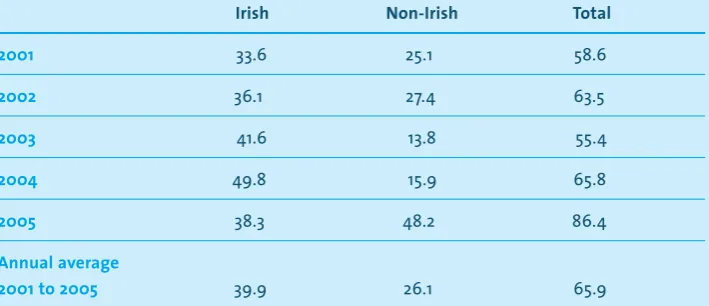
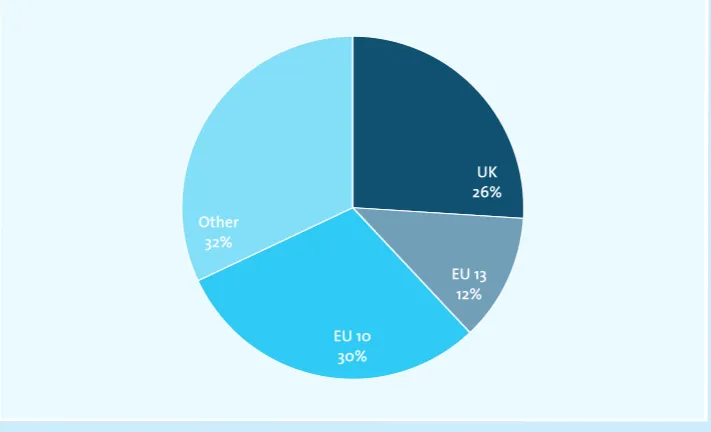
[image:29.595.177.532.151.304.2]More recent, but less comprehensive, data on the non-Irish population are available from the QNHS. This estimates that the non-Irish population aged 15 and over in 2006 (first quarter) was 271,300 or 8.1 per cent of the total population aged over 15. This is a substantial increase on the 6 per cent figure (for the total population) from the 2002 Census. The composition of this estimated non-Irish population is shown in Figure 2.2 below. Over 30 per cent, 82,000 people, were estimated to be from the NMS. It is striking that the estimated number of Table 2.1
Annual Change in Irish, Non-Irish
and Total Population (000
s)
Irish Non-Irish Total
2001 33.6 25.1 58.6
2002 36.1 27.4 63.5
2003 41.6 13.8 55.4
2004 49.8 15.9 65.8
2005 38.3 48.2 86.4
Annual average
2001 to 2005 39.9 26.1 65.9
immigrants from the NMS is two and a half times the number from the EU 15 excluding the UK and Ireland. The share of the NMS in the non-Irish labour force is even higher at 37 per cent, reflecting the high labour force participation of NMS nationals.
New estimates of the current size and composition of the migrant population will be provided in the 2006 Census. A tentative estimate included in the preliminary census release is that there are around 400,000 non-Irish nationals in the population in 2006. This would represent around 9.4 per cent of the population.
2.2
Channels of Migration
A crucial distinction with regard to entry to Ireland is the treatment of European Economic Area (EEA)1
and other nationals. Nationals of EEA countries, as long as they can prove that they are economically self-sufficient, have unrestricted access to Ireland for employment and other purposes such as study. Existing data shows that EEA nationals now constitute the bulk of inward migration to Ireland.
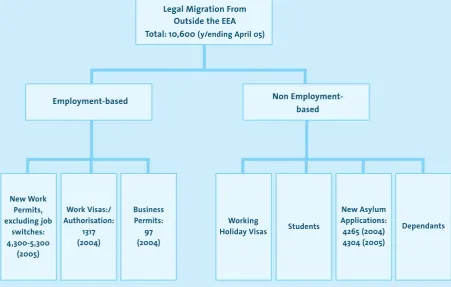
[image:30.595.86.442.282.498.2]For those living outside the EEA there are a number of legal entry routes to Ireland (summarised in Figure 2.3 at the end of this section):
Figure 2.2
Composition of Non-Irish Population Aged 15 and Over
SourceCSO,Quarterly National Household Survey,2006, First Quarter.
2.2
EU 10 30% Other
32%
UK 26%
EU 13 12%
s Work permits;
s Working visas/authorisations and working holiday visas;
s Asylum applications and refugee status;
s Student visas;
s Arrival as a dependant;
s Entry as a parent of Irish born children (no longer available); and
s Business permissions.
In addition to these legal channels, some people enter the country illegally and others, having entered legally, stay illegally.
Each of these is now briefly explained.
2.2.1 Work Permits
Work permits are the main legal route of entry to employment for non-EEA nationals. They are issued to employers for one year and are renewable. They grant permission for a specific employer to employ a named individual in a specified position. They are subject to a labour market test; employers are required to demonstrate to FÁS that they cannot find suitable people from within the EEA. The IOM consultants do not regard the implementation of the labour market test as effective at present (IOM, 2006: 43); possible reforms are discussed in Chapter 8 below. Work permits have been an important entry route for workers from the accession states, but following enlargement have declined in significance. In 2003, 47,707 permits were issued, while in 2005 the number issued was 27,136 (including renewals). The number of new permits issued in 2005 was 7,354. This number includes permits issued to those moving jobs; according to the Department of Enterprise, Trade and Employment (DETE) this averages around two to three thousand annually. Thus, work permits now play a modest role in the context of current Ireland’s estimated new inward migration flows. A large number of people have, however, entered Ireland on work permits since 1997. The Consultants point out that Ireland’s work permit regime contains no measure to ensure return of migrants when their permit expires, and limited procedures to monitor return. Consequently, it seems possible that there are many non-EEA migrants in Ireland whose work permits have expired. However, there is no data on this. Policy issues arising from this approach are discussed in Chapters 6, 8 and 12.
been a substantial increase in the share of new work permits allocated to the three higher-level groups (managers and administrators, professional occupations, associate professional and technical occupations) — up from 12 per cent for the period January to August 2004, to 31 per cent for the period September 2004 to April 2005.
Ireland has operated a small-scale Seasonal Horticultural Workers Scheme since 20022
. The scheme relies heavily on contacts with horticultural colleges in the students’ home countries and the colleges’ involvement in selecting and facilita-ting the placement of their students in Ireland.
Table 2.2
New Work Permits Issued to Non-EEA Nationals
by Job Category, January 2003 – April 2005
2003 Jan-Aug 2004 Sep 2004-April 2005
Managers & Administrators 2% 2% 4%
Professional Occupations 6% 11% 17%
Associate Professional
and Technical Occupations 4% 6% 10%
Clerical and
Secretarial Occupations 1% 1% 1%
Craft and Related Occupations 16% 15% 15%
Personal and Protective
Service Occupations 22% 18% 23%
Sales Occupations 2% 1% 1%
Plant and Machine Operatives 5% 3% 2%
Other Occupations 41% 44% 27%
Total (%) 100% 100% 100%
Total number 21,965 7,438 4,944
Source: IOM (2006: 33) based on work permits data provided by DETE.
2.2.2 Work Visas and Authorisations
Work visas are provided to fill positions in three selected professional areas, covering IT, construction and health. Unlike work permits, they are issued directly to employees, provided that they have a job offer in Ireland. They are valid for two years and may be renewed for another two. The number of visas issued has been quite small; by 2005, 12,927 visas had been issued.
There is also a scheme of working holiday visas for people aged 18 to 30 from Australia, Canada, New Zealand, Hong Kong and Japan, allowing them to work casually while visiting Ireland. These visas are not subject to the labour market test.
2.2.3 Students
In 2005, there were 27,000 registered non-EEA students in Ireland. Just over half of these, 14,000, were in higher education institutions; the remainder in other educa-tional institutions, such as private language schools. There are a further 9,000 international students from the EU registered in higher education institutions.
Until recently, people from outside the EEA with student visas had considerable flexibility in taking up casual employment. Policy on this has changed; it now says that only full-time students in courses of at least one year’s duration, leading to a qualification recognised by the Minister for Education and Science, are allowed to undertake casual work3
. There is, however, a question as to how effective these new restrictions are in practice. There is a commitment in the new social partnership agreement,Towards 2016,to extend the work permit system to students.
2.2.4 Refugees and Asylum Seekers
The number of new applications for asylum in Ireland has fallen sharply, from 11,634 in 2002 to 4,323 in 2005, which is just over 7 per cent of estimated immi-gration (excluding Irish people) in that year. Asylum seekers are not permitted to work, but those whose applications are successful and become recognised as refugees then acquire full employment and social rights. Of those who claim asylum status, almost 90 per cent are not successful in their claim. At the end of 2004, there were 7,201 refugees in Ireland and the combined number of asylum seekers and refugees was 10,897 (UNHCR, 2006).
2.2.5 Family Reunification: the Channels
There are no data publicly available on the annual inflows of non-EEA nationals admitted as family dependants. For some time, all non-EEA nationals aged 16 or over have been obliged to register with the Garda National Immigration Bureau (GNIB) within 90 days of entering the State. Since end April 2006, those who are family members of EU nationals resident in Ireland, including children, must apply for a Residence Card to confirm their family relationship with an EU citizen. Both these consequent databases—one established and one forthcoming—provide some basis, at least, for the authorities to track the significance of family reunification as a factor contributing to the stock of non-EEA nationals in Ireland. The Department of Justice, Equality and Law Reform (DJELR) notes that the
demand for family reunification, while currently not at all as significant as in other EU Member States, where it can account for up to 60 per cent of immigration, is ‘showing signs of intensifying and has the potential to become a major source of migration into Ireland’ (Department of Justice, Equality and Law Reform, 2005a:80). The Immigrant Council of Ireland records that queries on the family reunification application process constitute the largest single cause of people seeking their services (Immigrant Council of Ireland, 2006).4
Migration caused by family reunification—as the experience of northern European countries in the 1970s attests (see 4.2.2 below)—does not slow down when economic growth slows down.
People from outside the EEA may enter and reside in Ireland as the family dependant of a legal resident in one of five principal ways:
1. They may be the spouses or minor dependent children of resident Irish citizens. While their entry and residence is not a statutory entitlement, the authorities are required to have regard to their family relationship with an Irish national and permission is almost always granted. They are entitled to apply for Irish citizenship after three years and have immediate entry to the labour market. There is no formal requirement on the sponsoring Irish citizen to be in work or to demonstrate the economic viability of the family unit, though applications can be refused on the grounds of limited financial means. While there is no recognition of unmarried partners in Irish law, it is not unusual that immigration decisions admit an unmarried partner, a same-sex married partner or a partner in a civil union.
2. They may be the family members of EU/EEA nationals who moved to Ireland for the purposes of work, including of Irish citizens who once worked in another Member State. In this case, they ‘derive’ the same rights as the person who sponsors their arrival into Ireland and are protected by the European acquis prohibiting discrimination against migrant EU workers on grounds of nationality (see Appendix to Chapter 4 below). The concept of ‘family member’ in the European acquisgoes beyond the nuclear family based on marriage to include partners, dependent relatives, family members requiring the personal care of the EU citizen on health grounds and other members of the households of EU citizens before they moved to Ireland. The status of partner requires attesting a relationship lasting at least two years and is for admission and residence purposes only; it does not involve its recognition for other purposes within Ireland (e.g., tax, social welfare). As always with EU law on the free movement of persons, grounds of ‘public policy, public security or public health’ may be invoked to refuse entry to or expel EU nationals themselves and not just their non-EEA family members, but the onus is on national authorities to assess many factors affecting the well-being of the individuals concerned before taking such a major step.5
4. One third (4,185) of the queries to which the Immigrant Council of Ireland has responded since opening in 2002 (12,500 in all) came from people seeking information on the family reunification process or assistance in complying with it.
3. They may be family members of EU/EEA citizens legally resident in Ireland but ‘economically inactive’ (e.g., in retirement, students). The broader under-standing of family member holds here too but the family members in this instance must be covered by private medical insurance and the family unit be able to support itself without recourse to public funds.
4. They may be the dependants of people granted refugee status. Since the 1996 Refugee Act, married spouses, unmarried dependent children under the age of 18 and, in the case of a refugee who is a minor, the refugee’s parents have a statutory entitlement to join the person given refugee status in Ireland, while Ministerial discretion can include other members of the refugee’s extended family. Again, the family members attain the same rights as are conferred with refugee status on the original applicant; thus, they have access to the labour market and equal entitlement to public and social services as Irish citizens. Those granted leave to remain without satisfying the criteria for refugee status do not have an entitlement to family reunification but may be granted it at the discretion of the Minister.
5. They may be the family dependants of workers from outside the EEA who have been, or are being, admitted legally for work purposes. These workers fall into two groups. Generally, workers with full-time employment (or an offer of it) in occupations/sectors where a shortage of skills is deemed to be at a high level6 may be joined immediately by their spouses and minor dependent children, subject only to their having private medical insurance. The spouses must apply for work permits if they wish to work elsewhere in the Irish economy but without a labour market test being necessary. The second group of non-EEA workers are those employed (currently, they require work permits) in lesser-skilled jobs which their employers attested they were unable to fill from within the EU/EEA. If they are from non-visa required states, these workers can have family members join them immediately provided the working family member has sufficient resources to ensure they do not become a burden on the state. If they are from states which require a visa, they cannot apply for family reunification in the first 12 months, may apply during years two and three if they have an income above the threshold that would qualify for Family Income Supplement (FIS), a condition that is then waived after three years. In all cases, private medical insurance is required. When spouses are admitted to join them it is intended to extend to them also the freedom to apply for work permits without a labour market test when an offer of employment is made to them.
2.2.6 Parents of Irish-Born Children
Up to January 2003, foreign nationals who were parents of children born in Ireland could apply for permission to remain in Ireland on this basis. Between 1996 and February 2003, 10,500 parents were granted the right to remain in Ireland under this provision. In January 2003, the Supreme Court ruled that there was no absolute right to remain in Ireland on the basis of being the parent of an Irish-born child. The facility allowing parents of Irish-born children to automatically remain was withdrawn from February 2003. At that stage, there were 11,000 applications outstanding.
In 2004, the Irish Constitution was amended by a referendum, removing the automatic right to citizenship to all those born in Ireland. Legislation based on this amendment came into force in January 2005. In the same month, the Government also announced a once-off scheme allowing non-Irish parents who already had Irish-born children to apply for the right to remain. There were 18,000 applications under this scheme and just over 17,000 were successful. Of the 11,000 outstanding applicants under the scheme that was terminated in January 2003, 7,220 applied under the 2005 scheme and the overwhelming majority of these were successful. The 17,000 successful applicants have been granted permission to remain for two years; this permission is renewable. The permission to remain here does not include the right to family reunification.
In total, over 27,000 non-Irish have been granted permission to remain in Ireland as parents of Irish-born children. This group have legal access to the labour market.
2.2.7 Business Permits
Non-EEA nationals who wish to come to Ireland for the sole purpose of setting up a business require a business permit, which is issued by the DJELR. Business permits are valid for one year, and may be renewed for another year. After two years, longer-term permits may be granted. To qualify for a business permit, a number of conditions need to be met, including a minimum capital transfer to Ireland of c300,000 and the creation of at least two new jobs for EEA nationals.7
In 2004, 97 persons were granted business permits, down from 134 in 2003.
2.2.8 Intra-Company Transfers
The Intra-Company Transfer Scheme was intended to facilitate the temporary transfer of senior management and key personnel within international companies with offices in Ireland. The scheme could be used by senior managers who could be appointed to Ireland for a few years or by experts whose specialised knowledge was required on a project for a few months. The scheme was suspended in 2002, but the DETE has continued to issue a limited number of permits on a discretionary basis. While the scheme has always been small in terms of numbers, the ability of international companies to move key staff to Ireland without undue obstacles is an important part of Ireland’s attractiveness as a location in which to do business.
2.2.9 Programme for Trainees
Like the Intra-Company Transfer scheme, a trainee programme was abolished in 2002. The suspension was triggered by the concern of the DETE over the potential abuse of both schemes by both companies and workers. In particular, there was concern that Irish companies were abusing these schemes to bypass the work permit system and the domestic labour market. Prior to its suspension, the trainee programme was intended to enable persons coming to Ireland from an overseas company to engage in paid or unpaid training at an Irish-based company. The employment permit for trainees was valid for three years.
2.2.10 Labour Market and Other Channels
This section has followed the normal practice of outlining labour market and other channels of entry to Ireland. However, it is important to note that legal access to labour market is not confined to those who enter under explicitlabour market channels. A number of significant categories of people with legal access to the labour market are as follows:
s Non-EEA citizens who are family members of EEA citizens living in Ireland;
s Family members of migrant workers, work-authorisation/visa holders and,
soon, work permit holders;
s Non–nationals who are parents of Irish-born children, granted leave to remain;
s Others granted humanitarian leave to remain by the Minister for Justice; and
s Family members of refugees.
The numbers of persons comprehended by these categories in recent years is substantial. There are almost 70,000 people currently registered with the GNIB who could fall into these categories. In addition, there are over 7,000 people granted refugee status who have access to the labour market.
Family members of migrant workers are a potential source of labour supply, both high-skilled and low-skilled. This situation has become clearer as a result of changes introduced in 14 February 2006, which widened the potential pool of family members who may join workers in Ireland and which allows that such family members will have access to the labour market, as noted above.
Students are also a significant influence on the labour market. There are over 20,000 students registered in Ireland who have access to casual employment.
2.2.11 Irregular Migration
While Ireland is at a greater distance from the regions of origin, this does not make us immune to the problems. The attraction of Ireland’s economy and labour market, the ease of air travel, the use of the English language and a number of features of our migration policy generate conditions in which irregular migration is an undoubted feature of Ireland’s recent experience. The view of the IOM consultants is that illegal work is likely to be more pervasive than illegal entry (IOM, 2006: 223-224). There are a number of ways in which people may become irregular migrants. Some of those whose application for refugee status are refused may subsequently become irregular migrants. As noted above, it is possible that people whose work permits expire may remain in Ireland illegally. This raises important policy issues, discussed in Chapters 6, 8, 9, 10, 11 and 12.
Another source of irregular migration has been students who overstay the terms of their visa. This is potentially a significant source of irregular migration since a very liberal approach to educational migration was accepted until recently. Indeed, as the Consultants emphasise, many of the educational institutions inviting people to Ireland were, in reality, a conduit for labour migration (IOM, 2006: 93). It seems possible that a significant proportion of ‘students’ coming to such situations may also overstay their visas, thereby becoming illegal. Illegal migration can also arise when people from outside the EEA visit Ireland legally—for tourism or to spend time with non-EEA nationals, such as those on work permits—but stay on after expiry of their visitor visas. Recent evidence from the UK suggests that these sources of illegal migration are probably very significant (see Section 3.4.5 below). At the extreme end of illegal migration is the trafficking of people for sexual exploitation or forced labour. There is limited evidence of this in Ireland— although it does occur. It is a growing threat internationally.
Estimates of the numbers of irregular migrants vary widely. The IOM Consultants report a range of estimates, running from 15,000 to 50,000, while others suggest even higher figures (IOM, 2006: 20). While the number of illegal migrants is unknown, irregular migration is a real concern. Irregular migrants are particularly vulnerable to exploitation and irregular migration could undermine public confidence in the ability of the State to manage migration successfully. Policy issues arising are discussed in Chapters 6, 8 and 12.
In recent years, Ireland has passed a number of laws aimed at combating illegal immigration. The Immigration Act 1999 provides for deportation of non-Irish in violation of Ireland’s immigration laws. The Illegal Immigrants (Trafficking) Act 2000 bans the smuggling and trafficking of illegal immigrants and the Immigration Act (2003) prohibits the carrying of a passenger who does not have proper immigration documents. The Employment Permits Act 2003 and 2006 provide for financial penalties or imprisonment of employers and workers who do not comply with them. In addition, state benefits to illegal migrants have been restricted (e.g., the payment of rent assistance was restricted in 2003).
The lack of hard data or any systematic evidence makes it difficult to assess the extent to which Ireland’s current immigration and employment laws are actually enforced. The increased level of legislation and deportations suggests that the government is expanding its efforts to combat illegal immigration. At the same time, as the Consultants emphasise, there is no evidence to suggest a serious crackdown on illegal working. As of February 2005, only three employers had been convicted for violating the Employment Permits Act 2003 (IOM, 2006: 37)8
[image:39.595.100.552.277.564.2]8. Data provided by the DJELR in March 2005.
Figure 2.3
Channels of Legal Migration from Outside the EEA
Legal Migration From Outside the EEA Total: 10,600 (y/ending April 05)
Non Employment-based Employment-based
New Work Permits, excluding job
switches: 4,300-5,300
(2005)
Work Visas:/ Authorisation:
1317 (2004)
Business Permits:
97 (2004)
Working
Holiday Visas Students
New Asylum Applications: 4265 (2004) 4304 (2005)
2.3
Migrants in the Irish Economy
2.3.1 Employment of Migrants in the Irish Economy
The vast majority of migrants in Ireland are involved in the economy. Of the estimated 271,300 people not having Irish nationality aged 15 and over resident in Ireland at the start of 2006, almost 197,900 (73 per cent) are in the labour force. A particularly high share (90 per cent) of the EU 10 population aged over 15 is estimated to be in the labour force. Participation in the labour force refers to people engaged in or seeking paid employment. Some of those not formally classified as participating in the labour force are nonetheless engaged in work, whether caring work in the home or voluntary activity outside the home.
The share of non-Irish in total employment is not uniquely high in Ireland, but Ireland is at the higher end of the range of EU countries in this respect. The estimated share of foreign nationals in total employment—8.1 per cent in the third quarter of 2005—was the third highest among the 12 EU countries for which data are available. There are higher shares of non-domestic nationals in employment in Spain (11.4 per cent) and Austria (10.2 per cent).
Estimates suggest that there has been a substantial increase in the share of non-Irish in total employment of 4.4 percentage points between 2000 and 2005. The corresponding share has also increased in other EU Member States. The extent of the increase has been substantially higher in Ireland, with the exception of Spain which had a very large increase in the share of non-domestic nationals in employment of nine percentage points.
A substantial share (almost 40 per cent for the period 2001 to 2005) of the estimated growth of employment in recent years has consisted of non-Irish people. In the year to the first quarter of 2006 the increase in non-Irish emploment (47,600) accounted for just over half (53 per cent) of the total increase in employment.
Table 2.4
Annual Change in Irish,
Non-Irish and Total Employment (000s)
Irish Non-Irish Total
2001 27.1 20.1 47.3
2002 11.8 11.8 22.4
2003 37.1 9.6 46.6
2004 47.8 17.4 65.2
2005 43.1 43.3 86.5
average 2001 to 2005 33.4 20.4 53.6
[image:41.595.178.520.551.692.2]Source: Special tabulation provided by the CSO.
Table 2.3
Foreign Nationals as a Percentage of the Labour Force
2000 (Q1) 2005 (Q3) Change
Belgium 8.1 7.4 -0.7
Denmark 2.8 3.2 0.4
Greece 3.5 6.7 3.2
Spain 2.5 11.4 8.9
France 6.0 5.1 -0.9
Ireland 3.7 8.1 4.4
Netherlands 3.6 4.0 0.4
Austria 9.8 10.2 0.4
Portugal 1.9 3.5 1.6
Finland 1.1 1.6 0.5
Sweden * 4.8 *
United Kingdom 4.0 5.8 1.8
A complementary perspective on the contribution of migrant workers to the Irish economy is provided by distinguishing between the EU 10 and other non-Irish and identifying the sectors in which each are most prevalent. This is done in Table 2.5. It shows significant differences between the sectoral presence of nationals of the old EU 15 and those of the EU 10. Almost 30 per cent of EU 15 nationals with employment in Ireland are engaged in providing financial and business services, whereas the sectors to which EU 10 nationals have most recourse are manufacturing (where 26 per cent have employment), construction (25 per cent) and to a lesser extent hotels and restaurants and the wholesale and retail trade (13-14 per cent in each). The significance of the hotels and restaurants sector as an employer is most prominent for nationals from outside the EU 25 (22 per cent of whom work there).
Figure 2.4
Percentage of Total (ILO) Employment by Sector held by
(a) all non-Irish Nationals, and (b) EU 10 Nationals, Q4 2005
SourceCSO,Quarterly National Household Survey, Fourth Quarter, 2005. Public admin., Defence
Financial, Business Transport, Communications Hotels, Restaurants Wholesale, Retail Construction Manufacturing Agriculture etc. Education
Health 8.8%
5.4%
1.3%
8.6%
6.3%
21.0%
7.4%
10.0%
10.5%
3.5%
0.0
Other 8.9%
Total 8.6%
5.0 10.0 15.0 20.0 25.0