http://www.sciencepublishinggroup.com/j/ajpa doi: 10.11648/j.ajpa.20180606.13
ISSN: 2330-4286 (Print); ISSN: 2330-4308 (Online)
Improving Corrosion Resistance of Co Using Silane
Coupling Treatment in Neutral Solution
Katsumi Mabuchi
Research & Development Group, Hitachi Ltd., Omika, Hitachi, Japan
Email address:
To cite this article:
Katsumi Mabuchi. Improving Corrosion Resistance of Co Using Silane Coupling Treatment in Neutral Solution. American Journal of Physics and Applications. Vol. 6, No. 6, 2018, pp. 154-161. doi: 10.11648/j.ajpa.20180606.13
Received: October 30, 2018; Accepted: November 21, 2018; Published: January 15, 2019
Abstract:
Many products using a magnetic property, a mechanical property and chemical property of the thin metal film of the nm order are developing in the great many fields. The establishment of technology for corrosion prevention under nm level or the atom level is necessary to control corrosion without losing the characteristic of these products. In this study, surface treatments using BTSE, BTSPA, and BTSPS were evaluated from the viewpoint of improving the corrosion resistance of thin cobalt films. Corrosion behavior was evaluated corrosion current density using Tafel plots. Treated cobalt films were characterized by XPS and observed by SEM and AFM. A silane-coupling layer formed on the cobalt as a result of each of these treatments. However, the corrosion resistances offered by the different layers varied significantly. Immersion in BTSE with hydrogen peroxide for one hour did not yield an improvement, whereas immersion for 24 hours resulted in a large improvement. In contrast, immersion in BTSPA with hydrogen peroxide for 24 hours did not lead to a corrosion improvement, whereas immersion for one hour provided corrosion resistance. Immersion in BTSPS with hydrogen peroxide for either amount of time yielded no improvement, because of the poor coherency of the deposit on cobalt. These behaviors can be explained in terms of the hard and soft acid-base principle.Keywords:
Cobalt, Silane Coupling, Corrosion, Inhibition, High Affinity, HSAB Principle1. Introduction
Metal films are utilized for a great many purposes in various fields. Formation of thin metal films has to be controlled at the atomic level because the quality and thickness of a metal film of nanometer-order thickness greatly affects the performance of products such as semiconductor devices, magnetic disks, optical products, and biosensors. For this reason, “corrosion prevention” technology that works at the nanometer or atomic level is necessary for controlling corrosion of products incorporating thin metal films.
The most widely used conversion coating is produced by a process called “chromate anodic oxidation”. Owing to its toxicity and carcinogenic nature, chromium is very dangerous to human health and far from being environmentally friendly. Consequently, research on alternative non-toxic corrosion inhibitors [1-4]or trivalent chromium treatment [5] has led to the development of various novel conversion-coating processes. However, these alternative processes cannot be applied to a metal film because of two features of the protection process of
these alternative treatments: first, corrosion is controlled mainly by reaction products and base-metal oxide; second, the thin metal film disappears during the processing process.
In recent years, there has been a rapid upsurge in interest in “silane technology” as a replacement for conventional chromate treatments against metal corrosion [6-13]. This technology is based on a group of environmentally safe organic-inorganic silicon-based chemicals that provide corrosion protection for metals. Aimed at improving corrosion resistance without changing the surface topography, 3he present study applied “silane coupling” treatments to cobalt thin films.
2. Experimental
2.1. Sample
layers were inserted between the cobalt layer and the silicon wafer. The sputtered cobalt thin film sample was prepared by AdvanTech Corp.
2.2. Silane Coupling Treatment
Ethanol (EtOH)-based silane coupling solutions were prepared by mixing 0.2, 0.5, and 1.0 vol% 1,2-bis [triethoxysil]etane (C2H5O)3Si (CH2)2Si (OC2H5)3(BTSE),
1.2-bis [triethoxysilylpropyl]amine (BTSPA) and 1.2-bis [triethoxysilyl]tetrasulfide (BTSPS) with 3% H2O2 and 7% H2O.
Hydrogen peroxide and water were added to oxidize the cobalt thin film surface and to hydrolyze the silane coupling solutions. The solution was stirred for one hour to promote a hydrolytic dissociation reaction of these processing solutions. The sample was immersed for 1 h or 24 h in a stagnant solution condition. The silane coupling treated cobalt thin film was removed from the processing solution, washed with ethanol, and dried with compressed air. To obtain an extensively cross-linked film structure, several treated samples were cured at 100°C for one hour. The standard processing solution temperature was 25°C.
2.3. Electrochemical Measurement
The corrosion test solution was 0.5M boric acid and 0.05M sodium tetraborate decahydrate (borate solution; pH 7.47). The bare cobalt thin film was also tested as per the above conditions. A commercial saturated Ag/AgCl electrode and a platinum wire were used as the reference and counter electrodes, respectively. The sample surface was protected with chemical-resistant insulating tape except for a working electrode surface area of 1 cm2. The corrosion potential of the treated cobalt thin film (Ecorr) was measured for 10 min at
25°C. After the corrosion potential measurement, the potentiodynamic polarization was measured with a potential sweep rate of 30 mV/min over Ecorr-0.1 V to Ecorr+1.5 V in the
solution in open air. Assuming that the Tafel relationship is valid, the corrosion current density (Jcorr) was estimated from
the slope of the potential E and the logarithm of the current density over a potential range between 70 and 150 mV.
2.4. Characterization of Treated Cobalt Thin Film Surface
2.4.1. X-ray Photoelectron Spectroscopy (XPS) Analysis
The composition and bonding state in the surface film deposited by several silane couplings were evaluated by X-ray photoelectron spectroscopy (XPS: AXIS-HS manufactured by Shimazu/KRATOS). XPS was done with an AlK αX-ray source with a voltage of 15 kV and current of 15 mA. XPS separation of the peak components was performed, as was a composition analysis taking into account the sensitivity factor. For the XPS separation of the peak components, the position of the peak was identified with reference to that of a standard sample, and a fitting was made taking into account the halfwidth as well as the peak intensity.
2.4.2. SEM and AFM Observations
The topography of the surface of the cobalt thin film after the silane coupling treatment was observed by scanning
electron microscopy (SEM : S-4200 of HITACHI) and atomic microscopy (AFM : SPI 3700 of SEIKO Electronics). AFM monitoring was done in contact mode over range of 5 or 1µm.
3. Results
3.1. Corrosion Inhibition Effect of Silane Coupling Treatment
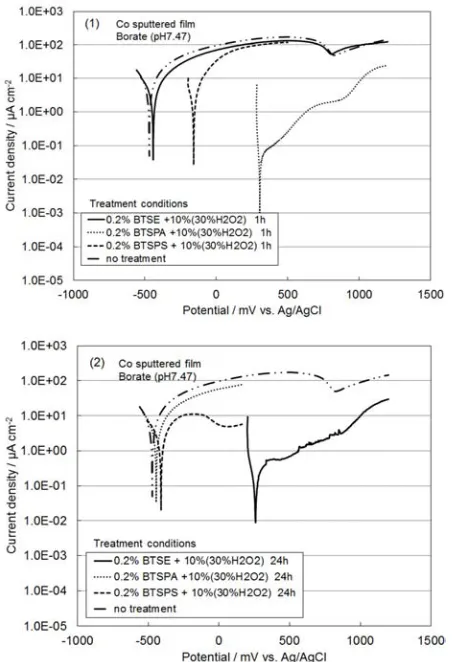
Figures 1-(1) and -(2) show the polarization curves, measured in borate solution, of the cobalt thin films treated in several silane coupling-ethanol solutions with H2O2 for one
hour and 24 hours, as well as those of untreated cobalt thin film. The polarization behavior of the cobalt thin film immersed in 0.2% BTSE-EtOH with hydrogen peroxide for one hour hardly changed from the untreated case, and no BTSE existed on the surface of the cobalt thin film. However,
Ecorr of the cobalt thin film treated in 0.2% BTSE-EtOH with
hydrogen peroxide for 24 hours shifted to the anode side, and the anodic current density decreased.
However, Ecorr and the anodic current density of the cobalt
thin film treated in 0.2% BTSE-EtOH with hydrogen peroxide for 24 hours, respectively, shifted to the anode side and decreased. Jcorr was 0.57 µA /cm2. Because the anodic current
density decreased, it is thought that a corrosion-restraining layer formed that was dependent on BTSE.
Figure 1. Polarization curves of sputtered cobalt films treated using several silane coupling–EtOH solutions with H2O2 for one hour (1) and 24 hours
Ecorr of the cobalt thin film treated in the 0.2%
BTSPA-EtOH solution with hydrogen peroxide for one hour shifted to the anode side as compared with that of the untreated cobalt thin film, and the anodic current density decreased. This behavior shows that a BTSPA layer formed on the cobalt thin film surface and improved corrosion resistance. However, Ecorr of the cobalt thin film immersed in this
solution for 24 hours shifted to the cathode side, and the anodic current density became the same as that of the untreated cobalt thin film. This behavior means that the BTSPA layer was removed by the long-term immersion or that the cobalt thin film was exposed to certain factors.
Although Ecorr of cobalt thin film immersed in 0.2%
BTSPS-EtOH with hydrogen peroxide for one hour shifted approximately -200 mV to the anode side, Jcorr did not
decrease as a result of this treatment. After the 24-hour immersion, Ecorr shifted to the same value as that of the
untreated cobalt thin film, and the anodic current slightly decreased on the anodic side.
Tables 1, 2, and 3 summarize the corrosion behaviors of cobalt thin films immersed in several silane coupling agents
under various conditions (concentration, immersion time, and pH). The corrosion behavior of cobalt thin film treated in BTSE-EtOH with hydrogen peroxide can be summarized as follows (Table 1): first, Jcorr decreased and Ecorr increased;
second, corrosion was controlled when the BTSE concentration and pH were increased and the treatment time was made longer.
The corrosion behavior of cobalt thin film treated BTSPA-EtOH solution can be summarized as follows (Table 2): first,
Jcorr decreased and Ecorr increased; second, corrosion became
uncontrollable when the BTSPA concentration and pH were high and the treatment time was long. This behavior is the opposite of that of the BTSE treatment. The corrosion behavior of cobalt thin film treated in the BTSPS solution can be summarized as follows (Table 3): first, the decreases in Jcorr were smaller than those of the other treatments;
second, when the pH of BTSPS was high and the treatment time long, corrosion could not be controlled; third, a thick film formed; the cobalt thin film surface was apparently discolored with gold colored interference. However, the corrosion resistance of the cobalt thin film did not improve.
Table 1. Corrosion potential (Ecorr) and corrosion current density (Jcorr) of thin cobalt film immersed in BTSE-EtOH solution with hydrogen peroxide.
Concentration of BTSE (wt%) Immersion time (h) pH Jcorr (µA/cm2) Ecorr (mV vs. Ag/AgCl) Comment
No- pretreatment ― ― 7.50 -470 ―
1.0 1 4.17 0.18 70 ―
0.2 1 4.62 1.66 -434 ―
0.2 24 4.62 0.057 218 ―
0.2 1 10.12 0.194 50 KOH addition
Table 2. Corrosion potential (Ecorr) and corrosion current density (Jcorr) of thin cobalt film immersed in BTSPA-EtOH solution with hydrogen peroxide.
Concentration of BTSPA (wt%) Immersion time (h) pH Jcorr(µA/cm2) Ecorr (mV vs. Ag/AgCl) Comment
No-pretreatment ― ― 7.50 -470 ―
0.5 1 5.89 0.0354 12 ―
0.2 1 6.46 0.0163 83 ―
0.5 24 5.89 0.106 30.8 The surface was discolored to whitish
0.2 24 6.46 0.100 110 The surface was discolored to whitish
0.2 1 10.90 7.05 -476 KOH addition
Table 3. Corrosion potential (Ecorr) and corrosion current density (Jcorr) of thin cobalt film immersed in BTSPS - EtOH solution with hydrogen peroxide.
Concentration of BTSPS (wt%) Immersion time (h) pH Jcorr(µA/cm2) Ecorr (mV vs. Ag/AgCl) Comment
No-pretreatment ― ― 7.50 -470 ―
1.0 1 3.00 1.58 -72 Surface color changes to gold
0.2 1 3.58 1.69 -67
1.0 24 3.00 0.870 7 Surface color changes to gold
0.2 24 3.58 4.45 -400
0.2 1 6.74 5.61 -420 KOH addition
Surface color changes to gold
3.2. Characterization of Treated Cobalt Thin Film Surface
3.2.1. SEM and AFM Observations
Figure 2 shows SEM and AFM images of an untreated cobalt thin film surface and a surface treated in 3% H2O2+7%H2O for one hour. The surface of the untreated
cobalt thin film was covered by uniform particles with diameters of 10 nm. On the other hand, the treated film surface had “grain-of-rice-like” deposits of cobalt oxide on it. Figure 3 shows SEM and AFM images of cobalt thin film surfaces treated in 0.2% BTSE-EtOH with hydrogen
peroxide for one hour and 24 hours.
Figure 2. SEM and AFM images of thin cobalt film surfaces non-treated and treated in 3% H2O2+7%H2O+EtOH for one hour.
Figure 3. SEM and AFM images of thin cobalt film surfaces treated in 0.2%
BTSE-EtOH solution with hydrogen peroxide for one hour and 24 hours.
Figure 4. SEM and AFM images of thin cobalt film surfaces treated in 0.2%
BTSPA-EtOH solution with hydrogen peroxide for 1 hour and 24 hours.
Figure 5. SEM and AFM images of thin cobalt film surfaces treated in 0.2%
BTSPS-EtOH solution with hydrogen peroxide for 1 hour and 24 hours.
Figure 4 shows SEM and AFM images of film surfaces treated in 0.2% BTSPA-EtOH with hydrogen peroxide. After one hour of immersion, the surface was uniformly covered with particles measuring 10-100 nm. Jcorr was very small,
namely, 0.0163 µA/cm2, because of the formation of uniform particles. Because this particles were clearly different in shape from the grain-of-rice-like particles shown in Figure 2 (non- treated surface), it is thought that they were a Co-BTSPA compound, not cobalt oxide. After 24 hours of immersion in 0.2% BTSPA-EtOH with hydrogen peroxide, the surface was covered with a thick sediment (a few hundred nanometers thick) with cracks. Jcorr after the 24-hour
treatment (0.10 µA/cm2) was not much different from that of the untreated cobalt thin film.
Figure 5 shows SEM and AFM images of the cobalt thin film surfaces treated in 0.2% BTSPS-EtOH with hydrogen peroxide for one hour and 24 hours. In either case, a large amount of pitting can be seen on the surface. Slim needle-like deposits (indicated by arrows) formed around the pit sites. The inside and outside of the pits were covered with particle-like deposits. The sizes of the particles in these deposits were different; namely, the particles inside the pits were smaller than the ones outside. As a result of these pits, the treatment in the BTSPS-EtOH solution with hydrogen peroxide did not improve corrosion resistance.
3.2.2. XPS Analysis
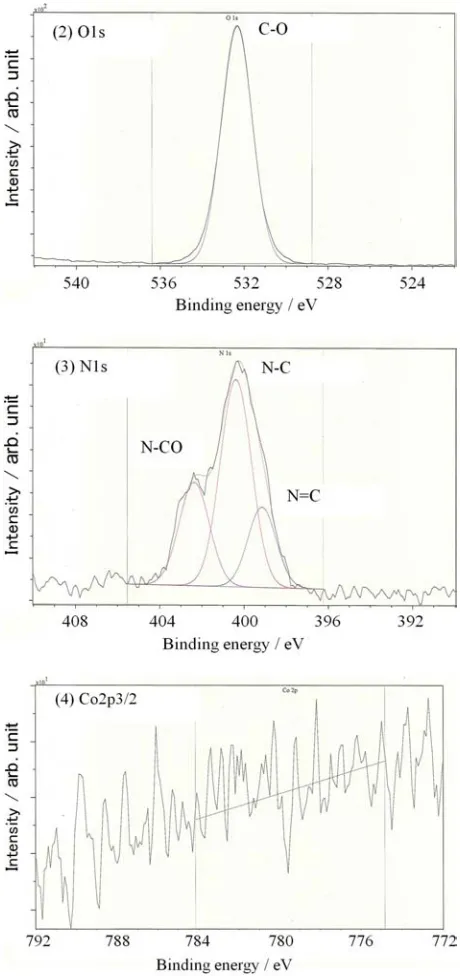
Figure 6 shows the Co2p and O1s XPS spectra of cobalt thin film treated in a 0.2%BTSE-ethanol solution with hydrogen peroxide for 24 hours. Si was not detected. The spectra indicate that the cobalt surface was covered with oxide and hydroxide. The O1s spectrum is of oxide, -OH, and C-O. The oxide and -OH bonding spectra come from oxides and hydroxides of cobalt, respectively. Despite that Si was not detected in the spectrum, a BTSE layer existed on the cobalt thin film surface because a C-O spectrum from it was detected in the O1s spectrum.
Figure 6. Co2p and O1sXPS spectra of thin cobalt film treated in BTSE-ethanol solution with hydrogen peroxide for 24 hours.
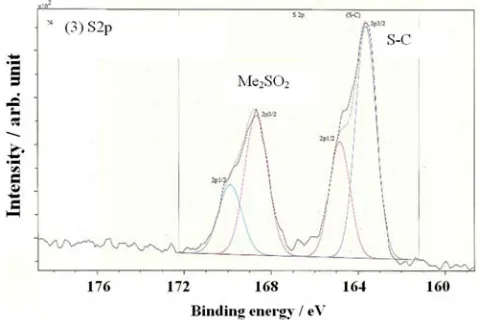
Figure 8 shows the Co2p, O1s and S2p XPS spectra of cobalt thin film treated in a 1.0% BTSPS-ethanol solution with hydrogen peroxide for 24 hours. The Co2p spectrum indicates that the cobalt thin film surface was covered with oxide and hydroxide. The O1s spectrum is divided into those of oxide, -OH, and C-O. The oxide and –OH spectra also show the existence of cobalt oxide and hydroxide. The detected C-O bonds show that BTSPS film formed on the cobalt thin film surface, though there is no spectrum of Si. The S2p spectrum has the two binding states. One comes from the S-C combination that is a component of BTSPS. It is assumed that the other binding state is a combination without BTSPS, but the spectrum could not be identified.
Figure 8. Co2p, O1s, and S2p spectra of thin cobalt film treated in 0.2%BTSPS-ethanol solution with hydrogen peroxide for 24 hours.
Table 4. Composition analysis by XPS of thin cobalt film treated with various solutions (at%).
Treatment condition Detected elements
Silane coupling agent Concentration (%) Immersion time (h) Co S Si O N C
BTSE 0.2 24 15.2 - - 51.6 - 32.3
BTSPA 0.2 1 - - 13.7 28.7 6.3 51.3
BTSPA 0.2 24 - - 15.9 38.2 5.0 40.8
BTSPS 0.2 1 11.9 3.4 - 51.9 - 32.2
BTSPS 0.2 24 10.0 7.9 - 50.6 - 31.0
Table 4 shows composition analysis by XPS of thin cobalt film treated in various solutions (at%). The Si spectrum from a silane-coupling agent was detected only when the cobalt thin film was treated in BTSPA-EtOH with hydrogen peroxide. The strength of the Si spectrum does not depend on the treatment time and remains at a constant value. It is supposed that a thick film formed because the existence ratio of carbon is bigger than that in the case of the other silane-coupling agents. The amount of sulfur in the film immersed in BTSPS-EtOH with hydrogen peroxide for 24 hours was approximately two times more than that of the film immersed for one hour, so the film thickness increased over time.
Tables 5-8 list the composition analysis from the Co 2p3/2, O1s, S2p and N1s spectra in which XPS was conducted on the surface of cobalt thin films treated with various solutions. The Co2p3/2 spectrum showed that most of the cobalt was in the form of oxide or hydroxide, because its surface was
oxidized by coexisting hydrogen peroxide. The O1s spectrum of the silane-coupling layer formed by the 0.2% BTSE and 0.2% BTSPA treatments indicated that most of the oxygen existed in the form of oxide or hydroxide.
The analysis for the S2p spectrum of the cobalt thin film after the BTSPS treatment shows that the ratios of other combination compounds such as Me2SO2 were high in the
case of the one-hour immersion. After the 24-hour immersion, the ratios of S-C-bonds derived from the main skeleton of BTSPS increased. It is considered that the BTSPS on the cobalt thin film that was immersed for the short time decomposed and the decomposition compounds adsorbed on cobalt thin film. In contrast, during the long immersion, BTSPS adsorbed on the decomposition product without decomposition. Because the N-C spectrum from the main skeleton grew stronger over time, it is supposed that the thickness of BTSPA increased as time progressed.
Table 5. Composition analysis from the Co 2p3/2 spectra by XPS on the surface of thin cobalt film treated with various solutions (%).
Treatment condition Morphology
Silane-coupling agent Concentration (%) Immersion time (h) Co Co-O Co (OH) 2
BTSE 0.2 24 5 47 48
BTSPS 1.0 1 - 48 52
BTSPS 1.0 24 - 40 60
Table 6. Composition analysis from the O1s spectra by XPS on the surface of thin cobalt film treated with various solutions (%).
Treatment condition Morphology
Silane-coupling agent Concentration (%) Immersion time (h) Oxide -OH C-O, Si-O
BTSE 0.2 24 32 59 9
BTSPA 0.2 1 23 66 11
BTSPA 0.2 24 20 72 8
BTSPS 0.2 1 - - 100
Table 7. Composition analysis from the S2p spectra by XPS on the surface of thin cobalt film treated with various solutions (%).
Treatment condition Treatment condition
Silane-coupling agent Concentration (%) Immersion time (h) S-C Other binding (Me2SO2)
BTSPS 0.2 1 11 90
BTSPS 0.2 24 59 41
Table 8. Composition analysis from the N1s spectra by XPS on the surface of thin cobalt film treated with various solutions (%).
Treatment condition Morphology
Silane-coupling agent Concentration (%) Silane-coupling agent Concentration (%) Silane-coupling agent Concentration (%)
BTSPA 0.2 BTSPA 0.2 BTSPA 0.2
BTSPA 0.2 BTSPA 0.2 BTSPA 0.2
4. Discussion
4.1. HSAB Principle
The relationship between corrosion inhibition and the silane structure can be described in terms of inhibitor actions as follows. The interactions between an inhibitor and a metal surface can roughly be categorized into three types: adsorbed, oxidized, and precipitated. The action of an inhibitor is based on the reaction of a Lewis acid and a base for the following cases.
(1)adsorbed type (chemical adsorption): [M] + RX: → [M]:XR
(2)oxidized type (formation of hydroxide precipitate): Mn+ + n:OH- → [Mn+(:OH-)n]
(3)precipitated type (formation of complex precipitation): Mn+ + nRX:- → [Mn+(:XR-)n]
Here, [M] and Mn+ are Lewis acids, and RX:, : OH-, and RX:- are Lewis bases. The stability of these reaction products can be evaluated according to the “hard and soft acid-base (HSAB) principle.” According to this principle, acids and bases are classified as hard and soft. When combinations of atoms and ions are put in an electric field, an atom or ion that is easy to change (polarizable) is defined as soft, whereas one that is difficult to change (non-polarizable) is defined as hard. Outer shell electrons around an atom or ion are attracted to the nucleus via the electrostatic force. Thus, a small atom or ion resists deformation when placed in an electric fieled due to the strong electrostatic attraction between outer shell electrons and nucleus (hard species). On the contrary, an atom or ion with a large size is easily deformed when placed in an electric field due to weak electrostatic attraction between outer shell electrons and the nucleus (soft species). As a result, a bulk-metal surface is soft, and a multivalent metal ion is a hard acid. Moreover, certain atoms and ions, namely, oxygen, fluorine, chlorine and nitrogen are hard bases, and others, such as sulfur, phosphorus, and iodine, are soft bases. According to the HSAB principle, a hard acid and a hard base make an acid-base combination (coordinate bond) with a stable ionic bond, and a soft acid and a soft base make a coordinate bond with a stable covalent bond nature. Other combinations, however, cannot easily make a stable
combination. Bases and acids are classified in Table 9[14]. The HSAB principle can shed light on the mechanism of corrosion resistance offered by the silane-coupling agent, as follows.
4.2. Application of the HSAB Principle to the Combination of Cobalt and BTSE
The end of the silane-coupling agent is a hard base because of OH- and RO- formed by hydrolysis. Therefore, it is necessary to oxidize cobalt and to form a polyvalent ion on the surface for a stable coupling film, because only a hard acid can be combined with a hard base (Figure 9-(1)(2)). Because the cobalt surface can be covered with BTSE by using hydrogen peroxide together with BTSE, the cobalt thin film surface has a corrosion-restraining action.
4.3. Application of the HSAB Principle to the Combination of Co and BTSPA
The corrosion resistance of cobalt thin film immersed in the BTSPA-EtOH solution with hydrogen peroxide for one hour was superior to that of the film immersed in BTSE. BTSPA has a nitrogen atom in the main-chain skeleton. Because nitrogen is a hard base (Table 9), nitrogens other than those in the hydroxide group at each end of BTSPA can bond to cobalt. Therefore, corrosion resistance improved because a film a few nanometers thick formed (as shown in Figure 4). However, the corrosion of the cobalt thin film immersed in the solution for 24 hours decreased. This behavior can be explained by the fact that a thick film (of a few hundred nanometers) formed on the cobalt thin film surface immersed for 24 hours, because the rate of the reaction between BTSPA and cobalt is high, and the film cracked when it was dried. Because the nitrogen spectrum showed at least three-combination-state bonding, BTSPA was partly decomposed. After the one-hour immersion, the ratio of nitrogen to silicon in the cobalt film was N : Si = 1:2. On the other hand, after the 24-hour immersion, the ratio changed to 1:3, so the ingredient ratio of N in the film decreased. This behavior can be explained as follows. The C-N-C combination of BTSPA was severed by hydrolysis, two (CH3O)2Si (CH3) 3-
formed, and NH3 formed. When NH3 formed, the pH of the
Table 9. Classification of bases and acids.
Acid Base
Hard H+, Na+, Co3+, oxide, hydroxide, multivalent ion, hydrogen-bonding molecule H
2O, OH-, RO-, RNH2, RNH, RCOO
-Soft Bulk metal, Cu+, Ag+, Au+ R
2S, RS-, CN-, R-, RSH
4.4. Application of the HSAB principle to the Combination of Cobalt and BTSPS
As for the treatment in the BTSES-EtOH solution with hydrogen peroxide, a film a few hundred nanometers in thickness formed on the cobalt surface, but the corrosion resistance hardly improved. Because BTSPS contains sulfur (which is a soft base; Table 9) in the main skeleton, it cannot easily bond to the polyvalent cobalt ion (which is a hard acid), and thus, a stable compound did not form (Figure 9-(2)).
Figure 9. Adsorption model of BTSE on cobalt surface.
5. Conclusion
Surface treatments using 1, 2-Bis (triethoxysilyl) ethane (BTSE), bis [triethoxysilylpropyl]amine (BTSPA) and 1.2-bis [triethoxysilyl]tetrasulfide (BTSPS) were conducted for the purpose of improving the corrosion resistance of thin cobalt films. A silane-coupling layer formed on the cobalt as a result of each of these treatments. However, the corrosion resistances offered by the different layers varied significantly. Immersion in BTSE with hydrogen peroxide for one hour did not yield an improvement, whereas immersion for 24 hours resulted in a large improvement. In contrast, immersion in BTSPA with hydrogen peroxide for 24 hours did not lead to a corrosion improvement, whereas immersion for one hour provided corrosion resistance. Finally, immersion in BTSPS with
hydrogen peroxide for either amount of time yielded no improvement, because of the poor coherency of the deposit on cobalt. The hard and soft acid-base (HSAB) principle was invoked to determine whether the film had good corrosion resistance or not.
References
[1] V. Subramaniam and W. J. van Ooij, Surf. Eng., 15, (2), (1999) 1-5.
[2] M. Bethencourt, F. J. Botann, M. J. Cano, and M. Marcos, Appl. Surf. Sci., 238, (2004) 278-284.
[3] M. Dabala, L. Armelao, A. Buchberger, and I. Calliari, Appl. Surf. Sci., 172, (2001) 312-322.
[4] M. A. Arenas, M. Bethencourt, F. J. Botana, J. de Damborenea, and M. Narcos, Corros. Sci., 43, (1), (2001) 157-170.
[5] X. Zhang, C. Van Den Bos, W. G. Sloof, H. Terryn, A. Hovestad, and J. H. W. De Wit, Surface Engineering, 20, (4), (2004) 244-250.
[6] Bhatt H., Manavbasi A., and Rosenquist D., Metal Finishing, 107, (7-8), (2009) 31-37.
[7] A. Franquet, H. Terryn, and J. Vereecken, Surf. Interf. Anal., 36, (8), (2004) 681-384.
[8] W. Trabelsi, E. Triki, L. Dhouibi, M. G. Ferreira, M. L. Zheludkevich, and M. F. Montemor, Surf. Coat. Technol., 200, (2006) 4240-4250.
[9] W. J. van Ooij and D. Zhu, Corrosion, 27, (5), (2001) 413-427.
[10] M. F. Montemor and M. G. S. Ferreira, Surf. Interf. Anal., 36, (8). (2004) 773-776.
[11] Angelja K. Surca, Aleksander Rauter, Mirjana Rodosek, Lidilija Slemenik Perse, Matlaz Kozelj and Boris Orel, Progress in Organic Coatings, 103 (2017) 1-14.
[12] Mirjana Rodosek, Matjaz Kozelj, Lidija Slemenik Perse, Romana Cerc Korosec, Miran Gaberscek and Angelja Kjara Surca, Corrosion Science, 126 (2017) 55-68.
[13] Katsumi. Mabuchi, Zairyo to Kankyo, 64, (2), (2015) 42-50. [14] Ralph G. Pearson, J. Chemical Education, 45, (9), (1968)