Collaborative Learning with Application
of Screen-based Technology in Physical
Education
Gabriela Luptáková
1and Branislav Antala
1Affiliations:1Comenius University, Faculty of Physical Education and Sports, Bratislava, Slovakia
Correspondence: Gabriela Luptáková, Faculty of Physical Education and Sports, Comenius University, Nábr. Arm. Gen. L. Svobodu 9, 81469 Bratislava, Slovakia. E-mail: [email protected]
ABSTRACT Collaborative learning has been shown to be a useful tool for improving several social skills in students; however, it is very diffi cult to set up the initial conditions that guarantee its eff ectiveness. Since group projects are made for students and, most importantly, by students, we should not forget to take their opinions based on previous experience into consideration, which might increase the effi ciency of their own learning. Th erefore, the aim of the study was to investigate what secondary school students learn from and think about group projects in Physical Education. A total of 94 secondary school students (46 girls and 48 boys) participated in the study carried out in the 2015/2016 school year. Th e participants were given the assignment to create a video exercise, which they were working on in small groups in PE. A questionnaire was designed to investigate students’ learning outcomes, participation, evaluation, and attitudes towards the project. Diff erences for selected categorical variables were determined using the Chi-square test. Th e majority of the students reported improvement in selected social skills and better relationships with their teammates. In addition, several signifi cant diff erences in students’ opinions with respect to age and gender were found.
KEY WORDS Physical Education, Collaborative learning, Social skills, Attitudes, Technology.
Introduction
Nowadays, employers suggest that schools at all levels need to do more to better prepare students to work in team-based environments. Life skills/social skills have become equally important to the “technical skills” that are still very oft en prioritized at schools in many countries. Riebe, Girardi, and Whitsed (2016) underline that being able to work eff ectively and productively with others in teams is essential in the 21st-century employment market. Th e importance of teamwork capability is repeatedly highlighted in reports from western and other economies. Th e authors emphasise that teamwork capability can be developed, supported, and improved through eff ective teamwork pedagogy in which collaborative, cooperative, or experiential learning strategies are necessary.
Collaborative learning creates an environment where students at various performance levels work together in small groups towards a common goal, which encourages their active participation. Th e students are responsible for one another’s learning as well as their own. Th us, the success of one student helps other students to be successful (Gokhale, 1995). Shared learning gives students an opportunity to engage in discussion, take responsibility for their own learning, and thus become critical thinkers (Totten, Sills, Digby & Russ, 1991). Group work can be used to encourage deeper learning and promote students’ autonomy by transferring some of the responsibility for teaching and learning to them (Hughes & Large, 1993; Somervell, 1993).
To make the collaborative learning successful, it is necessary to monitor and regulate the interactions. Th erefore, the teacher retains an important role in the success of collaborative learning as a facilitator. His role is not to provide the right answer to the students or to say which group members are right, but to facilitate
Accepted aft er revision: May 11 2017 | First published online: September 01 2017
© 2017 by the author(s). License MSA, Podgorica, Montenegro. Th is article is an open access article distributed under the terms and conditions of the Creative Commons Attribution (CC BY).
Confl ict of interest: None declared. @MJSSMontenegro
and redirect the group work in a productive direction with minimal pedagogical intervention (Dillenbourg, 1999). In a collaborative classroom, the teacher encourages students’ use of their own knowledge, ensures that students share their knowledge, expertise and their learning strategies, treat each other respectfully, and focus on high levels of understanding (Bonwell & Eison, 1991).
Another certain way to increase the probability that some types of interaction occur is to carefully design the situation. Th e most frequent questions that teachers ask themselves are: What is the optimal group size? Should I select group members with respect to some criteria or let them form groups by themselves? Boys and girls together or rather separately? Which tasks are suitable for collaborative processes? Th ese and other questions have inspired empirical research on collaborative learning. However, beyond a few main results, it appears that these conditions interact with each other in a complex way (Dillenbourg, 1995).
Because of these multiple interactions, it is very diffi cult to set up initial conditions that guarantee the eff ectiveness of collaborative learning. Since group projects are made for students and, most importantly, by students, we should not forget to take their opinions based on previous experience into consideration, which might increase the effi ciency of their own learning.
Moreover, this paper is also supported by Fullan’s (2013) arguments about technology having the potential to accelerate learning. Th e seemingly unstoppable growth in youth’s engagement with digital technologies in their personal lives means that digital technologies are socially relevant (Casey, Goodyear & Armour, 2017). Th is is also a growing opportunity to act as a medium through which to engage young people in immediate, attractive and increasingly personalized ways (Greenhow & Lewin, 2016; Selwyn & Stirling, 2016). Applying new technologies in teaching PE and at school settings is considered to be a possible means of teaching-learning process effi ciency and of forming the children’ relationship with physical activities, and therefore their performance both in and out of PE (Arnett & Lutz 2003; Štemberger, Knjaz & Tománek, 2011; McKenzie et al., 2013; Cardon et al. 2012; Lee, Burgeson, Fulton & Spain, 2006; Bendíková & Pavlovič, 2013).
Th erefore, the aim of the present study was to investigate what secondary school students learn from and think about the group project with the application of new technologies in Physical Education.
Methods
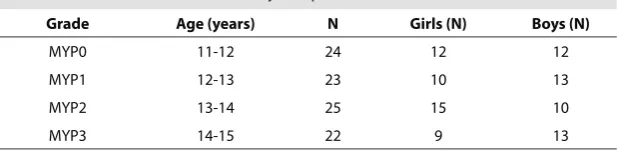
Th is study reports on a pedagogical experiment that was carried out in the 2015/2016 school year on a sample of 94 Middle Years Programme students (46 girls and 48 boys) of United School Novohradska located in Bratislava, Slovakia. Basic characteristics of the sample are presented in Table 1 below.
Th e participants were given a group assignment, which they were working on for nine weeks in Physical Education, once a week. Th e students were split into the coeducational groups of four to fi ve members by their PE teachers. Th e aim of the assignment was to create a video-exercise, called the “Brain Break”, respecting several criteria such as a time limitation (3-5 minutes), a space limitation (classroom settings), a theme limitation (sports, dance, fi tness, adapted, cultural), etc. Every team member played a specifi c role in the project. One was responsible for choreography, others for music, camera, video editing, and the performance. Before the project started, the students had watched some Brain Breaks made by HOPSports© online to get a better idea of and inspiration for the assignment.
A questionnaire was designed to investigate students’ learning outcomes, participation, evaluation, and attitudes towards the project. Th e questionnaire was anonymous for the students, and it consisted of 22 closed questions plus an open question to which the students could comment on the project. Possible answers were arranged across four-item scale: (1) strongly agree, (2) agree, (3) disagree and (4) strongly disagree. Given responses were binarized when answers “strongly agree” and “agree” represented the positive opinion “Yes” and “disagree” and “strongly disagree” represented the negative opinion “No”.
All the analyses were processed using SPSS Statistics, v. 17. First, we determined the number of answered questions using percentages (%). Diff erences for selected categorical variables (age and gender) were determined using Chi-square test (χ2). Statistical signifi cance was set up at p<0.05. Students’ answers to the open question were analysed qualitatively.
Th is study was approved in advance by the Faculty of Physical Education and Sports at Comenius University, as well as by the United School Novohradska/Gymnasium of Juraj Hronec, where the experiment was conducted. Each participant voluntarily provided written informed consent before participating.
TABLE 1 Characteristics of the study sample
Grade Age (years) N Girls (N) Boys (N)
MYP0 11-12 24 12 12
MYP1 12-13 23 10 13
MYP2 13-14 25 15 10
Results
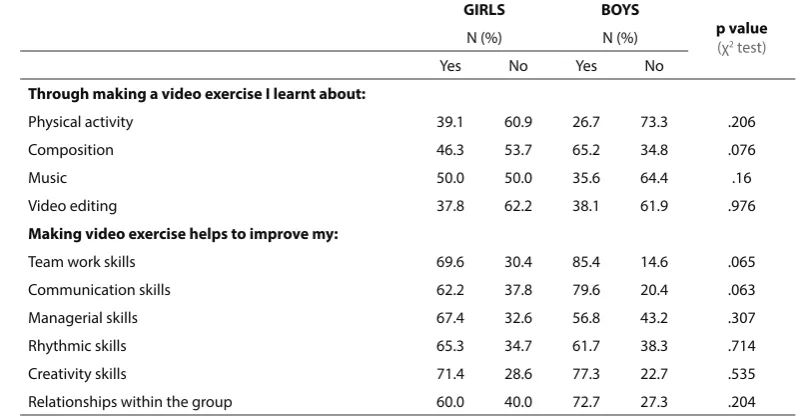
Among all the students, the prevalence of the students reporting knowledge acquired about composition was 56%. In round fi gures, 40% of them reported knowledge gained about the music as well as about video editing. Only 33% of all the students reported knowledge gained about physical activity. Signifi cantly, there was no statistical diff erence between the self-reported acquired knowledge of boys and girls as well as between the students of diff erent age (Table 2 and 3).
Similarly, no statistical diff erences in self-reported teamwork, managerial and creativity skills were found among diff erently aged students when the majority of all students reported improvement in aforementioned skills. However, a lower number of MYP 2 students reported improvement in communication and rhythmic skills compared to the rest of the students (p<0.01). Additionally, only 36.4% of MYP 2 students reported improvement of relationships with their teammates, which is a signifi cantly lower number in comparison with all the other students (p<0.05), (Table 2). In contrast, no signifi cant diff erences in self-reported improved skills were found between the boys and the girls (Table 3).
In Tables 4 and 5 below, students’ attitudes towards the assignment are presented with respect to age and gender. When analysing students’ attitudes towards the assignment, the only question for which no statistical diff erence between the students of diff erent age or gender was found, is “I can fi nd a certain value in doing this kind of project”; 62% of the students agreed with this statement.
TABLE 2 Students’ self-reported acquired knowledge and improved skills with respect to age
Total MYP0 MYP1 MYP2 MYP3
p value (χ2 test)
N (%) N (%) N (%) N (%) N (%)
Yes No Yes No Yes No Yes No Yes No
Through making a video exercise I learnt about:
Physical activity 33.0 67.0 22.7 77.3 35.0 65.0 31.8 68.2 11.1 88.9 .327
Composition 56.3 43.7 63.6 36.4 47.4 52.6 40.9 59.1 61.1 38.9 .39
Music 43.0 57.0 33.3 66.7 55.0 45.0 18.2 81.8 33.3 66.7 .097
Video editing 37.9 62.1 18.2 81.8 55.0 45.0 27.3 72.7 38.9 61.1 .072
Making video exercise helps to improve my:
Team work skills 77.7 22.3 86.4 13.6 85.0 15.0 54.5 45.5 72.2 27.8 .059
Communication skills 71.3 28.7 90.9 9.1 75.0 25.0 36.4 63.6 66.7 33.3 .001**
Managerial skills 62.1 37.9 63.6 36.4 60.0 40.0 54.5 45.5 61.1 38.9 .94
Rhythmic skills 63.5 36.5 77.3 22.7 70.0 30.0 27.3 72.7 55.6 44.4 .005**
Creativity skills 74.4 25.6 71.4 28.6 85.0 15.0 72.7 27.3 61.1 38.9 .429
Relationships with others 66.3 33.7 68.2 31.8 75.0 25.0 36.4 63.6 77.8 22.2 .019*
Legend: *p<0.05, **p<0.01
TABLE 3 Students’ self-reported acquired knowledge and improved skills with respect to gender
GIRLS BOYS
p value (χ2 test)
N (%) N (%)
Yes No Yes No
Through making a video exercise I learnt about:
Physical activity 39.1 60.9 26.7 73.3 .206
Composition 46.3 53.7 65.2 34.8 .076
Music 50.0 50.0 35.6 64.4 .16
Video editing 37.8 62.2 38.1 61.9 .976
Making video exercise helps to improve my:
Team work skills 69.6 30.4 85.4 14.6 .065
Communication skills 62.2 37.8 79.6 20.4 .063
Managerial skills 67.4 32.6 56.8 43.2 .307
Rhythmic skills 65.3 34.7 61.7 38.3 .714
Creativity skills 71.4 28.6 77.3 22.7 .535
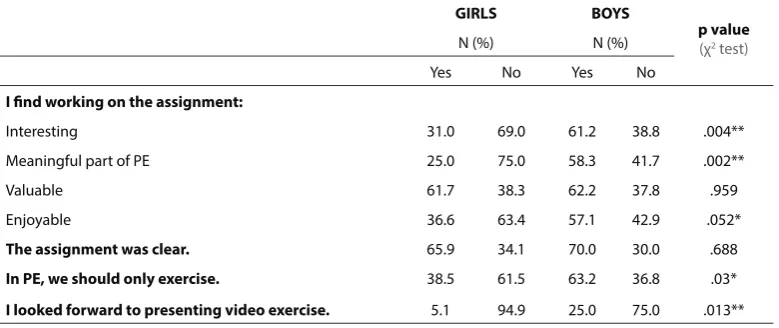
A signifi cantly lower number of MYP 2 students as well as of the girls think that this kind of group activity is interesting (p<0.05) and that it is a meaningful part of education in PE (p<0.01), in comparison to other age groups and the boys.
Although 67.9% of all the students reported that the assignment was clear and instructions were easy to understand, 59.1% of MYP 2 students maintained the contrary (p<0.01).
A strong majority (84.3%) of the students reported that they were not looking forward to presenting the video exercise to their classmates and the teacher. However, with respect to gender, more girls showed negative attitudes than the boys did (p<0.01).
In contrast, major variances in the attitudes among the students (50:50) were found in two questions: (1) “In PE we should only exercise and not do projects like this although they include physical activity”, and (2) “I enjoyed working on the project”. In both cases, more boys agreed with the statements than the girls did (p<0.05).
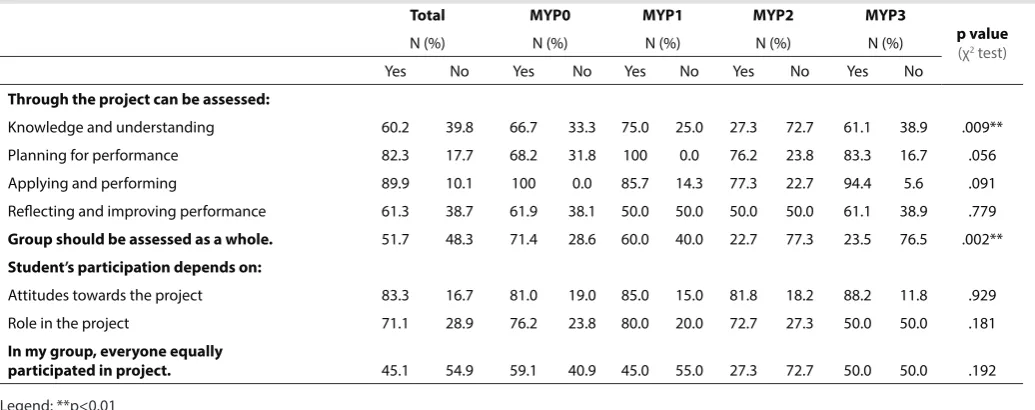
Students’ opinions about the evaluation of and participation in the assignment are presented in Tables 6 and 7. Regarding an evaluation of the project, about 60% of all the students reported that knowledge and understanding as well as refl ecting on and improving performance can be assessed through the project. Over 82% of the students reported that planning for performance and applying and performing can be assessed. However, a very low number of MYP 2 students think that knowledge and understanding can be evaluated through the project in comparison to the students of other ages (p<0.01). Most importantly, 51.7% of the students regardless the age and gender reported that a group should be assessed as a whole; in other words, every group member should get the same grade. More boys and younger students agreed with the statement than the girls (p<0.05) and the older students did (p<0.01).
TABLE 4 Students’ attitudes towards the assignment with respect to age
Total MYP0 MYP1 MYP2 MYP3
p value (χ2 test)
N (%) N (%) N (%) N (%) N (%)
Yes No Yes No Yes No Yes No Yes No
I fi nd working on the assignment:
Interesting 47.3 52.7 59.1 40.9 35.0 65.0 18.2 81.8 55.6 44.4 .023*
Meaningful part of PE 43.2 56.8 50.0 50.0 60.0 40.0 9.1 90.9 38.9 61.1 .004**
Valuable 62.0 38.0 57.1 42.9 70.0 30.0 45.5 54.5 55.6 44.4 .46
Enjoyable 47.8 52.2 61.9 38.1 30.0 70.0 40.9 59.1 33.3 66.7 .16
The assignment was clear. 67.9 32.1 90.9 9.1 65.0 35.0 40.9 59.1 72.2 27.8 .005**
In PE, we should only exercise. 50.7 49.3 59.1 40.9 40.0 60.0 45.5 54.5 72.2 27.8 .183
I looked forward to presenting video
exercise. 15.7 84.3 0.0 100 15.8 84.2 9.1 90.9 27.8 72.2 .064
Legend: *p<0.05, **p<0.01
TABLE 5 Students’ attitudes towards the assignment with respect to gender
GIRLS BOYS
p value (χ2 test)
N (%) N (%)
Yes No Yes No
I fi nd working on the assignment:
Interesting 31.0 69.0 61.2 38.8 .004**
Meaningful part of PE 25.0 75.0 58.3 41.7 .002**
Valuable 61.7 38.3 62.2 37.8 .959
Enjoyable 36.6 63.4 57.1 42.9 .052*
The assignment was clear. 65.9 34.1 70.0 30.0 .688
In PE, we should only exercise. 38.5 61.5 63.2 36.8 .03*
I looked forward to presenting video exercise. 5.1 94.9 25.0 75.0 .013**
With regard to participation in the project, the majority of the students think that one’s participation depends on his/her attitude towards the project (83.3%) as well as his/her role in it (71.1%). In addition, almost one half of the students reported that every group member equally participated in doing the project, but fewer girls than the boys did (p<0.01).
Discussion
Th e aim of the present study was to investigate what secondary school students learn from and think about the group project with the application of screen-based technology in Physical Education. Riebe et al. (2016) found that interest in teaching teamwork in higher education courses was more prolifi c in the most recent decade (n = 45; 2005 through 2015) than in the previous one (n = 12; 1995 through 2004), which might be caused by current market demand. Authors’ fi ndings regarding the research methods employed across journal articles show that quantitative methods remain a popular approach when investigating the effi cacy of teamwork pedagogies. Furthermore, some articles (26%) were categorized as conceptual, describing pedagogical interventions or tools for teaching teamwork skills, but not empirically examining such strategies. Samples reported in the journal articles are considered to be small, with 26% reporting sample sizes smaller than 100 individuals, which is also, regrettably, the case of this study. We agree with the authors that future research using longitudinal designs with larger samples would contribute to evidence-based knowledge about the implications of teamwork pedagogy in education.
TABLE 6 Students’ opinions about the evaluation of and participation in the assignment with respect to age
Total MYP0 MYP1 MYP2 MYP3
p value (χ2 test)
N (%) N (%) N (%) N (%) N (%)
Yes No Yes No Yes No Yes No Yes No
Through the project can be assessed:
Knowledge and understanding 60.2 39.8 66.7 33.3 75.0 25.0 27.3 72.7 61.1 38.9 .009**
Planning for performance 82.3 17.7 68.2 31.8 100 0.0 76.2 23.8 83.3 16.7 .056
Applying and performing 89.9 10.1 100 0.0 85.7 14.3 77.3 22.7 94.4 5.6 .091
Refl ecting and improving performance 61.3 38.7 61.9 38.1 50.0 50.0 50.0 50.0 61.1 38.9 .779
Group should be assessed as a whole. 51.7 48.3 71.4 28.6 60.0 40.0 22.7 77.3 23.5 76.5 .002**
Student’s participation depends on:
Attitudes towards the project 83.3 16.7 81.0 19.0 85.0 15.0 81.8 18.2 88.2 11.8 .929
Role in the project 71.1 28.9 76.2 23.8 80.0 20.0 72.7 27.3 50.0 50.0 .181
In my group, everyone equally
participated in project. 45.1 54.9 59.1 40.9 45.0 55.0 27.3 72.7 50.0 50.0 .192
Legend: **p<0.01
TABLE 7 Students’ opinions about the evaluation of and participation in the assignment with respect to gender
GIRLS BOYS
p value
(χ2 test)
N (%) N (%)
Yes No Yes No
Through the project can be assessed:
Knowledge and understanding 55.8 44.2 64.4 35.6 .408
Planning for performance 86.0 14.0 78.6 21.4 .366
Applying and performing 86.4 13.6 93.3 6.7 .276
Refl ecting an improving performance 54.3 45.7 68.1 31.9 .174
Group should be assessed as a whole. 40.5 59.5 61.2 38.8 .048*
Student’s participation depends on:
Attitudes towards the project 86.8 13.2 80.0 20.0 .418
Role in the project 75.6 24.4 66.7 33.3 .369
In my group, everyone equally participated in project. 27.0 73.0 60.0 40.0 .003**
Researchers contend that training higher education students in teamwork can lead to higher academic achievement (Rapp & Mathieu, 2007). Similarly, results of the present study show that secondary school students acquired some knowledge about composition, music, physical activity, and video editing. In addition, they improved their teamwork, managerial and creativity skills.
About half of the students think that they should only exercise in PE and not do group projects although they include physical activity. In contrast, a similar number of students think that projects are a meaningful part of education in PE; moreover, over 50% of them can fi nd a certain value in this kind of group activity in Physical Education, regardless of their age and gender. Th e following students’ statements support mentioned fi ndings: “Th e BrainBreak was a great project even though I personally think that PE projects are a bit ridiculous” (boy, 12 years old). “... students in diff erent schools usually don’t do projects...” (girl, 15 years old). “Such projects do not belong in PE” (boy, 14 years old). “I found this project interesting however I’m not sure if I want to do it again” (boy, 15 years old).
Half of the students enjoyed working on the project, but almost nobody looked forward to presenting the video-exercise to their classmates, which is supported by these comments: “...this type of project has its pluses and minuses. I enjoyed doing this project but I didn’t like the part where we had to show it to the other people” (girl, 14 years old) or “... a project is OK but a video is embarrassing” (girl, 13 years old).
Most of the students’ negative expressions concerned evaluation that is strongly connected to the group selection and students’ participation in the assignment. In particular, 13- to 14-year old girls had grievances about group evaluation. Two very strong comments are presented below.
... we didn’t get to choose the groups which made it very diffi cult. No matter how much you think we should improve our cooperation it just made it worse. When 90% of the group wants to work and we can’t get the rest to work, we end up doing everything last minute because of them, and we got a bad grade which could ruin my whole grade, but we still have to be graded as a group. Now think – how is this fair?” (girl, 14 years old).
“Our group was awful and full of lazy people that just want to take the credit for the work of others. How is giving us the same grade fair?! Th e group was awful, because we couldn’t choose it ourselves. Th e boys never want to work and pull down the entire group. Why should we suff er because of their incapability of doing a project? ...” (girl, 14 years old).
Working in a group is a skill that needs to be learnt and might be improved consequently. Th e reviewed journal articles by Riebe et al. (2016) indicate that educators oft en place students in teams with little or no instruction on how to work in teams prior to assigning complex team projects (e.g., Hansen, 2006; Raff erty, 2012; Sashittal, Jassawalla & Markulis, 2011). We suggest that students must be repeatedly exposed to collaborative/cooperative learning environments to improve their social skills, such as teamwork skills, cooperation, communication, confl ict resolution, etc. In this study, a 13-year old boy made a comment that “Th e instructions were understandable but we didn’t know what you expected from us. It was the fi rst time – now we learned” (boy, 13 years old). Similarly, another boy (13 years old) wrote: “It was the fi rst time, so the grades didn’t turn out well because we weren’t 100 % sure what the teachers wanted to see. Next time they’ll be better...”.
Many motivational theories highlight the infl uence social environments have on pupils’ motivation. In addition, teachers can support pupils’ need for relatedness that is concerned with being connected to others through feelings of belonging and being valued by interactive group activities like the case of PE teacher Dylan Blain who applied such activities with application of the new technologies in teaching basketball to a class of boys aged 13-14 (Casey et al., 2017).
According to Riebe et al. (2016), some educators are challenged by the transition from teacher-centred to collaborative/cooperative teaching methods, which constitutes a signifi cant psychological constraint when it comes to adopting collaborative instructional strategies. Many articles (e.g. Gilson, Maynard & Bergiel, 2013; Kirby, 2011; Snyder, 2010) reported that for some educators it is not always clear how they should teach teamwork skills; therefore, educators may be inadequately prepared to take on the task (Tombaugh & Mayfi eld, 2014). Th is has an impact on both educators and students. Many educators are discipline-based scholars and, because of this, they may not have had any formal training in teaching methods or be familiar with resources or collaborative approaches to develop students’ teamwork skills (e.g. Hansen, 2006; Kliegl & Weaver, 2013; Sashittal et al., 2011). Similarly, the literature suggests that while some teachers are enthusiastic technology adopters, others are more resistant, perhaps feeling they lack organizational and administrative support or expertise to integrate it (Fullan, 2013).
To conclude, it is crucial to train future teachers in physical education teacher education programs how to teach teamwork skills as much as they do motor skills as well as how to integrate new technologies into Physical Education classes.
Acknowledgements
technologies in Physical and Sport Education and their eff ects on an aff ective and a cognitive development of a secondary school pupil”.
R E F E R E N C E S
Arnett, M. G., & Lutz, R. B. (2003). Measurement of moderate to vigorous physical activity of middle school girls, using trigram activity monitors during small-sided, game-based lessons. Measurement in Physical Education and Exercise Science, 7(3), 149-59.
Bendíková, E., & Pavlović, R. (2013). Impact of the exercise programme based on Flowin concept and implemented in physical and sports education classes on functions of the postural muscle system. Sport scientifi c and practical aspects: international scientifi c journal of kinesiology, 10(2), 25-33.
Bonwell, C. C., & Eison, J. A. (1991). Active Learning: Creating Excitement in the Classroom. ASHE-ERIC Higher Education Report No. 1. Washington, DC: Th e George Washington University, School of Education and Human Development.
Casey, A., Goodyear, V. A., & Armour, K. M. (2017). Digital Technologies and learning in Physical Education: Pedagogical cases. Oxon: Routledge.
Cardon, G. M., Van Acker, R., Seghers, J., De Martelaer, K., Haerens, L. L., & De Bourdeaudhuij, I.M.M. (2012). Physical activity promotion in schools: which strategies do schools (not) implement and which socioecological factors are associated with implementation? Health education research, 27(3), 470-483. Dillenbourg, P. (1999). What do you mean by collaborative learning? In P. Dillenbourg (Ed.),
Collaborative-learning: Cognitive and Computational Approaches (pp. 1-19). Oxford: Elsevier.
Ding, H., & Ding, X. (2008). Project management, critical praxis, and process-oriented approach to teamwork.
Business Communication Quarterly, 71, 456-471. doi:10.1177/1080569908325861
Fullan, M. (2013). Stratosphere: Integrating technology, pedagogy and changed knowledge. Toronto, ONT: Pearson.
Gilson, L., Maynard, M. T., & Bergiel, E. B. (2013). Virtual team eff ectiveness: An experiential activity. Small Group Research, 44, 412-427. doi:10.1177/1046496413488216
Gokhale, A. A. (1995). Collaborative Learning Enhances Critical Th inking. Journal of Technology Education,
7(1), 22-30.
Goldfi nch, J., Laybourn, P., MacLeod, L., & Stewart, S. (1999). Improving groupworking skills in undergraduates through employer involvement. Assessment & Evaluation in Higher Education, 24, 41-51. doi:10.1080/0260293990240104
Greenhow, C., & Lewin, C. (2016). Social media and education: Reconceptualizing the boundaries of formal and informal learning. Learning, media and technology, 41(4), 6-30.
Hansen, R. (2006). Benefi ts and problems with student teams: Suggestions for improving team projects.
Journal of Education for Business, 82, 11-19. doi:10.3200/JOEB.82.1.11-19
Hughes, I. E., & Large, B. J. (1993). Staff and Peer-Group Assessment of Oral Communication Skills. Studies in Higher Education, 18(3), 379-385.
Johnson , R. T., & Johnson, D. W. (1986). Action research: Cooperative learning in the science classroom.
Science and Children, 24, 31-32.
Kirby, D. (2011). No one can whistle a symphony. It takes an orchestra to play it. Asian Social Science, 7(4), 36-43. doi:10.5539/ass.v7n4p36
Kliegl, J., & Weaver, K. (2013). Teaching teamwork through coteaching in the business classroom. Business and Professional Communication Quarterly, 77, 204-216. doi:10.1177/1080569913507596
Knowd, I., & Daruwalla, P. (2003). Peer Assessment in Hospitality Education. Journal of Teaching in Travel and Tourism, 3(1), 65-85.
Lee, S. M., Burgeson. C. R., Fulton, J. E., & Spain, C. G. (2006). Physical education and physical activity: results from the School Health Policies and Programs Study. Journal of School Health, 77, 435-63.
McKenzie, T. L., Sallis, J. F., Elder, J. P., Berry, C. C., Hoy, P. L., Nader, P. R., et al. (2013). Physical Activity Levels and Prompts in Young Children at Recess: A Two-Year Study of a Bi-Ethnic Sample. Research Quarterly for Exercise and Sport, 68(3), 195-202.
Raff erty, P. (2012). Group work in the MBA classroom: Improving pedagogical practice and maximizing positive outcomes with part-time MBA students. Journal of Management Education, 37, 623-650. doi:10.1177/1052562912458644
Rapp, T., & Mathieu, J. (2007). Evaluating an individually self-administered generic teamwork skills training program across time and levels. Small Group Research, 38, 532-555. doi:10.1177/1046496407300479 Riebe, L., Girardi A., & Whitsed C. (2016). A Systematic Literature Review of Teamwork Pedagogy in Higher
Education. Small Group Research, 47(6), 619-664.
Sashittal, H., Jassawalla, A., & Markulis, P. (2011). Teaching students to work in classroom teams: A preliminary investigation of instructors’ motivations, attitudes and actions. Academy of Educational Leadership Journal, 15(4), 93-106.
Selwyn, N., & Stirling E. (2016). Social media and education ... now the dust has settled. Learning, media and technology, 41(1), 1-5.
Snyder, L. G. (2010). Th e use of pre-group instruction to improve student collaboration. Journal of Applied Research for Business Instruction, 8, 65-69.
Somervell, H. (1993). Issues in Assessment, Enterprise and Higher Education: Th e Case For Self-, Peer and Collaborative Assessment. Assessment and Evaluation in Higher Education, 18(3), 221-233.
Štemberger, V., Knjaz, D., & Tománek, Ľ. (2011). Comparison between elementary school teacher and physical education teacher from Slovenia, Croatia and Slovakia in some of the health dimensions. Integrative power of kinesiology, 314-317.
Tombaugh, J., & Mayfi eld, C. (2014). Teams on teams: Using advice from peers to create a more eff ective student team experience. Academy of Educational Leadership Journal, 18(4), 69-83.