Adaptive Prototype Learning Algorithms:
Theoretical and Experimental Studies
Fu Chang
FCHANG @IIS.SINICE.EDU.TWInstitute of Information Science Academia Sinica
Taipei, Taiwan
Chin-Chin Lin
[email protected]Department of Electrical Engineering National Taipei University of Technology Taipei, Taiwan
Chi-Jen Lu
[email protected]Institute of Information Science Academia Sinica
Taipei, Taiwan
Editor: Rocco Servedio
Abstract
In this paper, we propose a number of adaptive prototype learning (APL) algorithms. They employ the same algorithmic scheme to determine the number and location of prototypes, but differ in the use of samples or the weighted averages of samples as prototypes, and also in the assumption of distance measures. To understand these algorithms from a theoretical viewpoint, we address their convergence properties, as well as their consistency under certain conditions. We also present a soft version of APL, in which a non-zero training error is allowed in order to enhance the generalization power of the resultant classifier. Applying the proposed algorithms to twelve UCI benchmark data sets, we demonstrate that they outperform many instance-based learning algorithms, the k-nearest neighbor rule, and support vector machines in terms of average test accuracy.
Keywords: adaptive prototype learning, cluster-based prototypes, consistency, instance-based prototype, pattern classification
1
Introduction
We divide this section into two parts, with the first part addressing the background of all related methods and the second part discussing our contributions.
1.1 Background
First, for a finite set of training samples S, the error rate using all samples as prototypes does not exceed twice the Bayes risk (Cover and Hart, 1967). Second, it ensures consistency, or asymptotic Bayes-risk efficiency (Stone, 1977; Devroye and Györfi, 1985; Zhao, 1987; Devroye et al., 1994).
However, recruiting all training samples as prototypes can incur a high computational cost during the test procedure, which is prohibitive in applications with large corpora. Consequently, certain editing rules have been proposed to reduce the number of prototypes. The condensed nearest neighbor (CNN) rule (Hart, 1968) was the first, and perhaps simplest, proposal among many subsequent ones, all of which try to extract a subset from a collection of samples. These algorithms execute a process iteratively to check the satisfaction of certain criteria for the current set of prototypes, and add or drop prototypes until a stop condition is met. Wilson and Martinez (2000) collected and compared many algorithms of this type (in particular, DROP1 to DROP5), and categorized them as instance-based learning (IBL) algorithms. More recently, an alternative IBL algorithm called the Iterative Case Filtering (ICF) algorithm (Brighton and Mellish, 2002) was proposed. ICF runs faster than most IBL algorithms, which drop rather than add samples (this point is discussed further in Section 7.2), yet it achieves comparable accuracy to the latter algorithms.
Another method for finding prototypes can be categorized as cluster-based learning (CBL) algorithms, in which prototypes are not samples per se, but can be derived as the weighted averages of samples. The k-means clustering algorithm (Lloyd, 1982; Max, 1960; Linde et al. 1980), the fuzzy c-means algorithm (Bezdek, 1981; Höppner et al., 1999), and the learning vector quantization algorithm (Kohonen, 1988, 1990) are examples of this method. Instead of representing prototypes as the weighted averages of samples, they can be represented as centroids of clusters (Devi and Murty, 2002), or as hyperrectangles (high-dimensional rectangles) (Salzberg, 1991). In the latter case, the distance between a sample and a hyperrectangle not containing the sample is defined as the Euclidean distance between the sample and the nearest face of the hyperrectangle.
In their guidelines for the design of prototype learning algorithms, Devroye et al. (1996, Chapter 19) propose some sufficient conditions for the consistency of this kind of algorithm. The conditions stipulate that: (a) the algorithm should minimize the empirical error, which is the error in classifying training samples; and (b) the number of prototypes should grow as a lower order of the number of training samples.
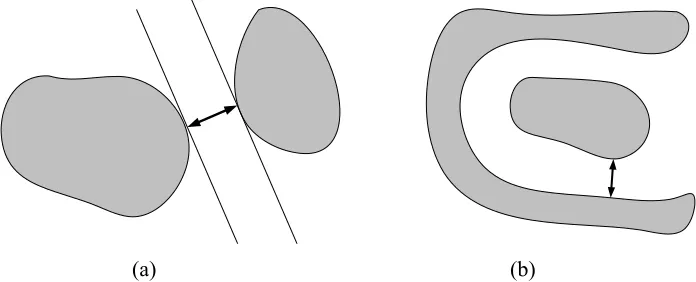
Support vector machines (SVM) can also be used for pattern classification. In this approach, objects are classified by maximizing the margins between samples with different labels, where the margin is defined as the gap between two parallel hyperplanes (Figure 1a). The consistency of SVM is assured if the samples are bounded and the margin between samples with different labels holds (Vapnik, 1995; Schölkopf et al. 1999; Cristianini and Shawe-Taylor, 2000).
1.2 Our Contributions
The requirement that data should be bounded is reasonable, since it is a common practice in applications to normalize feature values to a certain bounded interval (between 0 and 1, for example). The margin assumption, on the other hand, is unique to SVM. However, we can prove the consistency of CNN under a more relaxed assumption (Figure 1b). For convenience, we say that two labeled entities (that is, samples or prototypes) are homogeneous if they have the same label; otherwise, they are heterogeneous. We require a non-zero distance between heterogeneous samples.
the latter process often achieves better test accuracy than CNN. Another issue with this algorithm is its theoretical standing. The consistency of CNN derives from the fact that its prototypes are samples and thus always keep a certain distance from each other. The cluster centers, on the other hand, are not samples but the weighted averages of samples, so it is difficult to control the distances between them. To resolve this problem, we adopt a hybrid solution that combines cluster centers and certain selected samples to maintain a desirable separation between all the resultant prototypes.
(a) (b)
Figure 1. (a) A margin exists between two data sets. (b) A positive distance exists between two data sets.
Note that it is not always appropriate to minimize training errors for SVM. Sometimes, a higher number of training errors should be tolerated so that prediction errors can be reduced. Such flexibility, which is built into the “soft-margin” version of SVM (Cortes and Vapnik, 1995; Bartlett and Shaw-Taylor, 1999), yields better test accuracy than the “hard-margin” version. Fortunately, this flexibility also exists in adaptive prototype learning (APL) algorithms, and can be derived by a tradeoff between the number of prototypes and their predictive power. However, although APL reduces training errors by adding prototypes, it increases the risk of overfitting. A balance between these two factors is made possible by a cross-validation study, similar to that used for SVM. We discuss this point further in Section 6.
In summary, we propose two types of prototype learning algorithm. The first is an instance-based algorithm, which adds samples as prototypes according to an enhanced absorption criterion. The advantage of this approach (discussed in Section 7.2) is that it achieves substantially higher test accuracy at a relatively low training cost, compared to other instance-based algorithms, whose major merit is a lower ratio of prototypes to training samples. Although our algorithm achieves higher test accuracy at the expense of a somewhat higher ratio of prototypes to training samples, we believe this is acceptable, since it enables the proposed classifier to even outperform the k-nearest neighbor (k-NN) rule in terms of accuracy. The second approach is a hybrid method that constructs prototypes as either samples or the weighted averages of samples. Compared to SVM, the hybrid prototype learning method yields higher test accuracy, at the expense of a higher training cost (discussed in Section 7.3).
learning algorithms, namely, k-NN, CNN and SVM. Finally, in Section 8, we present our conclusions.
2
Vapnik-Chervonenkis Theory of Multiclass Classification
In this section, we develop a basic theory of prototype-learning algorithms. In particular, we derive an asymptotic result for generalization errors of prototype learning algorithms. For the case of binary classification, in which an object is classified as one of two class types, the standard Vapnik-Chervonenkis (VC) theory provides such a bound. This theory, however, is not sufficient for our purpose, since we deal with multiclass classifications in which we want to classify an object into one of m classes, with m≥2. Here, we focus on extending the standard VC theory to such a case.
The standard VC theory is a probabilistic theory that has great breadth and depth. To present a complete version of the theory in a journal paper is impossible. In fact, it is also unnecessary, since a comprehensive treatment can be found in the book A Probabilistic Theory of Pattern Recognition (Devroye et al., 1996). For this reason, we follow its notations closely (with some minor changes to suit our purpose) and quote those theorems that are relevant to our task.
We assume there are n training samples (x1, y1), …, (xn, yn), and a test sample (x, y) drawn independently from the set Rd×Λ according to the same distribution, where Λ = {1, 2,…, m} is a set of labels or class types. Then, for a classifier g: Rd→Λ, we define its training error Lˆ (g)
n and testing error L(g) as follows.
Definition 1 The training error of a classifier g is defined as the fraction of training samples
misclassified by g, that is, =
∑
n= ≠i g y
n g n I i i
Lˆ ( ) (1/ ) 1 { (x) }, where I is the indicator function such that
1 } ) ( {g i≠yi =
I x if and only if g(xi)≠ yi. The testing error of a classifier g is defined as the
probability that a test sample has been misclassified by g, that is, L(g) = Pr{g(x)≠y}.
Typically, from the training samples, a learning algorithm tries to build a classifier g of a generic class C, with the objective that g can generalize well in the sense that it has a small testing error. The standard VC theory provides a bound for the testing error of binary classifiers. This bound can be expressed in terms of the following complexity measure of C.
Definition 2 Let Cbe a collection of binary classifiers of the form g: Rd→ {0, 1}. For any n, the
nth shatter coefficient of C is defined as
|, } : { | max )
, (
| |
, g g C
n C
S T
n T R
T d ∈
=
= ⊆
where gT is the function obtained by restricting gto the domain T, and |X| for any set X is the
number of elements of X.
Intuitively, the nth shatter coefficient of C is the maximum number of ways that an n-element subset can be partitioned by the classifiers in C. The following well-known result of Vapnik and Chervonenkis (1971, 1974a, 1974b) provides a bound for the testing error of classifiers in C, which we denote as the VC-bound. We adopt this result from Theorem 12.6 in Devroye et al. (1996).
Theorem 3 Let C be a collection of binary classifiers. Then, for any n and any ε >0,
. )
, ( 8 |
) ( ) ( ˆ | sup
Pr ε2/32
ε n
n C g
e n C S g
L g
L −
∈ ⎭⎬≤
⎫ ⎩
⎨ ⎧
Next, we explain how to obtain an analogous result for multiclass classifiers. For a collection
Cof multiclass classifiers g: Rd→Λ, let CB be the class of binary classifiers gi: Rd→ {0, 1} such that gi(x) = 1 if and only if g(x) = i, for g∈Cand i = 1, 2, …, m.
Theorem 4 Let C be a collection of multiclass classifiers of the form g: Rd→Λ. Then, for any n
and any ε >0,
. ) , ( 8 | ) ( ) ( ˆ | sup
Pr B n 2/(8m2)
n C g e n C S g L g
L ε −ε
∈ ⎭⎬≤ ⎫ ⎩ ⎨ ⎧ > −
Proof: First, consider any classifier g: Rd→Λ. A sample (x, y)∈ Rd×Λis misclassified by g if and only if it is misclassified by both gy and gg(x). Thus, =
∑
m=i i n
n g L g
Lˆ ( ) 1ˆ ( )
2 and . ) ( ) (
2 =
∑
m=1 ii
g L g
L Then, by triangle inequality, the condition |Ln(g)−L(g)|>ε implies that
ε 2 | ) ( 2 ) ( ˆ 2 | | ) ( ) ( ˆ | | ) ( ) ( ˆ
| 1 1
1 − ≥
∑
−∑
= − >∑
= L g L g = L g = L g Ln g L gm i m i i i n m i i i n ,
and |Lˆn(gi)−L(gi)|>2ε/m for some i. Therefore,
⎭ ⎬ ⎫ ⎩ ⎨ ⎧ > − ≤ ⎭ ⎬ ⎫ ⎩ ⎨ ⎧ > − ∈
∈ L g L g L g L g m
i i n C g n C
g i B ( ) ( )| 2 /
ˆ | sup Pr | ) ( ) ( ˆ | sup
Pr ε ε .
This theorem follows from the previous theorem with ε replaced by 2ε/m.
As stated in the above theorem, the VC-bound is the product of two terms. The first is just the shatter coefficient, whose magnitude depends on the collection of classifiers C. The second term decays exponentially to zero as n→∞. To obtain an asymptotic result from this product, we need to know how fast the shatter coefficient grows as n→∞. If its growth is slower than the decay of the second term, then the VC-bound approaches zero as n→∞.
Let us now define some terms. A prototype data pair (p, y) consists of a prototype p∈Rd and its label y. We say that a classifier uses the 1-NN rule based on prototype data pairs if g
assigns to each x∈Rdthe label of the nearest prototype to x. The collection of all multiclass classifiers using the1-NN rule based on k prototype data pairs is denoted by C(k), while the collection of binary classifiers using the 1-NN rule based on k prototype data pairs is denoted by
B(k). We want to derive a result for C(k) in terms of a known result of B(k). To do this, we adopt the following lemma from Devroye et al. (1996, p. 305), which provides a bound for S(B(k), n).
Lemma 5 S(B(k), n) ≤ (ne/(d+1))(d+1)(k-1).
From Theorem 4 and Lemma 5, we derive the following result for C(k).
Theorem 6 For any n and any ε >0,
. )) 1 /( ( 8 | ) ( ) ( ˆ | sup
Pr ( 1)( 1) 2/(8 2)
) ( m n k d n C g e d ne g L g L k ε
ε + − −
∈ ⎪⎭≤ + ⎪ ⎬ ⎫ ⎪⎩ ⎪ ⎨ ⎧ > −
Proof: In order to apply Theorem 4, we need to find a bound for S(C(B),n)
k , where C(Bk) derives from C(k) in the same way as CB derives from C. Since C(Bk) ⊆B(k), we have
) , ( ) ,
(C( ) n S B( ) n
S B k
Therefore, by Lemma 5, we have S( B k
C( ), n) ≤ (ne/(d+1))(d+1)(k-1). Combining this inequality and Theorem 4, we obtain the desired result.
For a given sequence of training data Dn = {(x1, y1), …, (xn, yn)}, a classification rule is a sequence of classifiers {gn} such that gn is built on Dn. Such a rule is said to be consistent, or asymptotically Bayes-risk efficient, if
, 0 } ) ( inf ) ( Pr{
lim − > =
∞
→ L gn g L g ε
n
for any ε>0, where infL(g)
g is the infimum (i.e., the greatest lower bound) of the testing errors of all classifiers of the form g: Rd →Λ. A prototype classification rule, on the other hand, is a sequence {gn} such that gn uses the 1-NN rule based on kn prototypes for some kn. The following corollary provides a sufficient condition for the consistency of a prototype classification rule. Note that, in stating the corollary, we use o(f(n)) to denote a quantity whose ratio to f(n) approaches zero as n→∞.
Corollary 7 Suppose that {gn} is a prototype classification rule such that Lˆn(gn)=0 and kn = o(
nε2/(m2dlogn) ) for all n. Then, for any ε >0,
. 0 } ) ( Pr{ lim } ) ( inf ) ( Pr{
lim − > = > =
∞ → ∞
→ n g ε n n ε
n L g L g L g
Proof: SinceLˆn(gn)=0, the condition thatL(gn )>ε implies that|Lˆn(gn)−L(gn) |>ε and
thus sup | ˆ ( ) ( ) | ε ) ( > − ∈ g L g Ln C g kn
as well. Hence, Pr{ ( ) } Pr sup | ˆ ( ) ( )| . ) ( ⎪⎭ ⎪ ⎬ ⎫ ⎪⎩ ⎪ ⎨ ⎧ > − ≤ > ∈ ε
ε L g L g
g L n C g n n k
Also, since kn = o( nε2/(m2dlog n) ), by Theorem 6, we have Pr{L(gn )>ε}→0 as n→∞. Finally, L(g )−infL(g)>ε
g
n implies thatL(gn )>ε, so the probability of the former inequality
also approaches zero as n→∞.
3
The Condensed Nearest Neighbor Rule
Following the notations defined in Section 2, we assume that a set of observed data, or samples, (x1, y1), (x2, y2), ..., (xn, yn) is given. Our goal here is to extract a subset Un from Xn={xi}ni=1 in such a way that if u is the nearest member of Un to
x
i, then l(u)=yi, where l(u) is the label of u. Members of Un are called prototypes, and samples whose labels match those of their nearest prototypes are said to be absorbed.The CNN rule (Hart, 1968) is a simple way of solving the above problem. Starting with }
{x0 = n
U , where x0 is randomly chosen from Xn, CNN scans all members of Xn. It then adds to
Un a member x of Xn whose nearest prototype’s label does not match that of x. The algorithm scans Xn as many times as necessary, until all members of Xn have been absorbed or, equivalently, no more prototypes can be added to Un.
Let )}δn =min{||xi−xj||:xi,xj∈Xn ,andl(xj)≠l(xj , that is, δn is the minimal distance between heterogeneous samples. Since
{
δ
n}
is a decreasing sequence, there exists a δ such thatδ
region H of radius R such that Pr{x∈H}=1. 2) Non-zero separation: the limit δ of {δn} is non-zero.
Lemma 8 Under the conditions of boundedness and non-zero separation, the number of CNN
prototypes cannot exceed (2R/δ +1)d, where R is the radius of H and δis the limit of { } n δ .
Proof: We want to prove that all prototypes are δ-separated, that is, their distance is at least δ. This is true for any two prototypes with different labels, since all prototypes are samples and heterogeneous samples are δ-separated. Therefore, we only have to prove that all prototypes of the same label are also δ -separated.
We assume that p and q are prototypes of the same label. As CNN is a sequential process, its prototypes are constructed in linear order. Without loss of generality, we assume that p is constructed before q; hence, there must be a prototype m that is constructed before q,
) ( ) (m l q
l ≠ , and ||q−p||≥||q−m||. Now, since q and m have different labels, ||q−m||≥δ. Combining these two facts, we obtain ||q−p||≥δ .
We define a ball of radius r centered at w asB(w,r)={x :||x−w||<r }. Let the prototypes be k
i i} 1
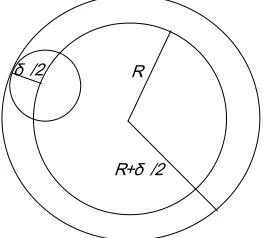
{p = . Since they are δ-separated from each other, all the ballsB(pi,δ/2) are non-overlapping. Moreover, the union of these balls is contained in a ball of radius R+δ/2 (Figure 2). So, we must have k(δ/2)d <(R+δ/2)d, or k<(2R/δ +1)d.
R δ /2
R+δ /2
Figure 2. If all samples are contained in a ball of radius R, then all balls of radius δ/2 centered at a sample are included in a ball of radius R+δ/2.
From this lemma and the corollary to Theorem 6, we derive the following.
Theorem 9 Let {gn} be a sequence of classifiers using the 1-NN rule based on CNN prototype
data pairs. The boundedness and non-zero separation conditions ensure the consistency of {gn}.
4
Adaptive Prototype Learning Algorithms
4.1 Generalized CNN
The instance-based APL includes CNN as a special case. For this reason, we denote it as a generalized CNN, or GCNN. The difference is that GCNN employs a strong absorption criterion, in contrast to the weak criterion employed by CNN. According to CNN, a sample x is absorbed if
0 || || ||
||x−q − x−p > , (1) where p and q are prototypes, p is the nearest homogeneous prototype to x, and q is the nearest heterogeneous prototype to x. For GCNN, however, we adopt the following criterion:
n ρδ || || ||
||x−q − x−p > , ρ∈[0,1). (2) We say that a sample is weakly absorbed if it satisfies (1), and strongly absorbed if it satisfies (2). Note that (1) corresponds to the case where ρ = 0 in (2). Adopting (2) makes it possible to improve the classifier by optimizing ρ. The question of how to optimize ρ is addressed in Section 6.
We now describe the steps of GCNN.
G1 Initiation: For each label y, select a y-sample as an initial y-prototype.
G2 Absorption Check: Check whether each sample is strongly absorbed (absorbed, for
short). If all samples are absorbed, terminate the process; otherwise, proceed to the next step.
G3 Prototype Augmentation: For each y, if any unabsorbed y-samples exist, select one as a new y-prototype; otherwise, no new prototype is added to label y. Return to G2 to proceed.
In G1, a y-sample is selected as follows. We let each y-sample cast a vote to its nearest y -sample, and select the one that receives the highest number of votes. In G3, an unabsorbed y -sample is selected as follows. Let Ψy = {xi: l(xi)=y & xi is unabsorbed}. We let each member of Ψy cast a vote for the nearest member in this set. The selected y-sample is the member of Ψy that receives the highest number of votes.
Lemma 10 GCNN prototypes satisfy the following properties. (a) For each prototype p, no
heterogeneous sample can be found in B(p,δn). (b) For any two heterogeneous prototypes p and q, ||p−q||≥δn. (c) For any two homogeneous prototypes m and n, ||m−n||>(1−ρ)δn.
Proof: Propositions (a) and (b) follow from the fact that GCNN prototypes are samples and the separation between any two heterogeneous samples is at least δn. To prove (c), let two homogeneous prototypes m and n be given, and let m be constructed before n. Since n is not absorbed by the time it is taken as a prototype, there exists a heterogeneous prototype q such that
n ρδ ≤ − −
− || || ||
||n q n m or, equivalently,
n ρδ − − ≥
− || || ||
||n m n q . (3) Since n and q are heterogeneous, by (a), n cannot lie in B(q,δn). Thus,
n δ ||
||n−q ≥ . (4) Combining (3) and (4), we obtain ||n−m||≥δn−ρδn=(1−ρ)δn.
We define the number of iterations as the number of times G2 has been executed. The following lemma states that the number of iterations cannot exceed a certain magnitude. Let R n
Lemma 11 The number of GCNN prototypes cannot exceed [(2Rn+δn)/(1−ρ)δn]d. Moreover,
GCNN converges within a finite number of iterations.
Proof: Lemma 10 ensures that homogeneous and heterogeneous GCNN prototypes are separated by certain constants. Using this fact and a similar argument to that in the proof of Lemma 8, we conclude that the number of GCNN prototypes cannot exceed [(2 )/(1 ) ]d.
n n
R+δ −ρ δ Since at least one prototype is created at each iteration, the number of iterations cannot exceed this number either.
Now, under the conditions of boundedness and non-zero separation, we can also show that the number of GCNN prototypes is bounded from above by d
n n
R )/(1 ) ]
2
[( +δ −ρ δ , with R
replacing Rn. Since d d
n
n R
R )/(1 ) ] [(2 )/(1 ) ]
2
[( +δ −ρ δ ≤ +δ −ρ δ , the number of GCNN prototypes is bounded from above by a constant independent of n. The consistency of GCNN follows from the same argument that demonstrates the consistency of CNN.
Theorem 12 Under the conditions of boundedness and non-zero separation, GCNN is consistent.
4.2 Linear Adaptive Prototype Learning
Having explained GCNN, we are ready to describe a more complex type of APL that can take a mixture of IBPs and CBPs as its prototypes. To differentiate it from GCNN, and from another version of APL to be described later, we denote this algorithm as linear APL (LAPL).
Recall that the consistency of GCNN derives from the separation of prototypes. We wish to obtain a similar separation between LAPL prototypes, but the addition of CBPs raises some problems.
The first problem is the separation required for heterogeneous prototypes. While a δn separation can be easily maintained by any two heterogeneous IBPs, it may not be maintained so easily by two heterogeneous CBPs. Therefore, we require the separation to be fδn, where
] 1 , 0 [ ∈
f . How we determine the optimal value of f is discussed in Section 6.
The next problem is the absorption criterion. For LAPL, we adopt the following:
n
fδ
ρ || || ||
||x−q − x−p > , for ρ∈[0,1). (5) How to optimize ρis also addressed in Section 6.
The third problem is how to maintain a positive separation between all LAPL prototypes. To achieve this objective, we specify the following requirements.
(C1) For each prototype p, no heterogeneous sample exists inB(p,fδn). (C2) For any two heterogeneous prototypes p and q, ||p−q||≥ fδn. (C3) For any two homogeneous prototypes m and n, ||m−n||>( 1−ρ)fδn.
Thus, in the transition from GCNN to LAPL, we have systematically changed δn to fδn. We now state the LAPL algorithm, and prove that the prototypes derived from it satisfy (C1), (C2), and (C3). We first describe the general scheme of the algorithm, and then provide the technical details. The steps of LAPL are:
H1 Initiation: For each label y, initiate a y-prototype as the average of all y-samples. If this prototype does not satisfy (C1), (C2), and (C3), we apply the prototype adjustment module (described later in this section).
H2 Absorption Check: Check whether each sample has been absorbed. If all samples have
H3 Prototype Refreshment: For each un-satiated label y (i.e., some y-samples are unabsorbed), select an unabsorbed y-sample. We then apply a clustering algorithm to construct clusters, using the selected y-sample and all existing y-prototypes as seeds. The centers of the resultant clusters are new y-prototypes. If these prototypes do not satisfy (C1), (C2), and (C3), we apply the prototype adjustment module (described later in this section). Return to H2 to proceed.
We now provide the technical details.
Selection of Unabsorbed Samples in H1 and H3. The selection procedures in H1 and H3 are the same as those in G1 and G3.
Clustering Algorithms in H3. Any clustering algorithm can be used. For the experiment described in this paper, we use the k-means (KM) and the fuzzy c-means (FCM) clustering algorithms, both of which are applied to training samples of the same label. Thus, if there are m
labels in the training data, we apply the algorithms m times. Details of the methods are as follows. The KM method (Lloyd, 1982; Max, 1960; Linde et al. 1980) derives a locally optimal solution to the problem of finding a set of cluster centers p
i i} 1
{c = that minimizes the objective function
2 1 min1,..., || j || n
j i p ci−x
∑
= = . (6)KM’s iterative process is performed as follows. Setting seeds as the initial cluster centers, we add each sample to the cluster whose center is nearest to it. We then reset the center of each cluster as the average of all the samples that fall in that cluster. To ensure rapid convergence of KM, we require that the process stops when the number of iterations reaches 30, or the membership of the clusters remains unchanged after the previous iteration.
In FCM (Bezdek, 1981; Höppner et al., 1999), the objective function to be minimized is
∑ ∑
= = −n j
p
i uijm i j
1 1
2 ||
||c x , for m∈(1,∞) (7)
under the constraint
∑
= =p
i1uij 1 , for j = 1, 2, ..., n, (8) where uijis the membership grade of sample xj to prototype ci. Using the Lagrangian method, we can derive the following equations:
(
)
(
)
∑
= − − − − = pk k j m
m j i ij u 1 1 2 1 2 || || / 1 || || / 1 x c x c
, (9)
∑
∑
= = = n j m ij nj ijm j i
u u
1 1 x
c , (10)
for i = 1, 2, …, p, and j = 1, 2, …, n respectively. FCM is a numerical method that finds a locally optimal solution for (9) and (10). Using a set of seeds as the initial solution for{ci}ip=1, the algorithm computes pn
j i ij u , 1 , }
{ = and p
i i} 1
{c = iteratively. To ensure rapid convergence of FCM, we
require that the process stops when the number of iterations reaches 30, or
∑
p= − = inew i old i
Prototype Adjustment in H1. The purpose of this module is to replace prototypes that violate (C1) or (C2) with those that do not. Note that there is only one prototype per label in H1, so we do not need to worry about (C3). There are two steps in this stage.
Step 1: If we find a CBP p that violates (C1), which requires that no heterogeneous sample exists inB(p,fδn), we replace p with a sample of the same label. The replacement sample is an IBP and is selected in exactly the same way as a seed is selected in G1. Step 2: If we find a CBP p that violates (C2), which requires that ||p−q||≥ fδn for any
other prototype q, we replace p with an IBP of the same label. We perform this operation iteratively, until the desired separations hold between CBPs, and between CBPs and IBPs.
We now prove that after these two steps, all prototypes satisfy (C1) and (C2). We first prove that, after Step 1, all prototypes satisfy (C1). By assumption, all CBPs satisfy (C1) after this step. Also, all IBPs satisfy (C1), since all heterogeneous samples are δn-separated from them and
n n fδ
δ ≥ . We now prove that, after Step 2, all prototypes satisfy both (C1) and (C2). It is clear that all prototypes satisfy (C1) at the end of this step; and each CBP maintains fδn-separations from other prototypes by assumption. Also, since each IBP maintains δn-separations from other IBPs and δn ≥ fδn, each IBP maintains fδn-separations from other IBPs.
Prototype Adjustment in H3. This module adjusts prototypes in two steps.
Step I: A set of prototypes of the same label is called a pack. When a pack consists of CBPs that satisfy (C1) and they are (1−ρ)fδn-separated from each other, as required by (C3), we preserve that pack. Otherwise, we replace it with the set of seeds from which the CBPs were derived.
Step II: Two packs are said to be fδn-separated if any two prototypes drawn from them are
n
fδ -separated. When we find two packs that are not fδn-separated, we replace one of them with the set of seeds from which its prototypes were derived. We perform this operation iteratively until the remaining packs are fδn-separated.
We now show that, after Step I, all prototypes satisfy (C1) and (C3). For convenience, we call preserved packs P-packs and replacement packs R-packs. An R-pack consists of existing prototypes, called X-prototypes, and an unabsorbed sample, called a U-prototype. By induction, all X-prototypes meet (C1) and (C3). The U-prototype, denoted as u, also satisfies (C1), because heterogeneous samples are δn-separated from each other. It remains to show that u is (1−ρ)fδn -separated from all X-prototypes. This fact follows from a similar argument to that for Lemma 10(c), so we omit the proof. We conclude that all the prototypes satisfy (C1) and (C3).
We now prove that, after Step II, all prototypes satisfy (C1), (C2), and (C3). It is clear that all prototypes satisfy (C1) and (C3) at the end of this step. It remains to prove that they also satisfy (C2), that is, heterogeneous prototypes are fδn-separated. We want to show that all heterogeneous prototypes in the R-packs are fδn-separated. As noted earlier, these prototypes consist of X-prototypes and U-prototypes. By induction, heterogeneous X-prototypes are fδn -separated. Heterogeneous U-prototypes are also fδn-separated, as noted before. U-prototypes are also fδn-separated from heterogeneous X-prototypes, since all X-prototypes satisfy (C1). Thus, at the end of Step II, all prototypes satisfy (C2).
conditions of boundedness and non-zero separation. Note that the above conclusions do not hold for the case where f = 0, which we deal with in Section 5.
Theorem 13 The LAPL terminates within a finite number of iterations, provided that f∈(0,1], ) 1 , 0 [ ∈
ρ , and m∈(1,∞).
Theorem 14. Let {gn} be a sequence of classifiers using the 1-NN rule based on LAPL prototype
data pairs. The conditions of boundedness and non-zero separation ensure the consistency of {gn}, provided that f∈(0,1], ρ∈[0,1), and m∈(1,∞).
5
Kernelized Adaptive Prototype Learning Algorithms
Let Φ:Rd →H be a function that maps from the d-dimensional Euclidean space to a Hilbert
space, whose dimension dim(H) may be infinite. In a kernelized adaptive prototype learning algorithm, the goal is to build prototypes in H. To this end, we first transform the given observed data n
j j} 1
{x = into {Φ(xj)}nj=1. When either KM or FCM is used to compute prototypes, each prototype in H is of the form
∑
∑
= Φ == n
j m ij n
j ijm j
i 1u (x )/ 1u
c ,
where ci and uij were introduced in (6), (7), and (8). When KM is used, m≡1. Moreover, uij = 1/ni provided that the jth sample falls in the ith cluster, whose population size is n
i; otherwise, uij = 0. When FCM is used, we compute uij according to (9) in which the distance now becomes a kernel-based distance, to be defined below.
If ,dim(H)=∞
c
i cannot be expressed in vector form. Even when dim(H) < ∞, it can be computationally expensive to find an explicit form ofc
i. Fortunately, we can compute the distance between Φ(xj) andc
i directly, provided there exists a kernel function (Mercer, 1909; Girosi, 1998) ) ( ), ( ) ,(x y = Φ x Φ y
K , for
x,
y
∈
R
d.When such a function exists, we obtain the kernel-based distance as
) ( ), ( || ) ( || 2 j i j i Ker j
i x c x c x
c −Φ = −Φ −Φ
) ( ), ( ) ( , 2
, i i j j j
i c c x x x
c − Φ + Φ Φ
= . (11)
Moreover, , ) , ( , 2 1 1 1 ⎟⎟ ⎠ ⎞ ⎜⎜ ⎝ ⎛ =
∑
∑∑
= = = n k m ik n k nl k l
m il m ik i i u K u
u x x
c
c (12)
, ) , ( ) ( , 1 1
∑
∑
= = = Φ n k m ik nk k j
m ik j i u K
u x x
x
and
) , ( ) ( ),
(xj Φ xj =K xj xj
Φ . (14)
From pn
j i Ker j
i ( )||2 },, 1
{||c −Φ x = , we derive pn j i ij
u ,
1 , }
{ = according to the appropriate formula in the clustering algorithm being used. Since we do not want to express the prototypes explicitly, we use
n p
j i ij
u ,
1 , }
{ = to represent them instead. From the prototypes, we can compute pn j i Ker j
i ( )||2 },, 1 {||c −Φ x = again, using (11)-(14). This iterative process stops if the number of iterations reaches 30, or
001 . 0 | |
max
, − <
new ij old j
i uij u . These steps represent the kernelized versions of KM and FCM,
depending on which definition of pn j i ij
u ,
1 , }
{ = is used. The kernelized version of FCM was proposed and studied by Wu, Xie and Yu (2003) and Kim et al. (2005).
There is also a kernelized version of GCNN, but we do not consider it in this paper, for the reason to be given in Section 7. We denote the kernelized version of LAPL simply as KAPL, which is derived from LAPL by replacing KM or FCM with an appropriate kernelized version. In addition, we make the following changes. First, the initial y-prototype in KAPL should be the average of all {Φ(x):l(x)= y}. Using (11)-(14), we compute the distance of each Φ(x) to this prototype. Second, we apply the prototype adjustment module in KAPL to separate prototypes. Prototype separation, however, does not imply the convergence of KAPL, since it may have to deal with data in a space of infinite dimensions.
To ensure the convergence of KAPL, we modify the prototype adjustment module as follows. As in LAPL, we adopt the necessary operations to create the desired prototype separation. However, prior to these operations we check if each prototype in a pack has a non-empty domain of attraction (DOA), where the DOA of a y-prototype p is the set of all y-samples )Φ(x for which p is the nearest prototype. Recall that we employ a clustering algorithm to create a pack of prototypes, using an unabsorbed sample Φ(u) and some other prototypes as seeds. If any prototype in a pack has an empty DOA, we replace that pack with the pack of prototypes constructed earlier. In this case, Φ(u)is called a futile sample. If a sample is declared futile in an iteration, it will not be taken as a sample in any later iteration.
Theorem 12 The KAPL algorithm converges within a finite number of iterations.
Proof: The number of futile samples is bounded from above, since it cannot exceed n, that is, the number of samples. We assume that the last futile sample is created at iteration i, with i≤n. If all samples are absorbed at the end of i, the proof is complete; otherwise, more prototypes will be created, all with non-empty DOAs. The number of unabsorbed samples must decrease to zero, or else the number of DOAs would eventually exceed the number of samples, which would be an absurd result.
Note that if we treat futile samples in LAPL in the same way, we can prove the convergence of LAPL in the setting where there is no guarantee of prototype separation.
Theorem 13 Adopting the prototype adjustment module used in KAPL, LAPL converges for 0
=
f and m∈(1,∞).
6
Soft Adaptive Prototype Learning Algorithms
enhances the generalization power of the resultant classifier. The optimal error rate can be determined in a cross validation task, which is also needed to find the optimal values of the parameters. All versions of APL involve some parameters; for example, they all involve f andρ, which regulate prototype separation (cf. (2), (5), (C1), (C2), and (C3)). Moreover, if FCM is used to compute cluster centers, there is another parameter m (cf. (7), (9), and (10)) to consider. In addition, some parameters in KAPL are used to define the kernel-based distance. For example, when the RBF kernel
) || || exp( ) ,
(x y = −γ x−y 2
K (15) is used to define the distance, there is an additional parameterγ , whose rangeis assumed to be
) , 0 ( ∞ .
To search for the optimal values of the parameters, we perform cross-validation. As all the parameters are assumed to be independent, we must evaluate all combinations of them and determine which one is the most suitable for the task. When a combination of parameter values Q
is given, we build prototypes on K-1 folds of data, which serves as the training data, and measure the test accuracy on the remaining fold of data, which serves as the validation data. We determine the optimal training error rate associated with Q as follows.
Given a set of training data and a set of validation data and assuming that the latter is the kth fold of the data, k = 1, 2, …, K, we construct prototypes and record the following information. First, for a given level of e, we record the lowest number of iterationsnk(e,Q) at which the training error rate falls below e. We also compute the validation accuracy rate vk(e,Q) for all the prototypes obtained at the end of iteration nk(e,Q). Let v(e,Q)=
∑
Kk=1vk(e,Q)/K. The optimal training error rate is then). , ( max arg )
(Q v e Q
e
e opt =
Note that once we have constructed prototypes to achieve a training error e1, we do not need to start from the scratch to obtain a lower training error e2. Instead, we continue to construct more prototypes until e2 is reached. At the end of this process, we obtain v(e,Q) for all e and thus
). ), ( (e Q Q
v opt When we have done this for all Q, we obtain the optimal Q as
) ), ( ( max
arg v e Q Q
Q opt
Q
opt = .
One additional parameter that needs be optimized is the number of k nearest prototypes, which we use in a voting mechanism to determine the label of a test sample. If a tie occurs, we classify the sample according to the nearest prototype. The optimal value of k should be evaluated in the cross-validation applied to the other parameters.
7
Experimental Results
v V
v x x
− × − ) 255 (
a ,
where x is a given feature value, V is the maximum value of the feature, and v is the minimum value. All experimental results reported in this section were obtained using an Intel Pentium 4 CPU 3.4GHz with a 1GB RAM.
7.1 Evaluation of APLs
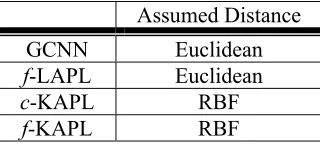
The four types of APL are listed in Table 1. The first one is GCNN. The other three types of APL are: fuzzy linear APL (f-LAPL), crisp kernelized APL (c-KAPL), and fuzzy kernelized APL (f -KAPL). We use “f-” to indicate that the clustering algorithm employed is FCM, and “c-” to indicate that the technique is KM. In the experiments, the soft versions of the four APLs are used. Although we can consider the kernelized version of GCNN using RBF as the kernel function, this version of GCNN gains only slightly higher testing accuracy, at the expense of a much higher number of prototypes, than GCNN. So we choose not to discuss it. We do not discuss c-LAPL either, since it usually has a lower performance than f-LAPL.
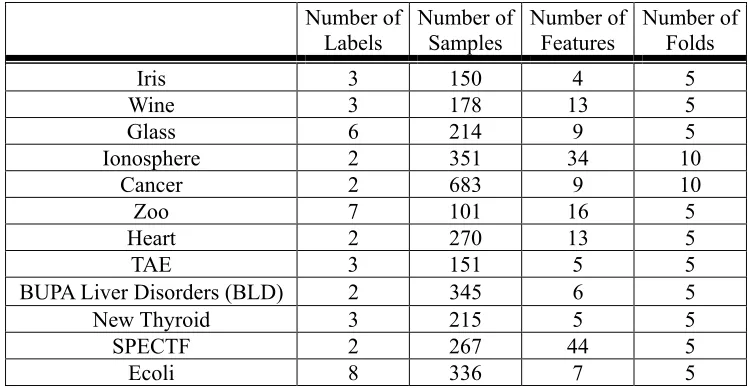
In Table 2, we show the parameters used in the four types of APL and also the values of the parameters whose combinations are considered in our experiments. The values result from a trade-off between the demand for accuracy and the need to reduce the computation time. When a combination, Q, of parameter values is given, we have to record v(e,Q) for certain values of e. In our experiments, the values of e, at which we record v(e,Q), are percentages that start from 0% and increase by some increments until they reach 30%. All the percentages are listed in Table 3. The 12 benchmark data sets retrieved from the UCI databases are listed in Table 4, which also shows the number of labels, the number of samples, the number of features per sample, and the number of folds into which we divide the samples during cross validation.
Assumed Distance GCNN Euclidean
f-LAPL Euclidean
c-KAPL RBF
f-KAPL RBF
Table 1. The four types of APL studied in our experiments.
Values GCNNf-LAPLc-KAPL f-KAPL
f 0., .1, .25, .5, .75, 1. √ √ √
ρ 0., .1, .25, .5, .75, .99 √ √ √ √
m 1.05, 1.1, 1.2, 1.3, 1.4 √ √
γ a×10-b; a = 1, 2, ..., 9; b = 4, 5, ..., 7 √ √
Table 2. Parameters: their value range, and the types of APL that involve them; “√” indicates that the parameter is used in that type of APL. The parameters f and ρ appear in (2), (5), (C1), (C2), and (C3); m appears in (7); and γ appears in (15).
Values of e
0%, 1%, 2%, 3%, 4%, 5%, 7.5%, 10%, 20%
Number of Labels
Number of Samples
Number of Features
Number of Folds
Iris 3 150 4 5
Wine 3 178 13 5
Glass 6 214 9 5
Ionosphere 2 351 34 10
Cancer 2 683 9 10
Zoo 7 101 16 5
Heart 2 270 13 5
TAE 3 151 5 5
BUPA Liver Disorders (BLD) 2 345 6 5
New Thyroid 3 215 5 5
SPECTF 2 267 44 5
Ecoli 8 336 7 5
Table 4. Information contained in the 12 data sets.
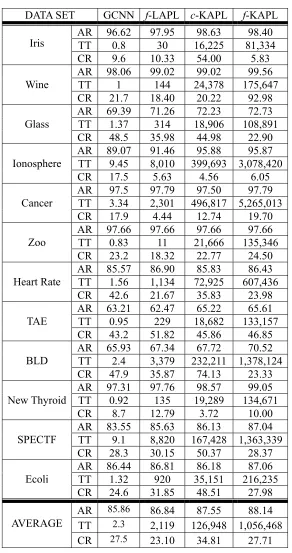
In Table 5, we show three performance measures of the four APLs, namely, the accuracy rate, the training time, and the condensation ratio. Given that K-fold cross-validation is conducted, the accuracy rate (AR) is the average accuracy over all validation data sets, each of which is one of the K folds; the training time (TT) is the sum of the training times of all training data sets, each of which consists of K-1 folds; and the condensation ratio (CR) is the average prototype-to-sample ratios obtained from all training data. Note that for most types of APL, we drop the decimal parts of their training times, since they are relatively insignificant to the integer parts. At the bottom of Table 5, we also show the average of the three measures over the 12 data sets. The boldface figures indicate that the performance of the corresponding method is the best of all the methods applied to the given data set.
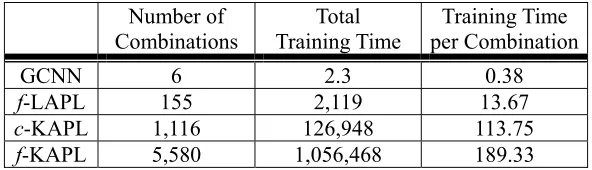
The averaged figures in Table 5 show that, in terms of training time, the four APLs are ranked in the following order: GCNN, f-LAPL, c-KAPL, and f-KAPL. The number of all possible combinations of parameter values is the major factor that affects the amount of training time. If we divide the total training time by the above number, then the temporal differences among the four algorithms are reduced drastically, as shown in Table 6. Since APL training under different combinations of parameter values is conducted independently, some fashion of parallel computing, such as cluster computing or grid computing, would help reduce the training time.
DATA SET GCNN f-LAPL c-KAPL f-KAPL AR 96.62 97.95 98.63 98.40
TT 0.8 30 16,225 81,334 Iris
CR 9.6 10.33 54.00 5.83
AR 98.06 99.02 99.02 99.56 TT 1 144 24,378 175,647 Wine
CR 21.7 18.40 20.22 92.98 AR 69.39 71.26 72.23 72.73
TT 1.37 314 18,906 108,891 Glass
CR 48.5 35.98 44.98 22.90 AR 89.07 91.46 95.88 95.87
TT 9.45 8,010 399,693 3,078,420 Ionosphere
CR 17.5 5.63 4.56 6.05
AR 97.5 97.79 97.50 97.79 TT 3.34 2,301 496,817 5,265,013 Cancer
CR 17.9 4.44 12.74 19.70 AR 97.66 97.66 97.66 97.66
TT 0.83 11 21,666 135,346 Zoo
CR 23.2 18.32 22.77 24.50 AR 85.57 86.90 85.83 86.43
TT 1.56 1,134 72,925 607,436 Heart Rate
CR 42.6 21.67 35.83 23.98 AR 63.21 62.47 65.22 65.61
TT 0.95 229 18,682 133,157 TAE
CR 43.2 51.82 45.86 46.85 AR 65.93 67.34 67.72 70.52
TT 2.4 3,379 232,211 1,378,124 BLD
CR 47.9 35.87 74.13 23.33 AR 97.31 97.76 98.57 99.05
TT 0.92 135 19,289 134,671 New Thyroid
CR 8.7 12.79 3.72 10.00
AR 83.55 85.63 86.13 87.04 TT 9.1 8,820 167,428 1,363,339 SPECTF
CR 28.3 30.15 50.37 28.37 AR 86.44 86.81 86.18 87.06
TT 1.32 920 35,151 216,235 Ecoli
CR 24.6 31.85 48.51 27.98 AR 85.86 86.84 87.55 88.14 TT 2.3 2,119 126,948 1,056,468 AVERAGE
CR 27.5 23.10 34.81 27.71
Number of Combinations
Total Training Time
Training Time per Combination
GCNN 6 2.3 0.38
f-LAPL 155 2,119 13.67
c-KAPL 1,116 126,948 113.75
f-KAPL 5,580 1,056,468 189.33
Table 6. The number of all possible combinations of parameter values, the total training time, and the training time per combination for the four types of APL.
Time to Compute δn (sec) GCNN Run Time (sec) Ratio (%)
Average 0.012 0.38 3.2
Table 7. The average amount of time to compute δn, the average run time of GCNN, and their ratio.
These findings suggest that the high accuracy rates of APLs are derived at the expense of a rather high computational cost. Hence, there is a tradeoff between accuracy rates and training costs, which allows users to choose the most suitable APL based on the size of their problems, their computing resources, and the degree of accuracy they require. There are two reasons for this tradeoff. First, the cluster-based approach has higher generalization power than the instance-based approach, since it picks the weighted averages of samples as prototypes and they are relatively immune to noise. Second, the RBF-based approach has higher generalization power than the Euclidean-based approach. To understand why this is so, we note that for very small
γ
, the RBF distance between x and y is approximately 2γ||x−y||2. This means that the RBF distance covers the Euclidean distance as a special case, and using the RBF distance may allow us to find a better-performing classifier than the one we obtain by using the Euclidean distance.Recall that when applying any APL algorithm we must first compute δn, the minimum distance between heterogeneous samples. One may be curious about the ratio of the computing time for δn to the run time of APL. In fact, the ratio is 3.2% for GCNN (Table 7) and much less for the other types of APL.
The reason for such a small ratio is as follows. If the number of training samples is n, then the time complexity of computing δn is in the order of n2, while the time complexity of conducting APL training is in the order of n3. To confirm the latter fact, we note that APL training takes no more than n iterations. Within each iteration, checking the absorption criterion takes no more than
n2 steps, and clustering takes no more than 30×n2 steps (if cluster-based prototypes are required), where 30 is the maximum number of iterations allowed in a clustering algorithm. Furthermore, the space complexity of APL training is in the order of n2 at most.
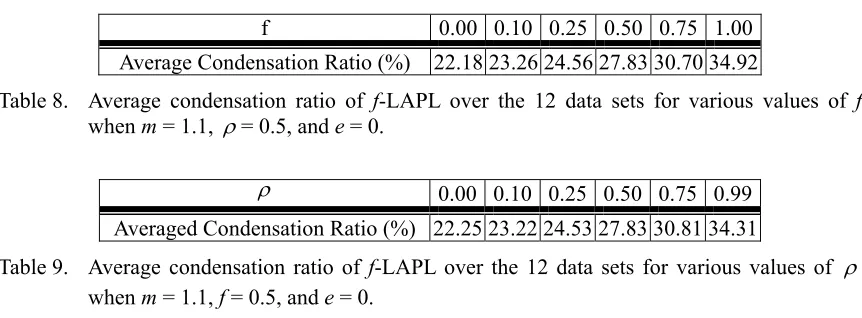
condensation ratio increases as the value of f increases. What happens when we fix the values of all parameters except ρ? By raising the value of ρ, we also make the absorption criterion more difficult to satisfy and therefore increase the number of prototypes that need to be built. This fact is reflected in Table 9.
f 0.00 0.10 0.25 0.50 0.75 1.00
Average Condensation Ratio (%) 22.18 23.26 24.56 27.83 30.70 34.92
Table 8. Average condensation ratio of f-LAPL over the 12 data sets for various values of f
when m = 1.1, ρ= 0.5, and e = 0.
ρ 0.00 0.10 0.25 0.50 0.75 0.99 Averaged Condensation Ratio (%) 22.25 23.22 24.53 27.83 30.81 34.31
Table 9. Average condensation ratio of f-LAPL over the 12 data sets for various values of ρ when m = 1.1, f = 0.5, and e = 0.
7.2 Comparison of GCNN with Some Instance-Based Learning Algorithms
As noted earlier, GCNN differs from LAPL and KAPL in that it adopts samples as prototypes. It is thus one of the methods, called instance-based learning algorithms, which reduce an entire set of training samples to a subset, while maintaining as much generalization power as possible. For this reason, we compare GCNN with some of the methods that have been proposed in the literature.
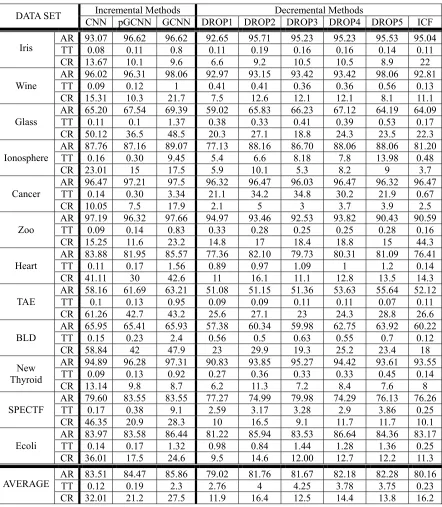
Two approaches can be adopted in IBL algorithms. The first is incremental, so it starts with a null set and gradually adds samples as prototypes. Both CNN and GCNN are incremental algorithms. For comparison purposes, we also include a primitive version of GCNN, called pGCNN. It is similar to GCNN, except that the value of parameter f is fixed at 0. Note that pGCNN is not the same as CNN. In pGCNN, we select unabsorbed samples through a voting procedure (cf. Section 4) and the training error rate e is determined by cross-validation (cf. Section 6). In CNN, however, unabsorbed samples are selected randomly and e is fixed at 0. The second approach is decremental, so it starts with the entire set of samples and gradually removes samples that are considered properly “protected” by the retained ones. For algorithms of this type, we include DROP1 to DROP5 (Wilson and Martinez, 2005) and ICF (Brighton and Mellish, 2002) for comparison. They differ from each other in the way samples are ordered for removal, and in the criterion for removing samples. For further details, readers should refer to the cited references. We used the code provided by Wilson and Martinez (2005) for DROP1 to DROP5, and implemented our own codes for ICF.
Incremental Methods Decremental Methods
DATA SET CNN pGCNN GCNN DROP1 DROP2 DROP3 DROP4 DROP5 ICF AR 93.07 96.62 96.62 92.65 95.71 95.23 95.23 95.53 95.04 TT 0.08 0.11 0.8 0.11 0.19 0.16 0.16 0.14 0.11 Iris
CR 13.67 10.1 9.6 6.6 9.2 10.5 10.5 8.9 22
AR 96.02 96.31 98.06 92.97 93.15 93.42 93.42 98.06 92.81
TT 0.09 0.12 1 0.41 0.41 0.36 0.36 0.56 0.13
Wine
CR 15.31 10.3 21.7 7.5 12.6 12.1 12.1 8.1 11.1 AR 65.20 67.54 69.39 59.02 65.83 66.23 67.12 64.19 64.09 TT 0.11 0.1 1.37 0.38 0.33 0.41 0.39 0.53 0.17 Glass
CR 50.12 36.5 48.5 20.3 27.1 18.8 24.3 23.5 22.3 AR 87.76 87.16 89.07 77.13 88.16 86.70 88.06 88.06 81.20 TT 0.16 0.30 9.45 5.4 6.6 8.18 7.8 13.98 0.48 Ionosphere
CR 23.01 15 17.5 5.9 10.1 5.3 8.2 9 3.7
AR 96.47 97.21 97.5 96.32 96.47 96.03 96.47 96.32 96.47 TT 0.14 0.30 3.34 21.1 34.2 34.8 30.2 21.9 0.67 Cancer
CR 10.05 7.5 17.9 2.1 5 3 3.7 3.9 2.5
AR 97.19 96.32 97.66 94.97 93.46 92.53 93.82 90.43 90.59 TT 0.09 0.14 0.83 0.33 0.28 0.25 0.25 0.28 0.16 Zoo
CR 15.25 11.6 23.2 14.8 17 18.4 18.8 15 44.3
AR 83.88 81.95 85.57 77.36 82.10 79.73 80.31 81.09 76.41
TT 0.11 0.17 1.56 0.89 0.97 1.09 1 1.2 0.14
Heart
CR 41.11 30 42.6 11 16.1 11.1 12.8 13.5 14.3 AR 58.16 61.69 63.21 51.08 51.15 51.36 53.63 55.64 52.12 TT 0.1 0.13 0.95 0.09 0.09 0.11 0.11 0.07 0.11 TAE
CR 61.26 42.7 43.2 25.6 27.1 23 24.3 28.8 26.6 AR 65.95 65.41 65.93 57.38 60.34 59.98 62.75 63.92 60.22
TT 0.15 0.23 2.4 0.56 0.5 0.63 0.55 0.7 0.12
BLD
CR 58.84 42 47.9 23 29.9 19.3 25.2 23.4 18
AR 94.89 96.28 97.31 90.83 93.85 95.27 94.42 93.61 93.55 TT 0.09 0.13 0.92 0.27 0.36 0.33 0.33 0.45 0.14 New
Thyroid
CR 13.14 9.8 8.7 6.2 11.3 7.2 8.4 7.6 8 AR 79.60 83.55 83.55 77.27 74.99 79.98 74.29 76.13 76.26 TT 0.17 0.38 9.1 2.59 3.17 3.28 2.9 3.86 0.25 SPECTF
CR 46.35 20.9 28.3 10 16.5 9.1 11.7 11.7 10.1 AR 83.97 83.58 86.44 81.22 85.94 83.53 86.64 84.36 83.17 TT 0.14 0.17 1.32 0.98 0.84 1.44 1.28 1.36 0.25 Ecoli
CR 36.01 17.5 24.6 9.5 14.6 12.00 12.7 12.2 11.3 AR 83.51 84.47 85.86 79.02 81.76 81.67 82.18 82.28 80.16 TT 0.12 0.19 2.3 2.76 4 4.25 3.78 3.75 0.23 AVERAGE
CR 32.01 21.2 27.5 11.9 16.4 12.5 14.4 13.8 16.2 Table 10. The performance of three incremental methods and six decremental methods.
and yields higher accuracy and generates fewer prototypes than CNN. Both GCNN and pGCNN generate fewer prototypes than CNN, because their training error rate e can be non-zero, while it is fixed at zero for CNN.
differences increase to 2.86% and 3.62% respectively, showing that the search for the optimal parameter values can be very useful. A similar situation is found with other types of APL.
7.3 Comparison of LAPL and KAPL with k-NN and SVM
To further evaluate the performance of the four APLs, we run two other alternative learning methods: k-NN, and SVM. Once again, for both methods, we apply cross-validation, similar to that used for APLs. For SVM, we employ the soft-margin version with the RBF kernel. Recall that the RBF function involves a parameter γ . In SVM, the value range of γ is taken as {a×10-b:
a = 1, 2, …, 9 and b = 3, 4, …, 6}, which differs from that of KAPL by a factor of 10. Also, since the soft-margin version of SVM is used, there is an additional parameter C, which serves as a penalty factor for SVM training errors whose value range is taken as {10c: c = -1, 0, …, 5}. We use the LIBSVM toolkit (Hsu and Lin, 2002) to train SVM. For k-NN, the optimal value of k is determined during cross-validation, in much the same way that we optimize the k nearest prototypes for use in the voting procedure to determine the label of a test sample (cf. Section 6).
One crucial difference between SVM and APL is the way of dealing with multiclass data sets, that is, data sets comprised of more than two class types. Since SVM only deals with one binary classification at a time, we need to use a decomposition scheme when applying it to multiclass data sets. We employ one-against-others (Bottou et al., 1994) in our experiment. In other words, if there are m class types in total, we train m SVM classifiers, each of which classifies a sample as
A or not A, where A is one of the m class types. One-against-one (Knerr et al., 1990; Platt et al., 2000) is an alternative decomposition scheme that allows us to train m(m-1)/2 classifiers. In our experience, the one-against-others scheme usually yields comparable or better accuracy rates than the one-against-one approach; however, the training cost is higher. For APLs, on the other hand, we construct prototypes for all class types simultaneously. Thus, in our experiments, there is no
decomposition scheme for APLs.
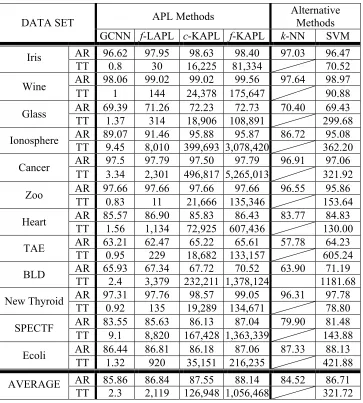
The accuracy rates and training times of all the methods are given in Table 11. The boldface numbers have the same meaning as before, while the underlined numbers are the accuracy rates that are lower than the corresponding SVM results. As usual, we list the averaged results over all the 12 data sets at the bottom of the table. From the last results, we observe that all the APLs outperform k-NN in terms of accuracy; and GCNN is faster in training than SVM, but it is less accurate. The other three APLs incur higher training costs than SVM, but yield higher accuracy rates.
8
Conclusion
APL Methods Alternative Methods DATA SET
GCNN f-LAPL c-KAPL f-KAPL k-NN SVM AR 96.62 97.95 98.63 98.40 97.03 96.47 Iris
TT 0.8 30 16,225 81,334 70.52 AR 98.06 99.02 99.02 99.56 97.64 98.97 Wine
TT 1 144 24,378 175,647 90.88 AR 69.39 71.26 72.23 72.73 70.40 69.43 Glass
TT 1.37 314 18,906 108,891 299.68 AR 89.07 91.46 95.88 95.87 86.72 95.08 Ionosphere
TT 9.45 8,010 399,693 3,078,420 362.20 AR 97.5 97.79 97.50 97.79 96.91 97.06 Cancer
TT 3.34 2,301 496,817 5,265,013 321.92 AR 97.66 97.66 97.66 97.66 96.55 95.86 Zoo
TT 0.83 11 21,666 135,346 153.64 AR 85.57 86.90 85.83 86.43 83.77 84.83 Heart
TT 1.56 1,134 72,925 607,436 130.00 AR 63.21 62.47 65.22 65.61 57.78 64.23 TAE
TT 0.95 229 18,682 133,157 605.24 AR 65.93 67.34 67.72 70.52 63.90 71.19 BLD
TT 2.4 3,379 232,211 1,378,124 1181.68 AR 97.31 97.76 98.57 99.05 96.31 97.78 New Thyroid
TT 0.92 135 19,289 134,671 78.80 AR 83.55 85.63 86.13 87.04 79.90 81.48 SPECTF
TT 9.1 8,820 167,428 1,363,339 143.88 AR 86.44 86.81 86.18 87.06 87.33 88.13 Ecoli
TT 1.32 920 35,151 216,235 421.88 AR 85.86 86.84 87.55 88.14 84.52 86.71 AVERAGE
TT 2.3 2,119 126,948 1,056,468 321.72 Table 11. The performance of the four APLs, k-NN and SVM.
Acknowledgements
We wish to thank Po-Han Kuo and Chien-Hsing Chou for providing some of the experimental results.
References
P. Bartlett and J. Shaw-Taylor. Generalization performance of support vector machines and other pattern classifiers. In B. Schölkopf, C. Burges, and A. J. Smola, editors, Advances in Kernel Methods: Support Vector Learning. MIT Press, 1999.
J. C. Bezdek, Pattern Recognition with Fuzzy Objective Function Algorithms. Plenum, New York, 1981.