ISSN: 2306-9007 Aljasser & Sasidhar (2018) 23
I
www.irmbrjournal.com March 2018I
nternationalR
eview ofM
anagement andB
usinessR
esearchVol. 7 Issue.1
R
M
B
R
Scheduling in A Single-Stage, Multi-Item Compatible Process
Using Multiple ARC Network Model and Excel Solver
Dr. IBRAHIM ABDULLAH ALJASSER
Associate Professor, MMIS Program Director, College of Business Dar Al Uloom University, Riyadh, Kingdom of Saudi Arabia
Email: [email protected], [email protected]
Dr. BOKKASAM SASIDHAR
Professor, College of Business Administration King Saud University, Riyadh, Kingdom of Saudi Arabia
Email: [email protected], [email protected]
Abstract
In the present competitive business environment, a more customer driven approach to production scheduling is required. The criteria considered for production scheduling objectives are generally derived from some desired production performance factors of a manufacturing system. Generally, the customers’ orders are categorized as either normal or prioritized based on the delivery requirements. The production is planned against customers’ orders, keeping in mind the customers’ priorities. The problem of scheduling a given set of machines in a single-stage, multi-item compatible environment, with the objective of maximizing capacity utilization has been formulated (Bokkasam, 2016) as a maximal flow problem in a Multiple Arc Network (MAN). The model provides optimal production schedule with an objective of maximizing capacity utilization, so that the customer-wise delivery schedules are fulfilled, keeping in view the priorities of the customers. The results of a working implementation of the MAN model using excel solver are presented in this paper. The same has been validated with results obtained using two examples. In future the managers will be able to use the worksheet for obtaining the results immediately, for scaled-up scenarios.
Keywords: Scheduling, Maximal Flow Problem, Multiple Arc Network Model, Optimization, Excel Solver.
Introduction
In the past decade, a large number of optimization models and approaches have been proposed for batch scheduling and planning. A number of reviews on the planning and scheduling of batch processes have been presented in the literature (Pinto and Grossmann, 1998; Kallrath, 2002; Floudas and Lin, 2004; Burkard and Hatzl, 2005; Mendez et. al, 2006; Pan et. al, 2009).
mixed-ISSN: 2306-9007 Aljasser & Sasidhar (2018) 24
I
www.irmbrjournal.com March 2018I
nternationalR
eview ofM
anagement andB
usinessR
esearchVol. 7 Issue.1
R
M
B
R
integer nonlinear programming model to determine the schedule of batches, the batch size, and the number of overtime shifts that satisfy the demand at minimum cost for this process. Shashank et. al (2012) considered scheduling of a multi-item single stage production-inventory system in the presence of uncertainty regarding demand patterns, production times and switchover times.
Optimal scheduling of a set of orders in a multi-product batch plant with non-identical parallel processing units where the process is single stage is presented by Ridvan et.al (2007). The allocation of orders to the production units was formulated as an mixed integer linear programming problem in continuous time. The short-term scheduling of a single-stage batch edible-oil deodorizer that can process multiple products in several product groups is considered by Songsong et. al (2010). Sequence-dependent changeovers occur when switching from one product group to another. Based on the incorporation of products into product groups, mixed integer linear programming models were proposed for two scenarios, with and without backlogs.
A stochastic production planning model for a multi-period, multi-product system, where the lead time to produce a product may be random is developed by Steven Hackman et. al (2002). A comparative study of algorithms for the flow shop scheduling problem is presented by Shiqiang Liu and Ong (2002). The problem of allocating the limited capital resources to the various stages of a multistage production system, in order to improve the yield of the production stages and, at the same time minimize the annual cost is considered by George and Andreas (2003). A heuristic procedure to derive non-permutation schedules from a given permutation schedule is given by Pugazhendhi et.al (2003). The application of artificial neural networks to the problem of job shop scheduling with a scope of a deterministic time-varying demand pattern over a fixed planning horizon is given in Shan Feng et.al (2003).
Since the pioneering work of Ford and Fulkerson (2010) in 1962, the use of network models and algorithms have proved to be particularly successful in different application areas. A Multiple Arc Network (MAN) model of production planning in a steel mill is presented by Sasidhar & Achary (1991). A MAN model for production planning in a single-stage, multi-item compatible processing environment, which provides an optimal production plan, with the objective of maximizing the capacity utilization has been presented by Bokkasam (2016). This paper presents the application of excel solver in maximizing the capacity utilization of the MAN model, assuming that the benefits of executing priority orders surpass the cost of equipment setup. The cases where the order books are full as well as when order books are not full have been considered, so that the managers will be able to use the worksheet for obtaining the results for scheduling and also that of spare capacity, for scaled-up scenarios.
Scheduling Procedure Using Excel Solver
As described in Bokkasam (2016), the PROCESSNET is represented by the MAN N=(s,t,V,A,b) with v=|V| vertices, representing the equipments and products. The arcs of A include all possible customer-wise orders and all possible products that can be processed on equipments. The procedure for planning and scheduling consists of the sequential applications of excel solver, using the notations in Bokkasam (2016).
Step 1:
Consider the PROCESSNET with single directed arcs (with arc number i=1). Maximize the flow along the
network by considering the problem as one of linear programming models.Define the capacities along the
arcs as follows: Set i=1 b(s,1,Sk)=Dk1 b(Sk,1,Er)=Akr
For all other (x,y) εN, b(x,y)=
.ISSN: 2306-9007 Aljasser & Sasidhar (2018) 25
I
www.irmbrjournal.com March 2018I
nternationalR
eview ofM
anagement andB
usinessR
esearchVol. 7 Issue.1
R
M
B
R
Step 2:
Set i=2 b(s,2,Sk)=Dk2
b(Sk,2,Er)= Min.[Akr , Akr – optimum flow along (Sk,Er) in Step1] For all other (x,y) εN, b(x,y)=
.Solve the problem using excel solver and determine the optimal flow.
The optimal scheduling is obtained by considering the optimal flows obtained in Step 1 and Step 2 for the prioritized and normal customer orders respectively.
The procedure also provides the machine-wise spare capacities whenever the order books are not full. Further, in case the order books are full, the optimal quantities to be supplied to the customers and the corresponding unfulfilled demands are also brought out.
Illustrative Examples
Application of the above procedure, using excel solver, is illustrated using two examples. Example 1 considers a simple situation of scheduling a workshop with two machines and three products, where each machine has equal capacity for each product and when the order books are full. The second example demonstrates the applicability of the procedure for a slightly bigger problem, using three machines and five products, where the machines have different capacities for different products and when the order books are not full. In general, the procedure is applicable for situations with any number of machines and products.
Example 1: 2 Machines and 3 Products (Scheduling when order books are full)
Consider a workshop having two similar lathes E1 and E2 which are being used for manufacturing three types of roller sets S1, S2 and S3. Assume that both the lathes are capable of manufacturing any of the products and the capacity of each of the lathes (Akr) is 400 units for each of the product. Consider the order position for priority orders and normal orders for the three roller sets S1, S2 and S3 to be as shown in Table 1.
Note that changeover for handling one type of roller to the other type incurs certain time and associated costs. Since the changeover costs increase with the number of set ups, to minimize the costs associated with the set ups, similar types of products should be processed successively so that the total number of changeovers are minimized. This problem is equivalent to the problem of maximizing the total capacity utilization.
This example illustrates the steps in scheduling the workshop.
Table 1: Order position and priorities for Example 1
Order Type/Product S1 S2 S3
Priority 600 500 300
Normal 400 300 700
ISSN: 2306-9007 Aljasser & Sasidhar (2018) 26
I
www.irmbrjournal.com March 2018I
nternationalR
eview ofM
anagement andB
usinessR
esearchVol. 7 Issue.1
R
M
B
R
Figure 1: PROCESSNET for the Workshop of Example 1.
Step 1: Consider the PROCESSNET with single directed arcs (with arc number i=1).
The demand Dki for the product Sk by Order type i will be as follows:
D11=600, D12=400, D21=500, D22=300, D31=300 and D32=700.
The capacity along the arc from s to Sk (k=1,2,3) is the order quantity Dki for the product Sk by the order type i=1, viz., D11=600, D21=500, and D31=300 respectively. The capacity of the arc (Sk, Er) is considered as Akr which is the capacity of processing product Sk by equipment Er. The capacities of the arcs (Er,t) are considered as infinity in this example, it is considered as 10000000.
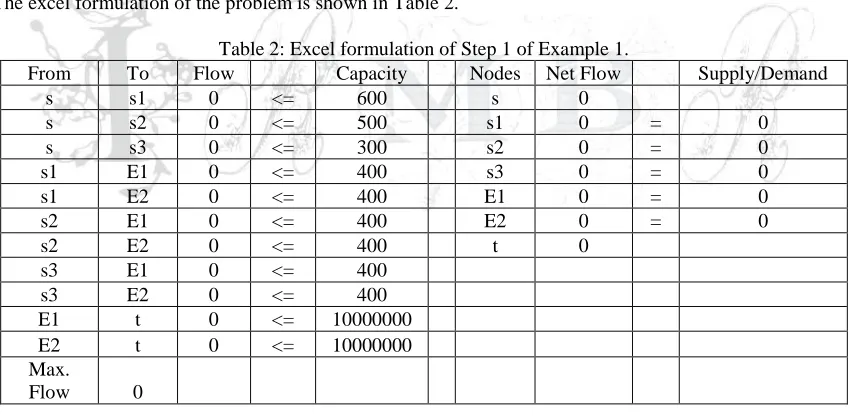
The excel formulation of the problem is shown in Table 2.
Table 2: Excel formulation of Step 1 of Example 1.
From To Flow Capacity Nodes Net Flow Supply/Demand
s s1 0 <= 600 s 0
s s2 0 <= 500 s1 0 = 0
s s3 0 <= 300 s2 0 = 0
s1 E1 0 <= 400 s3 0 = 0
s1 E2 0 <= 400 E1 0 = 0
s2 E1 0 <= 400 E2 0 = 0
s2 E2 0 <= 400 t 0
s3 E1 0 <= 400
s3 E2 0 <= 400
E1 t 0 <= 10000000
E2 t 0 <= 10000000
Max.
Flow 0
Using excel solver, the maximal flow as shown in Table 3 is obtained.
Table 3: Solver solution of Step 1 of Example 1.
Variable Cells
Cell Name Original Value Final Value
$D$4 s1 Flow 0 600
$D$5 s2 Flow 0 500
$D$6 s3 Flow 0 300
$D$7 E1 Flow 0 400
s
S
1 111S
2 111S
3 111E
1E
2t
ISSN: 2306-9007 Aljasser & Sasidhar (2018) 27
I
www.irmbrjournal.com March 2018I
nternationalR
eview ofM
anagement andB
usinessR
esearchVol. 7 Issue.1
R
M
B
R
$D$8 E2 Flow 0 200
$D$9 E1 Flow 0 400
$D$10 E2 Flow 0 100
$D$11 E1 Flow 0 0
$D$12 E2 Flow 0 300
$D$13 t Flow 0 800
$D$14 t Flow 0 600
Step 2: Consider the same PROCESSNET with single directed arcs (with arc number i=2).
The capacity along the arc from s to Sk (k=1,2,3) is the order quantity Dki for the product Sk by the order type i=2, viz., D12=400, D22=300, and D32=700 respectively. The capacity of the arc (Sk, Er) is considered as Min.[Akr , Akr – optimum flow along (Sk,Er) in Step1]. For example, capacity of the arc (S1, E1) is Min.[400, 400-400]=0. The capacities of the arcs (Er,t) are considered as infinity in this example, it is considered as 10000000.
The excel formulation of the problem is shown in Table 4.
Table 4: Excel formulation of Step 2 of Example 1.
From To Flow Capacity Nodes Net Flow Supply/Demand
s s1 0 <= 400 s 0
s s2 0 <= 300 s1 0 = 0
s s3 0 <= 700 s2 0 = 0
s1 E1 0 <= 0 s3 0 = 0
s1 E2 0 <= 200 E1 0 = 0
s2 E1 0 <= 0 E2 0 = 0
s2 E2 0 <= 300 t 0
s3 E1 0 <= 400
s3 E2 0 <= 100
E1 t 0 <= 10000000
E2 t 0 <= 10000000
Max. Flow 0
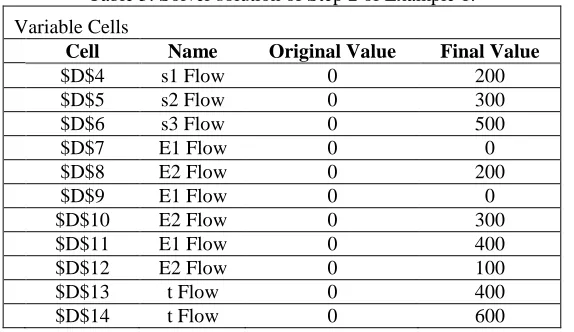
Using excel solver, the following maximal flow as shown in Table 5 is obtained.
Table 5: Solver solution of Step 2 of Example 1.
Variable Cells
Cell Name Original Value Final Value
$D$4 s1 Flow 0 200
$D$5 s2 Flow 0 300
$D$6 s3 Flow 0 500
$D$7 E1 Flow 0 0
$D$8 E2 Flow 0 200
$D$9 E1 Flow 0 0
$D$10 E2 Flow 0 300
$D$11 E1 Flow 0 400
$D$12 E2 Flow 0 100
$D$13 t Flow 0 400
ISSN: 2306-9007 Aljasser & Sasidhar (2018) 28
I
www.irmbrjournal.com March 2018I
nternationalR
eview ofM
anagement andB
usinessR
esearchVol. 7 Issue.1
R
M
B
R
The optimal scheduling is obtained by considering the optimal flows obtained in Step 1 and Step 2, which can be represented as in Table 6.
Table 6: Optimal scheduling for Example 1.
Optimal Schedules Opt. Flow1 Opt.Flow2
Product s1 (Priority/Normal) 600 200
Product s2 (Priority/Normal) 500 300
Product s3 (Priority/Normal) 300 500
Machine 1 400 0
Machine 2 200 200
Machine 1 400 0
Machine 2 100 300
Machine 1 0 400
Machine 2 300 100
Machine 1 Total 800 400
Machine 2 Total 600 600
The optimal flows along the arcs (s,Sk) provides the optimal scheduling for the lathes 1 and 2 and for the
products 1,2 and 3 respectively. In other words, f* = (600, 200, 500, 300, 300, 500) for the arcs (s,Sk).
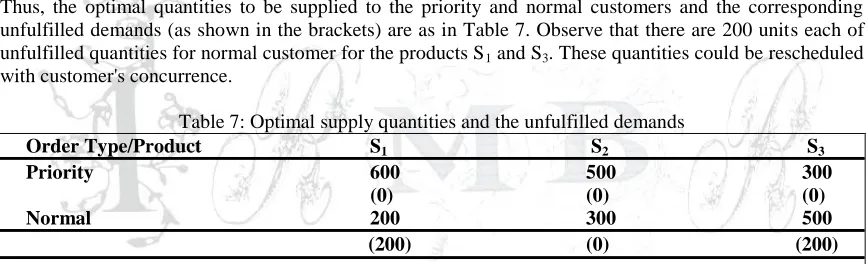
Thus, the optimal quantities to be supplied to the priority and normal customers and the corresponding unfulfilled demands (as shown in the brackets) are as in Table 7. Observe that there are 200 units each of unfulfilled quantities for normal customer for the products S1 and S3. These quantities could be rescheduled with customer's concurrence.
Table 7: Optimal supply quantities and the unfulfilled demands
Order Type/Product S1 S2 S3
Priority 600 500 300
(0) (0) (0)
Normal 200 300 500
(200) (0) (200)
The capacities, scheduled/utilized capacities and the corresponding spare capacity available for the two lathes are shown in Table 8.
Table 8: Machine utilization and the spare capacities available for Example 1.
Machine Capacity Scheduled Spare capacity available
E1 1200 1200 0
E2 1200 1200 0
It can be observed that, if the capacity exceeds the scheduled quantity, the difference provides the available spare capacity for each machine.
Example 2: 3 Machines and 5 Products (Scheduling when order books are not full)
Consider a workshop having three lathes E1, E2 and E3 which are being used for manufacturing five types
ISSN: 2306-9007 Aljasser & Sasidhar (2018) 29
I
www.irmbrjournal.com March 2018I
nternationalR
eview ofM
anagement andB
usinessR
esearchVol. 7 Issue.1
R
M
B
R
Table 9: Machine capacities for lathes in Example 2.
Machine / Product s1 s2 s3 s4 s5
Lathe 1 250 100 100 200 250
Lathe 2 50 100 200 200 250
Lathe 3 100 100 150 150 300
Consider the order position for priority orders and normal orders for the five roller sets S1 to S5 to be as shown in Table 10.
Table 10: Order position and priorities for Example 2.
Order Type/Product s1 s2 s3 s4 s5
Priority 200 100 50 300 150
Normal 100 200 150 50 400
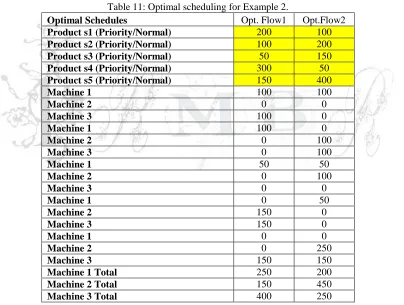
The optimal scheduling to the problem, using excel solver will be as in Table 11.
Table 11: Optimal scheduling for Example 2.
Optimal Schedules Opt. Flow1 Opt.Flow2
Product s1 (Priority/Normal) 200 100
Product s2 (Priority/Normal) 100 200
Product s3 (Priority/Normal) 50 150
Product s4 (Priority/Normal) 300 50
Product s5 (Priority/Normal) 150 400
Machine 1 100 100
Machine 2 0 0
Machine 3 100 0
Machine 1 100 0
Machine 2 0 100
Machine 3 0 100
Machine 1 50 50
Machine 2 0 100
Machine 3 0 0
Machine 1 0 50
Machine 2 150 0
Machine 3 150 0
Machine 1 0 0
Machine 2 0 250
Machine 3 150 150
Machine 1 Total 250 200
Machine 2 Total 150 450
Machine 3 Total 400 250
The optimal flows along the arcs (s,Sk) provides the optimal scheduling for the lathes 1,2 and 3 and for the
products 1 to 5 respectively. In other words, f* = (200, 100, 100, 200, 50, 150, 300, 50, 150, 400) for the
arcs (s,Sk).
ISSN: 2306-9007 Aljasser & Sasidhar (2018) 30
I
www.irmbrjournal.com March 2018I
nternationalR
eview ofM
anagement andB
usinessR
esearchVol. 7 Issue.1
R
M
B
R
The capacities, scheduled/utilized capacities and the corresponding spare capacity available for the three machines are shown in Table 12.
Table 12: Equipment utilization and the spare capacities available for Example 2.
Machine Capacity Scheduled Spare capacity available
E1 900 450 450
E2 800 600 200
E3 800 650 150
Conclusion
In this paper, a working implementation of the excel solver for scheduling the MAN developed by Bokkasam (2016) is presented. The excel has been validated with results obtained and we can now solve large problems involving many machines and products. The methodology of the system described above is in general applicable to all single-stage, multi-item compatible production processes where the process can handle different types of products. Depending on the layout and process flow of the plant, a tailor-made production planning and scheduling system can be formulated using the suitable MAN and the excel solver application. In future, the managers will be able to use this technique for obtaining the results immediately for scaled-up scenarios.
Acknowledgement
This paper is supported by the Deanship of Graduate Studies and Research at Dar Al Uloom University, Riyadh.
References
Bokkasam Sasidhar (2016) Multiple Arc Network Model for Scheduling in a Single-stage, Multi-item
Compatible Process. International Review of Management and Business Research, 5(3), 1223-1231.
Burkard, R. E. & Hatzl, J. (2005) Review, Extensions and Computational Comparison of MILP
Formulations for Scheduling of Batch Processes. Comput. Chem. Eng. 29: 1752–1769.
Floudas, C. A. & Lin, X. (2004) Continuous-Time versus Discrete-Time Approaches for Scheduling of
Chemical Processes: A Review. Comput. Chem. Eng. 28: 2109–2129.
Ford, L.R. & Fulkerson, D.R. (2010) Flows in Networks. Princeton University Press. Princeton, NJ. George C. Hadjinicola & Andreas C. Soteriou (2003) 'Reducing the cost of defects in multistage production
systems: A budget allocation perspective', European Journal of Operational Research 145(3): 621.
Gunter Schmidt (1992) 'A Decision Support System for Production Scheduling', Journal of Decision
Systems 1 (2-3): 243-260.
Gunter Schmidt (1996) 'Modelling Production Scheduling Systems', International Journal of Production
Economics 46-47: 109-118.
Kallrath, J. (2002) Planning and Scheduling in the Process Industry, OR Spectrum 24: 219–250.
Klaus Ecker, Jeet Gupta & Gunter Schmidt. 1997. 'A Framework for Decision Support Systems for
Scheduling Problems', European Journal of Operational Research 101(3): 452-462.
Maged M. Dessouky & Brian A. Kijowski (1997). Production scheduling of single-stage multi-product
batch chemical processes with fixed batch sizes, IIE Transactions, 29(5): 399-408.
Mendez C. A., Cerda´J., Grossmann I. E., Harjunkoski I. & Fahl, M. (2006) State of-the-Art Review of
Optimization Methods for Short-Term Scheduling of Batch Processes. Comput. Chem. Eng. 30: 913–
946.
Pan M., Li X. & Qian, Y. (2009) Continuous-Time Approaches for Short-Term Scheduling of Network
ISSN: 2306-9007 Aljasser & Sasidhar (2018) 31
I
www.irmbrjournal.com March 2018I
nternationalR
eview ofM
anagement andB
usinessR
esearchVol. 7 Issue.1
R
M
B
R
Pinto, J. M. & Grossmann, I. E. (1998) Assignment & Sequencing Models for the Scheduling of Process
Systems. Ann. Oper. Res. (81): 433–466.
Pugazhendhi, S., Thiagarajan, S., Rajendran, C. & Anantharaman, N. (2003) 'Performance enhancement by using non-permutation schedules in floline-based manufacturing systems', Computers & Industrial Engineering 44(1): 133.
Ridvan Berber, Mehmet Yuceer & Zafer Ozdemir (2007). Automatic generation of production scheduling
models in single stage multi-product batch plants: Some examples, Mathematical and Computer
Modelling, 46(1-2): 69–79.
Saksena, J.P. (1982) Applications of O.R. Techniques -3. Decision Networks with Managerial Applications.
National Productivity Council, New Delhi, India.
Saksena, J.P. (1985) 'Applications of decision networks', Journal of Operational Research 19: 41-44.
Sasidhar, B. & Achary, K.K. (1991) 'A multiple arc network model of production planning in a steel mill',
International Journal of Production Economics, 22: 195-202.
Shan Feng, Ling Li, Ling Cen & Jingping Huang (2003) 'Using MLP networks to design a production scheduling system', Computers & Operations Research 30(6): 821
Shashank Garg, D. Krishna Sundar & K. Ravi Kumar (2012).A periodic tabular policy for scheduling of a
single stage production-inventory system, Computers and Industrial Engineering, 62 (1): 21-28.
Shiqiang Liu & Ong H.L. (2002) 'A comparative study of algorithms for the flowshop scheduling
problem', Asia Pacific Journal of Operational Research, 19(2): 205-222.
Songsong Liu, Jose M. Pinto, & Lazaros G. Papageorgiou (2010). Single-Stage Scheduling of Multiproduct
Batch Plants: An Edible-Oil Deodorizer Case Study. Ind. Eng. Chem. Res. 49, 8657–8669.