International Journal of Current Research in
Biosciences and Plant Biology
Volume 4 ●Number 7 (June-2017)● ISSN: 2349-8080 (Online)Journal homepage: www.ijcrbp.com
Original Research Article doi: https://doi.org/10.20546/ijcrbp.2017.407.017
High Frequency of Plant Regeneration through Adventitious Shoots
Proliferation from Leaf Explant of Patchouli
–Pogostemon cablin
(Blanco)
Benth.
C. Gopi*
Department of Botany, Cardamom Planters’ Association College, Bodinayakanur - 625 513, Tamil Nadu, India
*Corresponding author.
A b s t r a c t A r t i c l e I n f o
Plant regeneration potential through adventitious shoots proliferation was studied from
leaf explant of evergreen perennial aromatic herb, patchouli plant, or Pogostemon cablin.
Leaf explant showed differentiation of embryogenic callus on Murashige and Skoog’s
medium (MS) supplemented with 2,4-D 0.5 mg L-1, 3% sucrose and 0.9% agar.
Embryogenic callus was further transfer to same medium with BA 0.5 mg L-1 produced
somatic embryos and adventitious shoots having dark green colour after four weeks. The maximum range of embryogenesis frequency was 89%, depending on the BAP concentration in combination with 2,4-D. The best response was observed on MS medium
containing 0.5 mg L-1 BAP along with 0.5 mg L-1 2,4-D. The embryos or adventitious
shoots matured and developed on fresh MS medium with growth regulators. Maximum numbers of 74 adventitious shoots germination were observed and developed further for root induction on the medium containing 0.5 mg/l BAP and 0.5 mg/l NAA after six weeks of culture. Regenerated shoots were separated and rooted on same half strength MS medium supplemented with 1.0 mg/l of NAA alone for three weeks. Approximately 30-105 plantlets were regenerated from each leaf explant. Well-regenerated plants grew vigorously after transplanting to a soil-less container in shade house.
Accepted: 03 February 2017 Available Online: 06 July 2017
K e y w o r d s
Adventitious shoots Embryogenic callus Leaf explants Plant regeneration
Pogostemon cablin
Introduction
Pogostemon cablin (Blanco) Benth. is commonly called as patchouli belongs to Lamiaceae, evergreen perennial aromatic plant native to tropical countries like Indonesia, the Philippines, Malaysia, India, China, Seychelles, and Brazil. The oil is extracted from patchouli plant used in various purposes like perfumery, cosmetics, incense, insecticides, food flavoring (Xiao, 2001). Pogostemon sp has been used traditionally in
Indian system of medicine and Chinese medicine to treat various diseases such as acne, eczema, inflamed, cracked or mature skin, dandruff, athlete’s foot, varicose veins, hemorrhoids, impetigo and also been used for nervousness, depression, insomnia, and aphrodisiac (Kageyama et al., 1995; Misra, 1996; Xiao, 2001).
techniques for micropropagation and biotechnological applications (Tokuhara and Mii, 2001). Therefore, the interest in using these techniques for rapid and large-scale propagation of medicinal and aromatic plants has been significantly increased (Sahooet al., 1997; Gopiet al., 2006). However, there have been no much reports on the induction of embryogenesis and adventitious shoots proliferation for plant regeneration in this species. Many
in vitro studies have been conducted for this plant using nodal and leaf explant for regeneration through callus (Kageyama, 1995; Misra, 1996; Xiao et al., 2001). Some of previous work on Lamiaceae species, including the Ocimum genus, using different explants, like nodal segments (Ahuja et al., 1982; Shahzad and Siddiqui, 2000; Begum et al., 2000; Gopi et al., 2006), leaf explants (Phippen and Simon, 2000; Gopi and Ponmurugan, 2006), young inflorescence (Singh and Sehgal, 1999) and axillary buds (Begum et al., 2000, 2002).
In the present study, we show the successful results on high frquency of plant regeneration through adventitious shoots proliferation from leaf explant of herbal spice patchouli - Pogostemon cablin (Blanco) Benth.
Materials and methods
For in vitro study on Pogostemon cablin (Patchouli), the experimental plant was grown in our medicinal plant garden. Young leaf explants from healthy plant were collected and washed in running tap water for approximately an hour. After surface sterilization of explants with 70% ethanol for 20-30s followed by 0.05% mercuric chloride treatment for 5-7 min were washed in double distilled water for five times. The
trimmed explants were cultured on 0.9% agar gelled Murashige and Skoog’s (MS) (1962) basal medium supplemented plant growth regulators with 3% sucrose. In this study, different concentrations (0.25 to 4.0 mg l-1) of plant growth regulators such as 2,4-dichlorophenoxy acetic acid (2,4-D), 6- benzylamino purine (BAP), and α-naphthalene acetic acid (NAA) alone/in combinations were used for establishments of adventitious shoots and complete plant regeneration with shoots and roots. The pH of the culture media was adjusted to 5.7±0.1 before addition of agar and sterilized to by autoclaving for 20 min under 1.1-kg/cm2 pressure at 121°C. Cultures were maintained in the culture room at 25±1°C with light intensity of 2000-3000 lux provided by cool white fluorescent light for 16 hrs photoperiod and 70-75% relative humidity. All the treatments were replicated thrice with 20 culture bottles in each set. The percentage of adventitious buds responses and number of shoots developments were recorded and analyzed statistically.
Results and discussion
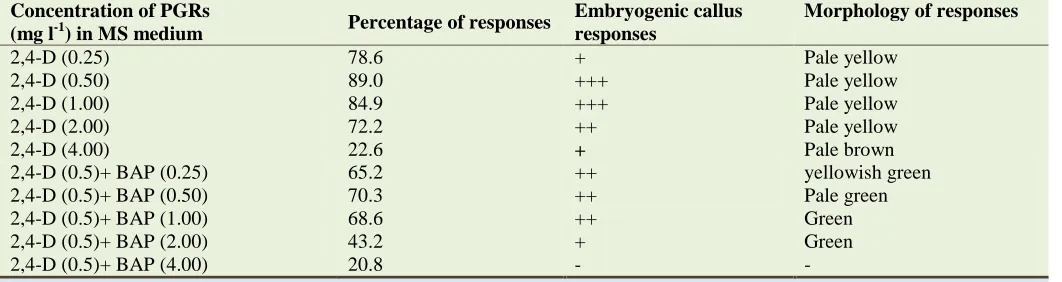
The chemical Initial studies on young leaf explants culture in MS medium supplemented with 2,4-D at different concentration was used and showed notable responses within four weeks of incubation (Table 1). White colour globular structured embryogenic callus was observed at 0.5 mgl-1 with 89% of responses among tested concentration (Fig. 1a-b). As earlier reports, 2,4-D has the ability to induce the embryogenic potential from leaf explants (Pola and Mani, 2006). This globular embryogenic callus was further sub cultured in above MS medium additionally supplemented with BAP at different concentration for further establishment of embryogenesis (Table 1).
Table 1. Effect of different concentration of 2,4-D and BA on MS medium for induction of somatic embryogenic callus from leaf
explant of Pogostemon cablin (Blanco) Benth.
Concentration of PGRs
(mg l-1) in MS medium Percentage of responses
Embryogenic callus responses
Morphology of responses
2,4-D (0.25) 2,4-D (0.50) 2,4-D (1.00) 2,4-D (2.00) 2,4-D (4.00) 78.6 89.0 84.9 72.2 22.6 + +++ +++ ++ + Pale yellow Pale yellow Pale yellow Pale yellow Pale brown 2,4-D (0.5)+ BAP (0.25)
2,4-D (0.5)+ BAP (0.50) 2,4-D (0.5)+ BAP (1.00) 2,4-D (0.5)+ BAP (2.00) 2,4-D (0.5)+ BAP (4.00)
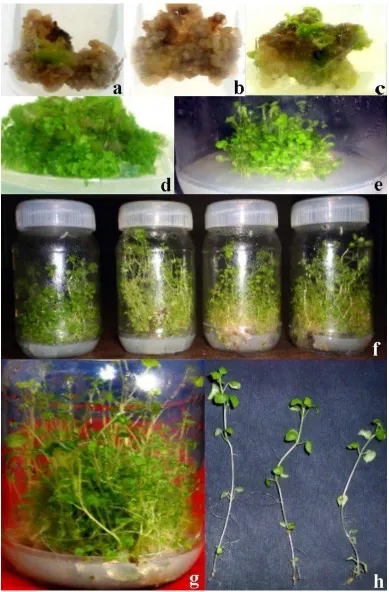
Fig. 1: In vitro studies on establishment of adventitious shootsand plantlet development from leaf explant of Pogostemon cablin
(Blanco) Benth.; (a-b) Induction of embryogenic callus from leaf explant on MS medium with 2,4-D (0.5 mg/l); (c-d) Formation
of dark-green embryogenic callus and adventitious buds of shoots on MS medium with 2,4-D (0.5mgl-1) and BAP (0.5 mg/l); (e-f)
Plantlets regenerated through adventitious shoots on MS medium with BAP (0.5 mg/l) and NAA (0.5 mgl-1); (g-h) Complete Plant
The embryogenesis efficiency was significantly increased in 0.5 mg/l BAP with green colour shoots germinations (Fig. 1c). BAP in combination with 2,4-D had remarkable responses towards effective embryogenesis and shoot proliferation as previous reports (Kintzios et al., 1999; Kim et al., 2004; Karun
et al., 2004; Gopi and Ponmurugan, 2006). In higher concentration of BAP found to be inefficient for shoot
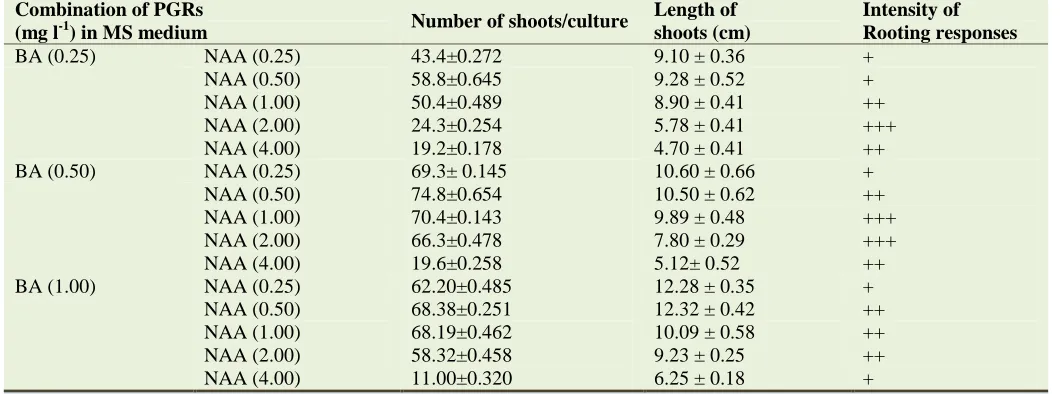
establishment. This result shows that low concentration of (0.5 mg/l) BAP is enough to develop the multiple shoots regeneration whereas, Misra (1996) reported that BAP at 1.0 mgl-1. These green embryogenic calli were sub-cultured to establish high frequency of plant regeneration in MS medium supplemented with BAP combination with NAA at different concentration (see Table 2).
Table 2. Effects of BAP in combination with different concentration of NAA on plant let regeneration, elongation and root
induction of somatic embryos of Pogostemon cablin (Blanco) Benth.
Combination of PGRs
(mg l-1) in MS medium Number of shoots/culture
Length of shoots (cm)
Intensity of Rooting responses
BA (0.25) NAA (0.25)
NAA (0.50) NAA (1.00) NAA (2.00) NAA (4.00) 43.4±0.272 58.8±0.645 50.4±0.489 24.3±0.254 19.2±0.178
9.10 ± 0.36 9.28 ± 0.52 8.90 ± 0.41 5.78 ± 0.41 4.70 ± 0.41
+ + ++ +++ ++
BA (0.50) NAA (0.25)
NAA (0.50) NAA (1.00) NAA (2.00) NAA (4.00) 69.3± 0.145 74.8±0.654 70.4±0.143 66.3±0.478 19.6±0.258
10.60 ± 0.66 10.50 ± 0.62 9.89 ± 0.48 7.80 ± 0.29 5.12± 0.52 + ++ +++ +++ ++
BA (1.00) NAA (0.25)
NAA (0.50) NAA (1.00) NAA (2.00) NAA (4.00) 62.20±0.485 68.38±0.251 68.19±0.462 58.32±0.458 11.00±0.320
12.28 ± 0.35 12.32 ± 0.42 10.09 ± 0.58 9.23 ± 0.25 6.25 ± 0.18
+ ++ ++ ++ +
15 cultures were maintained in each treatment and data (SE) recorded up to five weeks of culture; + Rooting response.
Ocimum sanctum belongs to this family has been reported by Singh and Sehgal (1999) that BAP alone is required for plant regeneration. The maximum number of shoots induction of per culture 74.80 was achieved from medium supplemented with 0.5 mg/l BAP and 0.5 mg/l NAA, in four weeks (Fig. 1c-f). Maoet al. (1995) and Espinosa et al. (2006) reported that BAP proved superior to other cytokinins for multiple shoot induction of Clerodendrum colebrookianum.
Normally, Pogostemon cablin shows good response towards plant regeneration in MS medium in the presence of BAP combined with NAA as earlier reports (Hu et al., 2005; Misra, 1996; Kageyama et al., 1995). Several authors have observed a strong co-relation between the auxins and cytokines ratio in the media and shoot formation using different explant sources and genotypes (Pattnaik and Chand, 1996; Reddy et al., 2001; Dode et al., 2003; Khanna and Raina, 1998; Sugimuraet al., 2005; Singh and Sehgal, 1999; Shahzad and Siddiqui, 2000; Gopi and Ponmurugan, 2006).
Shoot elongation higher while BAP along with NAA
combination at different concentration. While BAP at 0.5 mgl-1 combination with NAA at 0.5 mgl-1 showed maximum number of shoot germination occurred simultaneously shoot elongation was able to achieve about 10 cm length with remarkable rooting response (see Table 2). Similarly high concentration of BAP at 1.0 mgl-1 showed good elongation of shoots about 12 cm. After 3 to 4 weeks, when regenerated shoots reached a length of more than 8 cm, they were separated and planted on half strength MS basal medium with and without NAA. In cultures, where the shoots were inoculated on auxins free basal medium, no root formation was observed. Whereas root primordial emerged from the shoot base on first week of culture on NAA supplemented medium.
Pogostemon cablin. Thus, desirable genotypes can be regenerated in large numbers within a short period. It may be ideal for genetic transformation because of the high frequency of plant regeneration and ready availability of explants throughout the year. It may also be useful for inducing genetic variability through e.g. mutagenesis and somaclonal variation. Further studies into the transfer of germinated somatic embryos to ex vitro conditions are needed.
Conflict of interest statement
Authors declare that they have no conflict of interest.
Acknowledgement
The author acknowledges Department of Biotechnology, KSRCT, Tiruchengode and the Department of Botany, Cardamom Planters’ Association College, Bodinayakanur - 625 513, Tamil Nadu, India, for providing necessary facilities.
References
Ahuja, A., Verma, M., Grewal, S., 1982. Clonal propagation of Ocimum species by tissue culture. Ind. J. Exp. Biol. 20, 455-458.
Begum, F., Amin, M.N., Azad, M.A.K. In vitro clonal propagation of holy basil (Ocimum sanctum L.). Plant Tiss. Cult. 10(1), 31-37.
Dode, L. B., Bobrowski, V. L., Braga, E. J. B., Seixas, F. K., Schuch, M. W., 2003. In vitro propagation of
Ocimum basilicum L. (Lamiaceae), Acta Scient. Biol. Sci. 25(2), 435-437.
Espinosa, A. C., Pijut, P. M., Michler, C.H., 2006. Adventitious shoot regeneration and rooting of Prunus serotinain vitro cultures. HortSci. 41(1), 193-201.
Gopi, C., Ponmurugan, P., 2006. Somatic embryogenesis and plant regeneration from leaf callus of Ocimum basilicum L. J. Biotechnol. 126(2), 260-264.
Gopi, C., Sekhar, Y.N., Ponmurugan, P., 2006. In vitro
multiplication of Ocimum gratissimum L.. Afr. J. Biotech. 5(9), 723-726.
Gopi, C., Vatsala, T.M., Ponmurugan, P., 2006. In vitro
multiple shoot proliferation and plant regeneration of Vanilla planifolia Andr. - A commercial spicy orchid. J. Plant Biotechnol. 8(1), 37-41.
Hu, J.B., Liu, J., Yan, H.B., Xie, C.H., 2005. Histological observations of morphogenesis in
petiole derived callus of Amorphophallus rivieri
Durieu in vitro. Plant Cell Rep. 24(11), 642-648. Kageyama, Y., Honda, Y., Sugimura, Y., 1995. Plant
regeneration from patchouli protoplasts encapsulated in alginate beads. Plant Cell Tiss. Organ Cult. 41(1), 65-70.
Karun, A., Siril, E. A., Radha, E., Parthasarathy, V. A., 2004. Somatic embryogenesis and plant regeneration from leaf and inflorescence explants of arecanut (Areca catechu L.). Curr. Sci. 86(12), 1623-1628.
Khanna, H.K., Raina, S.K., 1998. Genotype × culture media interaction effects on regeneration response of three indica rice cultivars. Plant Cell Tiss. Organ Cult. 52, 145-153.
Kim, S. W., 2004. High frequency somatic embryogenesis and plant regeneration in petiole and leaf explant cultures and petiole-derived embryogenic cell suspension cultures of Hylomecon vernalis. Plant Cell Tiss. Organ Cult. 74(2), 163-167.
Kintzios, S., Nikolaou, A., Skoula, 1999. Somatic embryogenesis and in vitro rosmarinic acid accumulation in Salvia officinalis and S. fruticosa
leaf callus cultures. Plant Cell Rep. 18, 462-466. Mao, A.H., Wetten, A., Fay, M., Caligari, P.D.S., 1995.
In vitro propagation of Clerodendrum colebrookianum Walp.: A potential natural anti-hypertension medicinal plant. Plant Cell Rep. 14, 493-496.
Misra, M., 1996. Regeneration of patchouli (Pogostemon cablin Benth.) plants from leaf and node callus, and evaluation after growth in the field. Plant Cell Rep. 15, 991-994.
Murashige, T., Skoog, F., 1962. A revised medium for rapid growth and bioassays with tabacco tissue cultures. Physiol. Plant. 15, 473-479.
Pattnaik, S., Chand, P.K., 1999. In vitro propagation of the medicinal herbs Ocimum americanum L. syn. O. canum Sims. (Hoary basil) and Ocimum sanctum L. (holy basil). Plant Cell Rep. 15, 846-850.
Phippen, W.B., Simon, J.E., 2000. Shoot regeneration of young leaf explants from basil (Ocimum basilicum
L.). In Vitro Cell. Dev. Biol.-Plant. 36(4), 250-254. Pola, S. R., Sarada Mani, N., 2006. Somatic
embryogenesis and plantlet regeneration in Sorghum bicolour (L) Moench, from leaf segments. J. Cell Mol. Biol. 5, 99-107.
Reddy, P. S., Rodrigues, R., Rajasekharan, R., 2001. Shoot organogenesis and mass propagation of
Tiss. Organ Cult. 66(3), 183-188.
Sahoo, Y., Pattnaik, S. K., Chand, P. K., 1997. In vitro
clonal propagation of an aromatic medicinal herb
Ocimum basilicum L. (sweet basil) by axillary shoot proliferation. In Vitro Cell. Dev. Biol.-Plant. 33, 293-296.
Sharzad, A., Siddiqui, S.A., 2000. In vitro organogenesis in Ocimum sanctum L. – A multipurpose herb. Phytomorphol. 50(1), 27-35.
Singh, N.K., Sehgal, C.B., 1999. Micropropagation of ‘Holy Basil’ (Ocimum sanctum Linn.) from young inflorescences of mature plants. Plant Growth Regul. 29(3), 161-166.
Sugimura, Y., Kadotani, N., Ueda, Y., Shima, K., Kitajima, S., Furusawa, T., Ikegami, M., 2005. Transgenic patchouli plants produced by
Agrobacterium-mediated transformation, Plant Cell Tiss. Organ Cult. 82(3), 251-257.
Tokuhara, K., Mii, M., 2001. Induction of embryogenic callus and cell suspension culture from shoot tips excised from flower stalk buds of Phalaenopsis
(Orchidaceae). In Vitro Cell. Dev. Biol.-Plant 37, 457-461.
Xiao, He, H., Xu, H., 2001. Study on the tissue culture and plant regeneration of Pogostemon cablin, Zhong Yao Cai. 2, 391-392.
How to cite this article:
Gopi, C., 2017. High frequency of plant regeneration through adventitious shoots proliferation from leaf explant of patchouli–Pogostemon cablin (Blanco) Benth. Int. J. Curr. Res. Biosci. Plant Biol. 4(7), 134-139. doi: