http://www.ijcmph.com pISSN 2394-6032 | eISSN 2394-6040
Original Research Article
Attitude of first year medical students towards cadaveric dissection:
a cross sectional study in a medical college of West Bengal, India
Romy Biswas
1, Raktim Bandyopadhyay
2*
INTRODUCTION
Anatomy, the study of the structures of the human body is one of the first, most fundamental and essential subjects studied by medical students in their medical education career. Anatomy teaching in medical schools has been conventionally based around the use of human cadaveric specimens, either taking the whole body specimens for complete dissection or individual specimens. The practice of cadaveric dissection allows students grasp the three-dimensional anatomy and concept of biological inconsistency and skill development.1 Since the renaissance, dissection of cadaver has been vital to medical education and the chief pillar for learning anatomy.2
In medical colleges, cadaveric dissection is practiced during preclinical teaching of anatomy where students are exposed to cadavers in very early stages of their medical curriculum. This exposure may induce unintended negative experiences in these students. The emotional impact of such exposure on students and their ability to cope has been examined in some studies. The effects which have been described include the physical (smell, nausea, conjunctival irritation) and psychological (anxiety, stress, emotional trauma, depression) but available evidences suggest that adaptive mechanisms for coping with exposure are triggered soon afterwards in these students.2-5 In recent years, the relevance and worth of the dissection laboratory have been under discussion at different universities due to lofty costs and problems of less time in some medical curricula.6
ABSTRACT
Background: Cadaver dissection is mandatory for medical education. The cadaver dissection develops the knowledge and skill of the students regarding human anatomy to understand and accomplish the necessity of medical education and clinics in future. This study was conducted to assess the attitude and emotional reactions of first year Medical students to the dissecting cadavers.
Methods: The attitude and opinion of students on cadaver dissection was assessed by a modified structured pretested questionnaire after one week of dissection class among all first year medical students by cross-sectional design.
Results: Males and females were in the ratio of 7:3.88.3% complied that active involvement is necessary but only 10.9% told that models or virtual program could replace dissection. Altogether 49.6%% had experienced the excitement, 15.3% had experienced headache and sweating. 87.6%% were curious about cadaver dissection and 84.7 %were interested; however 8% had negative feelings towards dead body.
Conclusions: Majority of students opined cadaver dissection was the best method for learning and understanding Human anatomy. Pre-education sessions and interaction with the teacher’s prior dissection will help to remove the anxiety among students and will enable them to get involved in their dissection classes.
Keywords: Cadaver, Opinion, Dissection, Medical students
1
Department of Community Medicine, Coochbehar Government Medical College & Hospital, 2Department of Anatomy, Burdwan Medical College and Hospital, Burdwan, West Bengal, India
Received: 10 April 2019
Accepted: 17 May 2019
*Correspondence:
Dr. Raktim Bandyopadhyay, E-mail: romyraktim @yahoo.com
Copyright: © the author(s), publisher and licensee Medip Academy. This is an open-access article distributed under the terms of the Creative Commons Attribution Non-Commercial License, which permits unrestricted non-commercial use, distribution, and reproduction in any medium, provided the original work is properly cited.
Indeed, during the last decade, several universities in the US and the UK have abandoned dissection and have moved from a cadaver-oriented to a cadaver less anatomy6. But the benefits of orthodox dissection include memory enhancement, peer teaching, three dimensional anatomy and spatial association.7,8 In recent years, there has been much argument surrounding the ethics and effectiveness of using human tissue as a learning tool.
Students' attitudes towards dissection regarding anatomy may determine their learning concepts and affect their professionalization. Students' positive attitudes towards dissecting human cadavers could be related to a representation of the body, life and death leading to a future professional assuming a more humane relationship with the future patients. Managing emotions and learning from relationships with others is necessary for establishing empathy.
There are changeable responses regarding the attitudes and views towards cadaver dissection among first year medical students. So, this study was conducted to assess the attitude and to study the physical and emotional reactions among them on exposure to human cadaver in dissection hall.
METHODS
A cross-sectional, descriptive study was conducted among all first year students in Burdwan Medical College, West Bengal for August–October 2018. Students who were absent and refused to give consent were excluded. The purpose of the study was explained and informed consent was obtained. Anonymity and confidentiality was also ensured to them.
Data was collected using a pre-tested schedule consisting of two parts:
The first part includes the personal characteristics of the students, like age, sex, place of stay, type of occupation of their parents.
The second part includes questions of opinion & attitude towards cadaveric dissection during their regular dissection classes.
The content was discussed with the students and the question were framed and validated by the experts in the field of Anatomy. The study was undertaken immediately after one week of dissection class and the responses are the cumulative subjective effect of all the classes. The practical session of the Anatomy course consists of 2 hours of dissection 3-4 times in a week.
RESULTS
All the students were included as the study population but 137 of them were analysed due to completeness. The mean age of male and female students was 18.9±0.92 and 18.6±0.91 years.
Table 1 depicts 94.2% of the students were above 18 years, 29.9% were girls and 59.9% stayed in hostel. 62% and 32.8% had their schooling as English and vernacular respectively. Only 8% were exposed to animal dissection in their school life. 34.3% of the mothers were employed in some job and fathers were mostly engaged in service or business.
Table 1: Characteristics of the medical students.
Characteristics No (%)
Age of students (years) <18 08 (5.8)
≥18 129 (94.2)
Gender Male 96 (70.1)
Female 41 (29.9)
Type of stay
Hostel 82 (59.9)
Home 18 (13.1)
Others 37 (27.0)
Medium of schooling
English 85 (62.0)
Bengali 45 (32.8)
Others 07 (5.2)
Exposed to animal
dissection in school Yes 11 (8.0)
Occupation of mother Home maker 90 (65.7)
Teacher 27 (19.7)
Others 20 (14.6)
Occupation of father
Service 50 (36.5)
Business 39 (28.5)
Teacher 18 (13.1)
Self-employed 15 (10.9)
Others 15 (10.9)
Total 137 (100.0)
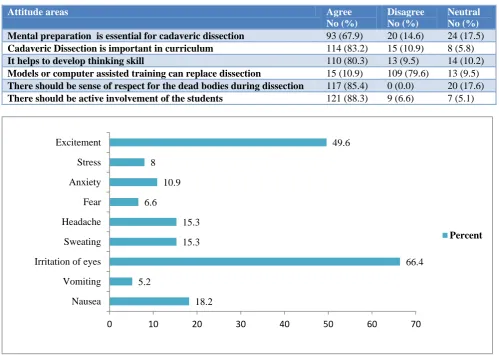
While assessing the attitude of medical students regarding dissection as shown in Table 2, 88.3% said there should be active involvement while dissecting cadavers, 85.4% agreed in respecting the cadavers while dissecting and 69.7% agreed that mental preparation is essential for cadaveric dissection. 79.6% disagreed to replace models for human cadaver.
Figure 1 shows the different physical and psychological symptoms before entering the dissection hall or while doing dissection. 66.4% had experienced irritation of eyes and 18.2% had nausea. 49.6% had excitement before doing cadaver dissection. Only 6.6% had fear in performing dissection.
Table 2: Attitude of medical students regarding dissection in curriculum.
Attitude areas Agree
No (%)
Disagree No (%)
Neutral No (%)
Mental preparation is essential for cadaveric dissection 93 (67.9) 20 (14.6) 24 (17.5)
Cadaveric Dissection is important in curriculum 114 (83.2) 15 (10.9) 8 (5.8)
It helps to develop thinking skill 110 (80.3) 13 (9.5) 14 (10.2)
Models or computer assisted training can replace dissection 15 (10.9) 109 (79.6) 13 (9.5)
There should be sense of respect for the dead bodies during dissection 117 (85.4) 0 (0.0) 20 (17.6)
There should be active involvement of the students 121 (88.3) 9 (6.6) 7 (5.1)
Figure 1: Physical and psychological symptoms while undergoing dissection classes.
Figure 2: Opinion of medical students towards cadaveric dissection.
18.2 5.2
66.4 15.3
15.3 6.6
10.9 8
49.6
0 10 20 30 40 50 60 70
Nausea Vomiting Irritation of eyes Sweating Headache Fear Anxiety Stress Excitement
Percent
87.6 8
84.7 17.5
8
32.1
0 50 100
Are you curious for cadaveric dissection? Are you depressed while attending dissection class? Are you interested in dissection? Do you desire to leave the dissection hall? Do you have negative feelings towards dead body? Do you want to donate your body for dissection?
DISCUSSION
The recognized truth in learning anatomy is from dead. Literature review reveals that there are varying responses regarding the emotions and opinions of medical students towards cadaver dissections.9 But the use of cadavers for dissection in anatomy learning has been identified by some scholars as expensive, time consuming and hazardous and stressful.10,11 Cadaver acquisition is a painstaking work out involving the collection of unclaimed bodies from hospital mortuaries throughout the country and very few are donated or unclaimed. The ethical rationale of using unclaimed bodies to teach anatomy has been questioned.12 But most of them considered cadaver dissection as important and indispensable in anatomy learning.
Personal characteristics of the medical students
The mean age of male and female students was 18.9±0.92 and 18.6±0.91 years.70.1% were males and the rest were females, whereas a study by Vikani in Gujarat found 56% males among medical undergraduates.13 But a study conducted by Mulu in Gondar found males about 85.7% but the mean ages were slightly higher than this study.1 60% of them stayed in hostel and the rest in home or rented accommodation. Service and business were the main occupation of their fathers whereas mothers were mainly homemakers. Similar findings were observed in study by Nirmalya et al in Imphal.14 Only 8% were engaged in animal dissection before which corroborates with the finding of the Imphal study.
Attitude towards cadaver dissection
More than 80% of the students had a positive attitude towards cadaveric dissection. They thought there should be active involvement, it is an important component of medical curriculum and it helps in critical thinking. 10.9% thought models can replace dissection. A study by Agnihotri et al found among 90%of the medical students that dissection enhances skill and enables to think in a logical manner, 82% also thought that discussing before dissection lessens anxiety and 33% opined that models can replace dissection.15 85.7% agreed that there should be sense of respect for the dead bodies which corroborates with the findings of the study done by Kaundal in Himachal Pradesh.16 However in a study conducted in Nigeria used a manual for dissection without the assistance of teachers.17
Physical and psychological symptoms
Irritation of eyes was the most common presenting physical symptom but about 50% were excited before dissection. A study by Agnihotri et al found the students lacking in concentration and one third of them feared and had nausea.15 But Mulu in his study found 42.9% excited and 58.5% experienced nausea.1 Similarly, a study by Mc Garvey et al on students of Royal College of Surgeons in
Ireland on their initial visit and on the tenth week visit of anatomy room showed a significant decrease of nausea, dizziness and fainting. Medical students of Mangalore revealed a similar picture.4,18 Another study done in India also showed that interest and excitement had increased while fear and nausea had decreased along the three surveys.19 Thus, for the majority of the students, dissection does not appear to be repulsive experience.
Opinion of medical students towards cadaveric dissection
87.6% of the students were curious to do the dissection class which was also seen in study by Kaundal et al.16 The negative feelings was noticed among 8% of the students. Rajkumari et al reported that most first year medical students found their first visit to the anatomy dissection room exciting and suffered very little or no stress at all on their first visit.2 Prior exposure to cadavers is found to be an important factor to reduce stress toward cadaveric dissection.13 Students should be adequately educated before performing dissection as 17.5% of them desired to leave the hall during cadaver dissection. This finding was also observed in study conducted in Imphal.14 Studies also reported that interaction with anatomy staff lessens the emotional impact.14,15 35% of students in Ekpoma, Nigeria had apprehension in handling the cadaver directly.17
Cadaveric dissection helps medical students by serving them in understanding the three-dimensional association of different anatomical structures and appreciating anatomical variations.20 But medical education has shifted towards problem-based learning and integrated curriculum.21 Paucity of cadavers and cost also shifted in developing alternative methods like virtual dissection programmes. These are being preferred over cadaveric dissection, as its use is not associated with emotional and ethical issues.22 According to various studies, younger physicians were less likely to prefer cadaveric dissection as compared to their seniors.23 Students’ attitudes towards the dissecting room remained consistently positive for the duration of the study with only a few in number of respondents reporting negative symptoms. The majority of students in various studies described before did not find the dissecting room always stressful.24
CONCLUSION
Cadaver dissection is a vital and indispensible in learning anatomy. Better teacher student’s interactions, pre-education sessions will help in improving the attitude of the students towards cadaveric dissection which in turn will help in improving their mental status to handle the highest level of stress and anxiety in their medical carrier.
Recommendations
motivated. There is also a need for the inclusion of courses on emotions and how to handle them in the medical curriculum.
Funding: No funding sources Conflict of interest: None declared
Ethical approval: The study was approved by the Institutional Ethics Committee
REFERENCES
1. Mulu A, Tegabu D. Medical students' attitudinal changes towards cadaver dissection: a longitudinal study. Ethiopian J Health Sci. 2012;22(1):51-8. 2. Rajkumari A, Singh Y. Body donation and its
relevance in anatomy learning: A review. J Anat Soc India. 2007;56:1–6.
3. Dinsmore CE, Daugherty S, Zeitz HJ. Student responses to the gross anatomy laboratory in a medical curriculum. Clin Ana. 2001;14(3):231–6. 4. Mc Garvey MA, Farrell T, Conroy RM, et al.
Dissection: a positive experience. Clin Anat. 2001;14(3):227–30.
5. Bataineh ZM, Hijazi TA, Hijleh MFA. Attitudes and reactions of Jordanian medical students to the dissecting room. Surg Radiol Anat. 2006;28(4):416– 21.
6. Korf HW, Witch H, Snipes RL et al. The dissection course-necessary and indispensable for teaching anatomy to medical students. Annal Anatomy. 2008;190(1):16-22.
7. Bentley BS, Hill RV. Objective and subjective assessment of reciprocal peer teaching in medical gross anatomy laboratory. Anat Sci Educ. 2009;2:143-9.
8. Gangata H, Ntaba P, Akol P, Louw G. The reliance on unclaimed cadavers for anatomical teaching by medical schools in Africa. Anat Sci Educ. 2010;3:174-83.
9. Patel KM, Moxham BJ. The relationship between learning outcomes and method of teaching anatomy as perceived by professional anatomists. Clin Anat. 2008;21(2):182-9 .
10. Winkelmann A. Anatomical dissection as a teaching method in medical school: a review of the evidence. Med Educ. 2007;41(1):15-22.
11. Aziz MA, McKenzie JC, Wilson JS, Cowie RJ, Ayeni SA, Dunn BK. The human cadaver in the age
of biomedical informatics. Anat Rec.
2002;269(1):20–32.
12. Jones DG, Whitaker MI. Anatomy’s use of unclaimed bodies: reasons against continued
dependence on an ethically dubious practice. Clin Anat. 2012;25:246-54.
13. Vikani S, Gujar S, Parmar J, Vaisnani H, Gadekar S. Attitude & Reaction of 1st Year Medical Students Toward Cadaveric Dissection. Int J Res Med. 2017;5(4):88-91.
14. Saha N, Chaudhuri S, Singh MM. Attitude of First Year Medical Students in Dissection Hall. IOSR. 2015;14(5):74-8.
15. Agnihotri G, Sagoo MG. Reactions of first year Indian medical students to the dissection hall experience. NJIRM. 2010;1(4):4-9.
16. Kaundal AP, Kaundal PK. Perception of students towards cadaveric dissection in a tertiary care teaching institution. Int J Res Med Sci. 2017;5:3684-7.
17. Izunya AM, Oaikhena GA, Nwaopara AO. Attitudes to Cadaver Dissection in a Nigerian Medical School. Asian J Medical Sci. 2010;2(3):89-94.
18. Vinay Kumar V, Martin Lucas A, Kumar V, Kulal P. Attitude of first year Indian medical students towards cadaver dissection. Int J Anat Res. 2015;3(3):1255-8.
19. Arora L, Sharma B. Assessment of role of dissection in anatomy teaching from the perspective of undergraduate students: A qualitative study. Ibnosina J Med BS. 2011;3(2):59–65.
20. Winkelmann A, Hendrix S, Kiessling C. What do students actually do during a dissection course? First steps towards understanding a complex learning experience. Acad Med. 2007;82(10):989-95.
21. Cho MJ, Hwang Y. Students' perception of anatomy education at a Korean medical college with respect to time and contents. Anat Cell Biol. 2013;46:157– 62.
22. apa , accare a M. eaching anatomy in the I century new aspects and pitfalls. Sci World J. 2013;2013:310348.
23. Romero-Reverón R. Venezuelan surgeons view concerning teaching human anatomical dissection. Anat Cell Biol. 2017;50:12–6.
24. Cahill KC, Ettarh RR. Attitudes to anatomy dissection in an Irish medical school. Clin Anat. 2009;22:386–91.