Constraints experienced by female students pursuing
science and technology-based university programs in their
learning of science in Ghana
Amponsah, Kwaku Darko
OLA College of Education, Ghana ([email protected])
Mensah, Fiifi
University of Cape Coast, Ghana ([email protected])
Mensah, Alfred
University of Cape Coast, Ghana ([email protected])
Received: 1 January 2014 Revised: 12 May 2014 Accepted: 23 May 2014
Available Online: 25 May 2014 DOI: 10.5861/ijrse.2014.684
ISSN: 2243-7703 Online ISSN: 2243-7711
OPEN ACCESS
Abstract
This paper is part of a larger study to investigate female students in science and
technology-based university (STU) programs in their motivation, perception and constraint in
learning science at senior high school and consequently science and technology-based
programs at the university level. The conceptual framework is rooted in Steele’s concept of
stereotype threat, which is the experience of anxiety or concern in a situation where a person
has the potential to confirm a negative stereotype about their social group. The investigation
was conducted among 328 final year female students pursuing engineering, medicine,
pharmacy and computer science/ICT at Kwame Nkrumah University of Science and
Technology (KNUST), Kumasi, Ghana. The study utilized cross-sectional descriptive survey
design. 328 final year female students in the 2008/2009 academic year pursuing engineering,
medicine, pharmacy and computer science/ICT formed the sample. A Self-Report Survey
Questionnaire on constraints female students experience in their learning of science was
designed and administered. This study indicated that female students have to grapple with
some challenges such as lack of funding, and the unavailability or expensive nature of some
textbooks. One-way between group analysis of variance (ANOVA) and Hotchberg GT2 Post
hoc analyses indicated that there were significant differences in constraints among some of
the four groups of students. It was concluded that Government and other stakeholders should
provide funding, scholarships or bursaries to female students in order to enhance their full
participation. These challenges may account in part to the low participation of females in
science and technology-based programs.
Constraints experienced by female students pursuing science and technology-based
university programs in their learning of science in Ghana
1. Introduction
Education of females has an overwhelming effect on national development since females contribute immensely to food production, domestic food storage and food processing, marketing and all household activities in Africa (Anamuah-Mensah, 2007), as lack of their education has been linked to low birth weight, poor health and high mortality rates in children, high fertility rates, poor family nutrition, low life expectancy, poor sanitation and high illiteracy rates. Thus education continues to be central to a country’s well-being and economic development. Governments in many parts of Africa are aware of the benefits that will accrue from the education of the girl child. Accordingly, Lopez-Claros and Zahidi, (2007) indicated that when a country educates its citizens (women as well as men), economic productivity rises, maternal and infant mortality rates fall, fertility rates decline, and the health and educational prospects of the next generation are improved. The socio-economic importance of female education can thus not be over emphasized.
In view of this efforts to boost female education in science and technology have been made by governments, international organizations and NGOs and the government of Ghana is no exception. Programs put in place over the years include the establishment of Science Resource Centers in selected senior secondary schools (Ampiah, 2006) to address issues surrounding inequitable opportunities for effective science course and for technological advancement; the introduction of Science, Mathematics and Technology Education (SMTE) clinic for both boys and girls, and the incorporation of technical drawing at the basic school level to encourage students to actively participate in science and technology activities and to increase the accessibility of females to apprenticeable and non-traditional areas of technical education and training in Ghana (Baryeh, Obu, & Lamptey, 1999). However, there is still a gender disparity in education. Females still have low access to education, low participation and poor performance in many subjects, especially Mathematics and Science subjects. Many factors which are home, community and school based, continue to restrict developments in female education.
Repeated experiences of stereotype threat can lead to a vicious circle of diminished confidence, poor performance and loss of interest in the relevant area of achievement (Gilovich, Keltner, & Nisbett, 2006).
Research has shown that factors within the classroom are not the only cause of gender imbalances in science education and that home based factors which include family size, household income, parents’ career, cultural and traditional beliefs all contribute substantially to poor female enrolment and consequent participation in science and technology in school. Girls are pulled out of school and boys left in school when the family income dictates that all children cannot be educated. The factors which interplay and affect female education are limitless. Extracurricular and out of school factors play a big role in female education. Long distances from school, sexual harassment by classmates, teachers and males in the community and inefficient use of her time contribute to making attendance in school poor. Finally, the girl child drops out of school when conditions at home, in school, on the way to school and in the community prevent her from having a meaningful and conducive learning environment (Torto, 2012).
Myers (as cited in Davies, Klawe, Nyhus, and Sullivan, 2000) indicated that the low participation by women in both the information technology (IT) industry and in computer science courses in secondary and post-secondary education is an important equity issue in science education. Partly, because of external influences and internal preferences, both genders face difficulties in career decision making. External forces such as social, cultural, and obsolete traditional manifestations, stereotype men’s and women's career roles, subsequently, streaming them into predefined dichotomous roles. Data on women participation in traditionally masculine labeled fields of study reported by the American Association of University Women (AAUW) and the National Association of Educational Progress (NAEP) (as cited in Abouchedid & Nasser, 2000) have cause for alarm. The number of women enrolled in science and engineering fields presents a desperate picture in the US noted by Sadker and Sadker (as cited in Abouchedid & Nasser, 2000). Similar patterns of gender differences appear to be large in countries like Lebanon where women continue to enroll into academic majors suitable for the family such as home-economics and education (The United Nations Report: Arab Women Trends Statistics and Indicators, as cited in Abouchedid & Nasser, 2000). According to them cultural norms exert overt pressures on the individual to follow a career outcome not desired by individual’s choice.
Accordingly, Whitelegg (as cited in Pearson & Fechter, 1994), in a study on Transforming Higher Education within Science and Technology and Creating a Gender-inclusive Labour Market within Science and Technology, discussed the barriers and constraints female scientists encounter whilst embarking on a scientific career be it in Physics, Engineering or Technology. The debate that ensued focused on the fact that many women are still marginalized in their SET (Science, Engineering & Technology) careers. It was discovered that there are in fact three principal barriers and constraints to career progression encountered by young physicists: Threshold, hurdles and ceilings. Highlighting Whitelegg’s findings, Pearson, and Fechter (1994) observed that examining threshold effects might keep women out of graduate programs, or glass ceiling effects might keep women with high quality training from progressing to the peak of academic careers. Whitelegg explained that the "threshold effect" presumes that women only face barrier in the early stages of their career, while the "glass ceiling" presumes barriers only at the higher levels of careers. They investigated the conditions under which women are at a disadvantage during their doctoral training and early stages of their academic careers. They observed that even though men do have some of these same experiences it is not as recurrent as those of women. Thus, the lack of social and professional connections available to most women in academic science and engineering departments, in concert with overt and covert gender bias as well as differences in socialization, creates special and unique problems for women at all stages of the academic ladder.
women in engineering has been slowly changing over the years, lack of encouragement, peer pressure and other factors still act as barriers preventing more women from pursuing a career in this non-traditional field (Anderson & Straka, 2004).
Earlier a study conducted by Hill (1997) on ‘Science and Engineering Bachelor's Degrees Awarded to Women Increase Overall, but Decline in Several Fields from the National Science Foundation’ says that there was a decrease in the number of bachelor's degree awards in mathematics and computer science between the years of 1985 and 1995. It also said that the percentage decline in computer science was much larger among women (51 percent) than among men (28 percent) from 1985 to 1995. Hill (1997) also noted that only 29 percent of the computer science bachelor's degree recipients were women, as opposed to the 47 percent in mathematics and 42 percent in chemistry, suggesting that women are still constrained in a number of ways in pursuing science and technology programs.
Accordingly, Camp (1997) conducted a study on the Incredible Shrinking Pipeline and found that while the percentage of bachelor's degrees awarded in Computer Science to women decreased, corresponding percentages of other science and engineering disciplines increased. The pipeline that Camp is referring to represents the ratio of women involved in computer science from high school to graduate school. One of Camp's reasons for such great concern in this matter is the critical labor shortage in the computer science field and although women are more than half the population, they are a significantly underrepresented percentage of the population earning CS degrees. She also found that the number of women graduating in computer science rose to 37.1 percent in 1984 and in 1994 had dropped to 28.4 percent. The thing she felt made this even more shocking is the number of women in similar disciplines as CS has increased. In fact, she observed that CS is the only science and engineering discipline where the percentage of bachelor's degrees awarded to women decreased.
Highlighting Camp’s work, Borg (1999) on what draws women to and keeps women in computing? at Institute for Women and Technology, explored why there are so few women in computer science. She observed that the decrease in the number of women going into these fields is mainly because of the information age hitting for two reasons. First how it has affected schools, Girls and boys got through most of secondary school without experiencing unequal participation with computers. There is also both an imbalance in the availability of software that appeals to girls. The second reason is that the culturally pervasive stereotypes of the computer professional did not exist. There are two particularly damaging aspects to the stereotype: the image of the nerd or hacker, and the pervasive belief that 60-80 hour workweeks are required.
1.1 The Purpose of the Study
Based on the problems highlighted, the study aimed at investigating the differences among female students in science and technology-based university programs in their constraints in pursuing science at Kwame Nkrumah University of Science and Technology, Kumasi, Ghana. The purpose of the study was therefore to:
Find out the constraints experienced by female students offering STU programs while pursuing their programs.
1.2 Research Question
One research question was formulated for the study as follows:
How do female students in various STU programs differ in the constraints they experience in their programs?
1.3 Null Hypothesis
There is no significant difference among female students in constraints they experienced while pursuing various STU programs.
1.4 Significance
The study is significant for a number of reasons. Results of the study had provided additional information regarding factors that influence choice of science and technology-based university (STU) programs. Guidance coordinators as well as teachers in schools could use the recommendations to guide students in the choice of STU programs. The outcome of the study would help educational policy formulators, implementers and curriculum developers to adopt appropriate strategies that will attract more students into the field of science and technology. This would also help to encourage more students to pursue careers in science and technology. The study has also shed some light on possible reasons why female students opt for science and technology-based careers in Ghana. It has also highlighted issues relating to low participation of female students in science and technology-based programs at the university level. This could help the organisers of the STME clinic to address female participation in science and technology related courses better.
2. Methodology
2.1 Research Design
The study utilized cross-sectional descriptive survey design to investigate the differences among female students in science and technology-based university programs in their constraints in pursuing science at Kwame Nkrumah University of Science and Technology, Kumasi in the Ashanti Region of Ghana. The purpose of using the survey design was to find out from the final year female students at KNUST the constraints (as dependent variable) they experience in pursuing STU programs. The study involved four intact groups of final year female students from the KNUST pursuing engineering, medicine, pharmacy and computer science/information communication technology (CS/ICT) (independent variable).
A Self-Report Survey Questionnaire with closed-ended and open-ended questions was designed and administered. The design made it possible for comparison to be made among the four groups of students and is therefore described as “between groups” design (Leedy & Ormerod, 2010) that helped to answer the research question and test the hypothesis. The rationale for the choice of a cross-sectional descriptive survey design is that it is of greater economy. Besides, results are procured faster. Sampling has a greater scope regarding the variety of information required and further, it allows for higher quality of work as more accurate data can be provided under suitable conditions. Sample surveys have some disadvantages though, when it comes to eliciting basic information required for every unit of the population. Errors due to sampling also tend to be higher for small sample sizes. However, considering the homogeneity and magnitude of the target population of this research, the advantages in descriptive sample survey far outweigh its disadvantages.
The questionnaire administered consisted of two sections, A and B as indicated in the appendix. In developing the instrument career women in engineering, pharmacy, medicine and CS/ICT in the Cape Coast Metropolis were asked to list the constraints they experienced when pursuing such programs at the university level. Their responses were compared with that of the career choice model proposed by Woolnough (1994) and developed into the questionnaire. The instrument was then pilot-tested to determine the validity of the questionnaire items as well the reliability of the instrument. The items of the questionnaire in this survey were pilot tested on 25 female students pursuing Optometry, Medicine and CS/ICT at the University of Cape Coast (UCC). Data for the pilot-test were collected in September 2008. The reliability coefficient was found to be 0.89 for section B using Crombach alpha formula. These values reflect the internal consistencies of the instrument. These values show that items grouped together under constraint are more highly correlated.
2.2 Procedure for Data Collection
Data for the study were collected in February 2009 at KNUST, Kumasi, Ghana. Access was gained to the research site through permission obtained from the Heads of Department of the various departments offering Engineering, Medicine, Pharmacy and CS/ICT at KNUST. The researcher made personal contacts with the respondents in order to administer the instruments. The researcher made two visits to the respondents in each case. The first was to give advance information to the students and to make the necessary arrangements for the administration of the instruments. The second was the administration and collection of the data. Access to respondents was gained through Heads of department, Lecturers and their teaching assistants as well as course representatives. In the first visit the time and place were agreed upon for the administration. On the second visit the researcher met the students in the agreed lecture theatres to coincide with specific lectures to ensure that all the students were present. The purpose of the study was explained to them through an introductory letter from the Head of Department of Science Education, UCC, presented by the researcher. The researcher distributed the questionnaire to the final year female students at KNUST for each of the four programs and stayed on until the respondents finished their responses and the answered questionnaire were then collected on the spot. This census sampling method by the researcher ensured 100% retrieval of questionnaire, while saving a lot of time.
2.3 Data Analysis
The procedures used to test the hypothesis and to answer the research question were in two phases. The first phase involved the use of percentages and means to determine the extent to which students agreed or disagreed with the statements on constraint in the questionnaire. The percentage of students’ responses showed how the four groups of students answered the statements in section B.
The second phase of the analysis also involved the use of one-way analysis of variance (ANOVA) on constraints as the dependent variable. The independent variables were engineering, medicine, pharmacy and CS/ICT. The ANOVA was used to find out whether the differences in the mean of students’ constraints depended on the type of program pursued. Because the null hypothesis was false it was refused to be accepted to avoid type I error. The Post-hoc Hochberg GT2 tests were carried out to find out which specific programs had significant differences in their mean responses. The Hotchberg GT2 tests were used as a result of the different number of respondents (engineering, 135; medicine, 75; pharmacy, 97; and CS/ICT, 21) presented for the study.
3. Results and Discussion
3.1 Constraints Experienced by Female Students Offering STU Programs
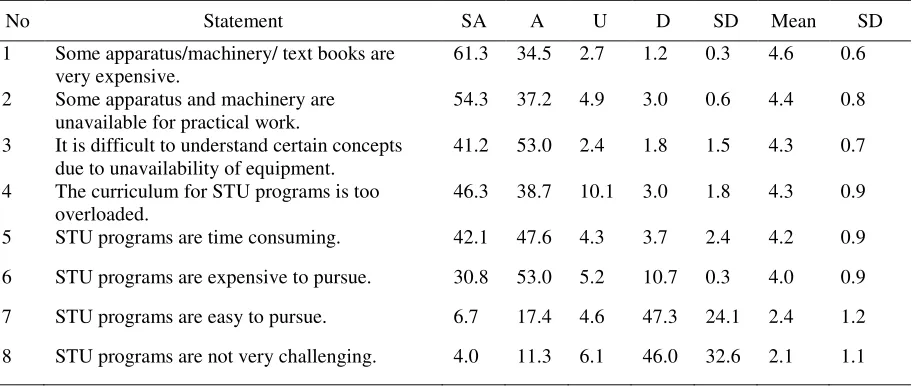
percentages and means of their responses were calculated. The research question looked at the differences in the constraints female students in various STU programs experienced in their programs. Table 1 shows female students’ percentage distributions and mean ratings of constraints they experienced.
Table 1
Female students’ percentage distributions and mean ratings of constraints they experienced while pursuing
various STU programs
No Statement SA A U D SD Mean SD
1 Some apparatus/machinery/ text books are very expensive.
61.3 34.5 2.7 1.2 0.3 4.6 0.6
2 Some apparatus and machinery are unavailable for practical work.
54.3 37.2 4.9 3.0 0.6 4.4 0.8
3 It is difficult to understand certain concepts due to unavailability of equipment.
41.2 53.0 2.4 1.8 1.5 4.3 0.7
4 The curriculum for STU programs is too overloaded.
46.3 38.7 10.1 3.0 1.8 4.3 0.9
5 STU programs are time consuming. 42.1 47.6 4.3 3.7 2.4 4.2 0.9
6 STU programs are expensive to pursue. 30.8 53.0 5.2 10.7 0.3 4.0 0.9
7 STU programs are easy to pursue. 6.7 17.4 4.6 47.3 24.1 2.4 1.2
8 STU programs are not very challenging. 4.0 11.3 6.1 46.0 32.6 2.1 1.1
As shown in Table 1, students indicated that it was difficult to understand certain concepts because some apparatus and machinery are unavailable for practical work. This is evident from the table as majority of students (94.2%) with mean of (4.3) strongly agree (41.2%) or agree (53.0%) to the statement that it is difficult to understand certain concepts due to unavailability of equipment/materials. According to Ogunjuyigbe, Ojofeitimi, and Akinlo (2006) the lack of teaching learning materials are some of the factors that discourage female students from getting involved in science, mathematics and technology (SMT) programs. This is not surprising because unavailability of equipment/materials makes the grasping of concepts very difficult and this tends affect female participation. It is suggested that such apparatus and materials must be made available by the central government and probably non-governmental organizations (NGOs). This is because NGOs continue to support the Ghana Government in the provision of equipment and expertise in the scientific enterprise. A typical example is the collaborative effort between the Ghana Government and Philip Harris International of Britain with the Ghana Government providing the funds whilst Philip Harris international provided the equipment and technical expertise. Under the agreement, the Ghana Government rehabilitated and refurbished old laboratories in selected Senior High Schools and Philip Harris International supplied and installed science equipment in those selected centres (Ampiah, 2006). The universities of Cape Coast and Education, Winneba have also benefited from this arrangement. Such collaboration can also be made between the Ghana government and other stakeholders to extend the support to other Universities by providing adequate machinery, apparatus and infrastructure to enhance effective participation in practical work (Anamuah-Mensah, 2007).
School. This implies that it will be difficult if not impossible for female students from poor backgrounds to pursue science and technology-based programs at the University level. This means that being able to pursue a program in science and technology at the University level may not necessarily depend on only academic excellence but also the required financial backbone that will enable them to purchase apparatus, machinery and textbooks for their studies. Thus, to increase participation of females into science and technology-based programs, financial support in the form of scholarship or bursaries should be given to them.
This is in view of the fact that most of students (91.4%) with mean of (4.4) strongly agree (54.2%) or agree (37.2%) to the statement that some apparatus and machinery are unavailable for practical work. From the foregoing, it is obvious that unavailability of materials affects the grasping of certain concepts and might be a barrier to full participation in science and technology-based programs as this study seems to portray. Also from Table 1 majority of the students claim that it is not easy to pursue science and technology-based programs (71.4%). With a low mean of (2.4), they strongly disagree (24.1%) or disagree (47.3%) with the statement that it is easy. Only 23.1% indicated that they strongly agree (6.7%) or agree (17.4%). It is therefore not surprising that majority (85%) of the students admitted that the curriculum for science and technology-based programs is too overloaded. With a mean of (4.3) they indicated that they strongly agree (46.3%) or agree (38.7%) to the statement.
From the foregoing it is obvious that science and technology-based courses are rather very challenging and not easy to pursue as a result of the overloaded nature of the curriculum. This seems to confirm the findings that science and technology-based programs are very challenging for women because of low mathematical and science ability. According to Baryeh, Obu, and Lamptey (1999) and Ventura (1992) there is low participation of females in science and technology-based programs because of the poor performance of females in science and mathematics. These tend to be barriers and pose a challenge to female participation in science and technology-based programs. Also, Ogunjuyigbe, Ojofeitimi, and Akinlo (2006) acknowledged the fact that if females are challenged in the mathematics and science classrooms just as their male counterparts, they will be able to perform better and increase their participation. Woolnough (1994) also found that students entering secondary schools did so with a variation of mathematical abilities. In this study, 86% of respondents indicated that they obtained grades ‘A’ or ‘B’ in Physics, Chemistry, Biology and Mathemaitcs at SSSCE. This means that if students gain confidence in mathematics and science at the lower levels of education it will enhance their chances of participating in science and technology-based programs because those barriers would have been overcome or reduced.
Table 1 reports that female students indicated that science and technology-based courses are time consuming, expensive to pursue because some apparatus/ equipment/ text books are also very expensive. The table shows that majority of students indicated that science and technology-based courses are time consuming (89.7%), with a mean of (4.2) they strongly agree (42.1%) or agree (47.6%) to that statement. Ogunjuyigbe, Ojofeitimi, and Akinlo (2006) have observed that even though there are financial gains for females in science and technology careers, the fact still remains that such students do not have time to do other female chores at home, which is very disturbing. This is not surprising since female labor, especially running errands, hawking/ trading, cooking meals and doing some household chores are still regarded as very necessary in Ghana.
3.2 Comparison of Constraints Female Students in Various STU Programs Experience
Hypothesis one states that there is no significant difference among female students in constraints they experienced while pursuing various STU programs. The results are presented in Table 2. Table 2 shows the number of students, the overall mean and overall standard deviation on constraints female students pursuing engineering, medicine, pharmacy and CS/ICT at KNUST experience in their programs.
To test this hypothesis, the type of science and technology-based program as independent variable was examined for constraints students experience using one-way between groups analysis of variance (ANOVA). This is to determine whether there were significant differences in the constraints experienced by female students offering engineering, medicine, pharmacy, and computer science/ICT at the university level. Table 2 shows that medical students (M=30.7, SD=2.8) had the highest mean on constraints compared with female students pursuing engineering, pharmacy and CS/ICT respectively.
Table 2
Overall mean and standard deviation distributions of female students’ rating of constraints they experienced
Program Number (N) Total Mean Total SD
Engineering 135 30.66 3.48
Medicine 75 30.73 2.75
Pharmacy 97 29.40 2.86
Computer Science/ICT 21 29.29 1.74
Total 328 30.22 3.10
The results of the ANOVA on constraints are presented in Table 3. From Table 3, there was a significant difference at the p<.05 level in constraints for the four Science and Technology-based programs [F(3, 324) = 4.6,
p < .001].
Table 3
One-way analysis of variance (ANOVA) on constraints experienced by female students pursuing STU programs
Sum of Squares df Mean Square F Sig.
Between Groups 129.033 3 43.011 4.610 .001
Within Groups 3022.598 324 9.329
total 3151.631 327
Note. Significant *p < .05, N = 135 (ENG); N = 75 (MED); N = 97 (PHA); N = 21 (CS/ICT)
This implies that there are differences in constraints among the four groups of students pursuing science and technology-based programs. Hence the ANOVA indicating the hypothesis that there is no significant difference between the constraints experienced by female students offering engineering, medicine, pharmacy and computer science/ICT cannot be supported. The null hypothesis was therefore rejected. One-way ANOVA determines whether constraint is differentially expressed by the four programs or not. However, it does not indicate which specific programs pair(s) are the ones where statistical differences occur. Post-hoc test can be used in conjunction with ANOVA to determine which specific program pair(s) is statistically different from each other. The results are presented in Table 4.
Table 4
Post-Hoc analysis on constraints experienced by female students pursuing STU programs
Note. * The mean difference is significant at the 0.05 level
The corresponding Post-hoc analysis with type of science and technology-based program as independent variable was therefore conducted as a follow up test to the ANOVA to evaluate pair-wise differences among the means for the type of science and technology-based program. This is also to find out which pair of science and
Program Mean Difference Std. Error Significance Engineering Medicine
Pharmacy
Computer Science/ICT
-0.1 1.3* 1.4
0.44 0.41 0.72
1.000 0.013* 0.292 Medicine Pharmacy
Computer Science/ICT
1.3* 1.4
0.47 0.75
0.029* 0.290
technology-based programs actually have significant mean differences in students’ responses on constraints. The results indicate that the mean of students’ responses on constraints engineering students experience (M=30.7, SD=3.5) was significantly different from pharmacy students (M=29.4, SD=2.9). This means that the engineering students experience more constraints than pharmacy students. This implies that engineering and pharmacy students may not have similar constraints as they pursue their corresponding STU programs. Similarly, the mean of students’ responses for medical students (M=30.7, SD=2.8) was significantly different from pharmacy students (M=29.4, SD=2.9) and in favor of medical students. This also means that medical students may be more constrained than pharmacy students. Comparisons between the remaining pairs were not statistically significant at p < .05 and therefore not reported. In summary, the results of the study show that constraints students have while pursuing a program in engineering, medicine, pharmacy and computer science/ ICT were significantly different in favor of engineering and medical students from pharmacy students.
4. Conclusion and Implications
The literature revealed numerous constraints against women that continue to influence the gendered nature of education even today and hence determine the occupation of men and women. However the current study has identified some other constraints experienced by female students of science and technology-based programs in engineering, medicine, pharmacy, and computer science/ICT. According to the findings science and technology-based programs were time consuming and expensive to pursue as some apparatus/equipment/text books were also very expensive. The study further revealed that some materials were not available for practical work and that the curriculum for science and technology-based programs was too overloaded. This made it difficult for females to pursue the science and technology-based programs used in this study. There was significant difference between constraints experienced by science and technology-based students offering engineering and pharmacy, and medicine and pharmacy. However there was no significant difference between constraint experienced by science and technology-based students offering CS/ICT and the other programs.
The implications are that it will be difficult if not impossible for female students from poor backgrounds to pursue science and technology-based programs at the University level. This means that being able to pursue a program in science and technology at the University level may not necessarily depend on only academic excellence but also the required financial backbone that will enable them to purchase apparatus, machinery and textbooks for their studies. Thus, to increase participation of females into science and technology-based programs, financial support in the form of scholarship or bursaries should be given to them. The study also revealed that if students gain confidence in mathematics and science at the lower levels of education it will enhance their chances of participating in science and technology-based programs because those barriers would have been overcome or reduced drastically.
This study was able to achieve its purpose, which was to find answers to the research question and the null hypothesis. One-way analysis of variance (ANOVA) and Post hoc analyses indicated that there were significant differences in constraints among some of the four groups of students. This study has shown that female students have to grapple with some challenges to pursue their programs, especially the expensive nature of science and technology-based programs. Steps should be taken to arrest this situation by providing scholarships, grants or bursaries to the students in order to enhance their full participation. These challenges may account in part in the differences among females in science and technology-based programs at KNUST.
4.1 Recommendations
females to participate. This will enhance their participation in science and technology-based programs because it will give them opportunity to have a lot of hands-on experiences. They will also have the opportunity to meet other female role models, which will boost their self-confidence and increase their self-motivation to pursue science and technology-based programs. Self-motivation may arise as a result of one’s involvement in science and technology competitions, science clubs or participation in STME programs. The results showed that students experience some constraints in pursuing STU programs at the University level. Students indicated that some apparatus/machinery/textbooks were either unavailable or very expensive to buy. This makes science and technology-based programs very expensive to pursue. Thus, to increase participation of females into STU programs, financial support in the form of scholarship or bursary should be given to them by the government, stakeholders or NGOs to enable them purchase apparatus, machinery and textbooks for their studies.
5. References
Ampiah, J. G. (2006). Students’ psychosocial perception of science laboratory environments in Ghana senior secondary schools. Ife Psychologia, 2, 136-151.
Anderson, L. S., & Straka, V. P. (2004). Engineering: A career choice for young women. Retrieved September 20, 2010, from http://www.ee.ryerson.ca
Baryeh, E. A., Obu, R. Y., & Lamptey, D. L. (1999). Ghanaian women and the engineering profession.
International Journal of Mechanical Engineering Education, 28(4), 335-346.
Borg, A. (1999). What draws women to and keeps women in computing? Retrieved December 14, 2010, from http://www.iwt.org/resultsreports/nyaspaper.html
Camp, T. (1997). The incredible shrinking pipeline. Communications of the Association of Computer Machinery, 40(10), 122-134. http://dx.doi.org/10.1145/262793.262813
Davies, A. R., Klawe, M., Nyhus, C., and Sullivan, H. (2000). Gender issues in computer science. Retrieved December 14, 2010, from http://www.pages.cpsc.ucalgary.ca/~msh/papers/canadawomenincs.pdf Gilovich, T., Keltner, D., & Nisbett, R. E. (2006). Social psychology. W. W. Norton.
Hill, S. T. (1997). Science and engineering bachelor's degrees awarded to women increase overall, but decline
in several fields. Retrieved December 24, 2009, from www.nsf.gov/sbe/srs/databrf/sdb97326.htm
Leedy, P. D., & Ormrod, J. E. (2010). Practical research planning and design (9th ed.). Boston: Pearson Education Inc.
Lopez-Claros, A., & Zahidi, S. (2007). Women’s empowerment: measuring the global gender gap, World Economic Forum. Retrieved January 30, 2013, from
http://www.oecd.org/dac/gender-development/43041409.pdf
Ogunjuyigbe, P. O., Ojofeitimi, E. O., & Akinlo, A. (2006). Science education in Nigeria: An examination of people’s perceptions about female participation in science, mathematics and technology. Journal of
Science Education and Technology, 15(3), 277-284. http://dx.doi.org/10.1007/s10956-006-9014-6
Pearson, W., & Fechter, A. (Eds.). (1994). Human resources for science. Baltimore: Johns Hopkins University Press.
Steele, C. M. (1997). A threat in the air: How stereotypes shape intellectual identity and performance. American Psychologist,52(6), 613–629. http://dx.doi.org/10.1037/0003-066X.52.6.613
Steele, C. M., Spencer, S. J., & Aronson, J. (2002). Contending with group image: The psychology of stereotype and social identity threat. Advances in Experimental Social Psychology, 34, 379.
http://dx.doi.org/10.1016/S0065-2601(02)80009-0
Torto, R. (2012). Extra-curricular and out of school factors affecting girls’ participation and performance in SMT subjects: (home/community factors; distance from school; safety; time use). Retrieved January 20, 2013, from http://www.unesco.org/education/educprog/ste/projects/girls%20africa/femsa/
Woolnough, B. E. (1994). Factors affecting students’ choice of science and engineering. International Journal
of Science Education, 16(6), 659-676. http://dx.doi.org/10.1080/0950069940160605
Abouchedid, K. & Nasser, R. (2000). External and internal social barriers in stereotyping university majors.
Ventura, F. (1992). Gender, science choice and achievement: A Maltese perspective. International Journal of Science Education, 14(4), 445-463.
Anamuah-Mensah, J. (2007, December 18-20). Relevant data collected for practical project plan. Paper Presented at the PRACTICAL workshop of NPT/PRACTICAL Project, Elmina, Ghana.
Masanja, V. G., & Huye, B. (2010, September 28 – October 1). Increasing women's participation in science, mathematics and technology education and employment in Africa. Expert group meeting on Gender, science and technology, Paris, France. Retrieved January 30, 2013, from