IN THE ANKLE JOINT IN CYCLISTS
Claudia Guadalupe Chavez
A thesis
submitted in partial fulfillment of the requirements for the degree of
Master of Science in Kinesiology Boise State University
© 2013
DEFENSE COMMITTEE AND FINAL READING APPROVALS
of the thesis submitted by
Claudia Guadalupe Chavez
Thesis Title: Strategies to Decrease Movement Variability in the Ankle Joint in Cyclists Date of Final Oral Examination: 04 November 2013
The following individuals read and discussed the thesis submitted by student Claudia Guadalupe Chavez, and they evaluated her presentation and response to questions during the final oral examination. They found that the student passed the final oral examination. Eric L. Dugan, Ph.D. Co-Chair, Supervisory Committee
Laura J. Petranek, Ph.D. Co-Chair, Supervisory Committee
Yong Gao, Ph.D. Member, Supervisory Committee
iv
ACKNOWLEDGEMENTS
I would like to thank Dr. Eric L. Dugan, Dr. Laura J. Petranek, and Dr. Yong Gao for their direction, guidance, and support. Their suggestions simplified and improved the process, while writing, collecting, and analyzing data. The time and dedication they provided are greatly appreciated.
v ABSTRACT
Coordination variability is thought to be indicative of a cyclist’s skill level as novices have higher levels of variability than experts (Sides & Wilson, 2012). It was hypothesized that the externally focused instructions with visual feedback group would decrease coordination variability in the ankle joint to a greater extent than those in the internally focused instructions with visual feedback group. Six cyclists (30-40 years) completed a four day acquisition period and a retention test. During this time, participants cycled for 10-15 minutes at a power output equal to 2.0-2.5W/kg of body mass.
Participants were provided with internally or externally focused instructions and visual feedback relating to those instructions. Two separate 6 (Trial Block) X 2 (Group) Mixed Model Repeated Measures ANOVAs were used to determine if the groups’ coordination variability (via MARP and DP values) changed as a result of the intervention. Both groups responded in a similar manner with DP values increasing above pretest values because participants were asked to perform a new task. DP values tended to decrease during the intervention and at retention, DP values continued to decrease. It is believed that the intervention was not long enough to cause a lasting change in how cyclists performed.
vi
TABLE OF CONTENTS
ACKNOWLEDGEMENTS ... iv
ABSTRACT ... v
LIST OF TABLES ... ix
LIST OF FIGURES ... x
LIST OF ABBREVIATIONS ... xi
CHAPTER ONE: INTRODUCTION ... 1
Coordination Variability ... 1
Attentional Focused Instructions ... 4
Attentional Focused Feedback ... 5
Need for the Current Study ... 7
Purpose of the Study ... 8
Limitations and Delimitations ... 9
Significance of the Study ... 9
Operational Definitions ... 10
CHAPTER TWO: LITERATURE REVIEW ... 12
Cycling ... 12
Dynamic Systems Theory ... 14
Attentional Focused Instructions ... 16
vii
The Integration of Motor Learning and Biomechanics... 24
Summary ... 25
CHAPTER THREE: METHODS ... 26
Participants ... 26
Procedures ... 27
Instruments ... 30
Data Collection and Processing ... 32
Data Analysis ... 36
CHAPTER FOUR: RESULTS ... 37
Introduction ... 37
Participants ... 37
Mean Absolute Relative Phase (MARP) ... 38
Deviation Phase (DP) Values... 39
Statistical Analysis of Mean Absolute Relative Phase (MARP) ... 39
Statistical Analysis of Deviation Phase (DP)... 40
REFERENCES ... 42
APPENDIX A ... 49
Lifestyle Questionnaire ... 49
APPENDIX B ... 52
Informed Consent Form ... 52
APPENDIX C ... 58
viii
ix
LIST OF TABLES
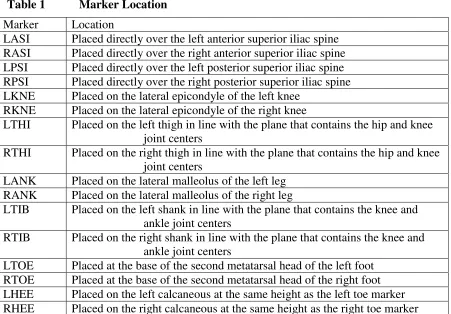
Table 1 Marker Location... 31
Table 2 Subject Demographics ... 38
Table 3 MARP Values for each Trial Block ... 38
x
LIST OF FIGURES
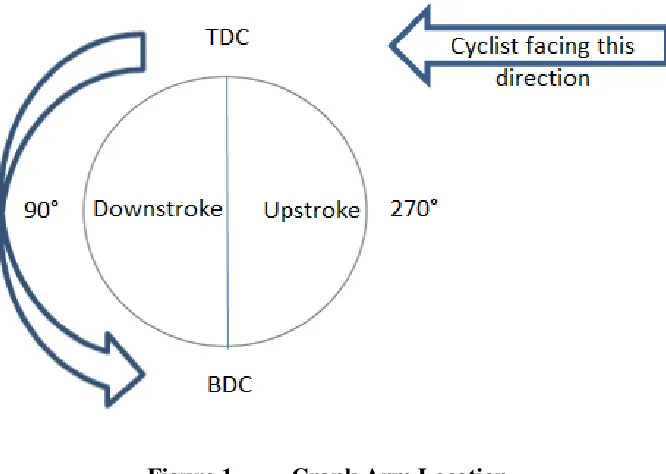
Figure 1 Crank Arm Location ... 11
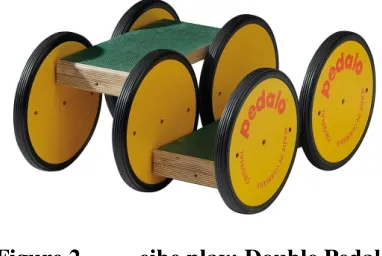
Figure 2 eibe play: Double Pedalo ... 19
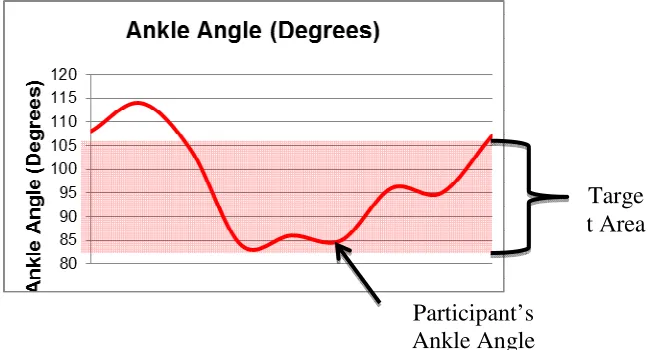
Figure 3 Ankle Angle Graph1 ... 29
Figure 4 Marker Placement2 ... 32
Figure 5 Data Analysis Explained3 ... 35
Figure 6 Average MARP values across each Trial Block for each Group4 ... 40
xi
LIST OF ABBREVIATIONS
BDC Bottom Dead Center
CRP Coordinative Relative Phase
DP Deviation Phase
EXT Externally Focused Instructions INT Internally Focused Instructions MARP Mean Absolute Relative Phase
ROM Range of Motion
CHAPTER ONE: INTRODUCTION
In order to gain competence in a skill, learners must engage in a considerable amount of practice (Ericsson, Krampe, & Tesch-Romer, 1993). Practice length is not the only factor influencing skill acquisition, thus researchers have conducted experiments to determine how to enhance the learning of a variety of skills. Motor learning researchers have focused on finding methods that enhance performance (Wulf, Shea, & Lewthwaite, 2010), while biomechanics researchers have focused on the differences that exist between athletes of different skill levels (Wilson, Simpson, van Emmerik, & Hamill, 2008). One area in which these fields intersect is cycling. The present study is an attempt to merge the information obtained by biomechanics researchers about the coordination variability that exists among novice cyclists and that obtained by researchers in motor learning about how attentional focused instructions and feedback have been utilized to enhance learning in healthy subjects.
Coordination Variability
variability present in one’s performance may remain stable or may change across multiple repetitions of a given task (Bartlett, Wheat, & Robins, 2007). Although some variability is required in order to be effective, too much or too little may lead to a
decrease in performance (Sides & Wilson, 2012; Wilson et al., 2008), and increase one’s susceptibility to injury (Hamill, Palmer, & Van Emmerik, 2012).
Intra-limb coordination variability provides a means to analyze how a
participant’s neuromuscular system adapts while learning a given task (Glazier, Wheat, Pease, & Bartlett, 2006). Intra-limb coordination variability (from this point forward is referred to as only coordination variability) is a measure of the amount of variability present within a single limb while performing a specific task. The amount of coordination variability present within the neuromuscular system should reach a level of stability as individuals learn a given task (Wilson et al., 2008).
Novices and skilled individuals have different levels of coordination variability across different skills. Novices have shown greater variability than skilled performers when bouncing a basketball (Broderick & Newell, 1999) and playing handball (Wagner, Pfusterschmied, Klous, Serge, & Müller, 2012). In other studies, novices and highly skilled performers have shown more coordination variability than those with intermediate skill level in the triple jump (Wilson et al., 2008). According to Wilson et al., as
participants learn a skill, the amount of coordination variability present within the neuromuscular system undergoes a U-shaped pattern. While novices have high
variability than novices and experts (Wilson et al., 2008). This will be discussed in greater detail in the literature review section.
In the sport of cycling, elite cyclists utilize different movement patterns than novices and are more effective than novices in terms of overall mechanical efficiency and muscle activation (Chapman, Vicenzino, Blanch, & Hodges, 2008; Chapman, Vicenzino, Blanch, & Hodges, 2009). It is believed that these differences can be accounted for at the ankle joint since novices show a decreased range of motion at the ankle and increased coordination variability of the knee and ankle in the sagittal plane when compared to elite cyclists (Chapman et al., 2009; Sides & Wilson, 2012). Novices also show greater
individual variance than experts in terms of the duration of the activation of ankle
plantar-flexors and dorsi-flexors (Chapman et al., 2008). These differences are important because high levels of coordination variability are thought to be detrimental to cycling performance (Sides & Wilson, 2012). This indicates that muscular coordination is one of the key components of effective cycling and changes in the level of coordination
variability could result in a decrease in performance.
focused instructions, cues, and visual feedback. These tools may prove to be beneficial for individuals learning to cycle as well as those who are training to enhance their
performance. The way these tools have been used in the past to enhance performance will be discussed in the following sections.
Attentional Focused Instructions
The effect of attentional focused instructions has been studied extensively in motor learning (Chiviacowsky, Wulf, & Wally, 2010; Shea & Wulf, 1999; Wulf,
McConnel, Gärtner, & Schwarz, 2002; Wulf, McNevin, & Shea, 2001; Wulf & Su, 2007; Zachry, Wulf, Mercer, & Bezodis, 2005). There are two forms of instructions that are provided to learners, internally focused instructions, which direct a learner’s attention to their body, or externally focused instructions, which direct their attention to the effect of their movement (Wulf, 2007). With discrete and continuous skills, researchers have found that internally focused instructions cause an interruption to the movement control process, which leads to a decrease in performance (during acquisition) and learning (as measured by a retention test; Chiviacowsky et al., 2010; Wulf et al., 2002; Wulf et al., 2001; Zachry et al., 2005). In contrast, externally focused instructions are thought to allow a “more automatic control process” to occur, which is needed in order to develop an effective movement pattern (Wulf et al., 2002, p. 180).
Chiviacowsky, Schiller, & Avila, 2010); and the volleyball tennis serve (Wulf et al., 2002). Movement effectiveness is thought of in terms of accuracy, consistency, and reliability where the goal of the movement is to produce a desired result, i.e. to hit a bull’s eye on a dart board (Wulf, 2013). Most studies conducted on movement
effectiveness have found that externally focused instructions improve performance to a greater extent than internally focused instructions (Wulf, 2013).
Little research exists on the effects of attentional focused instructions on
endurance activities (Freudenheim, Wulf, Madureira, Pasetto, & Corrêa, 2010; Schücker, Hagemann, Strauss, & Völker, 2009; Stoate & Wulf, 2011). An external focus of
attention has been shown to increase the speed of intermediate swimmers performing the front crawl (Freudenheim et al., 2010; Stoate & Wulf, 2011), to lower the oxygen
consumption of trained endurance runners (Schücker et al., 2009), and to improve the efficiency and effectiveness of oar placement for rowers (Parr & Button, 2009).
Movement efficiency is thought of in terms of movement that is economically performed and easily executed (Wulf, 2013). While an external focus of attention has been found to enhance one’s ability to perform some endurance tasks (Freudenheim et al., 2010; Schücker et al., 2009; Stoate & Wulf, 2011) more research is needed to determine if learning is also enhanced. The following section will discuss how researchers have provided participants with visual feedback directing their attention to a specific aspect of a skill in addition to providing them with attentional focused instructions.
Attentional Focused Feedback
(Schmidt & Lee, 2011). Feedback is used to direct a learner’s attention to an aspect of the skill that needs to be refined and has been found to allow them to learn a skill quicker than if they are not provided with feedback (Schmidt & Lee, 2011). Two types of feedback are available for learners, intrinsic and extrinsic. Intrinsic feedback refers to information learners obtain about their movement via proprioceptors, while extrinsic (augmented) feedback is information that is provided by an outside source regarding the movement characteristics (knowledge of performance, KP) or the movement outcomes (knowledge of results, KR; Schmidt & Lee, 2011). Extrinsic feedback is intended to enhance the effects of intrinsic feedback by providing information the learner may not be aware of.
Augmented feedback is typically delivered in a verbal format and can have either an internal or external focus of attention. Similar to the attentional focused instruction literature, externally focused visual feedback has been shown to be more beneficial than internally focused visual feedback for both novices and experts in terms of improving the movement pattern and learning for both discrete and continuous tasks (Wulf, 2007, 2013; Wulf et al., 2010; Wulf et al., 2002). Shea and Wulf (1999) examined dynamic balancing utilizing a stabilometer. Concurrent visual feedback regarding the location of the
Biomechanics researchers have found that providing learners with externally focused visual feedback has a positive effect on cycling (Lin, Lo, Lin, & Chen, 2012; Mornieux, Gollhofer, & Stapelfeldt, 2010; Sanderson, 1986). Sanderson found that when participants were able to see the amount of force they were exerting on the pedal, they were able to minimize the amount of force they applied to the pedal during the recovery phase even when visual feedback was removed. The application of force during the recovery phase has been shown to reduce pedaling effectiveness, thus the participant’s ability to reduce their force application during this point of the pedal cycle improved their effectiveness (Sanderson, 1986). Mornieux et al. (2010) found that cyclists were able to keep the tangential pedal force positive when provided concurrent visual feedback about the force applied to the pedal, which resulted in improved pedaling effectiveness. Lin et al. (2012) found that stroke patients generated greater power and a smoother cycling movement pattern when provided concurrent visual feedback about their cadence. Neither Mornieux et al. (2010) nor Lin et al. (2012) determined whether the results observed during the intervention were permanent using a retention test. However, these studies indicate that individuals are able to utilize concurrent externally focused visual feedback to adjust their movement patterns to a set reference point.
Need for the Current Study
participants with attentional focused instructions concurrently with visual feedback and the impact they have on the cycling pattern specifically with regards to coordination variability among cyclists has not been studied. Attentional training programs are
inexpensive and can easily be incorporated into a training program; therefore, the results from this study could have implications on how cyclists train. This study will merge the research that has been conducted by motor learning and biomechanics researchers on attentional focused manipulations with the aim of increasing knowledge on the effect of attentional focus manipulations on endurance tasks in terms of both performance and learning. This study will utilize the information obtained about cyclists of different skill levels and attentional focus manipulations to determine if this kind of manipulation is effective at changing an individual’s level of coordination variability.
Purpose of the Study
Limitations and Delimitations
A limitation of the study is that we did not control whether participants engaged in physical activity outside of the study; this could have changed as a result of their personal motivation, their time commitments, or a major change in lifestyle, and thus impact the results seen in this study. A delimitation of the study is that since this study is limited to cyclists within a specific age range who do not have recent injuries the results from the current study cannot be generalized to the entire cycling community. In
addition, the cyclists varied widely in their experience level. This study also focused on the ankle joint at the exclusion of other joints in the lower body that are utilized when cycling.
Significance of the Study
Results from the present study may provide information about the type of instructions that should be given to cyclists. Coaches may be able to influence an athlete’s focus of attention during practice. Research conducted in the athletic
study could have implications about how to enhance the acquisition of a less variable movement pattern among cyclists.
Operational Definitions
For the purposes of this study, coordination variability was assessed as the variability observed within the ankle joint throughout each practice period.
A phase angle is a measurement of a segment’s velocity and angle during a given time frame. Continuous Relative Phase (CRP) is a measure of the coordination that exists between two segments throughout a particular time period (Stergiou, Jensen, Bates, Scholten, & Tzetzis, 2001). Mean Absolute Relative Phase (MARP) is a measure of the coupling that exists between two segments throughout a trial (Stergiou et al., 2001). Deviation Phase (DP) is a measure of the coordination variability that exists between two segments (Stergiou et al., 2001). These terms will be explained in greater detail within the methods section and pictures showing how these calculates were made will be presented.
Figure 1 Crank Arm Location
CHAPTER TWO: LITERATURE REVIEW
Cycling has been utilized as a form of transportation, recreation, and competition for years. Biomechanics researchers have examined the factors that contribute to cycling effectiveness, including the differences that exist between cyclists with different levels of expertise (Chapman et al., 2009; Sides & Wilson, 2012; Takaishi, Yamamoto, Ono, Ito, & Moritani, 1998). It has been determined that novice cyclists exhibit high coordination variability at the ankle joint and it is speculated that this variability may have a negative impact on performance (Chapman et al., 2009; Sides & Wilson, 2012). This literature review will examine the factors that have been found to impact pedaling effectiveness (specifically focusing on the differences among novice and elite performers with respect to the coordination variability of the ankle joint). In addition, information will be
presented about how motor learning researchers have used attentional focused
instructions and visual feedback to enhance the learning of a wide range of skills (Wulf, 2013) and how biomechanics researchers have observed the effect of feedback on cycling performance (Mornieux et al., 2010; Sanderson, 1986).
Cycling
Muscle activation patterns, overall mechanical efficiency, and intra-limb
2010). Blake et al. (2012) found that when overall mechanical efficiency is high, there is greater activation of the ankle plantar-flexors and more plantar flexion through the top and downstroke of the pedal cycle, while there is more dorsiflexion during the upstroke of the pedal cycle. Power output is positively correlated to intra-limb coordination and that overall mechanical efficiency is dependent on the coordination of multiple muscles (Blake et al., 2012). These findings indicate that pedaling effectiveness is associated with intra-limb coordination. Bini, Diefenthaeler, and Mota (2010) found that cyclists adapt their pedaling technique to overcome increases in workload and fatigue. During cycling, adaptations to increasing cadence are characterized by decreased range of motion at the knee and ankle joints (Bini, Rossato, et al., 2010). The ankle joint becomes more plantar flexed with increasing cadence (Sanderson, Martin, Honeymann, & Keefer, 2006) and higher cadences produce more stable and economic movement patterns (Wilson & Sides, 2010). These findings indicate that cyclists are able to change pedaling techniques while cycling, which is a key component in the current research study.
between novice and expert cyclists, it is important to remember that even elite athletes exhibit coordination variability when performing the same skill including cycling (Bartlett et al., 2007; Sides & Wilson, 2012). Because of their experience with a sport, elite athletes are able to change the amount of coordination variability present in their movement pattern as the task constraints change. Novices on the other hand lack
experience and thus are unable to adapt to changing task constraints, which results in the production of variability that is not functional for the task (Davids, Glazier, Araújo, & Bartlett, 2003). Functional movement variability allows the neuromuscular system to adapt to changing task constraints easily while non-functional movement variability constrains the neuromuscular system and is the result of ineffective movement patterns.
Dynamic Systems Theory
Movement variability, of which coordination variability is a subcomponent, was thought to be a problem in the motor system that needed to be minimized or eliminated (Glazier et al., 2006). Movement variability is the amount of variability present within the entire neuromuscular system while performing a specific task and is now thought to be essential to human movement in that it provides an individual with the capability of adapting to a variety of contexts (Glazier et al., 2006). The neuromuscular system is effective because it is able to adapt to changes in the biological system, the environment, and the task constraints in order to produce a more consistent pattern when performing the same movement (Stergiou & Decker, 2011).
your ankle is capable of two degrees of freedom (plantarflexion/dorsiflexion and inversion/eversion). According to Dynamic Systems Theory, these redundancies (i.e., allowing the ankle and knee to invert/evert when only flexion/extension is needed) are reduced through the temporary coupling of multiple degrees of freedom, thus creating coordinative structures composed of a single ‘virtual’ degrees of freedom complex (Davids et al., 2003). The neuromuscular system creates coordinative structures by linking limbs and joints together. For example, when kicking a ball, one’s entire body works in sequence. First, a person leans back in preparation to kick the ball and winds up the leg (by swinging the leg back from the hip while the knee and ankle are flexing). The ball is then kicked by flexing from the hip (by swinging the leg forward) followed by knee extension and ankle dorsiflexion as the foot comes in contact with the ball. It should be noted that there is overlap in the coordinative structures that exist in the neuromuscular system with each limb and joint belonging to more than one coordinative structure. This overlap allows the neuromuscular system to function effectively in a variety of tasks.
task (Davids et al., 2003; Shumway-Cook & Woollacott, 2007), whereas skilled performers show functional movement variability that allows them to perform a given task when conditions change (Wilson et al., 2008).
Kinematic measurements (i.e., displacement, velocity, and coordinative relative phase) can be used to quantify the amount of variability that exists within the motor system (Glazier et al., 2006). Researchers look for the changes that occur as the motor system develops attractor patterns, these attractor patterns produce stability within the neuromuscular system when a specific task is performed (Glazier et al., 2006). Attractor patterns are the neuromuscular system’s preferred movement patterns (i.e., the preferred kinematic measurements while performing a specific task; Shumway-Cook &
Woollacott, 2007). Buttifield, Ball, and MacMahon (2009) state that more work is needed to determine how coordination changes with learning, because these changes could indicate an increase in the learning of a skill. The adoption of an attractor pattern is characterized by stability within the neuromuscular system, which should lead to a decrease in kinematic variables (Glazier et al., 2006). In the sections that follow, information will be presented about how an external focus of attention and augmented feedback have been found to enhance the learning of a skill.
Attentional Focused Instructions
instructions and the majority of those have found that an external focus of attention enhances both motor learning and performance to a greater extent than an internal focus of attention (Wulf, 2013). Wulf (2013) has questioned if the actual words used in previous research that found an internal focus of attention more beneficial for learning acted like or directed the learner in a similar manner as an external focus.
While a lot of research exists on the benefits of an external focus of attention for discrete skills, few studies have been conducted on their effect on continuous tasks. Researchers examining continuous tasks have found that an external focus of attention decreases swim time (Stoate & Wulf, 2011), improves technique in rowing (Parr & Button, 2009), increases balance time on a stabilometer (Chiviacowsky et al., 2010; Shea & Wulf, 1999), and increases the speed of participants on a Pedalo™ (Holz, Hoerz, Munsingen, Germany; Totsika & Wulf, 2003) to a greater extent than an internal focus of attention. These studies indicates that attentional focused instructions may prove to be as effective for one’s performance in continuous tasks as they are for performing and learning discrete skills. More research is needed to determine if this is the case for continuous tasks including cycling.
According to the Constrained Action Hypothesis an internal focus of attention constrains the motor system (Wulf et al., 2001). As the learner attempts to consciously control his/her own movements, they interfere with the automatic control processing that would normally occur (Wulf et al., 2001), causing motor performance to suffer.
test; Wulf et al., 2001). While performing a continuous task like running, it has been found that internally focused instructions lead to less economical movement compared to externally focused instructions (Schücker et al., 2009). This information is critical in that the goal of the present study is to reduce the amount of coordination variability present within the neuromuscular system, which could make movement more economical since expert cyclists show low levels of coordination variability relative to novices (Sides & Wilson, 2012).
Externally focused instructions have been found to enhance performance (Freudenheim et al., 2010; Schücker et al., 2009; Stoate & Wulf, 2011; Vance, Wulf, Töllner, McNevin, & Mercer, 2004; Wulf & Dufek, 2009; Zachry et al., 2005) and learning (Chiviacowsky et al., 2010; Parr & Button, 2009; Shea & Wulf 1999; Wulf et al., 2001; Wulf & Su, 2007) more than internally focused instructions for a variety of discrete skills and some continuous tasks like dynamic balancing, moving a Pedalo™ , swimming, running, and rowing. When participants are asked to concentrate on the implement that is being used in the study (external focus of attention) instead of what their body is doing (internal focus of attention), they are more effective at completing the desired task. For example, participants move a Pedalo™ (see Figure 2) faster when they are given instructions to push the platforms forward (external focus) rather than
Wulf et al., 2001). Wulf (2013) has found that externally focused instructions that vary from internally focused instructions in only the term that is used as to where participant’s should focus their attention but describe the same objective, i.e. cycling while focusing on either one’s feet (internal) or on the pedal (external), are more effective for learning a given task (Wulf, 2013). These findings are important because they led to the rational of where to direct participant’s attention in the present study (‘pedal’ for the external group, and ‘ankle’ for the internal group). In the following paragraph, information will be presented about how attentional focused instructions provide support for both Dynamic Systems Theory and the Constrained Action Hypothesis.
Figure 2 eibe play: Double Pedalo
Dynamic Systems Theory. Wulf and Dufek (2009) found that when participants adopted an external focus of attention, they displayed an increased release of bodily constraints (i.e., they freed up the degrees of freedom) as compared to those that adopted an internal focus of attention. These results indicate that an internal focus of attention interrupts the normal processing that should occur, thus movement patterns are proceduralized
appearing frozen and rigid. These results provide support for the Constrained Action Hypothesis, as adopting an external focus of attention allows for a more automatic form of control than an internal focus of attention. Even though increasing degrees of freedom through an external focus of attention may be perceived as being a negative, one should keep in mind that the body has multiple attractor patterns that it can utilize. The goal of the neuromuscular system, as explained by Dynamic Systems Theory, is to produce the most economical movement pattern and thus the neuromuscular system is charged with finding the most efficient attractor pattern. By releasing bodily constraints (i.e., freeing up degrees of freedom), the neuromuscular system is increasing movement economy. In the following section, information will be presented about how individuals are provided with attentional focused augmented visual feedback to enhance the learning of a skill.
Attentional Focused Feedback
Feedback is utilized in an attempt to increase performance and to enhance
located relative to space, whereas an example of extrinsic feedback is telling the cyclist the actual position of their foot relative to space. Augmented feedback can come in one of two forms, as information related to the characteristics of the movement, i.e. knowledge of performance (KP), or as information related to the outcome of the movement, i.e. knowledge of results (KR; Schmidt & Lee, 2011). Augmented feedback has been found to enhance learning in that participants that receive feedback perform better than
participants that do not receive feedback (Shea & Wulf, 1999).
Augmented feedback is given in either a verbal or a visual format and can have either an internal or an external focus. The effect of augmented feedback on learning a new skill is similar to the results found on the effect of attentional focused instructions in that augmented feedback provided with an external focus results in greater accuracy, balance, and an enhanced movement form as opposed to feedback provided with an internal focus (Shea & Wulf, 1999; Wulf et al., 2010; Wulf et al., 2002). Participants are able to utilize visual feedback about the location of an implement being used, such as a stabilometer, to increase the amount of time they can balance (Shea & Wulf, 1999). In addition, participants are able to utilize information about the forces they are applying to an implement, such as a pedal, to adjust their movements to a set reference point
(Mornieux et al., 2010; Sanderson, 1986). These results indicate that visual feedback provided with an external focus of attention can be utilized to help participant’s achieve a specific skill faster than that achieved without visual feedback. More detail about the use of visual feedback with these implements will be given in the following paragraphs.
attentional focused instructions with externally focused instructions being more beneficial to participants. While balancing on the stabilometer, participants in the internally focused groups were asked to keep their feet at the same height; those in the externally focused groups were asked to keep the yellow lines located in front of their feet (located on the stabilometer itself) at the same height. Those participants that received feedback were shown four lines on a computer screen while those that did not receive feedback were only given attentional focused instructions. Participants in the feedback groups were told that the lines located on the outermost region of the screen represented the horizontal axis and were told either that the lines located on the inside of the screen represented their feet (internally focused) or the yellow lines (externally focused). In reality, the lines located on the inside of the screen represented the same thing for both groups, their deviation from the horizontal plane. Shea and Wulf (1999) found both groups that were provided with concurrent visual feedback performed better than the groups that received only attentional focused instructions and that the externally focused groups performed better than the internally focused groups. This information is important because it shows that visual feedback seems to enhance the effects of
attentional focused instructions, an external focus of attention provided with concurrent visual feedback is even more effective than externally focused instructions provided without visual feedback. The frequency with which feedback is given to participants has been studied extensively and will be discussed in the following paragraph.
The Guidance Hypothesis states that providing learners with feedback after every trial improves performance during practice but causes a detriment to learning as
learner becoming dependent on the feedback and thus not learning the proper technique. Contrary to this view, Wulf et al. (2010) found that feedback provided with an external focus after every trial is more beneficial than reduced frequency externally focused feedback in terms of enhancing the acquisition of the correct movement form. Wulf et al. (2010) claim these results don’t support the Guidance Hypothesis because externally focused feedback directs learners to the effect of their movement (external focus of attention) when performing a task. It should be noted support for the Guidance
Hypothesis has been obtained by researchers who have utilized feedback that induced an internal focus (Wulf et al., 2010). More research is needed to determine if externally focused feedback provided frequently is indeed beneficial for learning a skill.
Biomechanics researchers have provided cyclists instructions and visual feedback to determine the impact of these instructions and feedback on proper cycling techniques. These researchers utilized instructions and feedback that were external in nature since they asked participants to focus on the amount of force they applied to the pedal
to stiffen, thus improving the pedaling effectiveness by changing muscle coordination patterns (Mornieux et al., 2010). This information indicates that participants are able to utilize externally focused instructions provided concurrently with visual feedback to improve pedaling techniques. It should be noted that Mornieux et al. (2010) indicate that in order to properly assess the benefits of the pull up action during the upstroke, cyclists must be allowed to practice. This is important because one of the goals in the current study is to see how practice changes coordination variability during the pedal stroke.
The Integration of Motor Learning and Biomechanics
The use of biomechanical measurements to evaluate the influence of motor learning on the learning of a skill is gaining popularity among researchers.
Biomechanical measurements may be used to provide individuals with KP and KR (e.g., forces, angles, velocity, etc.; Buttifield et al., 2009). Biomechanics can be used to determine if an individual’s performance changes due to alterations in their technique or to constraints on overall range of motion such as injury (Buttifield et al., 2009).
Biomechanics has been used to enhance the learning of a new skill through the use of visual feedback (Mornieux et al., 2010; Sanderson, 1986).
trained to apply force at the right time and to an extent that will result in an increased ability to execute a given skill.
Summary
Biomechanics provides a useful tool to evaluate the effectiveness of an attentional focused intervention. Previous studies indicate that externally focused instructions are beneficial to learning and that they produce a greater effect than internally focused instructions for a variety of discrete and continuous tasks (Chiviacowsky et al., 2010; Wulf, 2013; Wulf et al., 2002; Wulf et al., 2001; Zachry et al., 2005). Studies also
CHAPTER THREE: METHODS
This study was conducted to determine if feedback provided concurrently with attentional focused instructions enhanced a cyclist’s performance as measured by a decrease in coordination variability. This section will discuss the recruitment protocol, the procedures that were utilized in the study, and how data were analyzed. In addition, this section will provide a brief rational about the decisions that were made regarding participant recruitment and the procedures that were utilized in the study.
Participants
Participants were recruited from a community in the northwest. Flyers were posted around a northwest university campus, at public meeting places, local gyms, the YMCA, and local bike shops. In addition, information about the study was emailed to cycling groups within the community.
Participants were informed about the potential benefits and risks associated with their participation, the need for them to wear minimal and/or skin tight clothing, and the protocol they would follow during the study. Potential risks included minor discomfort and/or skin irritation from the adhesive used to hold the reflective markers in place. Participants were not informed of the expected outcome so as to minimize the effects the information might have on the data collected. The University’s Institutional Review Board approved all recruitment methodologies and the informed consent form (see Appendix B). The following section will discuss the procedures that were followed throughout the study.
Procedures
An equal number of participants would be assigned to five experimental groups, including: (1) an internally focused with visual feedback, (2) an externally focused with visual feedback, (3) an internally focused with no visual feedback, (4) an externally focused with no visual feedback, and (5) a control. The primary investigator met with each participant for an introductory session prior to the start of the study to review the informed consent and to administer the Lifestyle Questionnaire.
acquisition Trial Block and the retention test Trial Block consisted of five two-minute trials (see Appendix C for a description of each Trial Block). Data were collected during the second minute of each trial.
On day one of the acquisition period, participants had the reflective markers applied for the first time. Once the markers were in place, participants were asked to sit on their bicycle and complete a 5-minute warm-up at a mild intensity of 2.0W/kg of their body mass at their chosen speed. The lowest mean power output for competitive cyclists during the flat stages of a multistage race has been found to be 2.0W/kg of body mass (Vogt, Schumacher, Blum, et al., 2007). The reason for utilizing this power output was to allow for comparison between novice and competitive cyclists. In addition, the flat stages of a multistage race are associated with a low to moderate mean exercise intensity (Lucía, Hoyos, & Chicharro, 2001) and thus mean power outputs during these stages were
chosen for the required load. Any negative effects of utilizing this power output would be negated by allowing cyclists to choose their own cadence.
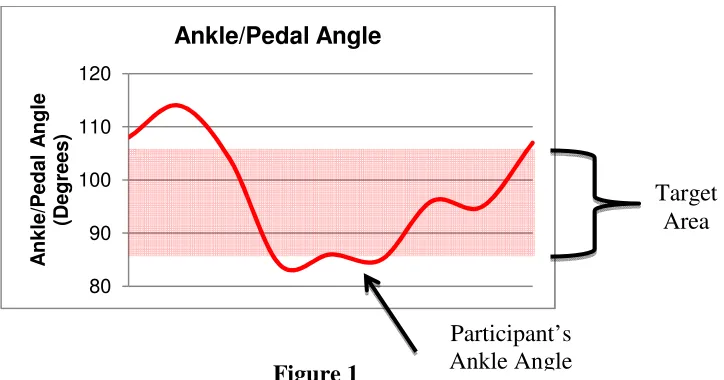
the television (see Figure 3) represented the angle of their foot (internal focus) or of the pedal (external focus). Following the familiarization period, the first acquisition Trial Block began.
Figure 3 Ankle Angle Graph1
Before each acquisition Trial Block, participants were given either internally focused instructions or externally focused instructions. Internally focused instructions consisted of the following: “I want you to focus on pushing down with your foot during the downstoke and pulling up with your foot during the upstroke while keeping the red line within the red box.” Externally focused instructions consisted of the following: “I want you to focus on pushing down on the pedal during the downstoke and pulling up on the pedal during the upstroke while keeping the red line within the red box.” It should be noted that the only difference in instructions provided to the internally focused and externally focused groups was the word “foot” and “pedal.” Every minute
_______________________
1
This figure represents the feedback participants were given during the intervention.
Targe t Area
during each 10-minute acquisition Trial Block, participants were reminded of instructions via cues like: “remember to push down on the pedal during the down stroke” or
“remember to push down with your foot during the down stroke.”
On days 2-4, participants completed the same 5-minute warm up and 10-minute moderate intensity cycling protocol as described above. All participants returned 72-96 hours after the acquisition period for a 5-minute warm-up and a 10-minute retention test. During the retention test, all participants cycled at a moderate intensity of 2.5W/kg of their body mass at their chosen speed without attentional focused instructions, cuing, or visual feedback.
Instruments
A Computrainer™ (cycle ergometer, Racermate Inc., Seattle, WA) was used to provide resistance as well as to provide the participants with information about their cadence. The rear wheel was replaced with a standard slick road wheel to facilitate calibration and to minimize wear or damage to either the bicycle or the Computrainer™.
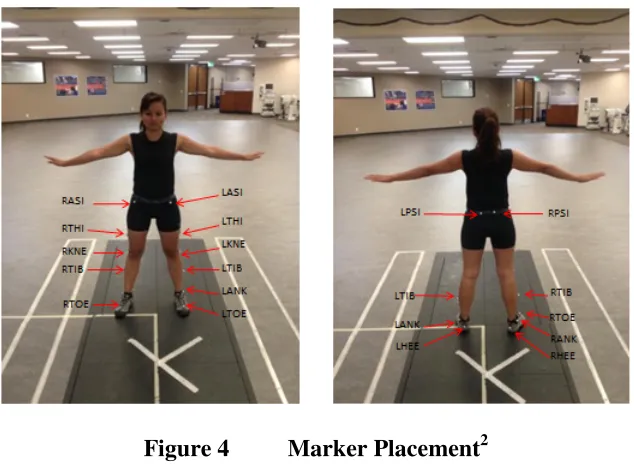
An eight camera Vicon Nexus motion capture system (Vicon Motion Systems, Oxford, UK) collected 3D kinematic data at a sample rate of 120Hz was utilized to collect data of each participant’s lower body. Sixteen markers were placed on the participants in a pattern corresponding to the Plug-In Gait marker set (“Tutorial”; see Table 1 for a detailed description of each marker placement and Figure 4). Measurement of each participant’s leg length (medial malleolus to ASIS) was obtained via a tape measure for both legs. Inter-ASIS (Left ASIS to Right ASIS), ankle (medio-lateral
knee axis), was obtained via a caliper. Each participant’s bicycle was fitted with three reflective markers on the left pedal to allow for analysis of the location of the pedal. Table 1 Marker Location
Marker Location
LASI Placed directly over the left anterior superior iliac spine RASI Placed directly over the right anterior superior iliac spine LPSI Placed directly over the left posterior superior iliac spine RPSI Placed directly over the right posterior superior iliac spine LKNE Placed on the lateral epicondyle of the left knee
RKNE Placed on the lateral epicondyle of the right knee
LTHI Placed on the left thigh in line with the plane that contains the hip and knee joint centers
RTHI Placed on the right thigh in line with the plane that contains the hip and knee joint centers
LANK Placed on the lateral malleolus of the left leg RANK Placed on the lateral malleolus of the right leg
LTIB Placed on the left shank in line with the plane that contains the knee and ankle joint centers
RTIB Placed on the right shank in line with the plane that contains the knee and ankle joint centers
Figure 4 Marker Placement2
Real-time data were presented to each participant in the form of a line graph showing them the flexion and extension of their left ankle or the left pedal angle in relation to the horizontal axis (see Figure 3). Participant’s bicycles were set-up so participants faced a television mounted on the wall of the lab, which displayed the line graph. Participants were asked to keep either their ankle flexion/extension or the left pedal angle in the target zone, a range indicated via a red box running the length of the line graph (see Figure 3).
Data Collection and Processing
Data collection consisted of 3D kinematic data of the lower limb during the second minute of every two minute trial. The first minute of each trial was intended to
_______________________
allow participants to achieve a degree of comfort with the instructions and cues before data were recorded.
All kinematic data were filtered using a low pass Butterworth filter with a cut-off frequency of 6Hz with Visual 3D motion analysis software (C-Motion, Germantown, MD). From the data collected during each trial, 10 consecutive revolutions were analyzed further. There is no consistency in the number of revolutions that are analyzed in cycling studies with a range of 3-30 revolutions, therefore 10 revolutions were chosen to be analyzed in the current study (Mornieux et al., 2010; Sanderson et al., 2006; Sides & Wilson, 2012). One revolution is defined as the time between two consecutive points as determined by the pedal segment reaching its maximal value along the z-axis (vertical axis); Top Dead Center (TDC) to TDC (see Figure 1).
Filtered data were then used to calculate 3D foot and shank segment angles (see Figure 7A left; dorsiflexion represented by positive slope; plantarflexion is represented by negative slope; 2 cycles/revolutions are shown in each graph). The derivatives of these segments were then calculated to determine the segment’s angular velocities. Only ankle dorsiflexion and plantarflexion were analyzed as the instructions and feedback that were provided to participants targeted this motion. A custom program written in MatLAB (MathWorks, Natick, MA) were utilized to calculate all of the measurements discussed in the following paragraphs.
movement (see Figure 5A left) while angular velocities were normalized to the greatest absolute value to maintain zero velocity at the origin (see Figure 5A right; Kurz & Stergiou, 2002; Sides & Wilson, 2012).
Angular position and velocity phase plots were created for the entire normalized pedal cycle (revolution) based on the segment’s angle and angular velocity (see Figure 5B; Seay, Haddad, van Emmerik, & Hamill, 2006). Phase angles were then calculated for the left foot and shank segments. A phase angle is a measurement of a segment’s velocity and angle during a given time frame. Phase angles were calculated as the arctan of the segment’s normalized angular velocity with respect to the segment’s normalized angular displacement (see Figure 5C; Seay et al., 2006).
Continuous Relative Phase (CRP) values were calculated for the left ankle (see Figure 5D). CRP is a measure of the coordination that exists between two segments throughout a particular time period (Stergiou et al., 2001). CRP is calculated by
subtracting the phase angles of the corresponding segments: φSagital Rel. Ankle Phase = φFoot – φ Shank (Stergiou et al., 2001). CRP values close to 0o indicate that the segments are coupled together, while values closer to 180o indicate that the segments are not
Figure 5 Data Analysis Explained3
_______________________
The CRP values were averaged to produce Mean Absolute Relative Phase (MARP) values. MARP values were calculated as follows: MARP = (Σpi=1│φSagital
Rel. Ankle Phase│i) / p, where p represents the number of CRP values (Stergiou et al.,
2001). A low MARP value is indicative of greater coupling between the segments (Stergiou et al., 2001). In addition to MARP, the standard deviations of the ensemble CRP curve points were averaged to calculate the Deviation Phase (DP) values (Stergiou et al., 2001). A low DP value is indicative of less variability (i.e., greater stability) between segments (Stergiou et al., 2001).
Data Analysis
Average MARP and DP values from the pretest, each acquisition Trial Block, and the retention test were compared to determine if movement patterns and coordination variability changed as a result of the intervention. Two separate 6 (Trial Block) x 2 (Group) Mixed Model Repeated Measures ANOVAs with a significance level of p=0.05 were run for MARP and DP values. A Tukey LSD Post Hoc test was run if any
CHAPTER FOUR: RESULTS
Introduction
Recreational (i.e., cycle primarily as a means of transportation or cycle for fitness) and competitive cyclists were recruited for this study when further research revealed that even competitive athletes had different levels of coordination variability. This study was designed for 50 participants, however significant difficulties in participant recruitment resulted in a small number of participants involved in the study. Seven healthy male and female cyclists between 30-40 years of age participated in this study. Since the main intent of this study was to determine if cyclists could benefit from the combination of visual feedback and attentional focused instructions, the seven participants that were successfully recruited for this study were divided into two groups: (1) an internally focused with visual feedback group, and (2) an externally focused with visual feedback group. By reducing the number of groups studied, only the first expected outcome in this study remained, that providing participants with externally focused instructions and visual feedback would reduce the coordination variability in the ankle joint to a greater extent than internally focused instructions provided with visual feedback.
Participants
provided internally focused instructions with concurrent visual feedback (INT) while two participants were provided externally focused instructions with concurrent visual
feedback (EXT). One participant did not complete acquisition Trial Block 4; this data was not included in the final analysis.
Table 2 Subject Demographics
Group Gender Age
Height (Inches) Weight (lbs) Competitions/ Year Miles/
Week Experience
INT Male 39 72.25 233 2 150 High
INT Male 35 68.5 181.5 0 40-50 Med.
INT Female 32 66.25 175.5 0 30-40 Med.
INT Female 35 64 139.5 Low
EXT Male 38 66.5 155 3 200 High
EXT Male 31 69.33 148 0 30 Low
Mean Absolute Relative Phase (MARP)
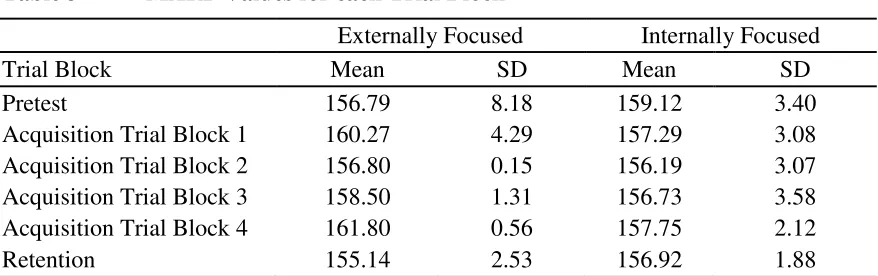
MARP describes the coordination pattern that existed between the left foot and shank segments for each Trial Block (see Table 3 for descriptive statistics for each group).
Table 3 MARP Values for each Trial Block
Externally Focused Internally Focused
Trial Block Mean SD Mean SD
Pretest 156.79 8.18 159.12 3.40
Acquisition Trial Block 1 160.27 4.29 157.29 3.08
Acquisition Trial Block 2 156.80 0.15 156.19 3.07
Acquisition Trial Block 3 158.50 1.31 156.73 3.58
Acquisition Trial Block 4 161.80 0.56 157.75 2.12
Deviation Phase (DP) Values
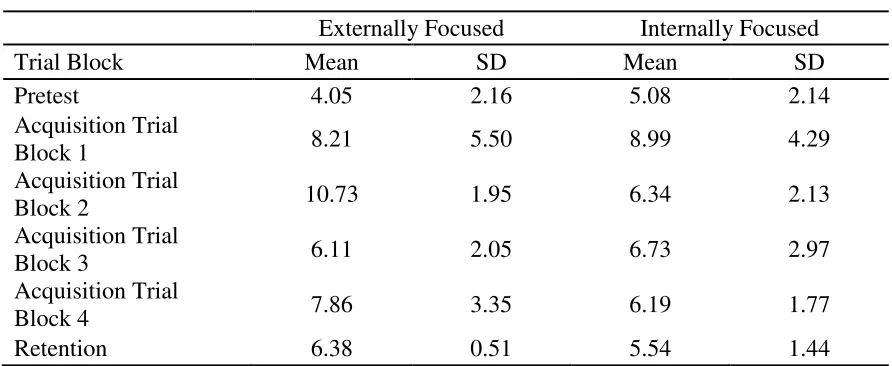
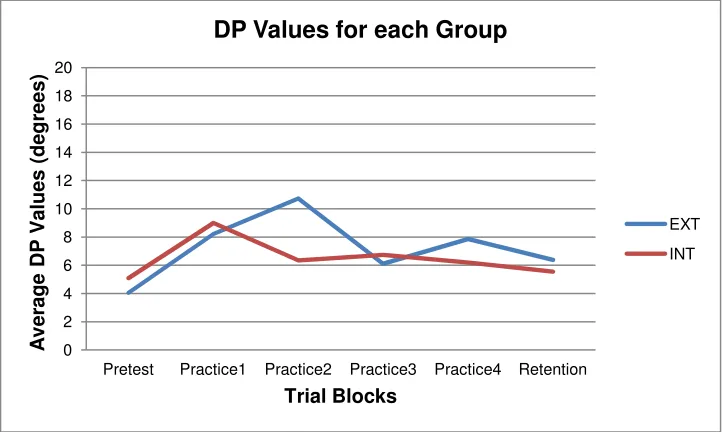
DP describes the coordination variability that existed between the left foot and shank segments for each Trial Block (see Table 4 for descriptive statistics for each group).
Table 4 DP Values for each Trial Block
Externally Focused Internally Focused
Trial Block Mean SD Mean SD
Pretest 4.05 2.16 5.08 2.14
Acquisition Trial
Block 1 8.21 5.50 8.99 4.29
Acquisition Trial
Block 2 10.73 1.95 6.34 2.13
Acquisition Trial
Block 3 6.11 2.05 6.73 2.97
Acquisition Trial
Block 4 7.86 3.35 6.19 1.77
Retention 6.38 0.51 5.54 1.44
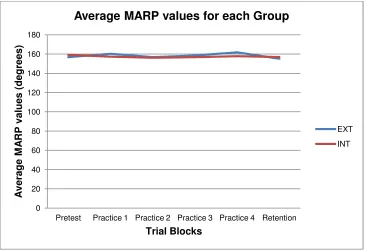
Statistical Analysis of Mean Absolute Relative Phase (MARP) A 6 (Trial Blocks) X 2 (Groups) Mixed Model Repeated Measures ANOVA found that the Trial Blocks (pretest, acquisition Trial Blocks, and retention test) were not significantly different, F(5,20) = 2.263, p = .087 (η2 = .361). No interaction was found between the Trial Blocks and the Groups, F(5,20) = 1.902, p = .139 (η2 = .322),
Figure 6 Average MARP values across each Trial Block for each Group4
Statistical Analysis of Deviation Phase (DP)
A 6 (Trial Blocks) X 2 (Groups) Mixed Model Repeated Measures ANOVA found that the Trial Blocks (pretest, acquisition Trial Blocks, and retention test) were Trial Blocks and Groups, F(5,20) = 1.85, p = .148 (η2 = .316), indicating that the two groups
responded in a similar manner to the intervention. In addition, no significant effect by Group was found, F(1,4) = 0.152, p = .717 (η2 = .037). Figure 7 indicates that the pretest DP values were lower than every other Trial Block, thus indicating that the intervention caused an increase to the DP values in both groups.
_______________________
4 Externally focused (EXT) and Internally focused (INT)
0 20 40 60 80 100 120 140 160 180
Pretest Practice 1 Practice 2 Practice 3 Practice 4 Retention
A v e ra g e M A R P v a lu e s ( d e g re e s ) Trial Blocks
Average MARP values for each Group
Figure 7 Average DP values across each Trial Block for each Group5
A Tukey LSD Post Hoc test was conducted to determine between which Trial Blocks significant differences existed. The pretest was found to be significantly different than all Trial Blocks except acquisition Trial Block 3, p <.05. The pretest was found to approach significant difference from acquisition Trial Block 3, p = .058. Acquisition Trial Block 2 was found to be significantly different than the retention test, p = .019.
_______________________
5 Externally focused (EXT) and Internally focused (INT)
0 2 4 6 8 10 12 14 16 18 20
Pretest Practice1 Practice2 Practice3 Practice4 Retention
A v e ra g e D P V a lu e s ( d e g re e s ) Trial Blocks
DP Values for each Group
EXT
REFERENCES
Bartlett, R., Wheat, J., & Robins, M. (2007). Is movement variability important for sports biomechanists? Sports Biomechanics, 6(2), 224-243.
Bini, R. R., Diefenthaeler, F., & Mota, C. B. (2010). Fatigue effects on the coordinative pattern during cycling: Kinetics and kinematics evaluation. Journal of
Electromyography & Kinesiology, 20,102-107.
Bini, R. R., Rossato, M., Diefenthaeler, F., Carpes, F. P., Cunha dos Reis, D., & Moro, A. R. P. (2010). Pedaling cadence effects on joint mechanical work during cycling.
Isokinetics & Exercise Science, 18, 7-13.
Blake, O. M., Champoux, Y., & Wakeling, J. M. (2012). Muscle coordination patterns for efficient cycling. Medicine & Science in Sports & Exercise, 44(5), 926-938. Broderick, M. P., & Newell, K. M. (1999). Coordination patterns in ball bouncing as a
function of skill. Journal of Motor Behavior, 31(2), 165-188.
Buttifield, A., Ball, K., & MacMahon, C. (2009). The use of motor learning in Biomechanics: A call for more collaboration. International Journal of Sport Psychology, 40(4), 603-615.
Chapman, A., Vicenzino, B., Blanch, P., & Hodges, P. (2009). Do differences in muscle recruitment between novice & elite cyclists reflect different movement patterns or less skilled muscle recruitment? Journal of Science & Medicine in Sport, 12, 31-34.
Chiviacowsky, S., Wulf, G., & Wally, R. (2010). An external focus of attention enhances balance learning in older adults. Gait & Posture, 32, 572-575.
Davids, K., Glazier, P., Araújo, D., & Bartlett, R. (2003). Movement systems as dynamical systems: The functional role of variability and its implications for sports medicine. Sports Medicine, 33(4), 245-260.
eibe play. (n.d.) [Image of a pedalo]. Double pedalo. Retrieved from:
http://www.eibe.co.uk/shop/item/507089/507120/0/638775/double-pedalo.html Ericsson, K. A., Krampe, R. T., & Tesch-Romer, C. (1993). The role of deliberate
practice in the acquisition of expert performance. Psychological Review, 100(3), 363-406.
Freudenheim, A. M., Wulf, G., Madureira, F., Pasetto, S. C., & Corrêa, U. C. (2010). An external focus of attention results in greater swimming speed. International Journal of Sports Science & Coaching, 5(4), 533-542.
Glazier, P. S., Wheat, J. S., Pease, D. L., & Bartlett, R. M. (2006). The interface of biomechanics and motor control: Dynamic systems theory and the functional role of movement variability. In K. Davids, S. J. Bennett, & K. M. Newell (Eds.),
Hamill, J., Palmer, C. & Van Emmerik, R. E. A., (2012). Coordinative variability and overuse injury. Sports Medicine, Arthroscopy, Rehabilitation, Therapy, & Technology, 4(45), 2-9.
Kurz, M. J., & Stergiou, N. (2002). Effect of normalization and phase angle calculations on continuous relative phase. Journal of Biomechanics, 35, 369-374.
Lin, S.-I., Lo, C.-C., Lin, P.-Y., & Chen, J.-J. J. (2012). Biomechanical assessments of the effect of visual feedback on cycling for patients with stroke. Journal of Electromyography & Kinesiology, 22, 582-588.
Lucía, A., Hoyos, J., & Chicharro, J. L. (2001). Physiology of professional road cycling.
Sports Medicine, 31(5), 325-337.
Mornieux, G., Gollhofer, A., & Stapelfeldt, B. (2010). Muscle coordination while pulling up during cycling. International Journal of Sports Medicine, 31, 843-846.
Parr, R., & Button, C. (2009). End-point focus of attention: Learning the ‘catch’ in rowing. International Journal of Sport Psychology, 40(4), 616-635.
Porter, J. M., Wu, W. F. W., & Partridge, J. A. (2010). Focus of attention and verbal instructions: Strategies of elite track and field coaches and athletes. Sports Science Review, 19, 77-89.
Salmoni, A. W., Schmidt, R. A., & Walter, C. B. (1984). Knowledge of results and motor learning: A review and critical reappraisal. Psychological Bulletin, 95(3), 355-386.
Sanderson, D. J., Martin, P. E., Honeymann, G., & Keefer, J. (2006). Gastrocnemius and soleus muscle length, velocity, and EMG responses to changes in pedalling cadence. Journal of Electromyography & Kinesiology, 16, 642-649.
Schmidt, R. A., & Lee, T. D. (2011). Augmented feedback. In M. Schrag (Ed.), Motor control and learning: A behavioral emphasis (pp. 393-428). Champaign, IL: Human Kinetics.
Schücker, L., Hagemann, N., Strauss, B., & Völker, K. (2009). The effect of attentional focus on running economy. Journal of Sports Sciences, 27(12), 1241-1248. Seay, J. F., Haddad, J. M., van Emmerik, R. E. A., & Hamill, J. (2006). Coordination
variability around the walk to run transition during human locomotion. Motor Control, 10, 178-196.
Shea, C. H., & Wulf, G. (1999). Enhancing motor learning through external-focus instructions and feedback. Human Movement Studies, 18, 553-571.
Shumway-Cook, A., & Woollacott, M. H. (2007). Motor learning and recovery of function (p.21-46) In: Motor control: Translating research into clinical practice. Lippincott Williams & Wilkin: Baltimore, MD.
Sides, D., & Wilson, C. (2012). Intra-limb coordinative adaptations in cycling. Sports Biomechanics, 11(1), 1-9.
Stergiou, N., & Decker, L. M. (2011). Human movement variability, nonlinear dynamics, and pathology: Is there a connection? Human Movement Science, 30, 869-888. Stergiou, N., Jensen, J. L., Bates, B. T., Scholten, S. D., & Tzetzis, G. (2001). A
Stoate, I., & Wulf, G. (2011). Does the attentional focus adopted by swimmers affect their performance? International Journal of Sports Science & Coaching, 6(1), 99-108.
Takaishi, T., Yamamoto, T., Ono, T., Ito, T., & Moritani, T. (1998). Neuromuscular, metabolic, and kinetic adaptations for skilled pedaling performance in cyclists.
Medicine & Science in Sports & Exercise, 30(3), 442-449.
Totsika, V., & Wulf, G. (2003). The influence of external & internal foci of attention on transfer to novel situations & skills. Research Quarterly for Exercise & Sport,
74(2), 220-225.
Tutorial: Plug-In Gait Lower-Limb. Retrieved from:
http://www.c-motion.com/v3dwiki/index.php?title=Tutorial:_Plug-In_Gait_Lower-Limb
Vance, J., Wulf, G., Töllner, T., McNevin, N., & Mercer, J. (2004). EMG activity as a function of the performer’s focus of attention. Journal of Motor Behavior, 36(4), 450-459.
Vogt, S., Schumacher, Y. O., Blum, A., Roecker, K., Dickhuth, H.-H., Schmid, A., & Heinrich, L. (2007). Cycling power output produced during flat and mountain stages in the Giro d’Italia: A case study. Journal of Sports Sciences, 25(12), 1299-1305.
Wagner, H., Pfusterschmied, J., Klous, M., Serge P. v. D., & Müller, E. (2012). Movement variability and skill level of various throwing techniques. Human Movement Science, 31, 78-90.
Wilson, C., & Sides, D. (2010, July). The influence of work rate and cadence on movement coordination in cycling. Paper presented at the annual meeting of International Symposium on Biomechanics in Sports, Marquette, Michigan, USA. Wilson, C., Simpson, S. E., van Emmerik, R. E. A., & Hamill, J. (2008). Coordinative
variability and skill development in expert triple jumpers. Sports Biomechanics,
7(1), 2-9.
Wulf, G. (2007). Attention and motor skill learning. Champaign, IL: Human Kinetics. Wulf, G. (2008). Attentional focus effects in balance acrobats. Research Quarterly for
Exercise & Sport, 79(3), 319-325.
Wulf, G. (2013). Attentional focus and motor learning: a review of 15 years.
International Review of Sport & Exercise Psychology, 6,77-104.
Wulf, G., Chiviacowsky, S., Schiller, E., & Avila, L. T. G. (2010). Frequent external-focus feedback enhances motor learning. Frontiers in Psychology, 1, 1-7. Wulf, G., & Dufek, J. S. (2009). Increased jump height with an external focus due to
enhanced lower extremity joint kinetics. Journal of Motor Behavior, 41(5), 401-409.
Wulf, G., McNevin, N., & Shea, C. H. (2001). The automaticity of complex motor skill learning as a function of attentional focus. The Quarterly Journal of Experimental Psychology, 54A(4), 1143-1154.
Wulf, G., Shea, C., Lewthwaite, R. (2010). Motor skill learning and performance: A review of influential factors. Medical Education, 44, 75-84.
Wulf, G., & Su, J. (2007). An external focus of attention enhances golf shot accuracy in beginners and experts. Research Quarterly for Exercise and Sport, 78(4), 384-389.
Zachry, T., Wulf, G., Mercer, J., & Bezodis, N. (2005). Increased movement accuracy and reduced EMG activity as the result of adopting an external focus of attention.
APPENDIX A
Lifestyle Questionnaire
Name: ____________________________ Date: _________________________ DOB: _____________________________ Gender: _______________________ Cycling Habits:
• How often do you compete in cycling competitions? □ Never
□ 1 – 2 a year □ >2 a year
• If you have competed in a cycling competition, was it a licensed event?
□ Yes
□ No
• If yes, do you have a cycling license?
□ Yes
□ No
• If yes, what kind? □ Competitive □ Non-competitive
• When was your last cycling competition if any? □ <6 months ago
□ 0-6 months ago
• Are you currently training for a cycling competition (check one)?
□ Yes
□ No
• Do you cycle primarily as a means of transportation or recreation (check one)? □ Transportation
□ Recreation
• At what intensity do you cycle (check all that apply)? □ Mild (perceived exertion low)
□ Moderate (perceived exertion moderate) □ High (perceived exertion high)
• Do you own a bike (check one)? □ Yes
□ No
□ If yes, what kind (check one)? □ Road
□ Mountain
• If you own a Mountain Bike, what kind of tires do you have? □ Slick
□ Treaded
□ No
Miscellaneous Information:
• Do you have any medical condition that will impede your ability to finish the training protocol?
□ Yes
APPENDIX B
Informed Consent Form
Principal Investigator: Claudia Chavez
Co-Investigator: Eric Dugan, PhD
Study Title: Strategies to Decrease Movement Variability in the Ankle Joint in Cyclists
This informed consent is intended to provide you with information to help you understand the nature of this research study. It will describe what you will be asked to do as a participant and the possible risks/discomfort involved. You may ask for clarification at any time. If after reviewing this form and asking questions, you decide to participate you will be asked to sign this form thereby indicating your consent to participate. A copy of the signed form will be kept on record separately from the data collected. You will be given a copy of this form to keep for your personal records.
Purpose and Background
You are being asked to participate in a research study to determine the effect different types of instructions and visual feedback have on cyclists when provided during a practice period. The information obtained from this study will be used to determine what type of instructions and visual feedback are beneficial for cyclists and will be used in part of a master’s thesis. You are being asked to participate because you are a cyclist. This study is restricted to those 18-40 years of age.
Procedures
Prior to the start of the study, you will be asked to complete an
determine your eligibility to participate in the study. In order to complete the Inclusion/Exclusion Questionnaire you will be asked to come to the Boise State
University Center for Orthopaedic and Biomechanical Research (COBR) located 1.0 mile off campus on Parkcenter Blvd. Once your eligibility is confirmed, the following
measurements will be obtained: height, weight, leg length, hip, ankle, and knee width. These measurements will be obtained using a scale, tape measure and calipers. The administration of the Informed Consent form, the Inclusion/Exclusion Questionnaire, and obtaining your measurements should take no more than an hour.
If you are eligible for this study, you will be asked to return to COBR for five days (Tuesday-Friday and the following Monday). All sessions will take place in under an hour.
Data will be collected via video recording and you will be asked to wear either skin-tight or minimal clothing without any reflective surfaces in order for proper placement of the reflective markers. The reflective markers are 5cm wide and are
attached with double-sided tape to either your skin or clothing. The cameras are designed to identify only reflective surfaces; the use of the reflective markers allows the cameras to find and track your body.
The practice period will occur over four consecutive days (Tuesday-Friday) and will be followed by a retention test on the Monday after the last practice session. During the practice sessions, you will be asked to cycle at a speed of your choice for
you what you should focus on while pedaling. All instructions will be provided prior to the start of the practice session and if you are given instructions about what to focus on, key phrases will be repeated every minute. In addition, you may be provided with visual feedback allowing you to see what you are being asked to focus on. If you are provided with visual feedback, you will only see the visual feedback during the 10 minute data collection during the practice sessions and you will be informed how to interpret the information presented. During the retention test you will not receive instructions about what to focus on or any visual feedback.
You must bring your own bike with you to COBR during the practice period and the retention test. Your bike will be placed on a Computrainer ™ and your rear wheel will be replaced with a slick road wheel in order to minimize differences in the calibration of the Computrainer ™.
Risks/Discomfort
The need to wear skin-tight or minimal clothing may cause you some anxiety, however, all doors will be locked to prevent the entry of unauthorized personal and only essential personal will remain in the lab during the practice sessions and post-test.