IJBCP
International Journal of Basic & Clinical Pharmacology
Original Research Article
A comparative study for evaluation of cognitive function in type-II
diabetes mellitus patients and non-diabetics
Dulcie Celia A.*, Ezhil Ramya J., Sriviruthi B.
INTRODUCTION
Diabetes mellitus is a heterogeneous metabolic disorder characterized by the common feature of chronic hyperglycaemia with disturbance of carbohydrate, fat and protein metabolism.1 The increasing prevalence of diabetes over the world has become an important public health problem. As population is increasing, getting older, more obese and sedentary, the number of individuals with diabetes is also steeply rising.
As of 2010, there were approximately 285 million people diagnosed with diabetes mellitus compared to around 30
million in 1985.2,3 Developing countries like India and China contribute much to the diabetic load of the world.4
Of the two types, Type-II diabetes is more common (90-95% of all cases) than type 1 and has increased markedly since 1960 in parallel with obesity.4 Type-II Diabetes Mellitus is a non-autoimmune, polygenic disease condition in which there is impaired insulin effectiveness (insulin resistance) and abnormal glucose homeostasis.
This form generally manifests in mid-life or beyond with a mean age of about 45 years.1 Risk factors include age over 45 years, a positive family history, physical inactivity, low fibre diet, people with impaired glucose
ABSTRACT
Background: To evaluate the impact of type-II diabetes mellitus on cognitive function and to assess the factors associated with impaired function.
Methods: This prospective study compared 100 type-II diabetic people attending the diabetic clinic of Tirunelveli Medical College Hospital with another 100 membered control group. The study group was selected randomly between the age group of 45-65 years. A neuro-cognitive assessment was done using Standardized Mini Mental State Examination (SMMSE), which is a simple and reliable screening test. This scale has 12 questions with time limits to assess orientation, memory, calculation, language, attention and construction. Magnitude and severity of cognitive decrement were analysed along with the possible factors affecting it.
Results: Mean age of the study population was 54.6±7.24 years. Cognitive impairment was noted among 62 of cases and 48 of the control group, which means a 14% higher prevalence of cognitive impairment among the type 2 diabetics. The association of development of cognitive impairment and duration of diabetes mellitus was significant statistically (p value = 0.025443; p<0.05). Other demographic variables like gender, education and domicile were also seen to affect the results.
Conclusions: Mild to moderate cognitive impairment was found significantly higher among the type-II diabetics than the non-diabetics. The cognitive impairment was found to be associated with the duration of diabetes. Hence the routine screening of cognition by SMMSE should be done in all type-II diabetic patients.
Keywords: Cognitive dysfunction, Standardized Mini Mental State Examination (SMMSE), Type-II diabetes mellitus
DOI: http://dx.doi.org/10.18203/2319-2003.ijbcp20181179
Department of Pharmacology, Tirunelveli Medical College, Tirunelveli, Tamil Nadu, India
Received: 26 January 2018
Accepted: 06 March 2018
*Correspondence to:
Dr. Dulcie Celia A.,
Email: [email protected]
tolerance or metabolic syndrome, prior gestational diabetes.5 The known deleterious effects of diabetes include changes in large and small blood vessels, which in turn can lead to peripheral neuropathy, retinopathy, renal failure, ischaemic heart disease as well as cerebrovascular disease including stroke.6
Neurological co-morbidities of diabetes have recently began to attract more interest. They are among the most common but under-recognized complications of diabetes. Several studies have established the relationship between cognitive dysfunction and type-II diabetes. Mild cognitive decline is a natural and inevitable part of growing older. Unfortunately for people with diabetes, the disease accelerates this process. Both extremes of high blood glucose (hyper glycaemia) and low blood glucose (hypo glycaemia) contribute to the development of memory loss among people with Type-II Diabetes Mellitus. This could affect the day-to-day activities of patients. Hence, a preserved cognitive status would help improve the quality of life of patients. Early detection can also help the clinician for a better management of the condition.
Aim of the study was to evaluate the impact of type-II diabetes mellitus on cognitive function and to assess the factors associated with impaired function.
METHODS
It was a prospective, randomized, comparative study. Study was carried out at Out-patient department, Diabetes Mellitus Clinic, Tirunelveli Medical College Hospital from August 2014-September 2014.
Hundred out-patients of type-II diabetes mellitus who are attending the diabetic clinic. Hundred non-diabetics of the same age group.
Inclusion criteria
• Known cases of type-II diabetes mellitus for minimum 2 years duration
• Age group-45 to 65 years • Both genders.
Exclusion criteria
• Any coexisting medical illness like stroke, hypertension, liver cirrhosis, chronic renal failure, congestive heart failure
• Concurrent medications like sedatives, hypnotics, and anti-depressants
• Psychological disorders/Neurologic disorders • Alcoholics/smokers/drug abusers
This comparative study was conducted at Tirunelveli Medical College Hospital with the co-operation of Department of Pharmacology and Department of General Medicine after obtaining approval from the Institutional Ethical Committee. Total of 100 type-II diabetes mellitus
patients (case group) and 100 non-diabetics (control group) were enrolled in the study. Selection was made randomly, based on the as mentioned criteria and with a written informed consent. After collecting their demographic information, patients were subjected to neuro-cognitive assessment using Standardized Mini Mental State Examination. This scale has 12 questions with time limits to assess orientation, memory, calculation, language, attention and construction (Table 1). Meanwhile, hundred non-diabetics of the same age group and with the same criteria were also assessed to serve as the control group. Scoring was based on 30 total points and less than 26 was considered as impaired. Scores in the range 20-25, 10-19, 0-9 is said to have mild, moderate and severe cognitive impairment respectively.6 Statistical representation of data was done. The Chi-square test was used to test the association between the events.
RESULTS
Demographic variables
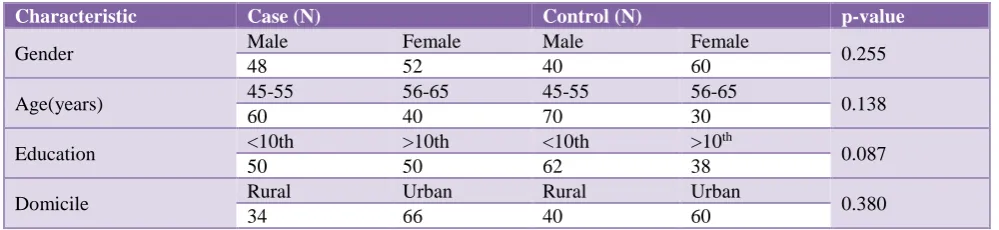
• Mean age of study population was 54.6±7.24 years. • No significant differences in sex distribution
(p=0.255), educational level (p=0.087) and domicile (p=0.380) were found between cases and control (Table 2).
Cognitive analysis
• Significant cognitive impairment was found among type-II diabetic cases when compared to the control group (p=0.047; p<0.05).
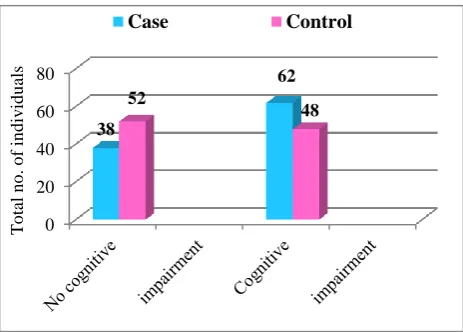
[image:2.595.312.544.508.674.2]• Among the cases, 62 individuals had SMMSE scores <26, and among the control group, 48 individuals scored below 26, so categorized as having cognitive dysfunction (Table 3, Figure 1).
Figure 1: Comparison of cognitive function between cases and control.
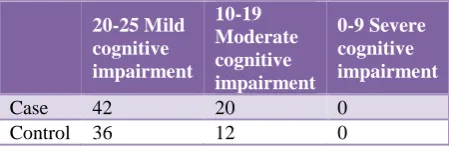
Out of these 62 cases, 42 had mild cognitive impairment (scores 20-25), 20 had moderate impairment (scores 10-19) and none had severe impairment (scores 0-9) (Table 4, Figure 2).
0 20 40 60 80
38
62 52
48
T
o
tal
n
o
.
o
f
in
d
iv
id
u
als
Table 1: standardized mini-mental state examination (SMMSE).
Question Time allowed Score
1
a. What year is this? 10 seconds /1
b. Which season is this? 10 seconds /1
c. What month is this? 10 seconds /1
d. What is today’s date? 10 seconds /1
e. What day of the week is this? 10 seconds /1
2
a. What country are we in? 10 seconds /1
b. What province are we in? 10 seconds /1
c. What city/town are we in? 10 seconds /1
d. IN HOME – What is the street address of this house? 10 seconds /1
IN FACILITY – What is the name of this building?
e. IN HOME – What room are we in? IN FACILITY – What floor are we on? 10 seconds /1
3
SAY: I am going to name three objects. When I am finished, I want you to repeat them. Remember what they are because I am going to ask you to name them again in a few minutes. Say the following words slowly at 1‐second intervals‐ball/ car/ man
20 seconds /3
4 Spell the word WORLD. Now spell it backwards. 30 seconds /5
5 Now what were the three objects I asked you to remember? 10 seconds /3
6 SHOW wristwatch. ASK: What is this called? 10 seconds /1
7 SHOW pencil. ASK: What is this called? 10 seconds /1
8 SAY: I would like you to repeat this phrase after me: No ifs, ands or buts. 10 seconds /1
9
SAY: Read the words on the page and then do what it says. Then hand the person the sheet with CLOSE YOUR EYES on it. If the subject reads and does not close their eyes, repeat up to three times. Score only if subject closes eyes
10 seconds
/1
10 HAND the person a pencil and paper. SAY: Write any complete sentence on that
piece of paper. (Note: The sentence must make sense. Ignore spelling errors) 30 seconds
/1
11
PLACE design, eraser and pencil in front of the person. SAY: Copy this design please.
1 minute /1
Allow multiple tries. Wait until person is finished and hands it back. Score only for
correctly copied diagram with a 4‐sided figure between two 5‐sided figures.
12
ASK the person if he is right or left‐handed. Take a piece of paper and hold it up in front of the person. SAY: Take this paper in your right/left hand (whichever is non‐ dominant), fold the paper in half once with both hands and put the paper down on the floor. Score 1 point for each instruction executed correctly.
Takes paper correctly in hand Folds it in half
Puts it on the floor
30 seconds
/1 /1 /1
Total test score /30
Table 2: Demographic variables.
Characteristic Case (N) Control (N) p-value
Gender Male Female Male Female 0.255
48 52 40 60
Age(years) 45-55 56-65 45-55 56-65 0.138
60 40 70 30
Education <10th >10th <10th >10
th
0.087
50 50 62 38
Domicile Rural Urban Rural Urban 0.380
[image:3.595.49.549.646.761.2]Figure 2: Severity grading of cognitive dysfunction.
[image:4.595.54.283.272.428.2]Figure 3: Factors affecting cognitive impairment of cases.
Table 3: Cognitive scores of cases and controls.
No cognitive Impairment
Cognitive
Impairment p value
Case 38 62 0.047
(<0.05)
Control 52 48
Table 4: Severity of cognitive impairment.
20-25 Mild cognitive impairment 10-19 Moderate cognitive impairment 0-9 Severe cognitive impairment
Case 42 20 0
Control 36 12 0
• Incidence of cognitive impairment was found to be greater in females (p=0.001; <0.01) (Figure 3). • Incidence of cognitive impairment was greater
among those from urban areas (p=0.003; <0.01). • Cognitive impairment was also greater among those
with low educational levels (p<0.05) (Figure 3). • Duration of diabetes mellitus also affected the
results. Patients known to be type-II diabetics for
more than 5 years had greater incidence of cognitive impairment (p=0.025; <0.05) (Figure 3).
• Age, drugs and glycaemic control were not found to affect the results (p>0.05).
DISCUSSION
Cognitive dysfunction is one of the recently established complications of type-II diabetes but this is not usually evaluated in clinical care. This study aims to highlight the association of cognitive impairment with type-II diabetes mellitus, using Standardized Mini Mental State Examination (SMMSE) test, thus providing insight into the magnitude and severity of cognitive decrement with possible factors affecting the scores.
Mild cognitive impairment (MCI) is a common condition that has been recognized as a prodrome to dementia.7 Diagnosing MCI is a challenge. Orientation, memory, calculation, language, attention and construction are the various cognitive domains to be assessed. Magnetic Resonance Imaging (MRI), Positron Emission Tomography (PET)scans to assess cerebral function are very expensive and cannot be used as a routine screening test. The Mini-Mental State Examination (MMSE) is the traditionally used simple screening test for cognitive impairment. Standardized Mini-Mental State Examination (SMMSE), an adaptation of MMSE has improved inter-rater reliability compared with MMSE, taking approximately 10 minutes to administer.8
The findings of this study strongly support that there is a significant relationship between cognitive dysfunction and type-II diabetes mellitus. The prevalence of cognitive dysfunction is 14% higher among type-II diabetics in this study. This is supported by various studies conducted in several places.9-11
The following hypotheses suggest the possible mechanisms for development of cognitive impairment with Type -II Diabetes Mellitus.12,13
• The oxidative stress created by insulin has detrimental impact on the brain cells.
• The direct effect of diabetes on the vascular system can increase the risk of vascular dementia.
• Metabolism of β amyloid protein and presence of APOE ξ4 allele seem to be a more deleterious impact. • Insulin degrading protein and glycosylation end
products also play a contributive role.
The study population included individuals between 45-65 years for the reason that mean age of occurrence of type-II diabetes is 45 years.1 and in the elderly, over 65 years of age, the brain normally undergoes neurodegenerative changes.9 Patients with history of smoking, alcoholism, drug abuse, hypertension or any other systemic illness have been excluded since each is an independent risk factor for cognitive impairment and could affect the results.14-16 0 5 10 15 20 25 30 35 40 45 20-25 Mild cognitive impairment 10-19 Moderate cognitive impairment 0-9 Severe cognitive impairment 42 20 0 36 12 0 T OT AL NO. OF I ND IVI DU AL S Case Control 40 22 44 18 34 28 34 28 0 10 20 30 40 50 60 70 Gender Educational level
Domicile Duration of Diabetes To ta l n o . o f in d iv id u a ls
[image:4.595.55.280.579.653.2]According to this study, people with lower educational
status scored less (Figure 3). This is similar to another study conducted in India.10
Females posed an increased risk that may be due to their lower literacy status (Figure 3).
The affected population was mostly from urban areas (Figure 3) as the diabetic prevalence rate is much more higher in the urban setup.
Longer duration of diabetes was associated with poorer scores (Figure 3) like Nurses’ Health Study conducted in U.S.17
In contrast to other studies, association between cognitive impairment and glycaemic status could not be proved in this study.18 This may be because patients were assessed only by their previous Fasting Blood Sugar values rather than the gold standard HbA1C as it is expensive.
There is an on-going phase – II trial of Metformin testing whether it could decrease cognitive decline in patients.13 Here no correlation was found between pharmacotherapy and SMMSE scores.
This study also has certain limitations. Study population included only 100 patients as the duration of study is shorter. A larger study is required to consolidate the finding that type-II diabetes mellitus patients are more susceptible to cognitive dysfunction. HBA1C can be used as an alternative to fasting blood sugar values to assess the glycaemic control of patients.
CONCLUSION
Mild to moderate cognitive impairment was found significantly higher among the type-II diabetics than the non-diabetics. The cognitive impairment was found to be associated with the duration of diabetes. This study suggests that the early implementation of Standardized Mini Mental State Examination as a routine ambulatory screening test for type-II diabetes patients can be useful to detect early stages of cognitive impairment.
ACKNOWLEDGEMENTS
Authors would like to thank the study participants for their cooperation in providing the necessary information.
Funding: No funding sources Conflict of interest: None declared
Ethical approval: The study was approved by the Institutional Ethics Committee
REFERENCES
1. Harsh Mohan. Textbook of Pathology. 6th Ed.: Jaypee Brothers Medical Publishers (P) Ltd; 2010:818.
2. Melmed S, Polonsky KS. Larsen PR, Kronenberg HM. William Textbook of Endocrinology. 12th Ed. Philadelphia: Elsevier/Saunders; 2011:1371-1435. 3. Smyth S, Heron A. Diabetes and Obesity: The twin
epidemics. Nature Medicine; January 2006;12(1):75-80.
4. Iacobuzio-Donahue CA. The Endocrine Pancreas. Robins and Cotran’s pathologic basis of disease. 9th Ed. Philadelphia; Elsevier/Saunders; 2015:1105. 5. Goldstein BJ. Dirk Mueller-Wieland. Type-II
diabetes: Principles and Practice. 2nd Ed. Crc Press.; 2007:7.
6. National Ageing Research Institute. Final Report: The Assessment of Older People with dementia and depression of Culturally and Linguistically Diverse Backgrounds: A review of current practice and the development of guidelines for Victorian Aged Care Assessment Services. Final Report, July 2011.
Available at:
https://www2.health.vic.gov.au/Api/downloadmedia/
%7B506DB4FF-039F-4753-88E2-61F4E76448D6%7D. Accessed 18 June 2014. 7. Morris JC, Storandt M, Miller JP, McKeel DW Jr,
Price JL, Rubin EH, and others. Mild cognitive impairment represents early-stage Alzheimer’s disease. Arch Neurology. 2001;58:397-405.
8. William Molloy D, MB, MRCPI, FRCPC1, Timothy IM Standish, Lewis DL, PhD_Can J. Screening for Mild Cognitive Impairment Psychiatry. January 2005;50(1).
9. Beeri MS, Goldbourt U, Silverman JM, Noy S, Schmeidler J, Ravona-Springer R, et al. Diabetes mellitus in midlife and the risk of dementia three decades later. Neurology. 2004 Nov 23;63(10):1902-7.
10. Kataria L, Pandya H, Shah S, Shah H, Gerg R. (India): Prevalence and pattern of cognitive dysfunction in type-II diabetes mellitus. International Journals of medical and applied sciences. ISSN:2320-3137. 11. Alencar RC. (Brazil). Assessment of cognitive status
in patients with type -II diabetes mellitus through MMSE. Diabetology and Metabolic syndrome. 28 Jan 2010.
12. Smith GE, Bondi MW. Mild Cognitive Impairment and Dementia: Definitions, Diagnosis, and Treatment. AACN/Oxford Workshop Series; 2013:238.
13. Luchsinger JA. Type-II Diabetes and cognitive impairment linking mechanisms. PMC June 12, 2012. 14. Knut-Olaf H, Groneberg D. Tobacco or Health?: Physiological and social damages caused by tobacco smoking. 2nd Ed. Springer; 2010:160.
15. Harward MP, Udden MM. Medical Secrets. 5th Ed. Mosby Elsevier; 2011:544.
16. Prisant ML. Hypertension in the elderly. Humana Press; 2005:272.
18. Reaven GM, Thompson LW, Nuhan D, Haskins E. Relationship between hyperglycemia and cognitive function in older NIDDM patients. Diabetes care. 1990;13:16-21.