Original Research Article
Knowledge regarding diabetes mellitus amongst arts, science and
commerce college students of Latur city, Maharashtra
Bhaskar Gaikwad, Udaykiran Bhalge*, Pramod Kulkarani, Anant Takalkar,
Sunil Sagare, Mukund Bhise
INTRODUCTION
Worldwide approximately 170 million humans are residing with diabetes.1 India alone has approximately 35 million human beings residing with diabetes. Each seventh patient touring a family health practitioner in india is a diabetic.2 In addition, researchers have anticipated a 65% upward thrust in the superiority of diabetes owing to the population growth, price, age structure, urbanization, unfavourably modification of
nutritional conduct and lifestyles, monetary and consequently the actual wide variety of diabetics will be as excessive as fifty two million by way of 2025.3 Three in view of the above information, global health organization has declared india because the ‘diabetic capital’.4
Also, the escalation of kind 2 diabetes mellitus is seen in all age companies of india populace.5 that implies that maximum Indians broaden diabetes in early adult existence, in the maximum productive years of lives. Insufficient expertise, public awareness
ABSTRACT
Background: Nearly 35 million people are suffering from diabetes in India. The present trend in diabetes is escalating diabetes prevalence and earlier onset of type 2 diabetes in the adult population. Awareness is an important factor in the early diagnosis, adequate treatment and prevention of complications due to diabetes. This study was undertaken to assess the knowledge regarding different aspects of diabetes mellitus among college students.
Methods: A cross-sectional study was undertaken with 348 college students of Latur City. The students were administered a 41 items, pre-tested, semi structured questionnaire assessing general and specific knowledge of diabetes like symptoms, causation, risk factors, complication, treatment, attitudes towards people with diabetes etc. The results were analyzed using Microsoft Excel software.
Results: Excessive tiredness, non healing wounds, and excessive sweating were mentioned as symptoms of diabetes by 81.03%, 73.85% and 72.70% subjects respectively. About (57.76%) study participants were aware of diabetes as a rising problem and only (8.33%) students had correct knowledge of the prevalence. Only (27.30%) were aware that genetic factors are reason for the causation of diabetes. As much as 85.91% subjects stated that blood and urine tests are done for diagnosing diabetic persons. Common complications not identified by the study subjects were impotence (68.39%), stroke (64.65%), ulcer on foot (54.31%), and repeated skin infections (53.16%).
Conclusions: Specific knowledge about diabetes is poor among the degree college students, hence appropriate activities to increase awareness about diabetes is the need of the hour.
Keywords: Awareness, Knowledge, Diabetes mellitus, Degree college students
Department of Community Medicine, MIMSR Medical College, Latur, Maharashtra, India
Received: 16 December 2018 Revised: 30 December 2018 Accepted: 02 January 2019
*Correspondence: Dr. Udaykiran Bhalge,
E-mail: udaykiranbhalge@yahoo,com
Copyright: © the author(s), publisher and licensee Medip Academy. This is an open-access article distributed under the terms of the Creative Commons Attribution Non-Commercial License, which permits unrestricted non-commercial use, distribution, and reproduction in any medium, provided the original work is properly cited.
approximately diabetes symptom, hassle and its prevention, coupled with the dearth of infrastructure for diabetic screening and high-risk organization identification are a number of the elements explaining the failure of early analysis. Consequently, many younger diabetics live up to an older age, developing and suffering from chronic morbidities and consequently residing a negative quality of existence.6 Considering greater than 50% of Indian population is inside the age organization of 15-25 years, proper expertise and knowledge can be very helpful in early diagnosis and proper as well as adequate treatment.7,8 Younger human beings have a unique possibility to interact and impact other humans life.9
Accordingly, it is essential that the knowledge they gain will definitely helpful for them as well as for the society. Properly knowledgeable empowered young people can help in decreasing severe complications and unnecessary disabilities resulting from diabetes; provide assist and encouragement for human beings dwelling with diabetes.10 For this reason this study is undertaken to assess the knowledge concerning different factors of diabetes mellitus among university college students of Latur city.
METHODS
A cross-sectional study was carried out amongst 348 college students during the period of September 2017 to October 2017. Smt. Sushila Devi Deshmukh Junior, Senior and Mahila College, Khadgaon road, Latur were selected for the study. All students studying in the junior and senior college were included in the study. These colleges are located in the field practice area of Urban Health Training Centre of Dept. of Community Medicine of MIMSR Medical College, Latur, Maharashtra. Before starting the study ethical clearance was obtained from Institutional ethical committee. Principals of above colleges were contacted personally and the permission to conduct the study was taken from principal of concerned colleges. All 348 students present at the time of data collection were included in our study with prior consent. Prior consent was taken from them and those who are contested to participate were administered a pre-designed, pre-tested questionner. The filled questioners were collected after 45 minutes on the same day. Those who were absent during the data collection due to any reasons were excluded from our study.
Data analysis
The data was entered in the MS Excel sheet and analysed by frequency, percentage and chi-square test whereever necessary.
RESULTS
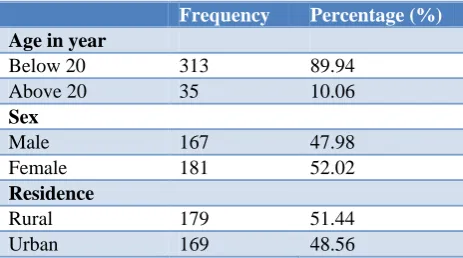
It was seen from Table 1 that total 348 students contested to participate in the study. The study subjects were in the
16–23 years age group, large proportion of them belongs to 16-19 years age group. Of the 348 students 167(47.98%) were males and remaining 181 (52.02%) were females. 179 (51.44%) of them were resident of rural area, where as 169 (48.56%) from urban area. Of the 348 students 252 (72.12%) were studying junior college (11th and 12th standards) and 97 (27.8%) studying in senior college.
Table 1: Demographic characteristics of study population (n=348).
Frequency Percentage (%)
Age in year
Below 20 313 89.94
Above 20 35 10.06
Sex
Male 167 47.98
Female 181 52.02
Residence
Rural 179 51.44
Urban 169 48.56
It was seen from Table 2 that excessive tiredness, non healing wounds, and excessive sweating were mentioned as symptoms of diabetes by 81.03%, 73.85% and 72.70% subjects respectively. Loss of sensation of hands and feet were mentioned by 69.83% participant. Passing excessive urine stated by 59.48% students. Reduced vision stated by 55.75% participant. Only 95 (27.30%) were aware that genetic factors are reason for the causation of diabetes; 231 (66.38%) believed eating too much sweets at any age can causes diabetes and 150 (43.10%) subjects believed eating too much sugar as a child causes diabetes.
It was seen from Table 3 that common complications identified by the study subjects were out of 348 participant 208 (59.77%) said kidney complication, 190 (54.60%) stated eye complication, 201(57.76%) participant said heart problem, where as common complications not identified by the study participant were impotence 238 (68.39%), stroke 218 (62.64%), ulcer on foot (54.31%), repeated skin infection 185 (53.16%) loss of sensation (52.87%) in considerable proportion of cases.
Table 2: Awareness about symptoms of diabetes among the study participants.
Symptom
Awareness of symptoms (n=348)
Z-value
P value significant at <0.05 No. of students
aware of symptom
% No.of students not aware of symptom
%
Excessive tiredness 282 81.03 66 18.97 11.5761 0.001
Non healing wounds 257 73.85 91 26.15 8.898534 0.001
Excessive sweating 253 72.70 95 27.30 8.469689 0.001
Drinking excess water 253 72.70 95 27.30 8.469689 0.001
Loss of sensation of hands and feet 243 69.83 105 30.17 7.397576 0.001
Passing excess urine 207 59.48 141 40.52 3.537971 0.001
Reduced vision 194 55.75 154 44.25 8.898534 0.001
Table 3: Knowledge regarding complications of diabetes among the study participant.
Complications
Aware about complications
Not aware about
complications Z value P value
No. % No. %
Kidney problem 208 59.77 140 40.23 3.645138 0.001
Heart problem 201 57.76 147 42.24 2.895231 0.001
Eye problem 190 54.60 158 45.40 1.716245 0.0436
Loss of sensation 164 47.13 184 52.87 -1.07078 0.1423
Repeated skin infections 163 46.84 185 53.16 -1.17898 0.121
Ulcer on foot 159 45.69 189 54.31 -1.60804 0.0458
Stroke 123 35.34 218 62.64 -5.04235 0.001
Impotence 110 31.61 238 68.39 -6.86117 0.001
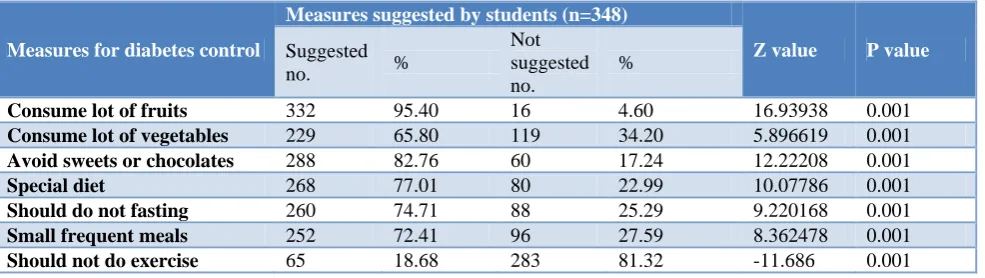
Table 4: Knowledge about various methods for control of diabetes among the study participants.
Measures for diabetes control
Measures suggested by students (n=348)
Z value P value
Suggested
no. %
Not suggested no.
%
Consume lot of fruits 332 95.40 16 4.60 16.93938 0.001
Consume lot of vegetables 229 65.80 119 34.20 5.896619 0.001
Avoid sweets or chocolates 288 82.76 60 17.24 12.22208 0.001
Special diet 268 77.01 80 22.99 10.07786 0.001
Should do not fasting 260 74.71 88 25.29 9.220168 0.001
Small frequent meals 252 72.41 96 27.59 8.362478 0.001
Should not do exercise 65 18.68 283 81.32 -11.686 0.001
DISCUSSION
The present study revealed that excessive tiredness, non healing wounds, and excessive sweating were mentioned as symptoms of diabetes by 81.03%, 73.85% and 72.70% subjects respectively. Loss of sensation of hands and feet were mentioned by 69.83% participant. Passing excessive urine stated by 59.48% students and reduced vision by 55.75% participant. As much as 85.92% subjects stated that blood and urine tests are done for diagnosing diabetic persons. Common complications not identified by the study participant were impotence 238 (68.39%), stroke 62.64%, repeated skin infection 53.16%, ulcer on foot 54.31%, loss of sensation 52.87% in considerable proportion of cases. Only 27.30% were aware that genetic
whereas 167 (47.99%) students believed that mothers with diabetes gives birth to diabetic baby. Similarly a study done in Singapore by Wee et al about public awareness on diabetes, it showed low scores in general knowledge, risk factors of diabetes mellitus, but had a good understanding of symptoms and complications of diabetes.10 Similarly a study done by Hashmi et al found that the positive association between stress, sedentary lifestyle, family history of diabetes, and hypertension and alcohol consumption with abnormal glucose tolerance. It was also found that type of family and type of diet were not significantly associated with abnormal glucose tolerance.11
Another study done by Mohan et al on urban population of Chennai city found that 75.5% of the whole population was aware of a condition called diabetes. However, the same study had revealed poorer knowledge about complications of diabetes i.e. 26.8% among non-diabetics and 74.2% among diabetics.12 A study done by Murugesan et al also revealed the poor knowledge regarding diabetes mellitus among the general as well diabetic population in a city in southern India.13
A study done by Hughes et al on community health workers not only revealed lack of requisite knowledge, attitude, and beliefs but also an array of myths and misconceptions which favours stigmatizing and adversely impact on prevention and management of diabetes.14 Another study conducted by Poornima et al on degree college students of Mandya city Karnataka, found that passing excess of urine, excessive tiredness and hunger were mentioned as symptom of diabetes by 73.15%: 50.15% and 46.91% subjects respectively and 59.94% students had knowledge about genetic factors in diabetes. As much as 62.8% and 35.02% subjects stated that blood and urine tests are done for diagnosing diabetic persons. Common complications not identified by the study subjects were impotence (82.25%), ulcer on foot 70.83%, loss of sensation 69.91%, repeated skin infections 62.80%, stroke 61.42%.15
CONCLUSION
The present study concluded that the knowledge about diabetes is poor among the degree college students, thus appropriate activities to increase awareness about diabetes is the need of the hour. Hence, there is a need to design and implement various educational activities providing for appropriate diagnosis, control, treatment and prevention of diabetes among the college students of Latur city.
Limitations
A cross-sectional questionnaire based study results may represent only the tip of the iceberg, hence in-depth community based studies have to be undertaken to assess the awareness about diabetes in the community.
Recommendations
College students are a special accessible group, hence organizing on campus awareness creating activities like to skits, dramas, collage poster competition etc can help increase awareness among them. Creating communities on various social networking sites like, face book, twitter etc can also be considered for increasing awareness among the student population.
Funding: No funding sources Conflict of interest: None declared
Ethical approval: The study was approved by the Institutional Ethics Committee
REFERENCES
1. Wild S, Roglic G, Green A, Sicree R, King H. Global prevalence of diabetes: Estimates for the year 2000 and projections for 2030. Diabetes Care 2004;27:1047–53.
2. Pradeepa R, Mohan V. The changing scenario of the diabetes epidemic: Implications for India. Indian J Med Res. 2002;116:121–32.
3. Ramachandran A, Snehalatha C, Baskar AD, Mary S, Kumar CK, Selvam S, et al. Temporal changes in prevalence of diabetes and impaired glucose tolerance associated with lifestyle transition occurring in the rural population in India. Diabetologia. 2004;47:860-5.
4. World Health Organization (WHO). Prevalence of diabetes in the WHO South-East Asia Region. 2009: 2-10.
5. Vibah Sharma. The Tribune, Chandigarh, India. Need to Spread Public Awareness on Diabetes. 2004. Available at: http://www.tribuneindia. com/2004/20041114/edit.htm1. Accessed on 15 May 2017.
6. Raheja BS, Kapur A, Bhoraskar A, Sathe SR, Jorgensen LN, Moorthi SR, et al. Diab Care Asia-India Study: Diabetes care in Asia-India-Current status. J Assoc Physicians India. 2001;49:717–22.
7. Chiasson JL. Prevention of type 2 diabetes: fact or fiction? Expert Opinion Pharmacotherapy. 2007;8;3147-58.
8. Soyed SA, Das S, Begum T. Foot Involvement in diabetes mellitus. Asian J Diabetol. 2005;7(1):15-24.
9. Lau SL, Debarm R, Thomas N, Asha HS, Vasan KS, Alex RG, et al. Healthcare Planning in North-East India: A Survey on Diabetes Awareness, Risk Factors and Health Attitudes in a Rural Community. J Assoc Physicians India. 2009;57:305-9.
10. Wee HL, Ho HK, Li SC. Public Awareness of Diabetes Mellitus in Singapore. Singapore Med J. 2002;43:128-34.
College, Badnapur, Jalna, Maharashtra. Indian J Forensic Community Med. 2017;4(1):36-40. 12. Mohan D, Raj D, Shanthirani CS, Datta M, Unwin
NC, Kapur A, et al. Awareness and knowledge of diabetes in Chennai - The Chennai Urban rural Epidemiology study. J Assoc Physicians India. 2005;53:283-7.
13. Murugesan N, Snehalatha C, Shobhana R, Roglic G, Ramachandran A, et al. Awareness about diabetes and its complications in the general and diabetic population in a city in southern India. Diabetes Res Clin Pract. 2007;77:433-7.
14. Hughes GD, Puoane T, Bradley H. Ability to manage diabetes-community health workers
knowledge, attitudes and beliefs. JEMDSA. 2006;11:10-4.
15. Poornima S, Ragavendra L, Shivakumar KM. Awareness regarding diabetes mellitus among degree college students of Mandya city, Karnataka, India. Indian J Prev Soc Med. 2012;43(3):284-7.