The Homogocene: a research prospectus for the study of biotic homogenisation 23
The Homogocene: a research prospectus for the study
of biotic homogenisation
Julian D. Olden1, Lise Comte1, Xingli Giam2
1 School of Aquatic and Fishery Sciences, University of Washington, Seattle, Washington 98195, USA
2 Department of Ecology and Evolutionary Biology, University of Tennessee, Knoxville 37996, USA
Corresponding author:Julian D. Olden ([email protected])
Academic editor:M. McKinney | Received 27 November 2017 | Accepted 17 February 2018 | Published 6 March 2018
Citation: Olden JD, Comte L, Giam X (2018) The Homogocene: a research prospectus for the study of biotic homogenisation. NeoBiota 37: 23–36. https://doi.org/10.3897/neobiota.37.22552
Abstract
In an era of global change, the process of biotic homogenisation by which regional biotas become more similar through time has attracted considerable attention from ecologists. Here, a retrospective look at the literature is taken and the question asked how comprehensive is the understanding of this global phenomenon? The goal is to identify potential areas for additional and future enquiries to advance this research frontier and best ensure the long-term preservation of biological diversity across the world. Six propositions are presented here to; (1) broaden our geographic and taxonomic understanding, (2) diversify the spatial and temporal scales of inquiry, (3) reconcile past and embrace new approaches to quantification, (4) improve our knowledge of the underlying drivers, (5) reveal the conservation implications and (6) forecast future homogenisation. It is argued that significant progress in the understanding of the causes, consequences and conservation implication of biotic homogenisation will come by integrating concepts and approaches from ecology, evolution and conservation across a hierarchy of spatial and temporal scales.
Keywords
beta-diversity, biodiversity conservation, species introductions, urbanisation, taxonomic, functional, phy-logenetic similarity
Introduction
Since its first formal definition close to two decades ago, biotic homogenisation – referring to the increase in floral and faunal similarity amongst communities or decrease in beta-diversity over time (McKinney and Lockwood 1999) – has been the focus of considerable
Copyright Julian D. Olden et al. This is an open access article distributed under the terms of the Creative Commons Attribution License (CC BY 4.0), which permits unrestricted use, distribution, and reproduction in any medium, provided the original author and source are credited.
NeoBiota 37: 23–36 (2018) doi: 10.3897/neobiota.37.22552 http://neobiota.pensoft.net
SHORT COMMUNICATION
Advancing research on alien species and biological invasions A peer-reviewed open-access journal
attention by ecologists (Fig. 1). This prominence in literature is not entirely surprising; many of the conservation challenges facing society necessitates broadening our science from understanding individual species loss to anticipating multi-faceted changes to biodi-versity (Naeem 2013, Dornelas et al. 2014, McGill et al. 2015, Socolar et al. 2016). The notion that the loss of native species concurrent with the introduction and establishment of non-native species aided by humans will continue relatively unabated into the future, has prompted many to herald the coming era in Earth’s history as the ‘Homogocene’. The world envisioned is one where considerable reshuffling of biotas will result in significant ecological and evolutionary consequences (Olden et al. 2004) and may ultimately flavour the manner in which humans experience the natural world (Olden et al. 2005).
Although there is little debate that species extinctions and invasions have funda-mentally altered patterns of biogeography (Dirzo et al. 2014, Ceballos et al. 2015), a literature review demonstrates that the number of articles referring to biotic homogeni-sation is seven times greater than the number of articles providing quantitative estimates of changes in community similarity (Fig. 1). This inevitably leads to the question: how comprehensive is our understanding of biotic homogenisation? What is known is that across all empirical studies, biotic homogenisation was reported more often (odds ratio = 1.6) than biotic differentiation or no change in community similarity through time (Fig. 2). A closer look at the data reveals that the overall homogenisation effects were driven largely by studies in the Nearctic region, whereas the results are somewhat more variable and sparse for other biogeographical zones. Similarly, estimates of biotic homog-enisation vary considerably within and amongst taxonomic groups (Fig. 2), which re-flects, to some extent, the rich variety of definitions and methods used (discussed below). Despite the apparent pervasive, but notably uncertain, evidence for biotic homog-enisation across the Earth, many questions remain unanswered. Are changes in com-munity similarity permanent or transient? What can past trends in biotic homogenisa-tion tell us about the likely future of biodiversity? How can this body of knowledge help to shape conservation policy and management decisions? While recent years have seen progress in addressing these and other more advanced questions, it is argued that additional and more targeted scientific inquiry is needed to advance the understanding of biotic homogenisation and best ensure that conservation efforts succeed in preserv-ing the antiquity of biological life across the world. By takpreserv-ing a retrospective look at the last 20 years of scientific inquiry, a series of propositions is presented that seek to stimulate further discussion and advance this research frontier.
Broaden our geographic and taxonomic understanding
The Homogocene: a research prospectus for the study of biotic homogenisation 25
Figure 1. Cumulative number of published articles that quantified biotic homogenisation (BH) (left axis; black line) based on a literature search using “(biotic OR taxonomic OR functional OR phylogenetic) AND (homogenization or homogenisation) AND (similarity OR Jaccard OR Sorensen OR Sørensen OR Bray-Curtis OR Raup-Crick)” as key terms in ISI Web of Knowledge and Google Scholar, compared to the cumulative number of articles containing the term “biotic homogenization” in the Abstract or key-words (right axis; grey dotted line) resulting from a broader search of the literature using “biotic homog-enization” OR “biotic homogenisation”. Only those studies that quantified changes in beta-diversity over time (i.e. the definition of homogenisation) were included. The inset illustrates the number of reported estimates of biotic homogenisation across all studies according to the major biogeographical zones.
mirrors similar geographic biases in the study of invasive species (Pyšek et al. 2008) and biodiversity (Trimble and van Aarde 2012) and also undoubtedly reflects the effects of under-reporting of no change or differentiation. Terrestrial plants and freshwater fishes are the most frequently studied taxonomic group, whereas birds, mammals and other verte-brate and inverteverte-brate groups were less often evaluated (Fig. 2). For example, only recently have studies examined taxa such as marine corals and freshwater molluscs and zooplankton.
Figure 2. Estimated odds ratio and associated 95 % confidence intervals for the demonstration of biotic homogenisation across all studies assessed (top) and studies organised by biogeographic areas (middle) and taxonomic group (bottom). Asterisks indicate statistically significant effects (p<0.05). Odds ratios were estimated from generalised linear mixed effect models using a binomial error structure where studies were coded 1 if they reported biotic homogenisation or 0 if they reported no significant change or biotic differentiation. Additionally, potential variations due to methodological factors were accounted for by
specifying article identity, spatial grain, spatial extent, facet, temporal extent and metric as random effects in the
models. Numbers in grey indicate the number of published articles for each group included in the models. Groups in middle and bottom panels represented by less than two articles were excluded from the analyses.
Diversify the spatial and temporal scales of inquiry
The Homogocene: a research prospectus for the study of biotic homogenisation 27
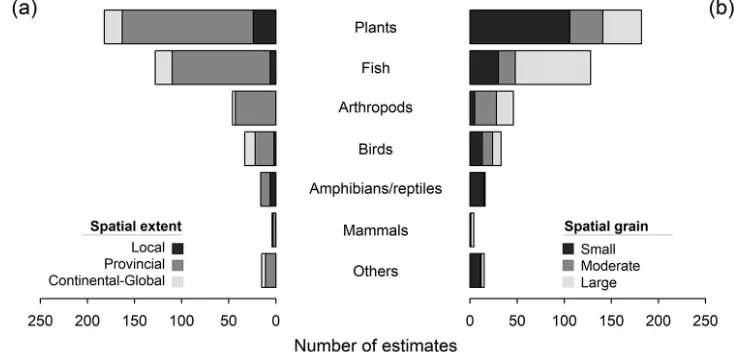
Figure 3. Spatial (a) extent (local < 100 km2; provincial; continental-global) and (b) grain (small < 10 km2;
10 km2 ≤ moderate ≤ 1000 km2; large > 1000 km2) of estimates reported in biotic homogenisation articles.
local extents are limited to the study of plants. Moreover, plant studies have largely fo-cused on small spatial grains, whereas fish studies commonly investigate biotic homog-enisation at larger grains. Comparative studies have highlighted the scale-dependence of perceived patterns in biotic homogenisation (e.g. Yang et al. 2015). In general, greater levels of homogenisation are expected at coarser spatial grains of investigation because of higher probabilities of recording the same non-native species and lower likelihoods of observing the extirpation of a native species by virtue of a greater total area and diversity of habitats (Olden et al. 2011). Stemming from the fact that the mechanisms responsible for shaping beta-diversity vary from local to regional spatial scales (McGill et al. 2015), a more explicit consideration of spatial scale is called for in future investigations of biotic homogenisation.
availability of “big data” through public repositories and citizen science programmes (Devictor et al. 2010) provides new research opportunities to better understand how patterns in biotic homogenisation manifest across multiple spatial and temporal scales.
Reconcile past and embrace new approaches to quantification
The burgeoning investigation of beta-diversity by ecologists (Anderson et al. 2011) is also reflected in the large variety of approaches used to both describe and quantify biotic homogenisation (Fig. 4). Over 84 % of studies have quantified homogenisation according to species (taxonomic) identity; relatively fewer studies focused on either the functional or phylogenetic facets of this phenomenon. Functional or phylogenetic homogenisation may occur because species invasions and extinction are not random, but are related to intrinsic life-history traits of species that exhibit higher-order phy-logenetic affinities (Blackburn and Jeschke 2009). Functional homogenisation reflects a convergence of biotas over time associated with the establishment of species with similar functional ‘roles’ in the ecosystem (e.g. high redundancy of functional forms or traits) and the loss of species possessing a unique combination of traits and/or evo-lutionary history (Olden et al. 2004). With increasing recognition of the important roles served by some non-native species in contemporary landscapes (Schlaepfer et al. 2011), enhanced focus on understanding the patterns and drivers of functional homogenisation is needed. Studies comparing patterns in taxonomic and functional homogenisation have been particularly intuitive in this regard (e.g. Smart et al. 2006, Pool and Olden 2012, Sonnier et al. 2014, Villéger et al. 2014).
Beta diversity reflects the dual phenomena of spatial turnover driven by species replacement and nestedness resulting from species loss (Baselga 2010). To date, the majority of studies have quantified homogenisation according to broad-sense measures of beta-diversity (e.g. Jaccard, Sorensen indices), making it impossible to disentan-gle the contributions of spatial turnover and nestedness to observed homogenisation (Fig. 4). Given that changes in community composition may be driven by (Baiser et al. 2012) or occur independently from (Dornelas et al. 2014) changes in species nested-ness, the appropriate selection of similarity metrics is paramount (Olden and Rooney 2006). For this reason, it is posited that studies which calculate complementary metrics of beta-diversity are most likely to yield the greatest insights into the process of biotic homogenisation. Until such studies are performed, the ability to broadly understand biotic homogenisation via literature syntheses will only be possible by re-analysing large databases (e.g. Baiser et al. 2012) rather than performing formal meta-analyses of published metric values.
exam-The Homogocene: a research prospectus for the study of biotic homogenisation 29
Figure 4. Methodological focus of the biotic homogenisation articles assessed. The facets include taxo-nomic for species-level analyses; phylogenetic for phylogenetic diversity metrics according to phylogenetic
trees or higher taxonomic ranks; and functional according to species-level traits. Biotic homogenisation has
been quantified according to presence-absence of species, traits or nodes in the phylogenetic tree (Jaccard, Simpson and Sørensen) or species/trait abundances (Bray-Curtis). Other metrics include the Raup-Crick measure of beta diversity, Morisita-Horn, Euclidean and Gower dissimilarity index and additive and
mul-tiplicative definitions of beta-diversity (e.g. βAdd, Whittaker’s βW, βShannon).
ple, studies have reported a 1.3 % increase in fish faunal similarity in Canada (Taylor 2004), a 2.8 % increase in bird community similarity in the Netherlands (Van Turn-hout et al. 2007) and a 0.3 % increase in compositional similarity of the continental flora of Chile (Castro and Jaksic 2008). Whether small degrees of homogenisation are greater than expectations based on chance alone remains questionable in many instances. Although the reporting of average similarity change continues today, it is reassuring that both univariate and multivariate tests of significance are increasingly deployed (e.g. Liu et al. 2017, Rosenblad and Sax 2017, Strecker and Brittain 2017) and the use of null models appears to be fruitful despite being under-utilised in the context of homogenisation.
Improve our knowledge of the underlying drivers
logging forest fragmentation was the dominant driver of taxonomic homogenisation in Brazilian Atlantic forests (Lôbo et al. 2011) and phylogenetic homogenisation in Cambodian forests (Toyama et al. 2015), fish faunal homogenisation of Australia was highly concordant with dam infrastructure (Olden et al. 2008) and increasing spring temperatures were associated with bird functional homogenisation in the Czech Re-public (Reif et al. 2013). Studies have also demonstrated that natural environmental variability can be an important driver of biotic homogenisation and that changing native species ranges, not the invasion of non-native species, can promote community similarity (e.g. McCune and Vellend 2013, Johnson et al. 2014).
Species assemblages will likely continue to bear the scars of past invasions and extirpations for years to come. However, some positive signs have already emerged. In response to decelerating rates of cropland expansion in large parts of Europe, Car-valheiro et al. (2013) found that species richness loss and biotic homogenisation has slowed and even partially reversed for certain taxa in recent decades. Moving forward, new research that seeks to elucidate temporal change amongst determinants of taxo-nomic, functional and phylogenetic homogenisation continues to be necessary (e.g. Clavero and García-Berthou 2006, Pool and Olden 2012). Evaluating and comparing drivers of homogenisation across taxa, regions and temporal and spatial scales remains ripe areas for future investigation.
Reveal the conservation implications
Despite the generally acknowledged fact that species diversity loss can result in vari-ous ecological, evolutionary and socioeconomic impacts, a robust understanding of the consequences of biotic homogenisation is still conspicuously lacking (Olden et al. 2004). Whereas biodiversity conservation is primarily concerned with maintaining na-tive species diversity at local (alpha-diversity) and/or regional (gamma-diversity) spatial scales, biotic homogenisation describes changes in beta-diversity over time. Maximis-ing beta-diversity is not necessarily desirable for gamma-diversity conservation, because human activities can cause the similarity of local communities to increase, decrease or remain unchanged (Socolar et al. 2016). Therefore, measures of biotic homogenisa-tion in isolahomogenisa-tion are not sufficient to design or evaluate conservahomogenisa-tion strategies. How-ever, the homogenisation concept can be applied to monitor temporal changes in the complementarity of conservation reserve networks (Rooney et al. 2007), thus helping achieve efficient conservation solutions by promoting alpha-diversity while simultane-ously allowing the representation of gamma-diversity to be maximised (Bush et al. 2016). Taken together, despite the fact that alpha- and gamma-diversity have been the focus of local and regional conservation actions, the adoption of beta-diversity research and, by extension, the study of biotic homogenisation into conservation remains an emerging frontier (Socolar et al. 2016).
The Homogocene: a research prospectus for the study of biotic homogenisation 31
compromise community and ecosystem functioning, stability and resistance to envi-ronmental change. For example, by both narrowing and synchronising the response diversity of communities, functional homogenisation could compromise the potential for landscape-level buffering of ecosystems to disturbance (Olden et al. 2004). Given continued calls to expand the notion of biodiversity in modern conservation efforts, more dedicated attention to the ecological implications of functional and phylogenetic homogenisation is needed.
Forecast future homogenisation in a rapidly changing world
One of the most pressing challenges is to provide reliable, yet practical, scenarios of future biotic homogenisation. Previous studies have predicted changes in community similarity by assuming that currently unconfirmed non-native and translocated native species would establish self-sustaining populations and native species of conservation concern (i.e. critically endangered, endangered and vulnerable) would be driven to ex-tinction in the future (e.g. Liu et al. 2017). However, spatio-temporal patterns of spe-cies extinctions and invasions are likely to change as a result of synergies across multiple human stressors (Urban 2015), thus putting into question these simple extrapolations of community change. In this respect, modelling approaches provide the most flexible way to generate projections of future community changes (D’Amen et al. 2017). Recent methodological developments have increased the potential for including detailed mech-anisms (e.g. dispersal, biotic interactions, adaptations) and improving species-specific range projections (Zurell et al. 2016). Community-level models also provide a promis-ing way forward because they facilitate the modellpromis-ing of all species, includpromis-ing the rare or poorly-sampled ones (Olden 2003), while expanding the possibility to account for the observation process (Iknayan et al. 2014). In the case of incomplete information about species’ distributions, trait-based approaches might be the most straightforward solu-tion to provide reliable estimates of future species’ extincsolu-tion risk (Pearson et al. 2014) and spread (Santini et al. 2016) in data-scarce areas. Understanding and projecting real, multi-species community (re)assembly represents a significant challenge, but also a great opportunity to better anticipate future changes in biodiversity.
Conclusion
are urged for understanding the causes, consequences and conservation implications of this phenomenon. Looking forward, significant progress in the burgeoning study of biotic homogenisation may come from research that tackles the above-articulated propositions by integrating concepts and approaches from ecology, evolutions and conservation across a hierarchy of spatial and temporal scales.
Data accessibility
All datasets are available at: https://figshare.com/s/68cd3d11f59add7b1b77.
Acknowledgements
We thank Ben Baiser and John Ross Wilson for their constructive comments that im-proved the final manuscript. JDO was supported by the H. Mason Keeler Endowed Professorship at the School of Aquatic and Fishery Sciences, University of Washington.
References
Anderson MJ, Crist TO, Chase JM, Vellend M, Inouye BD, Freestone AL, Sanders NJ, Cor-nell HV, Comita LS, Davies KF, Harrison SP, Kraft NJB, Stegen JC, Swenson NG (2011) Navigating the multiple meanings of beta-diversity: a roadmap for the practicing ecologist. Ecology Letters 14: 19–28. https://doi.org/10.1111/j.1461-0248.2010.01552.x
Baiser B, Olden JD, Record S, Lockwood JL, McKinney ML (2012) Pattern and process of biotic homogenization in the New Pangaea. Proceedings of the Royal Society B: Biological Sciences 279: 4772–4777. https://doi.org/10.1098/rspb.2012.1651
Baselga A (2010) Partitioning the turnover and nestedness components of beta diversity. Global Ecology and Biogeography 19: 134–143. https://doi.org/10.1111/j.1466-8238.2009.00490.x Blackburn TM, Jeschke JM (2009) Invasion success and threat status: two sides of a different
coin? Ecography 32: 83–88. https://doi.org/10.1111/j.1600-0587.2008.05661.x
Bush A, Harwood T, Hoskins AJ, Mokany K, Ferrier S (2016) Current uses of beta-diversity in biodiversity conservation: a response to Socolar et al. Trends in Ecology and Evolution 31: 337–338. https://doi.org/10.1016/j.tree.2016.02.020
Castro SA, Jaksic FM (2008) How general are global trends in biotic homogenization? Floristic tracking in Chile, South America. Global Ecology and Biogeography 17: 524– 531. https://doi.org/10.1111/j.1466-8238.2008.00392.x
The Homogocene: a research prospectus for the study of biotic homogenisation 33
Ceballos G, Ehrlich PR, Barnosky AD, Garcia A, Pringle RM, Palmer TM (2015) Accelerated modern human-induced species losses: entering the sixth mass extinction. Science Ad-vances 1: e1400253–e1400253. https://doi.org/10.1126/sciadv.1400253
Clavero M, García-Berthou E (2006) Homogenization dynamics and introduction routes of invasive freshwater fish in the Iberian Peninsula. Ecological Applications 16: 2313–2324. https://doi.org/10.1890/1051-0761(2006)016[2313:HDAIRO]2.0.CO;2
D’Amen M, Rahbek C, Zimmermann NE, Guisan A (2017) Spatial predictions at the commu-nity level: from current approaches to future frameworks. Biological Reviews 92: 169–187. https://doi.org/10.1111/brv.12222
Devictor V, Whittaker RJ, Beltrame C (2010) Beyond scarcity: Citizen science programmes as useful tools for conservation biogeography. Diversity and Distributions 16: 354–362. https://doi.org/10.1111/j.1472-4642.2009.00615.x
Dirzo R, Young HS, Galetti M, Ceballos G, Isaac NJB, Collen B (2014) Defaunation in the Anthropocene. Science 345: 401–406. https://doi.org/10.1126/science.1251817
Dornelas M, Gotelli NJ, McGill B, Shimadzu H, Moyes F, Sievers C, Magurran AE (2014) As-semblage time series reveal biodiversity change but not systematic loss. Science 344: 296–299. https://doi.org/10.1126/science.1248484
Iknayan KJ, Tingley MW, Furnas BJ, Beissinger SR (2014) Detecting diversity: emerging methods to estimate species diversity. Trends in Ecology and Evolution 29: 97–106. https://doi.org/10.1016/j.tree.2013.10.012
Johnson SE, Mudrak EL, Waller DM (2014) Local increases in diversity accompany com-munity homogenization in floodplain forest understories. Journal of Vegetation Science 25: 885–896. https://doi.org/10.1111/jvs.12147
Kühn I, Klotz S (2006) Urbanization and homogenization - Comparing the floras of urban and rural areas in Germany. Biological Conservation 127: 292–300. https://doi.org/10.1016/j. biocon.2005.06.033
Kunstler J (1993) The geography of nowhere. Simon and Schuster, New York, 303 pp. La Sorte FA, McKinney ML, Pysek P (2007) Compositional similarity among urban floras within
and across continents: biogeographical consequences of human-mediated biotic interchange. Global Change Biology 13: 913–921. https://doi.org/10.1111/j.1365-2486.2007.01329.x La Sorte FA, McKinney ML, Pysek P, Klotz S, Rapson GL, Celesti-Grapow L, Thompson
K (2008) Distance decay of similarity among European urban floras: the impact of an-thropogenic activities on beta diversity. Global Ecology and Biogeography 17: 363–371. https://doi.org/10.1111/j.1466-8238.2007.00369.x
Liu C, He D, Chen Y, Olden JD (2017) Species invasions threaten the antiquity of China’s freshwater fish fauna. Diversity and Distributions 23: 556–566. https://doi.org/10.1111/ ddi.12541
Lôbo D, Leão T, Melo FPL, Santos AMM, Tabarelli M (2011) Forest fragmentation drives At-lantic forest of northeastern Brazil to biotic homogenization. Diversity and Distributions 17: 287–296. https://doi.org/10.1111/j.1472-4642.2010.00739.x
Marchetti MP, Lockwood JL, Light T (2006) Effects of urbanization on California’s fish diversity: differentiation, homogenization and the influence of spatial scale. Biological Conservation. https://doi.org/10.1016/j.biocon.2005.04.025
McCune JL, Vellend M (2013) Gains in native species promote biotic homogenization over four decades in a human-dominated landscape. Journal of Ecology 101: 1542–1551. https://doi.org/10.1111/1365-2745.12156
McGill BJ, Dornelas M, Gotelli NJ, Magurran AE (2015) Fifteen forms of biodiversity trend in the Anthropocene. Trends in Ecology & Evolution 30: 104–113. https://doi.org/10.1016/j. tree.2014.11.006
McKinney M, Lockwood J (1999) Biotic homogenization: a few winners replacing many losers in the next mass extinction. Trends in Ecology & Evolution 14: 450–453. https://doi.org/10.1016/ S0169-5347(99)01679-1
McKinney ML (2006) Urbanization as a major cause of biotic homogenization. Biological Conservation 127: 247–260. https://doi.org/10.1016/j.biocon.2005.09.005
Monnet AC, Jiguet F, Meynard CN, Mouillot D, Mouquet N, Thuiller W, Devictor V (2014) Asynchrony of taxonomic, functional and phylogenetic diversity in birds. Global Ecology and Biogeography 23: 780–788. https://doi.org/10.1111/geb.12179
Naeem S (2013) Biotic impoverishment. Elementa: Science of the Anthropocene 1: 15. https://doi.org/10.12952/journal.elementa.000015
Olden JD (2003) A species-specific approach to modeling biological communities and its potential for conservation. Conservation Biology 17: 854–863. https://doi.org/10.1046/ j.1523-1739.2003.01280.x
Olden JD, Douglas ME, Douglas MR (2005) The human dimensions of biotic homogenization. Conservation Biology 19: 2036–2038. https://doi.org/10.1111/j.1523-1739.2005.00288.x Olden JD, Rooney TP (2006) On defining and quantifying biotic homogenization. Global Ecol-ogy and Biogeography 15:113–120. https://doi.org/10.1111/j.1466-822X.2006.00214.x Olden JD, Kennard MJ, Pusey BJ (2008) Species invasions and the changing biogeography of
Aus-tralian freshwater fishes. Global Ecology and Biogeography 17: 25–37. https://doi.org/10.1111/ j.1466-8238.2007.00340.x
Olden JD, Lockwood JL, Parr CL (2011) Biological invasions and the homogenization of fau-nas and floras. In: Ladle R, Whittaker RJ (Eds) Conservation Biogeography. John Wiley & Sons, Ltd, Chichester, UK, 224–243. https://doi.org/10.1002/9781444390001.ch9 Olden JD, Poff NL (2003) Toward a mechanistic understanding and prediction of biotic
ho-mogenization. The American Naturalist 162: 442–460. https://doi.org/10.1086/378212 Olden JD, Poff NL, Douglas MR, Douglas ME, Fausch KD (2004) Ecological and
evolution-ary consequences of biotic homogenization. Trends in Ecology and Evolution 19: 18–24. https://doi.org/10.1016/j.tree.2003.09.010
Pearson RG, Stanton JC, Shoemaker KT, Aiello-Lammens ME, Ersts PJ, Horning N, Fordham DA, Raxworthy CJ, Ryu HY, McNees J, Akcakaya HR, Akçakaya HR (2014) Life history and spatial traits predict extinction risk due to climate change. Nature Climate Change 4: 217–221. https://doi.org/10.1038/nclimate2113
The Homogocene: a research prospectus for the study of biotic homogenisation 35
Pyšek P, Richardson DM, Pergl J, Jarošík V, Sixtová Z, Weber E (2008) Geographical and taxonomic biases in invasion ecology. Trends in Ecology and Evolution 23: 237–244. https://doi.org/10.1016/j.tree.2008.02.002
Reif J, Prylová K, Šizling AL, Vermouzek Z, Šťastný K, Bejček V (2013) Changes in bird community composition in the Czech Republic from 1982 to 2004: increasing biotic ho-mogenization, impacts of warming climate, but no trend in species richness. Journal of Ornithology 154: 359–370. https://doi.org/10.1007/s10336-012-0900-9
Rooney TP, Olden JD, Leach MK, Rogers DA (2007) Biotic homogenization and conser-vation prioritization. Biological Conserconser-vation 134: 447–450. https://doi.org/10.1016/j. biocon.2006.07.008
Rosenblad KC, Sax DF (2017) A new framework for investigating biotic homogenization and exploring future trajectories: oceanic island plant and bird assemblages as a case study. Ecography 40: 1040–1049. https://doi.org/10.1111/ecog.02652
Santini L, Cornulier T, Bullock JM, Palmer SCF, White SM, Hodgson JA, Bocedi G, Travis JMJ (2016) A trait-based approach for predicting species responses to environmental change from sparse data: how well might terrestrial mammals track climate change? Global Change Biology 22: 2415–2424. https://doi.org/10.1111/gcb.13271
Schlaepfer MA, Sax DF, Olden JD (2011) The potential conservation value of non-native species. Conservation Biology 25: 428–437. https://doi.org/10.1111/j.1523-1739.2010.01646.x Smart SM, Thompson K, Marrs RH, Le Duc MG, Maskell LC, Firbank LG (2006) Biotic
ho-mogenization and changes in species diversity across human-modified ecosystems. Proceed-ings of the Royal Society B: Biological Sciences 273: 2659–2665. https://doi.org/10.1098/ rspb.2006.3630
Socolar JB, Gilroy JJ, Kunin WE, Edwards DP (2016) How should beta-diversity inform biodi-versity conservation? Trends in Ecology & Evolution 31: 67–80. https://doi.org/10.1016/j. tree.2015.11.005
Sonnier G, Johnson SE, Amatangelo KL, Rogers DA, Waller DM (2014) Is taxonomic homog-enization linked to functional homoghomog-enization in temperate forests? Global Ecology and Biogeography 23: 894–902. https://doi.org/10.1111/geb.12164
Strecker AL, Brittain JT (2017) Increased habitat connectivity homogenizes freshwater com-munities: historical and landscape perspectives. Journal of Applied Ecology 54: 1343–1352. https://doi.org/10.1111/1365-2664.12882
Taylor EB (2004) An analysis of homogenization and differentiation of Canadian freshwater fish faunas with an emphasis on British Columbia. Canadian Journal of Fisheries and Aquatic Sciences 61: 68–79. https://doi.org/10.1139/f03-141
Toyama H, Kajisa T, Tagane S, Mase K, Chhang P, Samreth V, Ma V, Sokh H, Ichihashi R, Onoda Y, Mizoue N, Yahara T (2015) Effects of logging and recruitment on community phylogenetic structure in 32 permanent forest plots of Kampong Thom, Cambodia. Philosophical Transactions of the Royal Society B: Biological Sciences 370: 20140008. https://doi.org/10.1098/rstb.2014.0008
Trimble MJ, van Aarde RJ (2012) Geographical and taxonomic biases in research on biodiversity in human-modified landscapes. Ecosphere 3: art119. https://doi.org/10.1890/ES12-00299.1 Urban MC (2015) Accelerating extinction risk from climate change. Science 348: 571–573.
https://doi.org/10.1111/j.1740-9713.2010.00403.x
Van Turnhout CAM, Foppen RPB, Leuven RSEW, Siepel H, Esselink H (2007) Scale-dependent homogenization: Changes in breeding bird diversity in the Netherlands over a 25-year peri-od. Biological Conservation 134: 505–516. https://doi.org/10.1016/j.biocon.2006.09.011 Villéger S, Grenouillet G, Brosse S (2014) Functional homogenization exceeds taxonomic
homogenization among European fish assemblages. Global Ecology and Biogeography 23: 1450–1460. https://doi.org/10.1111/geb.12226
Yang J, La Sorte FA, Pysek P, Yan P, Nowak D, McBride J (2015) The compositional similarity of urban forests among the world’s cities is scale dependent. Global Ecology and Biogeography 24: 1413–1423. https://doi.org/10.1111/geb.12376