P R I M A R Y R E S E A R C H
Open Access
Effect of Matrine on HPAC cell migration by
down-regulating the expression of MT1-MMP via
Wnt signaling
Yongchao Ma
1,2†, Fazhang Zou
1,2†, Junping Xiong
1, Wei Wan
1, Li Yin
1, Xianjia Li
1, Zhanyu Bei
3, Lei Yuan
1,
Song Meng
1, Jianguo Wang
1*and Guohua Song
1*Abstract
Aim:This study sought to explore the exact mechanism of Matrine inhibited migration and invasion of human pancreatic cancer cells.
Methods:HPAC or Capan-1 cells were cultured in completed RPMI-1640 medium, contained with 50μg/ml Matrine or 0.05μg/ml docetaxel, respectively. Cell viability was evaluated by spectrophotometric analysis using MTT assay. Wound healing assay and transwell approach were used to detect the effects of Matrine on HPAC cell migration and invasion. Western Blot and RT-PCR were performed to detect the expressions of MT1-MMP, Wnt andβ-Catenin. CHIP assay was used to detect whether the MT1-MMP transcription activity correlated with Wnt signaling pathway. Results:MTT results indicated that cell proliferration was inhibited by Matrine at a range of concentrations, especially at high dose. We further found that Matrine treatment significantly induced cell migration and invasion decreased. Interestingly, the expression of MT1-MMP decreased evidently upon Matrine treatment, paralleled with the expressions of Wnt andβ-Catenin detected by Western Blot and RT-PCR assay. Further analysis of MT1-MMP transcription activity revealed that Matrine reduced the expression of MT1-MMP mediated by Wnt signaling pathway.
Conclusion:Matrine play a vital role in inhibiting HPAC cellular migration and invasion through down-regulating the expression of MT1-MMP via Wnt signaling pathway.
Keywords:Matrine, Cell migration, MT1-MMP, Wnt, Human pancreatic cancer
Introduction
Matrine has been used for cancer treatment in China for a long time, which was extracted from Chinese Medicine plant. It was demonstrated that matrine was efficiency and safety using in clinic. Previous researches reported that Matrine has a role in inhibiting the growth of tumor cells directly [1]. In clinical work it has been used for treating the uterine cervical cancer and leukemia [2, 3]. Recently, some researchers suggest that matrine could inhibit cancer cells migration, invasion and metastasis [4–6]. But the exact molecular mechanism of matrine in inhibiting cell adhesion and migration need further
study. It was important to make an intensive investiga-tion of the pharmacologic and clinic applicainvestiga-tions of matrine and maybe it could help researcher figure out the mechanism of tumorigenesis in human.
Wnt signaling pathway play a vital role in normal de-velopments but also in tumorigenesis [7]. Inappropriate activation of Wnt signaling pathway results in the onset of several types of canceres [8]. Based on the differences of interactions with Wnt receptors or co-receptors, Wnt signaling pathway has been divided into three signaling pathways, namely the canonical Wnt/β-catenin, the non-canonical (or heretical) Wnt/ Ca2+and planar cell polar-ity (PCP) pathways [9]. Previous researches suggested that the Wnt/PCP pathway interaction with some key proteines related with cell polarization, motility, cancer cell migration and invasion [10, 11]. β-catenin involved in the canonical Wnt pathway as a key mediator, which
* Correspondence:[email protected];[email protected] †Equal contributors
1
Luohe Medical College, Daxue Road, #148, Luohe City, Henan Province 462000, People’s Republic of China
Full list of author information is available at the end of the article
can enter cell nucleus and associate with transcription factors Lef and Tcf, leading to the transcription of Wnt target genes [12, 13]. The stabilization of β-catenin was regulated by phosphorylated modification by GSK3β, followed by degradation via the proteasome. Abnormal activated Wnt/β-catenin pathway has been detected in a number of human tumors including lung, breast, cervical and liver, that is due toβ-catenin lack of degradation and ultimately nuclear accumulation. In hepatocellular car-cinoma, β-catenin accumulation has been linked to poorly differentiated, high proliferative activity and poor prognosis [14, 15]. The level ofβ-catenin is regu-lated by numerous proteins, which, if not reguregu-lated or expressed appropriately would account for increasedβ -catenin expression in cancer. By forming a complex with Tcf-4, β-catenin activates the transcription of tar-get genes included MT1-MMP, which correlates with cancer cell migration and invasion [16].
Abnormal expression of MT1-MMP has been found in many types of canceres. Such an induction expression of MT1-MMP could be regulated by the Wnt/β-catenin signaling pathway. This is based on the observation that depletion of β-catenin in colorectal carcinoma SW480 cells resulting down-regulation expression of MT1-MMP [17]. In the present study, our group has found that in some concentration ranges, matrine has the ef-fect of inhibiting the migration of pancreatic carcinoma HPAC or Capanc-1 cells.
Materials and methods
Cell culture and experimental reagents
Human pancreatic cancer cells, such as HPAC, Capan-1 (from American Type Culture Collection, Rockville, MD) were cultured in RPMI-1640 (Invitrogen) supplemented with 10 % fetal bovine serum (FBS) and 100 units/mL peni-cillin and 100μg/mL streptomycin, in a 5 % CO2
humidi-fied atmosphere at 37 °C. Matrine (50 μg/ml, Qilu Pharmaceutical Co., Ltd.) and docetaxel (0.05μg/ml, Sigma, USA) were added into the medium when necessary as indi-cated in figure legends. Primary antibodies of Wnt, β -catenin, MT1-MMP, and β-actin were purchased from Santa Cruz Biotechnology (Santa Cruz, USA). Other re-agents used in this study, such as Anti-mouse-IgG-HRP and Anti-Rabbit-IgG-HRP, were purchased from California Bioscience (California Bioscience, USA), Transwell Invasion Chambers were found from Promega, USA.
MTT assay
MTT [3-(4,5-dimethylthiazolyl-2-yl)-2,5-diphenyltetrazo-lium bromide] (Sigma- Aldrich; St. Louis, MO) assay was used for evaluation the viability of HPAC or Capan-1 cells upon Matrine treatment. Total Capan-1 × Capan-104cells/well were grown overnight in 96-well plate. The second day, various concentrations of Matrine were added and
incubation for 48 h. MTT solution was added to each well at a final concentration of 500 μg/ml for 4 h. For-mazan crystals formed by living cells were then dissolved in DMSO and measured at 570 nm by Multi-Detection microplate reader (Bio-Rad, USA).
Monolayer cell migration assay
A monolayer wound-healing model was performed as cell migration assay. HPAC or Capan-1 cells were seeded in 6-well-plate for 24 h in RPMI-1640 medium. A confluent monolayer of HPAC cells were then scraped with a sterile 200μl pipette tip and washed with PBS. After incubation with completed RPMI-1640 alone or contained with matrine (50 μg/ml) or with docetaxel (0.05 μg/ml) for 48 h, cell migration images were captured using an inverted phase contrast microscope at 100× magnification.
Transwell invasion assay
Matrigel Invasion Chambers were hydrated for 4 h be-fore starting the invasion assay. Log-phase cells (4 × 10⁴) were plated in 200μl RPMI-1640 containing 2 % FBS in the upper chamber of the transwell. The lower chamber was filled with 500 μl completed RPMI-1640 containing 10 % FBS. The upper chamber cells were treated with matrine and docetaxel as previous description and allowed to migrate for 10 h at 37 °C and 5 % CO2
cir-cumstance followed by carrying out the invasion assay. The cells were fixed for 15 min at room temperature by replacing the culture medium in the bottom with 4 % formaldehyde dissolved in PBS. Then, the cells on the upper chamber were moved with a cotton swab. After washing the chambers 5 times by dipping the chambers in a large beaker filled with dH2O, the cells that
remained on the bottom of the lower chamber were stained with 0.1 % crystal violet. The migrated clones were photographed under an optical microscope. The cell numbers were counted at 12 different areas.
RT–PCR analysis
Total RNA was extracted from HPAC cells using the TRI-ZOL reagent (Invitrogen Life Technologies). Reverse tran-scription (RT) was performed with 1μg of total RNA and 10μM of specific primers. cDNAs were amplified by poly-merase chain reaction (PCR) for testing MT1-MMP (sense 5′-AGCCCCGAAGCCTGGCTACA-3′; antisense 5′-GC CGCCCTCACCATCGAAGG-3′,492-bp product) and Glyceral dehyde-3-phosphate dehydrogenase (GAPDH) (sense 5′-ACCACAGTCCAT GCCATCAC-3′; antisense 5′-TCCACCACCCTGTTGCTGTA-3′, 556-bp product), which was used as loading controls.
Enzyme-linked immunosorbent assay
supernatants were quantified using MMP-9 and MMP-2 ELISA kits (R&D Systems, USA). Each sample was ana-lysed in triplicate and manipulated according to the kit’s protocols.
Western blot analysis
HPAC cells were lysed in RIPA buffer [50 mM Tris (pH 7.4), 150 mM NaCl, 1 % Triton X-100, 0.1 % SDS, 1 % sodium deoxycholate, 5 mM EDTA, 100 mM NaF, and 1 mM Na3VO4] containing a protease inhibitor cocktail for 30 min on ice, followed by centrifuged for 30 min at 16000 g. Protein concentrations were deter-mined by the BCA method (Pierce, USA). Equal total proteins were electrophoresis by 12 % SDS-PAGE gel and transferred to PVDF membranes using a wet trans-blot system (Bio-Rad, Hercules, CA). The membranes were blocked for 1 h at room temperature with 5 % non-fat dry milk and incubated overnight at 4 °C with anti-bodies against Wnt, β-catenin, Axin, GSK-3β, MT1-MMP and β-actin (1:1000). After washing three times, membrane was incubated for 1 h with HRP-conjugated goat anti-rabbit secondary antibody diluted 1:5,000 in PBST. After further washing and processed using Super Signal West Pico chemiluminescent substrate (Pierce, USA), the membrane was exposed to Fujifilm LAS3000 Imager (Fuji, Japan). The band densities were normalized relative to the relevantβ-actin with Image J Analyst soft-ware (NIH).
Chromatine immuno-precipitation (CHIP) assay
CHIP assay was performed using the CHIP Kit (Sigma, USA) with slight modifications. HPAC cells (2 × 10⁷) were cross-linked with 1 % formaldehyde for 10 min at room temperature, followed by the addition of 1 ml of 125 mM glycine to inactivate the formaldehyde. Cells were washed twice with ice-cold PBS and then scraped and centrifuged at 1000 g at 4 °C for 5 min. Pelleted cells were lysed with 1 ml modified-RIPA lysis buffer (0.1 % SDS, 10 mM EDTA, 1 % Triton Χ-100 and 50 mM Tris–HCl pH 8.0) containing with protease inhibitor cocktail and incubated on ice for 10 min. After sonic-ation to produce genomic DNA to lengths of 0.2 to 0.5 kb (optimized at 10 ~ 15-s pulses), samples were cen-trifuged at 13,000 g for 10 min to remove insoluble cell debris. Lysates were diluted in ChIP dilution buffer (0.01 % SDS, 0.1 % Triton X-100, 2 mM EDTA, 20 mM Tris–HCl pH 8.0 and 500 mM NaCl). Chromatin solu-tion was precleared with 20 μl of 3 % BSA/protein A agarose for 2 h at 4 °C with rotation. Anti–β-catenin polyclonal (Santa Cruz Biotechnologies) antibody was added to the precleared supernatant and incubated over-night at 4 °C with rotation. Negative controls included a sample incubated without antibody and one incubated with rabbit IgG (Santa Cruz Biotechnologies) to determine
whether interactions were due to nonspecific IgG interac-tions. Bead complexes were washed first with low-salt im-mune complex wash buffer, followed by high-salt imim-mune complex wash buffer and a final LiCl immune complex wash buffer for 5 min each on a rotating platform followed by brief centrifugation. After the final wash, DNA was ex-tracted by incubating the beads for 15 min with 200 μl elution buffer (1 % SDS and 50 mM NaHCO3). Samples
were then uncrosslinked in a 65 °C water bath overnight, and DNA was purified using Qiagen Nucleotide Removal Kit (Qiagen, Valencia, CA). Polymerase chain reaction (PCR) primers used to amplify the MT1-MMP promoter region were as follows: GTCTCCCGCCCCAAGACCCT (forward) and GGAACACCACATCGGGGGCG (reverse).
Statistical analysis
All experiments were performed three times and the re-sults were expressed as mean ± SD. Statistical analysis was performed by SPSS11.0.Ttest was used in order to compare the average values between two populations of data. AP value of less than 0.05 was considered to indi-cate statistical significance.
Results
Effects of Matrine on migration and invasion of HPAC and Capan-1 cells
The effects of Matrine on migration of HPAC and Capan-1 cells were monitored by monolayer wound healing assay. Log-phase cells were seeded on six-well plates, and incubation with complete cell medium alone or contained with 50 μg/ml Matrine or with 0.5 μg/ml Docetaxel as indicated time. After wounded by a sterile 200 μl pipette tip, cells that were treated with normal cell medium migrated clearly. But the cells that were treated with Matrine or Docetaxel have limited migra-tion (Fig. 1a, b and Addimigra-tional file 1: Figure S1). In a three-dimensional cell migration assay with the transwell system, the invasion cell numbers of the group that treated with Matrine or Docetaxel for 10 h were less than the control group (Fig. 1c). This data indicated that the migration of HPAC cells was inhibited upon Matrine treatment via an unknown mechanism.
Effects of Matrine on the expressions of MT1-MMP, MMP2, MMP9
Fig. 1The migration of HPAC cells was inhibited by Matrine. Log-phase cells were treated with normal complete RPMI-1640 alone or contained with 50μg/ ml Matrine or 0.05μg/ ml Docetaxel (a). Data were expressed as mean ± S.E.M from three separated experiments (b). Cell invasion ability was detected by transwell assay (c). Statistical analyses was performed using thet-test. * (P< 0.05) indicates a significant difference compared with the control group
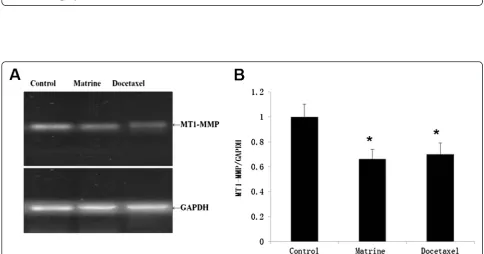
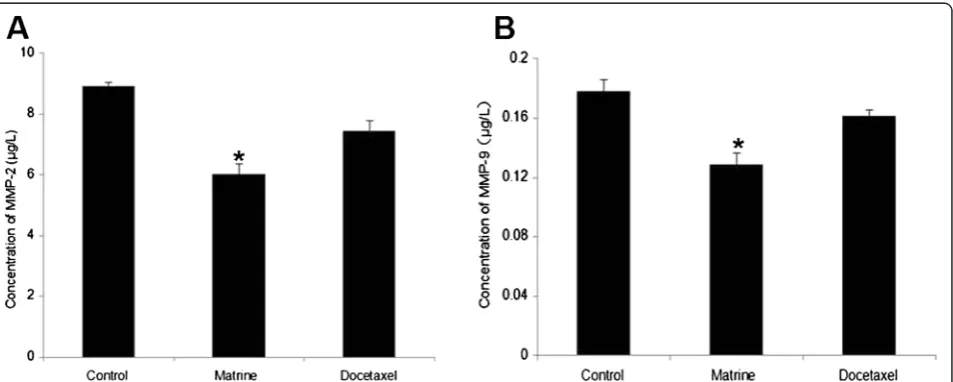
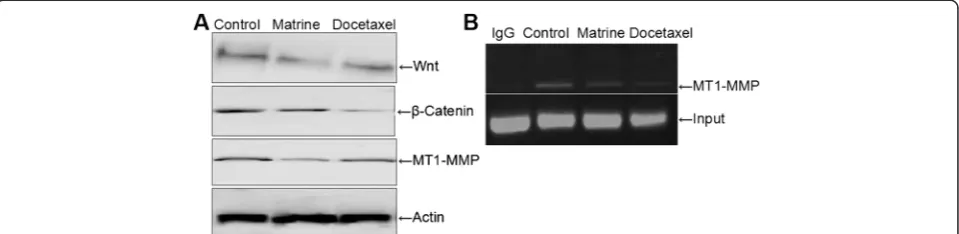
treatment, as our expectation, MT1-MMP protein de-creased evidently compared with the control group (Fig. 4a). We also detected the concentration of MMP2 and MMP9 in cell culture medium by ELISA kits, the results showed that the concentration of MMP2 and MMP9 decreased significantly in Matrine treatment (Fig. 3).
Wnt signaling pathway may be involved in the MT1-MMP down-regulation by Matrine treatment
To further explore the exact mechanism of Matrine down-regulating MT1-MMP expression, we first investi-gated the effects of Matrine on the Wnt signaling pathway related properties. When HPAC cells were treated with Matrine for indicated time, the expression of Wnt andβ -Catenin decreased significantly, paralleled with MT1-MMP expression level (Fig. 4a). These results suggested that the MT1-MMP expression was down regulated by Matrine maybe via Wnt signaling pathway.
Effects of Matrine on MT1-MMP transcription activity via Wnt signaling pathway
CHIP assay was performed in order to determine the re-lationship between MT1-MMP transcription activity and Wnt signaling pathway. HPAC cells were treated with Matrine for 24 h, β-Catenin antibody was used for immunoprecipitated with target gene (Fig. 4b). The re-sults have shown that MT1-MMP transcription activity decreased evidently compared with control cells, which demonstrated that Matrine regulated MT1-MMP ex-pression through Wnt signaling.
Discussion
Previous researches have indicated that Matrine has the potential function of inhibiting cancer cell migration, but the exact mechanism has not been unknown. Here, we have demonstrated that Matrine inhibited the migra-tion and invasion of HPAC cells through down-regulamigra-tion the Wnt-β-Catenin signaling pathway. In our present study, we first detected the cytotoxicity of Matrine on HPAC cell growth. We found that proliferation of HPAC cells were inhibited upon Matrine treatment, especially at too high a concentration or for too long a time (Additional file 2: Figure S2). The results are accordance with the earl-ier researches [2, 5]. In the next experiments, we have de-tected the invasion ability of HPAC or Capan-1 cells upon Matrine treatment through wound healing and transwell assays. We observed that the migration ability has been decreased significantly upon Matrine treatment for 24 h. Docetaxel was used for positive control to monitor the ef-fect of cell migration inhibition. We found that there is no statistical significance between Matrine and Docetaxel treated groups.
Tumor invasion and metastasis were multistage and multi-factorial process, which were regulated by compli-cated mechanisms and multiple signaling pathways [18]. Many protein molecules have involved in regulating cancer cell adhesion, migration and invasion in tumor biology be-haviors. Matrix metalloproteinases (MMPs) are a family of zinc-binding proteases that have been shown to contribute to cancer cell invasion through the ability to degrade ECM [19, 20]. MT1-MMP (also known as MMP-14) is the first identified and also the most common member of the MT-MMP subfamily involved in pericellular proteolysis associ-ated with cell migration [21, 22].
In searching for the underlying mechanism of Matrine inhibited the migration and invasion of HPAC cells, we first detected the expression of MT1-MMP in HPAC cells upon Matrine treatment. Indeed, we found that the mRNA and protein expressions of MT1-MMP decreased evidently upon Matrine treatment.
The activities of most MMPs are very low in the nor-mal tissues, however their expressions are regulated by various inflammatory cytokines, growth factors, hor-mones as well as by cell-cell interaction [23]. Moreover, the proteolytic activity of MMPs is strictly controlled at several levels, including transcriptional, posttranscriptional and post-translational, as well as via their endogenous in-hibitors [24, 25]. The transcription of MT1-MMP was regulated by Wnt signaling pathway [26, 27], so we hy-pothesized that Matrine inhibited HPAC migration and invasion may be through down-regulation the Wnt sig-naling pathway. According to this assumption, we de-tected the expressions of Wnt andβ-Catenin. Western blotting assay indicated that the expressions of Wnt and β-Catenin decreased markedly compared to the control group. However, the positive control, that the docetaxel treated group, their expressions decreased weakly. These results suggested that Matrine has a po-tential role in down-regulating the expressions of Wnt andβ-Catenin. To investigate the transcription activity of MT1-MMP whether mediated by the Matrine treat-ment through Wnt signaling pathway, we detected the MT1-MMP transcription activity through CHIP assay. As our expected, upon Matrine treatment, a small amount of MT1-MMP was detected, decreased signifi-cantly compared with the control group.
In summary, our present data first demonstrated that Matrine play a potential role in inhibiting the migration and invasion of HPAC cells, which may be through down-regulation the expression of MT1-MMP via the canonical Wnt signaling pathway. It is interesting that Matrine down-regulation the expression of MT1-MMP, which is identified as an activator of proMMP-2 (pro-gelatinase
A/72 kDa type IV collagenase) [28]. Since the degrad-ation of the basement membrane by MMP-2 is likely a necessary step for cancer invasion [29, 30]. It is neces-sary to research whether Matrine mediated the activity of other MMPs, which is the next question we need to identify.
Additional files
Additional file 1: Figure S1.Regulation of cell migration by Matrine in Capan-1 cells.
Additional file 2: Figure S2.Regulation of cell proliferation by Matrine in HPAC or Capan-1 cells. Log-phase cells were treated with normal complete RPMI-1640 medium contained with various concentrations Marine for indicated time. Cell proliferation was detected with MTT assay. Data were expressed as mean ± S.E.M from three separate experiments. Statistical analysis was performed using thet-test. *(P< 0.05) indicates a significant difference compared with the control group.
Abbreviations
CHIP:Chromatine immuno-precipitation; MMPs: Matrix metalloproteinases.
Competing interests
The authors declare that they have no competing interests.
Authors’contributions
GHS, JGW designed research; YCM, FZZ, JPX and WW performed the experiments and data analysis; LY and WW contributed new reagents and analytic tools; YCM wrote the paper. All authors read and approved the final manuscript.
Acknowledgements
This work was supported by the Foundation of Luohe Medical College (2013-DF-001) and the Plan of Science and Technology of Henan Province, P.R.C. (142102310465).
Author details 1
Luohe Medical College, Daxue Road, #148, Luohe City, Henan Province 462000, People’s Republic of China.2Key lab, of BioMedicine of Luohe City, Luohe, China.3Chengde Nursing Vocational College, Chengde, China.
Received: 2 October 2014 Accepted: 1 June 2015
References
1. Qiu S, Sun H, Zhang AH, Xu HY, Yan GL, Han Y, et al. Natural alkaloids: basic aspects, biological roles, and future perspectives. Chin J Nat Med. 2014;12(6):401–6.
2. Niu H, Zhang Y, Wu B, Zhang Y, Jiang H, He P. Matrine induces the apoptosis of lung cancer cells through downregulation of inhibitor of apoptosis proteins and the Akt signaling pathway. Oncol Rep. 2014;32(3):1087–93.
3. Li Y, Zhang ZN, Zhao HM, Tong ZC, Yang J, Wang H, et al. Matrine inhibits the invasive properties of human osteosarcoma cells by downregulating the ERK-NF-κB pathway. Anticancer Drugs. 2014;25(9):1035–43.
4. Zhang JW, Su K, Shi WT, Wang Y, Hu PC, Wang Y, et al. Matrine inhibits the adhesion and migration of BCG823 gastric cancer cells by affecting the structure and function of the vasodilator-stimulated phosphoprotein (VASP). Acta Pharmacol Sin. 2013;34(8):1084–92.
5. Zhang Y, Zhang H, Yu P, Liu Q, Liu K, Duan H, et al. Effects of matrine against the growth of human lung cancer and hepatoma cells as well as lung cancer cell migration. Cytotechnology. 2009;59(3):191–200. 6. Zhang L, Wang T, Wen X, Wei Y, Peng X, Li H, et al. Effect of matrine on
HeLa cell adhesion and migration. Eur J Pharmacol. 2007;563:69–76. 7. Zhang A, He S, Sun X, Ding L, Bao X, Wang N. Wnt5a promotes migration
of human osteosarcoma cells by triggering a phosphatidylinositol-3 kinase/ Akt signals. Cancer Cell Int. 2014;14(1):15.
8. Pećina-Slaus N. Wnt signal transduction pathway and apoptosis: a review. Cancer Cell Int. 2010;10:22.
9. Polakis P. The many ways of Wnt in cancer. Curr Opin Genet Dev. 2007;17(1):45–51.
10. Smalley MJ, Dale TC. Wnt signalling in mammalian development and cancer. Cancer Metastasis Rev. 1999;18(2):215–30.
11. Wang Y. Wnt/Planar cell polarity signaling: a new paradigm for cancer therapy. Mol Cancer Ther. 2009;8(8):2103–9.
12. Katoh M. WNT/PCP signaling pathway and human cancer. Oncol Rep. 2005;14(6):1583–8.
13. Hecht A. The p300/CBP acetyltransferases function as transcriptional coactivators of beta-catenin in vertebrates. EMBO J. 2000;19(8):1839–50. 14. Takemaru KI, Moon RT. The transcriptional coactivator CBP interacts with
beta-catenin to activate gene expression. J Cell Biol. 2000;149(2):249–54. 15. Inagawa S, Itabashi M, Adachi S, Kawamoto T, Hori M, Shimazaki J, et al.
Expression and prognostic roles of beta-catenin in hepatocellular carcinoma: correlation with tumor progression and postoperative survival. Clin Cancer Res. 2002;8(2):450–6.
16. Wong CM, Fan ST, Ng IO. Beta-Catenin mutation and overexpression in hepatocellular carcinoma: clinicopathologic and prognostic significance. Cancer. 2001;92(1):136–45.
17. Pulyaeva H, Bueno J, Polette M, Birembaut P. MT1-MMP correlates with MMP-2 activation potential seen after epithelial to mesenchymal transition in human breast carcinoma cells. Clin Exp Metastasis. 1997;15:111–20. 18. Takahashi M, Tsunoda T, Seiki M, Nakamura Y, Furukawa Y. Identification of
membrane-type matrix metalloproteinase-1 as a target of theβ-catenin/ Tcf4 complex in human colorectal cancers. Oncogene. 2002;21:5861–7. 19. Kessenbrock K, Plaks V, Werb Z. Matrix metalloproteinases: regulators of the
tumor microenvironment. Cell. 2010;141:52–67.
20. Itoh Y, Seiki M. MT1-MMP: a potent modifier of pericellular microenvironment. J Cell Physiol. 2006;206:1–8.
21. Kajita M, Itoh Y, Chiba T, Mori H. Membrane-type 1 matrix metalloproteinase cleaves CD44 and promotes cell migration. J Cell Biol. 2001;153:893–904. 22. Deryugina EI, Ratnikov BI, Postnova TI, Rozanov DV, Strongin AY. Processing
of integrin alpha(v) subunit by membrane type 1 matrix metalloproteinase stimulates migration of breast carcinoma cells on vitronectin and enhances tyrosine phosphorylation of focal adhesion kinase. J Biol Chem.
2002;277:9749–56.
23. Yao G, He P, Chen L, Hu X, Gu F, Ye C. MT1-MMP in breast cancer: induction of VEGF-C correlates with metastasis and poor prognosis. Cancer Cell Int. 2013;13(1):98.
24. Nagase H, Visse R, Murphy G. Structure and function of matrix metalloproteinases and TIMPs. Cardiovasc Res. 2006;69:562–73. 25. Egeblad M, Werb Z. New functions for the matrix metalloproteinases in
cancer progression. Nat Rev Cancer. 2002;2:161–74.
26. Knopfová L, BenešP, Pekarčíková L, Hermanová M, Masařík M, Pernicová Z, et al. Smarda J: c-Myb regulates matrix metalloproteinases 1/9, and cathepsin D: implications for matrix-dependent breast cancer cell invasion and metastasis. Mol Cancer. 2012;11:15.
27. Yousef EM, Tahir MR, St-Pierre Y, Gaboury LA. MMP-9 expression varies according to molecular subtypes of breast cancer. BMC Cancer. 2014;14:609. 28. Sounni NE, Noel A. Membrane type-matrix metalloproteinases and tumor
progression. Biochimie. 2005;87:329–42.
29. Sato H, Takino T, Miyamori H. Roles of membrane-type matrix metalloproteinase-1 in tumor invasion and metastasis. Cancer Sci. 2005;96:2metalloproteinase-12–7.
30. Seiki M. Membrane-type 1 matrix metalloproteinase: a key enzyme for tumor invasion. Cancer Lett. 2003;194:1–11.
Submit your next manuscript to BioMed Central and take full advantage of:
• Convenient online submission
• Thorough peer review
• No space constraints or color figure charges
• Immediate publication on acceptance
• Inclusion in PubMed, CAS, Scopus and Google Scholar
• Research which is freely available for redistribution