Introduction
It is noteworthy that headache sufferers often complain of memory impairment. Memory is usually subdivided into short-term and long-term memory: the former does not exceed 30 seconds and has a capacity limited to 9 items; the latter allows a relatively permanent storage and has an unlimited capacity [1]. According to different sensorial pathways of data acquirement, memory may be defined as verbal memory and a visuospatial memory [2].
An impairment in short-term memory may be due to posterior cortical lesions and respectively concerns the ver-bal memory or the visuospatial memory, depending upon
the involvement of the dominant or non-dominant hemi-sphere. Impairment of long-term memory may arise from damage to different cerebral and subcortical regions: unilat-eral left-sided lesions may result in a worsening of verbal long-term memory with relative sparing of visuospatial memory, whereas right-sided pathology may cause opposite effects [3].
A previous neuropsychological and neurophysiological study [4] on 21 unilateral adult migraineurs with aura assessed an involvement in memory tasks but failed to demonstrate any correlation between visuospatial or verbal short-term memory and the painful side. Moreover, memo-ry was worse in left-sided migraineurs than in the right-sided ones [4]
Memory functions in patients
with chronic daily headache
M. Savarese ()
Neurological Clinic I, Policlinico, Piazza Giulio Cesare, I-70124 Bari, Italy e-mail: [email protected] Tel.: +39-080-5592331
Fax: +39-080-5478532
The affiliations of the other authors are listed at the end of the article
Mariantonietta Savarese Maria Pia Prudenzano Teresa Francavilla Mauro Palumbo Maria Nicolodi Stefania Canova Giorgio Zanchin Franco Granella Andrea Alberti Susanna Russo Rosanna Cerbo Antonio Carolei
Abstract Memory loss is a common
complaint in headache sufferers. 71 patients, 50 women and 21 men, affected by chronic daily headache with different diagnoses at onset and at study entry underwent a test bat-tery in order to evaluate both short-and long-term memory according to the different sensorial pathways of data acquirement. Statistical analysis of the results was performed using means of Spearman’s correlation coefficients, analysis of variance, chi-square, Fisher’s test and Mann-Whitney U test. A percentage of patients, ranging from 2% to 56%, according to the different tests, showed a worse performance than normal subjects. The percentage of the subjects with memory difficulty
was higher in women and in patients with migraine-type headache at onset, but was not different between overusers and nonoverusers of anal-gesics, nor among the different forms of present headache. A com-plex neurotransmitter disorder might account for impairment of both short- and long-term memory in headache patients.
Key words Memory disorders •
Short-term memory •Long-term memory •Verbal memory •
A subsequent study on 47 juvenile migraineurs revealed only slight changes in memory functions, with an impair-ment of both short-term and long-term verbal memory on the logical memory test alone, without differences between migraineurs with aura and without aura. The higher level of impairment in adults than in children was presumed to be due to the longer history of disease and to drug intake by the adults [5].
Therefore, we hypothesize a severe involvement of memory function in headache sufferers when headache is a chronic daily headache. To this aim, we assessed memory functions in patients affected by chronic daily headache.
Patients and methods
A total of 101 outpatients with chronic daily headache (26 men and 75 women, aged 18–60 years, mean age 40.99 ± 13.55 years) with at least 8 years of education (mean education, 10.12 ± 3.8 years) were considered for the study. Prior to inclusion, all patients underwent Raven’s test [6] in order to assess the level of attention; 30 subjects, 25 women and 5 men, were excluded from the study due to a poor level of attention. Therefore, the final sample con-sisted of 71 patient, 50 women and 21 men (mean age 38.97 ± 13.41 years, mean education 10.61 ± 3.58 years). The mean age at headache onset was 19.77 ± 10.10 years, the mean age at chronic evolution onset was 33.28 ± 12.49 years, the mean duration of headache was 19.19 ± 13.50 years, and the mean duration of chronic daily headache was 5.70 ± 7.35 years. The different types of onset headache and of present chronic daily headache are given in Table 1.
In order to evaluate both short-term memory and long-term memory, the following test battery was performed:
1. Short-term memory
- Verbal memory: Digit span [7], immediate form of logical memory [8]
- Visuospatial memory: immediate form of Rey’s figure [9], Corsi’s test [8]
2. Long-term memory
- Verbal memory: delayed form of logical memory [8], Buschke’s procedure [10]
- Visuospatial memory: immediate form of Rey’s figure [9]
The patients underwent the tests when they had been pain-free for at least 24 hours. The statistic analysis was carried out in two steps:
- At first, Spearman’s correlation coefficients and the analysis of variance were used to investigate the influence of clinical parameters on raw scores of memory tests.
- Afterwards, raw scores of memory tests were normalized for age and education in order to subdivide the sample into two groups: the patients with a performance lower than normals and those with a good performance. With regard to the former group, chi-square and Fisher’s tests were used to investigate differences between men and women, between overusers and non-overusers, and among the different subgroups according both to the type of onset headache and to the type of present chronic daily headache. Finally, the patients were subdivided into three groups depending on age (18–33, 34–49 and 50–65 years). In each age group and for each memory test, the Mann-Whitney U test was used to compare the mean duration of headache and the mean duration of chronic evolution between the patients with memory impairment and those without memory disorders.
Results
Female patients had mean values higher than men in: age (42.1 ± 10.01 versus 31.5 ± 10.55 years. p <0.01), age at chronic daily headache onset (36.98 ± 12.78 vs. 30.15 ± 13.50 years, p <0.05), duration of disease (21.76 ± 13.42 vs. 12.69 ± 10.96 years, p <0.05), duration of chronic daily headache (7.72 ± 6.50 vs. 3.65 ± 3.75 years, p <0.01).
The most frequent types of headache were migraine without aura as onset headache and transformed migraine as present headache. The mean ages were not different among patients with different types of onset headache (41.85 ± 12.54 years in migraine without aura, 33.5 ± 6.36 years in migraine with aura, 33.72 ± 13.66 years in episodic tension type headache, 30.83 ± 15.81 years in new daily persistent headache, 33.75 ± 6.36 years in headache not classifiable), nor among patients with different types of present headache (43.77 ± 13.34 years in transformed migraine, 38.35 ± 15.21 years in chronic tension type headache, 36.72 ± 11.98 years in migraine and tension type headache).
Table 1Diagnosis of headache in the 71 patients, at onset and study entry
Onset diagnosis (n = 71) Present diagnosis (n = 71)
Migraine without aura, n = 48 Transformed migraine, n = 18 Migraine with aura, n = 2 Chronic tension-type headache, n = 20
Episodic tension-type headache, n = 11 Migraine and chronic tension-type headache, n = 33 New daily persistent headache, n = 6
Overuse of analgesics, diagnosed according to the IHS criteria [11] charactcrized 52% of the patients and was more frequent among women (62% vs. 28.6%, p < 0.05). Overusing men had a higher mean age than those not overusing (41.83 vs. 27.4 years, p <0.01).
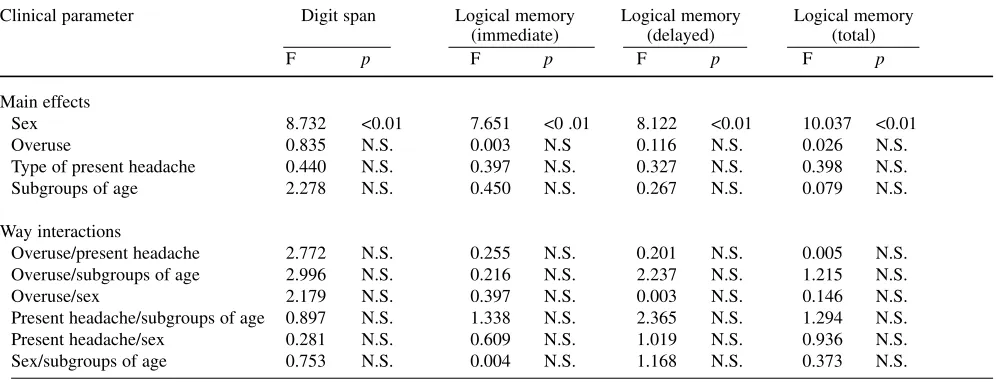
The analysis of variance showed an unfavorable effect of female sex on the performance of: one visuospatial test (immediate and delayed form of Rey’s figure) (Table 2), and a few of the verbal memory tests (digit span, immediate and delayed form of logical memory) (Table 3).
Spearman’s correlation coefficients indicated a positive influence of education on all memory tests and an unfavor-able effect of age on the immediate and delayed form of Rey’s figure and on the tests of verbal memory. These effects of age and education seem obvious and were subsequently
counteracted by the normalization of raw scores. The mean duration of headache exerted a negative effect on the raw scores of Rey’s figure (immediate and delayed forms), of digit span and of Buschke’s procedure (Tables 4 and 5).
The percentages of the patients with scores lower than normals are graphically summarized in Fig. 1.
The percentage of subjects with memory difficulty was higher among women than men as regards Rey’s figure (immediate form, 84% of women impaired vs. 13.6% of men impaired, p< 0.001; delayed form, 70% vs. 31.2%, p< 0.001), logical memory (immediate form, 28% vs. 0% impaired, p< 0.05; total, 40% vs. 9.5%, p< 0.05).
The distribution of patients with memory disorders showed no difference between the overusers and the nonoverusers.
Table 2Effects of clinical parameters on visuospatial memory (analysis of variance)
Clinical parameter Rey copy Rey immediate Rey delayed Corsi
F p F p F p F p
Main effects
Sex 0.229 N.S. 10.61 <0.005 7.834 <0.01 2.013 N.S.
Overuse 0.038 N.S. 0.001 N.S. 0.336 N.S. 0.552 N.S.
Type of present headache 0.055 N.S. 1.848 N.S. 1.457 N.S. 0.374 N.S.
Subgroups of age 0.436 N.S. 0.464 N.S. 0.944 N.S. 1.839 N.S.
Way interactions
Overuse/present headache 0.597 N.S. 0.046 N.S. 0.013 N.S. 0.204 N.S.
Overuse/subgroups of age 0.786 N.S. 0.156 N.S. 0.084 N.S. 0.497 N.S.
Overuse/sex 0.680 N.S. 0.973 N.S. 1.734 N.S. 0.671 N.S.
Present headache/subgroups of age 0.560 N.S. 0.148 N.S. 0.111 N.S. 1.171 N.S.
Present headache/sex 1.233 N.S. 1.027 N.S. 0.868 N.S. 0.037 N.S.
Sex/subgroups of age 1.508 N.S. 0.533 N.S. 0.388 N.S. 1.841 N.S.
Table 3 Effects of clinical parameters on verbal memory (analysis of variance)
Clinical parameter Digit span Logical memory Logical memory Logical memory
(immediate) (delayed) (total)
F p F p F p F p
Main effects
Sex 8.732 <0.01 7.651 <0 .01 8.122 <0.01 10.037 <0.01
Overuse 0.835 N.S. 0.003 N.S 0.116 N.S. 0.026 N.S.
Type of present headache 0.440 N.S. 0.397 N.S. 0.327 N.S. 0.398 N.S.
Subgroups of age 2.278 N.S. 0.450 N.S. 0.267 N.S. 0.079 N.S.
Way interactions
Overuse/present headache 2.772 N.S. 0.255 N.S. 0.201 N.S. 0.005 N.S.
Overuse/subgroups of age 2.996 N.S. 0.216 N.S. 2.237 N.S. 1.215 N.S.
Overuse/sex 2.179 N.S. 0.397 N.S. 0.003 N.S. 0.146 N.S.
Present headache/subgroups of age 0.897 N.S. 1.338 N.S. 2.365 N.S. 1.294 N.S.
Present headache/sex 0.281 N.S. 0.609 N.S. 1.019 N.S. 0.936 N.S.
Table 4Correlation between clinical parameters and visuospatial memory (Spearman’s correlation coefficients)
Age Age at Age at chronic daily Mean duration Mean duration of Years of headache onset headache onset of headache chronic daily headache education
Rey Copy r = -0.1921 r = -0.0496 r = -0.0644 r = -0.1740 r = -0.2332 r = -0.2450
N.S. N.S. N.S. N.S. N.S. p <0.05
Rey immediate r = -0.5110 r = -0.1703 r = -0.444 r = -0.344 r = -0.1871 r = 0.4873
N.S. N.S. p < 0.001 p < 0.005 N.S. p < 0.001
Rey delayed r = -0.5576 r = -0.1860 r = 0.5054 r = -0.3948 r = -0.1952 r = 0.5016
N.S. N.S. p < 0.001 p < 0.005 N.S. p < 0.001
Corsi’s test r = -0.1240 r = -0.0619 r = -0.1720 r = -0.1543 r = -0.2128 r = 0.3376
N.S. N.S. N.S. N.S. N.S. p < 0.005
Table 5 Correlation between clinical parameters and verbal memory (Spearman’s correlation coefficients)
Age Age at Age at CDH Mean duration Mean duration Years of
headache onset onset of headache of CDH education
Digit span r = -0.4254 r = -0.0185 r = -0.3142 r = -0.3359 r = -0.1061 r = 0.6459
p < 0.001 N.S. p < 0.01 p < 0.005 N.S. p < 0.001
Logical memory r = -0.2580 r = -0.1677 r = -0.2792 r = -0.1151 r = -0.0941 r = -0.03989
immediate p < 0.05 N.S. p < 0.05 N.S. N.S. p < 0.05
Logical memory r = -0.3614 r = -0.2291 r = -0.2632 r = -0.1803 r = -0.0791 r = 0.3989
delayed p < 0.005 N.S. p < 0.05 N.S. N.S. p < 0.05
Logical memory r = -0.3301 r = -0.2244 r = -0.3024 r = -0.1502 r = 0.0279 r = 0.409
total p < 0.01 N.S. p < 0.05 N.S. N.S. p < 0.001
STM r = -0.04017 r = -0.0604 r = -0.3402 r = -0.2748 r = -0.0675 r = 0.03073
p < 0.05 NS p < 0.005 p < 0.05 NS p < 0.01
LTR r = -0.3831 r = -0.003 r = -0.03424 r = -0.2826 r = -0.0678 r = 0.2839
p < 0.005 N.S. p < 0.005 p < 0.05 N.S. p < 0.05
DT r = -0.1152 r = 0.1415 r = 0.0619 r = 0.1105 r = -0.2361 r = 0.1259
N.S. N.S. N.S. N.S. p < 0.05 N.S.
0 10 20 30 40 50 60 70
Rey C Rey I Rey D Corsi
DS
LM-I LM-D LM-T STM LT
R
DT
Fig. 1 Chronic daily headache: patients with lower performance than controls on memory tests.
Rey C, Rey copy;
Rey I, Rey immediate;
Rey D, Rey delayed;
DS, digit span;
LM-I, logical memory immediate;
LM-D, logical memory delayed;
LM-T, logical memory total;
STM, short term memory;
LTR, long term memory;
DT, delayed test
STM, short-term memory; LTR, long-term memory; DT, delayed test; CHD, chronic daily headache
When considering the different types of onset headache, the migraineurs were characterized by a higher percentage of subjects with impairment in the immediate form of logi-cal memory than patients with new daily persistent headache (98% vs. 0, p< 0.05).
The percentage of patients with lower memory perfor-mance than normals was not different among the various types of present chronic daily headache.
The Mann-Whitney U test showed a higher mean dura-tion of headache in patients who presented an impairment on the delayed test of Buschke’s procedure (15.9 ± 10.73 vs. 10.1 ± 7.36 years).
Discussion
The present study reveals a severe impairment of memory functions in headache sufferers with a chronic evolution of disease. The performance on memory tests did not depend on drug overuse, nor on the present type of headache; in a few of tests, women showed a worse performance than men. The visuospatial memory presented a whole impairment, whereas the verbal memory showed a greater involvement in long-term phase.
The present study confirms the more widespread impair-ment of memory functions in adult headache sufferers than in juvenile patients, probably due to the longer duration of disease. In contrast, a relationship between overintake of analgesics and memory loss was not demonstrated.
According to these results, memory impairment in headache sufferers seems unlikely to be explained by clear-cut neuroanatomical damage. Actually, a cerebral lesion too small to cause neurological disorders other than memory deficits may not result in an involvement of both short- and long-term memories. Instead a neurotransmitter disorder can be hypothesized. Moreover, it should also be complex, since short- and long-term memories use different neurotransmit-ters that are, respectively, serotonin and glutamate [12].
With regard to serotonin, all medical conditions of chronic pain are associated with a deficit in serotoninergic activity. Particularly, increased 5-HT2 post-synaptic recep-tor binding has been observed in patients with transformed migraine. This finding is compatible with a compensatory up-regulation of postsynaptic elements in response to defi-ciencies in serotonin availability and is a typical sign of major depression [13]. Abnormalities of serotonin uptake by platelets and of factors which cause release of serotonin from platelets have been described in chronic tension type headache sufferers [14].
On the other hand, a role of glutamate in chronic evolu-tion of headache was recently shown by Post and Silberstein [15]. These authors purposed the amygdala “kindling” par-adigm as a useful, but nonhomologous model for a specific
subgroup of migraineurs who experience illness progress-sion and drug tolerance. According to the kindling model, illness progression is underlied by apparent memory-like processes: repeated and external stimulations of the brain induce transient synaptic events that in turn exert longer lasting enhancing action on neuronal excitability and on the microstructure of the brain via an intricate cascade of neu-robiological processes involving alterations in gene tran-scription, the effects of which may last for months and years. Therefore, the attacks of migraine, at first triggered by psychosocial stressors, become spontaneous and progress from isolated and intermittent to more chronic or daily. Moreover, the patients with this progression of dis-ease may also change their pharmacological responsivity and develop tolerance to previously effective prophylactic agents [15]. The NMDA receptors located on the surface of cervical spinal cord dorsal horn neurons and of brain-stem trigeminal nucleus caudalis neurons may play a key role in spinal and trigeminal hypersensitivity. Repetitive stimula-tion of these receptors contributes to an excessive increase of intracellular Ca2+that promotes excitotoxicity and neu-ronal dysfunction [16].
In conclusion, an involvement of both serotonin and glu-tamate systems characterizes patients with chronic migraine. If a decrease in serotonin activity and abnormal NMDA receptor activation resulting in neuronal excitotoxi-city are hypothesized to occurr in memory pathways too, a common neurobiological dysfunction may underlie on one hand both short-term and long-term memory impairment, on the other hand the illness progression at least in those chronic daily headache sufferers who present migraine as their first onset headache.
M.P. Prudenzano •T. Francavilla •M. Palumbo Neurological Clinic I, University of Bari, Bari, Italy
M. Nicolodi •S. Canova
Interuniversity Centre of Neurochemistry and Clinical Pharmacology of Primary Headache,
Florence University, Florence, Italy
G. Zanchin Neurological Clinic,
University of Padua, Padua, Italy
F. Granella
Institute of Neurology,
University of Parma, Parma, Italy
A. Alberti • S. Russo Neurological Clinic,
University of Perugia, Perugia, Italy
R. Cerbo
Department of Neurological Sciences University of Rome La Sapienza, Rome, Italy
A. Carolei Neurological Clinic
References
1. Drachman DA, Arbit J (1966) Memory and the hipocampal complex. Is mem-ory a multiple process? Arch Neurol 15:52
2. De Renzi E (1985) Disorders of space exploration and cognition. John Wiley and Sons, New York
3. Levin HS, Benton AL, Grossman RG (1982) Neurobehavioral effects of closed head injury. Oxford University Press, New York
4. Puca FM, Antonaci F, Savarese M, Covelli V, Tarascio G, Bellizzi, Lamorgese C, Musmeci GM, Sorrento G (1985) Memory impairment and painful side. In: Clifford-Rose F (ed) Clinical neurophysiology. Migraine Proc 5th Migraine Symp, London 1984. Kargel, Basel, pp 1–10 5. Puca FM, Genco S, Savarese M,
Prudenzano MP, de Tommaso M, Sciruicchio V, Pastore B (1994) Juvenile migraine and memory. In: Clifford Rose F (ed) New advances in headache research. Smith Gordon and Company, London, pp 33–37
6. Raven JC, Raven J (1977) Manual for Raven’s Progressive Matrices and Vocabulary Scale; the Coloured Progressive Matrices; Standard Progressive Matrices; Advances Progressive Matrices Sets 1 and 2. Lewis, London
7. Wechsler D, Stone CP (1963) Wechsler Memory Scale, Organizzazioni Speciali, Firenze, p 85
8. De Renzi E, Nichelli P (1975) Verbal and non-verbal short-term memory impairment following hemispheric damage. Cortex 11:41–43
9. Rey A (1959) Test de copie d’une fig-ure complexe. Centre de Psichologie Appliquée, Paris
10. Buschke H (1973) Selective reminding for analysis of memory and learning. J Verbal Learning Verbal Behav 12:543–550
11. Headache Classification Commitee of the International Headache Society (1988) Classification and diagnostic criteria for headache disorders, cranial neuralgias and facial pain. Cephalalgia 8[Suppl 7]:1–96
12. Brunelli M, Catarsi S (1990) La memoria cellulare. I meccanismi della memoria a livello biochimico delle cel-lule nervose. In: Cazzullo CL et al (eds) Le molte facce della memoria. Liviana Editrice, Padua, pp 19–38 13. Srikiatkhachorn A, Govitrapong P,
Limthavon C (1994) Up-regulation of 5-HT2 serotonin receptor: a possible mechanism of transformed migraine. Headache 34(1):8–11
14. Shimomura T, Takahashi K (1990) Alteration of platelet serotonin in patients with chronic tension-type headache during cold pressor test. Headache 30(9):581–583
15. Post RM, Silberstein SD (1994) Shared mechanisms in affective illness, epilep-sy, and migraine. Neurology 44[Suppl 7]:S37–S47