Optimizing the use of multi cores by image processing application
in desktop
M. Pavithra, G. Abinaya
MS Software Engineering VIT University, Vellore.
I.
INTRODUCTION
1Today due to the need for faster performance multi core processors became very common. Yet the full utilization of them is not done efficiently, in this paper we provide a measurement and analysis of the existing (We have chosen Image compression application) and optimized the code in terms of speed and compression factor, here we optimize the application, so that the same functions could be performed as before, but with a faster execution time. Thus the hidden capability of the multicore processor environment could be utilized well.
II. EXPERIMENTS PERFORMED AND RESULTS OBTAINED
A. Experiment
In this paper we are going to take one of the most commonly used desktop application, and optimize its code so that it executes faster. We have chosen Image compression application, as it is one of the most commonly used desktop application today.
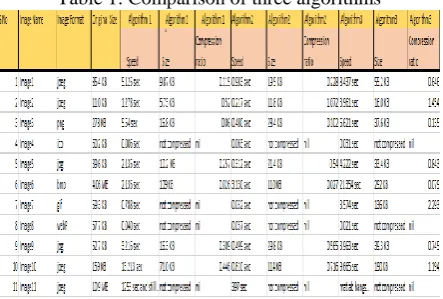
And we have selected three image compression algorithms, two based on the use of a frequency transform such as DCT and one based on the use of a Wavelet transform and performed their scalar execution and tabulated (Table 1) their results to choose the best algorithm out of the selected algorithms, there are many parameters to compare their efficiency we have used the execution speed, image size, compression factors as our parameters for comparison.
Table 1: Comparison of three algorithms
Abstract :
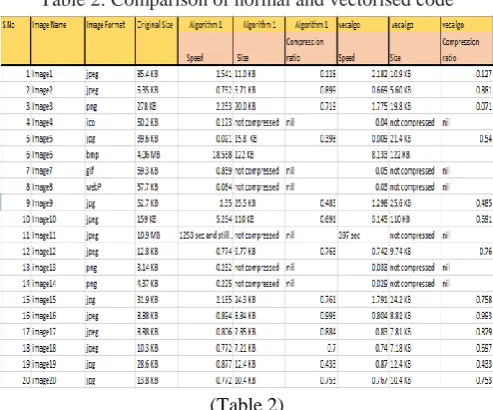
now a days, we see multi core processors everywhere, a customer who uses a multi core processor expects it to be that many times faster than a single core processor but do those computers actually give that expected output is an unanswered question, hence in this paper we are planning to optimize an existing code in such a way that it utilizes those multiple cores efficiently. The application that we are going to optimize in this paper is image processing application which is one of the most used applications by today’s desktop users. Our paper will efficiently bring out the processor utilization by the application chosen for the paper.Based on the results obtained, though algorithm2 has better speed, but the other two parameters are lesser, hence we chose algorithm1 and have vectorised it. Vectorizations is a processes in which multiple operations take place at a time, in our project We have vectorised the chosen algorithm by first splitting the read image matrix into two then we carried out the compression technique to each of these split matrix and we applied certain changes to the old code like preallocation of array size, parallelizing the inner loops and assignment of new variables. At the last we have combined the two split matrix into one to form the final compressed image output. After vectorising we ran both the initial and the modified algorithm and calculated their execution times, the vectorised algorithm is found to run at twice the speed of the initial algorithm (Table 2). Thus a properly vectorised code that makes full use of the multicore could be faster by two times.
Table 2: Comparison of normal and vectorised code
(Table 2)
We had run the vectorised code in a five, three, two core processors to see the difference in speed (Table 3), thus as the number of processor increases the speed also increases, and thus the purpose of the paper is shown.
Figure 2: Execution time difference of normal and vectorised code
(Figure 2)
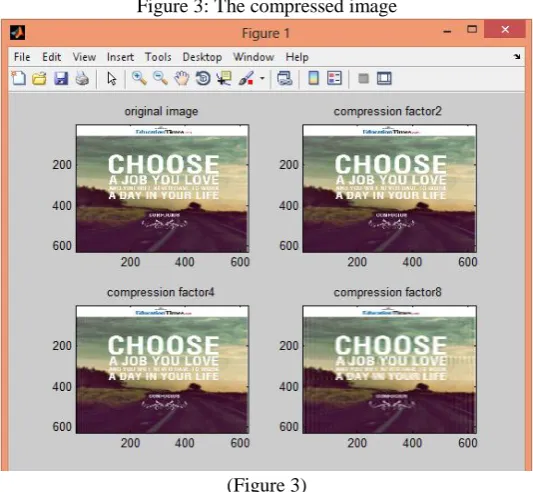
Figure 3: The compressed image
(Figure 3)
Graph 2: Graph of comparison of normal and vectorised code
(Graph 2)
Graph 3: Graph of comparison of vectorised code in different multi core processors
(Graph 3)
III.
ADDITIONAL INFORMATION
A. Abbreviations and Acronyms
IV.
CONCLUSION
Thus we have taken an already existing code of a desktop application and tried to optimize the code so that it makes full use of the hardware multi core environment. The same must be taken into consideration by the software developers in future and write codes in such a way that it uses the parallel environment efficiently. In this paper we have made our small step towards it.
ACKNOWLEDGMENT
We would like to thank Prof.Manikandan.N Assistant Prof (Sr), VIT University, Vellore for guiding us through the work, on this paper.
REFERENCES
[1]. Schalkwijk, Jerôme, et al. "High-performance simulations of turbulent clouds on a desktop PC: Exploiting the GPU." Bulletin of the American Meteorological Society 93.3 (2012): 307-314.
[2]. Kim, Cheong Ghil, Jeom Goo Kim, and Do Hyeon Lee. "Optimizing image processing on multi-core CPUs with Intel parallel programming technologies." Multimedia Tools and Applications (2014): 1-15.
[3]. Ferdman, Michael; Adileh, Almutaz; Kocberber, Onur; Volos, Stavros; Alisafaee, Mohammad; Jevdjic, Djordje; Kaynak, Cansu; Popescu, Adrian Daniel; Ailamaki, Anastasia; Falsafi, Babak, "A Case for Specialized Processors for Scale-Out Workloads," Micro, IEEE , vol.34, no.3, pp.31,42, May-June 2014 doi: 10.1109/MM.2014.41
[4]. Method of Optimizing The compression of image data, with automatic selection of compression conditions. [5]. Evolution of Thread-Level Parallelism in Desktop Applications
Authors:Geoffrey BlakeUniversity of Michigan, Ann Arbor, MI, USARonald G. DreslinskiUniversity of Michigan, Ann Arbor, MI, USA
[6]. The profiling method in multicore processor for effective performance improvement
Authors:Seung Hyun YoonSungkyunkwan University, Suwon, KoreaKyung Min LeeSungkyunkwan University, Suwon, KoreaYong Seok KimSamsung Electronics, Suwon, KoreaSeong Jin ChoSungkyunkwan University, Suwon, KoreaDong Won ChoiSungkyunkwan University, Suwon, KoreaKey Ho KwonSungkyunkwan University, Suwon, KoreaKil Jae KimSungkyunkwan University, Suwon, KoreaJong Hyun ParkSungkyunkwan University, Suwon, KoreaJae Wook JeonSungkyunkwan University, Suwon, Korea
[7]. Kim, Taehwan, et al. "Sequence Data Indexing Method Exploiting the Parallel Processing Resources of GPGPU." (2013).