http://www.sciencepublishinggroup.com/j/ijmfs doi: 10.11648/j.ijmfs.20160206.11
An Improved Firefly Algorithm Based on Local Search
Method for Solving Global Optimization Problems
R. M. Rizk-Allah
Department of Basic Engineering Science, Faculty of Engineering, Minoufia University, Shebin El-Kom, Egypt
Email address:
To cite this article:
R. M. Rizk-Allah. An Improved Firefly Algorithm Based on Local Search Method for Solving Global Optimization Problems. International Journal of Management and Fuzzy Systems. Vol. 2, No. 6, 2016, pp. 51-57. doi: 10.11648/j.ijmfs.20160206.11
Received: December 9, 2016; Accepted: December 20, 2016; Published: March 1, 2017
Abstract:
This paper proposes an improved firefly algorithm (IFA)based on local search method for solving globaloptimization problems. The main feature of the proposed algorithm is to improve the solutions quality generated from the fireflies by embedding the local search method. Moreover, the new solutions are generated based on the movement formula of the fireflies that is modified by exponential formula. The exponential formula reduces the randomization parameter so that it decreases gradually as the optimum is approaching. In addition, local search method (LSM) is introduced to improve the solution quality. Finally, the proposed algorithm is tested on several benchmark problems from the usual literature and the numerical results have demonstrated the superiority of the proposed algorithm in finding the global optimal solution.Keywords:
Firefly Algorithm, Local Search Method, Global Optimization1. Introduction
Optimization problems are of importance for the industrial as well as the scientific world in many applications. There are many optimization problems that present attributes, such as high nonlinearity and multimodality, the solution of this kind of problems is usually a complex task. Moreover, in many instances, complex optimization problems present noise and/or discontinuities which make traditional deterministic methods inefficient to find the global solutions. Meanwhile, global optimization methods based on meta-heuristics are robust alternatives to solve complex optimization problems and do not require any properties of the objective function have been developed.
Due to the computational drawbacks of existing numerical methods, researchers have to rely on meta-heuristic algorithms based on simulations to solve some complex optimization problems. A common feature in meta-heuristic algorithms is that they combine rules and randomness to imitate natural phenomena. These phenomena include the biological evolutionary process (e.g., the genetic algorithm (GA) [1] and the differential evolution (DE) [2]), animal behavior (e.g., particle swarm optimization (PSO) [3] and ant colony algorithm (ACA)
[4]), and the physical annealing process (e.g., simulated annealing (SA) [5]). Over the last decades, many meta-heuristic algorithms and their improved algorithms have been successfully applied to various engineering optimization problems [6, 7, 8, 9, 10]. They have outperformed conventional numerical methods on providing better solutions for some difficult and complicated real-world optimization problems.
A promising new meta-heuristic algorithm denoted as firefly algorithm (FA) which inspired by social behavior of fireflies and the phenomenon of bioluminescent communication. There are two important issues in the firefly algorithm that are the variation of light intensity and formulation of attractiveness. Yang [21] simplified that the attractiveness of a firefly is determined by its brightness which in turn is associated with the objective function. In general, the attractiveness is proportional to their brightness. Furthermore, every member of the firefly swarm is characterized by its bright that can be directly expressed as an inverse of an objective function for a minimization problem.
solving the global optimization problems. The motivation for the proposed algorithm is to improve the solutions quality for solving the global optimization problems. This methodology consists of two phases. The first phase explore new solutions based the movement formula of the fireflies that is modified by exponential formula. The exponential formula reduces the randomization parameter so that it decreases gradually as the optimum is approaching, while the other phase employs the local search method to exploit the existing solutions to improve the solution quality of optimization problems. By these phases, the proposed algorithm achieves robust results compared to the current well-known algorithms in the literature. Finally, the exploration and exploitation enhanced the superiority of the proposed approach in finding the global optimal solution.
The organization of the remaining paper is as follows. In Section 2 we describe some preliminaries on optimization problems and basics of FA. In Section 3, the proposed algorithm, named IFA-LSM, is explained in detail. Experiments anddiscussions are presented in Section 4. Finally, we conclude the paper in Section 5.
2. Preliminaries
2.1. Statement of Global Optimization Problem
The general numerical global optimization problem [22] can be defined as in (1):
Find x such that
1 2
min
F
( ),
x x
=
( ,
x x
,...,
x
n)
∈ℜ
n(1) where x∈Ω⊆S. The objective functionF is defined on the search space S⊆ℜ and the set Ω⊆S defines the feasible region. Usually, the search space S is defined as an
−
n dimensional rectangle in ℜn , domains of variables defined by their lower and upper bounds as in (2):
,
1, 2,...,
L U
j j j
x
≤
x
≤
x
j
=
n
(2)2.2. The Basics of FA
FA [30] is one of the most recent meta-heuristic techniques for approximate optimization. The inspiring source of FA is the social behavior of fireflies for sharing food with others or for attracting the prey. At the core of this behavior is the direct communication between the fireflies by means of bioluminescent communication, which enables them to moves toward a neighbor that glows brighter.
There are two important issues in the firefly algorithm that are the variation of light intensity and formulation of attractiveness. Yang [10] simplified that the attractiveness of a firefly is determined by its brightness which in turn is
associated with the objective function. In general, the attractiveness is proportional to their brightness. Furthermore, every member of the firefly swarm is characterized by its bright that can be directly expressed as an inverse of an objective function for a minimization problem. Based on this objective function, initially, all the agents (fireflies) are randomly dispersed across the search space. The two stages of the firefly algorithm are as follows.
1)Variation of light intensity: Light intensity is related to objective values [10]. So for minimization problem a firefly with high intensity will attract another firefly with high intensity. Assume that there exists a swarm of m agents (fireflies) and xi
represents a solution for a firefly
i
, whereas f(xi)denotes its fitness value. Here the brightness
I
of a firefly is selected to reflect its current position x of its fitness value f(x), given as in (3):( )
x
i1
( ) ,
x
i1, 2,...,
I
=
f
i
=
m
(3)2)Movement toward attractive firefly: The firefly has an attractiveness which is proportional to the light intensity seen by adjacent fireflies. Each firefly has its distinctive attractiveness
β
which implies how strong it attracts other members of the swarm. However, the attractivenessβ
is relative; it will vary with the distance. rij between two firefliesi
and j at locationsi
x and xj respectively, is given as in (4):
x
x
ij i j
r
=
−
(4)The attractiveness function
β
(r) of the firefly is determined by using (5):2
0
( )
r
=
e
−γrβ
β
(5)where β0 is the attractiveness at r=0 and
γ
is the lightabsorption coefficient.
The movement of a firefly
i
at location xi attracted toanother more attractive (brighter) firefly j at location xj is
determined as in (6):
2
0 0
(
1)
(
)
(
0.5)
x
it
+ = +
x
iβ
e
−γrx
j−
x
i+
α
rand
−
(6)Table 1. The pseudo code of the FA.
Set values of parameters.
Create an initial population of fireflies, m, within n-dimensional search spacexi,i=1, 2,...,m. Evaluate the fitness of the population f( )xi which is inversely proportional to light intensity ( )Ixi . while (not termination condition) do
for i=1to m
for j=1to m. ifIi<Ij,
Move firefly
i
towards j by using Equation (6) end ifVary attractiveness with distance r via e−γr2
Evaluate new solutions and update light intensity by using Equation (5) end forj
end for
i
Rank fireflies and find the current best; end while
3. The Proposed Algorithm
The motivation for the proposed algorithm is to improve the solutions quality for solving the global optimization problems compared with the state of the art.
By extending the basic ideas of FA, we can develop the following IFA-LSM.
The procedure starts with an appropriate definition of objective functions with associated nonlinear constraints. We first initialize a population ofmfireflies so that they should distribute among the search space as uniformly as possible. This can be achieved by using sampling techniques via uniform distributions. Once the tolerance or a fixed number of iterations is defined, the iterations start with the evaluation of brightness or objective values of all the fireflies and compare each pair of fireflies. Then, firefly is attracted to another more attractive (brighter) firefly. The main steps of the IFA-LSM are summarized as follows:
Step 1. Initialization
Initialize a swarm of fireflies with assigned a random vector x,(x1,x2,...,xn) , where each firefly contains n
variables (i.e., the position of the ith firefly in the n
dimensional search space can be represented as
) x ,..., x , x
( i i in i = 1 2
x ). Furthermore every member of the swarm is characterized by its light intensity (i.e., initialize each firefly with distinctive light intensity
m ,..., , i ), ( I
( 0 xi =12 ).
Step 2. Light intensity
Calculate the light intensity Ii(xi),i=1,2,...,m,for each
firefly which in turn is associated with the encoded objective function, where for minimization problem the brighter firefly represents the minimum value forI(x).
Step 3. Movement toward attractive firefly
In this step, each member of the swarm explores new solution based on the movement of a firefly. The traditional movement of a firefly is implemented by using Equation (6) where the randomization term may moves the
firefly to lose its best location, so we introduce a modification on the randomization term that makes the fireflies approached from the optimum. This modification represents a further improvement on the convergence of the proposed algorithm by using Equations (7) and (8).
2
0
(
1)
(
)
(
0.5)
x
it
+ = +
x
iβ
e
−γrx
j−
x
i+
α
trand
−
(7)0
,
1, 2,...,
t
t
t
T
α α θ
=
=
(8)where α0 is the initial randomness factor, T is the maximum number of generations, and
θ
∈[0,1] is the randomness reduction constant.Step 4. local search method
In this step the local search scheme is carried around the found solution by fireflies in order to enhance the existing solution by the fireflies, therefore the fireflies move in new directions in search of newer regions. The pseudo code of the local search scheme is shown in Table 2.
The flowchart of the proposed IFA-LSM approach is shown in Figure 1.
Table 2. The pseudo code of the local search method. Input: x=(x1,x2,...,xi,...,xn);xiL;xiU; number of maximum
iteration. Sett=0
Generate dx (dx n
L U )*( ) (
* 5
. − ε
=
If∃x′=x+dx|x′∈Ω,then xnew=x′
Else if ∃x′=x−dx|x′∈Ωx′∈Ω,then xnew=x′
Elsexnew=[] then t=t+1
Figure 1. The flowchart of the proposed IFA-LSM.
4. Experiments and Discussions
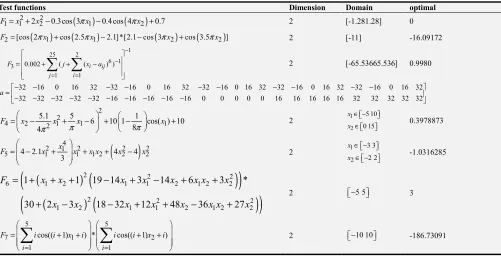
An extensive set of experiments have been conducted, in order to show IFA-LSM algorithm's effectiveness for the purpose of global optimization. fifteen common test functions were used in the experiments and then the evaluated results were compared with the prominent algorithms that reported in [19, 23] which are called successive zooming genetic algorithm (SZGA), harmony search theory (HS), dynamic random search technique (DRASET) [23], chaotic particle swarm optimization(CPSO), particle swarm optimization (PSO), genetic algorithm (GA) and particle swarm ant colony optimization (PSACO) [19]. The test functions, which are benchmark from [19, 23], are listed in Table 3. Table 3 gives
the details of the test functions, including their equations, dimensions, domains and the optimal values. Selected test functions are run on PC, which has Pentium 4 3.0 GHz processor and 1.0 GB RAM while testing the performance IFA-LSM. The IFA-LSM algorithm had been coded in MATLAB 7.
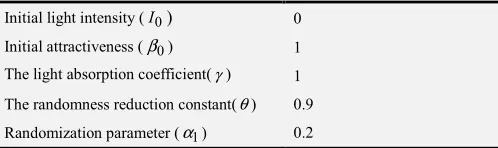
4.1. Parameters Setting
The proposed algorithm contains number of parameters. These parameters affect the performance of the proposed algorithm. Extensive experimental tests were conducted to see the effect of different values on the performance of the proposed algorithm. Based upon these observations, the following parameters have been set as in Table 4.
Table 3. Test functions.
Test functions Dimension Domain optimal
(
)
(
)
2 2
1= 1+2 2−0.3cos 3 1 −0.4 cos 4 2 +0.7
F x x πx πx 2 [-1.281.28] 0
(
)
(
)
(
)
(
)
2=[cos 2 1 +cos 2.5 1 −2.1]*[2.1 cos 3− 2 +cos 3.5 2 ]
F πx πx πx πx 2 [-11] -16.09172
1
25 2
6 1 3
1 1
0.002 ( ( ) )
− −
= =
= + + −
∑ ∑
i ijj i
F j x a 2 [-65.53665.536] 0.9980
32 16 0 16 32 32 16 0 16 32 32 16 0 16 32 32 16 0 16 32 32 16 0 16 32 32 32 32 32 32 16 16 16 16 16 0 0 0 0 0 16 16 16 16 16 32 32 32 32 32
− − − − − − − − − −
=
− − − − − − − − − −
a
2 2
4 2 2 1 1 1
5.1 5 1
6 10 1 cos( ) 10 8
4
= − + − + − +
F x x x x
π π
π 2
1 2
5 10 0 15
∈ − ∈ x
x 0.3978873
(
)
4
2 1 2 2 2
5 4 2.11 3 1 1 2 42 4 2
= − + + + −
x
F x x x x x x 2 1
2
3 3 2 2
∈ − ∈ − x
x -1.0316285
(
)
(
)
(
)
(
)
(
)
(
)
2 2 2
6 1 2 1 1 2 1 2 2
2 2 2
1 2 1 1 2 1 2 2
1 1 19 14 3 14 6 3 *
30 2 3 18 32 12 48 36 27
F x x x x x x x x
x x x x x x x x
= + + + − + − + +
+ − − + + − + 2
5 5
−
3
5 5
7 1 2
1 1
cos(( 1) ) * cos(( 1) )
= =
= + + + +
∑
i ∑
i Test functions Dimension Domain optimal
(
2)
2(
)
28=100 2− 1 + −1 1
F x x x 2 −10 10 0
(
)
2(
)
22 2 4
9 1 2 1 2 1 2
1 1
exp 25 sin (4 3 ) 10
2 2 = + − + − + + −
F x x x x x x 2 −5 5 1
2 2 2 2
2 2 1 2
10 1 2 4
1 1 2
1 100 1
12
10 ( )
+ +
= + + +
x x x
F x
x x x
2 0 10 1.74
(
)
(
)
(
)
(
)
(
) (
)
(
)(
)
2 2 2 2
2 2
11 2 1 1 4 3 3
2 2
2 4 2 4
100 1 90 1
10.1 1 1 19.8 1 1
= − + − + − + − +
− + − + − −
F x x x x x x
x x x x
4 −10 10 0
(
)
2(
) (
2)
4(
)
412= 1+10 2 +5 3− 4 + 2−2 3 +10 1− 4
F x x x x x x x x 4 −5 5 0
( )
(
2)
( )
( )
21 19 1 1 2 2 13 1 1 ++ + + = = +
∑
xi xii i
i
F x x 20 −1 4 0
( )
(
)
( )19
2 2
2 2
14 1 1 20
1
( / 20) 10 sin ( ) 1 1 10 sin ( +) 1
= = + − + + −
∑
i ii
F π πx x πx x 20 −10 10 0
4 3
2 15
1 1
exp ( )
= = = − − −
∑
i∑
ij j iji j
F c a x p 3 [01] -3.86278
i
aij ci pij1 2 3 4
3 10 30 0.1 10 35 3 10 30 0.1 10 35
1 1.2
3 3.2
0.3689 0.1170 0.2673 0.4699 0.4387 0.7470 0.1091 0.8732 0.5547 0.0381 0.5743 0.8828
Table 4. The algorithm parameters.
Initial light intensity (I0) 0
Initial attractiveness (β0) 1 The light absorption coefficient(γ) 1 The randomness reduction constant(θ) 0.9 Randomization parameter (α1) 0.2
4.2. The Comparison of Solution Quality
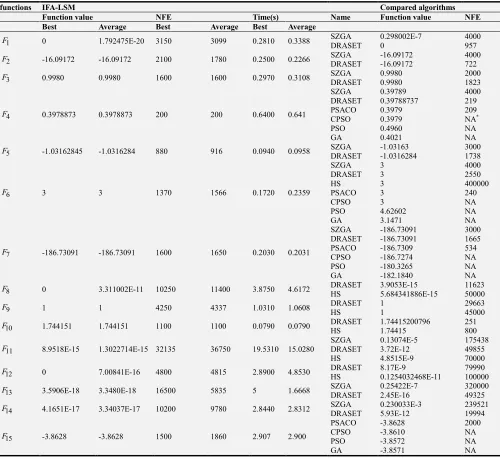
In order to examine the capability of IFA-LSM in global optimization problems, a comparison is made with the prominent algorithms from the literature. The test functions have been solved by IFA-LSM for 10 times. The starting values of the variables for each problem were selected randomly for all runs from the solution space. The results found by IFA-LSM such as the best and average function value, numbers of function evaluation (NFE) and solution time in seconds have been recorded in Table 5, whereas for the other algorithms only the function value and numbers of function evaluation are given because the solution times, the best and average function value for some algorisms not given. It is obtained that founded best function values by IFA-LSM are the same or the closest as average function values for all functions except from the functions
12 8 5 1,F ,F ,F
F . As it deduced from Table5, the IFA-LSM is successful while finding the optimum solution of the given
functions and IFA-LSM outperforms the prominent algorithms for all functions. On the other hand, IFA-LSM can find the global minimum with less iteration number than compared algorithms except for the functions
10 6 2 1,F ,F ,F
F .
5. Conclusions
In this paper, we propose IFA-LSM algorithm which hybridizes the solution construction mechanism of FA with the LSM. In order to overcome the drawback of classical ant colony algorithm this not suitable for solving global optimizations, the solutions obtained by the ants are evolve by roaming the fireflies through the search space. Therefore the fireflies refine the positions found by the ants by producing number of solutions equal the number of solutions generated by the ants. On the other hand, the performance of FA is improved by reducing the randomization parameter so that it decreases gradually as the optima are approaching. The comparisons of numerical results show that there is as cope of research in hybridizing swarm intelligence methods to solve difficult continuous optimization problems and the
IFA-LSM is a promising and valuable tool to solve global nonlinear optimization problems. A careful observation will reveal the following benefits of the proposed optimization technique.
a)It competitive when compared with the other existing algorithm.
b)The proposed algorithm is capable of capturing the global minimum for the problems very efficiently. c)The carried out results verified the validity and the
advantages of the proposed approach.
d)It can accelerate the convergence and boost the performance through elapsed low computational time. The future work will be focused on two directions: (i) the application of IFA-LSM to constrained optimization problems; and (ii) the extension of the method to solve the multi-objective problems.
Table 5. The comparison of solution quality.
functions IFA-LSM Compared algorithms
Function value NFE Time(s) Name Function value NFE
Best Average Best Average Best Average
1
F 0 1.792475E-20 3150 3099 0.2810 0.3388 SZGA DRASET 0.298002E-7 0 4000 957
2
F -16.09172 -16.09172 2100 1780 0.2500 0.2266 SZGA -16.09172 4000
DRASET -16.09172 722
3
F 0.9980 0.9980 1600 1600 0.2970 0.3108 SZGA 0.9980 2000
DRASET 0.9980 1823
4
F 0.3978873 0.3978873 200 200 0.6400 0.641
SZGA 0.39789 4000
DRASET 0.39788737 219
PSACO 0.3979 209
CPSO 0.3979 NA*
PSO 0.4960 NA
GA 0.4021 NA
5
F -1.03162845 -1.0316284 880 916 0.0940 0.0958 SZGA -1.03163 3000
DRASET -1.0316284 1738
6
F 3 3 1370 1566 0.1720 0.2359
SZGA 3 4000
DRASET 3 2550
HS 3 400000
PSACO 3 240
CPSO 3 NA
PSO 4.62602 NA
GA 3.1471 NA
7
F -186.73091 -186.73091 1600 1650 0.2030 0.2031
SZGA -186.73091 3000
DRASET -186.73091 1665
PSACO -186.7309 534
CPSO -186.7274 NA
PSO -180.3265 NA
GA -182.1840 NA
8
F 0 3.311002E-11 10250 11400 3.8750 4.6172 DRASET 3.9053E-15 11623
HS 5.684341886E-15 50000
9
F 1 1 4250 4337 1.0310 1.0608 DRASET 1 29663
HS 1 45000
10
F 1.744151 1.744151 1100 1100 0.0790 0.0790 DRASET 1.74415200796 251
HS 1.74415 800
11
F 8.9518E-15 1.3022714E-15 32135 36750 19.5310 15.0280
SZGA 0.13074E-5 175438
DRASET 3.72E-12 49855
HS 4.8515E-9 70000
12
F 0 7.00841E-16 4800 4815 2.8900 4.8530 DRASET 8.17E-9 79990
HS 0.1254032468E-11 100000
13
F 3.5906E-18 3.3480E-18 16500 5835 5 1.6668 SZGA 0.25422E-7 320000
DRASET 2.45E-16 49325
14
F 4.1651E-17 3.34037E-17 10200 9780 2.8440 2.8312 SZGA 0.230033E-3 239521
DRASET 5.93E-12 19994
15
F -3.8628 -3.8628 1500 1860 2.907 2.900
PSACO -3.8628 2000
CPSO -3.8610 NA
PSO -3.8572 NA
References
[1] J. H. Holland, Adaptation in Natural and Artificial Systems, University of Michigan Press, Ann Arbor, MI, 1975.
[2] R. Storn, Differential evolution design of an IIR-filter, in: IEEE International Conference on Evolutionary Computation, Nagoya, 1996, pp. 268–273.
[3] J. Kennedy, R. C. Eberhart, Particles warm optimization, in: Proceedings of IEEE International Conference on Neural Networks, 1995, pp. 1942–1948.
[4] M. Dorigo, T. Stützle, Ant Colony Optimization, MIT Press, London, 2004.
[5] S. Kirkpatrick, C. Gelatt, M. Vecchi, Optimization by simulated annealing, Science 220, 1983, pp. 671–680. [6] M. H. Mashinchi, A. O. Mehmet, P. Witold, Hybrid
optimization with improved tabu search, Applied Soft Computing 11, 2011, pp. 1993–2006.
[7] A. Y. Qing, Dynamic differential evolution strategy and applications in electromagnetic inverses catering problems, IEEE Transactions on Geo science and Remote Sensing 44 (1), 2006, pp. 116–125.
[8] J. H. V. Sickel, K. Y. Lee, J. S. Heo, Differential Evolution and its Applications to Power Plant Control, in: International Conference on Intelligent Systems Applications to Power Systems, ISAP, 2007, pp. 1–6.
[9] Y. Marinakis, M. Marinaki, G. Dounias, Particles warm optimization for pap-smear diagnosis, Expert Systems with Applications 35 (4), 2008, pp. 1645–1656.
[10] M. Serrurier, H. Prade, Improving inductive logic programming by using simulated annealing, Information Sciences 178 (6), 2008, pp. 1423–1441.
[11] M. Dorigo, Learning and Nature Algorithm (in Italian). Ph. D. Dissertation, Dipartimento di Electtonica, Politecnico di Milano, Italy, 1992.
[12] L. Chen, J. Shen, L. Qin, H J. Chen, An improved ant colony
algorithm in continuous optimization. Journal of Systems Science and Systems Engineering, 12 (2), 2003, pp. 224-235. [13] J. Dreo, P. Siarry, An ant colony algorithm aimed at dynamic
continuous optimization. Appl. Math. Comput., 181, 2006, pp. 457-467.
[14] A. A. Mousa, Waiel F. Abd El-Wahed, R. M. Rizk-Allah, A hybrid ant colony optimization approach based local search scheme for multiobjective design optimizations, Electric Power Systems Research, 81, 2011, pp. 1014–1023.
[15] C. Blum, Beam-ACO-Hybridizing ant colony optimization with beam search: An application to open shop scheduling. Computers & Operations Res32 (6), 2005, pp. 1565–1591. [16] Z. Xiaoxia, T. Lixin, A new hybrid ant colony optimization
algorithm for the vehicle routing problem, Pattern Recognition Letters 30, 2009, pp. 848–855.
[17] P. Hadi, T. M. Reza, Solving a multi-objective open shop scheduling problem by a novel hybrid ant colony optimization, Expert Systems with Applications 38, 2011, pp. 2817–2822.
[18] Y. Jingan, Z. Yanbin, An improved ant colony optimization algorithm for solving a complex combinatorial optimization problem, Applied Soft Computing 10, 2010, pp. 653–660. [19] P. S. Shelokar, P. Siarry, V. K. Jayaraman, B. D. Kulkarni,
Particle swarm and ant colony algorithms hybridized for improved continuous optimization. Applied Mathematics and Computation 188, 2007, pp. 129-142.
[20] C. Shyi-Ming, C. Chih-Yao, Parallelized genetic ant colony systems for solving the traveling salesman problem, Expert Systems with Applications 38, 2011, pp. 3873–3883.
[21] X. S. Yang.: Nature-Inspired Metaheuristic Algorithms. Luniver Press (2008).
[22] M. S. Bazaraa, C. M. Shetly, Nonlinear Programming Theory and Algorithms, Wiley, NewYork, 1979.