A Mathematical Model for a Robotic Humanoid
Ally DaudaAhmadu
1, Philemon Uten Emmoh
2, Dr. Asabe Sandra Ahmadu
3,
Joel Yohanna Hezekiah
4*( ICT Centre, Federal University Wukari, Taraba State, Nigeria)
** (Department of Computer Science, Federal University Wukari, Taraba State, Nigeria)
***( Department of Computer Science, Modibbo Adama University of Technology, Adamawa State, Nigeria) ****( Department of Computer Science, Federal University Wukari, Nigeria)
1.
INTRODUCTION
Today, people are interacting more and more with computers. Life is running at a microchip speed. If all computers are stopped for a day, complete civilization comes to a halt! Fifty years ago, this might’ve been a science fiction, but today it is a reality. Further, with computers being embedded in all our life accessories like mobiles, watches, cars, even our bodies and brains there is no indication that this microchip speed will not be multiplied in the future, Cohen(2001). Over the last decade, these electronic tiny minuscule signals have fundamentally revolutionized the way we live. People are spending more hours per day with machines than human. An amazing a human-machine relationship is developing. So far this bond has been one sided because the ability to generate, recognize and express emotions are a unique prerogative of living human beings. If this intelligence or abstract attribute could be taught to machines, it would re-conceptualize the perception of machines. It will fundamentally change the way we live, in the third millennium.
We taught machines how to read, speak and understand humans by voices, actions and events. With the use of self-organizing maps, we are able to create inference engines that mimic human behavior, Himberge et-al (2001). Now we are fast approaching a stage where we will have to impart intelligence to make these non-biological machines a part of living beings family. We equip robots with image and voice recognition capabilities which leads to the detection of vocal or body language schemes that are recognizable by machines, Livarinen(2000). This intelligence attributes could be emotional, creativie and spiritual. Society will jot restrict scientists from migrating human attributes into machines because eventually most of the people will want indefinite life span and better services from these machines with increased intelligence.
2.
METHODOLOGY
Set theory lays the foundation for the definition of many any mathematical concepts. For example, mathematical structures as diverse as graphs, manifolds, rings, and vector spaces can all be defined as sets satisfying various (axiomatic) properties. Equivalence and order relations are ubiquitous in mathematics, and the theory of mathematical relations can be described in set theory. Set theory is also a promising foundational system for much of mathematics and computer science. Since the publication of the first volume of Principia Mathematica, it has been claimed that most or even all mathematical theorems can be derived using an aptly designed set of axioms for set theory (Bishop, 1997). For example, properties of the natural and real numbers
Abstract:
The paper takes a snapshot view of the past, present and future of the conceptual machines with emotional intelligence. The past covers the background, the debate and discussions whether Man is a machine. It tries to answers the question: can machine be creative? Can machines be made to think, act in ways that mimic our humanity and match reality? The paper outlines how far we have come and why the time has come for society to build emotional machines. Further, it also gives an introduction to emotion modeling, generation of expressions in forms that would be most acceptable to society. It elaborates how some of the attributes and features could make us build machines that are human like. It also tries to create a mathematical model from which emotional machines can be built. Last but not the least; it is an inspiration for the future, a trip that leads the way for all the people who are intrigued by the idea of Artificial Intelligence.can be derived within set theory, as each number system can be identified with a set of equivalence classes under a suitable equivalence relation whose field is some infinite set. The intellect gives us a detached view against which we can assess objective clearly and decisively.
As we develop and we desire systems that make our lives better, the need for an emotional machine is day by day becoming more convincing and compelling but the concept is very raw. The idea needs to be turned and looked upon from various different sides, examined carefully, analyzed, re-analyzed, polished and delivered again.
2.1 IS MAN A MACHINE? OR A ROBOT?
Doctors see man as a neurological and biological system. Mathematicians consider man as a collection of logic and computational devices. Intelligent Computer Experts call them interactive robots. While some just as animal. The progenitors of computers, the calculators were basically invented to assist calculations. Nowadays, Super computer with AI (artificial Intelligent) algorithm; try to imitate the logical working of human brains, Kohonen(2000). Thinking refers to a huge abstraction, an infinite circle whose circumference engulfs everything and who’s center is in every human brain. Most of today’s application is just superficial application of logic developed by the human’s way of doing things. Such manifestation of logic implementation may not be regarded as thinking. Because, these hardware components don’t actually have any idea of what is happening. They are just action-reaction machines; they are dependent on events to happen. Taking information, decisions and ability to learn can be regarded as thinking. For all such activities, we need logical operations: like compare, duplicate, store, calculate, remember and order. Yes, computers can do all this! We see numerous demonstration of this ability in software applications and internet portals. Comparison is also the key which open the door of emotions in our mind. Building a huge repository of emotions and comparing our vocal and physical nuances with them will create the right paradigm for the construction of the emotional computer.
2.2 SETTING THE MODEL
How is biological state of man related to intelligence? Genetic engineering will enable us to manufacture ourselves just like we have car factories. But will twins, two individuals with same personalities have same level of intellect and vision? In science and mathematics the vast majority of theories rely on the hypothesis. For what is force that moves the mass and for what is mass that is moved by force. It is seesaw. What is 2/2=1, 1/1=1, 0/0=0? Infinity/infinity=? Science and mathematics’ are just a belief like religion; no doubt it has attained great height.
2.2.1 A SIMPLISTIC MODEL FOR A COMPUTER THAT FEELS AND THINKS
An emotional machine can be described as software or a hardware that can recognize, express and even generate its own emotions, Hilbert et al(2001). The purpose is to understand the behaviors of machine user(s) and accordingly facilitate an emotional response and an intuitive interaction with it. Basically it’s a robot that is empowered to understand the mental state of a user and interact in a more sensitive way.
However, it is not easy to dissect human behavior and to an build object that would perform operations like:
If(user) = sad then offer(drink) and play (jazz!) else
ask(what is the problem man?) then offer support;
Every human being is dynamic in interaction; every set of action can correspond to thousands of possible variables. Further, there are different cultures and individual factors, which can interestingly keep this “emotional” aspect of human behavior abstract.
2.2.3HOW CAN MACHINES GENERATE EMOTIONS?
Literature, Art, Dance, Music are all forms of emotional expressions. They can also be a source to induce emotions, and perhaps in combination with pictures and video even make a person relive the experience. Sometimes written and spoken text is so powerful much enhancing that it creates a illusion around a person. Psychologists have healed the ailing person just by verbal communication. Just lie a new born child is like a blank sheet of paper, our emotional computer can accumulate human experience through continuous interaction. The biggest challenge is whether to build a machine that can change its learning experience to fit a particular environment or universal emotional machines that understands basic emotions that cuts across all cultures. Chat bot are small stepping stones towards building anything close to an emotional machine. So far the bots are only able to understand emotions that are expressed by words or short sentences. Like “Hello!”, “How are you?”, “I don’t like you”, this step is just like the “hello world!” in programming language or single words.
May be emotions can’t be categorized, but they can't be understood like colors. All colors are made out of Red, Blue and Green. Perhaps with more than just 3 basic colors, we can generate a hierarchical tree for mapping human emotions and predicting behavior. If we add self-learning ability to a bot it can outsmart human curiosity and make a big illusion, it will conquer the unreal or non-living factor related to machines.
3.
RESULTS AND DISCUSSION
A computer that thinks and feel must draw extensively from human behavior to emotionalize its actions. To be able to do this, the human – bot or emotional computer shall learn and accumulate a knowledge based how human emotions manifest. There are principally key expressions of human emotions.
i. Facial emotions
ii. Body language
iii. Speech
The machine has no way of learning human thought unless expressly defined. These can be done either through facial expression of emotions like sadness or joy, body expression of unfriendliness and hospitality or appreciation and voice expressions of warmth, acceptability, identify e.t.c.
To build a mathematically model, we shall use set theory to create the sets that denote each action and the functions that transform each act into an emotion.
Let F,B,S denote the sets of facial, body and voice expression, as given below F = a set of facial expression - i
B = a set of Body actions - ii S = a set of voice expression - iii
Let set F have the following elements
F1,f2,f3 ………fn < F……….iv Where n=k and k is some finite number.
In the same vein let set B have the following elements
B1,b2,b3,……….bn < B………..v Where n=K
Also let set S have the following elements
S1,s2,s3,……….sn < S………vi Where n=K
Since n=K the set if finite, this gives a structure that is amendable to the creation of a finite state machine We now define a function that cause the transformation of the elements of F,B,S to a mirror image or reflection of them that we shall refer to as F’,B’,S’. this is shown as follows:
F x F’ ………vii B y B’ ………viii S z S’……….ix
F(x) = F’I,<=n ……….x I,<=n
B(y) = B’I,<=n ……….xi
I,<=n
S(z) = S’I,<=n ……….xii
I,<=n
We can now see that the functions f(x), B(y), S(z) create a unique mirror image of each element in F’, B’, and S’.
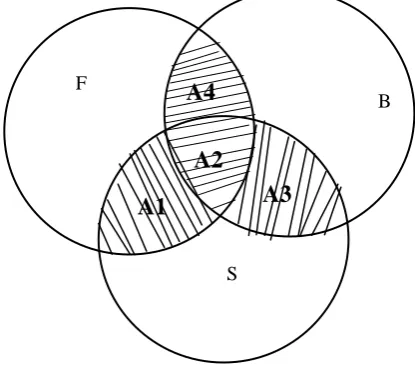
We must note that since human behavior is rarely unidirectional, we must create a more complex derivation of the mathematical model that captures cases of sadness and joy emotions, grief and mourning e.t.c. let’s create new sets A1, A2, A3, A4. Our set A1, A2, A3, A4 will be an intersection of the three sets F, B, S. This is illustrated as follows
Fig. 1: Intersection of the three sets F, B, S.
The portion shaded consist of the elements that belong to one, two or three sets in the F,B,S. A1 denotes a combination of facial and voice expressions, A2, denotes a combination of all the emotional expressions, facial, voice and body while A3 denotes voice and body expressions and A4 denotes facial and body expressions. We now derive the mathematical model.
A1 = F ∩ S - xiii A2 = F∩B∩S - xiv A3 = B∩S - xv A4 = F∩B - xvi
The elements of our new sets A1, A2, A3, A4 will be e.g (x,z), (x,y,z), (y,z) and (x,y) respectably. The elements shall be a concatenation of the elements in the points of intersection. Our formulae shall be as follows: FA1(xi<=n, yj<=m) = F(x)i<=n F(y)j<=m ………...xviia
FA1(x)i<=n,FA (y)j<=m) = A1’ ………..xviib
FA2(xi<=n, yj<=m, zk<=1) = F(x)i<=n F(y)j<=m F(z)k<=1 ………..xviiia
FA2(x)i<=n,F(y)j<=m, F(z)k<=1 = A2’ ………..xviiib
FA4(X)i<=n, (z)k<=1 = F(x)i<=n F(z)k<=1 ………..xxa
FA4(x)k=n, FA3(Z)k<=1 = A4’ ………..xxb
FA3(x)i<=n, (y)j<=m = F(x)i<=n F(y)j<=m ……….xixa
FA3(x)i<=n, F(y)j<=m = A3’
A1
B F
S
A1
A4
A2
4.
CONCLUSION
History of human existence is filled upon with tales of challenges and battles. Man has won and lost a fair share of these battles. The check list is long stuff that hitherto has been left for scientific fiction is now every day experiences of man, from the airplane to electricity to genetic engineering, the victory cries are getting louder and louder. As the world gets more and more individualist, the quest for a companion that understands us and connects to our lives becomes very important. As work puts a lot of pressure on us and the house helps become scarcer, is it possible for our emotional machine to replace the housemaid, know when the baby cries, feed her and sing jingle bell or a local folk song as a lullaby to send her to sleep. Can this machine friend of us understand our mood swings and respond accordingly? Will it be able to offer advice when we share our frustrations with it?
REFERENCES
[1] D. Daniel, L. Jay, Managing Artificial Intelligence & Expert Systems, Yourdon Press, NJ, 1990.
[2] E. Alhoniemi, Analysis of pulping Data Using Self organizing Maps, Tappi Journal, 7(83), 2000, 66.
[3] J. Hollmen, Learning Vector Optimization Algorithm for Probabilistic Models. Proc. 10th European Signal Processing Conference, Tampere, 2000, 721-724.
[4] I. Kohonen, An unsupervised Learning method that produced representation from real information.
Proc. 6th Annimab-1 Conference, Gothenburg, Sweden, 2000, 45-53.
[5] V. Siivola, language Model on Neural Clustering of Words, Martigny, Switzerland, 2000.
[6] J. Vasanto, Neural Network tool for data mining: SOM toolbox. Proc. 5th international symposium on
tools environment and development methods for intelligent system, Finland, 2000, 184-196.
[7] J. Himberg, the Self organizing map as tool for knowledge engineering. Vol 2 FLSI computing series,
2001, pp38-45
[8] A. Iline, detecting process state changes by nonlinear blind source separations: Proc. 3rd international conference on independent component analysis and blind separation, 2001, 704-709.