Belajardisini : The E-learning Framework Based on
Gamification Concept
Eko Sakti Pramukantoro1, Widhi Yahya1
1 Department of Informatics/ Computer Science, Brawijaya University, Indonesia [email protected], [email protected]
Received 21 February 2016; received in revised form 18 March 2016; accepted 25 March 2016
Abstract. The lack of motivation and student engagement in the learning process are the Challenges in education today. E-learning is one of the methods used to resolve these issues.The E-learning, the digital based learning media, enable students to study every where and every time. Basically the e-learning is only used for repository of teaching materials and for evaluation. This kind of learning cannot motivate the learning process. The development of e-learning must be done in order to increase the motivation to learn. The proposed solution extends the e-learning application with the Gamification approach. Gamification is adopted mechanism of the game in non game context. Typically, gamification is used in the business world. The Leaderboard, Challenges, and reward are components that are used to stimulate products sales by marketing. The reward will be given to the top rank salesman on the Leaderboard. This interesting concept can be applied to e-learning to stimulate the learning motivation
1 Introduction
The main problems of the current learning process are the lack of motivation and engagement of the students in the learning process. Variety of approaches are applied, one of them using e-learning. The E-learning ,commonly known as learning management system(LMS), is an approach to facilitate and enhance the learning process by using computer and communication technology. This system is built to provide the interaction directly and indirectly between teachers with students. The development of mobile devices, enabling access to the content of LMS by using a browser on mobile devices.
paper [1], Lim examines the perceptive users in the use of mobile learning in education. He opines that Mobile learning is not learning via smartphones or learn through a wireless connection, the use of smartphones in learning is a tool to support traditional learning.
E-learning and m-learning is used as a storage medium for learning materials, forums, and exams through either online quiz or submissions of assignment. Basically, e-learning does not have a feature that can increase the motivation to learn. Similar problems occurred at the company in motivating working and slack sales. The current solution, the company uses the Leaderboard to increase sales and customer loyalty programs. The management of many companies believe that gamification can be used to motivate involvement, activity and strengthen the relationship between the customer and the employee [2]. For example, IBM uses "Innov8" in every business process, the method used is gamification. In accordance with the report of the research [3], in 2015, more than 50% of organizations applying innovations by using game thinking in every business process including Ebay and Amazon that interested in using gamification in ordering goods.
Nokia in building a community of application developers by providing a container for the incubator, known as the developer level up (DVLUP). DVLUP has Challenges, activities and Leaderboard (Nokia 2014) which is the concept of gamification[4]. Application developers are able to complete the challenge, in this case making the application, will receive XP (experience) or points. Points can be exchanged for goods, such as smartphones.
In the world of education has been applied the game based learning that helps the students to understand a concept through a game. Game based learning and gamification is totally different. Gamification is the use of the game thinking on the fields that are not within the context of the game and not for entertainment. The main characteristics of the game are fun and there is a rule called the game play. Gamification approach can be applied to education, for example to see the loyalty of the class, course or activity at universities and to increase motivation and social relevance. This study proposed an e-learning extend by gamification approach a for the assessment process and determine the activity of students as a complement to traditional learning. The form of gamification that implemented on the e-learning is the implementation of game play (insert the game elements into the learning process), the results of these activities are converted into scores or points. The Leaderboard is used to see the activeness and credit (score) that is obtained by each student. By this manner, the objectives are making the student participating the learning process actively.
2
The theory gamification
p-ISSN: 2540-9433; e-ISSN: 2540-9824
2008 with a variety of approaches. This section will discuss how the intended gamification.
Many notions of gamification, one of them mentions that the gamifications is the use of game's thinking for non gaming context. Previous notions quite short, but it remains unclear what is meant by elements of the game. Game is an activity with the following characteristics:
a. Entertainment
b. Separate space and time
c. Rule
d. Unreal
e. activity based on a goal f. multiplayer
g. each player can interact with other players
The gamification uses the elements of the game, but not in the game context, for example a question in e-learning. The Question is an element of the game, if the player can answer the question will get points. The leader board will shows the high rank of people who often answer the questions correctly. This mechanism can stimulate people to answer the questions correctly.
3 The Proposed Gamification System
The concept of gamification applied to e-learning belajardisini.com. There are several modules that are common on the e-learning modules such as users module, teaching materials, course modules, evaluation modules, the cumulative score module. Game elements that adopted in gamification concepts are the Challenges, points, xp, reward, Leaderboard and game play. Here's an explanation of each element of the game.
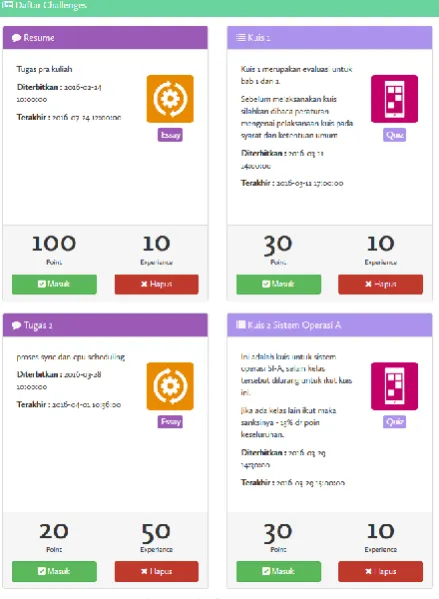
1. The challenge is the e-learning activities in the form of an online multiple choice quiz, assignments submission and essay exam. Each challenge has a point attributes, experience, and time limits.
2. The reward can be the score addition or the goods that can be offered to a student if he had taken some specific points or xp(experience point).
3. The Leaderboard shows the ranking of every student. The information about the event (quizzes, assignment) can be seen in this module. The lecturer in each subject shall determine the maximum points (e.g. 2000 = A, 1750 = B +, 1500 = value B, etc.), making it clear to the students how they should work to get an A score. The students will compete to complete the quiz and challenge as much as possible by this mechanism. It is also as a reference for lecturers to create how many Challenges that must be done by the student.
challenge Leaderboard menu, a list of all students that enrolled the course, and can be sorted by points gained. This is where gamification process begins, there are Challenges with certain points and then the challenge will have an impact on the Leaderboard (one of the elements of gamification).
4 Implementation
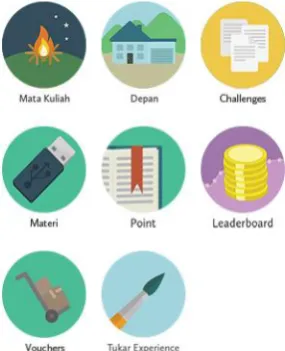
This section will discuss the system that has been created, the main users of this system are the lecturers and students. There are menu for the students shown in the figure 1, such as menu for access to lecture materials, see the challenge, working on Challenges, see the points, see the xp gained, accessing the Leaderboard to see the ranked number of the points and exchange experience with a reward that is determined by the lecturer.
The other side are menus for a lecturer that shown in figure 2. There are some menu, such as, determine the rules (game play) is in the course, making the challenge of the course, determine the points and xp from some challenge, filling the lecture material, determine the reward that will be given at the end of the course and make a final report. Lecturers can create three Challenges, such as: multiple choice, essay and submission of files. If the lecturer will make a challenge in the form of multiple-choice quiz, the lecturer must specify the points, xp and deadlines of the challenge.
Figure 1 The menu for students Figure 2 The menu for lecturers
p-ISSN: 2540-9433; e-ISSN: 2540-9824 Figure 3 Challenges
The activities of students in the lecture recorded on the Leaderboard features. The points in the Leaderboard are the accumulation of points that earned by the students from each challenge.
5 Conclusion and Recommendations
The concept of gamification is an alternative solution that is used in e-learning to improve the learning motivation. The students are required to collect points as much as possible. The Leaderboard indicated the rank of points that are obtained by each student. Point presented the students' abilities. It can be concluded that the Leaderboard can be used to see the ability of each student in a course. The next to be done is researching how the impact of this system when applied in lectures at a university.
Reference
[1]. Lim eang heng (2012) "End user persepective of usability in mobile learning system", 2012, international conference on computer and information science(ICCIS).
[2]. Kai, (2012) “The impact of gamification: a recommendation of scenarios for Education”, Interactive Collaborative Learning (ICL), 2012 15th International Conference on.
[3]. Gartner, (2011). “Gartner Says By 2015, More Than 50 Percent of Organizations That Manage Innovation Processes Will Gamify Those Processes”