A Novel CCA-Secure Verifiable
Authenticated Encryption
Scheme Using BSDH and
q-SDH Assumptions
ITC 4/48
Information Technology and Control
Vol. 48 / No. 4 / 2019 pp. 579-589
DOI 10.5755/j01.itc.48.4.23454
A Novel CCA-Secure Verifiable Authenticated Encryption Scheme Using BSDH and q-SDH Assumptions
Received 2019/05/29 Accepted after revision 2019/09/30
http://dx.doi.org/10.5755/j01.itc.48.4.23454
Corresponding author: [email protected]
Han-Yu Lin
Department of Computer Science and Engineering, National Taiwan Ocean University; 2, Beining Road, Keelung, 202, Taiwan; phone: +886-2-2462-2192 ext 6656; fax: +886-2-2462-3249;
e-mail: [email protected]
When it comes to secure transactions online, the requirements of confidentiality and authenticity are usually concerned the most. The former prevents unauthorized reading, while the latter ensures authorized access. Hy-brid cryptographic mechanisms such as authenticated encryption (AE) schemes, simultaneously combine the functions of public key encryption and digital signature. Some AE schemes also provide a cost-free arbitration mechanism to deal with the signer’s later repudiation. Such schemes have been found to have numerous practi-cal applications like on-line credit card transactions, confidential contract signing and the protection of digital evidence, etc. However, a designated verifier should also have the ability to convince any third party that he/ she is indeed the intended recipient. In this paper, the author presents a novel verifiable authenticated encryp-tion (VAE) scheme with the funcencryp-tionality of recipient proof. Furthermore, the paper shows that the proposed VAE scheme is non-delegatable and provably secure under the random oracle proof models. A non-delegatable hybrid cryptographic scheme provides a higher security level even if the shared common key is compromised. Specifically, the author of the paper will demonstrate that the designed construction is proved secure against adaptive chosen-ciphertext attacks (CCA2) assuming the hardness of Bilinear Square Diffie-Hellman Problem (BSDHP) and secure against adaptive chosen-message attacks (CMA) assuming the hardness of q-Strong Dif-fie-Hellman Problems (q-SDHP).
1. Introduction
A digital signature [5, 18] is an important mechanism of public key cryptosystems [4] and serves the same functionality as the hand-written signature. In a dig-ital signature scheme, a signer owning a private key can create a signature for his/her chosen message such that any person can authenticate the signature with the signer’s public key. Moreover, a signer can-not deny previous signing behavior, which is referred to as the property of no-repudiation [19]. However, for some e-commerce transactions, it is necessary that a digital signature should further satisfy the security requirement of confidentiality. At the same time, the signature can only be verified by a privileged person rather than anyone. Traditionally, the two-step meth-od could achieve this purpose, i.e., first create a signa-ture and then encrypt it with the symmetric manner. In such a way, a designated recipient who possesses the correct decryption key can verify the encrypted signature. It is evident that this method will result in complex processes and higher computational efforts. Therefore, it might be unsuitable for the application scenario which is involved with a large number of on-line transactions.
To provide a better solution, in 1994, Horster et al. [6] integrated the mechanisms of conventional digital signatures and public key encryptions [4] to intro-duce a hybrid system called authenticated encryption (AE). It simultaneously satisfies the security proper-ties of authenticity [21] along with confidentiality [7, 10]. In such a scheme, a signer utilizes two keys, i.e., his/her private key and the verifier’s public key, for creating an authenticated ciphertext and only the in-tended person owning the correct private key can de-crypt it to verify the original signature. Nevertheless, whenever a designated verifier comes across the cir-cumstance that an untruthful signer denies his/her signing behavior, the designated verifier is unable to persuade anyone of the fact.
In general, a secure AE system should satisfy the fol-lowing properties:
1 Confidentiality: Only a designated verifier owning
the correct private key has the privilege to decrypt the resulted ciphertext and validate the signature.
2 Integrity: A designated verifier can ensure the
in-tegrity of decrypted message if its corresponding signature is valid.
3 Unforgeability: Except for the original signer, it is computationally infeasible for any attacker to forge a valid signature.
4 Undeniability: When an original signer denies his/her signing behavior, the designated recipi-ent is capable of non-interactively converting the authenticated ciphertext into a publicly verifiable signature.
5 Non-delegatability: Even if the shared common key
between a signer and the designated recipient is compromised, any attacker cannot decrypt infor-mation in the transmitted ciphertext.
1.1. Related Works
For preventing the dispute over repudiation, in 1999, Araki et al. [1] proposed a new signature system named Convertible Limited Verifier Signature. Their scheme supports the functionality of a later arbitra-tion to settle repudiaarbitra-tion disputes. Yet, this approach must be interactively carried out by the original sign-er and the designated vsign-erifisign-er. In case that a dishonest signer refuses to cooperate, the situation of disputes remains unsolved. Moreover, Zhang and Kim [30] demonstrated that Araki et al.’s system is subjected to the notorious universal forgery attacks on arbitrary chosen messages.
link-age in practical applications, Yoon and Yoo proposed two improved variants [28, 29] to fulfill the property of forward secrecy and support message linkages for message flows.
In 2011, Hsu and Lin [8] adopted key-insulated sys-tems to propose an AE scheme suitable for multi-sign-er environments. In the next year, Lu et al. [16] pre-sented another variant supporting multi-verifier. In 2014, Lin [13] introduced a convertible AE scheme which enables a signer to select flexible signing pol-icies. Considering the multi-signer applications, in 2016, Tahat [23] proposed a convertible multi-AE scheme based on elliptic curve discrete logarithm problem (ECDLP). In 2017, the functionality of proxy delegation is realized in a group-oriented AE scheme [14]. Tsai et al. [24] further presented a publicly verifi-able AE scheme based on factoring and discrete loga-rithms. Even if one of the two cryptographic problems is broken, their scheme could still maintain essential security. Similarly, in 2018, Tahat and Abdallah [22] introduced a hybrid AE variant using chaotic maps and factoring problems. Recently, Lin [15] proposed a novel dual AE scheme suitable for social networking services such as Skype, Line and Facebook Messen-ger.
However, existing AE schemes and their variants with different functionalities primarily rely on the stan-dard cryptographic assumptions such as the Discrete Logarithm (DL) or the Computational Diffie-Hellman (CDH). In addition, these schemes lack of either in-teractive or non-inin-teractive recipient proof mecha-nism to protect the designated verifier’s benefits. This motivates us to think the possibility of constructing an ideal AE scheme providing the functionality of re-cipient proof and with provable security.
1.2. Contributions
In this paper, the author will come up with a novel verifiable AE (a.k.a. VAE) scheme utilizing the Bilin-ear Square Diffie-Hellman (BSDH) and the q-Strong Diffie-Hellman (q-SDH) assumptions. The contribu-tions of the proposed work are listed below:
1 This scheme supports the functionality of
recipi-ent-proof.
2 The requirement of non-delegatability is fulfilled
in the proposed scheme.
3 The proposed scheme is proved secure against
adaptive chosen-ciphertext attacks (CCA2) under the hardness of Bilinear Square Diffie-Hellman Problem (BSDHP).
4 The proposed scheme is secure against
adap-tive chosen-message attacks (CMA) under the hardness of q-Strong Diffie-Hellman Problems (q-SDHP).
5 Compared with related systems, the proposed
scheme is a better alternative owing to a higher se-curity level and better functionalities.
The rest of this paper is organized as follows. In the preliminary section, the author reviews some cryptographic assumptions and the mathemati-cal backgrounds. The composition of the proposed VAE system is introduced in Section 3. A concrete construction is presented in Section 4. The security proofs and comparisons are detailed in Section 5. Fi-nally, a concluding remark is given in Section 6.
2. Preliminaries
For facilitating the introduction of the proposed scheme, the author first states some preliminaries and the underlying cryptographic assumptions. Bilinear Pairing
Let q be a large prime and (G1, G2) denote two
multi-plicative groups of order q. There is a bilinear map e such that e: G1×G1 → G2. Some properties of bilinear
map are stated as follows:
1 Bilinearity:
e(p1p2, q) = e(p1, q)e(p2, q);
e(p, q1q2) = e(p, q1)e(p, q2);
2 Non-degeneracy:
If g is a generator of G1, then e(g, g) is a generator of G2.
3 Computability:
Given p, q ∈G1, there is a polynomial-time algorithm
that can efficiently compute the value e(p, q). q-Strong Diffie-Hellman Problem; q-SDHP Given an instance (g, gx, gx2, …, gxq) ∈G
1q+1where x ∈ Zq*,
output (c, g1/(x + c)) for some c ∈ Z q.
Bilinear Diffie-Hellman Problem; BDHP Given an instance (g, ga, gb, gc) ∈G
14for some a, b ∈Zq*,
compute e(g, g)abc ∈G 2.
Bilinear Diffie-Hellman (BDH) Assumption For all probabilistic polynomial-time algorithm A, the advantage for A to solve the BDHP is negligible. Bilinear Square Diffie-Hellman Problem; BSDHP Given an instance (g, ga, gb) ∈G
13for some a, b ∈Zq*,
compute e(g, g)a2b ∈G 2.
Bilinear Square Diffie-Hellman (BSDH) Assumption For all probabilistic polynomial-time algorithm A, the advantage for A to solve the BSDHP is negligible. According to the research of Zhang et al. [31], the BSDH assumption is as hard as that of BDH, i.e., they are polynomial-time equivalent. This paper shows that BDHP could be reduced to BSDHP. That is, BDHP can be solved by using the capability of break-ing BSDHP. Let three BSDHP instances be (g, ga, gc),
(g, gc, gb) and (g, ga+b , gc), respectively. By breaking
these BSDHP instances, e(g, g)a2c, e(g, g)b2c and e(g, g) (a+b)2c could be obtained. Then an BDHP instance (g, ga,
gb, gc) could be solved by computing
(e(g, g)(a + b)2c / e(g, g)a2c⋅ e(g, g)b2c)1/2 = (e(g, g)(a2c + 2abc + b2c) − (a2c + b2c))1/2
= (e(g, g)2abc)1/2 = e(g, g)abc.
3. Composition of VAE Scheme
Seeing that most existing AE schemes and related variants are based on the assumption of either RSA or (elliptic curve) discrete logarithm, it is unknown whether a secure AE variant could be constructed using different computational assumptions. Moti-vated by the reason, the author of the present paper employed the BSDH and the q-SDH assumptions to propose a novel VAE scheme in this paper. There are three main participated parties in a VAE scheme in-cluding a system authority, a signer and a designated verifier. The system authority is responsible for ini-tializing the system and setting public parameters. A signer can produce an authenticated ciphertext for an intended receiver. When receiving a ciphertext, a
des-ignated verifier could decrypt and verify it with his/ her private key. If necessary, the receiver also has the ability to convince anyone that he/she is the desig-nated verifier without compromising his/her private key. Specifically, a VAE scheme is constituted by eight general algorithms defined as follows:
_ Setup(1k): Given a security parameter k, this
algorithm outputs public parameters.
_ Keygen(i): Given an index i, this algorithm outputs
the corresponding private-and-public key pair.
_ SEnc(m, x
s, yv): Given a message m, the public key
yv of the designated recipient and the private key xs
of signer, the algorithm will output a ciphertext δ.
_ SDec(δ, x
v, ys): Given a ciphertext δ, the private
key xv of designated recipient and the public key
ys of signer, the algorithm will output a decrypted
message m together with its signature Ω.
_ SVerify(m, Ω, y
s): Given a message m, a signature
Ω, and the public key ys of signer, the algorithm will
return True if the signature is valid. Otherwise, an error symbol ⊥ is returned instead.
_ Eval1(δ, u): Given a ciphertext δ and a random
number u, the algorithm will output a recipient proof challenge D.
_ Eval2(D, x
v): Given a recipient proof challenge D
and the private key xv of designated recipient, the
algorithm will output a recipient proof Λ.
_ Judge(δ, Ω, u, Λ): Given a ciphertext δ, a signature
Ω, a random number u and a recipient proof Λ, the algorithm will return True if the recipient proof is correct. Otherwise, an error symbol ⊥ is returned instead.
4. Construction of the Proposed
Scheme
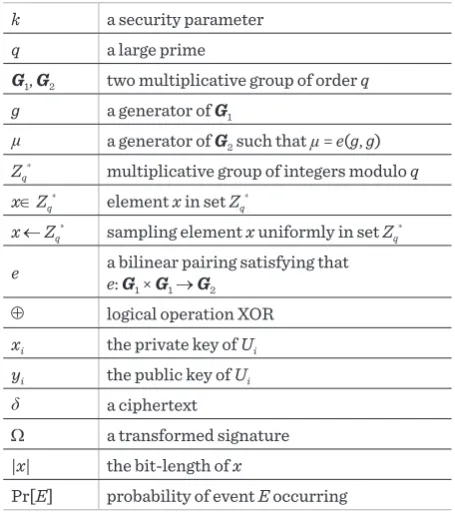
According to the composition of VAE scheme, the au-thor of this paper presents a concrete construction using bilinear pairings. Some utilized notations are defined as Table 1.
_ Setup(1k): On inputting a security parameter k,
the Setup algorithm selects two groups G1 and G2 of
the same prime order q. Let g be a generator of order q over G1, e: G1×G1→G2 a bilinear pairing and h1: {0, 1}k ×G1→ Zq, h2: G12×G2→ {0, 1}k and h3: G1→G1 collision
public parameters params = {G1, G2, q, g, e, µ = e(g, g),
h1, h2, h3}.
Keygen(i): On inputting an index i, the Keygen algo-rithm chooses a private key xi ∈Zq and computes the
corresponding public key yi = gxi.
Table 1
Used symbol notations
k a security parameter
q a large prime
G1, G2 two multiplicative group of order q
g a generator of G1
µ a generator of G2 such that µ = e(g, g)
Zq* multiplicative group of integers modulo q
x∈ Zq* element x in set Z
q*
x ← Zq* sampling element x uniformly in set Zq*
e a bilinear pairinge: G satisfying that
1 × G1→G2
⊕ logical operation XOR
xi the private key of Ui
yi the public key of Ui
δ a ciphertext
Ω a transformed signature |x| the bit-length of x
Pr[E] probability of event E occurring
_ SEnc(m, x
s, yv): On inputting a message m, the
public key yv of the designated recipient and the
private key xs of signer, the algorithm chooses t ∈ Zq*
to compute
T = yvt, (1)
R = gt, (2)
z = e(yvxs, h3(R)), (3)
σ = g1/(xs + h1(m, R)), (4)
r = m ⊕ h2(R, σ, z), (5)
and then outputs the authenticated ciphertext
δ = (T, σ, r).
_ SDec(δ, y
s, xv): On inputting an authenticated
ciphertext δ = (T, σ, r), the private key xv of designated
recipient and the public key ys of signer, the algorithm
computes
R = T xv−1, (6)
z = e(ysxv, h3(R)), (7)
and recovers the message m as
m = r ⊕ h2(R, σ, z). (8)
The transformed signature for m is Ω = (R, σ).
Theorem 1. A designated verifier can correctly reco- ver the original message with Eq. (8).
Proof: From the right-hand side of Eq. (8), it can be derived that
r ⊕ h2(R, σ, z)
= r ⊕ h2(R, σ, e(ysxv, h3(R)))
(by Eq. (7))
= r ⊕ h2(R, σ, e(ysxv, h3(T xv−1))) (by Eq. (6))
= r ⊕ h2(R, σ, e(ysxv, h3(yvtxv−1))) (by Eq. (1))
= r ⊕ h2(R, σ, e(yvxs, h3(gt)))
= r ⊕ h2(R, σ, z)
(by Eq. (3))
= m (by Eq. (5))
which leads to the left-hand side of Eq. (8).
_ SVerify(m, Ω, y
s): On inputting a message m, a
signature Ω = (R, σ), and the public key ys of signer, the
algorithm verifies the signature by checking if
e(σ, gh1(m, R)y
s) = µ. (9)
If it holds, the algorithm returns True; else, an error symbol ⊥ is returned as a result.
Theorem 2. A designated verifier can correctly verify the signer’s signature with Eq. (9).
Proof: From the left-hand side of Eq. (9), it can be ob-tained that
e(σ, gh1(m, R)y s)
= e(g1/(xs + h1(m, R)), gh1(m, R)y s)
= e(g, g) = µ
(by Eq. (4))
which leads to the right-hand side of Eq. (9).
_ Eval1(δ, u): On inputting a ciphertext δ = (T, σ, r)
recipient proof challenge D as
D = Tu. (10)
_ Eval2(D, x
v): On inputting a recipient proof
challenge D and the private key xv of designated
recipient, the algorithm computes a recipient proof
Λ as
Λ = Dxv−1. (11)
_ Judge(δ, Ω, u, Λ): On inputting a ciphertext δ = (T,
σ, r), a signature Ω = (R, σ), a random number u and a recipient proof Λ, the algorithm verifies whether
Λ = Ru. (12)
If it holds, the algorithm returns True; else, an error symbol ⊥ is returned as a result.
5. Security Proof and Efficiency
In this section, the author first proves the security of the proposed scheme and then evaluate the efficien-cy of this system. Some comparisons with previous mechanisms in terms of security properties and func-tionalities are also made.
5.1. Security Proofs
The underlying security assumptions of this work are BSDH and q-SDH. The former is a variant of the well-known intractable BDH assumption that has been adopted in many cryptographic schemes while the latter is introduced by Boneh and Boyen [3] in 2008. According to their literature, the q-SDH assumption could be regarded as a discrete logarithm analogue of the Strong RSA assumption. Therefore, it can be suggested that it is difficult for any adversary to break either the BSDH or the q-SDH assumption with any technique of computing attacks.
Definition1. (Confidentiality) A VAE scheme is secure against adaptive chosen-ciphertext attacks (CCA2) in the random oracle model if no probabilistic polynomial-time adversary A having a non-negligible advantage to beat a challenger B in the following game: Setup: The challenger B first delivers public parame-ters params to the adversary A.
Phase 1: A is permitted to submit several queries adaptively below.
_ Keygen query 〈i〉: Whenever A asks a Keygen query
〈i〉, B returns (yi, Certi) to A.
_ SEnc query 〈m, y
i, yj〉: Whenever A asks an SEnc
query for some message m with respect to the public keys (yi, yj), B returns a corresponding
ciphertext δ to A.
_ SDec query 〈δ, y
i, yj〉: Whenever A asks an SDec
query for some ciphertext δ with respect to the public keys (yi, yj), B returns a decrypted message
along with a transformed signature Ω.
_ SVerify query 〈m, Ω, y
i〉: Whenever A asks an
SVerify query for some message m, a transformed signature Ω with respect to the public key yi, B
returns either True or an error symbol ⊥ depending on the validity of the signature Ω.
_ Eval1 query 〈δ, u〉: Whenever A asks an Eval1 query
for some ciphertext δ and a random number u, B returns a recipient proof challenge D.
_ Eval2 query 〈D, y
j〉: Whenever A asks an Eval2
query for some recipient proof challenge D and the public key yj of designated recipient, B returns a
recipient proof Λ.
_ Judge query 〈δ, Ω, u, Λ〉: Whenever A asks a Judge
query for some ciphertext δ, a transformed signature Ω, a random number u and a recipient proof Λ, B returns either True or an error symbol ⊥ depending on the validity of the recipient proof Λ. Challenge: A picks up two messages of the same length, say m0 and m1. The challenger B will create
an authenticated ciphertext δ* for mλ which is deter-mined by an internal flipped coin λ← {0, 1} and then the ciphertext δ* is returned to A as a challenge. Phase 2: A submits new queries as those described in Phase 1. Note that any SDec query in relation to the target challenge is not allowed.
Guess: At the end of this game, A outputs a bit λ′. It can be said that A is the winner of the game on con-dition that λ′ = λ. The advantage of A is thus could be defined as Adv(A) = | Pr[λ′ = λ] − 1/2 |.
Theorem 3. (Proof of Confidentiality) The proposed VAE scheme can resist adaptive chosen-ciphertext at-tacks (CCA2) in the random oracle model if no proba-bilistic polynomial-time adversary having a non-neg-ligible advantage to break the BSDHP.
advan-tage ε to plot the adaptive chosen-ciphertext attacks for breaking the proposed VAE scheme. The adver-sary A will submit at most qi queries for each kind of
oracle i. In this case, one could build another algo-rithm B that would have a non-negligible advantage to break the BSDHP by employing A’s advantage. The goal of the algorithm B is to compute e(g, g)a2b by
in-putting a problem instance (g, ga, gb). In the following
proof, a challenger will be acted by B for answering the queries of A.
Setup: The challenger B first performs the Setup(1k)
algorithm and then delivers public parameters params = {G1, G2, q, g, e, µ = e(g, g)} to the adversary A. Phase 1: A is granted to adaptively submit the follow-ing oracle queries:
_ h
1 oracle: When being queried with an h1(m, R)
oracle, B first looks a matched record up in the h1
-list. If not, B chooses v1∈R Zq, keeps (m, R, v1) in the
h1-list and then returns v1.
_ h
2oracle: When being queried with an h2(R, σ, z)
oracle, B first looks a matched record up in the h2
-list. If not, B seeks an entry of the form (R, σ, NULL, v2) and then replaces NULL with z. Otherwise, B
chooses v2∈R {0, 1}k, keeps (R, σ, z, v2) in the h2-list
and then returns v2.
_ h
3 oracle: When being queried with an h3(R) oracle,
B first looks a matched record up in the h3-list. If
not, B chooses v3∈R G1, keeps (R, v3) in the h3-list
and then returns v3.
_ Keygen query 〈i〉: When being queried with a Keygen
query 〈i〉, B responds as follows. If i = Us, B returns
ys (= ga). If i = Uv, B returs yv (= gb). Otherwise, B
returns yi← Keygen(i) to A.
_ SEnc query 〈m, y
i, yj〉: When being queried with an
SEnc query for some message m with respect to the public keys (yi, yj), B returns δ← SEnc(m, xi, yj) if yi
≠ ga. Whenever y
i = ga, B would abort.
_ SDec query 〈δ, y
i, yj〉: When being queried with an
SDec query for some ciphertext δ with respect to the public keys (yi, yj≠ gb), B returns (m, Ω) ←
SDec(δ, yi, xj) to A. In case that yj = gb, B searches all
records containing (R, σ) in the h2-list. As long as
any v2 satisfies the equality of e(σ, gh1(r⊕v2, R)ys) = µ, B
returns {m = r ⊕ v2, Ω = (R, σ)}; else, B would abort.
_ SVerify query 〈m, Ω, y
i〉: When being queried with
an SVerify query for some 〈m, Ω, yi〉, B returns the
result of SVerify(m, Ω, yi) to A.
_ Eval1 query 〈δ, u〉: When being queried with an
Eval1 query for some 〈δ, u〉, B returns a recipient proof challenge D ← Eval1(δ, u) to A.
_ Eval2 query 〈D, y
j〉: When being queried with an
Eval2 query for some 〈D, yj〉 where yj≠ga or gb, B
returns a recipient proof Λ ← Eval2(D, xj) to A.
Otherwise, B would abort.
_ Judge query 〈δ, Ω, u, Λ〉: When being queried with
a Judge query for some 〈δ, Ω, u, Λ〉, B returns the result of Judge(δ, Ω, u, Λ) to A.
Challenge: A picks up two messages of the same length, say m0 and m1. The challenger B creates an
au-thenticated ciphertext δ* for mλ which is determined by an internal flipped coin λ← {0, 1} as follows: Step 1 Choose d, t, v1∈R Zq*, σ*∈R G1 and v2∈R {0, 1}k;
Step 2 Compute T* = gbt and R* = gt;
Step 3 Compute r* = mλ⊕ v2;
Step 4 Add the entry (mλ, R*, v1) into h1-list; Step 5 Add the entry (R*, gad) into h
3-list;
Step 6 Add the entry (R*, σ*, NULL, v2) into h2-list.
The ciphertext δ* = (T*, σ*, r*) is viewed as a target challenge for A.
Phase 2: A could ask new queries just like those of Phase 1.
Output: At the end of this game, A outputs a bit λ′ and B randomly selects a value z of some record in the h2
-list to compute zd−1 as its answer to the BSDHP.
Analysis of the game: On the basis of SDec algorithm defined above, the adversary A getting the challenge
δ* = (T*, σ*, r*) would try to decrypt it for recovering the original message mλ. To accomplish this job, A has to query an h2(R*, σ*, z*) oracle. Meanwhile, in the
challenge phase, B has set h3(R*) = gad and designated
the value v2 as the output of h2(R*, σ*, z*) is which z* =
e(ysxv, gad) = e((ga)b, gad) = e(P, P)a2bd. As long as the
ad-versary A submits the above expected h2 oracle query
during phase 2, it is clear that B would have a non-neg-ligible advantage to break the inputted instance of BSDHP. Although it is possible for the adversary A to successfully guess the correct value of an h2 oracle
query, it can be claimed that the probability for such an event occurring is not greater than 2−k. It also
im-plies that the probability of the desired value z* stored in the h2-list is not less than (ε− 2−k). By randomly
selecting a value z from the h2-list to compute zd −1
the problem answer, B would have the chance of qh2−1
to get the correct z*, i.e., Pr[z = z*] could be expressed as qh2−1. Thus, it can be claimed that B breaks the
in-stance of BSDHP with a non-negligible advantage (qh2−1)(ε− 2−k) in polynomial-time assuming the entire
interactive game is perfectly simulated without acci-dentally termination.
Definition2. (Unforgeability) A VAE scheme is se-cure against adaptive chosen-message attacks (CMA) in the random oracle model if no probabilistic polyno-mial-time adversary A having a non-negligible advan-tage to beat a challenger B in the following game: Setup: The challenger B first delivers public parame-ters params to the adversary A.
Phase 1: A is permitted to submit Keygen, SEnc, SVer-ify, Eval1, Eval2 and Judge queries as those described in Definition 1 adaptively.
Forgery: A finally chooses a message m* and then forges an authenticated ciphertext δ*. It can be said that A is the winner of the game on condition that δ* is valid. It should be noted that δ* cannot be obtained from any SEnc query.
Theorem 4.(Proof of Unforgeability) The proposed VAE scheme can resist adaptive chosen-message at-tacks (CMA) in the random oracle model if no probabi-listic polynomial-time adversary having a non-negli-gible advantage to break the q-SDHP.
Proof: Assume there is a probabilistic polynomi-al-time adversary A who has a non-negligible advan-tage ε to plot the adaptive chosen-message attacks for breaking the proposed VAE scheme. The adversary A will submit at most qi queries for each kind of oracle i.
In this case, one could build another algorithm B that would have a non-negligible advantage to break the q-SDHP by employing A’s advantage. The goal of the algorithm B is to compute (c, g1/(a + c)) for some c ∈ Z
q by
inputting a problem instance (g, ga, ga2, …, gaq) ∈G 1q+1.
In the following proof, a challenger will be acted by B for answering A’s queries.
Setup: The challenger B first initializes the Set-up(1k) algorithm and then delivers public parameters
params = {G1, G2, q, g, e, µ = e(g, g)} to the adversary A. Phase 1: A is granted to adaptively submit h1, h2 and
h3 oracles and SEnc, SVerify, Eval1, Eval2 and Judge
queries as those of Theorem 1. Note that when A makes a Keygen query 〈i〉 for i = Us, B returns ys (= ga)
to A. Otherwise, B returns yi← Keygen(i) to A.
Forgery: A outputs a forged authenticated ciphertext
δ* = (T*, σ*, r*) for some message m* with respect to the public keys (yi, yj).
Output: At the end of this game, B outputs (h1(m*, R*),
σ*) as the answer to the q-SDHP instance.
Analysis of the game: If the forged ciphertext δ* = (T*, σ*, r*) for some message m* is valid and in rela-tion to the public keys (yi*, yj*) where yi* = ga, one can
know that σ* = g1/(xi + h1(m*, R*)) = g1/(a + c) for c = h
1(m*, R*).
Consequently, (h1(m*, R*), σ*) is a correct answer to
the q-SDHP instance. By utilizing A’s non-negligible advantage ε, B would also a non-negligible advantage nε (where n is the likelihood for yi* = ga) to solve the
q-SDHP instance in polynomial-time.
In accordance with Theorem 4, it is evident that the pro-posed VAE scheme could withstand existential forgery attacks. Provided that there is no probabilistic poly-nomial-time adversary that could steal or forge a valid signing key, a signer cannot deny his/her signing behav-ior. Therefore, the following corollary can be obtained. Corollary 1. The proposed VAE scheme is secure in terms of the security characteristic of non-repudiation. 5.2. Efficiency
For evaluating the performance of the proposed VAE system, some adopted operations and their notations are first defined below:
B: To compute a bilinear pairing operation; H: To compute a secure one-way hash function; E: To compute an exponentiation computation in G1. Other operations like the exclusive-OR and the addi-tion are neglected since these operaaddi-tions are relative-ly insignificant. The detailed computational and com-municational evaluation results are demonstrated in Tables 2 and 3.
In order to make sure the practical feasibility of the proposed VAE system, the author of the paper further compare it with several previous mechanisms including Tsai et al.’s (a.k.a. TLT) [24], the Tahat-Abdallah (a.k.a. TA) [22], Tahat’s [23] and Lin’s [15] works. For conve-nience, some evaluated parts are first defined below: C1: Convertible Signature
C2: Recipient Proof C3: Non-delegatable C4: CCA-Secure
C5: Security Assumptions
Table 2
Computational evaluation of the proposed VAE system
Algorithm Complexity
Keygen E
SEnc 3H + 4E + B
SDec 2H + 2E + B
SVerify H + E + B
Eval1 E
Eval2 E
Judge E
Table 3
Communicational evaluation of the proposed VAE system
Item Evaluation
Ciphertext Length 2|G1| + |k|
Signature Length 2|G1|
Table 4
Comparisons of the proposed and previous schemes
TLT TA Tahat Lin Proposed
C1 √ √ √ √ √
C2 × × × × √
C3 √ √ √ √ √
C4 ∆* ∆* ∆* √ √
C5 DL & FA Chaotic map ECDLFA & BDH &ECDL BSDH &q-SDH
C6 × × × √ √
Remark*: The symbol ∆ stands for unknown, as the authors
did not provide related security proofs.
Itemized comparisons in the light of functionalities and security are summarized as Table 4. According to this table, it could be seen that the proposed VAE system not only provides better functionalities, but is also more secure.
6. Conclusions
Authenticated encryption schemes played an import-ant role in the applications of the digital world such as on-line auctions, confidential transactions and the protection of digital evidence, etc. In this paper, the author put the emphasis on the security requirement of non-delegatability along with the functionality of recipient proof and then proposed a novel verifiable AE (a.k.a. VAE) scheme based on the computational assumptions of BSDH and q-SDH. Unlike previous mechanisms which only provide heuristic security analyses, the paper formally prove that the proposed VAE scheme is secure under the attacking game models of adaptive chosen-ciphertext (CCA2) and adaptive chosen-message (CMA). The results of the computational evaluation of the proposed scheme reveal that the SEnc, the SDec and the SVerify algo-rithms only require to perform the time-consuming bilinear pairing computation once, which makes the proposed system suitable for practical implementa-tion. As compared with previous similar approaches, the proposed VAE construction not only has a higher security level, but also supports better functionality. Acknowledgement
This work was supported in part by the Ministry of Science and Technology of Republic of China under the contract number MOST 108-2221-E-019-027.
References
1. Araki, S., Uehara, S., Imamura, K. The Limited Verifier Signature and Its Application. IEICE Transactions on Fundamentals, 1999, E82-A(1), 63-68.
2. Arshad, R., Ikram, N. A Novel Convertible Authenti-cated Encryption Scheme Based on RSA Assumption. Information Assurance and Security Letters, 2010, 1, 041-046.
3. Boneh, D., Boyen, X. Short Signatures Without Random Oracles and the SDH Assumption in Bilinear Groups.
Journal of Cryptology, 2008, 21(2), 149-177. https://doi. org/10.1007/s00145-007-9005-7
6. Horster, P., Michel, M., Peterson, H. Authenticated En-cryption Schemes with Low Communication Costs. Electronics Letters, 1994, 30(15), 1212-1213. https:// doi.org/10.1049/el:19940856
7. Hou, F., Wang, Z., Tang, Y., Liu, Z. Protecting Integrity and Confidentiality for Data Communication. Proceed-ings of the 9th International Symposium on Computers and Communications (ISCC), 2004, 1(28), 357-362. https://doi.org/10.1109/ISCC.2004.1358430
8. Hsu, C. L., Lin, H. Y. New Identity-Based Key-Insu-lated Convertible Multi-Authenticated Encryption Scheme. Journal of Network and Computer Applica-tions, 2011, 34(5), 1724-1731. https://doi.org/10.1016/j. jnca.2011.06.005
9. Huang, H. F., Chang, C. C. An Efficient Convertible Au-thenticated Encryption Scheme and Its Variant. Pro-ceedings of the 5th International Conference on Infor-mation and Communications Security (ICICS2003), Springer-Verlag, Berlin, 2003, 382-392. https://doi. org/10.1007/978-3-540-39927-8_35
10. Jacob, J. A Uniform Presentation of Confidenti-ality Properties. IEEE Transactions on Software Engineering, 1991, 17(11), 1186-1194. https://doi. org/10.1109/32.106973
11. Lee, C. C., Hwang, M. S., Tzeng, S. F. A New Convertible Authenticated Encryption Scheme Based on the El-Gamal Cryptosystem. International Journal of Foun-dations of Computer Science, 2009, 20(2), 351-359. https://doi.org/10.1142/S0129054109006607
12. Li, F., Sun, X., Zhang, X., Wan, L., Yan, S. A New Au-thenticated Encryption Schemes Without Using Hash and Redundancy Functions. Proceedings of 2010 the 2nd International Conference on Industrial Mecha-tronics and Automation, 2010, 1, 378-381. https://doi. org/10.1109/ icindma.2010.5538129
13. Lin, H. Y. Group-Oriented Data Access Structure Us-ing Threshold-CAE Scheme and Its Extension. Infor-mation Technology and Control, 2014, 43(3), 252-263. https://doi.org/10.5755/j01.itc.43.3.5708
14. Lin, H. Y. PCMAE: A Proxy Convertible Multi-AE Scheme and Its Variant. Information Technology and Control, 2017, 46(4), 530-545. https://doi.org/10.5755/ j01.itc.46.4.15819
15. Lin, H. Y. A Novel Dual Authenticated Encryption Scheme Suitable for Social Networking Services. Applied Sciences, 2019, 9(7-1452), 1-11. https://doi. org/10.3390/app9071452
16. Lu, C. F., Hsu, C. L., Lin, H. Y. Provably Convertible Multi-Authenticated Encryption Scheme for Gener-alized Group Communications. Information Scienc-es, 2012, 199(15), 154-166. https://doi.org/10.1016/j. ins.2012.02.051
17. Lv, J., Wang, X., Kim, K. Practical Convertible Au-thenticated Encryption Schemes Using Self-Certified Public Keys. Applied Mathematics and Computation, 2005, 169(2), 1285-1297. https://doi.org/10.1016/j. amc.2004.10.057
18. Rivest, R., Shamir, A., Adleman, L. A Method for Obtain-ing Digital Signatures and Public-Key Cryptosystems. Communications of the ACM, 1978, 21(2), 120-126. https://doi.org/10.1145/357980.358017
19. Schneider, S. Formal Analysis of a Non-Repudia-tion Protocol. Proceedings of 11th IEEE Computer Security Foundations Workshop, IEEE Press, Pis-cataway, USA, 1998, 54-65. https://doi.org/10.1109/ CSFW.1998.683155
20. Sekhar, M. R. Signatures Scheme with Message Recov-ery and Its Applications. International Journal of Com-puter Mathematics, 2004, 81(3), 285-289. https://doi.or g/10.1080/00207160410001661294
21. Stallings, W. Cryptography and Network Security: Prin-ciples and Practices, 4th Ed., Pearson, 2005.
22. Tahat, N., Abdallah, E. Hybrid Publicly Verifiable Au-thenticated Encryption Scheme Based on Chaotic Maps and Factoring Problems. Journal of Applied Se-curity Research, 2018, 13(3), 304-314. https://doi.org/1 0.1080/19361610.2018.1463135
23. Tahat, N. Convertible Multi-Authenticated Encryp-tion Scheme with VerificaEncryp-tion Based on Elliptic Curve Discrete Logarithm Problem. International Journal of Computer Applications in Technology, 2016, 54(3), 229-235. https://doi.org/10.1504/IJCAT.2016.10000490 24. Tsai, C. Y., Liu, C. Y., Tsaur, S. C., Hwang, M. S. A Publicly
Verifiable Authenticated Encryption Scheme Based on Factoring and Discrete Logarithms. International Jour-nal of Network Security, 2017, 19(3), 443-448.
25. Tzeng, S. F., Tang, Y. L., Hwang, M. S. A New Convert-ible Authenticated Encryption Scheme with Message Linkages. Computers and Electrical Engineering, 2007, 33(2), 133-138. https://doi.org/10.1016/j.com-peleceng.2006.02.005
27. Wu, T. S., Lin, H. Y. Secure Convertible Authenticated Encryption Scheme Based on RSA. Informatica, 2009, 33(4), 481-486. https://doi.org/ 10.31449/inf.v33i4.265 28. Yoon, E. J., Yoo, K. Y. A Practical Convertible
Authenti-cated Encryption Scheme with Message Linkages and Forward Secrecy. Proceedings of 2011 14th IEEE In-ternational Conference on Computational Science and Engineering, 2011, 339-342. https://doi.org/10.1109/ CSE.2011.117
29. Yoon, E. J., Yoo, K. Y. Improved Hwang et al.’s Convert-ible Authenticated Encryption Scheme with Message Linkages for Message Flows. Proceedings of 2011 the
2nd International Conference on Networking and Distributed Computing, 2011, 183-186. https://doi. org/10.1109/ICNDC.2011.44
30. Zhang, F., Kim, K. A Universal Forgery on Araki et al.’s Convertible Limited Verifier Signature Scheme. IEICE Transactions on Fundamentals, 2003, E86-A(2), 515-51. 31. Zhang, F., Safavi-Naini, R., Susilo, W. An Efficient