907
The Development of Mathematical Model for the Prediction of Ageing Behaviour
for Al-Cu-Mg/Bagasse Ash Particulate Composites
V.S. Aigbodion*, S.B. Hassan, E.T. Dauda and R.A. Mohammed
Department of Metallurgical and Materials Engineering,
Ahmadu Bello University, Samaru, Zaria, Nigeria
*Corresponding Author: [email protected]
ABSTRACT
The thermal ageing behaviour model of Al-Cu-Mg/Bagasse ash particulate composites with
2-10wt% bagasse ash particles produced by double stir-casting method was developed in terms of
weight fraction of bagasse ash, ageing temperature and time. Hardness values measurement was
used in determining the ageing behaviour, after solution and age-hardened heat-treatment. The
experimental results demonstrate that the bagasse ash was the major parameter in the ageing
behaviour, followed by ageing temperature. The hardness values decreased as the ageing time
increases, interaction of weight of bagasse ash, ageing time and ageing temperature. Moreover,
the optimal combination of the testing parameters could be predicted. The predicted hardness
values were found to lie close to that of the experimentally observed ones. The developed
mathematical model can be employed for optimization of the process parameters of the ageing
behaviour of Al-Cu-Mg/Bagasse ash particulate composites with respect to hardness values.
Keywords: Al-Cu-Mg alloy, Ageing temperature and time, Analysis of variance, Bagasse Ash
and Linear regression
1. INTRODUCTION
methods such as casting, rolling, forging, extrusion and as a final process, machining [1-3].
Recently, there has been an increasing interest in composites containing low density and low
cost reinforcements [4-5]. Among various discontinuous dispersions used bagasse ash has been
found to be one of the most inexpensive and low density reinforcement available in large quantities as
solid waste from the sugar processing mill [3, 6]. Hence, composites with bagasse ash as
reinforcement are likely to overcome the cost barrier for wide spread applications in automotive
and small engine applications. It is therefore expected that the incorporation of bagasse ash
particles in aluminium alloy will promote yet another use of this low-cost waste by-product and,
at the same time, have the potential for conserving energy- intensive aluminium and thereby,
reducing the cost of aluminium products [3, 6].
The age hardening characteristics of an alloy are generally modified by the introduction of
reinforcement. These modifications are due to the manufacturing process, the reactivity between
the reinforcement and the matrix, the size, morphology and volume fraction of the reinforcement.
Strength increment due to ageing is necessary in aluminium alloys because it helps to develop
acceptable mechanical properties [1].
The earlier works [7-11] concluded that the addition of discontinuous ceramic particles into
aluminium matrix resulted in the dislocation generation leading to different ageing kinetics
compared to monolithic alloys. Thus, there is a complexity involved in the ageing process of
composites when compared with that of unreinforced alloys [8]. Hence, an attempt has been
made in the present investigation to study and systematically record the effects of heat-treatment
parameters on hardness of Al-Cu-Mg/BAp composite. The age-hardening model of these
composites was developed based on the weight fraction of bagasse ash, ageing temperature and
time. Further more analysis of variance (ANOVA) is employed to investigate the testing
characteristics of the Al-Cu-Mg/BAp composite
s.
2. MATERIALS AND EXPERIMENTAL PROCEDURE
The test coupons were polished at both the ends. The test samples were solution heat-treated at
temperature of 500
oC in an electrically heated furnace, soaked for 3 hours at this temperature and
then rapidly quenched in warm water at 65
oC. Thermal ageing of the quenched samples were
carried out at temperatures of 100, 200 and 300
oC, for various ageing times until the peak ageing
is exceeded [3]. The ageing characteristic of these grades of composites was evaluated using
hardness values obtained from age-hardening samples.
The hardness values of both as-cast and thermally age-hardened samples were determined
according to the provisions in ASTM E18-79 using the Rockwell hardness tester on “B” scale
(Frank Welltest Rockwell Hardness Tester, model 38506) with 1.56mm steel ball indenter, minor
load of 10kg, major load of 100kg and hardness value of 101.2HRB as the standard block.
Before the test, the mating surface of the indenter, plunger rod and test samples were thoroughly
clean by removing dirt, scratches and oil and calibration of the testing machine using the
standard block. The samples were placed on anvils, which act as a support for the test samples.
A minor load of 10kg was applied to the sample in a controlled manner without inducing impact
or vibration and zero datum position was established, and then the major load of 100kg was then
applied, the reading was taken when the large pointer came to rest or had slowed appreciably and
dwelled for up to 2 seconds. The load was then removed by returning the crank handle to the
latched position and the hardness value read directly from the semi automatic digital scale [1, 8].
The sequence of operations involved in the heat treatment is solutionizing, quenching, thermal
ageing and air-cooling. In the above mentioned sequence, the independently controllable
predominant process parameters considered for the investigation are ageing temperature (AT),
Bagasse ash particles (BAp) and ageing time (At) at two levels [9]. The two levels decided for
each of the three process parameters with their units and notations are given in Table 1.
Table 1: Statistical Design of the Ageing Process.
Factors
Low level
High level
Temperature (A
T) 100
oC 300
oC
%wt of (BAp)
2.0
10.0
Time(A
t) 1hr
14hrs
[image:4.612.66.438.81.254.2]
(5)Table 2: Factorial Design of the Ageing Process Showing Treatment Combination
Exp.number
Temperature level
%wt of BAp
level
Time level
1 -1 -1
-1
A
T+1 -1
-1
BAp -1 +1
-1
A
TBAp
+1
+1
-1
A
t-1 -1
+1
A
TA
t+1 -1
+1
BAp A
t-1
+1 +1
A
TBAp A
t+1
+1 +1
Coded=-1(low level), +1(upper level), BAp (Bagasse ash particles
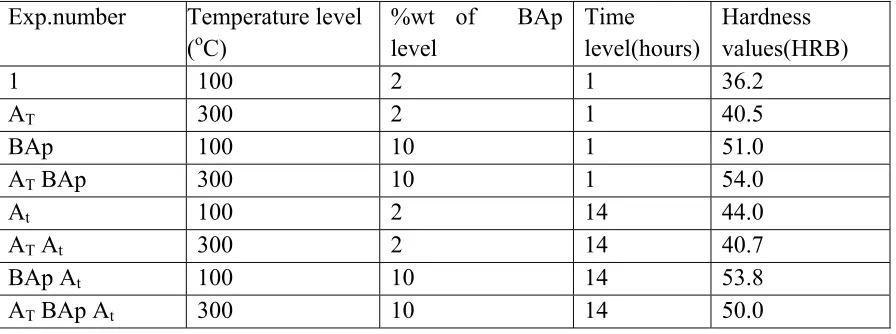
The test results were recorded against the standard order of sequence as shown in Table 3.
Table 3: Standard Order of Test Sequence and Result
Exp.number Temperature
level
(
oC)
%wt of BAp
level
Time
level(hours)
Hardness
values(HRB)
1 100
2 1
36.2
A
T300 2 1
40.5
BAp 100 10 1
51.0
A
TBAp
300
10
1
54.0
A
t100 2 14
44.0
A
TA
t300 2
14
40.7
BAp A
t100
10
14 53.8
A
TBAp A
t300
10
14
50.0
The sum of squares for main and interaction effects was calculated using Yates algorithm. The
significant factors (main and interaction) were identified by analysis of variance (ANOVA)
technique [13].
3. DEVELOPMENT OF MATHEMATICAL MODEL
[image:4.612.68.516.378.545.2]W=ƒ (A
T, B
P, A
t) --- (1)
Where A
T= Ageing temperature
B
P= weight % bagasse ash particle
A
t =Ageing time
The model selected includes the effects of main variables first-order and second-order
interactions of all variables. Hence the general model is written as:
W=
β
o+
β
1A
T+β
2B
P+β
3A
t+β
4A
TB
P+β
5A
TA
t+β
6B
PA
t +β
7A
TB
PA
t---(2)
Where
β
ois average response of W and
β
1,β
2,β
3,β
4,β
5,β
6,β
7are coefficients associated with each
variable A
T, B
P, A
tand interaction are calculated using the linear regression method [13].
4. RESULTS AND DISCUSSION
The composition and properties of the bagasse ash used in this study is shown in Table 4.
Table 4. Composition and properties of Bagasse ash particles.
Constituent Formula Cliftonite,(C), Quartz (SiO
2,), Moissanite(SiC), Titanium Oxide(Ti6O)
Density and phase
1.95g/cm
3and Solid
Refractoriness
1600
oC
Appearance(color) Black-Odorless
powder
Size 64µm
Hardness values
75.05 HRB
0 10 20 30 40 50 60 70
60 300 540 780
[image:6.612.181.442.87.234.2]Ageing Time(Minutes) H a rd n ess val u e s (HR B) 0Wt% 2Wt% 4Wt% 6Wt% 8Wt% 10Wt%
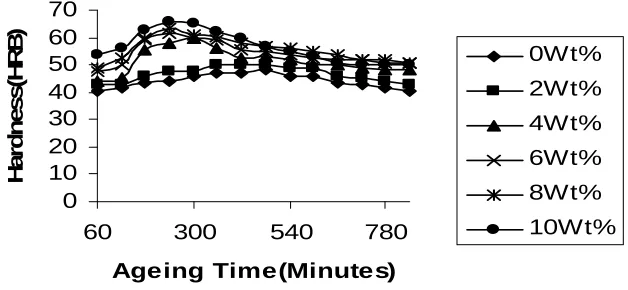
Figure 1: Variation of the Hardness values with Ageing Time at Ageing Temperature of 100
oC.
0 10 20 30 40 50 60 70
60 300 540 780
[image:6.612.177.447.297.444.2]Ageing Time(Minutes) Hard n e ss val u es( HRB) 0Wt% 2Wt% 4Wt% 6Wt% 8Wt% 10Wt%
Figure 2: Variation of the Hardness values with Ageing Time at Ageing Temperature of 200
oC.
0 10 20 30 40 50 60 70
60 300 540 780
Ageing Time(Minutes) Ha rd n e s s (H RB) 0Wt% 2Wt% 4Wt% 6Wt% 8Wt% 10Wt%
[image:6.612.154.468.507.652.2]From Figures 1-3, it can be seen that there is steep rise in hardness values of each grade of the
composite at initial stages for all ageing temperatures and then fell after reaching the various
peak ageing time, corresponding to over ageing. However, at higher ageing temperature the
materials developed peak hardness at shorter ageing time, because the rate of precipitation of the
second phase materials is faster and hence increases in hardness values. The time to obtain peak
hardness is shorter according to the sequence: 100
OC > 200
OC > 300
OC (see Figures 1-3).
The thermal age hardening behavior of the Al-Cu-Mg/BAp particulates composites are similar to
Al-Cu/SiC particulates as reported by Suresh et al [9] i.e. hardness continuously increases to a
maximum during thermal ageing and them decreases later due to over ageing. It is interesting to
note that in the reinforced aluminium alloy metal-matrix, as the volume fraction of bagasse ash
particle increase to 10wt% in the aluminium alloy, there is a monotonic reduction in the time
required to reach peak hardness (see Figure 3).
[image:7.612.68.509.514.720.2]The 10Wt%BAp addition yielded the highest hardness value. As far as hardening behavior of
the composites is concerned, particle addition in the matrix alloy increases the strain energy in
the periphery of the particles in the matrix and these tendencies may be due to the formation of
the dislocation at the boundary of the ceramic particles by the difference in the thermo-expansion
coefficient between the matrix and ceramic particles during solution treatment and quenching
since a lot of dislocations generate in the main matrix/particle interface [9-10]. Thus,
dislocations cause the hardness increase in composite as well as residual stress increase because
of acting as non-uniform nucleation sites in the interface following the age treatment. It is
thought that the higher the amount of the ceramic particles in the matrix, the higher the density of
the dislocation, and as a result, the higher the hardness of the composite [8, 11].
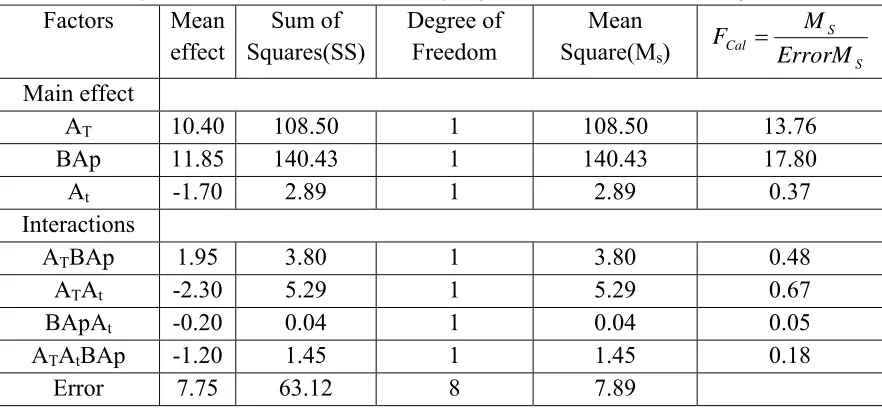
From the result
of factorial design in Table 5.
Table 5: Analysis of Variance table to identify significant factors influencing hardness
Factors Mean
effect
Sum of
Squares(SS)
Degree of
Freedom
Mean
Square(M
s)
SS Cal
ErrorM
M
F
Main effect
A
T10.40
108.50
1
108.50
13.76
BAp 11.85
140.43
1
140.43
17.80
A
t-1.70
2.89
1
2.89
0.37
Interactions
A
TBAp 1.95 3.80
1
3.80
0.48
A
TA
t-2.30 5.29
1
5.29
0.67
BApA
t-0.20 0.04
1
0.04
0.05
A
TA
tBAp -1.20 1.45
1
1.45
0.18
The Wt% of BAp appears to be the most important variable with main effect of 11.85HRB
followed by temperature with 10.48HRB and time -1.70HRB. The analysis shows that raising the
temperature from 100 to 300
oC would result in increase in hardness values by 10.40HRB, while
allowing ageing to continue from 1 to 14hours would result in decreased hardness values by
1.7HRB and increasing the Wt% of BAp from 2 to 10 would result in increasing the hardness
values by 11.85HRB.
The estimated interactions between temperature and Wt% of BAp; temperature and time; Wt%
of BAp and time and then between the three factors, temperature, Wt% of BAp and time are
1.95HRB, -2.30HRB, -0.20HRB and -1.20HRB respectively. This means that raising
temperature and time would result in decrease in hardness values by 2.30HRB whereas raising
all the three factors would result in decrease in hardness values by 1.2HRB. The main reason for
the decreased in hardness values when time increase from 1 to 14hours is due to the fact that
after peak ageing time has been reached further ageing will not lead to any increases in hardness
as a result of over- ageing [8], this facts can be evident from the Figures 1-3.
The values of Fcalculated (F=Fishers distribution) are compared with Fcritical.
F
distribution
critical values for {1,8} degrees of freedom are above 5.32 for 95% and above 11.26 for 99%
confidence level [13]. Thus, from Table 5, it can be observed that only bagasse ash and
temperature have significant factor on hardness values, all others factor have no significant
effect. From this statistical analysis, %Wt of BAp and temperature is the most important
parameter in the ageing behaviour of Al-Cu-Mg/BAp particulate composites.
The model equation was obtained after calculating each of the coefficients of Eq. 2. The
developed model equation for the ageing behaviour of the composites can be expressed as:
W=48.55 + 3.63A
T+4.57B
P-1.42A
t-0.23A
TB
P-1.8A
TA
t-3.45B
PA
t-0.1A
TB
PA
t---(3)
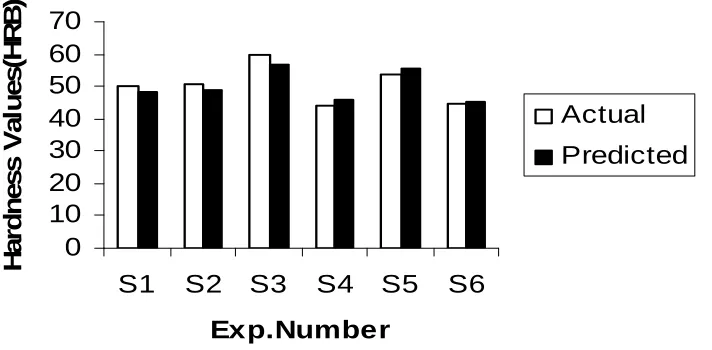
Substituting the coded values of the variables for any experimental condition in Eq. 3, the
hardness values for the ageing behaviour of the composites can be calculated. Table 6 and Figure
4 show the predicted values along with the actual experimental values in different experimental
conditions.
[image:9.612.66.518.101.257.2]
(10)