Joanna Kowalska
1, A–D, Joanna Rymaszewska
1, 2, E, F, Joanna Szczepańska-Gieracha
1, C, E, FOccurrence of Cognitive Impairment
and Depressive Symptoms Among
the Elderly in a Nursing Home Facility
Występowanie zaburzeń poznawczych i objawów depresyjnych
u pacjentów starszych przebywających
w Zakładzie Opiekuńczo-Leczniczym
1 Department of Physiotherapy, University School of Physical Education, Wroclaw, Poland
2 Research Unit of Consultation-Liaison Psychiatry & Behavioral Medicine, Department of Psychiatry,
Wroclaw Medical University, Poland
A – research concept and design; B – collection and/or assembly of data; C – data analysis and interpretation;
D – writing the article; E – critical revision of the article; F – final approval of article; G – other
Abstract
Objectives. The aim of the study was to assess the occurence of cognitive impairment and depressive symptoms in elderly patients rehabilitated in a Nursing Home Facility (NHF) in Poland.
Material and Methods. The study involved a group of 254 patients out of 410 subsequently admitted to NHF in years 2007–2010. The group included 205 (80.7%) women, the mean age was 77.7 (± 7.8) years. 52.7% of patients had had a stroke, 29.9% – orthopedic injuries, and 17.3% were suffering from chronic diseases of old age. The patients’ mental status was assessed in the first week of their stay by the Mini Mental State Examination (MMSE) and the Geriatric Depression Scale (GDS-15).
Results. Cognitive impairment (MMSE < 24) was found in 71.6% of the patients, mild cognitive impairment (MMSE = 26–24) in 16.5%. The mean MMSE was 18.96 (±6.36). Only 11.8% of the seniors achieved a normal score. The highest percentage of people with dementia was reported among stroke patients (79.1%, 106/134). The mean GDS was 7.30 (±3.37). Over 65% of patients had depressive symptoms at admission (GDS>5). Low mood was detected in nearly 70% of patients hospitalised for orthopedic injuries and after a stroke. The correlation analysis showed a significant relationship between MMSE scores and the age among patients after stroke (p < 0.03).
Conclusions. The results indicate that it is justified and necessary to do screening tests in order to detect cognitive impairment and depressive symptoms at NHFs. Introducing such a protocol enables us to provide patients with essential medical and psychological help, which in turn influences the effectiveness of the physiotherapy process (Adv Clin Exp Med 2013, 22, 1, 111–117).
Key words: cognitive impairment, depression, elderly patients.
Streszczenie
Cel pracy. Ocena występowania zaburzeń poznawczych i objawów depresyjnych u pacjentów starszych rehabilito-wanych w Zakładzie Opiekuńczo-Leczniczym (ZOL).
Materiał i metody. Spośród 410 pacjentów kolejno przyjmowanych do ZOL w latach 2007–2010 badania prze-prowadzono u 254 osób (średnia wieku 77,7 ±7,8; 205 kobiet, 80,7%). W badanej grupie było 52,7% pacjentów po udarze mózgu, 29,9% z urazami ortopedycznymi, a 17,3% z chorobami przewlekłymi wieku podeszłego. Stan psychiczny pensjonariuszy oceniano w pierwszym tygodniu pobytu pacjenta w placówce z użyciem: Krótkiej Skali Oceny Stanu Psychicznego (MMSE) i Geriatrycznej Skali Depresji (GDS-15).
Wyniki. Zaburzenia funkcji poznawczych (MMSE < 24) stwierdzono u 71,6% badanych, łagodne zaburzenia poznawcze bez cech otępienia (MMSE = 26–24) u 16,5% pacjentów. Średni wynik MMSE wyniósł 18,96 (±6,36). Wynik prawidłowy uzyskało tylko 11,8% seniorów. Największy odsetek osób z cechami otępienia odnotowano wśród pacjentów po udarze mózgu (79,1%, 106/134). Średni wynik GDS w badanej grupie wyniósł 7,30 (±3,37).
Adv Clin Exp Med 2013, 22, 1, 111–117 ISSN 1899–5276
ORIGINAL PAPERS
The growing percentage of elderly people, and consequently aging population in Poland and the world, increases the number of elderly people with serious health problems, functional disability and multiple diseases which require expert institutional care. In addition to many somatic symptoms and chronic diseases of the old age, mental disorders are common problems of this day and age. These include cognitive impairment (CI), syndromes of dementia and depressive symptoms [1]. The prevalence of de-mentia in the population of over 65 years of age is approximately 10% [2]. According to Polish studies, dementia occurs in 5.7% or even 55.7% of patients primary health care [3]. These figures are even higher among residents of nursing homes and reach 60–80% [4–7]. The prevalence of depressive disorders among primary health care patients in Poland is also high and amounts to 41% [8]. Among hospital patients and residents of nursing homes, it reaches 15–65%, out of which 2/3 do not receive medical help [9]. It is worth noting that due to the extending average life expectancy, these figures will increase.
The presence of dementia or depression, and often their co-occurrence, is a problem usually under-diagnosed and therefore not treated [4, 10], which significantly complicates the process of care and physiotherapy [11, 12] and prolongs the pa-tient’s stay in an institution [13]. In addition, psy-chiatric problems of patients have a negative im-pact on their relationships with the medical staff. It may contribute to the development of burnout and chronic fatigue syndrome [14, 15]. Long-term care facilities are still not fully prepared and suited to care for such patients [10].
Due to the aforementioned facts, it was con-sidered legitimate to investigate the occurrence of cognitive impairment and depressive symptoms in elderly patients rehabilitated in a Nursing Home Facility (NHF), and thus to answer the question of the intellectual and emotional state of elderly people admitted to a NHF for rehabilitation.
Material and Methods
The study was conducted in a Nursing Home Facility with a rehabilitation profile in Wroclaw
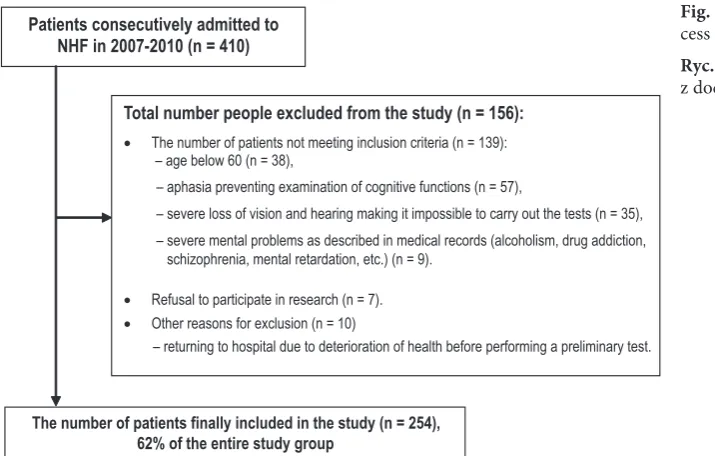
where 410 patients were admitted consecutively in the years 2007–2010. Patients with aphasia and severe loss of vision or hearing impairment that hinder an assessment of cognitive functions were excluded from participation in the study. Other exclusion criteria were: age below 60 years, alco-holism, the presence of consciousness disorders at the time of examination or medical records of mental retardation and other serious mental disorders (e.g. schizophrenia), as well as a pa-tient’s refusal at every stage of the study. Even-tually, the study involved 254 patients, including 205 women (80.7%) and 49 men (19.3%) (Fig-ure 1). The average age in the study group was 77.7 ± 7.8 years. The main cause of hospitaliza-tion and physiotherapy were: stroke (52.7%), or-thopedic injuries resulting from a fall (29.9%), and chronic diseases of old age (17.3%), such as arthrosis, rheumatoid arthritis or a state after lower limb amputation resulting from diabetes or atherosclerotic occlusive disease. In the group of patients after stroke, 104 had ischemic stroke (40.2%) and 32 patients had hemorrhagic stroke (12.5%). The most common diseases that coex-isted among patients after stroke (also in the other groups) were: hypertension, diabetes, atheroscle-rosis and ischemic heart disease.
The patients’ mental condition was assessed during the first week of their stay in a
NHF
with the use of Mini Mental State Examination (MMSE) and Geriatric Depression Scale (GDS-15). These are easy and very time-saving screening methods recommended by both the Interdisciplinary Group of Experts in Recognition and Treatment of De-mentia (IGERO) and by other researchers working with patients over 65 years of age [1, 16].MMSE by Folstein et al. is a specific method developed to examine individuals with suspected dementia. It examines orientation, memory, nam-ing, reading comprehension, writnam-ing, and con-structional praxia (copying of a complex graphic pattern). Diagnostic sensitivity of this method is 87–90% and specificity 80–82% [17]. In the test, the patient can score a maximum of 30 points. The norm is a score of 30–27 points, a score between: 26–24 points suggests cognitive impairment with-out dementia, 23–19 points suggests mild
demen-Objawy depresyjne przy przyjęciu na oddział (GDS>5) stwierdzono u 65,2% pacjentów. Obniżony nastrój wykryto u blisko 70% pacjentów hospitalizowanych z powodu urazów ortopedycznych oraz u pacjentów po udarze mózgu. Analiza korelacji wykazała zależność między MMSE a wiekiem w grupie pacjentów po udarze mózgu (p < 0.03).
Wnioski. Uzyskane rezultaty wskazują na konieczność wykonywania testów przesiewowych pod kątem zaburzeń funkcji poznawczych i objawów depresyjnych w ośrodkach opieki długoterminowej. Wprowdzenie takiej procedu-ry umożliwia udzielenie niezbędnej pomocy medycznej i psychologicznej, co przekłada się na skuteczność prowa-dzonej fizjoterapii (Adv Clin Exp Med 2013, 22, 1, 111–117).
tia, 18–11 points suggests moderate dementia, 10–0 points indicates severe dementia.
Test results depend on the patient’s age, educa-tion, and also their profession, social status, senso-ry deficits as well as their pre-morbid intelligence [3]. Due to the difficulty in obtaining information regarding the number of years of schooling from some patients, and considerably few patients with secondary or higher education, a uniform set of criteria was adopted in the study and arbitrarily set cut-off points were applied to differentiate patients with dementia and without signs of dementia.
The GDS was established in 1983 and is the most commonly used screening scale of well-be-ing and quality of life self-assessment of the elder-ly. The short version contains 15 questions where patient answers “yes” or “no”. The assessment con-cerns a period of two weeks immediately preceding the test. The GDS measures subjective satisfaction with quality of life, mood, sense of happiness or lack thereof. A score between 0–5 points indicates no depression, 6 points and above – a depression of increasing severity [18]. As emphasised by many authors, the GDS maintains high diagnostic value when the MMSE ≥ 15. Under this assumption, the sensitivity of the scale is 84% and the specificity is 91% [19]. Therefore, the examination was per-formed only in those patients who achieved a score above 15 points in the MMSE. Please note that the results of these screening tests only reflect the gen-eral state of the patients’ cognitive functions and mood, and they are not a medical diagnosis.
The obtained results were presented as means ±standard deviations, numbers and percentag-es. The Shapiro-Wilk test was used to check for normal distribution of the data. The Student’s
t-Test and the Mann-Whitney test were used to assess the significance of differences between two groups and the Kruskal-Wallis test for three groups. Spearman’s rank correlation coefficient was determined to examine the relationship be-tween variables. P-value ≤ 0.05 was adopted as a boundary for significance. Statistica Version 7.0 of Statsoft Poland was used to carry out the statistical analysis.
Results
Cognitive impairment disorders (MMSE<24) were found in 71.6% of the patients studied (182/254). Only 11.8% had normal MMSE score (30–27). The mean MMSE score was 18.96 (±6.37). On admission to NHF, depressive symp-toms (GDS>5) were found in 65.2% of patients (120/184). The mean GDS score in the study group was 7.30 (±3.37). More than 44% (81/184) of the study group are patients who had developed both: impaired cognitive functions and depressive symptoms (MMSE<24, GDS>5). The remaining results are presented in Table 1.
Upon the division of the study sample accord-ing to gender, the results indicate that in both: women group (205) and men group (49) the larg-est group were patients with dementia (70.7% vs. 75.5%). The mean MMSE score did not differ sig-nificantly in both groups and amounted to 18.84 ±6.54 in women and 19.47 ±5.54 in men (p = 0.5340). The number of examined men and women who had normal scores did not exceed 15% (13.2% vs. 6.1%). The results regarding the occurrence of depressive disorders were found to be similar. The
Fig. 1. The recruitment pro-cess towards the study group
Ryc. 1. Proces rekrutacji z docelową grupą badaną
Patients consecutively admitted to NHF in 2007-2010 (n = 410)
The number of patients finally included in the study (n = 254), 62% of the entire study group
Total number people excluded from the study (n = 156):
• The number of patients not meeting inclusion criteria (n = 139): – age below 60 (n = 38),
– aphasia preventing examination of cognitive functions (n = 57),
– severe loss of vision and hearing making it impossible to carry out the tests (n = 35), – severe mental problems as described in medical records (alcoholism, drug addiction, schizophrenia, mental retardation, etc.) (n = 9).
• Refusal to participate in research (n = 7).
• Other reasons for exclusion (n = 10)
mean GDS scores did not differ statistically (7.36 ± 3.35 vs. 7.08 ± 3.50, p = 0.6529), and the num-ber of patients with depressive symptoms was over 60% in both groups (64.4% women, 60.5% men). The two groups differed significantly in age (p = 0.0122). Women were older (78.35 vs. 75.26).
Dividing the group under study according to disease entity being the leading cause of hospi-talization, the largest percentage of patients with
dementia symptoms was reported among stroke patients (79.1%). A similar percentage of pa-tients with dementia was found among those with chronic diseases and the lowest – in patients hos-pitalized due to fractures. Low mood was detected in nearly 70% of patients hospitalized for ortho-pedic injuries and in stroke patients (Table 2). These groups did not differ significantly in terms of mean MMSE and GDS scores. Nevertheless, it
Table 1. Percentage distribution of MMSE and GDS results in the study group
Tabela 1. Wyniki MMSE i GDS w grupie badanej
MMSE GDS
Results n % Results n %
normal
30–27 points 30 11.8 no depression0–5 points 64 34.8
mild cognitive impairment
26–24 points 42 16.6
mild dementia
23–19 pkt 75 29.5 mild depression6–10 points 83 45.1
moderate dementia
18–11 points 75 29.5
severe dementia
0–10 points 32 12.6 severe depression11–15 points 37 20.1 Total
(Suma) 254 100.0 total 184 100.0
Table 2. Percentage distribution of MMSE and GDS results by type of disease
Tabela 2. Rozkład procentowy wyników MMSE i GDS z podziałem na rodzaj schorzenia Results
(Wyniki) Type of disease (Rodzaj choroby)
stroke orthopedic injuries chronic illness
GDS n % n % n %
no depression
0–5 points 32 33.7 19 31.7 13 44.8
depression
6–15 points 63 66.3 41 68.3 16 55.2
Total
(Suma) 95 100.0 60 100.0 29 100.0
MMSE n % n % n %
normal
27–30 points 9 6.7 13 17.1 8 18.2
mild cognitive impairment
26–24 points 19 14.2 18 23.7 5 11.4
dementia
23–0 points 106 79.1 45 59.2 31 70.4
Total
is worth noting that the best scores concerning cognitive functions were achieved by patients with orthopedic disorders, and the worst were patients after a stroke. A similar situation was with the oc-currence of depressive symptoms. These groups differed significantly only in age, the oldest pa-tients were ones with orthopedic problems, and the youngest were stroke patients. The results are shown in Table 3.
In the whole study sample (n = 254), correla-tion analysis revealed no relacorrela-tionship between age and GDS score (p = 0.1847) and a low significant relationship between age and MMSE score (p = 0.050). Simultaneously, the GDS and MMSE were correlated (p = 0.0013). This means that a seri-ous cognitive impairment is usually accompa-nied by depressed mood. In the group of stroke patients, a significant correlation between MMSE and age was also confirmed, and this relationship was stronger than for the entire study group (p = 0.0231).
Discussion
Among elderly patients residing in long-term care facilities (nursing homes, medical care facili-ties), the percentage of people with CI is greater than in the general population and in the United States, for example, it amounts to 26.4% [20]. The results obtained in this project strongly deviate from this data. The percentage of people with CI is above 70%. This result is similar to the results ob-tained by Muela et al. (2009), where the percentage of people with some degree of CI was approximate-ly 76% [6] and similar to the results Mongila et al. (2009) and Majica et al. (2009), respectively 61.7% and above 60% [4, 15]. An even higher percentage of people with CI (81.3% and 82%) were diagnosed among residents of Polish and Norwegian nursing homes in the study by Tomaszewski et al. (2010) and Bergh et al. (2012) [5, 7]. Unfortunately, the diversity of methods used by researchers causes a great difficulty in comparing the results which
Gustaw and Bylina (2007) point out in their paper [21]. The same applies to the occurrence of de-pressive symptoms. The result of 65.2% obtained in this study is high and indicates the existence of serious emotional problems in patients residing at the NHFs. Similar findings (57.7%) were reported by Chahine et al. (2007) [22].
According to the findings by some authors, mental disorders in the form of cognitive and emotional impairments more often affect women than men [5]. In this study there were no signifi-cant differences in the prevalence of cognitive and emotional impairments according to gender. Sim-ilarly, in study Mongila et al. (2009) [4].
The worst results both in cognitive and emo-tional terms (although the youngest at age) were found in patients after a stroke. The obtained re-sults, 79.1% and 66.3% respectively are similar to the results of Saxena et al. (54% and 60%) and own earlier studies (85% and 78%) [23, 24]. For this group of patients a highly probable assumption can be made that cognitive impairments have already occurred before the stroke incident (especially in patients with ischemic stroke, 40.2%), since vas-cular factors ultimately leading to stroke are also a significant component of the process of demen-tia [25]. The sudden stroke incident which causing damage to a specific area of the brain, disability and total dependence on other people causes de-pressed mood and post-stroke depression [24, 26]. The best results of the cognitive function obtained in patients after orthopedic injuries. Meanwhile studies had shown that this group of elderly peo-ple undergoing rehabilitation regains lost capac-ity at the fastest rate [27]. It seems therefore, that CI’s are a significant factor impeding the process of physiotherapy.
The studies here have confirmed a mutual re-lationship between age and the state of cognitive function in the whole study group. This confirms findings of other authors, stating that older age is a factor determining the existence of CI [4, 20]. The thesis that symptoms of depression are more common in older people has not, however, been
Table 3. MMSE and GDS results by type of disease
Tabela 3. Wyniki MMSE i GDS z podziałem na rodzaj schorzenia
Stroke
(Udar) Orthopedic injuries (Urazy ortopedyczne) Chronic illness (Choroba przewlekła) p-value
n mean std n mean std n mean std
Age
(Wiek) 134 75.47 8.24 76 81.29 5.69 44 78.53 7.21 < 0.00001
MMSE 134 18.23 6.13 76 20.13 6.59 44 19.55 6.34 0.0579
confirmed, although a belief among clinicians about a particularly high incidence of depression among the elderly is widespread. The authors should mention here the diagnostic difficulties which result from the treatment of cognitive im-pairment and low mood as a consequence of the aging process [1]. Over and above, many people despite health and social problems, regardless of advancing age, live actively and get pleasure from it. The results obtained are in line with views pre-sented by Wichowicz (2008), who claims that age is the most ambiguous prognostic factor of depres-sion [26]. The performed studies show that the worse the subjects’ intellectual state, the greater the severity of depressive symptoms. It has proba-bly something to do with the frequent coexistence of depression and the CI (in these studies 44%). Similar results reported by Chahine et al. (2007). They presented that 41% of patients with dementia had some degree of depression [22]. It is known that there may be multiple relationships between these two types of disorders. Depression may de-velop because of difficulties in everyday function-ing (caused by CI). At the same time cognitive im-pairments may be part of the psychopathology of depression. Some authors mention depression as a hypothetical predictive factor of dementia or its early symptom [1].
In summary, the obtained results do show the existence of a serious problem (often not diag-nosed) among patients residing in long-term care
facilities. The high prevalence of CI and depres-sive disorders detected in screening tests requires a complete clinical diagnosis, in accordance with the ICD-10 criteria as well as additional special-ised tests. Unfortunately, financial constraints of-ten make exof-tended research impossible to conduct and cause the prevalence of psychiatric disorders in residents of long-term care facilities underes-timated and definitely understated. Only in case of 15% of patients a medical record (e.g. hospital discharge card) suggests the presence of psychiat-ric problems [13]. In the present study group this record was only in 13.4% (34/254) of patients (of which 8 patients had record of depression). Con-sequently, in long-term care facilities for the el-derly, it is necessary to perform screening tests to detect disorders of cognitive functions and depres-sive symptoms. Such a procedure helps to iden-tify patients requiring special care and other (than the standard adopted) models of physiotherapy. In addition, working with the mentally ill seniors without adequate knowledge of the personnel is extremely strenuous for both staff and patients, and the effects of physiotherapy are usually much worse than in the case of the mentally healthy peers. Both the long-term care institutions and the staff employed there must be properly prepared (e.g. staff training on the basic issues of psychopa-thology of mental disorders of the old age) [14, 15] to guarantee an adequate level of care and effective physiotherapy.
References
Dobrzyńska E, Rymaszewska J, Kiejna A:
[1] Depressions in the elderly. Psychogeriatr Pol 2007, 4(1), 51–60.
Jóźwiak A:
[2] Otępienie u osób w starszym wieku. Geriatria 2008, 2, 237–246.
Górna R, Rymaszewska J, Kiejna A, Chłodzińska-Kiejna S:
[3] Zespoły otępienie w populacji pacjentów
podsta-wowej opieki zdrowotnej. I. Występowanie. Adv Clin Exp Med 2004, 13(3), 447–455.
López Mongil R
[4] , López Trigo JA, Castrodeza Sanz FJ, Tamames Gómez S, León Colombo T: Prevalence of dementi in institutionalized patients. The RESYDEM study. Rev Esp Geriatr Gerontol 2009, 44(1), 5–11.
Tomaszewski K, Matusik P, Chmielowska K, Nowak J, Parnicka A, Dubiel M, Gąsowski J:
[5] Otępienie a
spraw-ność fizyczna pacjentów w podeszłym wieku mieszkających w wybranych domach opieki. Gerontol Pol 2010, 18(2), 71–75.
Gutiérrez Rodríguez J
[6] , Jiménez Muela F, Alonso Collada A, de Santa María Benedet LS: Prevalence and therapeutic management of dementia in nursing homes in Asturias (Spain). Rev Esp Geriatr Gerontol 2009, 44(1), 31–33.
Bergh S
[7] , Holmen J, Saltvedt I, Tambs K, Selbæk G: Dementia and neuropsychiatric symptoms in nursing-home patients in Nord-Trøndelag County. Tidsskr Nor Laegeforen 2012, 132(17), 1956–1959.
Dróżdż W, Wojnar M, Araszkiewicz A, Nawacka-Pawlaczyk D, Urbański R, Ćwiklińska-Jurkowska M, [8]
Rybakowski J: Badanie rozpowszechnienia zaburzeń depresyjnych u pacjentów podstawowej opieki zdrowotnej w Polsce. Wiad Lek 2007, 69(3–4), 109–113.
Weterle K, Sołtysiak J:
[9] Objawy depresji i ich wykrywalność przez lekarzy Podstawowej Opieki Zdrowotnej u pacjentów po 65. roku życia. Psychogeriatr Pol 2005, 2(4), 361–367.
Durda M:
[10] Organizacja opieki nad osobami z demencją w Polsce na tle krajów rozwiniętych i rozwijających się. Gerontol Pol 2010, 18(2), 76–85.
Szczepańska-Gieracha J, Kowalska J, Malicka I, Rymaszewska J:
[11] Cognitive impairment, depressive symptoms
and the efficacy of physiotherapy in elderly people undergoing rehabilitation in a Nursing Home Facility. Adv Clin Exp Med 2010, 19(6), 755–764.
Ghisla MK, Cossi S, Timpini A, Baroni F, Facchi E, Marengoni A:
[12] Predictors of successful rehabilitation in
Kowalska J, Szczepańska-Gieracha J, Piątek J:
[13] Zaburzenia poznawcze i emocjonalne a długość pobytu osób
star-szych w Zakładzie Opiekuńczo-Leczniczym o Profilu Rehabilitacyjnym. Psychogeriatr Pol 2010, 7(2), 61–70.
Szczepańska-Gieracha J, Wieprow J, Kowalska J:
[14] Stosunek fizjoterapeutów do pacjentów w podeszłym wieku
z zaburzeniami mentalnymi i depresyjnymi. Ocena skuteczności przeprowadzonego szkolenia. Psychogeriatr Pol 2009, 6(1), 23–31.
Majic T, Pluta J-P, Mell T, Decker A, Heinz A, Rapp MA:
[15] Prevalence of behavioural and psychological
symp-toms of dementia in nursing homes in Berlin. Eur Psychiatry 2009, 24, p. S490.
Barcikowska M, Bień B, Bidzan L, Bilikiewicz L, Gabryelewicz T, Grabiec U, Grodzicki T, Kłoszewska I, Klich-[16]
Rączka A, Kądzielawa D, Kotapka-Minc S, Leszek J, Motyl R, Ochudło S, Opala G, Paradowski B, Parnowski T, Pfeffer A, Sławek J, Sobów T, Szczudlik A, Vertulani J: Rozpoznawanie i leczenie otępień. Rekomendacje Interdyscyplinarnej Grupy Ekspertów Rozpoznawania i Leczenia Otępień (IGERO 2006). Czelej, Lublin 2006.
Folstein MF, Folstein SE, McHugh PR:
[17] Mini-Mental State: A practical method for grading the cognitive state of patients for the clinician. J Psychiatr Res 1975, 12, 189– 198.
Yesavage JA, Brink TL, Rose A:
[18] Development and validation of a geriatric screening depression scale: A prelimi-nary report. J Psychiatr Res 1983, 22, 37–49.
McGivney SA, Mulvihill M, Taylor B:
[19] Validating the GDS depression screen in the nursing home. J Am Geriatr
Soc 1996, 44(1), 98–100.
O´Brien JA, Caro JJ:
[20] Alzheimer´s disease and other dementia in nursing homes: levels of management and cost. Psychogeriatrics 2001, 13, 347–358.
Gustaw K, Bylina J:
[21] Rozpowszechnienie choroby Alzheimera i innych zespołów otępiennych – trudności meto-dologiczne. Zdr Publ 2007, 117(1), 94–100.
Chahine LM, Bijlsma A, Hospers APN, Chemali Z:
[22] Dementia and depression among nursing home residents in
Lebanon: a pilot study. Int J Geriatr Psychiatry 2007, 22, 283–285.
Saxena SK, Ng TP, Yong D, Fong NP et al.:
[23] Subthreshold depression and cognitive impairment but not demented
in stroke patients during their rehabilitation. Acta Neurol Scand 2008, 117, 133–140.
Kowalska J, Szczepańska-Gieracha J, Rymaszewska J:
[24] Zaburzenia poznawcze i objawy depresyjne a stan
funkcjo-nalny osób starszych po udarze mózgu. Post Reh 2010, 24(4), 17–22.
Opala G, Ochudło S:
[25] Obraz kliniczny i różnicowanie otępienia naczyniowego. Udar Mózgu 2004, 6(1), 7–16.
Wichowicz H:
[26] Czynniki ryzyka depresji poudarowej. Udar Mózgu 2008, 10(2), 91–95.
Szczepańska-Gieracha J, Kowalska J, Rymaszewska J:
[27] Skuteczność fizjoterapii w przypadku osób starszych
usprawnianych w warunkach zakładu opiekuńczo-leczniczego – badanie pilotażowe. Gerontol Pol 2010, 18(1), 41–47.
Address for correspondence:
Joanna Kowalska
Department of Physiotherapy
University School of Physical Education al. Paderewskiego 35
51-612 Wrocław Poland
Tel.: +48 71 347 35 22
E-mail: [email protected]
Conflict of interest: None declared