Introduction
Among the oral diseases, dental caries is the most common chronic disease of humankind.[1] It remains the persistent and important oral
health problem internationally, and particularly, among developing countries.[2,3] It affects all people regardless of their sex, socioeconomic
strata, race, and age. It is also profoundly affected by other factors such as oral hygiene and saliva.[4]
ABSTRACT
Dental caries is the most common chronic disease of humankind. Dental caries development is considered to involve a triad of indispensable factors that can be concluded as bacteria in dental plaque, carbohydrates in the diet, and susceptible teeth. Saliva composition is an important factor in determining the prevalence of caries. For relative protection against dental cavities, salivary flow rate, buffer capacity, calcium, phosphate, and fluoride concentrations are essentials. The aim of this systematic review was to analyze the existing literature on the evaluation of salivary flow rate, pH, calcium, total protein, buffering capacity, and total antioxidant capacity (TAC) level among caries-active and caries-free adolescence. Search strategy: The Data Bases of PubMed and Google Scholar were used. Selection criteria: A cross-sectional study evaluating salivary flow rate, pH, calcium, total protein, buffering capacity, and TAC among caries-free and caries-active adolescence was selected. The systematic search revealed a total of 3 publications from PubMed, seven from Google scholar, and which were scrutinized based on present inclusion and exclusion criteria. Five publications fulfilled all the inclusion criteria, and one publication was excluded from the review. Two studies used decayed missing filled teeth and decayed missing filled surfaces index for assessing caries increment. Among the included studies, one studies had a low risk of bias with level 2 evidence. Salivary calcium concentration values were found to be higher in caries-free group in two studies. In one study, total protein and total antioxidant values are higher in caries-active group except those in the 11–15-year-old girls group. In other study, there was increase in total protein and TAC in caries-active study participant of both age groups. No significant correlation between caries activity and salivary flow rate were established. With the available evidence, based on quality assessment and evidence level of selected articles, it can be concluded that salivary physiochemical properties differ in caries-active and caries-free individuals, and thus, salivary parameters influence the dental caries activity.
Keywords: Saliva, dental caries, children
Evaluation of salivary flow rate, pH, buffering capacity, total
calcium, protein, and total antioxidant capacity level among
caries-free and caries-active children: A systematic review
E. Maheswari, R. Pradeep Kumar, I. Meignana Arumugham, D. Sri Sakthi, T. Lakshmi
Department of Public Health Dentistry, Saveetha Dental College, Saveetha University, Chennai, Tamil Nadu, IndiaCorrespondence: Dr. R. Pradeep Kumar, Department of Public Health Dentistry, Saveetha Dental College, Saveetha University, No. 162, Poonamallee High Road, Velapanchavadi, Thiruverkadu, Chennai, Tamil Nadu, India. E-mail: [email protected]
The saliva circulating in the mouth at any given time is termed as whole saliva and it comprises a mixture of secretions from the major and minor salivary glands and traces from the gingival crevicular fluid. Saliva definitely promotes oral health, and hence, lack of its secretion contributes to the disease process.[4,5]
Saliva, a heterogeneous fluid comprising proteins, glycoproteins, electrolytes, small organic molecules, and compounds transported from the blood, constantly bathes the teeth and oral mucosa. Whole saliva represents a mixture of the secretions of the major (subman-dibular, sublingual, and parotid) and minor (accessory) salivary glands, together with the gingival fluid.[6] There are many and varied
biologi-cal factors in saliva that protect enamel, dentin, and cementum from caries development and facilitate the remineralization. The ability of saliva to affect caries development is dependent on the quantity and composition of the secretions.[7]
Saliva possesses antimicrobial components and a buffering agent that acts to protect and maintain oral tissues. Proteins that are found
How to cite this article: Maheswari E, Kumar RP, Arumugham IM, Sakthi DS. Evaluation of salivary flow rate, pH, buffering capacity, total calcium, protein, and total antioxidant capacity level among caries-free and caries-active children: A systematic review. J Adv Pharm Edu Res 2017;7(2):132-136.
Source of Support: Nil, Conflict of Interest: None declared.
Access this article online
in saliva, such as lactoferrin, lysozyme, peroxidase, defensins, and histatins, can destroy or inhibit the growth of microorganisms in the oral cavity.[8]
Oxidative stress is defined as a disturbance in the pro-oxidant-antioxidant balance in favor of the former, leading to potential damage. Antioxidant is defined as those substances which when present at low concentrations compared to those of an oxidizable substrate will significantly delay or inhibit oxidation of that substrate, for example, uric acid, superoxide dismutase, glutathione peroxidase, and carotenoids.[9] In normal physiology, there is a dynamic
equilibrium between reactive oxygen species activity and antioxidant defense capacity, and when that equilibrium shifts in favor of reactive oxygen species, either by a reduction in antioxidant defense or an increase in reactive oxygen species production or activity, oxidative stress results.[9] The antioxidant defense systems are highly complex.
Their most important function is to control oral bacteria that form dental plaque that leads to dental caries and chronic inflammatory periodontal diseases.[10] In general, higher the flow rate, faster the
clearance, and higher the buffer capacity and thus lesser microbial attacks.[11]
There are differences in obtained results between the studies in different regions. Hence, evaluation of these factors in saliva that may increase the risk of dental caries is important. With this background, the aim of this systematic review was to evaluate salivary flow rate, pH, calcium, total protein, buffering capacity, and total antioxidant capacity (TAC) among free and caries-active adolescence.
Materials and Methods
Structured question
Does salivary parameters such as salivary flow rate, pH, calcium, total protein, buffering capacity, and TAC vary in free and caries-active adolescence.
PICO analysis
• Population: Adolescence • Exposure: Dental caries
• Outcome: Whether there is a significant difference in
physiochemical properties of saliva associated with dental caries.
Inclusion criteria
Criteria for considering studies for the review
The search was narrowed down manually by the reviewer according to the following inclusion criteria of the present systematic review.
• A cross-sectional study • Observational study • Longitudinal study
· Prospective studies and retrospective cohorts
• Literature in other languages which can be translated by the
reviewer was included.
Exclusion criteria
Studies evaluating the effectiveness of salivary Streptococcus mutans, Lactobacillus, fluoride level in children, adults and elderly population, animal study, in vitro studies, in situ studies, reviews, and literature in other languages which cannot be translated by the reviewer were excluded from the study.
Sources used
The data bases of PubMed, Cochrane, and Google Scholar were used.
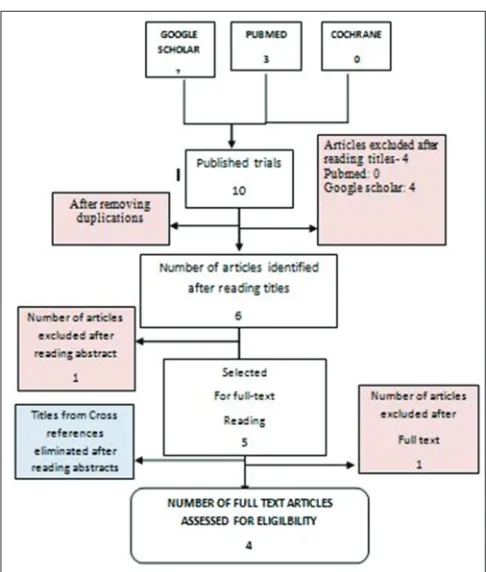
Flowchart for search strategy
Figure 1: Flow chart for search strategy
Data collection and analysis
Screening and selection
Electronic search was carried out using the keywords in the search engines - PubMed and Google Scholar which yielded a total of 4 articles. Based on present inclusion and exclusion criteria, the titles of the studies identified from the search were assessed independently by two review authors (Jayashri and Dr. Pradeep Kumar). Three were identified from the search after excluding duplications. Abstracts of selected articles were reviewed independently. One article excluded after reading the abstract. Full-text articles were retrieved for two relevant studies. Finally, four articles were selected based on eligibility criteria.
Difference of opinion concerning the inclusion of a study was resolved by discussion, and one article in the reference is already a PubMed indexed. Quality Assessment criteria to evaluate the studies were decided by two review authors in accordance with guidelines. The risk of bias for each study was independently assessed by the review authors, and conflicts concerning the risk of bias were sorted by discussion.
Data extraction
Data extraction for general characteristics of studies and variables of outcome was done. For each trial the following data were recorded:
• Author and journal • Study design • Sample size
• Participants and group • Methodology • Parameters • Statistical analysis • Results.
Discussion
Saliva plays a critical role in oral homeostasis, as it modulates the
ecosystem within the oral cavity. Lubrication of the alimentary
bolus, protection against virus, bacteria, and fungi, buffer capacity, protection and repair of the oral mucosa, and dental remineralization are some of the functions of saliva.
Under resting conditions without the exogenous stimulation that is linked with feeding, there is a slow flow of saliva which keeps the mouth moist and lubricates the mucous membrane. This unstimulated flow is what is secreted by the salivary glands the majority of the time. Unstimulated saliva is essential for the health and well-being of the oral cavity and also bestows a strong protective effect to the oral cavity, against dental caries.[12]
Saliva contains many biological systems known to be involved in soft tissue repair and many antibacterial components including lysozyme, lactoferrin, and salivary peroxidase, all of these are protein in nature. Human saliva contains a complex peroxidase system, the major components of which include different forms of lactoperoxidase secreted by salivary glands and myeloperoxidase from polymorphonuclear neutrophils. It has been suggested that one of the most important functions of salivary peroxidase is the control of oral bacteria that form dental plaque, to imbalance in etiology which lead to dental caries.[13]
Browne et al. and Scully where they showed that dental caries is probably the most common consequence of hyposalivation. In contrast to the above, the studies conducted by Birkhed and Heintze and Russell et al. reported that there was no correlation between salivary secretion rate and caries activity.[11] The other
factors such as microflora, diet, and retention of food might have dominated the buffering capacity to initiate caries, which is a multifactorial disease.[14] A study done by Ericsson which showed
that salivary buffering capacity has a negative relationship with caries incidence.[15]
Saliva may contribute a first line of defense against free radical-mediated oxidative stress since the process of mastication promotes a variety of such reactions including lipid peroxidation.[16] It has been
suggested that saliva is rich in antioxidant, mainly uric acid with lesser, but definite contributions from albumin, ascorbate, and glutathione and all of these are proteins or have proteins in their structure. It has been reported that uric acid is the major antioxidant in saliva accounting for more than 85% of TAC of both unstimulated and stimulated saliva.[6] Thus, it can be concluded that salivary antioxidant
levels must be in a linear association with total protein levels. Schlesier et al.[17] measured antioxidant activity using different in vitro methods
such as Trolox equivalent antioxidant capacity I-III assay, 2,2-diphenyl-1-picrylhydrazyl assay, N, N-dimethyl-p-phenylenediamine assay, photochemiluminescence assay, and ferric reducing ability of plasma assay Table 1.
Considering the importance of physicochemical properties of saliva in relation with dental caries activity, Prabhakar et al.[18] and
Preethi et al.[19] reported that salivary flow rate, pH, and buffering
capacity are slightly decreased in caries-active children compared to caries-free children. Pandey et al.[20] showed that pH was increased
in caries-active group.[6] Prabhakar et al. and Preethi et al. reported
that total calcium was decreased in caries-active group.[17] Pandey
et al. and Tulunoglu et al. (2006) showed that total calcium content was increased in caries-free group Table 2.[18] Prabhakar et al.,
Preethi et al., Pandey et al., and Tulunoglu et al. reported that similar findings were total protein and TAC levels are increased in caries-active group.
Results
Interpretation of results
The review included four studies, which estimated salivary flow rate, pH, buffering capacity, calcium, total protein, and TAC among caries-free and caries-active adolescence (Pandey et al. 2015, Prabhakar et al. 2009, Preethi et al. 2010 and Tulunoglu et al. 2006).
A total of 440 children were included in this review [Figure 7]. Age group of patients ranged from 7 to 14 years. In two studies, the saliva was allowed to accumulate in patients mouth for 2 min and was aspirated directly from floor of the mouth (suction method). One study where unstimulated saliva was collected by spitting method in pre-weighted plastic cylinders for 5 min.
In all four studies, pH was measured using pH meter. In one study, buffering capacity is determined by quantitative test using handheld pH meter method. Two studies were saliva buffer capacity that was determined by Ericsson method.
three studies, the examination of dental caries was made according to the dentition status and treatment needs by the WHO (1997). Caries-active children having at least five decayed tooth surfaces. Caries-free children having no caries, decayed missing filled surfaces = 0.
Limitations
The present systematic review limits the studies included are to be in English only. This limited the number of studies assessing the aim of this review. This systematic review also considers only the published data for result interpretation. The unpublished and the raw data of the studies have not been included for interpretation. Due to the heterogeneous nature of the various assessment techniques and interventions included in this review, the pooling of data was not possible.
Conclusion
With the available evidence, based on quality assessment and evidence level of selected articles, all four articles have level 5 evidence and had a low risk of bias.
Table 1: General characteristics of the studies
Article Study groups Method of evaluation Outcome Limitations/Future
scope
Estimation of salivary flow rate, pH, buffer capacity, calcium, total protein, and TAC in relation to dental caries severity, age, and gender.
Pallavi Pandey, Venugopal Reddy N, Arun Prasad Rao V, Adithya Saxena, Chaudhary CP
Two groups: Group I - 7–10 years
Group II - 11–14 years. Both the groups subdivided based on gender. They were further divided into caries-active and caries-free groups with 15 children in each group
Saliva samples collected by spitting method. pH is measured by manual pH meter. Buffer capacity is determined by quantitative test using a handheld pH meter method. Total protein and total calcium level of samples are measured by autoanalyzer. Salivary antioxidant capacity is measured with a spectrophotometer using ABTS assay
Salivary pH value was found to be higher in caries-free group. Buffer capacity lower in caries-active group. Calcium content of saliva was found to be more in caries-free group. Increase in protein and antioxidant capacity in caries-active children of both age groups
Salivary factors such as fluoride content, immunoglobulin, and bacterial load assessment is essential to predict the caries activity with respect to physicochemical properties of saliva
Evaluation of flow rate, pH, buffering capacity, calcium, total protein, and TAC levels of saliva in caries-free and caries-active children - An in vivo study AR Prabhakar, Reshma Dodawad, Raju OS
Two groups: Group I - 7–10 years
Group II - 11–14 years. Both the groups subdivided based on gender. They were further divided into caries-active and caries-free groups with 15 children in each group
Salivary flow rate estimated by spitting method into pre-weighted plastic cylinders. pH measured using pH meter. Estimation of total protein and calcium done by autoanalyzer. Total antioxidant levels were done using a spectrophotometer
Saliva flow rate. pH and buffering capacity decreased in caries-active group, but total protein and total antioxidant increased significantly and total calcium decreased significantly in caries-active children
TAC of saliva has a linear relation with caries that is as the severity of caries increased, the TAC levels also increase. However, to extrapolate these findings, studies using larger sample size are needed
Evaluation of flow rate, pH, buffering capacity, calcium, total protein, and total antioxidant levels of saliva in caries-free and caries-active children - An in vivo
study.
Preethi BP, Anand Pyati, Reshma Dodawad
Two groups: Group I - 7–10 years
Group II - 11–14 years. Both the groups subdivided based on gender. They were further divided into caries-active and caries-free groups with 15 children in each group
Salivary flow rate estimated by spitting method into pre-weighted plastic cylinders. pH measured using pH meter. Estimation of total protein and calcium done by autoanalyzer. Total antioxidant levels were done using a spectrophotometer
The mean level of saliva flow rate, pH, buffering capacity, and total calcium are decreased in caries-active children. Total protein and TAC was increased in caries-active children compared to caries-free group
The limitation of this study was it requires larger sample size to assess the exact relation of physicochemical properties of saliva with dental caries activity
Total antioxidant levels of saliva in children related to caries, age, and gender. Tulunoglu O Demirtas S, Tulunoglu I
Two groups: Group I - 7–10 years Group II - 11–14 years. Both the groups subdivided based on gender. They were further divided into caries-active and caries-free group, with 10 children in each group
Salivary flow rate estimated by spitting method into pre-weighted plastic cylinders. pH measured using pH meter. Estimation of total protein and calcium done by autoanalyzer. Total antioxidant levels were done using a spectrophotometer (ABTS assay)
No linear association between salivary flow rate, pH, and buffering capacity values from different groups. Salivary calcium levels were higher in caries-free group. Total protein and total antioxidant values were higher in caries-active group
More clinical and laboratory studies are needed to determine the exact relationship between physicochemical properties of saliva such as flow rate, buffering capacity, pH, calcium level, total protein, total antioxidant status, and dental caries, age, and gender
TAC: Total antioxidant capacity, ABTS: 2,2’‑azino‑bis (3‑ethylbenzothiazoline‑6‑sulphonic acid)
Table 2: Summation of outcome of variables
Outcome Total
studies Caries‑active group Caries‑free group
Saliva flow rate 4 Decreased (1, 2) Increased (1, 2) Salivary pH 4 Higher (10),
Decreased (11, 12) Decreased (10) Buffering capacity 4 Decreased (16, 1, 2) Increased (16, 1, 2) Total calcium 4 Decreased (1,2) Increased (16)
Total protein 4 Increased (16, 1, 2, 15) Decreased (10, 11, 12, 15) Total antioxidant
In one study, salivary pH value was found to be higher in caries-free group. Buffer capacity lowers in caries-active group. Calcium content of saliva was found to be more in caries-free group. There was an increase in protein and antioxidant capacity in caries-active children of both age groups. Two studies showed saliva flow rate. pH and buffering capacity decreased in caries-active group, but total protein and total antioxidant increased significantly and total calcium decreased significantly in caries-active children.
Out of four studies, in one study, it reported that, in general, although there was no linear association between salivary flow rate, pH and buffering capacity values obtained from different groups. Salivary calcium concentration values were found to be higher in caries-free groups. Total protein and total antioxidant values were higher in caries-active group except in the 11–15-year-old girls group. The limitation of this study was it requires larger sample size to assess the exact relation of physicochemical properties of saliva with dental caries activity.
References
1. Mc-Donald RE, Avery DR, Stookey GK. Dental cariesin the child and adolescents. In: Mc-Donald RE, Avery DR, Dean JA, editors. Dentistry for the Child and Adolescent. 8th ed., Vol. 4. New Delhi: Elsevier; 2005. p. 203-35. 2. García-Godoy F, Hicks MJ. Maintaining the integrity of the enamel surface: The
role of dental biofilm, saliva and preventive agents in enamel demineralization and remineralisation. J Am Dent Assoc 2008;139 Suppl:25S-34.
3. Tickle M, Milsom KM, Donaldson M, Killough S, O’Neill C, Crealey G, et al. Protocol for Northern Ireland caries prevention in practice trial (NIC-PIP) trial: A randomised controlled trial to measure the effects and costs of a dental caries prevention regime for young children attending primary care dental services. BMC Oral Health 2011;11:27.
4. Shafer WG, Hine MK, Levy BM, editors. A Text Book of Oral Pathology. 5th ed.
Philadelphia, W.B.: Saunders Company; 1993. p. 567-658.
5. Lavelle LB. Christopher Applied Oral Physiology. 2nd ed. London: Butterworth’s
and Co (Publishers) LTD., Saliva; 1988. p. 128-41.
6. Moore S, Calder KA, Miller NJ, Evans CA. Antioxidant activity of saliva and periondontal disease. Free Radic Res 1997;26:209-34.
7. Dowd FJ. Saliva and dental caries. Dent Clin North Am 1999;43:579-97. 8. Lamey PJ, Lewis MA. Oral medicine in practice: Salivary gland disease. Br
Dent J 1990;168:237-43.
9. Battino M, Ferreiro MS, Gallardo I, Newman HN, Bullon P. The antioxidant capacity of saliva. J Clin Periodontol 2002;29:189-94.
10. Tulunoglu O, Demirtas S, Tulunoglu I. Total antioxidant levels of saliva in children related to caries, age, and gender. Int J Paediatr Dent 2006;16:186-91. 11. Lenander-Lumikari M, Loimaranta V. Saliva and dental caries. Adv Dent Res
2000;14:40-7.
12. Kedjarune U, Migasena P, Changbumrung S, Pongpaew P, Tungtrongchitr R. Flow rate and composition of whole saliva in children from rural and urban Thailand with different caries prevalence and dietary intake. Caries Res 1997;31:148-54.
13. Tenovuo J, Lehtonen OP, Aaltonen AS, Vilja P, Tuohimaa P. Antimicrobial factors in whole saliva of human infants. Infect Immun 1986;51:49-53. 14. Mandel ID. The functions of saliva. J Dent Res 1987;66:623-7.
15. Johansson I, Lenander-Lumikari M, Saellström AK. Saliva composition in Indian children with chronic protein-energy malnutrition. J Dent Res 1994;73:11-9. 16. Prior RL, Cao G. In vivo total antioxidant capacity: Comparison of different
analytical methods. Free Radic Biol Med 1999;27:1173-81.
17. Schlesier K, Harwat M, Böhm V, Bitsch R. Assessment of antioxidant activity by using different in vitro methods. Free Radic Res 2002;36:177-87.
18. Prabhakar AR, Dodawad R, Raju OS. Evaluation of flow rate, pH, buffering capacity, calcuium, total proteins and total antioxidant capacity levels of saliva in caries free and caries active children: An in vivo study. Int J Clin Pediatr Dent 2009;2:9-12.
19. Preethi BP, Reshma D, Anand P. Evaluation of flow rate, pH, buffering capacity, calcium, total protein and total antioxidant capacity levels of saliva in caries free and caries active children: An in vivo study. Indian J Clin Biochem 2010;25:425-8.
20. Pandey P, Reddy NV, Rao VA, Saxena A, Chaudhary CP. Estimation of salivary flow rate, pH, buffer capacity, calcium, total protein content and total antioxidant capacity in relation to dental caries severity, age and gender. Contemp Clin Dent. 2015;6(Suppl 1):S65-71.