This is an open access journal, and articles are distributed under the terms of the Creative Commons Attribution-Non Commercial-ShareAlike 4.0 License, which allows others to remix, tweak, and build upon the work non-commercially, as long as appropriate credit is given and the new creations are licensed under the identical terms.
© 2017 Journal of Advanced Pharmacy Education & Research | Published by SPER Publication
515
Relationship between motivation to teach and teaching
method of Physical educators
Hossein Alimohammadi
1, Mehdi Sohrabi
2 *, Alireza Saberi
21 PhD student of general-sports psychology, Imam Reza (peace be upon him) International University, University of Mashad, Khorasan Razavi, Iran,2 Associate Professor in
Motor Behavior Ferdowsi University of Mashhad, Mashhad, Iran.
Correspondence: Mehdi Sohrabi,Associate Professor in Motor Behavior Ferdowsi University of Mashhad, Mashhad, Iran. E_mail: [email protected]
ABSTRACT
Nowadays, education systems are led by the two-way teacher-student graph. Thanks to students' participation in the act of teaching, a teacher can easily select the appropriate method or methods of teaching in accordance with his/her students' ability, the topic of the lesson, educational goals and contextual conditions. Therefore, all communities need experienced, talented and motivated teachers so that they can educate their youth in a modern education system and prepare them to realize the goals of the society. This research aims at investigating the relationship between motivation to teach and physical educators' training method. To do this, 250educators who taught at senior high school were randomly selected. All educators responded to the teaching method and motivation to teach questionnaires. Alpha Cronbach's coefficient was used to measure the reliability of these tools. Results of the measurements showed that the data collection tools have acceptable validity and reliability. The results of the study indicate that there is a relationship between motivation to teach and educator's training method. They also showed that an educator's intrinsic motivation is positively related to their student-centered method of teaching and his/her extrinsic motivation has a positive relationship with their teacher-centered method of training. Thus, based on the findings of this research, it is suggested that education systems pay more attention to teachers' motivation (particularly their intrinsic motivation) and learner-centered teaching methods as factors that affect students' motivation and educational development.
Keywords:Teaching method, motivation to teach.
Introduction
In recent decades, it has been emphasized that education is the foundation of social, economic, political and cultural development in every society. Investigating the factors that affect a society's development shows that all developed countries have had powerful and efficient education systems. Taking a glance at the history of nations indicates that each nation's period of prosperity and glory has been contemporaneous with the growth and dynamicity of its education system. Besides that, scientists today consider human education as one of the most complicated, the most delicate and the most fruitful tasks of mankind. They describe it as a valuable
and time-consuming activity. In this regard, teachers play the most important role. They are the starting point where educational development begins. All countries need effective and motivated teachers as an essential part of education so that they can nurture their youth through their education system and equip them with the means they require for a better future. In today's complex world, no one can say that he/she does not need education. Nowadays, being at schools and learning things is itself a major part of people's lives. We can no longer view pupils and their education as before when rote learning without understanding resulted in stress and anxiety for the test and teachers and parents' blaming of the students always made them hate school and try to escape classrooms, lessons and educational environments [1].
In the past, the goal of education was simply to pass knowledge and experience to the next generations and the process of teaching was teacher-centered. However, due to the developments that gradually took place after the middle ages and because of the change in the view towards children, educators' perspectives about the process of education transformed: Learner-centeredness replaced teacher-centeredness. Invention of modern teaching methods and their
Access this article online
Website: www.japer.in E-ISSN: 2249-3379
How to cite this article:
Hossein Alimohammadi, Mehdi Sohrabi, Alireza
Saberi. The relationship between motivation to teach and teaching method of physical educators. J Adv Pharm Edu Res 2017;7(4):515-523.
516 Journal of Advanced Pharmacy Education & Research | Oct-Dec 2017 | Vol 7 | Issue 4
application besides traditional methods, the inevitable and widespread use of educational devices and testing methods' becoming scientific were the most important results of these developments. Thus, global education systems changed considerably because of such transformations and developments. Besides having brilliant personalities, teachers must acquire awareness and recognition towards new educational principles and methods so that they can be successful in their career as a teacher. Nowadays, we cannot enter the classroom simply because we hold a diploma, a BA/BSc. Degree or above since knowing the students and being aware of the teaching process is the first requirement that every efficient teacher must fulfill.
Teaching methods are so important that some scholars in the field of education consider mastery over teaching methods more important than having scientific knowledge and information. Therefore, it is essential that on the path towards development and success, we make use of the latest achievements of the highly developed education systems [2] Regarding the fact that
the acquisition of modern sciences and technologies is possible by making use of modern education methods and a teacher plays an important role in achieving this goal, knowing teachers and discovering their needs and factors that motivate them can lead to a more efficient teaching process. This way, we would have a more dynamic, growing and efficient education system. We must pay attention to the relationship between teachers' motivation and learners' performance and be sure that motivated teachers bring up motivated students. Research studies conducted about the relationship between motivation and teachers' method are very few (perhaps scarce in Iran). Thus, research on this topic can open doors to new horizons and facts. Motivation to teach is one of the most important elements that play an effective role in realizing educational goals. It seems that an individual who does not have sufficient motivation to continue his/her job and feels dissatisfied with it, would always suffer until the last days of his/her occupational life and would make others suffer. Particularly if they are teachers, they might create behavioral, emotional and educational disorders in students [3]. All this said, if we want to
build the foundations of economic and social development in a country and make plans for development, we have to make educational plans before everything since every country's development is dependent on a dynamic and highly efficient education system. Therefore, all societies need skilled, talented and motivated teachers so that they can educate their youth in the framework of a modern education system and prepare them to achieve the goals of the society [3]. Nowadays, the
teacher-student diagram determines the efficiency of an education system and thanks to learners' entrance into the world of teaching, a teacher can easily select the appropriate teaching method (6) based on the abilities of his/her students. This would not only lead to the improvement of teaching quality but is also an opportunity for the emergence of talents, creativities and personal skills in learners. According to this approach, an efficient teacher is a teacher who is familiar with different
teaching methods, applies various teaching methods and styles and selects the appropriate method based on the topic of the lesson, educational goals and contextual factors. By selecting the appropriate method, an efficient teacher paves the way for the students to be dynamic and develop [4]. In this respect, Deci
& Ryan's [5] self-determination theory states that teachers'
behavior affects learners' behavior and attitudes. According to this theory, a teacher can affect learners' motivation by supporting or going against students' basic psychological needs such as the need to autonomy, competence and relatedness. A teacher's support for learners' need to autonomy creates more pleasure and vivacity in students. If a teacher tries to improve students' competence, they would have more energy and their motor activity performance would be enhanced. Eventually, if a teacher helps learners to satisfy their need to healthy relationships, a topic that is related to the interaction between the qualitative and quantitative aspects of teacher-student relationship, students will be more encouraged [6]. If a teacher is
not acquainted with the basic principles and goals of education, his/her pupils' characters and needs, teaching methods and techniques, he/she will never be able to help students' talents flourish [3] Since teachers with self-determined motivation have
a deep understanding of the topics they teach and the methods they use, they can provide their students with convincing explanations and give examples to show the importance and relevance of those topics. Self-determined teachers' understanding towards the subjects they teach enables them to realize that there are many aspects and methods related to particular subjects. This realization helps them give a right to choose to their students [3]. Another important component of
the self-determination theory is the self-determined motivation for teaching. This process might lead to autonomy-protection teaching which includes self-understanding and is based on teachers' experience about self-determined motivation and its benefits. In this process, teachers who have experienced the benefits of self-determined motivation prefer that their students act and learn according to self-determined motivations because they realize that different kinds of motivation given to learners would help them learn in a more desirable manner and gain a better understanding of the subjects they study and the topics they like. Therefore, teachers with self-determined motivation apply their own motivational experiences to deduce that if learners realize the importance of the subject they learn and find it interesting, they would begin to learn in the most serious manner. Based on this understanding and realization, teachers take up autonomy-supportive activities such as the clarification of the relationship among different topics with the learners' goals and preparation of the ability for the students to choose from among interesting learning activities. In brief, it can be stated that physical educators play an important role in the development of behaviors, attitudes, skills in learners and giving them the required information for physical activity [7].
Journal of Advanced Pharmacy Education & Research | Oct-Dec 2017 | Vol 7 | Issue 4 517
succeed in something, other psychological abilities and features will not have so much effect on people's successful performance
[7] Motivation is the most important pre-requisite and it is the
heart of learning. Learning is in turn the goal of education [8].
In the self-determination theory, three motivational factors are emphasized: de-motivation, extrinsic motivation (which itself includes four types of regulation: external regulation, introjected regulation, simulated/identical regulation and unified regulation) and intrinsic motivation. Each one of these different types of motivation changes depending on the amount of self-determination related to it and can be placed on a continuum showing a range from low self-determination (lack of motivation) to high self-determination (intrinsic motivation),
[9].
Intrinsic motivation
: When an individual doessomething for self-satisfaction, pleasure and sense of desirability and does it autonomously, he/she has used his/her intrinsic motivation. Self-determination motivations enable people to find their reliable selves.
External motivation
: This kind of motivation indicatesthe least amount of independence, reflects behavior that is reinforced by external factors such as gaining a reward or avoiding pain. Investigating motivational responses obtained from high school students showed that the external factors demonstrated have positive relationships with motivational regulations accompanied by a high level of self-determination. Extrinsic motivations are experienced in the form of external or internal pressure resources. According to the self-determination theory, regulation of motivation involves a continuum that is made up of different levels of decisiveness including external motivation to internal motivation. Four types of external motivation can be placed on this continuum: 1) external regulation 2) introjected regulation 3) identified regulation 4) internal regulation [9].
External regulation takes place when behavior is regulated through rewards or external pressure. In this type of behavior regulation, the reason to do an activity exists outside the activity itself.
In introjected regulation, the motivational forces are internal but they are controlled by external factors because they are not perceived as part of the Self. This stage of the continuum includes avoiding sins, being worried about oneself and seeking others' acknowledgement. Although in introjected motivation, behavior is not dependent on particular external factors, this type of motivation is still considered very controlled instead of being self-determined because individuals suppose that they do things because they have to and not due to their willingness [5, 10].
Identified regulation occurs when an individual recognizes underlying goals and values and accepts them [9]. Then, behavior
that is based on "I want" is formed. The last form of external motivation is unified regulation. This form is the most complete type of introjection for external motivation. This stage of the continuum not only involves determining the importance of behaviors but also unifies other aspects of the Self. In unified
regulation, individuals accept goals through creating a balance between them and other aspects of their lives. Both simulation and unified kinds of motivation are assumed relatively self-determined and when they are very controlled, people experience sense of determination. The highest self-determined motivation is called internal motivation. Totally internal motivations involve doing different activities for the sake of those activities. This type of motivation is accompanied by features like enthusiasm, spontaneity, emotion, a high level of concentration and happiness. Demotivation is a state when individuals cannot understand the relationship between their behavior and the results of that behavior. Lack of motivation is the result of this fault in understanding. Demotivated people feel incompetent, do not have control over what they do and perform activities without a particular goal in mind [1]. In short,
the motivation model suggests that there are five types of motivation which demonstrate different levels of perceived self-determination against force. Demotivation is defined as the belief that there is not any possibility to succeed and that efforts and activities are worthless. External motivation is something that causes an individual to take part in different activities in order to achieve certain rewards or avoid particular punishment (external regulation) and includes mental stress, feeling guilty, self-improvement (introjected regulation), preserving particular behavioral results which are important to an individual such as improving one's fitness and health (susceptibility regulation). When susceptibility regulation is completely internalized for an individual and gets aligned with the individual's other needs and values, unified regulation takes place. Internal factors are the factors which lead to behavior that indicates the highest amount of self-determination. When these factors apply, a person's participation in an activity is for gaining happiness or pleasure. According to Deci & Ryan, although many values, attitudes or behavioral self-determination are internalized in people, they are not yet unified with their true feelings and personalities. In fact, these four types of self-regulation are different from each other with respect to their degree of internalization: external self-regulation which is the same as the classic form of non-internalized external motivation. In non-internalized self-regulation, internalization takes place to some extent but the person has not yet accepted the internalized value completely as his/her personal value. In assimilated self-regulation, the person tries to adopt some particular values, goals and activities as those of his/her own. Eventually, in integrated (unified) self-regulation, not only does assimilation take place but it is also integrated with other values, rules and emotions of the person and is realized as part of the individual's personality [11].
518 Journal of Advanced Pharmacy Education & Research | Oct-Dec 2017 | Vol 7 | Issue 4
effective role in meaningful learning and mental health compared to controlled motivation, [12].
According to the autonomy theory, the type of regulation that leads one's behavior can be identified using the variable of meeting the basic psychological needs. Meeting the needs to autonomy and competence are necessary for improving internal motivation. Different forms of autonomy caused by external motivation (such as unified and assimilated regulations) are necessary for directing behavior. In the same way, meeting the need to autonomy and relationship is essential. However, if these needs are in contrast with each other or we prevent them from being satisfied, the controlling forms of motivational regulation (such as introjected regulation and external regulation) and as a result demotivation would occur [9]. When
the psychological needs are satisfied and the behavior is guided by different forms of autonomous regulation, responses would occur on the emotional, cognitive, behavioral and adaptive planes [12]. In contrast, repressing needs and applying less
autonomous regulations would lead to the occurrence of undesirable or suboptimal outcomes [11].
According to the self-determination theory, there are three basic psychological needs which would lead to well-being and intrinsic motivation in any arena of life. These needs are the needs to self-determination, competence and relatedness [11].
Autonomy as defined in self-determination theory (SDT) is not equal to independence (which refers to lack of dependence on others) but is preferably indicative of an individual's need to feel he/she is the decision-maker and initiator of activities and tasks. For example, when students enthusiastically spend their time and energy on their studies, they feel autonomous [11].
Need to relatedness is the need to feel confident that you have relations with others and are an individual worthy of love and respect. Competence is the need to be effective in interactions with the environment which indicates the willingness to apply one's talents and skills and in doing so following the optimal challenges and overcoming those challenges so that innate motivation is secured [13]. If psychological needs are satisfied,
feelings of self-confidence and self-esteem take shape in individuals but when these basic needs are repressed or not satisfied, an individual would have a fragile, negative, alien and critical perception of himself/herself [13].
One of the important assumptions in cognitive models is facilitating the meeting of the psychological need to be autonomously motivated and face adaptive outcomes. Experts in the fields of healthcare and sports use self-determination theory to change the behavior that is related to health. This theory particularly determines three contextual-social variables (for example, supporting self-determination, structure and interpersonal conflict) and asserts that with the potential to change the way psychological needs are met, motivational regulations that lead behavior are consistent with motivational outcomes. In supporting self-determination, the related experts provide the conditions for personal choice, give meaningful logical reasons, consider others' viewpoints and attitudes important and reduce the stress upon [5]. For instance, a physical
educator who takes up a behavior that supports self-determination, assess situations based on individuals' viewpoints and encourages trainees to make personal decisions. Such an educator does not impose his/her opinions on individuals and does not force them to change [12]. If at least two components of
support for self-determination are available, the participants' perception is that they can regulate their behavior in their favorable manner. In this case, their behavior is led by the most self-determined forms of external regulation. If only one of these factors are present or when none of them are available, internalization takes place in a deficient way and forms of regulation appear with less self-determination [9].
While the relationship between different teaching methods and students' motivations have been widely reported, the relationship between a teacher's motivation and teaching styles has not been analyzed up to now. Since teachers with self-determined motivation, have a deep understanding of the topics they teach and the methods they use, they can give convincing explanations to their students and provide them with examples about the importance and relation of those topics and methods. Self-determined teachers' understanding of the topics they teach enables them to realize that there are different aspects to those topics that can be learned and this realization provides them with the ability to give their students the right to choose [13].
The second process through which self-determined motivation to teach may lead to autonomy-supportive teaching, involves personal perception and is based on teachers' experience of self-determined motivation and its benefits. In this process, teachers who have experienced the benefits of self-determined motivation prefer that their students act and learn according to self-determined motivations because they realize that different types of motivation would lead to very good learning and increase in understanding towards the topics they teach and like. Therefore, teachers with self-determined motivation use their motivational experiences as a basis for deducing the fact that if learners understand the importance of the material to be learned and find it interesting, they would get engaged in the process of learning in the most serious manner. Due to this realization and understanding, teachers carry out autonomy-supportive activities such as clarification of the relationship among different topics and the students' goals and provision of the opportunity to choose from among interesting learning activities [14]. One of the essential bases of education systems
Journal of Advanced Pharmacy Education & Research | Oct-Dec 2017 | Vol 7 | Issue 4 519
that, or at least claim that they believe educational curricula can be successful when learners actively participate in them and are directly involved in their development [15]. Therefore, the
spectrum of teaching methods consists of a series of methods classified based on the decisions that a teacher or the learners make in planning, teaching and evaluation of different stages in a lesson. The teacher-centered part of the spectrum indicates an authoritative teaching style where the teacher makes all the decisions at every stage of the lesson. On the other side of the spectrum falls the learner-centered teaching style where the learner assumes responsibility for the whole process of learning
[14]. Learner-centered method of teaching is a method in which
human being is considered as a living thing that is innately active. In this method, paying attention to learners and their abilities are of utmost importance. According to this method, the aim of education is to realize individuals' potential abilities. All teaching methods have advantages and disadvantages and the learner-centered approach to teaching can be applied within the framework of some of the so-called teaching methods. Several teaching methods can also be integrated by taking into consideration some of the students' abilities and their guidance as a pattern for blending methods. Thus, some tutoring methods can be considered as learner-centered ways of teaching. Some traditional teaching methods can be combined to make a learner-centered method in which teachers and students interact with each other. This method is based on the following assumptions and directions:
- Learning is basically a set of experiences through which students acquire some knowledge.
- The main goal of a teacher is to encourage and facilitate learners' activities.
- A teacher must select and prepare the content of learning while the process of learning is going on. - As far as possible, specific and unique goals must be
defined for each and every student so that everyone's particular needs are met.
- Individuality, creativity and the growth of learners' emotional dimensions of personality must be paid particular attention [16].
[17] refers to the high level of cooperation, adaptation to
situations, the extent and depth of learning, enjoying peer support, assuming responsibility for one's learning, growth in communicative skills and experience in action as the benefits of active learning and teaching.
With regard to the relationship between motivation to teach and teaching method very few studies have been conducted. For example, [14]. showed that teachers reported to have used more
of teacher-centered methods rather than learner-centered ones. The results of this study showed that teachers with autonomous (intrinsic) motivation use learner-centered methods and teachers with dependent (extrinsic) motivation adopt teacher-centered styles of teaching. Innate (intrinsic) motivation is significantly higher among the teachers who adopt student-centered methods compared to other teachers who do not use such methods. Teachers with innate motivation who apply
learner-centered methods contribute more to students' physical activity and movement [18]. showed that teachers use
teacher-centered methods of teaching more than student-teacher-centered methods. Giving instructions and doing exercises are common teaching techniques in the teacher-centered style while guided discovery, convergent discovery and divergent production methods are the most frequently used techniques in the learner-centered style. [17] also showed that self-determined motivation
in teaching has a positive relationship with teachers' sense of achievement and a negative relationship with teachers' exhaustion. Studies conducted in the field of sports indicate that there is a positive relationship between motivation (with an emphasis on self-decision-making theory) and activity and its continuity [3, 4]. In addition, [19] compared intrinsic and extrinsic
types of motivation to take part in community exercise activities and showed that intrinsic motivation is superior to extrinsic motivation. Moreover, a direct and significant relationship was seen between both the intrinsic and the extrinsic motivations and the employees' occupational success
[20]. showed that self-determination theory very well fits the
conditions faced by physical educators and three basic psychological needs (competence, autonomy and relatedness) can predict 18 percent of changes in the occupational performance of physical educators. [7] The results of testing
hypotheses also showed that intrinsic motivation has a positive effect on occupational performance. In explaining these results, it can be said that intrinsic motivation is natural motivation that spontaneously comes into existence due to individuals' need to competence and self-determination. Therefore, outside events cannot create intrinsic motivation in individuals but they can be used to help the intrinsic motivation that they already possess
[15]. found that self-determined (intrinsic) motivation to teach is
favorably related to learners' self-determined and intrinsic motivation [6]. Rilde et al [15] also concluded that when learners
feel that their trainer or instructor carries out the task of teaching not as an assignment or duty but as a voluntary act accompanied by internal willingness, they would have a higher sense of encouragement to do their homework.
As stated before, the review of literature shows that motivation to teach is related to a teacher's teaching method [14, 15].
However, the relationship between these variables has not yet been investigated in Iranian education system for the physical education learners and trainers. Thus, the research question in this piece of research is investigating the relationship between teachers' (physical educators') motivation to teach and their teaching method (style).
According to the research question stated above, the following hypotheses can be formed:
1. There is a relationship between physical educators' intrinsic motivation and the learner-centered teaching style.
520 Journal of Advanced Pharmacy Education & Research | Oct-Dec 2017 | Vol 7 | Issue 4
Method
This research is a descriptive correlational study in which the relationship between variables is investigated.
Participants
The population of this study consists of all senior high school students in Kerman province in the educational year 2014-2015 (650 teachers (trainers) each of whom taught at one school). The sample size is 250 teachers (trainers) teaching at senior high school (125male teachers and 125 female ones). Teaching method and teaching motivation questionnaires were given to all the trainers and collected after being completed by them.
Research tools
Mousapor's teaching style questionnaire
This scale was constructed by Mousapour (1998) and has 39 items. The items in each row are related to two different types of teaching: A) teacher-centered or direct teaching (teacher as a leader), B) learner-centered or indirect teaching (teacher as a counselor). Each item has six alternatives on the Likert scale ranging from at all to very much. Scoring was done from the lowest to the highest: the at all alternative had the values of zero and the very much alternative had the score of five. The questions were classified into four categories: Items about creating relationship (5 questions), items about the continuity of the relationship (14 questions), and items about making the relationship effective (10 questions) and items about the evaluation of the relationship (10 questions). The questionnaire's validity was measured using expert opinion and its reliability was confirmed through the calculation of Cronbach alpha. Cronbach alpha was first calculated for all the questions and then for each of the categories in the two styles of active and passive teaching. The questionnaire had good reliability which is as follows: All questions had an alpha coefficient of 94%. Besides, in the components of creating relationship, continuing relationship, making the relationship effective and evaluating the relationship the calculated alphas were equal to 86.5%, 79% and 82%, respectively. Reliability of each component was measured for the two styles of active and passive teaching: Cronbach alpha was separately calculated and confirmed [21].
Roth et al's [19] self-determination questionnaire
This questionnaire was constructed by Roth et al [19] and consists
of 16 items. The items have two alternatives each (they are yes/no questions). The scores for extrinsic motivation (questions 1-4), introjected motivation (questions 5-8), determined motivation (questions 9-12) and intrinsic motivation (questions 13-16) were -3, -1, +1 and +3, respectively [19] Cronbach alpha coefficient for the subscales of
four motivations was within the range of 68% to 76% [5] In a
research study conducted by Ahmadi et al [7].the value of
Cronbach alpha for the components of external regulation was 81%, for the introjected regulations it was 69%, for the susceptibility regulations it was 73% and for intrinsic motivation, it was 80%. In addition, reliability of the whole test was obtained to be 69%.
Data analysis and statistical methods
To investigate the relationship between the variables and assess its significance, graphs, tables and Pearson correlation coefficient tests were used. One-way variance analysis and regression were used to test hypotheses.
Findings
In order to investigate the relationship between the research variables (teachers' (physical educators') motivation to teach and their teaching method), variance analysis was conducted based on regression. The results are shown in (Table 1).
In (Table 1), we can see that intrinsic motivation to teach has a positive significant relationship with the learner-centered teaching method at the significance level of 0.01. As a result, it can be said that intrinsic motivation to teach predicts the amount of using the learner-centered teaching style. Besides, taking multivariate correlation coefficient (39%) and determination coefficient (16) into consideration, it can be stated that altogether 15% of the use of the learner-centered method of teaching can be explained by intrinsic motivation.
Table 1: Final result of variance analysis based on regression to predict the amount of using learner-centered style of teaching through teachers' intrinsic
motivation R2 R Level of significance Amount of F Mean of squares Degree of freedom Total of squares Source of changes 0.01 15.42 992.04 1 992.04 Regression 0.15 0.39 64.30 248 5530.23 Remain 249 6522.27 Total
Table 2: Final result of variance analysis based on regression to predict the amount of using learner-centered style of teaching through teachers' extrinsic
motivation R2 R Level of significance Amount of F Mean of squares Degree of freedom Total of squares Source of changes 0.12 0.346 0.01 11.72 992.04 1 688.84 Regression 58.74 248 5051.48 Remain 249 5740.32 Total
Journal of Advanced Pharmacy Education & Research | Oct-Dec 2017 | Vol 7 | Issue 4 521
altogether 12% of the amount of teacher-centered method of teaching can be explained as affected by extrinsic motivation.
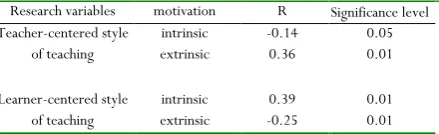
Table 3: Results of Pearson coefficient test used to investigate the relationship between teacher motivation
and teaching style
Significance level R
motivation Research variables
0.05 -0.14
intrinsic Teacher-centered style
of teaching extrinsic 0.36 0.01
0.01 0.39
intrinsic Learner-centered style
of teaching extrinsic -0.25 0.01
According to the results obtained, there is a significant relationship between the teacher-centered style of teaching and intrinsic motivation (R= -0.14, P<0.05) and between the teacher-centered style and extrinsic motivation (R= 0.36, P<0.01). In addition, there is a significant relationship between the learner-centered style of learning and intrinsic motivation (R=0.39, P<0.01) and between the learner-centered style and extrinsic motivation (R= - 0.25, P<0.01).
The first research hypothesis which states that there is a relationship between intrinsic motivation and the learner-centered style of learning is confirmed according to the results shown in (Table 1, 3). These tables indicate that intrinsic motivation positively predicts the learner-centered teaching style at the level of 0.01.
The second research hypothesis stated that a teacher's extrinsic motivation can predict the teacher-centered style of teaching. The results shown in (Table 1, 3) indicate that extrinsic motivation can positively predict the teacher-centered style of teaching at the level of 0.01.
Discussion and Conclusion
The aim of this research was to investigate the relationship between physical educators' teaching style and the type of motivation they have to teach. In this regard, according to theoretical principles and the studies carried out, it can be concluded that there is a relationship between teachers' style of teaching and their motivation to teach.
The first research hypothesis was that there is a relationship between the learner-centered teaching style and physical educators' intrinsic motivation. Findings showed that the learner-centered teaching style is positively related to physical educators' intrinsic motivation. This finding is consistent with the results of some previous studies including [7, 19, 22] which
showed that intrinsic and extrinsic motivations are positively related to occupational success.
The second hypothesis was that there is a relationship between the teacher-centered style of education and physical educators' extrinsic motivation. As the results show there is a positive relationship between the teacher-centered style of teaching and physical educators' extrinsic motivation. This finding is in line with the findings of some studies including [7, 14, 15] which
concluded that there is a positive relationship between intrinsic and extrinsic motivations and occupational success.
According to the findings of this study, intrinsic motivation to teach positively predicts the learner-centered teaching style. This finding indicates that teachers who have independent (intrinsic) motivation use learner-centered methods of teaching and teachers with dependent (extrinsic) motivation use teacher-centered methods. Innate (intrinsic) motivation is significantly higher in teachers who apply learner-centered methods of teaching compared to the teachers who do not use such methods. Teachers with innate motivation who use learner-centered methods contribute more to students' physical activity and movement [14, 18]. Roth et al [15] also showed that the effect
of teacher's motivation on students' motivation can be a direct result of teaching methods. When teachers apply learner-centered methods of teaching, the role of the student is emphasized. We can use student-centered methods of teaching as autonomous-protective styles of teaching. The statistical analysis showed that educational average had a negative relationship with demotivation and was positively related to the intrinsic motivation, extrinsic motivation and performance [11].
In addition, Roth et al [15] showed that self-determined
motivation in teaching has a positive relationship with teacher's sense of success and a negative relationship with their feeling of exhaustion.
According to the literature it can be concluded that a teacher's style of teaching is one of the most important factors that predicts their motivation to teach [8]. Based on the
self-determination theory, teachers who have experienced the benefits of self-determined motivation prefer that their students as well act and learn according to self-determined motivations because they realize that different types of such motivations would lead to desirable learning and creates more understanding towards the topics that they teach and like. Therefore, teachers with self-determined motivations use their personal experiences as a basis for deducing that if learners realize the importance of the topic they learn and find it interesting, they would get down to work in the most serious manner possible. Due to this understanding and realization, teachers then try to take up autonomy-supportive activities such as clarification of the relationships among different topics with their students' goals and provision of the possibility to select interesting learning activities. In short, it can be stated that physical educators have an important role in the evolution of behaviors, attitudes and skills of the students and in giving them the required information for physical activity [4]. In this regard,
522 Journal of Advanced Pharmacy Education & Research | Oct-Dec 2017 | Vol 7 | Issue 4
attention to learners' needs and interests and planning and exercising plans that are appropriate to the learners' growth conditions are some of the other effective measures that physical educators can take. However, it must be kept in mind that achieving these desirable points requires the presence of expert educators who try to use the best teaching and instruction methods.
Based on the findings of this research, it is suggested that educational authorities and managers emphasize the importance of the student-centered style of teaching so that learners are more leaded towards intrinsic motivation, organize class structure in such a manner that affects students' motivation positively and pave the way for the students' natural talents to emerge and for their motivation to progress to improve since students' good performance is dependent on their teachers' motivation and style of teaching. Eventually, students' advancement and improvement in their levels of progress can improve the society's conditions. It is suggested that during in-service programs or workshops teachers and instructors be trained in teaching methods and how to use them according to the field they work in. Important topics such as educational goals and teachers' intrinsic motivation and the effect of these variables on students' motivation must also be discussed in such courses. In the end, it is suggested that researchers conduct similar studies at other educational levels and universities so that differences in results could be seen for these different groups. As for the limitations of the study we would say that care must be taken in generalizing the results of this study to other groups of learners rather than the population under study in this research: teachers (trainers) at senior high schools.
References
1. Hockey, Eten, I. Interaction between academic
motivation and student teachers’ academic
achievement, Hacettepe University, Faculty of Education, Ankara 06800, Turkey, 2014.
2. Anderson, L. Teacher's effectiveness in the teaching process, translated by Amini, M. Tehran: Payam, 1998.
3. Rafeqi, M. & Narimani, F. Effective factors in teachers' occupational satisfaction or dissatisfaction and the variables that increase their efficiency. A summary of studies, 2011.
4. Ahmadi, M.; Amani, J.; Baglou, S. & Masoumi, V. Applying self-determination theory in predicting physical educators' occupational performance. Applied Studies in Sports' Management, 2, 2014. 5. Deci, E.L. and Ryan, R.M. Intrinsic motivation and
self-determination in human behavior. New York: Plenum Press, 1985.
6. Berghe, L. V. D., Soenens, B., Vansteenkiste, M., Alterman, N., Cardon, G., Tallir, I. B., & Haerens, L. Observed need-supportive and need-thwarting teaching behavior in physical education: do teachers'
motivational orientations matter? Psychology of Sport and Exercise, 2013, 14, 650-661.
7. Afsharnejad, T., Hemmatinejad, M., Ramezaninejad, R. Effect of participation in scientific-technical contests on physical educators' professional performance, unpublished MA thesis, faculty of physical education, Gilan University, 2007.
8. Biabangard, E. Relationship between self-esteem, achievement motivation and academic achievement. Psychological Studies, 2006, 1(4&5), 5-18 (In Farsi). 9. Deci, EL & Ryan, RM. Self-determination theory
and the facilitation of intrinsic motivation, social development, and well-being. American Psychologist, 2000, 55, 68–78.
10. Vallerand, J. R., Fortier, M. S., & Guay, F. Self-determination and persistence in a real life setting: Toward a motivational model of high school dropout. Journal of Personality and Social psychology, 1997, 72, 5, 1161-1176.
11. Deci, E.L.; Ryan, R.M. & Williams, G.C. Need satisfaction and the Self-Regulation of Learning. Learning and Individual Differences, 1996, 8,165-183.
12. Ryan R. M., Williams G. C., Patrick H. et al. Self-determination theory and physical activity: the dynamics of motivation in development and wellness. Hellenic Journal of Psychology, 2009, 6,107–124. 13. Rio, J. M. Motivation and emotion. Translated by
Seyyed Mohammadi, Y. Tehran: Virayesh, 1997. 14. Vello H., Francis R., Francisco P., Agnese C., Arunas
E., Judit H. E. & Irena V. The relationship between teaching styles and motivation to teach among physical education teachers. Journal of Sports Science and Medicine, 2012, 123-130.
15. Deci, E. L., Eghrari, H., Patrick, B. C., & Leone, D. Facilitating internalization: The self-determination theory perspective. Journal of Personality, 1994, 62, 119–142.240.
16. Shabani, H. Teaching skills, methods and techniques. Tehran: Samt, 2006.
17. Robson, J. Active teaching and learning, 2006. Available at:w.gre.ac.uk/~bj61/talessi/atl.html. 18. Roth, G.; Assor, A.; Kanat-Maymon, Y. & Kaplan,
H. Autonomous mmotivation for teaching: how self-determined teaching may lead to self-self-determined learning. Journal of Educational Psychology, 2007. 4, 761-774.
19. Pelletier, L. G., Fortier, M. S., Vallerand, R. J., & Briere, N. M. Assocaations among perceived autonomy support, froms of self- regulation, and persistennnnnce, Motivation and Emotion, 2001, 4, 279- 306.
Journal of Advanced Pharmacy Education & Research | Oct-Dec 2017 | Vol 7 | Issue 4 523
Organization of Education in Kermanshah Province. Applied Research of Sport Management, 2014 Vol.2, No.3.
21. Alimohamadi, h. Relationship between Motivation to Teach and Teaching Method of Physical Educators. Imam Reza) International University Mashad, Khorasan Razavi, Iran, 2014.