R E V I E W
Open Access
Is air pollution a risk factor for rheumatoid
arthritis?
Mickael Essouma
1*and Jean Jacques N. Noubiap
2,3Abstract
Rheumatoid arthritis is a chronic inflammatory debilitating disease triggered by a complex interaction involving genetic and environmental factors. Active smoking and occupational exposures such as silica increase its risk, suggesting that initial inflammation and generation of rheumatoid arthritis-related autoantibodies in the lungs may precede the clinical disease. This hypothesis paved the way to epidemiological studies investigating air pollution as a potential determinant of rheumatoid arthritis. Studies designed for epidemiology of rheumatoid arthritis found a link between traffic, a surrogate of air pollution, and this disease. Furthermore, a small case–control study recently found an association between wood smoke exposure and anticyclic citrullinated protein/peptide antibody in sera of patients presenting wood-smoke-related chronic obstructive pulmonary disease. However, reports addressing impact of specific pollutants on rheumatoid arthritis incidence and severity across populations are somewhat conflicting. In addition to the link reported between other systemic autoimmune rheumatic diseases and particulate matters/gaseous pollutants, experimental observation of exacerbated rheumatoid arthritis incidence and severity in mice models of collagen-induced arthritis after diesel exhaust particles exposure as well as hypovitaminosis D-related autoimmunity can help understand the role of air pollution in rheumatoid arthritis. All these
considerations highlight the necessity to extend high quality epidemiological researches investigating different sources of atmospheric pollution across populations and particularly in low-and-middle countries, in order to further explore the biological plausibility of air pollution’s effect in the pathogenesis of rheumatoid arthritis. This should be attempted to better inform policies aiming to reduce the burden of rheumatoid arthritis.
Keywords:Rheumatoid arthritis, Pathogenesis, Environmental risk factors, Air pollution
Background
Rheumatoid arthritis (RA) is a systemic autoimmune disease that primarily targets joints leading to progres-sive joint erosions, and which affects 0.24 % [95 % confi-dence interval (CI) 0.23 to 0.25 %] of the world population. RA patients continue to face steep rises of the burden of disease, with disability-adjusted life years estimates increased from 3 335 000 (95 % CI 2 573 000 to 4 192 000) in 1990 to 4 815 000 (95 % CI 3 705 000 to 6 056 000) in 2010 [1, 2]. Based on serologic features, two forms are identified: seronegative and seropositive RA [3]. Hereditability of the disease accounts for 50–60 % of its variance, the HLA-DRB1 shared epitope–containing allele being the strongest genetic risk factor [4–6]. Some
environmental risk factors are playing out on this genetic background to determine the occurrence of RA. Besides active and heavy tobacco smoking which is the most im-portant environmental risk factor for RA with its attribut-able risk sustained for up to 20 years after discontinuation, other potential risk factors include estrogens, low socio-economic status, silica dust, abestoses, mineral oil, diet and infections [5, 6]. However, the exact etiopathogenesis of RA is still not clearly elucidated.
Air pollution, a mixture of suspended particulate mat-ters (PM) of different diamemat-ters (<10μm [PM10], <2.5μm [PM2.5] and <0.1 μm [PM0.1]) and gases (nitrates [NO2], sulphur dioxide [SO2], ozone [O3], and carbon monoxide) has recently been paid more attention in the field of RA [7]. Main sources include: traffic, industry, stationary fuel burners, forest fires, and solid fuel combustion [7]. Tropo-spheric pollutants drive climate change and adverse health effects including chronic obstructive pulmonary disease * Correspondence:[email protected]
1
Division of Medicine, Sangmelima’s Reference Hospital, P.O. Box 890, Sangmelima, Cameroon
Full list of author information is available at the end of the article
(COPD), cancers, cataracts, stillbirths, and cardiovascular diseases [7].
Assuming that active smoking and occupational expo-sures increase the risk of RA, it was suggested that initial inflammation and production of RA-related autoanti-bodies in the lungs may lead to RA [4]. This idea to-gether with the inflammation-related burden of disease attributable to atmospheric pollution guided epidemio-logical studies of air pollution in relation to RA, in view of eventual preventive strategies.
A link between sources of air pollution and rheumatoid arthritis
Currently, the association between sources of atmos-pheric pollution and RA has been investigated in three large epidemiological studies: the Nurses’ Health Study (NHS) in the United States [8, 9], the British Colombian (BC) study in Canada[10], and the Swedish Epidemiological Investigation of Rheumatoid Arthritis (EIRA) [11, 12]. In the NHS, association of distance to road-a marker of traffic pollution exposure- and incidence of RA was studied in 90297 women. After adjustment for multiple confounders (age, calendar year, race, cigarette smoking, parity, lactation, menopausal status and hor-mone use, oral contraceptive use, body mass index, phys-ical activity, and census-tract-level median income and house value), women living within 50 m of a road had an incremented risk of RA compared with those living 200 m or farther away (hazard ratio [HR] = 1.31; 95 % CI 0.98– 1.74) [8]. This finding was more consistent among non-smokers (HR = 1.62; 95 % CI, 1.04–2.52). Similarly, the BC study assessed the effects of proximity to traffic, ambient air pollution, and community noise on the risk of develop-ing RA usdevelop-ing health records of 640041 subjects at risk of developing RA in the Border Air Quality Study cohort. Residential proximity to traffic five years prior to RA diag-nosis, but consistently not noise, was associated with an increased risk of RA; with highest risks noted for highways and with greater proximity. Since health service records did not contain informations on low socioeconomic sta-tus, nonwhite race, and smoking which are all risk factors for RA highly prevalent close to roadways, the authors did not adjust for these factors in statistical analyses. Never-theless, there was little confounding due to neighborhood-level income, and smoking was unlikely to be an import-ant confounder according to sensitivity analyses [10]. Additionally, Sigari et al. [13] recently found signifi-cantly elevated anticyclic citrullinated protein/peptide antibody (ACPA) levels in 56 wood smoke-induced COPD patients compared to 56 tobacco-induced COPD patients, and to 56 healthy controls. It is noteworthy that ACPA (the most specific biological markers with predictive and prognostic value in RA patients) are ele-vated in patients’sera five to 10 years prior to diagnosis
Indirect evidence for a potential link between air pollution and rheumatoid arthritis
Despite sparse literature on air pollution and RA per se, tropospheric pollutants have repeatedly been associated with various systemic autoimmune rheumatic diseases (SARDs) [15–18]. In particular, PM2.5 levels 24 h–48 h before visits were significantly associated with anti-double stranded DNA serum specific autoantibodies in 237 Canadian patients followed up for systemic lupus er-ythematosus (SLE) during a time frame of seven years [15]. Likewise, a Brazilian study reported a link between SO2exposures 14 days earlier and increased hospital ad-missions for pediatric autoimmune rheumatic diseases [16]. Moreover, Bernatsky et al. recently studied associa-tions between local-scale ambient NO2 and PM2.5 in Calgary, Alberta-Canada, using Land Use Regression models (a preferred approach for exposure estimation including individual exposure estimation) and SARDs (SLE, Sjogren’s Syndrom, scleroderma, polymyositis, dermatomyositis, or undifferentiated connective tissue disease) [17]. Resultantly, ambient PM2.5levels but not NO2 are strongly associated with SARDs in Alberta (OR adjusted for age, sex and income = 1.10, 95 % CI 1.01–1.22).
Based on the aforementioned studies and the small amount of data addressing air pollution in relation to RA together with extrapolations from relevant data in other areas, RA could be associated with PM, but also NO2,SO2and O3exposures as well. Indeed, PM pollut-ants are the most toxic tropospheric pollutpollut-ants for all-cause morbidity and mortality associated with air pollut-ants [19–22]. In addition, they have been associated with other SARDs [15, 17]. Still, they can interact with gas-eous pollutants that have been associated with RA [11], and even result from their transformation [22]. Most im-portantly, exposure to diesel exhaust particles (nano PM) during arthritis development exacerbated incidence and severity of RA in mice models of collagen-induced arthritis [23, 24]. However, NO2and SO2linked with RA in the EIRA study [11], and O3linked with risk of RA in the BC study [10] all appear less toxic than PM and their respective concentrations highly depend on their complex interactions. Furthermore, NO2may essentially serve as a proxy for PM, and O3increases permeability of the re-spiratory epithelium to PM, hence exacerbating their ac-tions [22].
Reports on the precise mechanistic link between these specific air pollutants and RA are somewhat conflicting. Anyhow, extrapolating from studies on air pollution and respiratory diseases [21, 22] as well as studies on air pol-lution and other SARDs [15–17] together with know-ledge on mechanism of action of tropospheric pollutants [15–24], local lung and systemic oxidative stress and in-flammation may be the central underlying mechanism
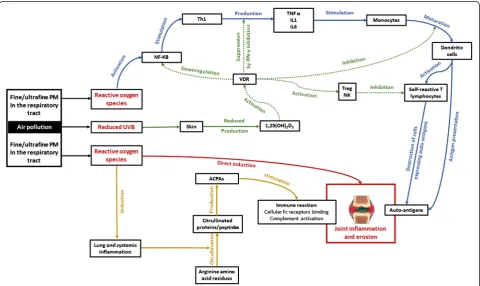
[4, 18, 19, 25, 26]. In particular, free reactive oxygen spe-cies released by fine/ultrafine PM or gaseous pollutants inhaled in the respiratory tract are capable of activating nuclear factorƙappa B (NF-ƙB), a key regulator for pro-inflammatory cytokine production in RA patients [18, 19, 25], leading to excess T helper lymphocyte type1 (Th1) production of tumor necrosis factor alpha, interleukin-1 and interleukin-6 [25]. These cytokines stimulate resting monocytes to mature dendritic cells which then present autoantigens, co-stimulating self-reactive T lymphocytes that migrate to target tissues (preferentially synovial joints), and cause destruction of cells expressing autoantigens [18]. Hence, there is persistent amplified chronic inflammation, a major prerequisite for protein bounded arginine citrullina-tion and subsequent ACPA produccitrullina-tion that will later on lead to clinical signs of RA in genetically susceptible individuals [4, 26]. Moreover, reactive oxygen species per se are capable of worsening RA through induction of periarticular bone erosion [26].
Beyond oxidative stress, air pollution might further contribute to RA development and exacerbation through hypovitaminosis D [27–30]. Remarkably, the link be-tween air pollution and low serum vitamin D has been investigated in astonishingly few cross-sectional studies [31–33]. Agarwal et al. [31] compared serum total 25-hydroxycholecalciferol (25-OH-D)-the best indicator of vitamin D storage- of 34 infants (aged 9–24 months) and toddlers in Mori Gate–a highly polluted area- with serum total 25-OH-D of a similar number of age and sex matched controls living in Gurgaon, a less polluted area. Mori Gate inhabitants had significantly lower mean serum 25-OH-D compared with Guargaon inhabitants (11.7 ± 7 ng/ml vs 27.1 ± 7 ng/ml, p< 0.001) [31]. An-other study [32] evaluated the characteristics and preva-lence of subjects with serum 25-OH- D less than 75 nmol/l among 85 postmenopausal women engaging in outdoor activities in either Brussels (urban highly polluted area) or the countryside (rural less polluted area) and recruited from the rheumatology outpatient clinic. Despite a higher sun exposure index (113 vs. 87,
serum 25-OH-D [33]. Particularly relevant here, ~90 % of the body’s requisites for vitamin D are covered by skin synthesis in presence of sun’s ultraviolet B (UVB) radia-tions [33]. Also, 99 % of UVB radiaradia-tions with wavelength 291–320 nm are absorbed by the ozone layer which is in-creased in situations of incremented air pollution levels [30]. Along with O3, NO2 and SO2 can absorb UVB in polluted atmosphere, thus reducing the effectiveness of sun exposure on skin synthesis of vitamin D [30]. There-fore, air pollution lowers serum vitamin D independently of sun exposure and other determinants of vitamin D sta-tus, probably through UVB radiations absorption by gas-eous pollutants, and could thus increment RA incidence.
In fact, the active form of vitamin D, 1,25-dihydroxyvita-min D3[1,25(OH)2D3], acts as an immunomodulator by binding to vitamin D receptor (VDR) besides its meta-bolic activities [27–30, 33]. Remarkably, 1,25(OH)2D3is
capable of inducing natural killer and T regulatory cells, thereby preventing autoimmunity [27]. Furthermore, 1,25 (OH)2D3suppresses Th1 responses via interferon-γ inhibition, prevents monocyte differentiation into den-dritic cells as well as antibody formation, and downre-gulates NF-ƙB [27].
Altogether, local lung and systemic oxidative stress along with hypovitaminosis D may trigger RA in the context of air pollution (Fig. 1).
Air pollution and rheumatoid arthritis with focus on low-and-middle income countries
Considering that majority of the world population resides in low-and-middle-income countries (LMICs), the number of affected people in this part of the world are projected to increase in the upcoming years. For instance, with an additional prevalence of 0.1 %, four
Fig. 1Schematic representation of mechanisms putatively influencing rheumatoid arthritis through air pollution exposure. Four main mechanistic pathways are represented (blue, brown, red, and green arrows). Blue arrows: free reactive oxygen species released by fine/ultrafine particulate matter (PM) inhaled in the respiratory activate nuclear factorƙappa B (NF-ƙB) that stimulates the production of tumor necrosis factor alpha (TNF-α), interleukin 1 (IL1) and interleukin 6 (IL6) by T helper lymphocytes type 1 (Th1). These cytokines stimulate resting monocytes to mature dendritic cells which then present autoantigens, co-stimulating self-reactive T lymphocytes that migrate to target tissues (preferentially synovial joints), and cause destruction of cells expressing autoantigens and thereby joint inflammation and erosion. Brown arrows: free reactive oxygen species cause chronic lung and systemic inflammation that enhance citrullination of arginine amino acid residues into citrullinated proteins/peptides. These citrullinated products induce anticyclic citrullinated protein/peptide antibodies (ACPAs) production that will later on lead to immune reaction through binding to cellular Fc receptors and complement activation, and finally cause joint inflammation and erosion. Red arrow: reactive oxygen species per se can worsen joint inflammation and erosion. Green arrows: Reduced ultraviolet B (UVB) radiation levels lead to decreased skin synthesis of 1,25-dihydroxyvitamin D3[1,25(OH)2D3] which acts as an immunomodulator through vitamin D receptor (VDR) activation.
Resultantly, immunomodulatory activities of 1,25(OH)2D3represented by green doted arrows are not met, and RA can develop. IFN-γinterferon
million supplemental individuals might be affected [34]. Furthermore, a low socio-economic status has been associated with both increased risk of developing RA and increased mortality of RA patients [35]. Yet, RA is neglected in LMICs undoubtedly because of gaps in estimates of the burden of disease along with lack of communication strategies informing policy makers on the urgency of the problem [34].
As concerns sub-Saharan Africa, potential RA genetic background and environmental risk factors are quite dif-ferent from those of other parts of the world despite an overall similar phenotype [4, 14, 36–38]. Notheworthy, smoking is not a risk factor for RA in this population [14, 36]. Hence, RA in Black Africans may be deter-mined by specific genetic and environmental factors such as lower socio-economic status, and infections [4, 14, 37]. But the role of infections is controversial [14, 36], with parasitic infections suggested to protect against RA in Sub-Saharan Africa since they rage at en-demic levels in that area [14, 39, 40]. Admittedly, para-sites cannot resist in a milieu characterized by amplified immuno-inflammatory activation. Subsequently, the pro-tection against RA is probably a consequence of defense mechanisms developed by parasites to survive in the host organism [39, 40]. Along this line, ES-62, a glycopro-tein secreted by a filarial nematode called Acanthocheilo-nema viteae has been shown to restore interleukin-10 producing regulatory B cells (Breg) in collagen-induced arthritis mice models [39]. It is notable that IL-10 is an anti-inflammatory cytokine associated with downregula-tion of Th1/Th17 responses [39]. Therefore, it appears necessary to pursue research of risk factors for RA in sub-Saharan Africa, and air pollution could be a plausible, if not the most important candidate.
Household air pollution (HAP) defined as “air pollu-tion generated by household fuel combuspollu-tion, leading to indoor air pollution, and contributing to ambient air pollution” [41] is mostly prevalent in LMICs where nearly three million people still rely on solid fuels for heating, cooking and lighting [21, 41–43] resulting in approximately 4.3 million premature deaths worldwide [41]. Still, peak prevalences of HAP exposure worldwide occur in sub-Saharan Africa (77 % with the number of affected individuals almost doubled from 333 million to 646 million over three decades) and Southeast Asia (61 %) [21]. Of note, this prevalence also varies within countries, with up to 100 % households concerned in some rural areas [44]. Moreover, individuals with a lower socioeco-nomic status have an incremented risk of exposure to at-mospheric pollution compared with individuals who have high incomes (differential exposure) [11, 45, 46]. Likewise, people with a lower socioeconomic status are at increased risk of developing air pollution-related health hazards compared with those who have a higher socioeconomic
status (differential susceptibility) [11, 45, 46]. Taken col-lectively, poverty increases the risk of air pollution and exacerbates its consequences. Hence, Africa and Southeast Asia may carry the heaviest burden of air pollution.
RA has been associated with a lower socioeconomic status [5, 35] which may be a marker for residential ex-posure to air pollution [11]. Indeed, it is a confounder of the association between tropospheric pollutants and RA [9, 11]. In this light, results from the NHS which failed to demonstrate any association between RA and specific pollutants [9] are unlikely to be generalized in impover-ished societies given the high economic status of the in-cluded nurses thus residing in less polluted areas [9], unlike populations from LMICs.
In total, the burden of RA and increased atmospheric pollution coincide in LMICs-especially in sub-Saharan Africa and Southeast Asia- with poverty raising the risk of air pollution and exacerbating air pollution. However, there is still a small amount of data on air pollution and RA coming from LMICs.
Conclusion
Traffic, a surrogate of air pollution, has been associated with incident RA. Whether this environmental factor is causally associated with RA across populations is still a matter of debate. Based on indirect arguments, as well as exacerbation of RA incidence and severity in mice models of collagen-induced arthritis after diesel exhaust particles exposure, local lung and systemic oxidative stress together with vitamin D deficiency-related auto-immunity may help to clarify a putative mechanistic link between tropospheric pollutants and RA. Additional well-designed epidemiological studies investigating different sources of air pollution and specific pollutants in relation to RA across populations, especially in LMICs are thus needed to better explore the biological plausibility of air pollutions’ effects in RA. If a causal relationship is con-firmed, then health policies should be made to reduce the burden of RA.
Abbreviations
25-OH-D:25-hydroxycholecalciferol; 1,25(OH)2D3: 1,25-dihydroxyvitamin D3;
ACPA: Anticyclic citrullinated protein/peptide antibody; BC: British Colombian study; COPD: Chronic obstructive pulmonary disease; EIRA: Epidemiological Investigation of Rheumatoid Arthritis; HAP: Household air pollution; HR: Hazard ratio; LMICs: Low-and-middle-income countries; NF-ƙB: Nuclear factorƙappa B; NHS: Nurses’health study; NO2: Nitrates; OR: Odds ratio;
O3: Ozone; PM: Particulate matters; PM0.1: Particulate matter with an
aerodynamic diameter less than 0.1μ; PM2.5: Particulate matter with an
aerodynamic diameter less than 2.5μ; PM10: Particulate matter with an
aerodynamic diameter less than 10μ; RA: Rheumatoid arthritis; SARDs: Systemic autoimmune rheumatic diseases; SLE: Systemic lupus erythematosus; SO2: Sulphur dioxide; Th1: T helper lymphocyte type 1;
UVB: Ultraviolet B radiations; VDR: Vitamin D receptor.
Competing interests
Authors’contributions
ME conceived the plan of the review, drafted the manuscript, and revised it. JJNN was involved in drafting and revised the manuscript. All authors read and approved the final manuscript.
Acknowledgments
The authors are solely responsible for the manuscript preparation, for its intellectual content, and for the decision to submit it for publication. No author received a funding. The manuscript was not revised by any language editor.
Author details 1
Division of Medicine, Sangmelima’s Reference Hospital, P.O. Box 890, Sangmelima, Cameroon.2Department of Medicine, Groote Schuur Hospital and University of Cape Town, Cape Town, South Africa.3Medical Diagnostic Center, Yaoundé, Cameroon.
Received: 17 March 2015 Accepted: 20 July 2015
References
1. Cross M, Smith E, Hoy D, Carmona L, Wolfe F, Vos T, et al. The global burden of rheumatoid arthritis: estimates form the Global Burden of Disease 2010 study. Ann Rheum Dis. 2014;73:1316–22.
2. Dadoun S, Zeboulon-Ktorza N, Combescure C, Elhai M, Rozenberg S, Gossec L, et al. Mortality in rheumatoid arthritis over the last fifty years: systematic review and meta-analysis. Joint Bone Spine. 2013;80:29–33.
3. Aletaha D, Neogi T, Silman AJ, Funovtis J, Felson DT, Bingham 3rd CO, et al. 2010 Rheumatoid arthritis classification criteria: an American College of Rheumatology/European League Against Rheumatism collaborative initiative. Ann Rheum Dis. 2010;69:1580–8.
4. Ruiz-Esquide V, Sanmartí R. Tobacco and other environmental risk factors in rheumatoid arthritis. Reumatol Clin. 2012;8(6):342–50.
5. Tobon GJ, Youinou P, Saraux A. The environment, geo epidemiology, and auto-immune disease: Rheumatoid arthritis. J Autoimmun. 2010;35(1):10–4. 6. Hoovestol RA, Mikuls TA. Envirronmental exposures and rheumatoid arthritis
risk. Clin Rheumatol Rep. 2011;13:431–9.
7. Boama PO, Onumah J, Takase M, Bonsu PO, Salifu T. Air pollution control techniques. Global J Bio-Sci Biotechnol. 2012;1(2):124–31.
8. Hart JE, Laden F, Puett RC, Kostenbader KH, Karlson WE. Exposure to traffic pollution and increased risk of rheumatoid arthritis. Environ Health Perspect. 2009;117:1065–9.
9. Hart JE, Kalberg H, Laden F, Kostenbader KH, Yanosky JD, Klareskog R, et al. Ambient air pollution exposures and risk of rheumatoid arthritis in the Nurses’Health Study. Arthritis Care Res (Hoboken). 2013;65(7):1190–6. 10. De Roos AJ, Koehoorn M, Tamburic L, Davies HW, Brauer M. Proximity to
traffic, ambient air pollution, and community noise in relation to incident rheumatoid arthritis. Environ Health Perspect. 2014;122:1075–80. 11. Gan RW, Deane KD, Zerbe GO, Demoruelle MK, Weisman MH, Buckner JH,
et al. Relationship between air pollution and positivity of RA-related autoantibodies in individuals without established RA: a report on SERA. Ann Rheum Dis. 2013;72(12):2002–5.
12. Hart JE, Källberg H, Laden F, Bellander T, Costenbader KH, Holmqvist M, et al. Ambient air pollution exposures and risk of rheumatoid arthritis: results from the Swedish EIRA case–control study. Ann Rheum Dis. 2013;72(6):888–94.
13. Sigari N, Moghimi N, Sharhaki SF, Mohammadi S, Roshani D. Anti‑cyclic citrullinated peptide (CCP) antibody in patients with wood‑smoke‑induced chronic obstructive pulmonary disease (COPD) without rheumatoid arthritis. Rheumatol Int. 2015;35:85–91.
14. Nogueira L, Cornillet M, Singwe-Ngandeu M, Viatte S, Bas S, Gabay C, et al. In Black Africans with rheumatoid arthritis, ACPA recognize citrullinated fibrinogen and the derived peptidesα36-50Cit38,42 andβ60-74Cit60,72,74, like in Caucasians. Clin Immunol. 2014;152:58–64.
15. Bernatsky S, Fournier M, Pineau CA, Clarke AE, Vinet E, Smargiassi A. Associations between ambient fine particulate levels and disease activity in patients with Systemic Lupus Erythematosus (SLE). Environ Health Perspect. 2011;119:45–9.
16. Vidotto JP, Pereira LA, Braga ALF, Silva CA, Sallum AM, Campos LM, et al. Atmospheric pollution: influence on hospital admissions in paediatric rheumatic diseases. Lupus. 2012;21:526–33.
17. E Bernatsky S, Smargiassi A, Johnson M, Kaplan GG, Barnabe C, Svenson L, et al. Fine particulate air pollution, nitrogen dioxide, and systemic auto- immune rheumatic disease in Calgary, Alberta. Environment Res. 2015;140:474–8. 18. Ritz SA. Air pollution as a potential contributor to the‘epidemic’of
autoimmune disease. Med Hypotheses. 2010;74:110–7.
19. Farhat SCL, Silva CA, Orione MAM, Campos LMA, Sallum AME, Braga ALF. Air pollution in autoimmune rheumatic diseases: a review. Autoimmunity Rev. 2011;11:14–21.
20. Balti EV, Echouffo-Tcheugui JB, Yako YY, Kengne AP. Air pollution and risk of type 2 diabetes mellitus: a systematic review and meta-analysis. Diabetes Res Clin Pract. 2014;106:161–72.
21. Bonjour S, Adair-Rohani H, Wolf J, Bruce NG, Mehta S, Pru-ustun A, et al. Solid fuel use for household cooking: country and regional estimates for 1980–2010. Environ Health Perspect. 2013;121:784–90.
22. World Health Organization. Health Aspects of Air Pollution with Particulate Matter, Ozone and Nitrogen Dioxide. World Health Organization. Bonn, Germany; 2003. http://www.euro.who.int/__data/assets/pdf_file/0005/ 112199/E79097.pdf. Accessed 7 June 2015.
23. Yoshino S, Sagai M. Enhancement of collagen-induced arthritis in mice by diesel exhaust particles. J Pharmacol Exp Ther. 1999;290(2):524–9. 24. Yoshino S, Hayashi H, Taneda S, Sagai M, Mori Y. Effect of diesel exhaust
particle extracts on collagen-induced arthritis in mice. Autoimmunity. 2002;35(1):57–61.
25. Ying G, Wang Y, Cen XM, Yang M, Liang Y, Xie QB. Lipid peroxidation-mediated inflammation promotes cell apoptosis through activation of NF-κB pathway in rheumatoid arthritis synovial cells. Mediators Inflamm. 2015;2015:460310.
26. Valesini G, Gerardi MC, Iannuccelli C, Pacucci VA, Pendolino M, Shoenfeld Y. Citrullination and autoimmunity. Autoimmunity Rev. 2015;14:490–7. 27. Song GG, Bae SC, Lee YH. Association between vitamin D intake and the
risk of rheumatoid arthritis: a meta-analysis. Clin Rheumatol. 2012;31:1733–9. 28. Hiraki LT, Arkema EV, Cui J, Malspeis S, Costenbader KH, Karlson EW.
Circulating 25-hydroxyvitamin D level and risk of developing rheumatoid arthritis. Rheumatology. 2014;53:2243–8.
29. Sahebari M, Mirfeizi Z, Rafatpanah H, Goshyeshi L. 25(OH) vitamin D serum values and rheumatoid arthritis disease activity (DA S28 ESR). Caspian J Intern Med. 2014;5(3):148–55.
30. Wacker M, Holick MF. Sunlight and Vitamin D: A global perspective for health. Dermatoendocrinol. 2013;5(1):51–108.
31. Agarwal KS, Mughal MZ, Upadhyay P, Berry JL, Mawer EB, Puliyel JM. The impact of atmospheric pollution on vitamin D status of infants and toddlers in Delhi. India Arch Dis Child. 2002;87(2):111–3.
32. Manicourt DH, Devogelaer JP. Urban tropospheric ozone increases the prevalence of vitamin D deficiency among Belgian postmenopausal women with outdoor activities during summer. J Clin Endocrinol Metab.
2008;93(10):3893–9.
33. Hosseinpanah F, Hashemi Pour S, Heibatollahi M, Moghbel N, Asefzade S, Azizi F. The effects of air pollution on vitamin D status in healthy women: A cross sectional study. BMC Public Health. 2010;10:519.
34. Rudan I, Sidhu S, Papana A, Meng S-J, Xin–Wei Y, Wang W, et al. Prevalence of rheumatoid arthritis in low–and middle–income countries: A systematic review and analysis. J Global Health. 2015;5(1):010409.
35. Ghawi H, Crowson CS, Rand-Weaver J, Krusemark E, Gabriel SE, Juhn YJ. A novel measure of socioeconomic status using individual housing data to assess the association of SES with rheumatoid arthritis and its mortality: a population-based case–control study. BMJ Open. 2015;5:e006469. 36. Malemba JJ, Mbuyi-Muamba JM, Mukaya J, Bossuyt X, Emonds MP, Deiteren
K. The phenotype and genotype of rheumatoid arthritis in the Democratic Republic of Congo. Arthritis Res Ther. 2013;15:R89.
37. Jung KR, Choi S-E, Cha CH, Oh HB, Heo SH, Ahn HY, et al. Meta-analysis of the association between HLA-DRB1 allele and rheumatoid arthritis susceptibility in Asian populations. J Korean Med Sci. 2007;22:973–80. 38. Herraez DL, Martinez-Bueno M, Riba L, Gracia de la Torre I, Sacnum M, Goni
M, et al. Rheumatoid Arthritis in Latin Americans Enriched for American Ancestry Is Associated with Loci in Chromosomes 1, 12, 13, and the HLA Class II Region. Arthritis Rheum. 2013;65(6):1457–67.
40. Rzepecka J, Pineda MA, Al-Riyami LA, Rodgers DT, Huggan JK, Lumb FE, et al. Prophylactic and therapeutic treatment with a synthetic analogue of a parasitic worm product prevents experimental arthritis and inhibits IL-1β production via NRF2-mediated counter-regulation of the Inflammasome. J Autoimmun. 2015;60:59–73.
41. World Health Organization. WHO indoor air quality guidelines: household fuel combustion. World Health Organization. Geneva, Switzerland; 2014. http://apps.who.int/iris/bitstream/10665/141496/1/9789241548885_eng.pdf. Accessed 07 June 2015.
42. Bruce N, Pope D, Rehfuess E, Balakrishnan K, Adair-Rohani H, Dora C. WHO indoor air quality guidelines on household fuel combustion: Strategy implications of new evidence on interventions and exposure-risk functions. Atmos Environ. 2015;106:451–7.
43. Rogalsky DK, Mendola P, Metts TA, Martin 2nd JW. Estimating the number of low-income Americans exposed to household air pollution from burning solid fuels. Environ Health Perspect. 2014;122(8):806–10.
44. Rehfuess EA, Bruce NG, Smith KR. Solid Fuel Use: Health Effect. In: Nriagu JO, editor. Encyclopedia of Environmental Health. Burlington: Elsevier; 2011. p. 150–61.
45. Samet JM, White RH. Urban air pollution, health, and equity. J Epidemiol Community Health. 2004;58:3–5.
46. Deguen S, Zmirou-Navier D. Social inequalities resulting from health risks related to ambient air quality-A European review. Eur J Public Health. 2010;20(1):27–35.
Submit your next manuscript to BioMed Central and take full advantage of:
• Convenient online submission
• Thorough peer review
• No space constraints or color figure charges
• Immediate publication on acceptance
• Inclusion in PubMed, CAS, Scopus and Google Scholar
• Research which is freely available for redistribution