What You’ll Learn
• You will learn how to describe and measure rotational motion. • You will learn howtorque changes rotational velocity. • You will explore factors
that determine the stability of an object. • You will learn the
nature of centrifugal and Coriolis “forces.”
Why It’s Important
You encounter many rotating objects in everyday life, such as CDs, wheels, and amusement-park rides. Spin Rides Amusement-park rides that spin are designed to thrill riders using the physics of rotational motion. The thrill is produced by a “force” that is present only when the ride spins.Think About This
Why do people who ride amusement-park rides that spin in circles, such as this one, experience such strong physical reactions?
physicspp.com
physicspp.com
How do different objects rotate
as they roll?
Question
Do different objects of similar size and mass roll at the same rate on an incline?
Procedure
1.You will need a meterstick, a piece of foam board, a ball, a solid can, and a hollow can.
2.Position the foam board on a 20°incline.
3.Place the meterstick horizontally across the foam board, near the top of the incline, and hold it.
4.Place the ball, solid can, and hollow can against the meterstick. The solid can and hollow can should be placed sideways.
5.Simultaneously, release the three objects by lifting the meterstick.
6.As each object accelerates down the incline, due to gravity, observe the order in which each object reaches the bottom.
7. Repeat steps 2–5 two more times.
Analysis
List the objects in order from the greatest to the least acceleration.
Critical Thinking Which of the objects’ properties may have contributed to their behavior? List the properties that were similar and those that were different for each object.
8.1
Describing Rotational Motion
Objectives •Describeangular
displacement.
•Calculateangular velocity. •Calculateangular
acceleration.
•Solveproblems involving rotational motion. Vocabulary
radian
angular displacement angular velocity angular acceleration
Y
ou probably have observed a spinning object many times. Howwould you measure such an object’s rotation? Find a circular object, such as a CD. Mark one point on the edge of the CD so that you can keep track of its position. Rotate the CD to the left (counterclockwise), and as you do so, watch the location of the mark. When the mark returns to its original position, the CD has made one complete revolution. How can you measure a fraction of one revolution? It can be measured in several different ways. A grad is 4100 of a revolution, whereas a degree is 3160 of a revolution. In mathematics and physics, yet another form of measure-ment is used to describe fractions of revolutions. In one revolution, a point on the edge travels a distance equal to 2 times the radius of the object. For this reason, the radianis defined as 1
2 of a revolution. In other words, one complete revolution is equal to 2radians. A radian is abbreviated “rad.”
23
34
54
32
74 2
3
4
6
0 2
r d
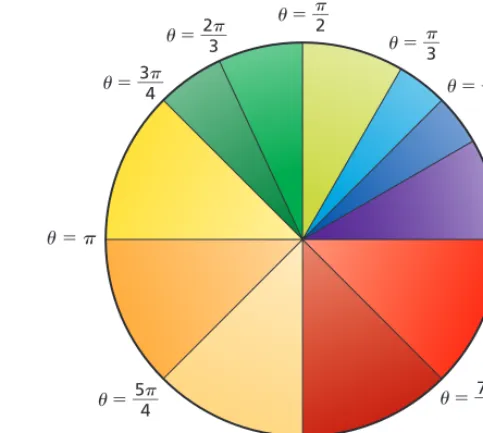
■Figure 8-1 The pie chart shows the radian measure of the most common angles, measured in the counterclockwise direction. Each angle is measured from 0.
Angular Displacement
[image:3.660.250.492.41.258.2]The Greek letter theta, , is used to represent the angle of revolution.
Figure 8-1shows the angles in radians for several common fractions of a revolution. Note that counterclockwise rotation is designated as positive, while clockwise is negative. As an object rotates, the change in the angle is called angular displacement.
As you know, Earth makes one complete revolution, or 2rad, in 24 h. In 12 h, its rotation is through rad. Through what angle does Earth rotate in 6 h? Because 6 h is one-fourth of a day, Earth rotates through an angle of
2 rad during that period. Earth’s rotation as seen from the north pole is
positive. Is it positive or negative when viewed from the south pole? How far does a point on a rotating object move? You already found that a point on the edge of an object moves 2times the radius in one revolu-tion. In general, for rotation through an angle, , a point at a distance, r, from the center, as shown in Figure 8-2,moves a distance given by dr. If ris measured in meters, you might think that multiplying it by rad would result in dbeing measured in mrad. However, this is not the case. Radians indicate the ratio between dand r. Thus, dis measured in m.
Angular Velocity
How fast does a CD spin? How do you determine its speed of rotation? Recall from Chapter 2 that velocity is displacement divided by the time taken to make the displacement. Likewise, the angular velocityof an object is angular displacement divided by the time taken to make the displacement. Thus, the angular velocity of an object is given by the following equation, where angular velocity is represented by the Greek letter omega, .
Angular Velocity of an Object
t
The angular velocity is equal to the angular displacement divided by the time required to make the rotation.
■Figure 8-2 The dashed line shows the path of the point on the CD as the CD rotates counterclockwise about its center.
Recall that if the velocity changes over a time interval, the average veloc-ity is not equal to the instantaneous velocveloc-ity at any given instant. Similarly, the angular velocity calculated in this way is actually the average angular velocity over a time interval, t. Instantaneous angular velocity is equal to the slope of a graph of angular position versus time.
Angular velocity is measured in rad/s. For Earth, E(2 rad)/ (24.0 h)(3600 s/h)7.27105 rad/s. In the same way that
counter-clockwise rotation produces positive angular displacement, it also results in positive angular velocity.
If an object’s angular velocity is , then the linear velocity of a point a distance, r, from the axis of rotation is given by vr. The speed at which an object on Earth’s equator moves as a result of Earth’s rotation is given by vr(6.38106 m)(7.27105 rad/s)464 m/s. Earth is an
example of a rotating, rigid body. Even though different points on Earth rotate different distances in each revolution, all points rotate through the same angle. All parts of a rigid body rotate at the same rate. The Sun, on the other hand, is not a rigid body. Different parts of the Sun rotate at different rates. Most objects that we will consider in this chapter are rigid bodies.
Angular Acceleration
What if angular velocity is changing? For example, if a car were acceler-ated from 0.0 m/s to 25 m/s in 15 s, then the angular velocity of the wheels also would change from 0.0 rad/s to 78 rad/s in the same 15 s. The wheels would undergo angular acceleration,which is defined as the change in angular velocity divided by the time required to make the change. Angular acceleration, , is represented by the following equation.
Angular acceleration is measured in rad/s2. If the change in angular
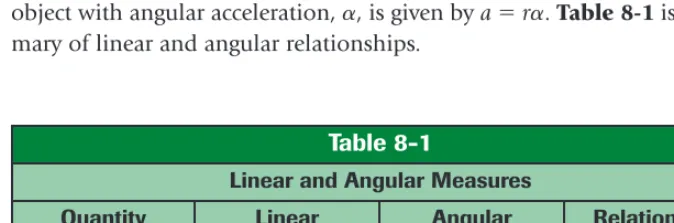
velocity is positive, then the angular acceleration also is positive. Angular acceleration defined in this way is also the average angular acceleration over the time interval t. One way to find the instantaneous angular accel-eration is to find the slope of a graph of angular velocity as a function of time. The linear acceleration of a point at a distance, r, from the axis of an object with angular acceleration, , is given by ar. Table 8-1is a sum-mary of linear and angular relationships.
Angular Acceleration of an Object
t
[image:4.666.70.407.619.730.2]
Angular acceleration is equal to the change in angular velocity divided by the time required to make that change.
Table 8-1
Linear and Angular Measures
Quantity Linear Angular Relationship
Displacement Velocity Acceleration
d (m)
v (m/s)
a (m/s2)
(rad) (rad/s) (rad/s2)
dr vr ar
Astronomy Connection
5. Angular Displacement A movie lasts 2 h. During that time, what is the angular displacement of each of the following?
a.the hour hand
b.the minute hand
6. Angular Velocity The Moon rotates once on its axis in 27.3 days. Its radius is 1.74106m.
a.What is the period of the Moon’s rotation in seconds?
b.What is the frequency of the Moon’s rotation in rad/s?
c. What is the linear speed of a rock on the Moon’s equator due only to the Moon’s rotation?
d.Compare this speed with the speed of a person on Earth’s equator due to Earth’s rotation.
7. Angular Displacement The ball in a computer mouse is 2.0 cm in diameter. If you move the mouse 12 cm, what is the angular displacement of the ball?
8. Angular Displacement Do all parts of the minute hand on a watch have the same angular displacement? Do they move the same linear distance? Explain.
9. Angular Acceleration In the spin cycle of a clothes washer, the drum turns at 635 rev/min. If the lid of the washer is opened, the motor is turned off. If the drum requires 8.0 s to slow to a stop, what is the angular acceleration of the drum?
10. Critical Thinking A CD-ROM has a spiral track that starts 2.7 cm from the center of the disk and ends 5.5 cm from the center. The disk drive must turn the disk so that the linear velocity of the track is a constant 1.4 m/s. Find the following.
a.the angular velocity of the disk (in rad/s and rev/min) for the start of the track
b.the disk’s angular velocity at the end of the track
c. the disk’s angular acceleration if the disk is played for 76 min
8.1
Section Review
1. What is the angular displacement of each of the following hands of a clock in 1 h? State your answer in three significant digits.
a. the second hand
b. the minute hand
c. the hour hand
2. If a truck has a linear acceleration of 1.85 m/s2and the wheels have an angular acceleration of 5.23 rad/s2, what is the diameter of the truck’s wheels?
3. The truck in the previous problem is towing a trailer with wheels that have a diameter of 48 cm.
a. How does the linear acceleration of the trailer compare with that of the truck?
b. How do the angular accelerations of the wheels of the trailer and the wheels of the truck compare?
4. You want to replace the tires on your car with tires that have a larger diameter. After you change the tires, for trips at the same speed and over the same distance, how will the angular velocity and number of revolutions change?
Angular frequency A rotating object can make many revolutions in a given amount of time. For instance, a spinning wheel can go through several complete revolutions in 1 min. Thus, the number of complete revolutions made by the object in 1 s is called angular frequency. Angular frequency isf/2. In the next section, you will explore the factors that cause the angular frequency to change.
H
ow do you start the rotation of an object? That is, how do you change its angular velocity? Suppose you have a soup can that you want to spin. If you wrap a string around it and pull hard, you could make the can spin rapidly. Later in this chapter, you will learn why gravity, the force of Earth’s mass on the can, acts on the center of the can. The force of the string, on the other hand, is exerted at the outer edge of the can, and at right angles to the line from the center of the can, to the point where the string leaves the can’s surface.You have learned that a force changes the velocity of a point object. In the case of a soup can, a force that is exerted in a very specific way changes the angular velocity of an extended object, which is an object that has a definite shape and size. Consider how you open a door: you exert a force. How can you exert the force to open the door most easily? To get the most effect from the least force, you exert the force as far from the axis of rota-tion as possible, as shown in Figure 8-3.In this case, the axis of rotation is an imaginary vertical line through the hinges. The doorknob is near the outer edge of the door. You exert the force on the doorknob at right angles to the door, away from the hinges. Thus, the magnitude of the force, the distance from the axis to the point where the force is exerted, and the direc-tion of the force determine the change in angular velocity.
Lever arm For a given applied force, the change in angular velocity depends on the lever arm,which is the perpendicular distance from the axis of rotation to the point where the force is exerted. If the force is perpendicular to the radius of rotation, as it was with the soup can, then the lever arm is the distance from the axis, r.For the door, it is the distance from the hinges to the point where you exert the force, as illustrated in Figure 8-4a, on the next page. If the force is not perpendicular, the perpendicular component of the force must be found.
The force exerted by the string around the can is perpendicular to the radius. If a force is not exerted perpendicular to the radius, however, the lever arm is reduced. To find the lever arm, extend the line of the force until it forms a right angle with a line from the center of rotation. The distance between the inter-section and the axis is the lever arm. Thus, using trigonometry, the lever arm, L,can be calculated by the equation
Lrsin θ, as shown in Figure 8-4b.In this equation, ris the distance from the axis of rotation to the point where the force is exerted, and θ is the angle between the force and the radius from the axis of rotation to the point where the force is applied.
Objectives
•Describetorque and the factors that determine it. •Calculatenet torque. •Calculatethe moment
of inertia. Vocabulary
lever arm torque
moment of inertia Newton’s second law for
rotational motion
8.2
Rotational Dynamics
No effect Little effect Maximum effect
No effect Some effect Maximum effect ■Figure 8-3 When opening a door that is free to rotate about its hinges, the greatest torque is produced when the force is applied farthest from the hinges (a),at an angle perpendicular to the door (b).
a
Lever Arm A bolt on a car engine needs to be tightened with a torque of 35 Nm. You use a 25-cm-long wrench and pull on the end of the wrench at an angle of 60.0°from the perpendicular. How long is the lever arm, and how much force do you have to exert?
Analyze and Sketch the Problem
• Sketch the situation. Find the lever arm by extending the force vector backwards until a line that is perpendicular to it intersects the axis of rotation.
Known: Unknown:
r 0.25 m 35 Nm L?
60.0° F?
Solve for the Unknown
Solve for the length of the lever arm.
Lrsin
(0.25 m)(sin 60.0°) Substitute r0.25 m, 60.0°
0.22 m Solve for the force.
Frsin
Frsin
Substitute 35 Nm, r0.25 m, 60.0°
1.6102N
Evaluate the Answer
• Are the units correct? Force is measured in newtons.
• Does the sign make sense? Only the magnitude of the force needed to rotate the wrench clockwise is calculated.
3
35 Nm
(0.25 m)(sin 60.0°)
2 1
Math Handbook Trigonometric Ratios
page 855 60.0°
Lever arm 25 cm
60.0° Axis of rotation
Lever arm
F
Lever arm
r
F rsin ■Figure 8-4 The lever arm is
along the width of the door, from the hinge to the point where the force is exerted (a).The lever arm is equal to rsin, when the angle,
, between the force and the radius of rotation is not equal to 90°(b).
Torqueis a measure of how effectively a force causes rotation. The mag-nitude of torque is the product of the force and the lever arm. Because force is measured in newtons, and distance is measured in meters, torque is measured in newton-meters (Nm). Torque is represented by the Greek letter tau, τ. The equation for torque is shown below.
Torque τFrsinθ
Torque is equal to the force times the lever arm.
a b
11. Consider the wrench in Example Problem 1. What force is needed if it is applied to the wrench at a point perpendicular to the wrench?
12. If a torque of 55.0 Nm is required and the largest force that can be exerted by you is 135 N, what is the length of the lever arm that must be used?
13. You have a 0.234-m-long wrench. A job requires a torque of 32.4 Nm, and you can exert a force of 232 N. What is the smallest angle, with respect to the vertical, at which the force can be exerted?
14. You stand on the pedal of a bicycle. If you have a mass of 65 kg, the pedal makes an angle of 35°above the horizontal, and the pedal is 18 cm from the center of the chain ring, how much torque would you exert?
15. If the pedal in problem 14 is horizontal, how much torque would you exert? How much torque would you exert when the pedal is vertical?
Fg1 Fg2
r2 r1
■Figure 8-5 The torque exerted by the first coin, Fg1r1, is equal and opposite in direction to the torque exerted by the second coin, Fg2r2, when the pencil is balanced.
Finding Net Torque
Try the following experiment. Get two pencils, some coins, and some transparent tape. Tape two identical coins to the ends of the pencil and bal-ance it on the second pencil, as shown in Figure 8-5. Each coin exerts a torque that is equal to its weight, Fg, times the distance, r, from the balance point to the center of the coin, as follows:
Fgr
But the torques are equal and opposite in direction. Thus, the net torque is zero:
1 20
or
Fg1r1Fg2r20
How can you make the pencil rotate? You could add a second coin on top of one of the two coins, thereby making the two forces different. You also could slide the balance point toward one end or the other of the pencil, thereby making the two distances different.
Balancing Torques Kariann (56 kg) and Aysha (43 kg) want to balance on a 1.75-m-long seesaw. Where should they place the pivot point?
Analyze and Sketch the Problem
• Sketch the situation.
• Draw and label the vectors.
Known: Unknown:
mK56 kg rK? mA43 kg rA? rKrA1.75 m
Solve for the Unknown
Find the two forces.
Kariann:
FgKmKg
(56 kg)(9.80 m/s2) Substitute mK56 kg, g9.80 m/s2
5.5102N Aysha:
FgAmAg
(43 kg)(9.80 m/s2) Substitute mA43 kg, g9.80 m/s2
4.2102N
Define Kariann’s distance in terms of the length of the seesaw and Aysha’s distance.
rK1.75 mrA
When there is no rotation, the sum of the torques is zero.
FgKrKFgArA FgKrKFgArA0.0 Nm
FgK(1.75 mrA)FgArA0.0 Nm Substitute rK1.75 mrA
Solve for rA.
FgK(1.75 m)FgK(rA)FgArA0.0 Nm
FgKrAFgArAFgK(1.75 m) (FgKFgA) rAFgK(1.75 m)
rAF
(F
g
g K
K (1
.75
Fg
m A)
)
0.99 m
Evaluate the Answer
• Are the units correct? Distance is measured in meters.
• Do the signs make sense? Distances are positive.
• Is the magnitude realistic? Aysha is about 1 m from the center, so Kariann is about 0.75 m away from it. Because Kariann’s weight is greater than Aysha’s weight, the lever arm on Kariann’s side should be shorter. Aysha is farther from the pivot, as expected.
3
Substitute FgK5.5102N, F
gA4.2102N
(5.5102N)(1.75 m)
(5.5102N4.2102N) 2
1
Math Handbook Isolating a Variable
page 845
FgK FgA
rA rK
16. Ashok, whose mass is 43 kg, sits 1.8 m from the center of a seesaw. Steve, whose mass is 52 kg, wants to balance Ashok. How far from the center of the seesaw should Steve sit?
17. A bicycle-chain wheel has a radius of 7.70 cm. If the chain exerts a 35.0-N force on the wheel in the clockwise direction, what torque is needed to keep the wheel from turning?
18. Two baskets of fruit hang from strings going around pulleys of different diameters, as shown in Figure 8-6.What is the mass of basket A?
19. Suppose the radius of the larger pulley in problem 18 was increased to 6.0 cm. What is the mass of basket A now?
20. A bicyclist, of mass 65.0 kg, stands on the pedal of a bicycle. The crank, which is 0.170 m long, makes a 45.0°angle with the vertical, as shown in Figure 8-7. The crank is attached to the chain wheel, which has a radius of 9.70 cm. What force must the chain exert to keep the
wheel from turning? 0.170 m
45.0°
9.70 cm 4.5 cm
0.23 kg A
1.1 cm
■Figure 8-7
■Figure 8-6
(Not to scale)
The Moment of Inertia
If you exert a force on a point mass, its acceleration will be inversely proportional to its mass. How does an extended object rotate when a torque is exerted on it? To observe firsthand, recover the pencil, the coins, and the transparent tape that you used earlier in this chapter. First, tape the coins at the ends of the pencil. Hold the pencil between your thumb and forefinger, and wiggle it back and forth. Take note of the forces that your thumb and forefinger exert. These forces create torques that change the angular velocity of the pencil and coins.
Now move the coins so that they are only 1 or 2 cm apart. Wiggle the pencil as before. Did the amount of torque and force need to be changed? The torque that was required was much less this time. Thus, the amount of mass is not the only factor that determines how much torque is needed to change angular velocity; the location of that mass also is relevant.
The resistance to rotation is called the moment of inertia, which is represented by the symbol Iand has units of mass times the square of the distance. For a point object located at a distance, r, from the axis of rota-tion, the moment of inertia is given by the following equation.
Moment of Inertia of a Point Mass Imr2
The moment of inertia of a point mass is equal to the mass of the object times the square of the object’s distance from the axis of rotation.
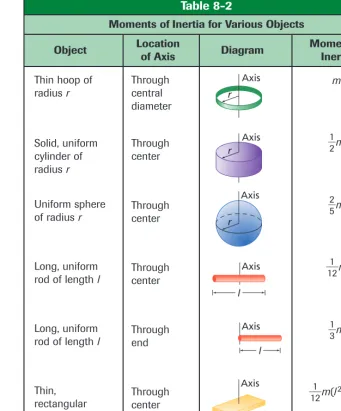
As you have seen, the moment of inertia for complex objects, such as the pencil and coins, depends on how far the coins are from the axis of rotation. A bicycle wheel, for example, has almost all of its mass in the rim and tire. Its moment of inertia is almost exactly equal to mr2, where r is the radius of the wheel. For most objects, however, the mass is distributed continuously and so the moment of inertia is less than mr2. For example, as shown in Table 8-2,for a solid cylinder of radius r,
I1
2mr
2, while for a solid sphere, I 2
5mr
2.
The moment of inertia also depends on the location of the rotational axis, as illustrated in Figure 8-8.To observe this first-hand, hold a book in the upright position, by placing your hands at the bottom of the book. Feel the torque needed to rock the book towards you, and then away from you. Now put your hands in the middle of the book and feel the torque needed to rock the book toward you and then away from you. Note that much less torque is needed when your hands are placed in the middle of the book because the average distance of the book’s mass from the rotational axis is much less in this case.
Axis of rotation
[image:11.660.196.537.44.455.2]Axis of rotation
Table 8-2
Moments of Inertia for Various Objects
Object Location
of Axis Diagram
Moment of Inertia
Thin hoop of radius r
Solid, uniform cylinder of radius r
Uniform sphere of radius r
Long, uniform rod of length l
Long, uniform rod of length l
Thin, rectangular plate of length
land width w
Through central diameter
Through center
Through center
Through center
Through end
Through center
mr2
12mr2
25mr2
112ml2
13ml2
112m(l2 w2)
r
Axis
r
Axis
Axis
r
Axis
l
Axis
l
l w
Axis
b a
■Figure 8-8 The moment of inertia of a book depends on the axis of rotation. The moment of inertia of the book in (a)is larger than the moment of inertia of the book in (b) because the average distance of the book’s mass from the rotational axis is larger.
Moment of Inertia A simplified model of a twirling baton is a thin rod with two round objects at each end. The length of the baton is 0.65 m, and the mass of each object is 0.30 kg. Find the moment of inertia of the baton if it is rotated about the midpoint between the round objects. What is the moment of inertia of the baton when it is rotated around one end? Which is greater? Neglect the mass of the rod.
Analyze and Sketch the Problem
• Sketch the situation. Show the baton with the two different axes of rotation and the distances from the axes of rotation to the masses.
Known: Unknown:
m0.30 kg I? l 0.65 m
Solve for the Unknown
Calculate the moment of inertia of each mass separately.
Rotating about the center of the rod:
r1
2l
12(0.65 m) Substitute l= 0.65 m
0.33 m
Isingle mass mr2
(0.30 kg)(0.33 m)2 Substitute m0.30 kg, r0.33 m
0.033 kgm2
Find the moment of inertia of the baton.
I 2Isingle mass
2(0.033 kgm2) Substitute Isingle mass 0.033 kgm2
0.066 kgm2
Rotating about one end of the rod:
Isingle mass mr2
(0.30 kg)(0.65 m)2 Substitute m0.30 kg, r0.65 m
0.13 kgm2
Find the moment of inertia of the baton.
I Isingle mass
0.13 kgm2
The moment of inertia is greater when the baton is swung around one end.
Evaluate the Answer
• Are the units correct?Moment of inertia is measured in kgm2.
• Is the magnitude realistic?Masses and distances are small, and so are the moments of inertia. Doubling the distance increases the moment of inertia by a factor of 4. Thus, doubling the distance overcomes having only one mass contributing.
3 2
1 0.33 m 0.33 m
0.65 m 0.30 kg 0.30 kg
Axis
Math Handbook Operations with Significant Digits pages 835–836
21. Two children of equal masses sit 0.3 m from the center of a seesaw. Assuming that their masses are much greater than that of the seesaw, by how much is the moment of inertia increased when they sit 0.6 m from the center?
22. Suppose there are two balls with equal diameters and masses. One is solid, and the other is hollow, with all its mass distributed at its surface. Are the moments of inertia of the balls equal? If not, which is greater?
23. Figure 8-9shows three massive spheres on a rod of very small mass. Consider the moment of inertia of the system, first when it is rotated about sphere A, and then when it is rotated about sphere C. Are the moments of inertia the
same or different? Explain. If the moments of inertia are different, in which case is the moment of inertia greater?
24. Each sphere in the previous problem has a mass of 0.10 kg. The distance between spheres A and C is 0.20 m. Find the moment of inertia in the following instances: rotation about sphere A, rotation about sphere C.
C A
Rank the objects shown in the diagram according to their moments of inertia about the indicated axes. All spheres have equal masses and all separations are the same.
A
B
C
D
Newton’s Second Law for Rotational Motion
Newton's second law for linear motion is expressed as aFnet/m. If you rewrite this equation to represent rotational motion, acceleration is replaced by angular acceleration, , force is replaced by net torque, net, and mass is replaced by moment of inertia, I. Thus, Newton’s second law for rotational motionstates that angular acceleration is directly propor-tional to the net torque and inversely proporpropor-tional to the moment of inertia. This law is expressed by the following equation.
Recall the coins taped on the pencil. To change the direction of rotation of the pencil—to give it angular acceleration—you had to apply torque to the pencil. The greater the moment of inertia, the more torque needed to produce the same angular acceleration.
Newton’s Second Law for Rotational Motion n
I
et
The angular acceleration of an object is equal to the net torque on the object, divided by the moment of inertia.
■Figure 8-9
Torque A solid steel wheel has a mass of 15 kg and a diameter of 0.44 m. It starts at rest. You want to make it rotate at 8.0 rev/s in 15 s.
a. What torque must be applied to the wheel?
b. If you apply the torque by wrapping a strap around the outside of the wheel, how much force should you exert on the strap?
Analyze and Sketch the Problem
• Sketch the situation. The torque must be applied in a counterclockwise direction; force must be exerted as shown.
Known: Unknown:
m 15 kg ?
r 1
2(0.44 m) = 0.22 m I ?
i0.0 rad/s ?
f2(8.0 rev/s) F ?
t 15 s
Solve for the Unknown
a. Solve for angular acceleration.t
Substitute f 2(8.0 rev/s), i 0.0 rad/s
3.4 rad/s2
Solve for the moment of inertia.
I12mr2
12(15 kg)(0.22 m)2 Substitute m15 kg, r0.22 m
0.36 kgm2
Solve for torque.
I
(0.36 kgm2)(3.4 rad/s2) Substitute I0.36 kgm2, 3.4 rad/s2
1.2 kgm2/s2
1.2 Nm
b. Solve for force.
Fr F
r
10.2.22Nmm Substitute 1.2 Nm, r0.22 m
5.5 N
Evaluate the Answer
• Are the units correct? Torque is measured in Nm and force is measured in N.
• Is the magnitude realistic? Despite its large mass, the small size of the wheel makes it relatively easy to spin.
3
2(8.0 rev/s)(0.0 rad/s)
15 s
2 1
0.44 m
F
τ
Math Handbook Operations with Significant Digits pages 835–836
30.Torque Vijesh enters a revolving door that is not moving. Explain where and how Vijesh should push to produce a torque with the least amount of force.
31. Lever Arm You try to open a door, but you are unable to push at a right angle to the door. So, you push the door at an angle of 55°from the perpen-dicular. How much harder would you have to push to open the door just as fast as if you were to push it at 90°?
32. Net Torque Two people are pulling on ropes wrapped around the edge of a large wheel. The wheel has a mass of 12 kg and a diameter of 2.4 m. One person pulls in a clockwise direction with a 43-N force, while the other pulls in a counterclock-wise direction with a 67-N force. What is the net torque on the wheel?
33. Moment of Inertia Refer to Table 8-2 on page 206 and rank the moments of inertia from least to greatest of the following objects: a sphere, a wheel with almost all of its mass at the rim, and a solid disk. All have equal masses and diameters. Explain the advantage of using the one with the least moment of inertia.
34. Newton’s Second Law for Rotational Motion A rope is wrapped around a pulley and pulled with a force of 13.0 N. The pulley’s radius is 0.150 m. The pulley’s rotational speed goes from 0.0 to 14.0 rev/min in 4.50 s. What is the moment of iner-tia of the pulley?
35. Critical Thinking A ball on an extremely low-friction, tilted surface, will slide downhill without rotating. If the surface is rough, however, the ball will roll. Explain why, using a free-body diagram.
8.2
Section Review
25. Consider the wheel in Example Problem 4. If the force on the strap were twice as great, what would be the speed of rotation of the wheel after 15 s?
26. A solid wheel accelerates at 3.25 rad/s2when a force of 4.5 N exerts a torque on it. If the wheel is replaced by a wheel with all of its mass on the rim, the moment of inertia is given by Imr2. If the same angular velocity were desired, what force would have to be exerted on the strap?
27. A bicycle wheel can be accelerated either by pulling on the chain that is on the gear or by pulling on a string wrapped around the tire. The wheel’s radius is 0.38 m, while the radius of the gear is 0.14 m. If you obtained the needed acceleration with a force of 15 N on the chain, what force would you need to exert on the string?
28. The bicycle wheel in problem 27 is used with a smaller gear whose radius is 0.11 m. The wheel can be accelerated either by pulling on the chain that is on the gear or by pulling string that is wrapped around the tire. If you obtained the needed acceleration with a force of 15 N on the chain, what force would you need to exert on the string?
29. A disk with a moment of inertia of 0.26 kgm2is attached to a smaller disk mounted on the same axle. The smaller disk has a diameter of 0.180 m and a mass of 2.5 kg. A strap is wrapped around the smaller disk, as shown in Figure 8-10.Find the force needed to give this system an angular acceleration of 2.57 rad/s2.
F
■Figure 8-10
Objectives
•Definecenter of mass. •Explainhow the location of
the center of mass affects the stability of an object. •Definethe conditions for
equilibrium.
•Describehow rotating frames of reference give rise to apparent forces. Vocabulary
center of mass centrifugal “force” Coriolis “force”
8.3
Equilibrium
Center of mass
W
hy are some vehicles more likely than others to roll over when involved in an accident? What causes a vehicle to roll over? The answer lies in the design of the vehicle. In this section, you will learn some of the factors that cause an object to tip over.The Center of Mass
How does an object rotate around its center of mass? A wrench may spin about its handle or end-over-end. Does any single point on the wrench follow a straight path? Figure 8-11ashows the path of the wrench. You can see that there is a single point whose path traces a straight line, as if the wrench could be replaced by a point particle at that location. The center of massof an object is the point on the object that moves in the same way that a point particle would move.
Locating the center of mass How can you locate the center of mass of an object? First, suspend the object from any point. When the object stops swinging, the center of mass is along the vertical line drawn from the sus-pension point as shown in Figure 8-11b.Draw the line. Then, suspend the object from another point. Again, the center of mass must be below this point. Draw a second vertical line. The center of mass is at the point where the two lines cross, as shown in Figure 8-11c.The wrench, racket, and all other freely rotating objects rotate about an axis that goes through their center of mass. Where is the center of mass of a person located?
■Figure 8-11 The path of the center of mass of a wrench is a straight line (a).The center of mass of an object such as a tennis racket can be found by first suspending it from any point (b). The point where the strings intersect is the location of the racket’s center of mass (c).
b a
The center of mass of a human body For a person who is standing with his or her arms hanging straight down, the center of mass is a few centimeters below the navel, midway between the front and back of the person’s body. It is slightly higher in young children, because of their relatively larger heads. Because the human body is flexible, however, its center of mass is not fixed. If you raise your hands above your head, your center of mass rises 6 to 10 cm. A ballet dancer, for example, can appear to be floating on air by changing her center of mass in a leap. By raising her arms and legs while in the air, as shown in Figure 8-12,the dancer moves her center of mass closer to her head. The path of the center of mass is a parabola, so the dancer’s head stays at almost the same height for a surprisingly long time.
Center of Mass and Stability
What factors determine whether a vehicle is stable or prone to roll over in an accident? To understand the problem, think about tipping over a box. A tall, narrow box, standing on end, tips more easily than a low, broad box. Why? To tip a box, as shown in Figure 8-13,you must rotate it about a corner. You pull at the top with a force, F, applying a torque, F. The weight of the box, acting on the center of mass, Fg, applies an opposing torque, w. When the center of mass is directly above the point of support, wis zero. The only torque is the one applied by you. As the box rotates
farther, its center of mass is no longer above its base of support, and both torques act in the same direction. At this point, the box tips over rapidly.
Path of the dancer,s head
Path of the dancer
,
s center of mass
F
τ
Fτ
wτ
wFg Fg Fg
F
F
τ
Fτ
F■Figure 8-12 The upward motion of the ballet dancer’s head is less than the upward motion of the center of mass. Thus, the head and torso move in a nearly horizontal path. This creates an illusion of floating.
■Figure 8-13 The bent arrows show the direction of the torque produced by the force exerted to tip over a box.
The Fosbury-Flop In high jumping, a technique called the Fosbury-Flop allows a high jumper to clear the bar when it is placed at the highest position. This is possible because the athlete’s center of mass passes below the bar as he or she somersaults over the bar, with his or her back toward it.
Stability An object is said to be stable if an external force is required to tip it. The box in Figure 8-13 is stable as long as the direction of the torque due to its weight, wtends to keep it upright. This occurs as long as the box’s center of mass lies above its base. To tip the box over, you must rotate its center of mass around the axis of rotation until it is no longer above the base of the box. To rotate the box, you must lift its center of mass. The broader the base, the more stable the object is. For this reason, if you are standing on a bus that is weaving through traffic and you want to avoid falling down, you need to stand with your feet spread apart.
Why do vehicles roll over? Figure 8-14 shows two vehicles rolling over. Note that the one with the higher center of mass does not have to be tilted very far for its center of mass to be outside its base—its center of mass does not have to be raised as much as the other vehicle’s. The lower the location of an object’s center of mass, the greater its stability.
You are stable when you stand flat on your feet. When you stand on tiptoe, however, your center of mass moves forward directly above the balls of your feet, and you have very little stability. A small person can use torque, rather than force, to defend himself or herself against a stronger person. In judo, aikido, and other martial arts, the fighter uses torque to rotate the opponent into an unstable position, where the opponent’s center of mass does not lie above his or her feet.
In summary, if the center of mass is outside the base of an object, it is unstable and will roll over without additional torque. If the center of mass is above the base of the object, it is stable. If the base of the object is very narrow and the center of mass is high, then the object is stable, but the slightest force will cause it to tip over.
Conditions for Equilibrium
If your pen is at rest, what is needed to keep it at rest? You could either hold it up or place it on a desk or some other surface. An upward force must be exerted on the pen to balance the downward force of gravity. You must also hold the pen so that it will not rotate. An object is said to be in static equilibrium if both its velocity and angular velocity are zero or constant. Thus, for an object to be in static equilibrium, it must meet two conditions. First, it must be in translational equilibrium; that is, the net force exerted on the object must be zero. Second, it must be in rotational equilibrium; that is, the net torque exerted on the object must be zero.
1 2
■Figure 8-14 Larger vehicles have a higher center of mass than smaller ones. The higher the center of mass, the smaller the tilt needed to cause the vehicle’s center of mass to move outside its base and cause the vehicle to roll over.
Spinning Tops
1.Cut out two cardboard disks of 10-cm and 15-cm diameter. 2.Use a pencil with an eraser that has rounded edges from use. If it is new, rub it on paper to round it. 3. Spin the pencil and try to make it stand on the eraser. Repeat several times and record your observations.
4. Carefully push the pencil through the center of the 10-cm disk.
5. Spin the pencil with the disk and try to make it stand on the eraser.
6. Move the disk to different points on the pencil. Spin and record your observations. 7. Repeat steps 4-6 with the 15-cm disk.
Analyze and Conclude 8. Sequencethe three trials in order from least to most stable. 9. Describethe location of the pencil’s center of mass.
10. Analyzethe placement of the disk and its effect on stability.
Static Equilibrium A 5.8-kg ladder, 1.80 m long, rests on two sawhorses. Sawhorse A is 0.60 m from one end of the ladder, and sawhorse B is 0.15 m from the other end of the ladder. What force does each sawhorse exert on the ladder?
Analyze and Sketch the Problem
• Sketch the situation.
• Choose the axis of rotation at the point where
FAacts on the ladder. Thus, the torque due to FA
is zero.
Known: Unknown:
m5.8 kg FA?
l 1.80 m FB?
lA 0.60 m
lB 0.15 m
Solve for the Unknown
For a ladder that has a constant density, the center of mass is at the center rung.
The net force is the sum of all forces on the ladder.
The ladder is in translational equilibrium, so the net force exerted on it is zero.
Solve for FA.
FAFgFB
Find the torques due to Fgand FB.
gis in the clockwise direction.
Bis in the counterclockwise direction.
The net torque is the sum of all torques on the object.
The ladder is in rotational equilibrium, so net0.0 Nm.
Substitute BrBFB, g rgFg
Solve for FB.
FBrg
r F
B g
rg
r m
B
g
Substitute Fgmg
Using the expression FAFgFB, substitute in the expressions for FBand Fg.
FAFgFB
Fgrg
r m
B
g
Substitute FBrg
r m
B
g
mgrg
r m
B
g
Substitute Fgmg
mg (1rr
B g
)
netBg
0.0 NmBg
Bg rBFBrgFg
g rgFg
B rBFB
FnetFAFB(Fg) 0.0 NFAFBFg
2 1
Math Handbook Isolating a Variable
page 845 1.80 m
0.30 m 0.75 m
0.15 m
0.60 m
A
Axis of rotation
B
FA FB
Fg Fg
rB
rg FB
36. What would be the forces exerted by the two sawhorses if the ladder in Example Problem 5 had a mass of 11.4 kg?
37. A 7.3-kg ladder, 1.92 m long, rests on two sawhorses, as shown in Figure 8-15.
Sawhorse A, on the left, is located 0.30 m from the end, and sawhorse B, on the right, is located 0.45 m from the other end. Choose the axis
of rotation to be the center of mass of the ladder.
a. What are the torques acting on the ladder?
b. Write the equation for rotational equilibrium.
c. Solve the equation for FAin terms of Fg.
d. How would the forces exerted by the two sawhorses change if A were moved very close to, but not directly under, the center of mass?
38. A 4.5-m-long wooden plank with a 24-kg mass is supported in two places. One support is directly under the center of the board, and the other is at one end. What are the forces exerted by the two supports?
39. A 85-kg diver walks to the end of a diving board. The board, which is 3.5 m long with a mass of 14 kg, is supported at the center of mass of the board and at one end. What are the forces on the two supports?
A B
1.92 m
0.66 m 0.51 m 0.45 m 0.30 m
■Figure 8-15
Solve for rg.
rg1
2lA For a ladder, which has a constant density, the center of mass is at the center rung.
0.90 m0.60 m Substitute 2l0.90 m, lA0.60 m
0.30 m Solve for rB.
rB(0.90 mlB)(0.90 mlA)
(0.90 m0.15 m)(0.90 m0.60 m) Substitute lB0.15 m, lA0.60 m
0.75 m0.30 m
1.05 m Calculate FB.
FBrg
r m
B
g
Substitute rg0.30 m, m5.8 kg, g9.80 m/s2, r
B1.05 m
16 N
Calculate FA.
FAmg
1r r
B g
1((01..035 m0m))(5.8 kg)(9.80 m/s2) Substitute rg0.30 m, m5.8 kg, g9.80 m/s2, rB1.05 m
41 N
Evaluate the Answer
• Are the units correct? Forces are measured in newtons.
• Do the signs make sense? Both forces are upward.
• Is the magnitude realistic? The forces add up to the weight of the ladder, and the force exerted by the sawhorse closer to the center of mass is greater, which is correct.
3
(0.30 m)(5.8 kg)(9.80 m/s2)
(1.05 m)
Viewed from fixed frame
Coriolis "force" viewed from rotating frame
Observed positions of ball
Observed positions of ball Center
■Figure 8-16 The Coriolis “force” exists only in rotating reference frames.
a b
Rotating Frames of Reference
When you are on a on a rapidly spinning amusement-park ride, it feels like a strong force is pushing you to the outside. A pebble on the floor of the ride would accelerate outward without a horizontal force being exerted on it in the same direction. The pebble would not move in a straight line. In other words, Newton’s laws would not apply. This is because rotating frames of reference are accelerated frames. Newton’s laws are valid only in inertial or nonaccelerated frames.
Motion in a rotating reference frame is important to us because Earth rotates. The effects of the rotation of Earth are too small to be noticed in the classroom or lab, but they are significant influences on the motion of the atmosphere and therefore, on climate and weather.
Centrifugal “Force”
Suppose you fasten one end of a spring to the center of a rotating plat-form. An object lies on the platform and is attached to the other end of the spring. As the platform rotates, an observer on the platform sees the object stretch the spring. The observer might think that some force toward the outside of the platform is pulling on the object. This apparent force is called centrifugal “force.”It is not a real force because there is no physi-cal outward push on the object. Still, this “force” seems real, as anyone who has ever been on an amusement-park ride can attest.
As the platform rotates, an observer on the ground sees things differ-ently. This observer sees the object moving in a circle. The object acceler-ates toward the center because of the force of the spring. As you know, the acceleration is centripetal acceleration and is given by acv2/r. It also can
be written in terms of angular velocity, asac2/r. Centripetal acceleration
is proportional to the distance from the axis of rotation and depends on the square of the angular velocity. Thus, if you double the rotational frequency, the acceleration increases by a factor of 4.
The Coriolis “Force”
A second effect of rotation is shown in Figure 8-16.Suppose a person standing at the center of a rotating disk throws a ball toward the edge of the disk. Consider the horizontal motion of the ball as seen by two observers and ignore the vertical motion of the ball as it falls.
40.Center of Mass Can the center of mass of an object be located in an area where the object has no mass? Explain.
41. Stability of an Object Why is a modified vehicle with its body raised high on risers less stable than a similar vehicle with its body at normal height?
42. Conditions for Equilibrium Give an example of an object for each of the following conditions.
a.rotational equilibrium, but not translational equilibrium
b.translational equilibrium, but not rotational equilibrium
43. Center of Mass Where is the center of mass of a roll of masking tape?
44. Locating the Center of Mass Describe how you would find the center of mass of this textbook.
45. Rotating Frames of Reference A penny is placed on a rotating, old-fashioned record turntable. At the highest speed, the penny starts sliding outward. What are the forces acting on the penny?
46. Critical Thinking You have learned why the winds around a low-pressure area move in a coun-terclockwise direction. Would the winds move in the same or opposite direction in the southern hemisphere? Explain.
8.3
Section Review
Equator Actual
path
Expected path
■Figure 8-17 An observer on Earth sees the Coriolis “force” cause a projectile fired due north to deflect to the right of the intended target.
Meteorology Connection
Meteorology Connection An observer standing outside the disk, as shown in Figure 8-16a,sees
the ball travel in a straight line at a constant speed toward the edge of the disk. However, the other observer, who is stationed on the disk and rotat-ing with it, as shown in Figure 8-16b,sees the ball follow a curved path at a constant speed. A force seems to be acting to deflect the ball. This appar-ent force is called the Coriolis “force.” Like the centrifugal “force,” the Coriolis “force” is not a real force. It seems to exist because we observe a deflection in horizontal motion when we are in a rotating frame of reference.
Coriolis “force” due to Earth Suppose a cannon is fired from a point on the equator toward a target due north of it. If the projectile were fired directly northward, it would also have an eastward velocity component because of the rotation of Earth. This eastward speed is greater at the equator than at any other latitude. Thus, as the projectile moves northward, it also moves east-ward faster than points on Earth below it do. The result is that the projectile lands east of the target as shown in Figure 8-17.While an observer in space would see Earth’s rotation, an observer on Earth could claim that the projec-tile missed the target because of the Coriolis “force” on the rocket. Note that for objects moving toward the equator, the direction of the apparent force is westward. A projectile will land west of the target when fired due south. The direction of winds around high- and low-pressure areas results from the Coriolis “force.” Winds flow from areas of high to low pressure. Because of the Coriolis “force” in the northern hemisphere, winds from the south go to the east of low-pressure areas. Winds from the north, however, end up west of low-pressure areas. Therefore, winds rotate counterclockwise around low-pressure areas in the northern hemisphere. In the southern hemisphere however, winds rotate clockwise around low-pressure areas.
Most amusement-park rides thrill the riders because they are in acceler-ated reference frames while on the ride. The “forces” felt by roller-coaster riders at the tops and bottoms of hills, and when moving almost vertically downward, are mostly related to linear acceleration. On Ferris wheels, rotors, other circular rides, and on the curves of roller coasters, centrifugal “forces” provide most of the excitement.
Translational and Rotational Equilibrium
For maintenance on large buildings, scaffolding can be hung on the outside. In order for the scaffolding to support workers, it must be in translational and rota-tional equilibrium. If two or more forces act on the scaffolding, each can produce a rotation about either end. Scaffolding with uniform mass distribution acts as though all of the mass is concentrated at its center. In translational equilibrium the object is not accelerating; thus, the upward and downward forces are equal.In order to achieve rotational equilibrium, the sum of all the clockwise torques must equal the sum of all the counterclockwise torques as measured from a pivot point. That is, the net torque must be zero. In this lab you will model scaffolding hung from two ropes using a meterstick and spring scales, and use numbers to measure the forces on the scaffolding.
QUESTION
What conditions are required for equilibrium when parallel forces act on an object? Alternate CBL instructions
can be found on the Web site.
physicspp.com
■Collect and organize dataabout the forces acting on the scaffolding.
■Describeclockwise and counterclockwise torque.
■Compare and contrasttranslational and rotational equilibrium.
■Use care to avoid dropping masses.
meterstick two Buret clamps two 0-5 N spring scales 500-g hooked mass two ring stands 200-g hooked mass
The left spring scale will be considered a pivot point for the purposes of this lab. Therefore, the lever arm will be measured from this point.
1. Place the ring stands 80 cm apart.
2. Attach a Buret clamp to each of the ring stands.
3. Verify that the scales are set to zero before use. If the scales need to be adjusted, ask your teacher for assistance.
4. Hang a spring scale from each Buret clamp attached to a ring stand.
5. Hook the meterstick onto the spring scale in such a manner that the 10-cm mark is supported by one hook and the 90-cm mark is supported by the other hook.
6. Read each spring scale and record the force in Data Table 1.
7. Hang a 500-g mass on the meterstick at the 30-cm mark. This point should be 20-cm from the left scale.
8. Read each spring scale and record the force in Data Table 1.
9. Hang a 200-g mass on the meterstick at the 70-cm mark. This point should be 60 cm from the left scale.
10. Read each spring scale and record the force in Data Table 1.
Procedure
Materials
Safety Precautions Objectives
Horizons Companies
Data Table 1
Object Added Distance From Left Scale (m)
Left Scale Reading (N)
Right Scale Reading (N)
Meterstick 0.4
500-g mass 0.2
200-g mass 0.6
Data Table 2
Object Added c cc Lever Arm (m) Force (N)
Meterstick
500-g mass
200-g mass
Right scale
Data Table 3
Object Added c(Nm) cc(Nm)
Meterstick
500-g mass
200-g mass
Right scale
1. Calculate Find the mass of the meterstick.
2. Calculate Find the force, or weight, that results from each object and record it in Data Table 2. For the right scale, read the force it exerts and record it in Data Table 2.
3. Using the point where the left scale is attached as a pivot point, identify the forces located elsewhere that cause the scaffold to rotate clockwise or counterclockwise. Mark these in Data Table 2 with an x.
4. Record the lever arm distance of each force from the pivot point in Data Table 2.
5. Use Numbers Calculate the torque for each object by multiplying the force and lever arm distance. Record these values in Data Table 3.
1. Is the system in translational equilibrium? How do you know?
2. Draw a free-body diagram of your system, showing all the forces.
3. Compare and contrast the sum of the clockwise torques, c, and the counterclockwise torques,
cc.
4. What is the percent difference between c and cc?
Use additional masses at locations of your choice with your teacher’s permission and record your data.
Research the safety requirements in your area for putting up, using, and dismantling scaffolding.
Real-World Physics Going Further
Conclude and Apply Analyze
To find out more about rotational motion, visit the Web site: physicspp.com
Why are sport-utility vehicles more
flippable?
Many believe that the large size of the sport-utility vehicle makes it more sta-ble and secure. But, a sport-utility vehicle, as well as other tall vehicles such as vans, is much more likely to roll over than a car.The Problem
A sport-utility vehicle has a high center of mass which makes it more likely to topple. Another factor that affects rollover is the static stability factor, which is the ratio of the track width to the center of mass. Track width is defined as half the distance between the two front wheels. The higher the static stability factor, the more likely a vehicle will stay upright.Many sport-utility vehicles have a center of mass 13 or 15 cm higher than passenger cars. Their track width, however, is about the same as that of passenger cars. Suppose the stabil-ity factor for a sport-utilstabil-ity vehicle is 1.06 and 1.43 for a car. Statistics show that in a single-vehicle crash, the sport-utility vehicle has a 37 percent chance of rolling over, while the car has a 10.6 percent chance of rolling over.
However, the static stability factor oversimpli-fies the issue. Weather and driver behavior are also contributers to rollover crashes. Vehicle factors, such as tires, suspension systems, inertial properties, and advanced handling systems all play a role as well.
It is true that most rollover crashes occur when a vehicle swerves off the road and hits a rut, soft soil, or other surface irregularity. This usually occurs when a driver is not paying proper attention or is speeding. Safe drivers greatly reduce their chances of being involved in a rollover accident by paying attention and driving at the correct speed. Still, weather and driver behavior being equal, the laws of physics indicate that sport-utility vehicles carry an increased risk.
What Is Being Done?
Some models arebeing built with wider track widths or stronger roofs. Optional side-curtain air bags have sensors to keep the bags inflated for up to 6 s, rather than the usual fraction of a second. This will cushion passengers if the vehicle should flip several times.
A promising new technology called Electronic Stability Control (ESC) can be used to prevent rollover accidents. An ESC system has elec-tronic sensors that detect when a vehicle begins to spin due to oversteering, and also when it begins to slide in a plowlike manner because of understeering. In these instances, an ESC system automatically applies the brakes at one or more wheels, thereby reorienting the vehicle in the right direction.
Safe driving is the key to preventing many automobile accidents. Knowledge of the physics behind rollover accidents and the factors that affect rollover accidents may help make you an informed, safe driver.
Engine control unit ESC
hydraulic unit
Yaw sensor
Wheel speed sensors
Wheel speed sensors Steering
angle sensor
1. Hypothesize In a multi-vehicle
acci-dent, sport-utility vehicles generally fare better than the passenger cars involved in the accident. Why is this so?
2. Debate the Issue ESC is a life-saving
technology. Should it be mandatory in all sport-utility vehicles? Why or why not?
Going
Further
The Stability of Sport-Utility Vehicles
The Stability of Sport-Utility Vehicles
An ESC system processes information from the sensors and automatically applies the brakes to individual wheels when instability is detected.
8.1 Describing Rotational Motion
Vocabulary
• radian (p. 197)
• angular displacement
(p. 198)
• angular velocity (p. 198)
• angular acceleration
(p. 199)
8.2 Rotational Dynamics
Vocabulary
• lever arm (p. 201)
• torque (p. 202)
• moment of inertia (p. 205)
• Newton’s second law for rotational motion (p. 208)
8.3 Equilibrium
Vocabulary
• center of mass (p. 211)
• centrifugal “force” (p. 216)
• Coriolis “force” (p. 217)
Key Concepts
•
Angular position and its changes are measured in radians. One complete revolution is 2rad.•
Angular velocity is given by the following equation.•
Angular acceleration is given by the following equation.•
For a rotating, rigid object, the angular displacement, velocity, and acceleration can be related to the linear displacement, velocity, and acceleration for any point on the object.dr vr ar t
t
Key Concepts
•
When torque is exerted on an object, its angular velocity changes.•
Torque depends on the magnitude of the force, the distance from the axis of rotation at which it is applied, and the angle between the force and the radius from the axis of rotation to the point where the force is applied.•
The moment of inertia of an object depends on the way the object’s mass is distributed about the rotational axis. For a point object:•
Newton’s second law for rotational motion states that angular acceleration is directly proportional to the net torque and inversely proportional to the moment of inertia.nIet Imr2 Frsin
Key Concepts