www.biogeosciences.net/7/1915/2010/ doi:10.5194/bg-7-1915-2010
© Author(s) 2010. CC Attribution 3.0 License.
Biogeosciences
A global database of soil respiration data
B. Bond-Lamberty and A. Thomson
JGCRI/Pacific Northwest National Laboratory, College Park, Maryland, USA
Received: 9 February 2010 – Published in Biogeosciences Discuss.: 19 February 2010 Revised: 28 May 2010 – Accepted: 1 June 2010 – Published: 15 June 2010
Abstract. Soil respiration –RS, the flux of CO2 from the soil to the atmosphere – is probably the least well constrained component of the terrestrial carbon cycle. Here we introduce the SRDB database, a near-universal compendium of pub-lishedRS data, and make it available to the scientific com-munity both as a traditional static archive and as a dynamic community database that may be updated over time by inter-ested users. The database encompasses all published studies that report one of the following data measured in the field (not laboratory): annualRS, mean seasonalRS, a seasonal or annual partitioning ofRS into its sources fluxes,RS temper-ature response (Q10), orRS at 10◦C. Its orientation is thus to seasonal and annual fluxes, not shorter-term or chamber-specific measurements. To date, data from 818 studies have been entered into the database, constituting 3379 records. The data span the measurement years 1961–2007 and are dominated by temperate, well-drained forests. We briefly examine some aspects of the SRDB data – its climate space coverage, mean annualRS fluxes and their correlation with other carbon fluxes,RSvariability, temperature sensitivities, and the partitioning ofRS source flux – and suggest some potential lines of research that could be explored using these data. The SRDB database is available online in a perma-nent archive as well as via a project-hosting repository; the latter source leverages open-source software technologies to encourage wider participation in the database’s future devel-opment. Ultimately, we hope that the updating of, and cor-rections to, the SRDB will become a shared project, managed by the users of these data in the scientific community.
Correspondence to: B. Bond-Lamberty ([email protected])
1 Introduction
Soil respiration – RS, the flux of carbon dioxide from the soil surface to the atmosphere – comprises the second-largest terrestrial carbon (C) flux (IPCC, 2001; Raich and Potter, 1995); at 75–100 Pg C yr−1, it is an order of magnitude larger than anthropogenic fossil fuel combustion (Boden et al., 2009), implying that∼10% of atmospheric CO2cycles through the soil annually (Reichstein and Beer, 2008). This large flux comes from a large pool: globally, soils store at least twice as much C as is in the atmosphere (Tarnocai et al., 2009; Post et al., 1982). Given that climate models pre-dict mid- and high-latitude warming throughout this century (IPCC, 2007), a critical question is whether enhancedRSwill constitute a significant climate feedback (Jenkinson, 1991; Knorr et al., 2005; Davidson and Janssens, 2006). Such a feedback would have significant consequences for the global C cycle and rates of climate change (Jones et al., 2003; Rus-tad et al., 2000) and affect policy decisions based on the val-uation of terrestrial C fluxes (Wise et al., 2009).
Because of its high variability, inaccessibility of the soil medium, and high cost of measurement instruments (Savage et al., 2008),RSremains the least well constrained compo-nent of the terrestrial C cycle (Trumbore, 2006; Davidson et al., 2006). The spatial variability ofRS, and our inability to measure it remotely, remain significant constraints to re-gional and global evaluations of its magnitude and climate feedback potential; modeling efforts linking observations at different scales are critical to future progress in this arena (Reichstein and Beer, 2008). As the integrated result of a broad spectrum of autotrophic and heterotrophic respiratory processes operating under wildly varying environmental con-straints, the temporal and spatial dynamics ofRSremain dif-ficult to model or predict (Zobitz et al., 2008).
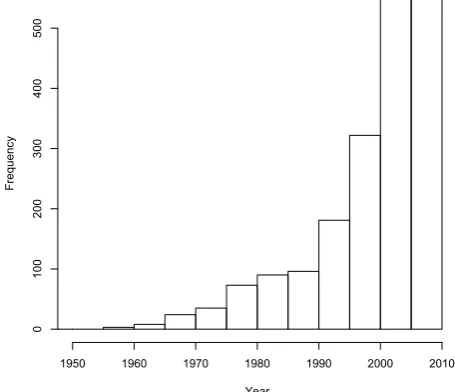
kinetic properties of soil organic compounds (Davidson and Janssens, 2006). It is also important, however, to lever-age the thousands of RS observations made over decades (Singh and Gupta, 1977; Raich and Schlesinger, 1992; Schlesinger, 1977; Chen and Tian, 2005; Hibbard et al., 2005). This is particularly important for understandingRS, as it has been almost 20 years since the last comprehensive RS data collection and meta-analysis was published (Raich and Schlesinger, 1992); 80% ofRS studies have appeared since that time (Fig. 1), a number large enough to deter or limit most data collection projects. Nonetheless, a global, communityRSdata set would be useful both on its own and in conjunction with remote sensing, eddy covariance, soils and other databases that either exist or are being assembled, opening the possibility of identifying large-scale patterns not visible in individual studies. Such meta-analyses can result in unexpected or interesting results, even if they are sometimes subject to particular statistical issues, e.g., the “file drawer” problem (Rosenthal, 1979). For example, a database recently assembled to support a meta-analysis of C balance in relation to stand age (Luyssaert et al., 2007) led to a provocative hy-pothesis about the controls on forest C sequestration (Luys-saert et al., 2008). Other reviews and meta-analyses have drawn similarly broad, if tentative, inferences on ecosys-tem structure and function (Elser et al., 2007; LeBauer and Treseder, 2008; Lusk and Warton, 2007; Rustad et al., 2001; Wan et al., 2001; Hanson et al., 2000).
Meta-analyses are thus not new, but recent efforts to as-semble large shared data sets in the earth system sciences make use of Internet-facing databases and modern computa-tional tools, allowing for a vastly expanded pool of potential users, increased analytical power, and increased public trust (Anonymous, 2009). New data-sharing models can also be applied; in particular, technologies such as version control, developed and exploited by the open-source software move-ment (Raymond, 2001), enable a “living” database that is continually expanded and improved by its users. These new technologies drive the goals of this study: to assemble a near-universal database of all publishedRSdata and make it avail-able to the scientific community, both as a traditional static archive and as a dynamic community database.
2 Methods
2.1 Data sources and inclusion criteria
We collected all available studies in the peer-reviewed sci-entific literature reportingRS measured in the field; lab in-cubation studies were not included. The ISI Web of Sci-ence™ constituted the primary source of published studies; search terms used included “soil respiration,” “soil CO2 evo-lution,” etc. Each study’s title and abstract was used to decide whether to acquire it;∼40% of the almost 4700 studies were
Year
Frequency
1950 1960 1970 1980 1990 2000 2010
0
100
200
300
400
[image:2.595.313.541.66.262.2]500
Fig. 1. Soil respiration studies over time, from the ISI Web of
Sci-ence™ database.
acquired and examined. To qualify for inclusion, a study had to report at least one of the following data:
– AnnualRS(as reported by the authors, or easily calcula-ble from data; no minimum-measurement requirement was imposed)
– Mean seasonalRS (as defined and reported by the au-thors)
– Annual or seasonal partitioning ofRS sources (based on field measurements; regression approaches based on other studies, e.g., Subke et al. (2006) were not allowed) – Q10and associated temperature range
– R10(RSat 10◦C)
If at least one of these data was reported, or could be cal-culated with few or no assumptions, e.g., straightforwardly estimated from points in a figure, the study was entered into the database. Short-term experiments (i.e.,RSmeasurements made over less than 1–2 weeks) were not entered unless the study authors extrapolated their results to seasonal or annual values; the database’s orientation is thus to seasonal and an-nual fluxes, not shorter-term or chamber-specific measure-ments. Annual fluxes were sometimes reported by authors, and in other cases calculated from sub-annual (e.g., monthly) means. In general we did not do additional research to find older publications that might not be listed in the Web of Sci-ence.
2.2 Database structure
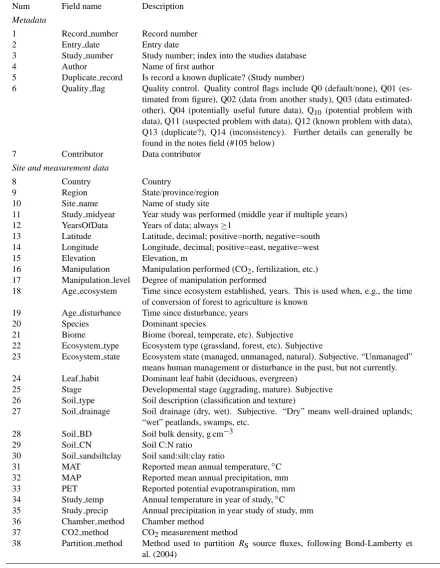
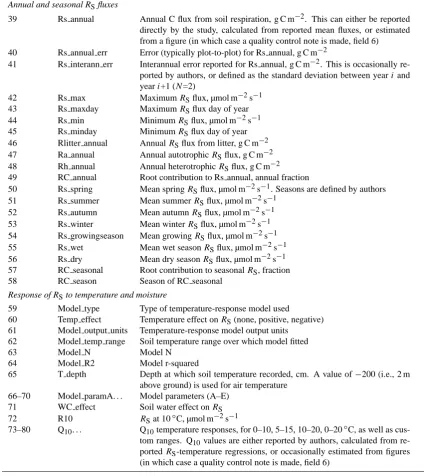
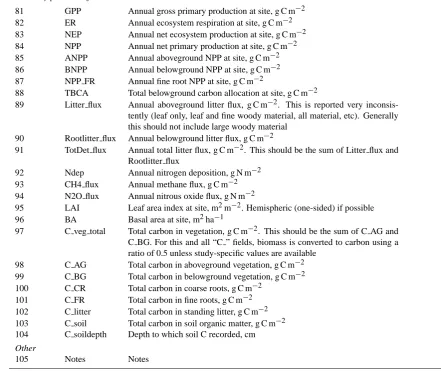
all studies acquired, examined, entered or rejected, etc., and a “data” file, holding the acquiredRS data. An index num-ber is used to map entries between the two files. The pri-maryRS units used were g C m−2yr−1 (for annual fluxes) and µmol m−2s−1 (for mean seasonal andR10 fluxes); val-ues were converted as necessary from those given by study authors. A variety of ancillary data were also entered when reported, including site-related and experimental data, infor-mation on ecosystem structure and function, methods used, etc.; we assumed a 12:44 ratio of C to CO2 molecular weights, and that biomass was 50%C (unless specified other-wise in the study). Temperate-response functions were cat-egorized following table 10.1 in Luo and Zhou. (Luo and Zhou, 2006) and Reichstein et al. (2008). The primary data file includes 105 fields (Table 1). A Google Earth (http: //earth.google.com/) data layer is included with the database for easy geographic visualization of the included studies. 2.3 Quality control
Some basic quality control has been performed on the data. Map plots were used to identify incorrectly entered loca-tion or climate informaloca-tion, and histograms of the primary variables of interest used to flag outliers for special atten-tion. We have also attempted to check for basic data in-compatibilities (e.g., cases whereRS>total ecosystem res-piration), and to identify duplicate entries. In addition, the database has fields documenting the chamber and CO2 mea-surement method employed; methodological errors associ-ated with such techniques can have important implications for field measurements (Keith and Wong, 2006; Pongracic et al., 1997; Pumpanen et al., 2004) and upscaling of fluxes (Reichstein and Beer, 2008). In spite of these efforts, many errors undoubtedly remain in the database (see Sect. 4.2 be-low).
Several metadata fields (field 6 in Table 1) are used to flag duplicate records, or ones with potential problems. In retro-spect we wish that these metadata were even more extensive, recording, e.g., exactly how annual fluxes were calculated for each record, as such metadata constitute a critical means of filtering data and testing how assumptions affect the end data products. Certainly any use of the existing database needs to account carefully for known quality control issues along with the recorded measurement conditions (e.g., any manip-ulations performed, or CO2measurement technique used).
3 Results and discussion
In total, 1932 studies were marked for acquisition, 1853 acquired and examined, and 818 entered into the SRDB database, spanning the publication years 1963–2008 and measurement years 1961–2007. As of this writing the 818 studies resulted in 3379 records (a single study generates multiple records if, e.g., there are multiple years of data,
or different sites reported, or different experimental treat-ments). The countries most frequently represented include USA (1404 records), Canada (308), China (273), Finland (179), Japan (162) and Germany (115); Figure 2 shows the spatial distribution of the collected data. Temperate-biome studies dominate the database (2373 records), with boreal (415) and tropical (353) also significant. While spatially clumped, the data cover the terrestrial climate space fairly completely (Fig. 3). Data from forest (2198 records), grass-land (460) and agricultural (453) ecosystems are most fre-quently reported; upland systems (3084 records) far outnum-ber wetland ones. A majority of studies took place in unma-nipulated ecosystems (2382 records), but data from thinned, burned, CO2-increase, warmed and fertilized plots are repre-sented as well.
Below we outline, rather than analyze in depth, a few char-acteristics of the SRDB data and suggest some lines of re-search that could be explored using these data.
3.1 Observed annual fluxes
Mean (±1 s.d.) annual RS was 109±109, 383±228, 745±421, 813±436, 776±380, and 1286±633 g C m−2 for unmanipulated Arctic, boreal, temperate, Mediterranean, subtropical, and tropical ecosystems respectively. The tropi-cal data are near-normally distributed, while boreal and tem-perate data are not (Fig. 4); this reflects the zero-bound of annualRS (it is not normally negative) in ecosystems lim-ited by low temperatures. Three variables – mean annual temperature, precipitation, and leaf area index, when com-bined in a simple linear regression analysis – explain∼41% of the observed variability in annualRS, in line with previous meta-analyses of these drivers (Raich and Schlesinger, 1992; Reichstein et al., 2003). The annual data also exhibited an increasing temporal trend, driven primarily by air tempera-ture anomaly (Bond-Lamberty and Thomson, 2010). Annual fluxes were correlated with other C fluxes (Fig. 5); such re-lationships have been noted in previous studies, e.g., that be-tween litterfall andRS(Raich and Nadelhoffer, 1989; Raich and Schlesinger, 1992; Davidson et al., 2002) or gross pri-mary production andRS (Hibbard et al., 2005; Janssens et al., 2001). The correlations shown in Fig. 5 (and Fig. 6 be-low) are relatively crude and did not vary by ecosystem type – i.e., between forests, grasslands, etc. – in spite of the signif-icantly variation in biotic and abiotic controls that would be expected. More sophisticated analyses, e.g. machine learning or other stratified regression techniques (Jung et al., 2009), might be profitably applied to this problem.
Table 1. Categories of database fields and examples of data included for the soil respiration (RS)database’s main “data” file. A separate
“studies” file contains bibliographic information for all studies, indexed by a study number common to both files.
Num Field name Description
Metadata
1 Record number Record number
2 Entry date Entry date
3 Study number Study number; index into the studies database
4 Author Name of first author
5 Duplicate record Is record a known duplicate? (Study number)
6 Quality flag Quality control. Quality control flags include Q0 (default/none), Q01
(es-timated from figure), Q02 (data from another study), Q03 (data es(es-timated- estimated-other), Q04 (potentially useful future data), Q10 (potential problem with
data), Q11 (suspected problem with data), Q12 (known problem with data), Q13 (duplicate?), Q14 (inconsistency). Further details can generally be found in the notes field (#105 below)
7 Contributor Data contributor
Site and measurement data
8 Country Country
9 Region State/province/region
10 Site name Name of study site
11 Study midyear Year study was performed (middle year if multiple years)
12 YearsOfData Years of data; always≥1
13 Latitude Latitude, decimal; positive=north, negative=south
14 Longitude Longitude, decimal; positive=east, negative=west
15 Elevation Elevation, m
16 Manipulation Manipulation performed (CO2, fertilization, etc.)
17 Manipulation level Degree of manipulation performed
18 Age ecosystem Time since ecosystem established, years. This is used when, e.g., the time
of conversion of forest to agriculture is known
19 Age disturbance Time since disturbance, years
20 Species Dominant species
21 Biome Biome (boreal, temperate, etc). Subjective
22 Ecosystem type Ecosystem type (grassland, forest, etc). Subjective
23 Ecosystem state Ecosystem state (managed, unmanaged, natural). Subjective. “Unmanaged”
means human management or disturbance in the past, but not currently.
24 Leaf habit Dominant leaf habit (deciduous, evergreen)
25 Stage Developmental stage (aggrading, mature). Subjective
26 Soil type Soil description (classification and texture)
27 Soil drainage Soil drainage (dry, wet). Subjective. “Dry” means well-drained uplands;
“wet” peatlands, swamps, etc.
28 Soil BD Soil bulk density, g cm−3
29 Soil CN Soil C:N ratio
30 Soil sandsiltclay Soil sand:silt:clay ratio
31 MAT Reported mean annual temperature,◦C
32 MAP Reported mean annual precipitation, mm
33 PET Reported potential evapotranspiration, mm
34 Study temp Annual temperature in year of study,◦C
35 Study precip Annual precipitation in year study of study, mm
36 Chamber method Chamber method
37 CO2 method CO2measurement method
38 Partition method Method used to partitionRS source fluxes, following Bond-Lamberty et
Table 1. Continued.
Annual and seasonal RSfluxes
39 Rs annual Annual C flux from soil respiration, g C m−2. This can either be reported
directly by the study, calculated from reported mean fluxes, or estimated from a figure (in which case a quality control note is made, field 6)
40 Rs annual err Error (typically plot-to-plot) for Rs annual, g C m−2
41 Rs interann err Interannual error reported for Rs annual, g C m−2. This is occasionally re-ported by authors, or defined as the standard deviation between yeariand yeari+1 (N=2)
42 Rs max MaximumRSflux, µmol m−2s−1
43 Rs maxday MaximumRSflux day of year
44 Rs min MinimumRSflux, µmol m−2s−1
45 Rs minday MinimumRSflux day of year
46 Rlitter annual AnnualRSflux from litter, g C m−2
47 Ra annual Annual autotrophicRSflux, g C m−2
48 Rh annual Annual heterotrophicRSflux, g C m−2
49 RC annual Root contribution to Rs annual, annual fraction
50 Rs spring Mean springRSflux, µmol m−2s−1. Seasons are defined by authors
51 Rs summer Mean summerRSflux, µmol m−2s−1
52 Rs autumn Mean autumnRSflux, µmol m−2s−1
53 Rs winter Mean winterRSflux, µmol m−2s−1
54 Rs growingseason Mean growingRSflux, µmol m−2s−1
55 Rs wet Mean wet seasonRSflux, µmol m−2s−1
56 Rs dry Mean dry seasonRSflux, µmol m−2s−1
57 RC seasonal Root contribution to seasonalRS, fraction
58 RC season Season of RC seasonal
Response of RSto temperature and moisture
59 Model type Type of temperature-response model used
60 Temp effect Temperature effect onRS(none, positive, negative)
61 Model output units Temperature-response model output units
62 Model temp range Soil temperature range over which model fitted
63 Model N Model N
64 Model R2 Model r-squared
65 T depth Depth at which soil temperature recorded, cm. A value of−200 (i.e., 2 m
above ground) is used for air temperature
66–70 Model paramA. . . Model parameters (A–E)
71 WC effect Soil water effect onRS
72 R10 RSat 10◦C, µmol m−2s−1
73–80 Q10. . . Q10temperature responses, for 0–10, 5–15, 10–20, 0–20◦C, as well as
cus-tom ranges. Q10values are either reported by authors, calculated from
re-portedRS-temperature regressions, or occasionally estimated from figures
(in which case a quality control note is made, field 6)
of estimatingRS, with an associated error range, from air-borne and satellite observations; the lack of such large-scale, observation-drivenRSestimates is a major problem in con-straining regional- to global-scale C fluxes (Qi et al., 2002; Rayner et al., 2005; Jones et al., 2003).
3.2 Experimental error andRSvariability
The high variability ofRS constitutes a major reason why its measurement and modeling remain so difficult, as it re-sponds to a suite of drivers including temperature, moisture,
Table 1. Continued.
Ancillary pools and fluxes
81 GPP Annual gross primary production at site, g C m−2
82 ER Annual ecosystem respiration at site, g C m−2
83 NEP Annual net ecosystem production at site, g C m−2
84 NPP Annual net primary production at site, g C m−2
85 ANPP Annual aboveground NPP at site, g C m−2
86 BNPP Annual belowground NPP at site, g C m−2
87 NPP FR Annual fine root NPP at site, g C m−2
88 TBCA Total belowground carbon allocation at site, g C m−2
89 Litter flux Annual aboveground litter flux, g C m−2. This is reported very inconsis-tently (leaf only, leaf and fine woody material, all material, etc). Generally this should not include large woody material
90 Rootlitter flux Annual belowground litter flux, g C m−2
91 TotDet flux Annual total litter flux, g C m−2. This should be the sum of Litter flux and Rootlitter flux
92 Ndep Annual nitrogen deposition, g N m−2
93 CH4 flux Annual methane flux, g C m−2
94 N2O flux Annual nitrous oxide flux, g N m−2
95 LAI Leaf area index at site, m2m−2. Hemispheric (one-sided) if possible
96 BA Basal area at site, m2ha−1
97 C veg total Total carbon in vegetation, g C m−2. This should be the sum of C AG and C BG. For this and all “C ” fields, biomass is converted to carbon using a ratio of 0.5 unless study-specific values are available
98 C AG Total carbon in aboveground vegetation, g C m−2
99 C BG Total carbon in belowground vegetation, g C m−2
100 C CR Total carbon in coarse roots, g C m−2
101 C FR Total carbon in fine roots, g C m−2
102 C litter Total carbon in standing litter, g C m−2
103 C soil Total carbon in soil organic matter, g C m−2
104 C soildepth Depth to which soil C recorded, cm
Other
105 Notes Notes
reported by study authors or calculated within the database from individual year data. The mean coefficient of variability (standard deviation divided by the mean) in the SRDB is 15– 16% for both variables. Ecosystem variability does not scale linearly to regional or global variability, and estimates of the interannual variability of large-scaleRSfluxes are much smaller than these means (Potter and Klooster, 1998; Raich et al., 2002; Bond-Lamberty and Thomson, 2010).
3.3 Temperature sensitivity
Ambient temperature constitutes the dominant – but not only – short-term control on RS in most boreal and temperate ecosystems, at most points in time (Chen and Tian, 2005); temperate deserts and other dry areas constitute only one of many exceptions to this generalization (Parker et al., 1983; Zhou et al., 2009; Sponseller and Fisher, 2008; Tang et al., 2005). Our understanding ofRS and ecosystem respiration generally (Trumbore, 2006) is less advanced than that of
pho-tosynthesis, and most biogeochemical models still use sim-ple, constant-Q10models (originating from van’t Hoff, 1898) that – among other problems – have been shown to overesti-mate low-temperatureRS(Lloyd and Taylor, 1994).
Fig. 2. Location of SRDB database observations (dots), by ecosystem type. A Google Earth™ data layer is included with the database for
more detailed spatial views.
-30 -20 -10 0 10 20 30
0
1000
2000
3000
4000
5000
6000
MAT (°C)
MAP (mm)
Forest
Grassland
Agriculture
Shrubland
Wetland Desert Savanna
Fig. 3. SRDB data distribution across global mean annual
temper-ature (MAT) and mean annual precipitation (MAP) climate space, by ecosystem type. Background dots show climate distribution of terrestrial surface (0.5◦cells).
are “apparent” (Davidson and Janssens, 2006) temperature sensitivities, as they are observed in the field and thus con-strained by ambient environmental conditions (Zhou et al., 2009), rather than “intrinsic” or theoretical sensitivities; in
RS (g Cm−2yr−1)
Percent of Total
0 20 40 60
80
0 1000200030004000
Mediterranean Subtropical
0 1000200030004000
Tropical
Arctic
0 1000200030004000
Boreal
0
20
40 60
[image:7.595.329.522.388.576.2]80 Temperate
Fig. 4. Annual soil respiration (RS)fluxes observed in the field,
un-manipulated plots only, by biome. Relative histograms are shown; total observations areN=17, 180, 1053, 51, 46, and 215 for Arctic, boreal, temperate, Mediterranean, subtropical, and tropical respec-tively.
[image:7.595.58.280.388.590.2]0 500 1500 2500 s$ER RS ( g C m − 2y r − 1) Arctic Boreal Mediterranean Subtropical Temperate Tropical (a)
0 500 1000 1500 2000 2500 3000 3500
0 500 1000 2000 3000 s$GPP RS ( g C m − 2y r − 1) (b)
0 200 400 600 800
0
500
1500
2500
Flux (gCm−2yr−1
[image:8.595.50.289.61.297.2]) RS ( g C m − 2y r − 1) (c)
Fig. 5. Correlation between annual soil respiration (RS)and other
carbon fluxes: (a) annual ecosystem respiration, (b) annual gross primary production, and (c) annual aboveground litter flux, by biome. Solid lines show linear regression fit; dashed lines are 95% confidence intervals. Regressions shown are (a)y=361+0.33x, N=116,R2=0.48; (b)y=296+0.32x,N=92,R2=0.33; (c) y=502+1.43x,N=421,R2=0.21.
Reported Q10 values forRSdepend strongly on the depth at which the temperature measurement is made (Reichstein and Beer, 2008; Graf et al., 2008), as well as the observed temperature range. The current database structure includes a field for recording this depth datum, and is flexible enough to accommodate multiple depths of measurement. If a study reported a variety of Q10values across multiple depths, these are not always all measured, as we focused on typical mea-surement depths (0–20 cm). This is an obvious area for future improvement.
3.4 Source fluxes of soil respiration
PartitioningRS into its autotrophic (RA)and heterotrophic (RH)source fluxes is important for assessing plant physiol-ogy, C allocation, ecosystem C balance, and the climate feed-back potential of changes inRS. The relative responses ofRA andRH will strongly affect the terrestrial climate feedback
under future conditions, at scales from the ecosystem to the globe (Burton et al., 2008; Boone et al., 1998; Curiel Yuste et al., 2007; Lavigne et al., 2003). Broad means have been com-puted for the relative contribution ofRSsource fluxes (Han-son et al., 2000); in addition, Bond-Lamberty et al. (2004) noted a highly significant (R2=0.8,P <0.001) relationship betweenRS andRH, permitting the estimation of the latter from annual estimates of the former. The much larger data set collected here allows us to re-examine this relationship
0 500 1000 1500 2000 2500
0 200 400 600 800 1000 1200 1400
[image:8.595.310.547.65.283.2]RS (g C m−2yr−1) RH ( g C m − 2y r − 1) Arctic Boreal Mediterranean Subtropical Temperate Tropical
Fig. 6. Relationship between soil respiration (RS) and
het-erotrophic soil respiration (RH)in the database, by biome,
follow-ing Bond-Lamberty et al. (2004). Fitted model shown (solid line) is ln(RH)=0.22+0.87 ln(RS), R2=0.64,P <0.001; dashed lines
show 95% confidence interval. Two studies (Grier and Logan, 1977; Thierron and Laudelout, 1996) in the database were excluded from this figure based on a Cook’s influential outlier test (R Development Core Team, 2009).
(Fig. 6); it remains fundamentally the same as that found in Bond-Lamberty et al. (2004), although these data show con-siderably more scatter. We also note that a few studies ex-amine mycorrhizal (Moyano et al., 2007; Heinemeyer et al., 2007) and geological (Andrews and Schlesinger, 2001) con-tributions toRS, although these sources are not broken out in the current database.
4 SRDB access and future development
The SRDB database described here is being released to the scientific community and other interested users, and is avail-able immediately online.
4.1 Database access and updates
Both archives include the database itself, metadata, and us-age notes. Initially the two repositories will hold identical copies, but we anticipate that the dynamic version will be expanded and change with time. (In fact it has been up-dated, as of mid-May 2010, with studies published in 2009.) Thus we recommend that citations to this database always include a version number, download date, and relevant URL. For the immediate future, we anticipate biannual updates to the database; ultimately the scientific community will deter-mine how, and if, this database is used and updated.
4.2 Weaknesses of the current database
This database should be viewed as a “1.0” release. First, there are inevitable data entry mistakes – in unit conversion, language translation, etc. – that will be discovered and cor-rected. Second, data can be added: new studies appear fre-quently (91 studies published in 2008 alone were entered, and a similar number were published in 2009), and missed older ones found. In particular, we suspect that there is substantial data in the Russian- and Chinese-language sci-entific literatures not currently in SRDB. Finally, there are undoubtedly better ways to structure the existing data, and new fields or calculations could be added (for example, meta-information could be improved, as noted above; theRS soil moisture response is only cursorily treated in the current database; no error terms are included for Q10 and R10 esti-mates;RS partitioning is limited to a crude autotrophic and heterotrophic separation; Q10estimates are not recorded sep-arately by source flux; etc). For all these reasons, we intend to update the dynamic version of this database, and hope that such updating and corrections will ultimately become a shared project driven by interested users of these data; this will make it a true community database that over time could be linked with other, similar projects.
5 Conclusions
The SRDB is designed to capture and make available for analysis the large number ofRS studies published over the last four decades. It will also, we hope, be one of the first such databases in the earth sciences to leverage open-source software technologies, resulting in a dynamic, shared, and more powerful data resource for interested users. The sci-ence community will determine how, and if, it changes in the future, and the uses to which these data will be put.
Acknowledgements. This research was supported by the U.S. De-partment of Energy Office of Science and the Laboratory Directed Research and Development program of the Pacific Northwest National Laboratory. It would not have been possible without the thousands of researchers worldwide who measured, analyzed, and published the data collected here.
Edited by: M. Bahn
References
Andrews, J. A. and Schlesinger, W. H.: Soil CO2dynamics,
acidifi-cation, and chemical weathering in a temperate forest with exper-imental CO2enrichment, Global Biogeochem. Cy. 15, 149–162,
2001.
Anonymous: Data’s shameful neglect, Nature, 461, 145,
doi:10.1038/461145a, 2009.
Boden, T. A., Marland, G., and Andres, R. J. Global, regional, and national fossil-fuel CO2 emissions: Oak Ridge, TN:
Car-bon Dioxide Information Analysis Center, ORNL, http://cdiac. ornl.gov/trends/emis/overview 2006.html, 2009.
Bond-Lamberty, B., Wang, C., and Gower, S. T.: A global re-lationship between the heterotrophic and autotrophic compo-nents of soil respiration?, Global Change Biol., 10, 1756–1766, doi:10.1111/j.1365-2486.2004.00816.x, 2004.
Bond-Lamberty, B. and Thomson, A. M.: Temperature-associated increases in the global soil respiration record, Nature, 464, 579– 582, doi:10.1038/nature08930, 2010.
Boone, R. D., Nadelhoffer, K. J., Canary, J. D., and Kaye, J. P.: Roots exert a strong influence on the temperature sensitivity of soil respiration, Nature, 396, 570–572, doi:10.1038/25119, 1998. Burton, A. J., Melillo, J. M., and Frey, S. D.: Adjustment of forest ecosystem root respiration as temperature warms, J. Integr. Plant Biol., 50, 1467–1483, doi:10.1111/j.1744-7909.2008.00750.x, 2008.
Chen, H. and Tian, H.-Q.: Does a general temperature-dependent Q(10) model of soil respiration exist at biome and global scale?, J. Integr. Plant Biol., 47, 1288–1302, 2005.
Curiel Yuste, J., Baldocchi, D. D., Gershenson, A., Goldstein, A. H., Misson, L., and Wong, S. C.: Microbial soil respira-tion and its dependency on carbon inputs, soil temperature and moisture, Global Change Biol., 13, 1–18, doi:10.1111/j.1365-2486.2007.01415.x, 2007.
Davidson, E. A., Savage, K. E., Bolstad, P. V., Clark, D. A., Curtis, P. S., Ellsworth, D. S., Hanson, P. J., Law, B. E., Luo, Y., Pregit-zer, K. S., Randolph, J. C., and Zak, D. R.: Belowground carbon allocation in forests estimated from litterfall and IRGA-based soil respiration measurements, Agric. Forest Meteorol., 113, 39– 51, 2002.
Davidson, E. A. and Janssens, I. A.: Temperature sensitivity of soil carbon decomposition and feedbacks to climate change, Nature, 440, 165–173, doi:10.1038/nature04514, 2006.
Davidson, E. A., Janssens, I. A., and Luo, Y.: On the vari-ability of respiration in terrestrial ecosystems: moving beyond Q10, Global Change Biol., 12, 154–164,
doi:10.1111/j.1365-2486.2005.01065.x, 2006.
Del Grosso, S. J., Parton, W. J., Mosier, A. R., Holland, E. A., Pendall, E., Schimel, D. S., and Ojima, D. S.: Modeling soil CO2emissions from ecosystems, Biogeochemistry, 73, 71–91, doi:10.1007/s10533-004-0898-z, 2005.
Elser, J. J., Bracken, M. E. S., Cleland, E. E., Gruner, D. S., Harpole, W. S., Hillebrand, H., Ngai, J. T., Seabloom, E. W., Shurin, J. B., and Smith, J. E.: Global analysis of nitrogen and phosphorus limitation of primary producers in freshwater, marine and terres-trial ecosystems, Ecol. Lett., 10, 1135–1142, doi:10.1111/j.1461-0248.2007.01113.x, 2007.
Bio-geosciences, 5, 1175–1188, doi:10.5194/bg-5-1175-2008, 2008. Grier, C. C. and Logan, R. S.: Old-growth Pseudotsuga-menziesii communities of a western Oregon watershed: biomass distribu-tion and producdistribu-tion budgets, Ecological Monographs, 47, 373– 400, 1977.
Hanson, P. J., Edwards, N. T., Garten, C. T., and Andrews, J. A.: Separating root and soil microbial contributions to soil respira-tion: A review of methods and observations, Biogeochemistry, 48, 115–146, doi:10.1023/A:1006244819642, 2000.
Heinemeyer, A., Hartley, I. P., Evans, S. P., Carreira de la Fuente, J. A., and Ineson, P.: Forest soil CO2 flux: uncovering the
contribution and environmental responses of ectomycorrhizas, Global Change Biol., 13, 1786–1797, doi:10.1111/j.1365-2486.2007.01383.x, 2007.
Hibbard, K. A., Law, B. E., and Sulzman, J.: An analysis of soil respiration across northern hemisphere temperate ecosystems, Biogeochemistry, 73, 29–70, doi:10.1007/s10533-004-2946-0, 2005.
IPCC: Climate Change 2001: The Science of Climate Change. Con-tribution of Working Group I to the Second Assessment Report of the Intergovernmental Panel on Climate Change, Cambridge Univ. Press, Cambridge, 20, 2001.
IPCC: Summary for Policymakers, in: Climate Change 2007: The Physical Science Basis. Contribution of Working Group I to the Fourth Assessment Report of the Intergovernmental Panel on Climate Change, edited by: Solomon, S. D., Qin, D., Manning, M. R., Chen, Z., Marquis, M., Averyt, K. B., Tignor, M., and Miller, H. L., Cambridge University Press, Cambridge, UK and New York, NY, USA, 18, 2007.
Janssens, I. A., Lankreijer, H., Matteucci, G., Kowalski, A. S., Buchmann, N., Epron, D., Pilegaard, K., Kutsch, W. L., Long-doz, B., Gr¨unwald, T., Montagnani, L., Dore, S., Rebmann, C., Moors, E. J., Grelle, A., Rannik, ¨U., Morgenstern, K., Oltchev, S., Clement, R., Gudmundsson, J., Minerbi, S., Berbigier, P., Ibrom, A., Moncrieff, J. B., Aubinet, M., Bernhofer, C., Jensen, N.-O., Vesala, T., Granier, A., Schulze, E.-D., Lindroth, A., Dolman, A. J., Jarvis, P. G., Ceulemans, R., and Valentini, R.: Productivity overshadows temperature in determining soil and ecosystem respiration across European forests, Global Change Biol., 7, 269–278, 2001.
Jenkinson, D. S.: Model estimates of CO2 emissions from
soil in response to warming, Nature, 351, 304–306,
doi:10.1038/351304a0, 1991.
Jones, C. D., Cox, P. M., and Huntingford, C.: Uncertainty in climate-carbon-cycle projections associated with the sensitivity of soil respiration to temperature, Tellus, 55B, 642–648, 2003. Jung, M., Reichstein, M., and Bondeau, A.: Towards global
em-pirical upscaling of FLUXNET eddy covariance observations: validation of a model tree ensemble approach using a biosphere model, Biogeosciences, 6, 2001–2013, doi:10.5194/bg-6-2001-2009, 2009.
Kabwe, L. K., Farrell, R. E., Carey, S. K., Hendry, M. J., and Wilson, G. W.: Characterizing spatial and temporal vari-ations in CO2 fluxes from ground surface using three
com-plimentary measurement techniques, J. Hydrol., 311, 80–90, doi:10.1016/j.jhydrol.2004.12.015 2005.
Keith, H. and Wong, S. C.: Measurement of soil CO2ef?ux using
soda lime absorption: both quantitative and reliable Soil Biol. Biochem., 38, 1121–1131, doi:10.1016/j.soilbio.2005.09.012,
2006.
Knorr, W., Prentice, I. C., House, J. I., and Holland, E. A.: Long-term sensitivity of soil carbon turnover to warming, Nature, 433, 298–301, 2005.
Lavigne, M. B., Boutin, R., Foster, R. J., Goodine, G., Bernier, P. Y., and Robitaille, G.: Soil respiration responses to temperature are controlled more by roots than by decomposition in balsam fir ecosystems, Can. J. For. Res., 33, 1744–1753, doi:10.1139/X03-090, 2003.
LeBauer, D. S. and Treseder, K. K.: Nitrogen limitation of net primary productivity in terrestrial ecosystems is globally dis-tributed, Ecology, 89, 371–379, 2008.
Lloyd, J. and Taylor, J. A.: On the temperature dependence of soil respiration, Functional Ecology, 8, 315–323, 1994.
Luo, Y. and Zhou, X.: Soil Respiration and the Environment, Else-vier/Academic Press, Amsterdam, 316 pp., 2006.
Lusk, C. H., and Warton, D. I.: Global meta-analysis shows that relationships of leaf mass per area with species shade tolerance depend on leaf habit and ontogeny, New Phytol., 176, 764–774, doi:10.1111/j.1469-8137.2007.02264.x, 2007.
Luyssaert, S., Inglima, I., Jung, M., Richardson, A. D., Reichstein, M., Papale, D., Piao, S., Schulze, E.-D., Wingate, L., Matteucci, G., Arag˜ao, L. E. O. C., Aubinet, M., Beer, C., Bernhofer, C., Black, K. G., Bonal, D., Bonnefond, J.-M., Chambers, J. L., Ciais, P., Cook, B. D., Davis, K. J., Dolman, A. J., Gielen, B., Goulden, M. L., Grace, J., Granier, A., Grelle, A., Griffis, T. J., Gr¨unwald, T., Guidolotti, G., Hanson, P. J., Harding, R. B., Hollinger, D. Y., Hutyra, L. R., Kolari, P., Kruijt, B., Kutsch, W. L., Lagergren, F., Laurila, T., Law, B. E., Le Maire, G., Lindroth, A., Loustau, D., Malhi, Y., Mateus, J., Migliavacca, M., Misson, L., Montagnani, L., Moncrieff, J. B., Moors, E. J., Munger, J. W., Nikinmaa, E., Ollinger, S. V., Pita, G., Rebmann, C., Roup-sard, O., Saigusa, N., Sanz, M. J., Seufert, G., Sierra, C., Smith, M.-L., Tang, J., Valentini, R., Vesala, T., and Janssens, I. A.: CO2balance of boreal, temperate, and tropical forests derived from a global database, Global Change Biol., 13, 2509–2537, doi:10.1111/j.1365-2486.2007.01439.x, 2007.
Luyssaert, S., Schulze, E.-D., B¨orner, A., Knohl, A., Hes-senm¨oller, D., Law, B. E., Ciais, P., and Grace, J.: Old-growth forests as global carbon sinks, Nature, 455, 213–215, doi:10.1038/nature07276, 2008.
Moyano, F. E., Kutsch, W. L., and Schulze, E.-D.: Response of mycorrhizal, rhizosphere and soil basal respiration to tempera-ture and photosynthesis in a barley field, Soil Biol. Biochem., 39, 843–853, doi:10.1016/j.soilbio.2006.10.001, 2007.
Parker, L. W., Miller, J., Steinberger, Y., and Whitford, W. G.: Soil respiration in a Chihuahuan desert rangeland, Soil Biol. Biochem., 15, 303–309, 1983.
Pongracic, S., Kirschbaum, M. U. F., and Raison, R. J.: Comparison of soda lime and infrared gas analysis techniques for in situ mea-surement of forest soil respiration Can. J. For. Res., 27, 1890– 1895, 1997.
Post, W. M., Emanuel, W. R., Zinke, P. J., and Stangenberger, A. G.: Soil carbon pools and world life zones, Nature, 298, 156– 159, 1982.
Potter, C. S. and Klooster, S.: Interannual variability in soil trace gas (CO2, N2O, NO) fluxes and analysis of controllers on regional to
T., Niinist¨o, S., Lohila, A., Larmola, T., Morero, M., Pih-latie, M., Janssens, I. A., Curiel Yuste, J., Gr¨unzweig, J. M., Reth, S., Subke, J.-A., Savage, K. E., Kutsch, W. L., Østreng, G., Ziegler, W., Anthoni, P. M., Lindroth, A., and Hari, P.: Comparison of different chamber techniques for mea-suring soil CO2 flux, Agric. Forest Meteorol., 123, 159–176,
doi:10.1016/j.agrformet.2003.12.001, 2004.
Qi, Y., Xu, M., and Wu, J.: Temperature sensitivity of soil respi-ration and its effects on ecosystem carbon budget: nonlinearity begets surprises Ecol. Model., 153, 131–142, 2002.
Raich, J. W. and Nadelhoffer, K. J.: Belowground carbon allocation in forest ecosystems, Ecology, 70, 1346–1354, 1989.
Raich, J. W. and Schlesinger, W. H.: The global carbon dioxide flux in soil respiration and its relationship to vegetation and cli-mate, Tellus B, 44, 81–99, doi:10.1034/j.1600-0889.1992.t01-1-00001.x, 1992.
Raich, J. W. and Potter, C. S.: Global patterns of carbon dioxide emissions from soils, Glob. Biogeochem. Cy., 9, 23–36, 1995. Raich, J. W., Potter, C. S., and Bhagawati, D.: Interannual
variabil-ity in global soil respiration, 1980–94, Global Change Biol., 8, 800–812, 2002.
Raymond, E. S.: The Cathedral & the Bazaar: Musings on Linux and Open Source by an Accidental Revolutionary, O’Reilly Me-dia, Inc., Sebastopol, CA, 241 pp., 2001.
Rayner, P. J., Scholze, M., Knorr, W., Kaminski, T., Giering, R., and Widmann, H.: Two decades of terrestrial carbon fluxes from a carbon cycle data assimilation system (CCDAS), Glob. Bio-geochem. Cy., 19, GB2026, doi:10.1029/2004GB002254, 2005. Reichstein, M., Rey, A., Freibauer, A., Tenhunen, J. D., Valentini, R., Banza, J., Casals, P., Cheng, Y., Gr¨unzweig, J. M., Irvine, J., Joffre, R., Law, B. E., Loustau, D., Miglietta, F., Oechel, W. C., Ourcival, J.-M., Pereira, J., Peressotti, A., Ponti, F., Qi, Y., Ram-bal, S., Rayment, M. B., Romanya, J., Rossi, F., Tedeschi, V., Tirone, G., Xu, M., and Yakir, D.: Modeling temporal and large-scale spatial variability of soil respiration from soil water avail-ability, temperature and vegetation productivity indices Glob. Biogeochem. Cy., 17, 1104, 1115, doi:10.1029/2003GB002035, 2003.
Reichstein, M. and Beer, C.: Soil respiration across scales: The importance of a model-data integration framework for data interpretation, J. Plant Nutr. Soil Sc., 171, 344–354, doi:10.1002/jpln.200700075, 2008.
Rochette, P., Desjardins, R. L., and Pattey, E.: Spatial and temporal variability of soil respiration in agricultural fields, Can. J. Soil Sci., 71, 189–196, 1991.
Rodeghiero, M. and Cescatti, A.: Spatial variability and optimal sampling strategy of soil respiration, Forest Ecol. Manage., 255, 106–112, doi:10.1016/j.foreco.2007.08.025, 2008.
Rosenthal, R.: The file drawer problem and tolerance for null re-sults, Psychological Bulletin, 86, 638–641, doi:10.1037/0033-2909.86.3.638, 1979.
Rustad, L. E., Huntington, T. G., and Boone, R. D.: Controls on soil respiration: implications for climate change, Biogeochemistry, 48, 1–6, doi:10.1023/A:1006255431298, 2000.
Rustad, L. E., Campbell, J. L., Marion, G. M., Norby, R. J., Mitchell, M. J., Hartley, A. E., Cornelissen, J. H., Gurevitch, J., and GCTE-NEWS: A meta-analysis of the response of soil respiration, net nitrogen mineralization, and aboveground plant growth to experimental ecosystem warming, Oecologia, 126,
543–562, 2001.
Saiz, G., Green, C., Butterbach-Bahl, K., Kiese, R., Avitabile, V., and Farrell, E. P.: Seasonal and spatial variability of soil respi-ration in four Sitka spruce stands, Plant and Soil, 287, 161–176, doi:10.1007/s11104-006-9052-0, 2006.
Savage, K. E., Davidson, E. A., and Richardson, A. D.: A conceptual and practical approach to data quality and anal-ysis procedures for high-frequency soil respiration measure-ments, Functional Ecology, 22, 1000–1007, doi:10.1111/j.1365-2435.2008.01414.x, 2008.
Schlesinger, W. H.: Carbon balance in terrestrial detritus, Annual Reviews in Ecology and Systematics, 8, 51–81, 1977.
Singh, J. S. and Gupta, S. R.: Plant decomposition and soil respi-ration in terrestrial ecosystems, The Botanical Review, 43, 449– 528, 1977.
Sponseller, R. A. and Fisher, S. G.: The influence of drainage net-works on patterns of soil respiration in a desert catchment, Ecol-ogy, 89, 1089–1100, doi: 10.1890/06-1933.1, 2008.
Subke, J.-A., Inglima, I., and Cotrufo, M. F.: Trends and method-ological impacts in soil CO2efflux partitioning: A
metaanalyti-cal review, Global Change Biol., 12, 921–943, 2006.
Tang, J., Baldocchi, D. D., and Xu, L.: Tree photosynthesis mod-ulates soil respiration on a diurnal time scale, Global Change Biol., 11, 1298–1304, 2005.
Tarnocai, C., Canadell, J. G., Schuur, E. A. G., Kuhry, P., Mazhi-tova, G., and Zimov, S. A.: Soil organic carbon pools in the northern circumpolar permafrost region, Glob. Biogeochem. Cy., 23, GB2023, doi:10.1029/2008GB003327, 2009.
Thierron, V. and Laudelout, H.: Contribution of root respiration to total CO2efflux from the soil of a deciduous forest, Can. J. For.
Res., 26, 1142–1148, doi:10.1139/cjfr-26-7-1142, 1996. Tjoelker, M. G., Oleksyn, J., and Reich, P. B.: Modelling
respira-tion of vegetarespira-tion: evidence for a general temperature-dependent Q10, Global Change Biol., 7, 223–230, 2001.
Trumbore, S. E.: Carbon respired by terrestrial ecosystems–recent progress and challenges, Global Change Biol., 12, 141–153, doi:10.1111/j.1365-2486.2005.01067.x, 2006.
van’t Hoff, J. H.: Lectures on Theoretical and Physical Chemistry. Part 1. Chemical Dynamics, Edward Arnold, London, 1898. Vincent, G., Shahriari, A. R., Lucot, E., Badot, P.-M., and Epron,
D.: Spatial and seasonal variations in soil respiration in a tem-perate deciduous forest with fluctuating water table, Soil Biol. Biochem., 38, 2527–2535, 2006.
Wan, S., Hui, D. and Luo, Y.: Fire effects on nitrogen pools and dynamics in terrestrial ecosystems: a meta-analysis, Ecol. Appl., 11, 1349–1365, 2001.
Wayson, C. A., Randolph, J. C., Hanson, P. J., Grimmond, C. S. B., and Schmid, H. P.: Comparison of soil respiration methods in a mid-latitude deciduous forest, Biogeochemistry, 80, 173–189, doi:10.1007/s10533-006-9016-8, 2006.
Webster, K. L., Creed, I. F., Beall, F. D., and Bourbonni`ere, R. A.: Sensitivity of catchment-aggregated estimates of soil carbon dioxide efflux to topography under different cli-matic conditions, J. Geophys. Res.-Biogeosci., 113, G03040, doi:10.1029/2008JG000707, 2008.
doi:10.1126/science.1168475, 2009.
Zhou, T., Phi, P., Hui, D., and Luo, Y.: Global pattern of tem-perature sensitivity of soil heterotrophic respiration (Q(10)) and its implications for carbon-climate feedback, J. Geophys. Res.-Biogeosci., 114, G02016, doi:10.1029/2008JG000850, 2009.