10.6 Genes control phenotypic traits
through the expression of proteins
•
DNA specifies traits by dictating protein synthesis.
•
Proteins are the links between genotype and phenotype.
•
The molecular chain of command is from DNA in the nucleus to RNA
10.6 Genes control phenotypic traits
through the expression of proteins
•
Transcription
is the synthesis of RNA under the direction of DNA.
Figure 10.6a-1
DNA
NUCLEUS
Figure 10.6a-2
DNA
NUCLEUS
CYTOPLASM
RNA
Figure 10.6a-3
DNA
NUCLEUS
CYTOPLASM
RNA
Transcription
Translation
10.6 Genes control phenotypic traits
through the expression of proteins
•
Genes provide the instructions for making specific proteins.
• The initial one gene–one enzyme hypothesis was based on studies of
inherited metabolic diseases.
10.6 Genes control phenotypic traits
through the expression of proteins
•
Most recently, the one gene–one polypeptide hypothesis recognizes
that some proteins are composed of multiple polypeptides.
•
Even this description is not entirely accurate, in that the RNA
transcribed from some genes is not translated but nonetheless has
important functions.
•
In addition, many eukaryotic genes code for a set of polypeptides
10.7 Genetic information written in
codons is translated into amino
acid sequences
•
The sequence of nucleotides in DNA provides a code for constructing
a protein.
• Protein construction requires a conversion of a nucleotide sequence to an
amino acid sequence.
• Transcription rewrites the DNA code into RNA, using the same nucleotide
10.7 Genetic information written in
codons is translated into amino
acid sequences
•
The flow of information from gene to protein is based on a
triplet code
.
•
The genetic instructions for the amino acid sequence of a polypeptide
chain are written in DNA and RNA as a series of nonoverlapping three-base
“words” called
codons
.
•
Translation involves switching from the nucleotide “language” to the amino
acid “language.”
•
Each amino acid is specified by a codon.
• 64 codons are possible.
Figure 10.7-0
DNA molecule
Gene 2
Gene 1
Gene 3 DNA
RNA
Amino acid Codon Transcription
Translation
Polypeptide
A A A C C G G C A A A A
Figure 10.7-1
DNA
RNA
Amino acid Codon Transcription
Translation
Polypeptide
A A A C C G G C A A A A
10.8 The genetic code dictates how
codons are translated into amino
acids
•
The
genetic code
is the amino acid translations of each of the
nucleotide triplets.
• Three nucleotides specify one amino acid. • Sixty-one codons correspond to amino acids.
10.8 The genetic code dictates how
codons are translated into amino
acids
•
The genetic code is
• redundant, with more than one codon for some amino acids,
• unambiguous, in that any codon for one amino acid does not code for any
other amino acid, and
• nearly universal, in that the genetic code is shared by organisms from the
Figure 10.8a
Second base of RNA codon
T h ir d b as e o f R N A c o d o n F ir st b as e o f R N A c o d o n
U C A G
U C A G U C A G U C A G U C A G UUU UUC UUA UUG UCU UCC UCA UCG UAU UAC UGU UGC UGG Phe Leu Leu lle Val Ala Thr Pro Ser Tyr Cys Trp UGA Stop UAA Stop
UAG Stop
Figure 10.8b-1
Strand to be transcribed
DNA T A C T T C A A A A T C
Figure 10.8b-2
Strand to be transcribed
DNA T A C T T C A A A A T C
A T G A A G T T T T A G
RNA
Transcription
Figure 10.8b-3
Strand to be transcribed
DNA T A C T T C A A A A T C
A T G A A G T T T T A G
RNA
Transcription
A U G A A G U U U U A G
Translation
Polypeptide Met Lys Phe
Stop codon Start
10.9 VISUALIZING THE CONCEPT: Transcription
produces genetic messages in the form of RNA
•
Transcription of a gene occurs in three main steps:
1. initiation, involving the attachment of RNA
polymerase to the promoter and the start of RNA synthesis,
2. elongation, as the newly formed RNA strand
grows, and
3. termination, when RNA polymerase reaches the
Figure 10.9-1
Initiation
RNA synthesis begins after RNA polymerase attaches to the promoter.
RNA polymerase
DNA of gene
Promoter
Terminator DNA
Newly formed
RNA Template strandof DNA Unused strand of DNA
Figure 10.9-2
Initiation
RNA synthesis begins after RNA polymerase attaches to the promoter.
RNA polymerase DNA of gene Promoter Terminator DNA Newly formed
RNA Template strandof DNA Unused strand of DNA
Direction of transcription
Elongation
Using the DNA as a template, RNA polymerase adds free RNA nucleotides one at a time.
Newly made RNA
DNA strands reunite
Direction of transcription
Free RNA nucleotide
DNA strands separate
U
T C C A A
T
A G G T T
C A
T
G
AG A U C C A
A U
A A
Figure 10.9-3
Initiation
RNA synthesis begins after RNA polymerase attaches to the promoter.
RNA polymerase DNA of gene Promoter Terminator DNA Newly formed
RNA Template strandof DNA Unused strand of DNA
Direction of transcription
Elongation
Using the DNA as a template, RNA polymerase adds free RNA nucleotides one at a time.
Newly made RNA
DNA strands reunite
Direction of transcription
Free RNA nucleotide DNA strands separate U Termination
RNA synthesis ends when RNA polymerase reaches the
terminator DNA sequence.
Terminator DNA
RNA polymerase detaches
Completed RNA
T C C A A
T
A G G T T
C A
T
G
AG A U C C A
A U
A A
10.10 Eukaryotic RNA is processed
before leaving the nucleus as mRNA
•
Messenger RNA
(
mRNA
)
• encodes amino acid sequences and
• conveys genetic messages from DNA to the translation machinery of the cell.
• In prokaryotes, this occurs in the same place that mRNA is made.
• But in eukaryotes, mRNA must exit the nucleus via nuclear pores to enter the cytoplasm.
•
Eukaryotic mRNA has
introns
, interrupting sequences that separate
10.10 Eukaryotic RNA is processed
before leaving the nucleus as mRNA
•
Eukaryotic mRNA undergoes processing before leaving the nucleus.
• RNA splicing removes introns (intervening sequences) and joins exons
10.10 Eukaryotic RNA is processed
before leaving the nucleus as mRNA
•
A cap and tail of extra nucleotides are added to the ends of the mRNA
to
• facilitate the export of the mRNA from the nucleus,
• protect the mRNA from degradation by cellular enzymes, and • help ribosomes bind to the mRNA.
Figure 10.10
Exon Exon Exon
DNA
Intron
Intron Transcription
Addition of cap and tail
Tail Introns removed
Exons spliced together
NUCLEUS
CYTOPLASM
Cap
Coding sequence RNA
transcript with cap and tail
10.11 Transfer RNA molecules serve
as interpreters during translation
•
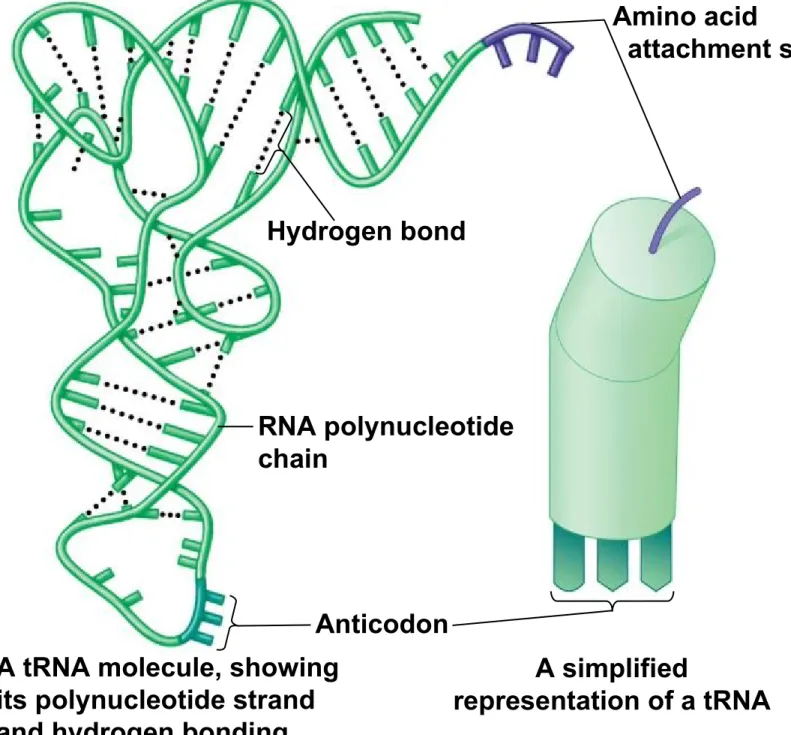
Transfer RNA
(
tRNA
) molecules function as an interpreter, converting
the genetic message of mRNA into the language of proteins.
•
Transfer RNA molecules perform this interpreter task by
• picking up the appropriate amino acid and
• using a special triplet of bases, called an anticodon, to recognize the
Figure 10.11a
Amino acid
attachment site
Hydrogen bond
RNA polynucleotide chain
A simplified
representation of a tRNA A tRNA molecule, showing
its polynucleotide strand and hydrogen bonding
Figure 10.11b
tRNA
Enzyme
10.12 Ribosomes build polypeptides
•
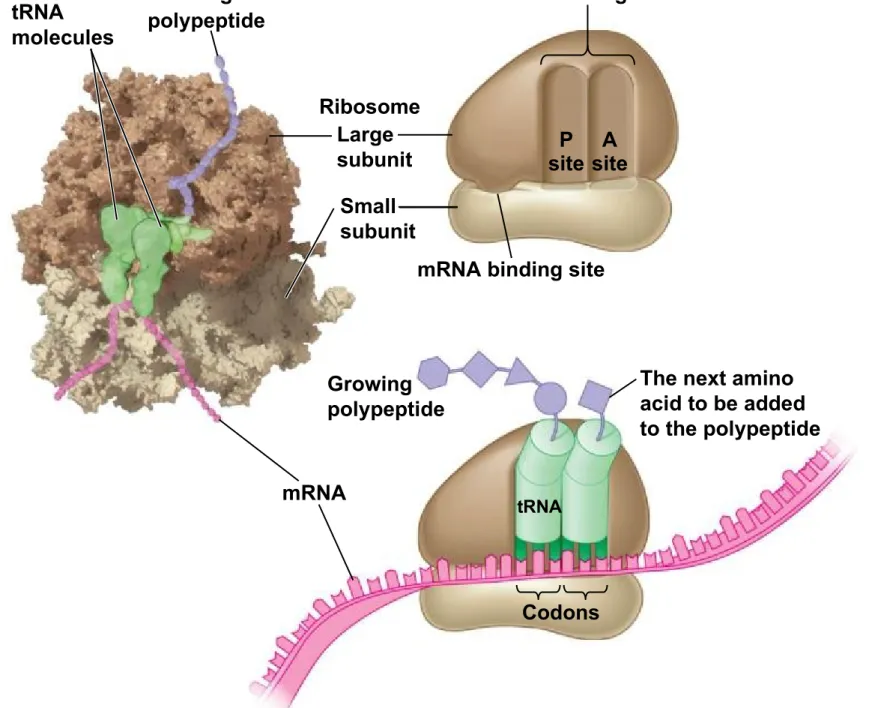
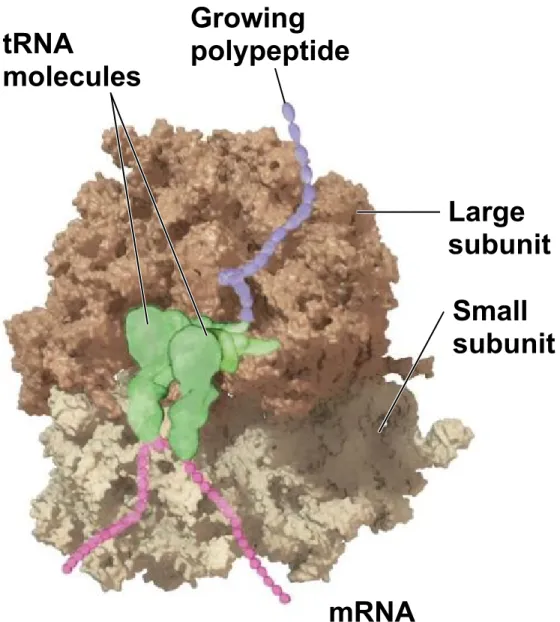
Translation occurs on the surface of the
ribosome
.
• Ribosomes coordinate the functioning of mRNA and tRNA and, ultimately, the
synthesis of polypeptides.
• Ribosomes have two subunits: small and large.
• Each subunit is composed of ribosomal RNAs and proteins. • Ribosomal subunits come together during translation.
Figure 10.12-0 tRNA molecules Growing polypeptide Ribosome Large subunit
tRNA binding sites
Small subunit
mRNA binding site P
site siteA
Growing polypeptide
mRNA
tRNA
The next amino acid to be added to the polypeptide
Figure 10.12-1
tRNA
molecules
Growing polypeptide
Large subunit
Small subunit
Figure 10.12-2
Large subunit
tRNA binding sites
Small subunit
mRNA binding site P site
Figure 10.12-3
Growing polypeptide
mRNA
tRNA
The next amino acid to be added to the polypeptide
10.12 Ribosomes build polypeptides
•
The ribosomes of bacteria and eukaryotes are very similar in function.
•
Those of eukaryotes are slightly larger and different in composition.
•
The differences are medically significant.
• Certain antibiotic drugs can inactivate bacterial ribosomes while leaving
eukaryotic ribosomes unaffected.
• These drugs, such as tetracycline and streptomycin, are used to combat
10.13 An initiation codon marks the
start of an mRNA message
•
Translation can be divided into the same three phases as
transcription:
1. initiation,
2. elongation, and 3. termination.
•
Initiation brings together
• mRNA,
• a tRNA bearing the first amino acid, and • the two subunits of a ribosome.
10.13 An initiation codon marks the
start of an mRNA message
•
Initiation establishes where translation will begin.
•
Initiation occurs in two steps.
1. An mRNA molecule binds to a small ribosomal subunit, and a special initiator tRNA binds to mRNA at the start codon.
• The start codon reads AUG and codes for methionine.
• The first tRNA has the anticodon UAC.
10.13 An initiation codon marks the
start of an mRNA message
•
Initiation establishes where translation will begin.
•
Initiation occurs in two steps.
2. A large ribosomal subunit joins the small subunit, allowing the ribosome to function.
• The first tRNA occupies the P site, which will hold the growing polypeptide.
• The A site is available to receive the next amino-acid-bearing tRNA.
Figure 10.13a
Cap
Start of genetic message
End
Figure 10.13b-1
Small ribosomal subunit
U
Start codon A C mRNA
Initiator tRNA
A U G
Met
Figure 10.13b-2
Small ribosomal subunit
U
Start codon A C mRNA
Initiator tRNA
A U G
Met
1 2
Met
Large ribosomal subunit
P
site siteA U A C
10.14 Elongation adds amino acids to the polypeptide
chain until a stop codon terminates translation
•
Once initiation is complete, amino acids are added one by one to the
first amino acid.
10.14 Elongation adds amino acids to the polypeptide
chain until a stop codon terminates translation
•
Each cycle of elongation has three steps.
1. The anticodon of an incoming tRNA molecule, carrying its amino acid, pairs with the mRNA codon in the A site of the ribosome.
2. The polypeptide separates from the tRNA in the P site and attaches by a new peptide bond to the amino acid carried by the tRNA in the A site.
Figure 10.14-1
mRNA
Polypeptide Aminoacid
Anticodon A site
P site
Codons
Codon
recognition
Figure 10.14-2
mRNA
Polypeptide Aminoacid
Anticodon A site
P site
Codons
Codon
recognition
1
Peptide bond formation
Figure 10.14-3
mRNA
Polypeptide Aminoacid
Anticodon A site
P site
Codons
Codon
recognition
1
Peptide bond formation
2
New peptide bond
Translocation
Figure 10.14-4
mRNA
Polypeptide Aminoacid
10.14 Elongation adds amino acids to the polypeptide
chain until a stop codon terminates translation
•
Elongation continues until the termination stage of translation, when
• the ribosome reaches a stop codon,
10.15 Review: The flow of genetic
information in the cell is DNA
RNA
protein
•
The flow of genetic information is from DNA to RNA to protein.
• In transcription (DNA → RNA), the mRNA is synthesized on a DNA template. • In eukaryotic cells, transcription occurs in the nucleus, and the messenger
RNA is processed before it travels to the cytoplasm.
Figure 10.15-1
DNA
mRNA
RNA
polymerase
NUCLEUS
Transcription
Transcription
2
Amino acid attachment
Figure 10.15-2
DNA
mRNA
RNA
polymerase
NUCLEUS
Transcription
1
Translation
Amino acid Enzyme ATP tRNA
CYTOPLASM
10.15 Review: The flow of genetic
information in the cell is DNA
RNA
protein
•
Translation can be divided into four steps, all of which occur in the
cytoplasm:
1. amino acid attachment,
2. initiation of polypeptide synthesis, 3. elongation, and
2 Amino acid attachment Figure 10.15-3 DNA mRNA RNA polymerase Transcription 1 Translation Amino acid Enzyme ATP tRNA Anticodon Initiation of polypeptide synthesis 3 Large ribosomal subunit Small ribosomal subunit Start codon mRNA Initiator tRNA
AUG
U CA
CYTOPLASM
Transcription
Amino acid attachment 2 Figure 10.15-4 DNA mRNA RNA polymerase Transcription 1 Translation Amino acid Enzyme ATP tRNA Anticodon 3 Large ribosomal subunit Small ribosomal subunit Start codon mRNA Initiator tRNA
AUG
U CA
Figure 10.15-5 Amino acid attachment 2 DNA mRNA RNA polymerase Transcription 1 Translation Amino acid Enzyme ATP tRNA Anticodon 3 Large ribosomal subunit Small ribosomal subunit Start codon mRNA Initiator tRNA
AUG
U CA
10.16 Mutations can affect genes
•
A
mutation
is any change in the nucleotide sequence of DNA.
•
Mutations can involve
10.16 Mutations can affect genes
•
Mutations within a gene can be divided into two general categories.
1. Nucleotide substitutions involve the replacement of one nucleotide and its base-pairing partner with another pair of nucleotides. Base substitutions may
• have no effect at all, producing a silent mutation,
• change the amino acid coding, producing a missense mutation, which produces
a different amino acid,
• lead to a base substitution that produces an improved protein that enhances the
success of the mutant organism and its descendants, or
10.16 Mutations can affect genes
2. Nucleotide insertions or deletions of one or more nucleotides in a gene may
• cause a frameshift mutation, which alters the reading frame (triplet grouping) of the genetic message,
• lead to significant changes in amino acid sequence, and
10.16 Mutations can affect genes
•
Mutagenesis
is the production of mutations.
•
Mutations can be caused
• by spontaneous errors that occur during DNA replication or recombination or • by mutagens, which include
• high-energy radiation such as X-rays and ultraviolet light and
Figure 10.16a
Normal hemoglobin DNA Mutant hemoglobin DNA
Sickle-cell hemoglobin Normal hemoglobin
mRNA mRNA
C T T C A T
G U A G A A
Figure 10.16b-0 Normal gene Nucleotide substitution mRNA Protein Nucleotide deletion Nucleotide insertion Inserted Deleted Met Met Met Met Lys Lys Lys Lys Phe Phe Leu Leu Gly Trp Ala Ser Ala Ala Arg
A U G A A G U U U G G C G C A
A U G A A G U U U A G C G C A
A U G A A G U U G G C G C A
A U G A A G U U U G G C G C
U
Figure 10.16b-1
Normal gene
Nucleotide substitution
mRNA
Protein Met
Met
Lys
Lys
Phe
Phe
Gly
Ser
Ala
Ala A U G A A G U U U G G C G C A
Figure 10.16b-2
Normal gene
mRNA
Protein Met Lys Phe Gly Ala
A U G A A G U U U G G C G C A
Nucleotide deletion
A U G A A G U U G G C G C A
Met Lys Leu Ala
Deleted
Figure 10.16b-3
Normal gene
mRNA
Protein Met Lys Phe Gly Ala
A U G A A G U U U G G C G C A
Nucleotide insertion
Inserted
Met Lys Leu Trp Arg
A U G A A G U U U G G C G C