Chapter 9
Molecular Geometries
and Bonding Theories
Chemistry, The Central Science, 11th edition Theodore L. Brown, H. Eugene LeMay, Jr.,
Molecular Shapes
• The shape of a
molecule plays an important role in its reactivity.
• By noting the number of bonding and
What Determines the Shape of a
Molecule?
• Simply put, electron pairs, whether they be bonding or nonbonding, repel each other.
Electron Domains
• We can refer to the
electron pairs as electron
domains.
• In a double or triple bond, all electrons shared
between those two atoms are on the same side of the central atom;
therefore, they count as one electron domain.
• The central atom in this molecule, A,
Valence Shell Electron Pair
Repulsion Theory (VSEPR)
“The best
arrangement of a given number of
electron domains is the one that
minimizes the
Electron-Domain
Geometries
Electron-Domain Geometries
• All one must do is count the number of electron domains in the Lewis structure. • The geometry will be
that which
Molecular Geometries
• The electron-domain geometry is often not
the shape of the molecule, however.
• The molecular geometry is that defined by the
Molecular Geometries
Within each electron domain, then, there might be more than one molecular
Linear Electron Domain
• In the linear domain, there is only one molecular geometry: linear.
Trigonal Planar Electron Domain
• There are two molecular geometries:
Nonbonding Pairs and Bond Angle
• Nonbonding pairs are physically larger than bonding pairs.
Multiple Bonds and Bond Angles
• Double and triple
bonds place greater electron density on one side of the
central atom than do single bonds.
Tetrahedral Electron Domain
• There are three molecular geometries:
– Tetrahedral, if all are bonding pairs,
Trigonal Bipyramidal Electron
Domain
• There are two
distinct positions in this geometry:
– Axial
Trigonal Bipyramidal Electron
Domain
Lower-energy conformations result from having nonbonding electron pairs in
Trigonal Bipyramidal Electron
Domain
• There are four
distinct molecular geometries in this domain:
– Trigonal bipyramidal – Seesaw
Octahedral Electron Domain
• All positions are equivalent in the octahedral domain. • There are three
molecular geometries:
– Octahedral
Larger Molecules
In larger molecules, it makes more sense to talk about the
Larger Molecules
This approach makes sense,
Polarity
• In Chapter 8 we
discussed bond dipoles. • But just because a
molecule possesses polar bonds does not
mean the molecule as a
Polarity
Overlap and Bonding
• We think of covalent bonds forming through the sharing of electrons by adjacent atoms.
Overlap and Bonding
• Increased overlap brings the electrons and nuclei closer together while
simultaneously
decreasing electron-electron repulsion.
• However, if atoms get too close, the internuclear
Hybrid Orbitals
Hybrid Orbitals
• Consider beryllium:
– In its ground electronic state, it would not be able to form bonds because it has no
Hybrid Orbitals
But if it absorbs the small amount of
energy needed to promote an electron
from the 2s to the 2p
Hybrid Orbitals
• Mixing the s and p orbitals yields two degenerate
orbitals that are hybrids of the two orbitals.
– These sp hybrid orbitals have two lobes like a p orbital. – One of the lobes is larger and more rounded as is the s
Hybrid Orbitals
• These two degenerate orbitals would align
themselves 180 from each other.
Hybrid Orbitals
• With hybrid orbitals the orbital diagram for beryllium would look like this.
Hybrid Orbitals
Hybrid Orbitals
Hybrid Orbitals
Hybrid Orbitals
…four degenerate
Hybrid Orbitals
For geometries involving expanded octets on
the central atom, we must use d orbitals in
Hybrid Orbitals
This leads to five degenerate
sp3d orbitals…
…or six degenerate sp3d2
Hybrid Orbitals
Once you know the electron-domain
geometry, you know the hybridization
Valence Bond Theory
• Hybridization is a major player in this
approach to bonding.
Sigma (
) Bonds
• Sigma bonds are characterized by
– Head-to-head overlap.
Pi (
) Bonds
• Pi bonds are
characterized by
– Side-to-side overlap. – Electron density
Single Bonds
Single bonds are always bonds, because
Multiple Bonds
In a multiple bond one of the bonds is a bond
Multiple Bonds
• In a molecule like
formaldehyde (shown
at left) an sp2 orbital
on carbon overlaps in
fashion with the
corresponding orbital on the oxygen.
• The unhybridized p
orbitals overlap in
Multiple Bonds
In triple bonds, as in
acetylene, two sp
orbitals form a
bond between the carbons, and two
pairs of p orbitals
overlap in fashion
Delocalized Electrons: Resonance
When writing Lewis structures for species like the nitrate ion, we draw resonance structures to more accurately reflect the structure of the
Delocalized Electrons: Resonance
• In reality, each of the four
atoms in the nitrate ion has a
p orbital.
• The p orbitals on all three
oxygens overlap with the p
Delocalized Electrons: Resonance
This means the electrons are
not localized between the nitrogen and one of the oxygens, but rather are
Resonance
The organic molecule
benzene has six
bonds and a p orbital
Resonance
• In reality the electrons in benzene are not
localized, but delocalized.
• The even distribution of the electrons in benzene
Molecular Orbital (MO) Theory
Though valence bond
theory effectively conveys most observed properties of ions and molecules,
there are some concepts better represented by
Molecular Orbital (MO) Theory
• In MO theory, we
invoke the wave nature of electrons.
• If waves interact constructively, the
Molecular Orbital (MO) Theory
If waves interact destructively, the resulting orbital is
MO Theory
• In H2 the two electrons
go into the bonding molecular orbital.
• The bond order is one half the difference
MO Theory
For hydrogen, with two electrons in the bonding MO and none in the
antibonding MO, the bond order is
1
MO Theory
• In the case of He2,
the bond order would be
1
2 (2 - 2) = 0
• Therefore, He2
MO Theory
• For atoms with both s
and p orbitals, there are
two types of interactions:
– The s and the p orbitals that face each other
MO Theory
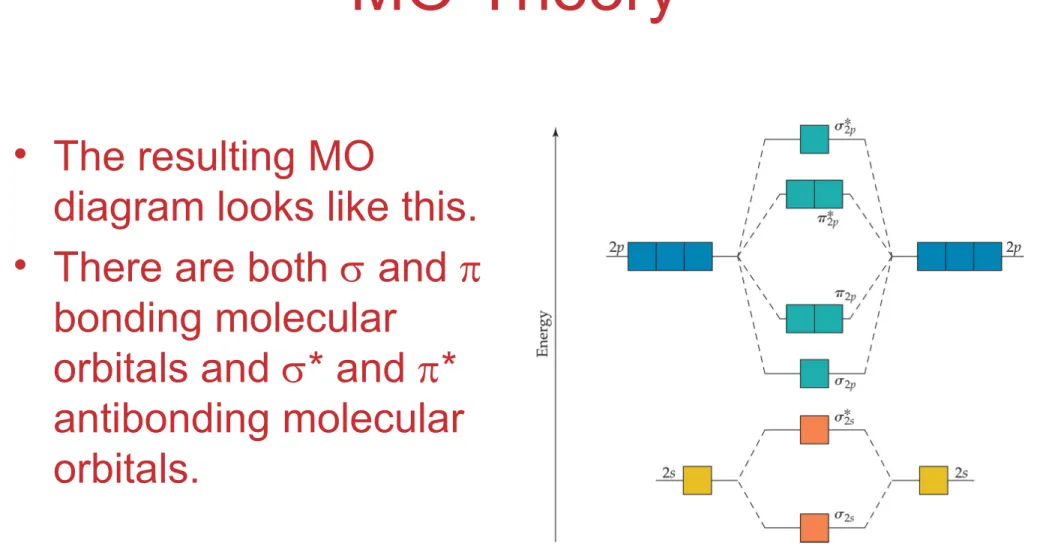
• The resulting MO
diagram looks like this.
• There are both and
bonding molecular
orbitals and * and *
MO Theory
• The smaller p-block elements in
the second period have a
sizeable interaction between the