Hierarchical Phrase-Based Translation Representations
Gonzalo Iglesias⋆ Cyril Allauzen‡ William Byrne⋆ Adri`a de Gispert⋆ Michael Riley‡
⋆Department of Engineering, University of Cambridge, Cambridge, CB2 1PZ, U.K.
{gi212,wjb31,ad465}@eng.cam.ac.uk
‡Google Research, 76 Ninth Avenue, New York, NY 10011
{allauzen,riley}@google.com
Abstract
This paper compares several translation rep-resentations for a synchronous context-free grammar parse including CFGs/hypergraphs, finite-state automata (FSA), and pushdown automata (PDA). The representation choice is shown to determine the form and complex-ity of target LM intersection and shortest-path algorithms that follow. Intersection, shortest path, FSA expansion and RTN replacement al-gorithms are presented for PDAs. Chinese-to-English translation experiments using HiFST and HiPDT, FSA and PDA-based decoders, are presented using admissible (or exact) search, possible for HiFST with compact SCFG rulesets and HiPDT with compact LMs. For large rulesets with large LMs, we intro-duce a two-pass search strategy which we then analyze in terms of search errors and transla-tion performance.
1 Introduction
Hierarchical phrase-based translation, using a
syn-chronous context-free translation grammar (SCFG)
together with an n-gram target language model (LM), is a popular approach in machine transla-tion (Chiang, 2007). Given a SCFG G and an n -gram language modelM, this paper focuses on how to decode with them, i.e. how to apply them to the source text to generate a target translation. Decod-ing has three basic steps, which we first describe in terms of the formal languages and relations in-volved, with data representations and algorithms to follow.
1. Translating the source sentence s with G to give target translations: T = {s} ◦ G, a (weighted) context-free language resulting
from the composition of a finite language and the algebraic relationGfor SCFGG.
2. Applying the language model to these target
translations:L=T ∩M, a (weighted) context-free language resulting from the intersection of a context-free language and the regular lan-guageMforM.
3. Searching for the translation and language
model combination with the highest-probablity path:Lˆ= argmaxl∈LL
Of course, decoding requires explicit data represen-tations and algorithms for combining and searching them. In common to the approaches we will con-sider here,sis applied toGby using the CYK algo-rithm in Step 1 andM is represented by a finite au-tomaton in Step 2. The choice of the representation of T in many ways determines the remaining de-coder representations and algorithms needed. Since {s} is a finite language and we assume through-out that G does not allow unbounded insertions, T and L are, in fact, regular languages. As such, T and L have finite automaton representations Tf andLf. In this case, weighted finite-state intersec-tion and single-source shortest path algorithms (us-ing negative log probabilities) can be used to solve Steps 2 and 3 (Mohri, 2009). This is the approach taken in (Iglesias et al., 2009a; de Gispert et al., 2010). Instead T and L can be represented by
hy-pergraphsThandLh(or very similarly context-free rules, and-or trees, or deductive systems). In this case, hypergraph intersection with a finite automa-ton and hypergraph shortest path algorithms can be used to solve Steps 2 and 3 (Huang, 2008). This is the approach taken by Chiang (2007). In this paper, we will consider another representation for context-free languagesT and Las well, pushdown
automata (PDA) Tp and Lp, familiar from formal
language theory (Aho and Ullman, 1972). We will describe PDA intersection with a finite automaton and PDA shortest-path algorithms in Section 2 that can be used to solve Steps 2 and 3. It cannot be over-emphasized that the CFG, hypergraph and PDA representations ofT are used for their compactness rather than for expressing non-regular languages.
As presented so far, the search performed in Step 3 is admissible (or exact) – the true shortest path is found. However, the search space in MT can be quite large. Many systems employ aggressive prun-ing durprun-ing the shortest-path computation with little theoretical or empirical guarantees of correctness. Further, such pruning can greatly complicate any complexity analysis of the underlying representa-tions and algorithms. In this paper, we will exclude any inadmissible pruning in the shortest-path algo-rithm itself. This allows us in Section 3 to compare the computational complexity of using these differ-ent represdiffer-entations. We show that the PDA represen-tation is particularly suited for decoding with large SCFGs and compact LMs.
We present Chinese-English translation results under the FSA and PDA translation representations. We describe a two-pass translation strategy which we have developed to allow use of the PDA repre-sentation in large-scale translation. In the first pass, translation is done using a lattice-generating version of the shortest path algorithm. The full translation grammar is used but with a compact, entropy-pruned version (Stolcke, 1998) of the full language model. This first-step uses admissible pruning and lattice generation under the compact language model. In the second pass, the original, unpruned LM is simply applied to the lattices produced in the first pass. We find that entropy-pruning and first-pass translation can be done so as to introduce very few search errors in the overall process; we can identify search errors in this experiment by comparison to exact transla-tion under the full translatransla-tion grammar and language model using the FSA representation. We then inves-tigate a translation grammar which is large enough that exact translation under the FSA representation is not possible. We find that translation is possible using the two-pass strategy with the PDA translation representation and that gains in BLEU score result from using the larger translation grammar.
1.1 Related Work
There is extensive prior work on computational ef-ficiency and algorithmic complexity in hierarchical phrase-based translation. The challenge is to find al-gorithms that can be made to work with large trans-lation grammars and large language models.
Following the original algorithms and analysis of Chiang (2007), Huang and Chiang (2007) devel-oped the cube-growing algorithm, and more recently Huang and Mi (2010) developed an incremental de-coding approach that exploits left-to-right nature of the language models.
Search errors in hierarchical translation, and in translation more generally, have not been as exten-sively studied; this is undoubtedly due to the diffi-culties inherent in finding exact translations for use in comparison. Using a relatively simple phrase-based translation grammar, Iglesias et al. (2009b) compared search via cube-pruning to an exact FST implementation (Kumar et al., 2006) and found that cube-pruning suffered significant search errors. For Hiero translation, an extensive comparison of search errors between the cube pruning and FSA imple-mentation was presented by Iglesias et al. (2009a) and de Gispert et al. (2010). Relaxation techniques have also recently been shown to finding exact so-lutions in parsing (Koo et al., 2010) and in SMT with tree-to-string translation grammars and trigram language models (Rush and Collins, 2011), much smaller models compared to the work presented in this paper.
Although entropy-pruned language models have been used to produce real-time translation sys-tems (Prasad et al., 2007), we believe our use of entropy-pruned language models in two-pass trans-lation to be novel. This is an approach that is widely-used in automatic speech recognition (Ljolje et al., 1999) and we note that it relies on efficient represen-tation of very large search spacesT for subsequent rescoring, as is possible with FSAs and PDAs.
2 Pushdown Automata
In this section, we formally define pushdown au-tomata and give intersection, shortest-path and re-lated algorithms that will be needed later.
Typ-0
1 a
2 ε (
3 ) b
0
1 a
2 ε ( ε
3 ) ε b
(a) (b)
0 1 (
3 ε
2 a
4 ( )
5 b
)
0,ε
1,( ε
3,ε ε
2,( a
4,( ε ε
5,( b ε
[image:3.612.75.300.56.237.2](c) (d)
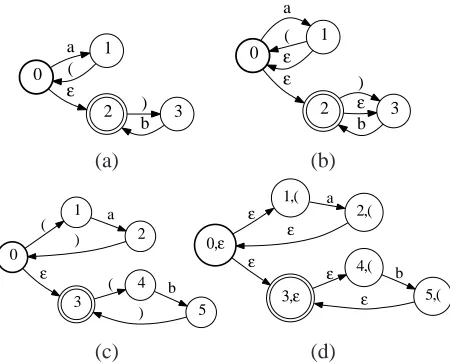
Figure 1: PDA Examples: (a) Non-regular PDA accept-ing{anbn
|n∈N}. (b) Regular (but not bounded-stack) PDA acceptinga∗b∗. (c) Bounded-stack PDA accepting
a∗b∗and (d) its expansion as an FSA.
ically this is done by adding a stack alphabet and la-beling each transition with a stack operation (a stack symbol to be pushed onto, popped or read from the stack) in additon to the usual input label (Aho and Ullman, 1972; Berstel, 1979) and weight (Kuich and Salomaa, 1986; Petre and Salomaa, 2009). Our equivalent representation allows a transition to be la-beled by a stack operation or a regular input symbol but not both. Stack operations are represented by pairs of open and close parentheses (pushing a sym-bol on and popping it from the stack). The advantage of this representation is that is identical to the finite automaton representation except that certain sym-bols (the parentheses) have special semantics. As such, several finite-state algorithms either immedi-ately generalize to this PDA representation or do so with minimal changes. The algorithms described in this section have been implemented in the PDT ex-tension (Allauzen and Riley, 2011) of the OpenFst library (Allauzen et al., 2007).
2.1 Definitions
A (restricted) Dyck language consist of “well-formed” or “balanced” strings over a finite num-ber of pairs of parentheses. Thus the string
( [ ( ) ( ) ]{ }[ ] ) ( )is in the Dyck language over 3 pairs of parentheses.
More formally, let Aand Abe two finite alpha-bets such that there exists a bijection f fromA to
A. Intuitively,f maps an open parenthesis to its cor-responding close parenthesis. Let ¯adenote f(a) if
a∈ A and f−1(a) if a∈ A. The Dyck language
DA over the alphabet Ab=A ∪A is then the lan-guage defined by the following context-free gram-mar: S → ǫ,S → SS andS → aS¯afor alla∈A. We define the mapping cA : Ab∗ → Ab∗ as follow.
cA(x) is the string obtained by iteratively deleting fromxall factors of the forma¯awitha ∈ A. Ob-serve thatDA=c−A1(ǫ).
Let A and B be two finite alphabets such that
B ⊆ A, we define the mapping rB : A∗ → B∗ byrB(x1. . . xn) =y1. . . ynwithyi=xi ifxi∈B andyi=ǫotherwise.
A weighted pushdown automaton (PDA) T over the tropical semiring (R∪ {∞},min,+,∞,0) is a 9-tuple (Σ,Π,Π, Q, E, I, F, ρ)whereΣis the fi-nite input alphabet,ΠandΠare the finite open and close parenthesis alphabets,Qis a finite set of states,
I∈Qthe initial state,F ⊆Qthe set of final states,
E ⊆ Q×(Σ∪Πb ∪ {ǫ})×(R∪ {∞})×Qa fi-nite set of transitions, and ρ : F → R∪ {∞} the final weight function. Lete= (p[e], i[e], w[e], n[e])
denote a transition inE.
A pathπis a sequence of transitionsπ=e1. . . en such thatn[ei] =p[ei+1]for1≤i < n. We then
de-finep[π] =p[e1],n[π] =n[en],i[π] =i[e1]· · ·i[en], andw[π] =w[e1] +. . .+w[en].
A path π is accepting ifp[π] =I and n[π]∈F. A pathπ is balanced ifrΠb(i[π])∈DΠ. A balanced
pathπ accepts the stringx∈Σ∗ if it is a balanced accepting path such thatrΣ(i[π]) =x.
The weight associated by T to a string x ∈ Σ∗
is T(x) = minπ∈P(x)w[π] +ρ(n[π]) where P(x)
denotes the set of balanced paths accepting x. A weighted language is recognizable by a weighted pushdown automaton iff it is context-free. We de-fine the size ofT as|T|=|Q|+|E|.
A PDAThas a bounded stack if there existsK ∈
Nsuch that for any sub-pathπof any balanced path inT:|cΠ(rΠb(i[π]))| ≤K. IfT has a bounded stack,
then it represents a regular language. Figure 1 shows non-regular, regular and bounded-stack PDAs.
2.2 Expansion Algorithm
Given a bounded-stack PDAT, the expansion ofT
is the FSAT′equivalent toTdefined as follows. A state inT′is a pair(q, z)whereqis a state inT
andz∈Π∗. A transition(q, a, w, q′)inT results in a transition ((q, z), a′, w,(q′, z′))inT′ only when: (a)a∈Σ∪ {ǫ},z′=zanda′=a, (b)a∈Π,z′=za
and a′ =ǫ, or (c) a∈ Π, z′ is such that z = z′a
and a′ =ǫ. The initial state ofT′ isI′= (I, ǫ). A state(q, z)inT′ is final ifq is final inT and z=ǫ
(ρ′((q, ǫ)) =ρ(q)). The set of states ofT′is the set of pairs(q, z) that can be reached from an initial state by transitions defined as above. The condition that
T has a bounded stack ensures that this set is finite (since it implies that for any(q, z),|z| ≤K).
The complexity of the algorithm is linear in
O(|T′|) =O(e|T|). Figure 1d show the result of the algorithm when applied to the PDA of Figure 1c.
2.3 Intersection Algorithm
The class of weighted pushdown automata is closed under intersection with weighted finite automata (Bar-Hillel et al., 1964; Nederhof and Satta, 2003). Considering a pair(T1, T2)where one element is an
FSA and the other element a PDA, then there exists a PDAT1∩T2, the intersection ofT1 and T2, such
that for allx∈Σ∗: (T1∩T2)(x) =T1(x) +T2(x).
We assume in the following thatT2 is an FSA. We
also assume thatT2has no input-ǫtransitions. When
T2 has input-ǫ transitions, an epsilon filter (Mohri,
2009; Allauzen et al., 2011) generalized to handle parentheses can be used.
A state inT=T1∩T2is a pair(q1, q2)whereq1is
a state ofT1andq2 a state ofT2. The initial state is
I= (I1, I2). Given a transitione1= (q1, a, w1, q1′)in
T1, transitions out of(q1, q2)inTare obtained using
the following rules.
If a ∈ Σ, then e1 can be matched with a
tran-sition (q2, a, w2, q2′) in T2 resulting a transition
((q1, q2), a, w1+w2,(q1′, q2′))inT.
If a =ǫ, then e1 is matched with staying in q2
resulting in a transition((q1, q2), ǫ, w1,(q1′, q2)).
Finally, if a ∈ Πb, e1 is also matched
with staying in q2, resulting in a transition
((q1, q2), a, w1,(q1′, q2))inT.
A state(q1, q2)inT is final when bothq1 andq2
are final, and thenρ((q1, q2)) =ρ1(q1)+ρ2(q2).
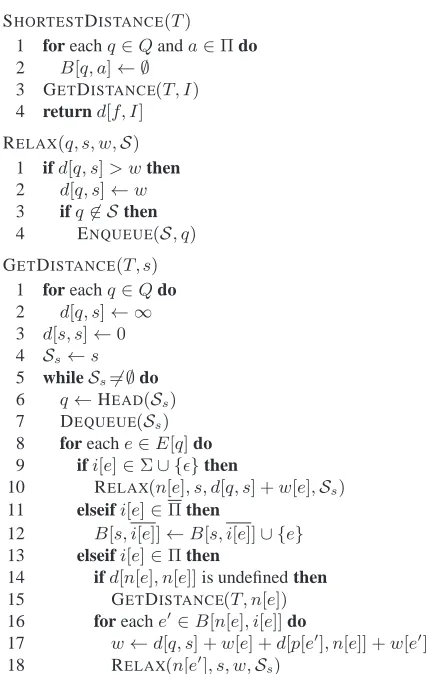
SHORTESTDISTANCE(T) 1 for eachq∈Qanda∈Πdo
2 B[q, a]← ∅
3 GETDISTANCE(T, I) 4 returnd[f, I]
RELAX(q, s, w,S) 1 ifd[q, s]> wthen
2 d[q, s]←w 3 ifq6∈ Sthen
4 ENQUEUE(S, q)
GETDISTANCE(T, s) 1 for eachq∈Qdo
2 d[q, s]← ∞
3 d[s, s]←0
4 Ss←s 5 whileSs=6 ∅do
6 q←HEAD(Ss)
7 DEQUEUE(Ss)
8 for eache∈E[q]do
9 ifi[e]∈Σ∪ {ǫ}then
10 RELAX(n[e], s, d[q, s] +w[e],Ss)
11 elseifi[e]∈Πthen
12 B[s, i[e]]←B[s, i[e]]∪ {e} 13 elseifi[e]∈Πthen
14 ifd[n[e], n[e]]is undefined then 15 GETDISTANCE(T, n[e])
16 for eache′∈B[n[e], i[e]]do
[image:4.612.312.527.62.399.2]17 w←d[q, s] +w[e] +d[p[e′], n[e]] +w[e′] 18 RELAX(n[e′], s, w,Ss)
Figure 2: PDA shortest distance algorithm. We assume thatF={f}andρ(f) = 0to simplify the presentation.
The complexity of the algorithm is inO(|T1||T2|).
2.4 Shortest Distance and Path Algorithms
A shortest path in a PDAT is a balanced accepting path with minimal weight and the shortest distance inTis the weight of such a path. We show that when
T has a bounded stack, shortest distance and short-est path can be computed in O(|T|3log|T|) time (assumingT has no negative weights) andO(|T|2)
space.
pseudo-code is given in Figure 2.
GETDISTANCE(T, s)starts a new instance of the shortest-distance algorithm from susing the queue Ss, initially containing s. While the queue is not empty, a state is dequeued and its outgoing transi-tions examined (line 5-9). Transitransi-tions labeled by non-parenthesis are treated as in Mohri (2009) (line 9-10). When the considered transitioneis labeled by a close parenthesis, it is remembered that it balances all incoming open parentheses in slabeled by i[e]
by addingetoB[s, i[e]](line 11-12). Finally, when
eis labeled with an open parenthesis, if its destina-tion has not already been visited, a new instance is started fromn[e](line 14-15). The destination states of all transitions balancing eare then relaxed (line 16-18).
The space complexity of the algorithm is quadratic for two reasons. First, the number of non-infinity d[q, s] is |Q|2. Second, the space
re-quired for storing B is at most in O(|E|2) since
for each open parenthesis transition e, the size of |B[n[e], i[e]]| is O(|E|) in the worst case. This last observation also implies that the cumulated number of transitions examined at line 16 is in
O(N|Q| |E|2)in the worst case, where N denotes
the maximal number of times a state is inserted in the queue for a given call of GETDISTANCE. As-suming the cost of a queue operation isΓ(n) for a queue containing n elements, the worst-case time complexity of the algorithm can then be expressed asO(N|T|3 Γ(|T|)). WhenT contains no negative
weights, using a shortest-first queue discipline leads to a time complexity in O(|T|3log|T|). When all
theCs’s are acyclic, using a topological order queue discipline leads to aO(|T|3)time complexity.
In effect, we are solving a k-sources shortest-path problem withksingle-source solutions. A po-tentially better approach might be to solve the k -sources ork-pairs problem directly (Hershberger et al., 2003).
WhenT has been obtained by converting an RTN or an hypergraph into a PDA (Section 2.5), the poly-nomial dependency in|T|becomes a linear depen-dency both for the time and space complexities. In-deed, for each q inT, there exists a unique ssuch thatd[q, s]is non-infinity. Moreover, for each close parenthesis transistione, there exists a unique open parenthesis transitione′ such thate∈B[n[e′], i[e′]].
When each component of the RTN is acyclic, the complexity of the algorithm is hence in O(|T|) in time and space.
The algorithm can be modified to compute the shortest path by keeping track of parent pointers.
2.5 Replacement Algorithm
A recursive transition network (RTN) can be speci-fied by(N,Σ,(Tν)ν∈N, S)whereN is an alphabet of nonterminals,Σis the input alphabet,(Tν)ν∈N is a family of FSAs with input alphabet Σ∪N, and
S∈N is the root nonterminal.
A string x∈Σ∗ is accepted by R if there exists an accepting pathπ inTS such that recursively re-placing any transition with input labelν∈N by an accepting path inTν leads to a pathπ∗with inputx. The weight associated byRis the minimum over all suchπ∗ofw[π∗]+ρS(n[π∗]).
Given an RTN R, the replacement of R is the PDA T equivalent to R defined by the 9-tuple
(Σ,Π,Π, Q, E, I, F, σ, ρ) withΠ =Q=Sν∈NQν,
I=IS,F=FS,ρ=ρS, and E=Sν∈N
S
e∈EνE
e
where Ee = {e} if i[e] 6∈ N and Ee = {(p[e], n[e], w[e], Iµ),(f, n[e], ρµ(f), n[e])|f∈Fµ} withµ=i[e]∈N otherwise.
The complexity of the construction is inO(|T|). If |Fν|= 1, then |T|=O(Pν∈N|Tν|) =O(|R|). Creating a superfinal state for eachTνwould lead to aT whose size is always linear in the size ofR.
3 Hierarchical Phrase-Based Translation Representation
In this section, we compare several different repre-sentations for the target translationsT of the source sentencesby synchronous CFGGprior to language modelM application. As discussed in the introduc-tion,T is a context-free language. For example, sup-pose it corresponds to:
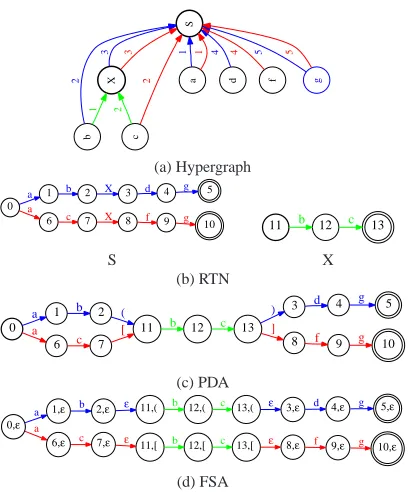
S→abXdg, S→acXf g, andX→bc.
pro-S X 3 3 a 1 1 b 2 1 c 2 2 d 4 f 4 g 5 5 (a) Hypergraph 0 1 a 6 a 2 b 7 c 3
X d 4 g 5
8
X f 9
10 g
11 b 12 c 13
S X (b) RTN 0 1 a 6 a 2 b 7 c 11 ( 12 b
3 d 4 g 5
[
8 f 9 g 10
[image:6.612.84.288.52.299.2]13 c ) ] (c) PDA 0,ε 1,ε a 6,ε a 2,ε b 7,ε c 11,( ε 11,[ ε 12,( b 12,[ b 13,( c 13,[ c 3,ε ε 8,ε ε 4,ε d 9,ε f 5,ε g 10,ε g (d) FSA
Figure 3: Alternative translation representations
duced by the HiFST decoder (Iglesias et al., 2009a; de Gispert et al., 2010). Figure 3c shows the push-down automaton representation generated from the RTN with the replacement algorithm of Section 2.5. Since s is a finite language and G does not allow unbounded insertion, Tp has a bounded stack and T is, in fact, a regular language. Figure 3d shows the finite-state automaton representation ofT gen-erated by the PDA using the expansion algorithm of Section 2.2. The HiFST decoder converts its RTN translation representation immediately into the finite-state representation using an algorithm equiv-alent to converting the RTN into a PDA followed by PDA expansion.
As shown in Figure 4, an advantage of the RTN, PDA, and FSA representations is that they can bene-fit from FSA epsilon removal, determinization and minimization algorithms applied to their compo-nents (for RTNs and PDAs) or their entirety (for FSAs). For the complexity discussion below, how-ever, we disregard these optimizations. Instead we focus on the complexity of each MT step described in the introduction:
1. SCFG Translation: Assuming that the parsing of the input is performed by a CYK parse, then the CFG, hypergraph, RTN and PDA
represen-0 a 1 2 b 3 c 4 X 5 X 6 d f 7 g
0 b 1 c 2
S X
(a) RTN
0 a 1 2 b
3
c 8
(
[ b 9
4 6 d 7 g 5 f 1 0 c ) ] (b) PDA
[image:6.612.324.535.58.208.2]0 a 1 2 b 3 c 4 b 5 b 6 c 7 c 8 d f 9 g (c) FSA
Figure 4: Optimized translation representations
tations can be generated inO(|s|3|G|)time and
space (Aho and Ullman, 1972). The FSA rep-resentation can require an additionalO(e|s|3|G|)
time and space since the PDA expansion can be exponential.
2. Intersection: The intersection of a CFG Th with a finite automatonMcan be performed by the classical Bar-Hillel algorithm (Bar-Hillel et al., 1964) with time and space complex-ityO(|Th||M|3).1 The PDA intersection algo-rithm from Section 2.3 has time and space com-plexityO(|Tp||M|). Finally, the FSA intersec-tion algorithm has time and space complexity
O(|Tf||M|)(Mohri, 2009).
3. Shortest Path: The shortest path algorithm on the hypergraph, RTN, and FSA representations requires linear time and space (given the under-lying acyclicity) (Huang, 2008; Mohri, 2009). As presented in Section 2.4, the PDA rep-resentation can require time cubic and space quadratic in|M|.2
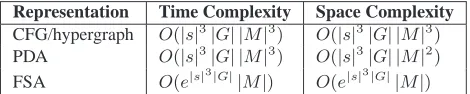
Table 1 summarizes the complexity results. Note the PDA representation is equivalent in time and su-perior in space to the CFG/hypergraph representa-tion, in general, and it can be superior in both space
1The modified Bar-Hillel construction described by
Chi-ang (2007) has time and space complexityO(|Th||M|4); the
modifications were introduced presumably to benefit the subse-quent pruning method employed (but see Huang et al. (2005)).
2
The time (resp. space) complexity is not cubic (resp. quadratic) in |Tp||M|. Given a state q inTp, there exists a
uniquesq such thatq belongs toCsq. Given a state(q1, q2)
Representation Time Complexity Space Complexity
CFG/hypergraph O(|s|3
|G| |M|3) O( |s|3
|G| |M|3)
PDA O(|s|3
|G| |M|3) O( |s|3
|G| |M|2)
FSA O(e|s|3|G||M|) O(e|s|3|G||M|)
Table 1: Complexity using various target translation rep-resentations.
and time to the FSA representation depending on the relative SCFG and LM sizes. The FSA representa-tion favors smaller target translarepresenta-tion sets and larger language models. Should a better complexity PDA shortest path algorithm be found, this conclusion could change. In practice, the PDA and FSA rep-resentations benefit hugely from the optimizations mentioned above, these optimizations improve the time and space usage by one order of magnitude.
4 Experimental Framework
We use two hierarchical phrase-based SMT de-coders. The first one is a lattice-based decoder im-plemented with weighted finite-state transducers (de Gispert et al., 2010) and described in Section 3. The second decoder is a modified version using PDAs as described in Section 2. In order to distinguish both decoders we call them HiFST and HiPDT, re-spectively. The principal difference between the two decoders is where the finite-state expansion step is done. In HiFST, the RTN representation is immedi-ately expanded to an FSA. In HiPDT, this expansion is delayed as late as possible - in the output of the shortest path algorithm. Another possible configu-ration is to expand after the LM intersection step but before the shortest path algorithm; in practice this is quite similar to HiFST.
In the following sections we report experiments in Chinese-to-English translation. For translation model training, we use a subset of the GALE 2008 evaluation parallel text;3 this is 2.1M sentences and approximately 45M words per language. We re-port translation results on a development set tune-nw (1,755 sentences) and a test set test-nw (1,671 sen-tences). These contain translations produced by the GALE program and portions of the newswire sec-tions of MT02 through MT06. In tuning the
sys-3See http://projects.ldc.upenn.edu/gale/data/catalog.html.
We excluded the UN material and the LDC2002E18, LDC2004T08, LDC2007E08 and CUDonga collections.
0 7.5×10⁻⁹ 7.5
×10−8 7.5 ×10⁻⁷
[image:7.612.72.307.56.103.2]207.5 20.2 4.1 0.9
Table 2:Number of ngrams (in millions) in the 1st pass 4-gram language models obtained with differentθvalues (top row).
tems, standard MERT (Och, 2003) iterative param-eter estimation under IBM BLEU4 is performed on the development set.
The parallel corpus is aligned using MTTK (Deng and Byrne, 2008) in both source-to-target and target-to-source directions. We then follow stan-dard heuristics (Chiang, 2007) and filtering strate-gies (Iglesias et al., 2009b) to extract hierarchical phrases from the union of the directional word align-ments. We call a translation grammar the set of rules extracted from this process. We extract two transla-tion grammars:
• A restricted grammar where we apply the fol-lowing additional constraint: rules are only considered if they have a forward translation probabilityp >0.01. We call thisG1. As will
be discussed later, the interest of this grammar is that decoding under it can be exact, that is, without any pruning in search.
• An unrestricted one without the previous con-straint. We call thisG2. This is a superset of
the previous grammar, and exact search under it is not feasible for HiFST: pruning is required in search.
The initial English language model is a Kneser-Ney 4-gram estimated over the target side of the par-allel text and the AFP and Xinhua portions of mono-lingual data from the English Gigaword Fourth Edi-tion (LDC2009T13). This is a total of 1.3B words. We will call this language modelM1. For large
lan-guage model rescoring we also use the LMM2
ob-tained by interpolatingM1with a zero-cutoff
stupid-backoff (Brants et al., 2007) 5-gram estimated using 6.6B words of English newswire text.
We next describe how we build translation sys-tems using entropy-pruned language models.
1. We build a baseline HiFST system that usesM1
and a hierarchical grammarG, parameters be-ing optimized with MERT under BLEU.
2. We then use entropy-based pruning of the lan-guage model (Stolcke, 1998) under a relative perplexity threshold of θto reduce the size of
M1. We will call the resulting language model
asM1θ. Table 2 shows the number of n-grams (in millions) obtained for differentθvalues. 3. We translate with M1θ using the same
param-eters obtained in MERT in step 1, except for the word penalty, tuned over the lattices under BLEU performance. This produces a transla-tion lattice in the topmost cell that contains hy-potheses with exact scores under the translation grammar andMθ
1.
4. Translation lattices in the topmost cell are pruned with a likelihood-based beam widthβ. 5. We remove the Mθ
1 scores from the pruned
translation lattices and reapplyM1, moving the
word penalty back to the original value ob-tained in MERT. These operations can be car-ried out efficiently via standard FSA opera-tions.
6. Additionally, we can rescore the translation lat-tices obtained in steps 1 or 5 with the larger language model M2. Again, this can be done
via standard FSA operations.
Note that ifβ=∞or ifθ= 0, the translation lattices obtained in step 1 should be identical to the ones of step 5. While the goal is to increaseθto reduce the size of the language model used at Step 3, β will have to increase accordingly so as to avoid pruning away desirable hypotheses in Step 4. If β defines a sufficiently wide beam to contain the hypotheses which would be favoured by M1, faster decoding
withMθ
1 would be possible without incurring search
errorsM1. This is investigated next.
5 Entropy-Pruned LM in Rescoring
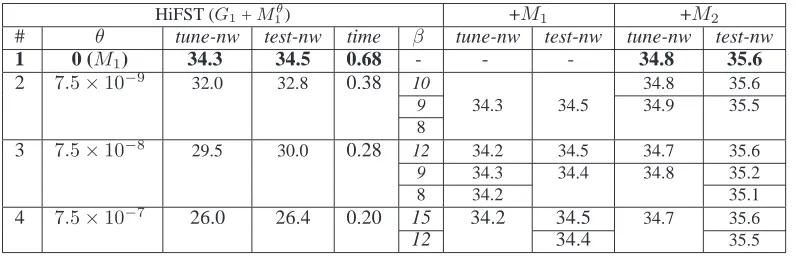
In Table 3 we show translation performance under grammarG1 for different values ofθ. Performance
is reported after first-pass decoding with M1θ (see step 3 in Section 4), after rescoring with M1 (see
step 5) and after rescoring withM2(see step 6). The
baseline (experiment number 1) usesθ= 0(that is,
M1) for decoding.
Under translation grammar G1, HiFST is able to
generate an FSA with the entire space of possible candidate hypotheses. Therefore, any degradation
in performance is only due to the M1θ involved in decoding and theβapplied prior to rescoring.
As shown in row number 2, for θ ≤ 10−9 the
system provides the same performance to the base-line whenβ > 8, while decoding time is reduced by roughly 40%. This is becauseMθ
1 is 10% of the
size of the original language model M1, as shown
in Table 2. As M1θ is further reduced by increas-ingθ (see rows number3 and 4), decoding time is also reduced. However, the beam widthβ required in order to recover the good hypotheses in rescoring increases, reaching12 for experiment 3 and 15 for experiment 4.
Regarding rescoring with the larger M2 (step 6
in Section 4), the system is also able to match the baseline performance as long asβ is wide enough, given the particularM1θ used in first-pass decoding. Interestingly, results show that a similar β value is needed when rescoring either withM1orM2.
The usage of entropy-pruned language models crements speed at the risk of search errors. For in-stance, comparing the outputs of systems 1 and 2
withβ= 10in Table 3 we find 45 different 1-best hy-potheses, even though the BLEU score is identical. In other words, we have 45 cases in which system2
is not able to recover the baseline output because the 1st-pass likelihood beamβis not wide enough. Sim-ilarly, system3fails in 101 cases (β= 12) and sys-tem4fails in 95 cases. Interestingly, some of these sentences would require impractically huge beams. This might be due to the Kneser-Ney smoothing, which interacts badly with entropy pruning (Chelba et al., 2010).
6 Hiero with PDAs and FSAs
In this section we contrast HiFST with HiPDT under the same translation grammar and entropy-pruned language models. Under the constrained grammar
G1 their performance is identical as both decoders
can generate the entire search space which can then be rescored withM1orM2as shown in the previous
section.
Therefore, we now focus on the unconstrained grammarG2, where exact search is not feasible for
decod-HiFST (G1+M1θ) +M1 +M2 # θ tune-nw test-nw time β tune-nw test-nw tune-nw test-nw 1 0 (M1) 34.3 34.5 0.68 - - - 34.8 35.6
2 7.5×10⁻⁹ 32.0 32.8 0.38 10 34.8 35.6
9 34.3 34.5 34.9 35.5
8
3 7.5×10⁻⁸ 29.5 30.0 0.28 12 34.2 34.5 34.7 35.6
9 34.3 34.4 34.8 35.2
8 34.2 35.1
[image:9.612.109.507.54.182.2]4 7.5×10⁻⁷ 26.0 26.4 0.20 15 34.2 34.5 34.7 35.6 12 34.4 35.5
Table 3: Results (lowercase IBM BLEU scores) under G1 with variousM1θ as obtained with several values ofθ. Performance in subsequent rescoring withM1 andM2after likelihood-based pruning of the translation lattices for variousβis also reported. Decoding time, in seconds/word over test-nw, refers strictly to first-pass decoding.
Exact search forG2+M1θwith memory usage under 10 GB
# θ HiFST HiPDT
Success Failure Success Failure
Expand Compose Compose Expand
2 7.5×10⁻⁹ 12 51 37 40 8 52
3 7.5×10⁻⁸ 16 53 31 76 1 23
[image:9.612.145.471.237.319.2]4 7.5×10⁻⁷ 18 53 29 99.8 0 0.2
Table 4: Percentage of success in producing the 1-best translation underG2 with variousM1θwhen applying a hard memory limitation of 10 GB, as measured over tune-nw (1755 sentences). If decoder fails, we report what step was being done when the limit was reached. HiFST could be expanding into an FSA or composing the FSA withMθ
1; HiPDT could be PDA composing withMθ
1 or PDA expanding into an FSA.
HiPDT (G2+M1θ) +M1 +M2
θ tune-nw test-nw β tune-nw test-nw tune-nw test-nw
7.5×10⁻⁷ 25.7 26.3 15 34.6 34.8 35.2 36.1
Table 5: HiPDT performance on grammarG2withθ= 7.5×10⁻⁷. Exact search with HiFST is not possible under these conditions: pruning during search would be required.
ing, the process is killed5. We report what internal decoding operation caused the system to crash. For HiFST, these include expansion into an FSA
(Ex-pand) and subsequent intersection with the language
model (Compose). For HiPDT, these include PDA intersection with the language model (Compose) and subsequent expansion into an FSA (Expand), using algorithms described in Section 2.
Table 4 shows the number of times each decoder succeeds in finding a hypothesis given the memory limit, and the operations being carried out when they fail to do so, when decoding with variousMθ
1. With
θ= 7.5×10⁻⁹(row 2), HiFST can only decode 218 sentences, while HiPDT succeeds in 703 cases. The
5We used ulimit command. The experiment was carried out
over machines with different configurations and load. There-fore, these numbers must be considered as approximate values.
differences between both decoders increase as the
M1θis more reduced, and forθ= 7.5×10⁻⁷(row 4), HiPDT is able to perform exact search over all but three sentences.
Table 5 shows performance using the latter con-figuration (Table 4, row 4). After large language model rescoring, HiPDT improves 0.5 BLEU over baseline withG1 (Table 3, row 1).
7 Discussion and Conclusion
us-age (fails 536 times). In contrast, HiPDT creates a PDA, which is a more compact representation of the search space and allows efficient intersection with the language model before expansion into an FST. Therefore, the memory usage is considerably lower. Nevertheless, the complexity of the language model is critical for the PDA intersection and very specially the PDA expansion into an FST (fails 403 times for
θ= 7.5×10⁻⁸).
With the algorithms presented in this paper, de-coding with PDAs is possible for any translation grammar as long as an entropy pruned LM is used. While this allows exact decoding, it comes at the cost of making decisions based on less complex LMs, although this has been shown to be an ad-equate strategy when applying compact CFG rule-sets. On the other hand, HiFST cannot decode under large translation grammars, thus requiring pruning during lattice construction, but it can apply an un-pruned LM in this process. We find that with care-fully designed pruning strategies, HiFST can match the performance of HiPDT reported in Table 5. But without pruning in search, expansion directly into an FST would lead to an explosion in terms of memory usage. Of course, without memory constraints both strategies would reach the same performance.
Overall, these results suggest that HiPDT is more robust than HiFST when using complex hierarchi-cal grammars. Conversely, FSTs might be more efficient for search spaces described by more con-strained hierarchical grammars. This suggests that a hybrid solution could be effective: we could use PDAs or FSTs e.g. depending on the number of states of the FST representing the expanded search space, or other conditions.
8 Acknowledgments
The research leading to these results has received funding from the European Union Seventh Frame-work Programme (FP7-ICT-2009-4) under grant agreement number 247762, and was supported in part by the GALE program of the Defense Advanced Research Projects Agency, Contract No.HR0011-06-C-0022, and a Google Faculty Research Award, May 2010.
References
Alfred V. Aho and Jeffrey D. Ullman. 1972. The Theory of Parsing, Translation and Compiling, volume 1-2. Prentice-Hall.
Cyril Allauzen and Michael Riley, 2011. Pushdown Transducers. http://pdt.openfst.org.
Cyril Allauzen, Michael Riley, Johan Schalkwyk, Wo-jciech Skut, and Mehryar Mohri. 2007. OpenFst: A general and efficient weighted finite-state trans-ducer library. In Proceedings of CIAA, pages 11–23. http://www.openfst.org.
Cyril Allauzen, Michael Riley, and Johan Schalkwyk. 2011. Filters for efficient composition of weighted finite-state transducers. In Proceedings of CIAA, vol-ume 6482 of LNCS, pages 28–38. Springer.
Y. Bar-Hillel, M. Perles, and E. Shamir. 1964. On formal properties of simple phrase structure grammars. In Y. Bar-Hillel, editor, Language and Information: Se-lected Essays on their Theory and Application, pages 116–150. Addison-Wesley.
Jean Berstel. 1979. Transductions and Context-Free Languages. Teubner.
Thorsten Brants, Ashok C. Popat, Peng Xu, Franz J. Och, and Jeffrey Dean. 2007. Large language models in machine translation. In Proceedings of EMNLP-ACL, pages 858–867.
Ciprian Chelba, Thorsten Brants, Will Neveitt, and Peng Xu. 2010. Study on interaction between entropy prun-ing and kneser-ney smoothprun-ing. In Proceedprun-ings of In-terspeech, pages 2242–2245.
David Chiang. 2007. Hierarchical phrase-based transla-tion. Computational Linguistics, 33(2):201–228.
Adri`a de Gispert, Gonzalo Iglesias, Graeme Blackwood, Eduardo R. Banga, and William Byrne. 2010. Hier-archical phrase-based translation with weighted finite state transducers and shallow-n grammars. Computa-tional Linguistics, 36(3).
Yonggang Deng and William Byrne. 2008. HMM word and phrase alignment for statistical machine transla-tion. IEEE Transactions on Audio, Speech, and Lan-guage Processing, 16(3):494–507.
Manfred Drosde, Werner Kuick, and Heiko Vogler, ed-itors. 2009. Handbook of Weighted Automata. Springer.
John Hershberger, Subhash Suri, and Amit Bhosle. 2003. On the difficulty of some shortest path problems. In Proceedings of STACS, volume 2607 of LNCS, pages 343–354. Springer.
Liang Huang and Haitao Mi. 2010. Efficient incremental decoding for tree-to-string translation. In Proceedings of EMNLP, pages 273–283.
Liang Huang, Hao Zhang, and Daniel Gildea. 2005. Machine translation as lexicalized parsing with hooks. In Proceedings of the Ninth International Workshop on Parsing Technology, Parsing ’05, pages 65–73, Stroudsburg, PA, USA. Association for Computational Linguistics.
Liang Huang. 2008. Advanced dynamic programming in semiring and hypergraph frameworks. In Proceedings of COLING, pages 1–18.
Gonzalo Iglesias, Adri`a de Gispert, Eduardo R. Banga, and William Byrne. 2009a. Hierarchical phrase-based translation with weighted finite state transducers. In Proceedings of NAACL-HLT, pages 433–441.
Gonzalo Iglesias, Adri`a de Gispert, Eduardo R. Banga, and William Byrne. 2009b. Rule filtering by pattern for efficient hierarchical translation. In Proceedings of EACL, pages 380–388.
Terry Koo, Alexander M. Rush, Michael Collins, Tommi Jaakkola, and David Sontag. 2010. Dual decomposi-tion for parsing with non-projective head automata. In Proceedings of EMNLP, pages 1288–1298.
Werner Kuich and Arto Salomaa. 1986. Semirings, au-tomata, languages. Springer.
Shankar Kumar, Yonggang Deng, and William Byrne. 2006. A weighted finite state transducer transla-tion template model for statistical machine translatransla-tion. Natural Language Engineering, 12(1):35–75.
Andrej Ljolje, Fernando Pereira, and Michael Riley. 1999. Efficient general lattice generation and rescor-ing. In Proceedings of Eurospeech, pages 1251–1254. Mehryar Mohri. 2009. Weighted automata algorithms. In Drosde et al. (Drosde et al., 2009), chapter 6, pages 213–254.
Mark-Jan Nederhof and Giorgio Satta. 2003. Probabilis-tic parsing as intersection. In Proceedings of 8th In-ternational Workshop on Parsing Technologies, pages 137–148.
Franz J. Och. 2003. Minimum error rate training in sta-tistical machine translation. In Proceedings of ACL, pages 160–167.
Ion Petre and Arto Salomaa. 2009. Algebraic systems and pushdown automata. In Drosde et al. (Drosde et al., 2009), chapter 7, pages 257–289.
R. Prasad, K. Krstovski, F. Choi, S. Saleem, P. Natarajan, M. Decerbo, and D. Stallard. 2007. Real-time speech-to-speech translation for pdas. In Proceedings of IEEE International Conference on Portable Information De-vices, pages 1 –5.
Alexander M. Rush and Michael Collins. 2011. Ex-act decoding of syntEx-actic translation models through
lagrangian relaxation. In Proceedings of ACL-HLT, pages 72–82.